
Dear Zazie, Here is today’s Lovers’ Chronicle from Mac Tag dedicated to his muse. Follow us on twitter @cowboycoleridge. Rhett
The Lovers’ Chronicle
Dear Muse,
dream trio…
he and the ravishing redhead find themselves on a large country estate;
Do you know where we are
this is fascinatin’, how is your Russian
Uh, nyet, are you sure
pretty sure this is Professor Serebryakov’s
estate and i think that is Uncle Vanya
Wow dreams can be weird as fuck
oh look, here comes Yelena, the old farts
much younger wife, Vanya and the good
doctor Astrov are gonna fawn over her
Let’s go before the caviar hits the fan
speakin’ of, grab some, i got the vodka
And we should go by the cherry orchard
before those jerks cut down the trees,
hey Meatloaf, take us out
Cuz three outta three ain’t bad
© copyright 2024 mac tag/cowboy coleridge all rights
this one was easy,
written by Jim Steinman,
and sung by Meatloaf;
“Cuz two outta three ain’t bad”
“Of course, that makes sense,
and he did have a great voice”
i played the hell outta that album
“I see what you did there with hell”
you do not miss anything,
pre-you there were times i thought
one outta three was not bad,
it was better than none outta three,
now, imagine my astonishment
cuz three outta three is pretty damn good
© copyright 2023.2024 mac tag/cowboy coleridge all rights
here today to tell the tale of the triplets; want, need, love; almost spent a life content with only one, never made it to two, nor all three, sure there were times i fooled myself into thinkin’ i had two or three, but nope, it was a process to git there and i was not ready, till i met you
© copyright 2022.2024 mac tag/cowboy coleridge all rights
apparently
just needed to wait
a few years
what was
can now
be rewritten
this
and somethin’ more
nothin’ else matters
what comes knockin’,
the usual trio
the first
can no longer
be dismissed
the second
cannot be denied
and the third,
at last
can be said
© copyright 2021 mac tag/cowboy coleridge all rights
Pale Love, Pale Rider
reserved
hey, hold on…
so this is a normal state
shows us who i could be
and no i am not crazy,
ok, well probably,
but not that kind
no matter your assessment,
i keep comin’ back to this,
the most consistent, best
thing in my life for the past
ten years has been this
that has to mean somethin’
© copyright 2020 mac tag/cowboycoleridge all rights reserved
silence accompanies
none other
better understood
had to poeticize
each and every one
probably not wise
settin’ expectations
that could not be met
but for you, always willin’
by all means,
if you wish it
on these conditions:
everything must be
as it has been hitherto
© copyright 2019 mac tag/cowboy coleridge all rights reserved
only this
and nothin’ more
what comes knockin’
the usual trio
the first
can be dismissed
summarily
the second
can still be denied
and the third
remains, for you
undiminished
© copyright 2018 mac tag/cowboy coleridge all rights reserved
a flame of future
amid all the dark denial
no… does not dispel
this hollowin’ sense of loss
a guilt that will not diminish
made of somethin’ imperishable
upon which time has not
the slightest erosive effect
© copyright 2017 mac tag/cowboy Coleridge all rights reserved
I would ask that
You hold me ’till
The tremblin’ stops
But I do not
Know if it will
***
Well, I loved her
Enough to know
That I could not
Ever tell her just
How much I did
***
I have it in
Me to love but
Not to be loved
© copyright 2015 mac tag/cowboy Coleridge all rights reserved

Today is the birthday of Henry Ward Ranger (Syracuse, New York; January 29, 1858 – November 7, 1916 New York City); artist. He was a prominent landscape and marine painter, an important Tonalist, and the leader of the Old Lyme Art Colony. Among his paintings are, Top of the Hill, Corcoran Gallery of Art, Washington, D.C.; and East River Idyll, Carnegie Institute, Pittsburgh, Pennsylvania.
In 1883, he married Helen Jennings, a divorced actress with a son.
Gallery
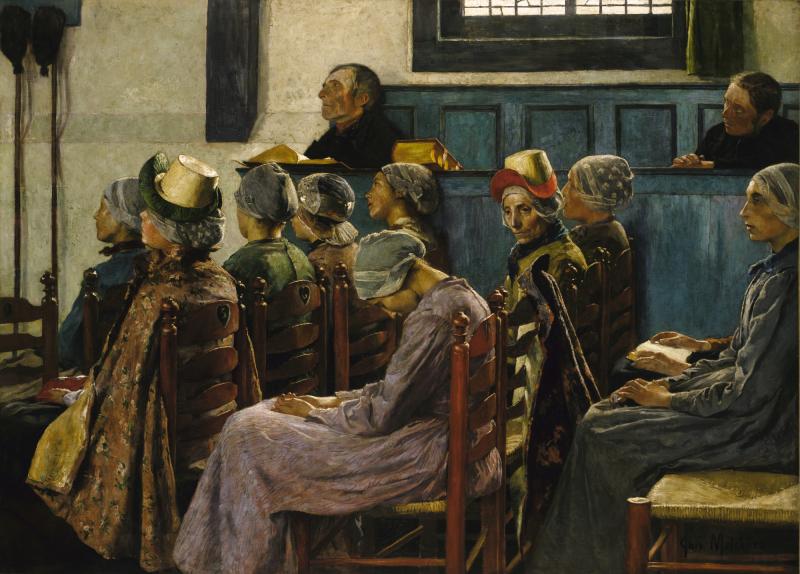
The sermon
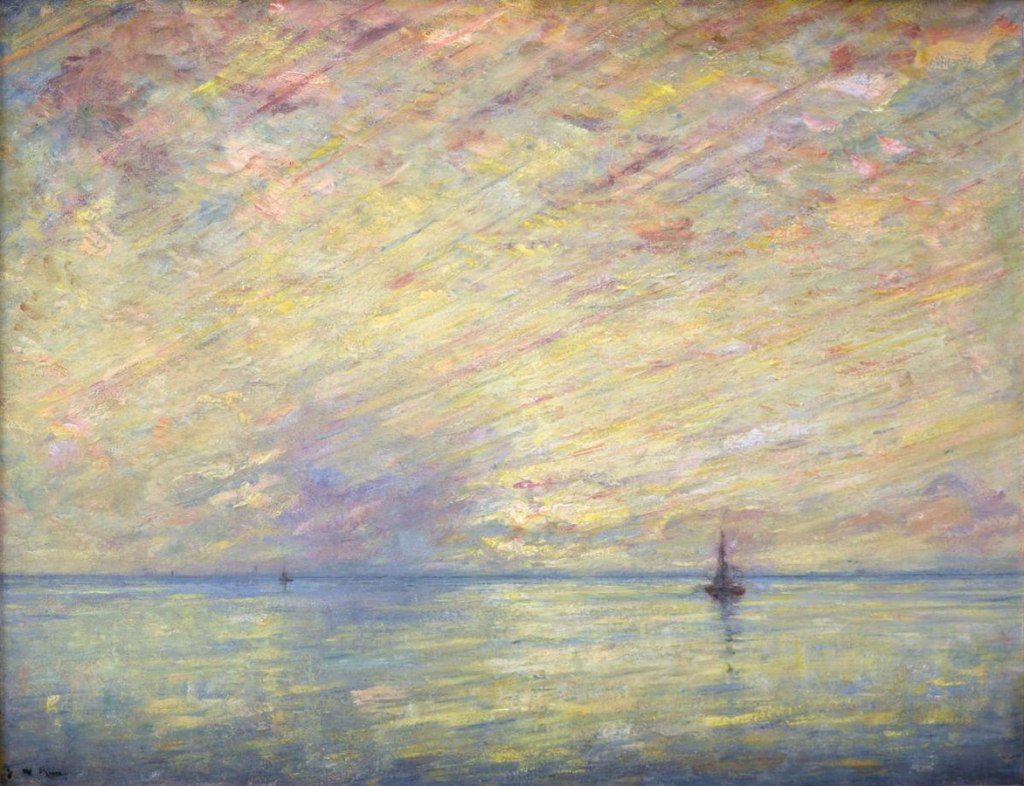
Marine – Green and Gold
1928
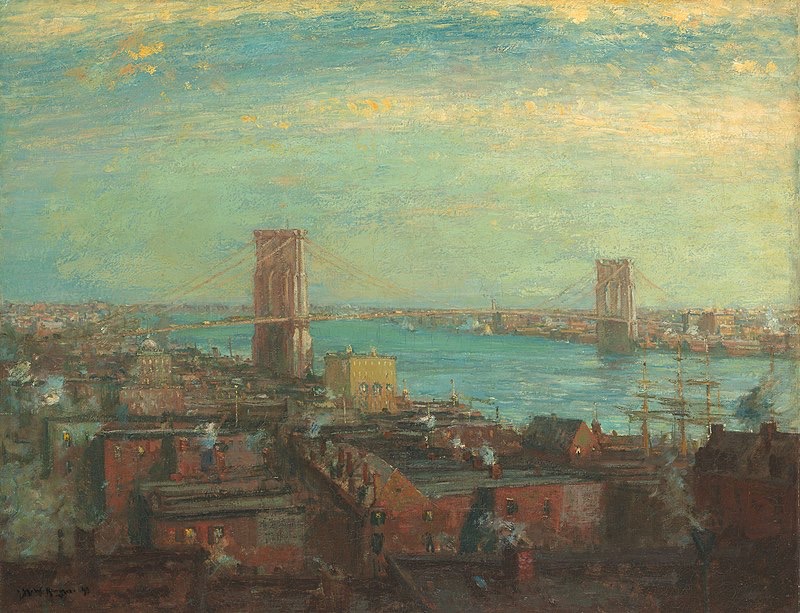
Brooklyn Bridge – 1925 – Art Institute of Chicago
Today is the birthday of Anton Chekhov (born Anton Pavlovich Chekhov, Taganrog, Russian Empire, 29 January 1860 – 15 July 1904 Badenweiler, German Empire); playwright and short story writer. In my opinion, one of the greatest writers of short fiction in history. His career as a playwright produced four classics and his best short stories are held in high esteem. Along with Henrik Ibsen and August Strindberg, Chekhov is often referred to as one of the three seminal figures in the birth of early modernism in the theatre. Chekhov practiced as a medical doctor throughout most of his literary career: “Medicine is my lawful wife”, he once said, “and literature is my mistress.”

in 1889
Chekhov’s plays often present a challenge to the acting ensemble as well as to audiences, with their reliance on “theatre of mood” and a “submerged life in the text”, instead of conventional action.Chekhov had at first written stories only for financial gain, but as his artistic ambition grew, he made formal innovations which have influenced the evolution of the modern short story. He made no apologies for the difficulties this posed to readers, insisting that the role of an artist was to ask questions, not to answer them.
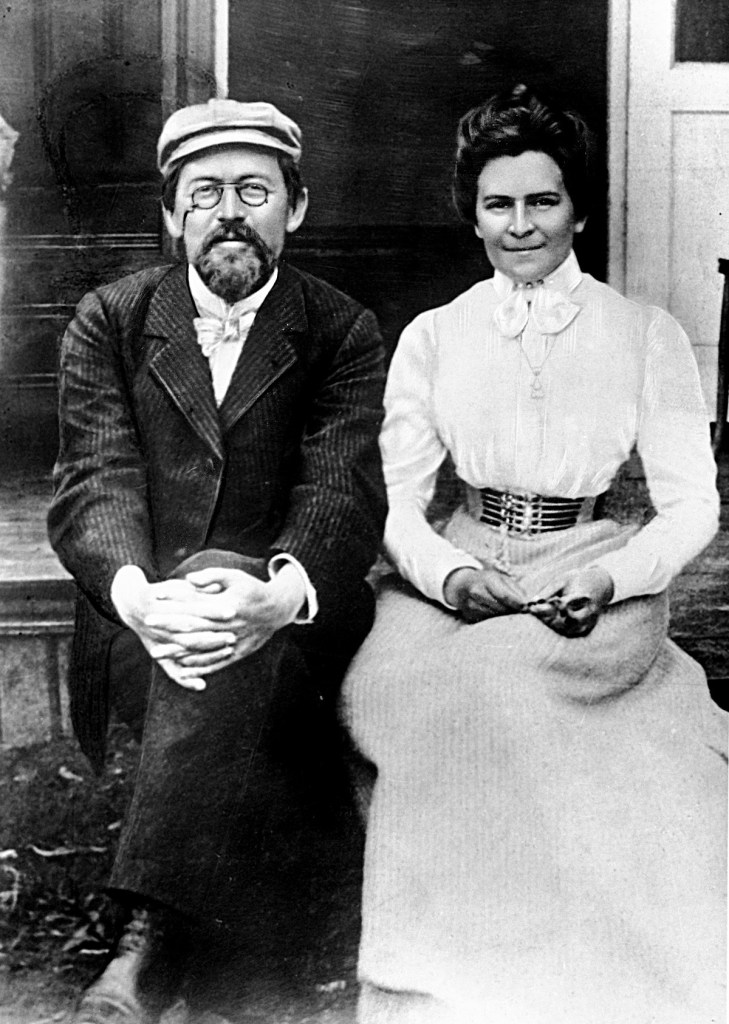
Chekhov and Olga, 1901, on their honeymoon
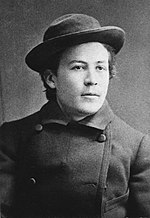 On 25 May 1901, Chekhov married Olga Knipper quietly, owing to his horror of weddings. She was a former protegée and sometime lover of Nemirovich-Danchenko whom he had first met at rehearsals for The Seagull. Up to that point, Chekhov, known as “Russia’s most elusive literary bachelor,” had preferred passing liaisons and visits to brothels over commitment. He had once written:
By all means I will be married if you wish it. But on these conditions: everything must be as it has been hitherto — that is, she must live in Moscow while I live in the country, and I will come and see her … I promise to be an excellent husband, but give me a wife who, like the moon, won’t appear in my sky every day.
The letter proved prophetic of Chekhov’s marital arrangements with Olga: he lived largely at Yalta, she in Moscow, pursuing her acting career. In 1902, Olga suffered a miscarriage.
By May 1904, Chekhov was terminally ill with tuberculosis. His brother, Mikhail Chekhov recalled that “everyone who saw him secretly thought the end was not far off, but the nearer [he] was to the end, the less he seemed to realise it.” On 3 June, he set off with Olga for the German spa town of Badenweiler in the Black Forest, from where he wrote outwardly jovial letters to his sister Masha, describing the food and surroundings, and assuring her and his mother that he was getting better. In his last letter, he complained about the way German women dressed.
Chekhov’s death has become one of “the great set pieces of literary history,” retold, embroidered, and fictionalised many times since, notably in the short story “Errand” by Raymond Carver. In 1908, Olga wrote this account of her husband’s last moments:
Anton sat up unusually straight and said loudly and clearly (although he knew almost no German): Ich sterbe (“I’m dying”). The doctor calmed him, took a syringe, gave him an injection of camphor, and ordered champagne. Anton took a full glass, examined it, smiled at me and said: “It’s a long time since I drank champagne.” He drained it and lay quietly on his left side, and I just had time to run to him and lean across the bed and call to him, but he had stopped breathing and was sleeping peacefully as a child …
Chekhov’s body was transported to Moscow in a refrigerated railway car meant for oysters. Some of the thousands of mourners followed the funeral procession of a General Keller by mistake, to the accompaniment of a military band. Chekhov was buried next to his father at the Novodevichy Cemetery.
quotes
- Perhaps the feelings that we experience when we are in love represent a normal state. Being in love shows a person who he should be.
- Seeing Chekhov: Life And Art
- Love (1886)
- Enemies (1887)
- Gusev (1890)
- Rothschild’s Fiddle (1894)
- Ariadna (1895)
- About Love (1898)
- After the Theatre
- On the Road
- The Letter
- In a Native Corner
- The Piano Player
- The Fruits of Long Meditations
- Guide for Those Wishing to Marry
- Ilia Gurliand Reminiscences of A. P. Chekhov, in Teatr i iskusstvo 1904, No 28, 11 July, p. 521. commonly known as Chekhov’s dictum or Chekhov’s gun.
- Alternate Version: Nothing better forges a bond of love, friendship or respect than common hatred toward something.Quoted in “Psychologically Speaking: A Book of Quotations” – Page 96 – by Kevin Connolly, Margaret Martlew – 1999
- Death is terrible, but still more terrible is the feeling that you might live for ever and never die.When one longs for a drink, it seems as though one could drink a whole ocean—that is faith; but when one begins to drink, one can only drink altogether two glasses—that is science.If you are afraid of loneliness, do not marry.If you wish women to love you, be original; I know a man who used to wear felt boots summer and winter, and women fell in love with him.As I shall lie in the grave alone, so in fact I live alone.I observed that after marriage people cease to be curious.
- In order to cultivate yourself and to drop no lower than the level of the milieu in which you have landed, it is not enough to read Pickwick and memorize a monologue from Faust…. You need to work continually day and night, to read ceaselessly, to study, to exercise your will…. Each hour is precious.
- Letter to his brother, N.P. Chekhov (March 1886)
- When in a serious mood, it seems to me that those people are illogical who feel an aversion toward death. As far as I can see, life consists exclusively of horrors, unpleasantnesses and banalities, now merging, now alternating.
- Letter to M.V. Kiseleva (September 29, 1886)
- Despite your best efforts, you could not invent a better police force for literature than criticism and the author’s own conscience.
- Letter to M.V. Kiseleva (January 14, 1887
- I was so drunk the whole time that I took bottles for girls and girls for bottles.
- Letter to the Chekhov family (April 25, 1887)
- In Western Europe people perish from the congestion and stifling closeness, but with us it is from the spaciousness…. The expanses are so great that the little man hasn’t the resources to orient himself…. This is what I think about Russian suicides.
- Letter to D.V. Grigorovich (February 5, 1888)
- Happiness does not await us all. One needn’t be a prophet to say that there will be more grief and pain than serenity and money. That is why we must hang on to one another.
- Letter to K.S. Barantsevich (March 3, 1888)
- I feel more confident and more satisfied when I reflect that I have two professions and not one. Medicine is my lawful wife and literature is my mistress. When I get tired of one I spend the night with the other. Though it’s disorderly it’s not so dull, and besides, neither really loses anything, through my infidelity.
- Letter to A.S. Suvorin (September 11, 1888)
- My holy of holies is the human body, health, intelligence, talent, inspiration, love, and the most absolute freedom imaginable, freedom from violence and lies, no matter what form the latter two take. Such is the program I would adhere to if I were a major artist.
- Letter to Alexei Pleshcheev (October 4, 1888)
- An artist must pass judgment only on what he understands; his range is limited as that of any other specialist—that’s what I keep repeating and insisting upon. Anyone who says that the artist’s field is all answers and no questions has never done any writing or had any dealings with imagery. An artist observes, selects, guesses and synthesizes.
- Letter to A.S. Suvorin (October 27, 1888)
- It is a poor thing for the writer to take on that which he doesn’t understand.
- Letter to A.S. Suvorin (October 27, 1888)
- You are right to demand that an artist engage his work consciously, but you confuse two different things: solving the problem and correctly posing the question.
- Letter to A.S. Suvorin (October 27, 1888)
- I have in my head a whole army of people pleading to be let out and awaiting my commands.
- Letter to A.S. Suvorin (October 27, 1888)
- I don’t care for success. The ideas sitting in my head are annoyed by, and envious of, that which I’ve already written.
- Letter to A.S. Suvorin (October 27, 1888)
- We learn about life not from pluses alone, but from minuses as well.
- Letter to A.S. Suvorin (December 23, 1888)
- It doesn’t matter that your painting is small. Kopecks are also small, but when a lot are put together they make a ruble. Each painting displayed in a gallery and each good book that makes it into a library, no matter how small they may be, serve a great cause: accretion of the national wealth.
- Letter to S.P. Kuvshinnikova (December 25, 1888)
- Of course politics is an interesting and engrossing thing. It offers no immutable laws, nearly always prevaricates, but as far as blather and sharpening the mind go, it provides inexhaustible material.
- Letter to A.S. Suvorin (January 4, 1889)
- In one-act pieces there should be only rubbish—that is their strength.
- Letter to A.S. Suvorin (January 6, 1889)
- Narrative prose is a legal wife, while drama is a posturing, boisterous, cheeky and wearisome mistress.
- Letter to A.N. Pleshcheev (January 15, 1889)
- Everything is good in due measure and strong sensations know not measure.
- Letter to N.M. Lintvareva (February 11, 1889)
- Everyone judges plays as if they were very easy to write. They don’t know that it is hard to write a good play, and twice as hard and tortuous to write a bad one.
- Letter to A.S. Suvorin (May 4, 1889)
- Life is difficult for those who have the daring to first set out on an unknown road. The avant-garde always has a bad time of it.
- Letter to A.S. Suvorin (May 14, 1889)
- When a person doesn’t understand something, he feels internal discord: however he doesn’t search for that discord in himself, as he should, but searches outside of himself. Thence a war develops with that which he doesn’t understand.
- Letter to A.S. Suvorin (May 15, 1889)
- Without a knowledge of languages you feel as if you don’t have a passport.
- Letter to A.S. Suvorin (November 1889)
- Wherever there is degeneration and apathy, there also is sexual perversion, cold depravity, miscarriage, premature old age, grumbling youth, there is a decline in the arts, indifference to science, and injustice in all its forms.
- Letter to A.S. Suvorin (December 27, 1889)
- I divide all literary works into two categories: Those I like and those I don’t like. No other criterion exists for me.
- Letter to I.L. Leontev (March 22, 1890)
- Letter to A.S. Suvorin (March 29, 1890)
- Letter to I.L. Leontev (March 22, 1890)
- The world is a fine place. The only thing wrong with it is us. How little justice and humility there is in us, how poorly we understand patriotism!
- Letter to A.S. Suvorin (December 9, 1890)
- I think that it would be less difficult to live eternally than to be deprived of sleep throughout life.
- Letter to A.S. Suvorin (December 9, 1890)
- One had better not rush, otherwise dung comes out rather than creative work.
- Letter to A.S. Suvorin (August 18, 1891)
- Satiation, like any state of vitality, always contains a degree of impudence, and that impudence emerges first and foremost when the sated man instructs the hungry one.
- Letter to A.S. Suvorin (October 20, 1891)
- The wealthy man is not he who has money, but he who has the means to live in the luxurious state of early spring.
- Letter to L.A. Avilova (April 29, 1892)
- There is nothing more vapid than a philistine petty bourgeois existence with its farthings, victuals, vacuous conversations, and useless conventional virtue.
- Letter to A.S. Suvorin (June 16, 1892)
- The person who wants nothing, hopes for nothing, and fears nothing can never be an artist.
- Letter to A.S. Suvorin (November 25, 1892)
- By all means I will be married if you wish it. But on these conditions: everything must be as it has been hitherto—that is, she must live in Moscow while I live in the country, and I will come and see her. … I promise to be an excellent husband, but give me a wife who, like the moon, will not appear every day in my sky.
- Letter to A.S. Suvorin (March 23, 1895)
- The bourgeoisie loves so-called “positive” types and novels with happy endings since they lull one into thinking that it is fine to simultaneously acquire capital and maintain one’s innocence, to be a beast and still be happy.
- Letter to A.S. Suvorin (April 13, 1895)
- A man who doesn’t drink is not, in my opinion, fully a man.
- Letter to N.A. Leikin (May 8, 1895)
- It’s worth living abroad to study up on genteel and delicate manners. The maid smiles continuously; she smiles like a duchess on a stage, while at the same time it is clear from her face that she is exhausted from overwork.
- Letter to I.P. Chekhov (October 2, 1897)
- When a person expends the least amount of motion on one action, that is grace.
- Letter to Maxim Gorky (January 3, 1899)
- Is it our job to judge? The gendarme, policemen and bureaucrats have been especially prepared by fate for that job. Our job is to write, and only to write.
- Letter to L.A. Avilova (April 27, 1899)
- There are plenty of good people, but only a very, very few are precise and disciplined.
- Letter to V.A. Posse (February 15, 1900)
- Perhaps the feelings that we experience when we are in love represent a normal state. Being in love shows a person who he should be.
today is the birthday of Patrick Caulfield (Patrick Joseph Caulfield; Acton, Middlesex, England 29 January 1936 – 29 September 2005 London); painter and printmaker known for his bold canvases, which often incorporated elements of photorealism within a pared-down scene.
Gallery

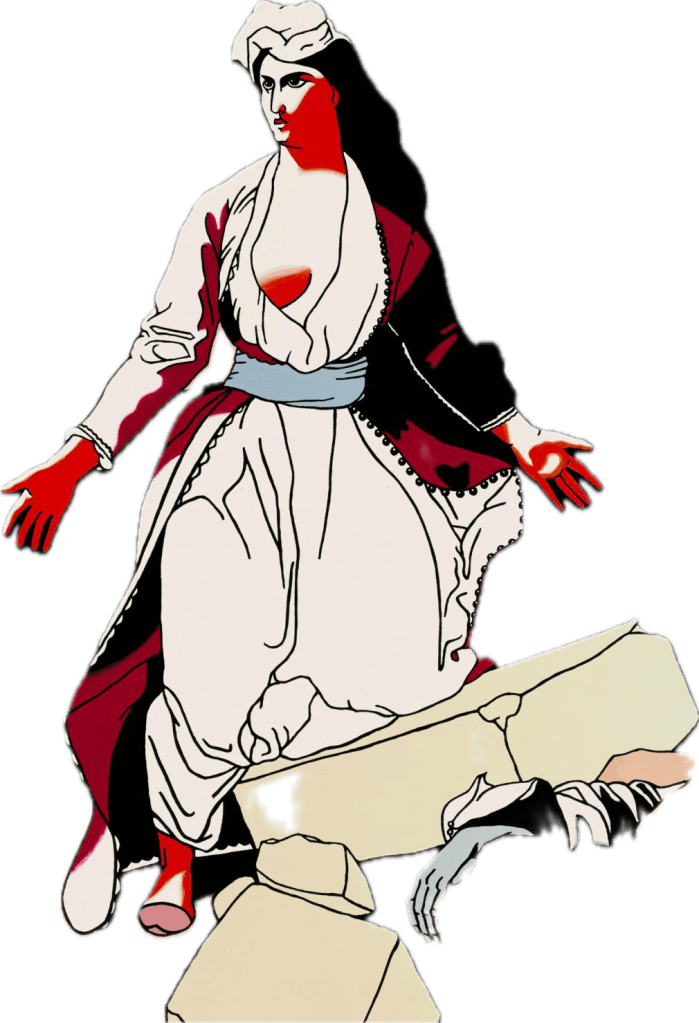
1963
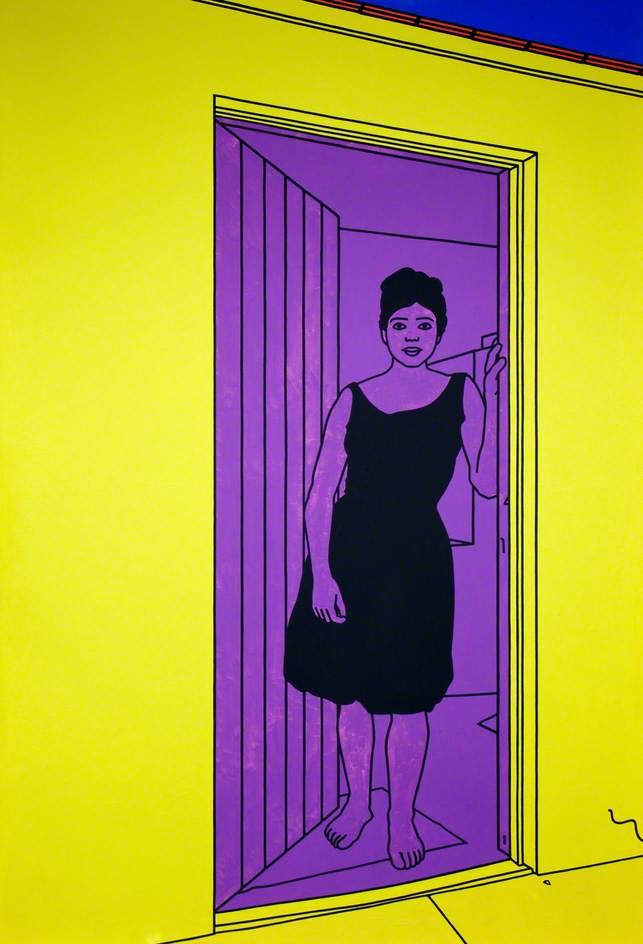
girl in a doorway


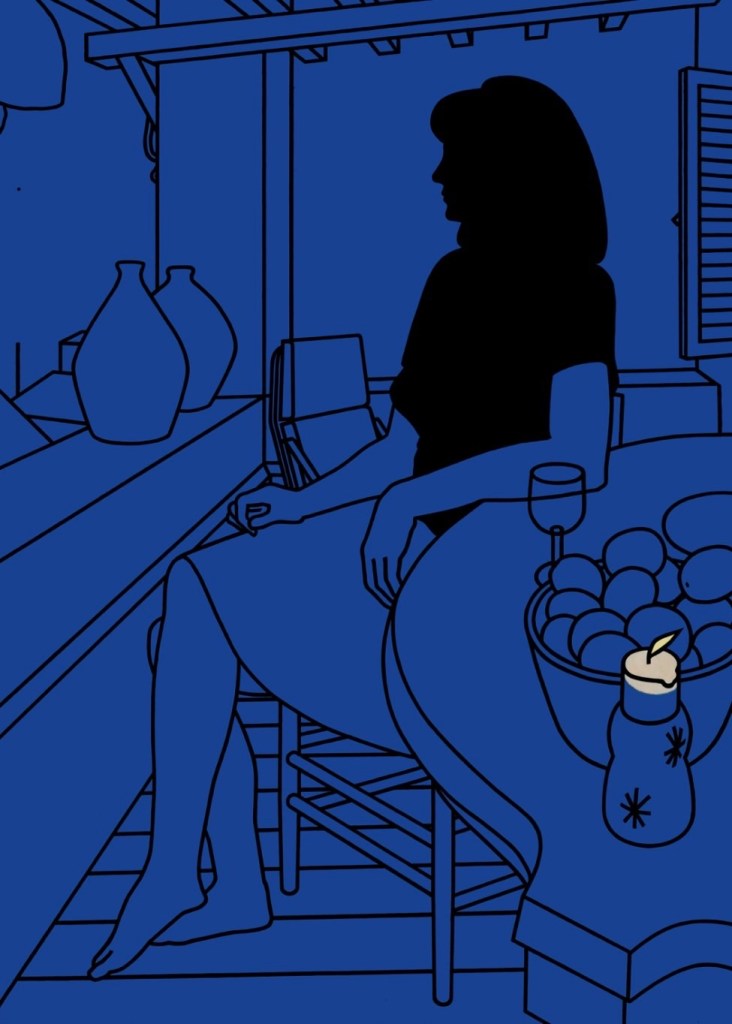
Girl on a Terrace, 1971, Acrylic on canvas
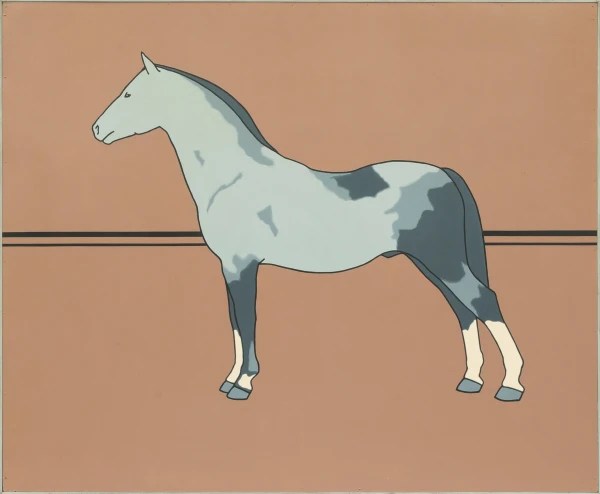
pony 1964
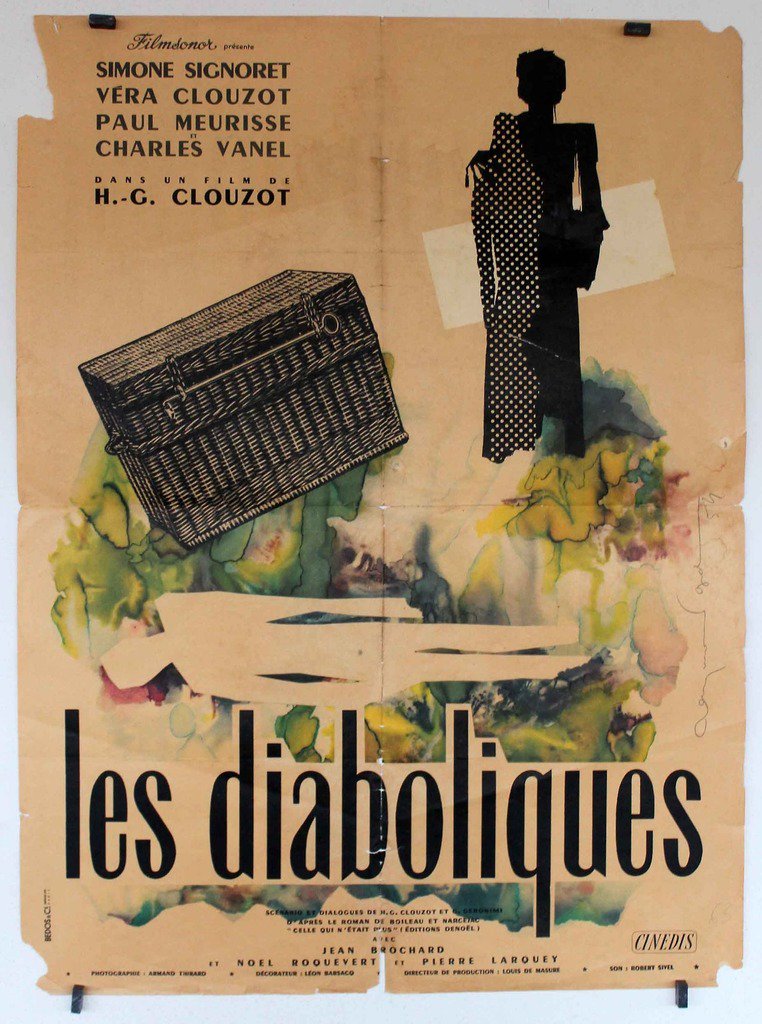
And on this day in 1955 the premiere in France of, Les Diaboliques a French psychological horror thriller film co-written and directed by Henri-Georges Clouzot, starring Simone Signoret, Véra Clouzot, Paul Meurisse and Charles Vanel. It is based on the 1952 novel She Who Was No More (Celle qui n’était plus) by Pierre Boileau and Thomas Narcejac.
thanks for stoppin’ by y’all
mac tag
 The Lovers’ Chronicle
Leave a reply to The Lovers’ Chronicle 30 August – À bout de souffle – come to me – art by Jacques-Louis David, Isaac Levitan & Leonor Fini – birth of Mary Shelley – The Lovers’ Chronicle Cancel reply