
Dear Zazie, Hey thanks for stoppin’ by! Loved your note. Here is today’s Lovers’ Chronicle from Mac Tag dedicated to his muse. Who is the other side of you? Rhett
The Lovers’ Chronicle
Dear Muse,
we could git part way there with Aerosmith;
“I’m looking for another kind of love
Oh, Lordy, how I need it
The kind that likes to leap without a shove
Oh, honey, best believe it”
“Well you know Steven is a favorite”
and we were lookin’ for a connection
that was deeper, more meanin’ful
“And that is what we found”
takin’ each other to the other side
© copyright 2023 mac tag/cowboy coleridge all rights reserved
still feels that way wherever and whenever, whether searchin’ for stories, sharin’ new insights and discoveries, visions never before seen, slakin’ inexhaustible curiosity, the horizon keeps expandin’, ideas and inspiration to write continue and i am most eager to show you, as the other side of me
© copyright 2022.2023 mac tag/cowboy coleridge all rights reserved
and now we know
there was another
just had to git to you
how and why has unfolded on these pages
somethin’ Éluard wrote, yes beautiful
and not sad, might be useful in explainin’,
Une femme est plus belle que le monde où je vis,
i met a woman more wonderful than anything i knew
© copyright 2021.2023 mac tag/cowboy coleridge all rights reserved
Pale Love, Pale Rider
so you can hear
visions of you
want, even need
to be, and to have
dreams intertwined
to get beyond
solitude
remember,
penance paid
can want
make another
other side of me
designed
by fixed devotions
destiny allowed
to come with you
to catch as can
as your other side
© copyright 2020 mac tag/cowboy coleridge all rights reserved
moved a time zone away
from a place with more cattle than people
to a place with millions more people
and still no other
unless this vision counts
which is fine y’all, please no sympathy
absent someone of like mind and spirit
far better to reside in solitude
and take the chance
that it just might stick
© copyright 2019.2023 mac tag/cowboy coleridge all rights reserved
whisper, so you can hear
troubles passed
with patience
seekin’ consolation
for havin’ been lost
left behind
disconsolate,
forever desire
yet visions of you
want, even need
to be, and to have
to get beyond
solitude
remember,
penance
must be paid
self imposed
not to be another’s
can your want
make another
other side of me
the sorrow felt
will not allow
nor disappear
nor be forgiven
for the other side of you
destiny designed
by fixed devotions
allowed to come with you
to catch as cannot
as your other side
© copyright 2018 mac tag/cowboy coleridge all rights reserved
there is no other
unless this vision counts
so, we should write one for Éluard
and his Capitale de la douleur,
or Capital of Pain, yes it is
sad and dark and therefore
fabulous
at least it can be said
that we no longer live there
havin’ taken up residence
in Capitale de la solitude
© copyright 2017.2023 mac tag/cowboy coleridge all rights reserved
Seeker of all
Forms of beauty
For therein lies
Hope, though withered
And forsaken,
Wanin’ and faint,
Wastin’ away
And fadin’ fast
© copyright 2014 mac tag/cowboy coleridge all rights reserved
The muses took me on a wild ride with this one:
Other Side of You
Whisper so, can you hear
You must hear me call you,
The other side of you
The troubles suffered,
Until now never-endin’,
Passed with patience,
Hopin’ to be consoled
Of havin’ been lost
But now, finally found
Must try to remove desperate
And disconsolate, forever desire
The visions of you
Want, even need
To be, and to have,
The other side of you
Have not begun to seek,
Nor go beyond solitude,
To become a legend of the fall
Remember, so many storms
And penance must be paid
You can say that I have died,
Kept in self imposed prison
Not to be another’s,
Your want made another
Other side of me
Yes harsh fortunes have always been
Constant moods, still emergin’
And foretold, not sold
Buried here
The sorrow felt
Will not allow
Nor disappear nor be forgiven
For the other side of you
Destinies designed by fixed devotions
Eternally earned by mixed emotions
Allowed to come with you
To be the other side of you
(if over time prayers permit)
To catch as cannot
As your other side
Which I do not lie
As your other side,
Or from pride
Penetrate feelin’s
That, for you so kind,
Shall grant and allow
Promise the price
That I have paid
If this will not do, only say
To want to finish misery,
If not to be your other side,
Refer to our learnin’ of the verse
Or for that matter to boil
Down the point brought to you
You are the other side of me
I am the other side of you
© copyright 2012 mac tag/Cowboy Coleridge all rights reserved
The Song of the Day is “The Other Side Of You” by American Bang. Disclaimer: No coyright infringement intended. I do not own the rights to the SOD.
| Pierre Puvis de Chavannes | |
|---|---|
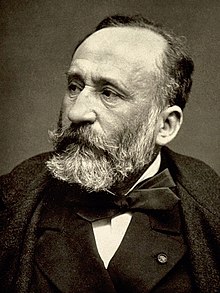 | |
Today is the birthday of Pierre Puvis de Chavannes (Lyon, Rhône 14 December 1824 – 24 October 1898 Paris); painter. Perhaps best known for his mural painting, he came to be known as ‘the painter for France.’ He became the co-founder and president of the Société Nationale des Beaux-Arts, and his work influenced many other artists, notably Robert Genin. Puvis de Chavannes was a prominent painter in the early Third Republic. Émile Zola described his work as “an art made of reason, passion, and will”.
In Montmartre, he had an affair with one of his models, Suzanne Valadon, who would become one of the leading artists of the day as well as the mother, teacher, and mentor of Maurice Utrillo.
Gallery

Marie Madeleine au désert (1869), Francfort-sur-le-Main, musée Städel.

Death and Young Girls,1872

la toilette
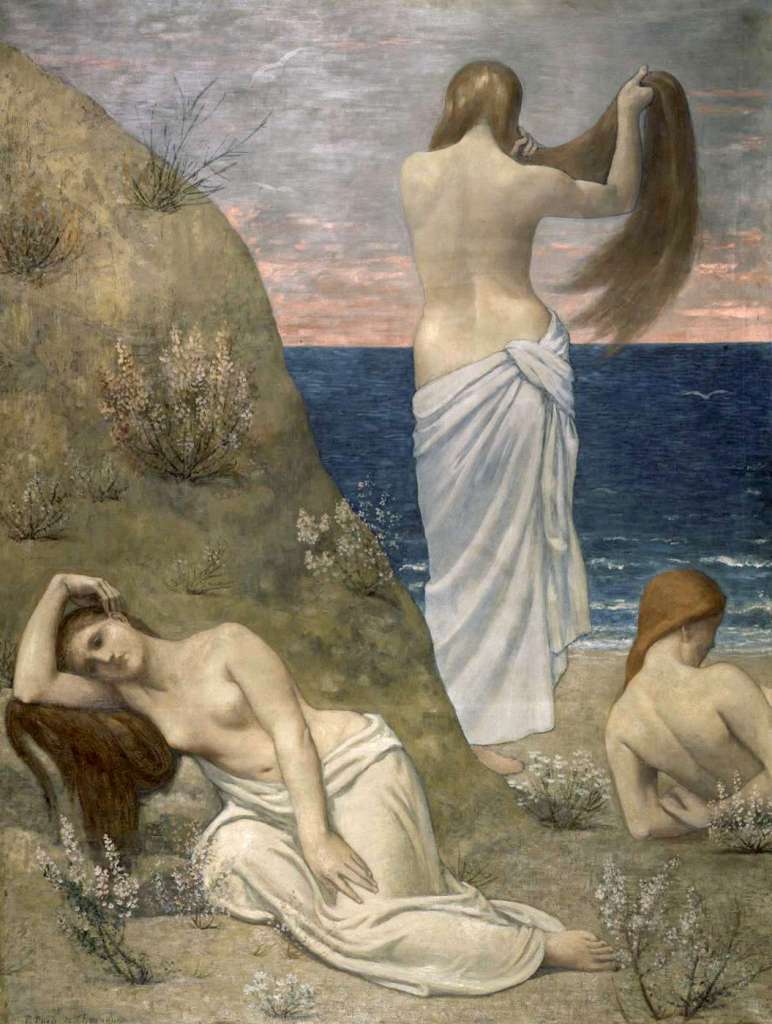
jeunes filles au bord de la mer
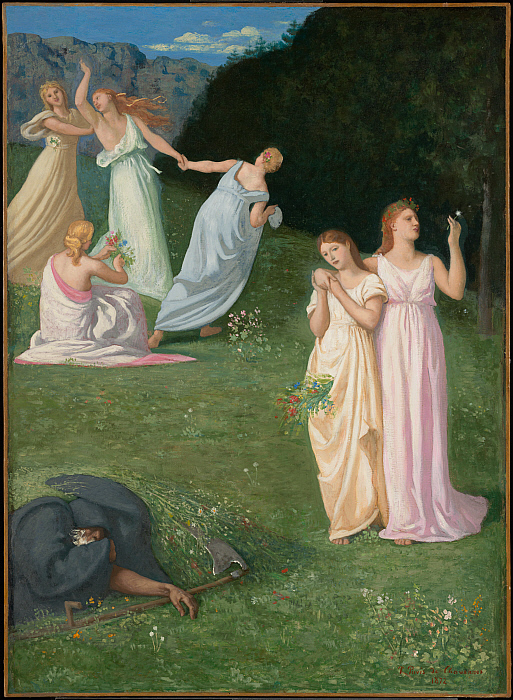
Death and the Maidens, 1872, Clark Art Institute, Williamstown

Fantasy, Ohara Museum of Art
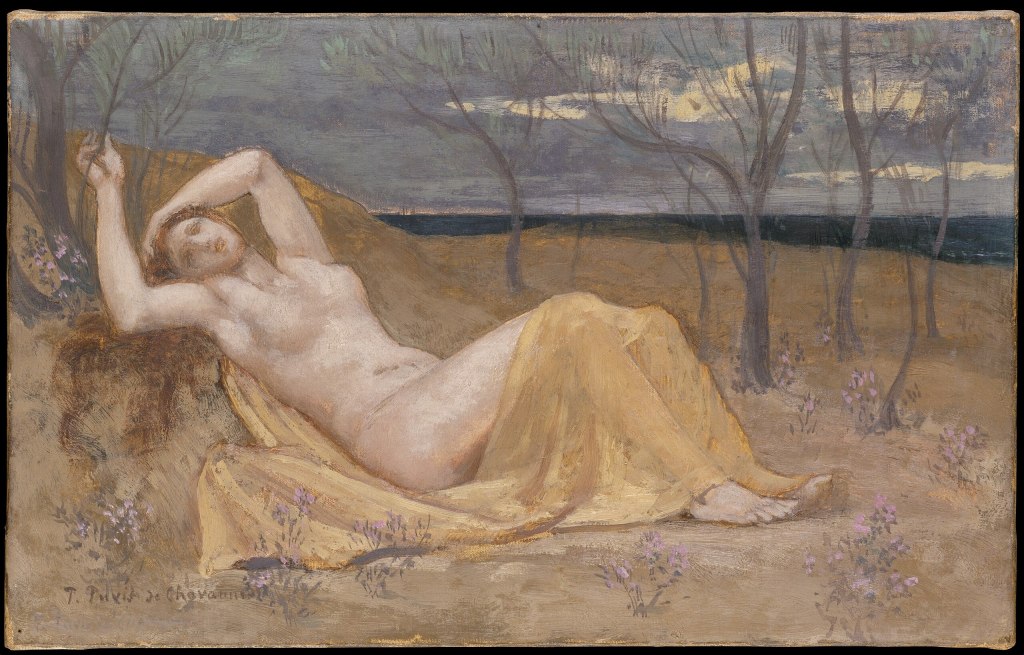
tamaris

Femme sur la plage (1887), Saint-Pétersbourg, musée de l’Ermitage
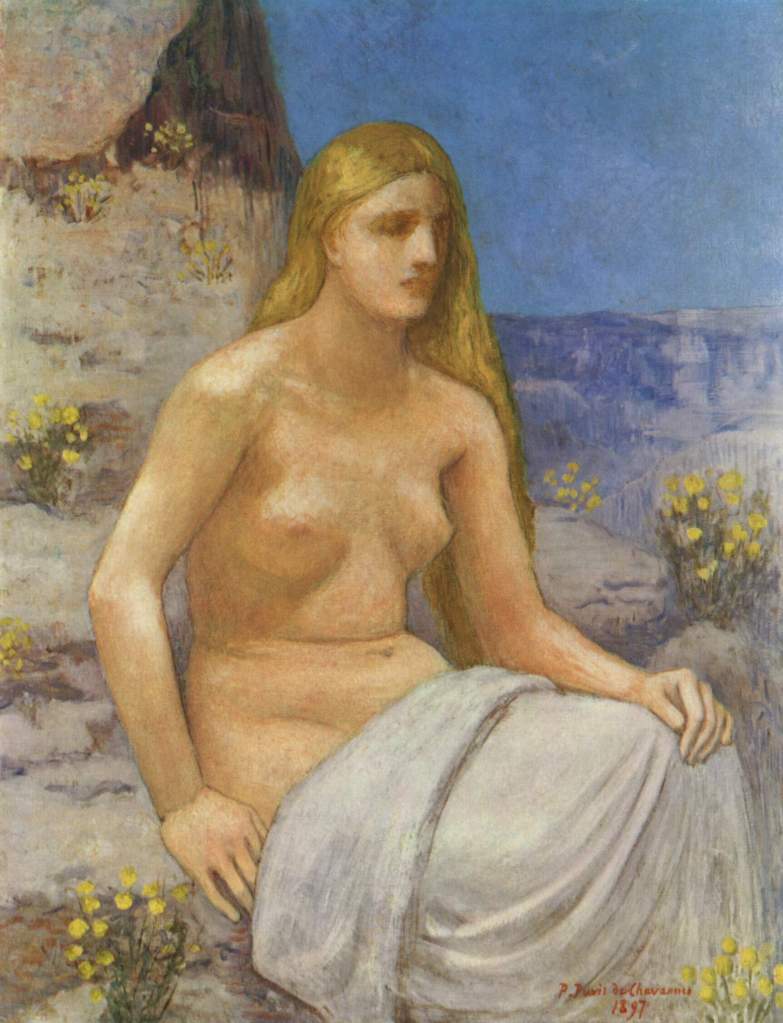
La Madeleine (1897), musée des Beaux-Arts de Budapest

Fille à la plage (1882), Munich, Neue Pinakothek

Hope (1872), Walters Art Museum

Le Rêve (1883), Paris, musée d’Orsay

The Wine Press , 1865, The Phillips Collection

Today is the birthday of Roger Fry (Roger Eliot Fry; St Pancras, London 14 December 1866 – 9 September 1934 Royal Free Hospital, Hampstead, London); painter and critic, and a member of the Bloomsbury Group. Establishing his reputation as a scholar of the Old Masters, he became an advocate of more recent developments in French painting, to which he gave the name Post-Impressionism. He was the first figure to raise public awareness of modern art in Britain, and emphasised the formal properties of paintings over the “associated ideas” conjured in the viewer by their representational content. He was described by the art historian Kenneth Clark as “incomparably the greatest influence on taste since Ruskin … In so far as taste can be changed by one man, it was changed by Roger Fry”. The taste Fry influenced was primarily that of the Anglophone world, and his success lay largely in alerting an educated public to a compelling version of recent artistic developments of the Parisian avant-garde.
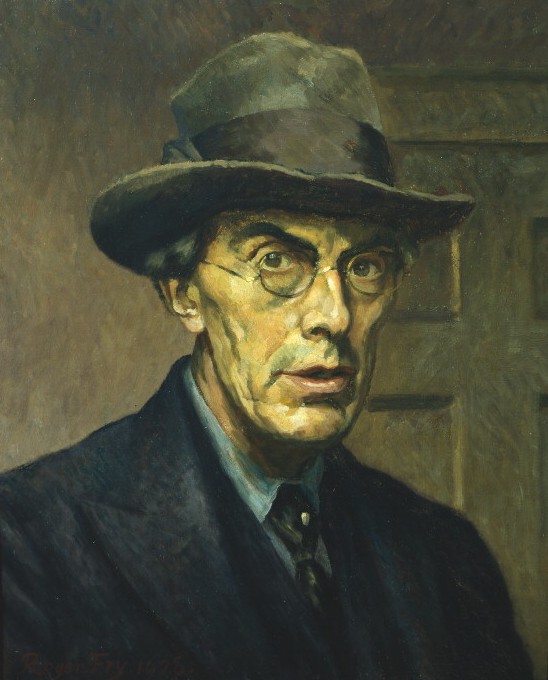
self portrait
In 1896, he married the artist Helen Coombe and they subsequently had two children, Pamela and Julian. Helen soon became mentally ill and in 1910 was committed to a mental institution, where she remained for the rest of her life. Fry took over the care of their children with the help of his sister, Joan Fry. That same year, Fry met the artists Vanessa Bell and her husband Clive Bell, and it was through them that he was introduced to the Bloomsbury Group. Vanessa’s sister, the author Virginia Woolf later wrote in her biography of Fry that “He had more knowledge and experience than the rest of us put together”.
In 1911, Fry began an affair with Vanessa, who was recovering from a miscarriage. Fry offered her the tenderness and care she felt was lacking from her husband. They remained lifelong close friends, even though Fry’s heart was broken in 1913 when Vanessa fell in love with Duncan Grant and decided to live permanently with him.
After short affairs with artists Nina Hamnett and Josette Coatmellec, Fry too found happiness with Helen Maitland Anrep. She became his emotional anchor for the rest of his life, although they never married (she too had had an unhappy first marriage, to the mosaicist Boris Anrep).
Fry died unexpectedly after a fall at his home in London. His death caused great sorrow among the members of the Bloomsbury Group, who loved him for his generosity and warmth. Vanessa decorated his coffin. Fry’s cremated remains were placed in the vault of Kings College Chapel in Cambridge. Woolf was entrusted with writing his biography, a task she found difficult, because his family asked her to omit certain key facts, his love affair with Bell among them.
Gallery

Garden at no 7. Dalmeny Avenue, 1924

Vanessa Bell in a deckchair”, 1911

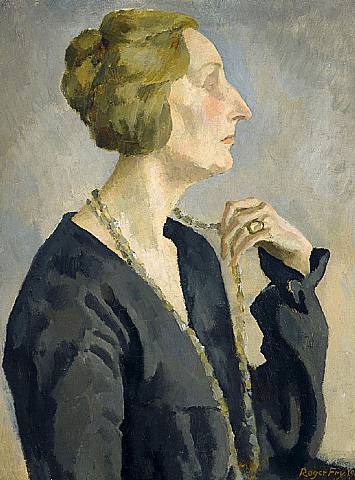
Edith Sitwell

Virginia woolfe

Edith sitwell
And today is the birthday of Paul Éluard (born Eugène Émile Paul Grindel; Saint-Denis, France 14 December 1895 – 18 November 1952 Charenton-le-Pont, France); poet and one of the founders of the surrealist movement.

At the age of 16, he contracted tuberculosis and remained hospitalized until April 1914 in the Clavadel sanatorium near Davos. There he met a young Russian girl of his age, Helena Diakonova, whom he nicknamed Gala. He confided in her of his dream of becoming a poet, of his admiration for “poets dead of hunger, sizzling dreams” and of his parents’ disapproval. She wrote to him that “you will become a great poet”. They became inseparable. She believed in him and gave him the confidence and encouragement and provided him with the sense of security he needed to write. She listened and was involved in the creation of his verses. She became his muse.
In April 1914, Éluard and Gala were both declared healthy again and sent home, to Paris and Moscow respectively. The separation was brutal. Europe was on the brink of war. Éluard was mobilised. He passed his physical and was assigned to the auxiliary services because of his poor health. He spent most of 1915 under treatment in a military hospital not far from home. His mother came to visit him and he talked for hours about his beloved, opening his heart to her and slowly rallying her to his cause. Her initial hostility towards Gala slowly faded away, and she started calling her “the little Russian”. However, Éluard’s father, who had also been mobilised, remained adamant that she could not come to Paris.
In Moscow, Gala listened to no one. Her love for Éluard gave her an unshakable faith that they would be reunited again. She wrote to his mother to befriend her and finally convinced her stepfather to let her go to Paris to study French at the Sorbonne.
In June 1917, Éluard was sent to Hargnicourt to work in one of the military evacuation hospital, 10 kilometres from the front line. The ‘poet’ was given a chair, a desk and a pen to painfully write to the families of the dead and the wounded. He wrote more than 150 letters a day. At night he dug graves to bury the dead. For the first time since Clavadel, shaken by the horrors of the war, he started writing verses again. Gala wrote to him “I promise you our life will be glorious and magnificent”.
On 14 December 1917, Éluard turned 21 and wrote to his mother “I can assure you, that your approval will be infinitely precious to me. However, for all our sakes, nothing will change my mind”. He married Gala on 20 February 1918. Two days after getting married, he left for the front line. His health suffered. On 20 March 1917 he was sent to a military hospital with incipient pleurisy.
In 1919, Éluard wrote to Gala: “War is coming to an end. We will now fight for happiness after having fought for Life”. Waiting to be sent home, he published “Duty and Anxiety” and “Little Poems for Peace”.
In November 1921, Éluard and Gala visited Max Ernst at his home in Cologne. Éluard and Gala moved to a house just outside Paris and were joined by Ernst, who entered France illegally, using Éluard’s passport. Éluard, Ernst and Gala entered into a ménage à trois in 1922. Éluard was torn between his love for Gala and his friendship for Max. He refused to challenge Gala, and spent his nights in clubs: the Zelli, the Cyrano, the Parrot, and Mitchell. Gala’s well-being was still what mattered to him above all and he tried to forget his anxiety by drinking.
Éluard, depressed, wrote “Dying of not Dying”. On 24 March 1924, Éluard disappeared. No one knew where he was. The night before he had had a worrisome meeting with Louis Aragon during which he confessed that he wanted to put an end to a present that tortured him. For his friends, Éluard was gone forever. But Éluard wrote to Gala and four months later she bought a ticket to go and find him and bring him back, locating him in Saigon.
In 1928 he had another bout of tuberculosis and went back to the Clavadel sanatorium with Gala. It was their last winter together. Gala met Salvador Dalí soon after and remained with him for the rest of her life.
In 1934, Éluard married Nusch (Maria Benz), a music-hall artist, whom he had met through his friends Man Ray and Pablo Picasso.
Verse
- Une femme est plus belle que le monde où je vis, Et je ferme les yeux.
- A woman is more beautiful than the world in which I live, and I close my eyes.
- Il y a assurément un autre monde, mais il est dans celui-ci…
- There is another world, but it is in this one.
L’Amour la poésie, 1929
Je te l’ai dit pour les nuages
Je te l’ai dit pour l’arbre de la mer
- Capitale de la douleur (1926), Paul Éluard, éd. Gallimard, coll. « Poésie/Gallimard », 1997, p. 150
La terre est bleue comme une orange
Jamais une erreur les mots ne mentent pas
- Capitale de la douleur (1926), Paul Éluard, éd. Gallimard, coll. « Poésie/Gallimard », 1997, p. 153
La brûlure de toutes les métamorphoses
La chaîne entière des aurores dans la tête
Tous les cris qui s’acharnent à briser les mots
Et qui creusent la bouche et qui creusent les yeux
Où les couleurs furieuses défont les brumes de l’attente
Dressent l’amour contre la vie les morts en rêvent.
- Capitale de la douleur suivi de L’amour la poésie (1929), Paul Éluard, éd. Gallimard, coll. « Poésie », 1966 (ISBN 978-2-07-030095-2), partie Seconde nature, V. En l’honneur des muets, p. 181
La faim couverte d’immondices
Etreint le fantôme du blé.
- Capitale de la douleur suivi de L’amour la poésie (1929), Paul Éluard, éd. Gallimard, coll. « Poésie », 1966 (ISBN 978-2-07-030095-2), partie Répétitions, IX. Les yeux brûlés du bois, p. 185
La peur en loques perce les murs.
- Capitale de la douleur suivi de L’amour la poésie (1929), Paul Éluard, éd. Gallimard, coll. « Poésie », 1966 (ISBN 978-2-07-030095-2), partie Répétitions, IX. Les yeux brûlés du bois, p. 185
Bouquet des sèves le brasier que chevauche le vent
Fumées en tête les armées de la prise du monde
L’écume des tourments aériens la présence
Les attaches du front le plus haut de la terre.
- Capitale de la douleur suivi de L’amour la poésie (1929), Paul Éluard, éd. Gallimard, coll. « Poésie », 1966 (ISBN 978-2-07-030095-2), partie Comme une image, III. Bouquet des sèves, p. 203
La fleur de chardon construit un château
Elle monte aux échelles du vent.
- Capitale de la douleur suivi de L’amour la poésie (1929), Paul Éluard, éd. Gallimard, coll. « Poésie », 1966 (ISBN 978-2-07-030095-2), partie Comme une image, IV. Armure de proie, p. 204
Des étoiles d’ébène sur les vitres luisantes
Promettent tout à leurs amants
Les autres qui simulent
Maintiennent l’ordre de plomb.
- Capitale de la douleur suivi de L’amour la poésie (1929), Paul Éluard, éd. Gallimard, coll. « Poésie », 1966 (ISBN 978-2-07-030095-2), partie Comme une image, IV. Armure de proie, p. 204
Pour en finir
Une tombe ornée de très jolis bibelots
Un voile de soie sur les lenteurs de la luxure
Pour en finir
Une hache dans le dos d’un seul coup.
- Capitale de la douleur suivi de L’amour la poésie (1929), Paul Éluard, éd. Gallimard, coll. « Poésie », 1966 (ISBN 978-2-07-030095-2), partie Comme une image, IV. Armure de proie, p. 205
Dans les ravins du sommeil
Le silence dresse ses enfants
Voici le bruit fatal qui crève les tympans
La poussiéreuse mort des couleurs
L’idiotie.
- Capitale de la douleur suivi de L’amour la poésie (1929), Paul Éluard, éd. Gallimard, coll. « Poésie », 1966 (ISBN 978-2-07-030095-2), partie Comme une image, IV. Armure de proie, p. 205
Aux alentours de l’espoir
En pure perte
Le calme fait le vide.
- Capitale de la douleur suivi de L’amour la poésie (1929), Paul Éluard, éd. Gallimard, coll. « Poésie », 1966 (ISBN 978-2-07-030095-2), partie Comme une image, IV. Armure de proie, p. 206
Aux marches des torrents
Des filles de cristal aux tempes fraîches
Petites qui fleurissent et faibles qui sourient
Pour faire la part de l’eau séduisent la lumière
Des chutes de soleil des aurores liquides
Et quand leurs baisers deviennent invisibles
Elles vont dormir dans la gueule des lions.
- Capitale de la douleur suivi de L’amour la poésie (1929), Paul Éluard, éd. Gallimard, coll. « Poésie », 1966 (ISBN 978-2-07-030095-2), partie Comme une image, IX. Révolte de la neige, p. 212
Passage où la vue détourne d’un coup la pensée
Une ombre s’agrandit cherche son univers
Et tombe horizontalement
Dans le sens de la marche.
- Capitale de la douleur suivi de L’amour la poésie (1929), Paul Éluard, éd. Gallimard, coll. « Poésie », 1966 (ISBN 978-2-07-030095-2), partie Comme une image, XII. Passage où la vue détourne d’un coup la pensée, p. 215
La verdure caresse les épaules de la rue
Le soir verse du feu dans des verres de couleur
Comme à la fête
Un éventail d’alcool.
- Capitale de la douleur suivi de L’amour la poésie (1929), Paul Éluard, éd. Gallimard, coll. « Poésie », 1966 (ISBN 978-2-07-030095-2), partie Comme une image, XII. Passage où la vue détourne d’un coup la pensée, p. 215
Les hommes errants plus forts que les nains habituels
Ne se rencontrent pas. L’on raconte
Qu’ils se dévoreraient.
- Capitale de la douleur suivi de L’amour la poésie (1929), Paul Éluard, éd. Gallimard, coll. « Poésie », 1966 (ISBN 978-2-07-030095-2), partie Défense de savoir, V. Les hommes errants, p. 223
L’on vit de ce qu’on n’apprend pas
Comme une abeille dans un obus
Comme un cerveau tombant de haut
De plus haut.
- Capitale de la douleur suivi de L’amour la poésie (1929), Paul Éluard, éd. Gallimard, coll. « Poésie », 1966 (ISBN 978-2-07-030095-2), partie Défense de savoir, VI. Ma mémoire, p. 223
Tu ne pleureras pas
Tu ne videras pas cette besace de poussière
Et de félicités
Tu vas d’un concret à un autre
Par le plus court chemin celui des monstres.
- Capitale de la douleur suivi de L’amour la poésie (1929), Paul Éluard, éd. Gallimard, coll. « Poésie », 1966 (ISBN 978-2-07-030095-2), partie Défense de savoir, VII. Receleuse du réel, p. 235
Mac Tag
thanks for stoppin’ by y’all
Fellow-wanderer,
Could we but mix ourselves into a dream,
Not in its image on the mirror!
- W. B. Yeats
 The Lovers’ Chronicle
Leave a reply to The Lovers’ Chronicle 26 December – rememberin’… – art by Maurice Utrillo – birth of Henry Miller – The Lovers’ Chronicle Cancel reply