Dear Zazie, Here is today’s Lovers’ Chronicle from Mac Tag dedicated to his muse. Do you want it darker? Rhett
The Lovers’ Chronicle
Dear Muse,
darker dream…
oh that song, one of my favorites,
he thinks as he floats into dream space,
i fell asleep with it playin’ in my head
so i was hopin’ it would follow me;
”Seen it’s dreadful imposition
Come blacking in my mind
And that I see a darkness
And that I see a darkness”
lets go a direction we both agree on
that basically fits the category
our shared love of heavy metal
“Yes sometimes we want
our music heavier and darker”
from Lemy and Motörhead, to Megadeth,
the Prince of Darkness himself, Ozzy,
and Metallica who recorded our song;
“So close, no matter how far
Couldn’t be much more from the heart
Forever trusting who we are
No, nothing else matters”
lighter or darker we will have it our way
© copyright 2023 mac tag/cowboy coleridge all rights reserved
rope tied off, and the trips are short now, just dip a toe in, yep still cold, still bitter, far better than the days of goin’ in head first and stayin’ there for , when the knot was loose, when just gittin’ through the day took effort, before discovery and proper perspective, understandin’ purpose and place, before the dawn of you
© copyright 2022.2023 mac tag/cowboy coleridge all rights reserved
considerably lighter these days
only goin’ there as the verse demands
it did provide meanin’ and definition,
a structure that i came to depend on
gotta cling to somethin’ in the depths
but those days are past, dawn breaks
on new visions, adventures and dreams
shall we away, see where the verse leads
© copyright 2021.2023 mac tag/cowboy coleridge all rights reserved
Pale Love, Pale Rider
the right words
were there all along
i just had to find them
and learn how to say them
three words say it all,
i grapple with thee,
no longer empty
when written again,
when said, will convey
all that we will need
and shades of darkness
will be just what they were
© copyright 2020 mac tag/cowboy coleridge all rights reserved
many shades but no need to worry
i have the roped securely tied off
playin’ Leonard of course, flyin’ solo
still the preferred method of travel
went to no. 246, had some pizza at the bar
and their Sophia Loren tequila cocktail,
of course finished off with a selection
from their excellent amari menu,
the Amaro dell’Erborista, smoky,
dark, bitter, you know how i like it
for Marci
i miss you
© copyright 2019.2023 mac tag/cowboy coleridge all rights reserved
one may be pardoned,
i suppose,
for the hyperbole
for feelin’s,
undyin’
blessed are those whose faith
is not framed by ordinary things
here, existence is flawed
transcendence unconditional
the journey to redemption
perpetual
“Is there refuge
here for me?”
yes, take my hand
© copyright 2018 mac tag/cowboy coleridge all rights reserved
beauty and sorrow
sorrow and beauty
i grapple with thee,
the one, then the other,
with a vigor
unlike anything
you can imagine
two words
that can mean
so much
yet sometimes
feel so empty
two words
overused
ad nauseam
yet not said enough
two words fraught
with light and dark
perhaps
that is the attraction
though the effort
to go there feels futile
far better poets
have written
better odes
if written again
would it matter
would it convey
this utter, complete
feelin’ of loss
that threatens
to subdue
the last vestige
of hope
yes, that word
can still be written
but is it real
or is it just
layin’ there
for your sake
remember this my friend,
ain’t nothin’
but a lit match in the wind,
and it is a far, far better fate
to swathe oneself
in shrouds of sorrow,
than to feel nothin’ at all
that answers
the question
does it not,
for once joy
cannot be felt
then sorrow must
be probed often
to prove
that feelin’s
still exist
“How many more
shades darker
will you have it?”
many, many…
a new goal in life…
to take pictures
half as stunnin’
as the ones
Stieglitz took
of O’Keeffe
a new goal in life…
to take pictures of you
half as stunnin’
as the ones
Stieglitz took
of O’Keeffe
© copyright 2017 mac tag/cowboy Coleridge all rights reserved
“It’s called reaping it”
Yeah, maybe you should
Beat me over the head
With it ninety-nine more
Times, just so I git it
© copyright 2016 mac tag/cowboy Coleridge all rights reserved
Now, turn towards darkness
Saddle bags packed and time
come to start ridin’ West
© copyright 2015 mac tag/cowboy Coleridge all rights reserved
| Marianne Moore | |
|---|---|
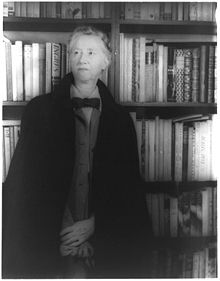 | |
Today is the birthday of Marianne Moore (Marianne Craig Moore; Kirkwood, Missouri; November 15, 1887 – February 5, 1972 New York City); Modernist poet, critic, translator, and editor. Her poetry is noted for formal innovation, precise diction, irony, and wit. Moore never married.
Verse
- One may be pardoned, yes I know
one may, for love for love, undying (Ephesians 6:24)- Voracities and Verities Sometimes are Interesting
- There is hate’s crown beneath which all is
death; there’s love without which none
is king.- In Distrust of Merits
- In Homer, existence
is flawed; transcendence, conditional;
‘ the journey from sin to redemption, perpetual’,- To a Giraffe
- Tell me, Tell me where might there be a refuge for me
from egocentricity
and its propensity to bisect,
mis-state, misunderstand
and obliterate continuity?- Tell Me, Tell Me
- You are not male nor female, but a plan
deep-set within the heart of man.- “Sun” from Tell Me, Tell Me (1966)
- Consume hostility;
employ your weapon in this meeting-place of surging enmity!
Insurgent feet shall not outrun
multiplied flames, O Sun.- “Sun” from Tell Me, Tell Me (1966)
Collected Poems (1951)
- Poetry I too, dislike it: there are things that are important beyond
all this fiddle,
Reading it, however, with a perfect contempt for it
one discovers in
it after all, a place for the genuine.- Poetry
- If you demand on the other hand,
the raw material of poetry in
all its rawness and
that which is on the other hand
genuine, you are interested in poetry.- Poetry
- ‘Hebrew poetry is,
prose with a sort of heightened consciousness’ Ecstasy
affords
the occasion expediency, determines the form- The Past is the Present
Poetry (1919)
Hands that can grasp, eyes
that can dilate, hair that can riseif it must, these things are important not because a
high-sounding interpretation can be put upon them but because they areuseful. When they become so derivative as to become unintelligible,
the same thing may be said for all of us, that wedo not admire what
we cannot understand: the batholding on upside down or in quest of something to
eat, elephants pushing, a wild horse taking a roll, a tireless wolf undera tree, the immovable critic twitching his skin like a horse that feels a flea, the base-
ball fan, the statistician —
nor is it validto discriminate against “business documents and
school-books; all these phenomena are important. One must make a distinctionhowever: when dragged into prominence by half poets, the result is not poetry,
nor till the poets among us can be“literalists of
the imagination” — aboveinsolence and triviality and can present
for inspection, “imaginary gardens with real toads in them,” shall we haveit.In the meantime, if you demand on the one hand,the raw material of poetry in
all its rawness andthat which is on the other handgenuine, you are interested in poetry.
The Poems of Marianne Moore (2003)
- that which is impossible to force, it is impossible
to hinder.- “Radical”
- My father used to say “Superior people never make long visits.”
- “Silence”
- The deepest feeling always shows itself in silence;
not in silence, but restraint.- “Silence”
- He’s not out
seeing a sight but the rock
crystal thing to see — the startling El Greco
brimming with inner light — that
covets nothing that it has let go. This then you may know
as the hero.- “The Hero”
- What is our innocence,
what is our guilt? All are
naked, none is safe.- “What Are Years?”
- Beauty is everlasting
and dust is for a time.- “In Distrust of Merits” (1944)
- Some speak of things we know, as new;
And you, of things unknown as things forgot.- “Quoting an Also Private Thought” (this poem is a very slight reworking of an earlier poem “As Has Been Said”)
- We Call Them the Brave
who likely were reluctant to be brave.- “We Call Them the Brave” (the title of this poem is also obviously meant to be read as its first line, though set apart)
- What of it? We call them brave
perhaps? Yes; what if the time should come
when no one will fight for anything
and there’s nothing of worth to save.- “We Call Them the Brave”
- A symbol from the first, of mastery,
experiments such as Hippocrates made
and substituted for vague
speculation stayed
the ravages of plague.- “The Staff of Aesculapius”
- Staff and effigy of the animal
which by shedding its skin
is a sign of renewal —
the symbol of medicine.- “The Staff of Aesculapius”
- The problems is mastered — insupportably
tiring when it was impending.
Deliverance accounts for what sounds like axiom. - The Gordian knot need not be cut.
- “Charity Overcoming Envy”
- Love, ah Love, when your slipknot’s drawn,
One can but say, “Farewell, good sense.”- “The Lion in Love”
- We are what we were at birth, and each trait has remained
in conformity with earth’s and with heaven’s logic:
Be the devil’s tool, resort to black magic,
None can diverge from the ends which Heaven foreordained.- “The Mouse Metamorphosed into a Maid”
| Georgia O’Keeffe | |
|---|---|
 | |
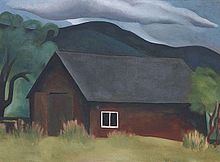
Today is the birthday of Georgia O’Keeffe (Georgia Totto O’Keeffe; Town of Sun Prairie, Wisconsin; November 15, 1887 – March 6, 1986 Santa Fe, New Mexico); artist. Perhaps known for her paintings of enlarged flowers, New York skyscrapers, and New Mexico landscapes. O’Keeffe has been recognized as the “Mother of American modernism”.
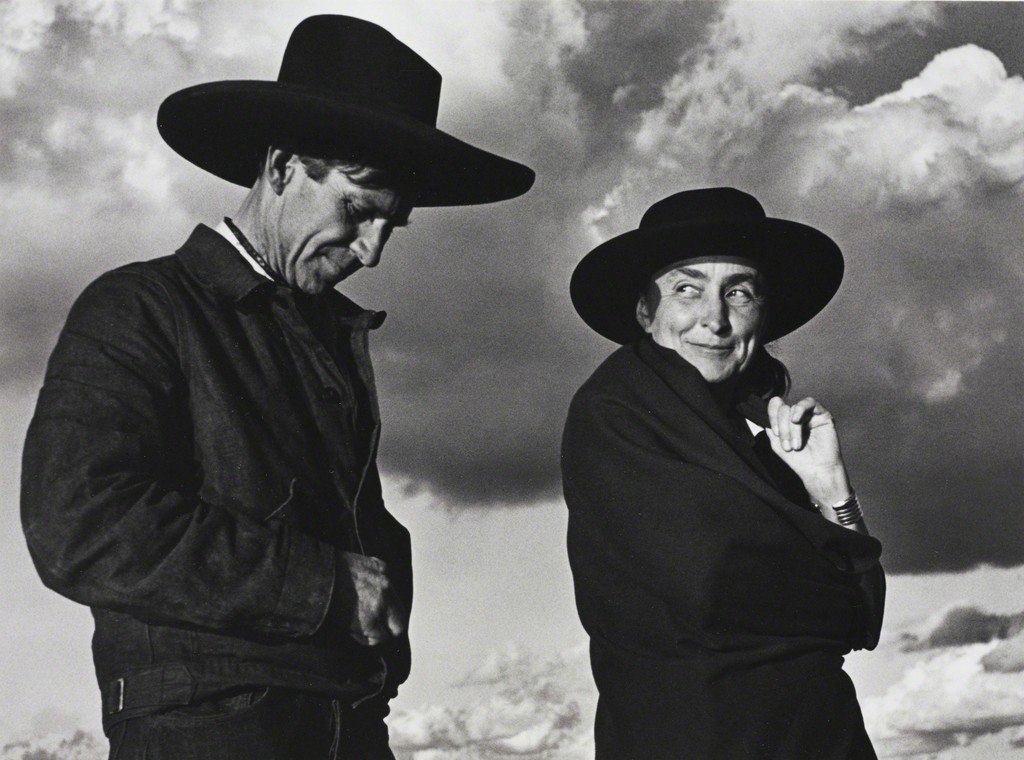
By Ansel Adams with Orville Cox, Canyon de Chelly National Monument, Arizona, 1937.
O’Keefe took a job as head of the art department at West Texas State Normal College from late 1916 to February 1918, the fledgling West Texas A&M University in Canyon just south of Amarillo. While there, she often visited the Palo Duro Canyon, making its forms a subject in her work.
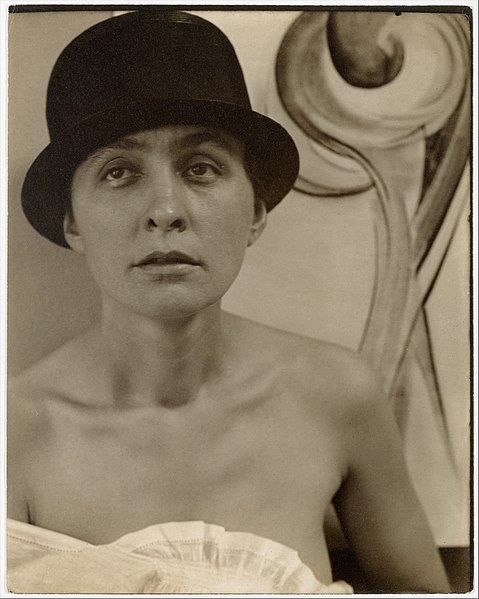
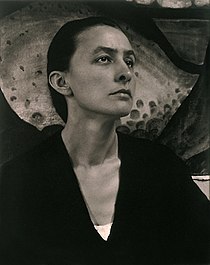
by stieglitz
Alfred Stieglitz organized O’Keeffe’s first solo show at his 291 art gallery in April 1917, which included oil paintings and watercolors completed in Texas.

by Stieglitz
Stieglitz and O’Keeffe corresponded frequently beginning in 1916 and, in June 1918, she accepted his invitation to move to New York to devote all of her time to her work. The two were in love and, shortly after her arrival, they began living together, even though Stieglitz was married and 23 years her senior. That year, Stieglitz first took O’Keeffe to his family home at the village of Lake George in New York’s Adirondack Mountains. They spent part of every year there until 1929, when O’Keeffe spent the first of many summers painting in New Mexico. In 1924, Stieglitz’s divorce was approved by a judge and, within four months, he and O’Keeffe married. It was a small, private ceremony at John Marin’s house, and afterward the couple went back home. There was no reception, festivities, or honeymoon. After the marriage, they both continued working on their individual projects as they had before. For the rest of their lives together, their relationship was, as biographer Benita Eisler characterized it,
a collusion … a system of deals and trade-offs, tacitly agreed to and carried out, for the most part, without the exchange of a word. Preferring avoidance to confrontation on most issues, O’Keeffe was the principal agent of collusion in their union.
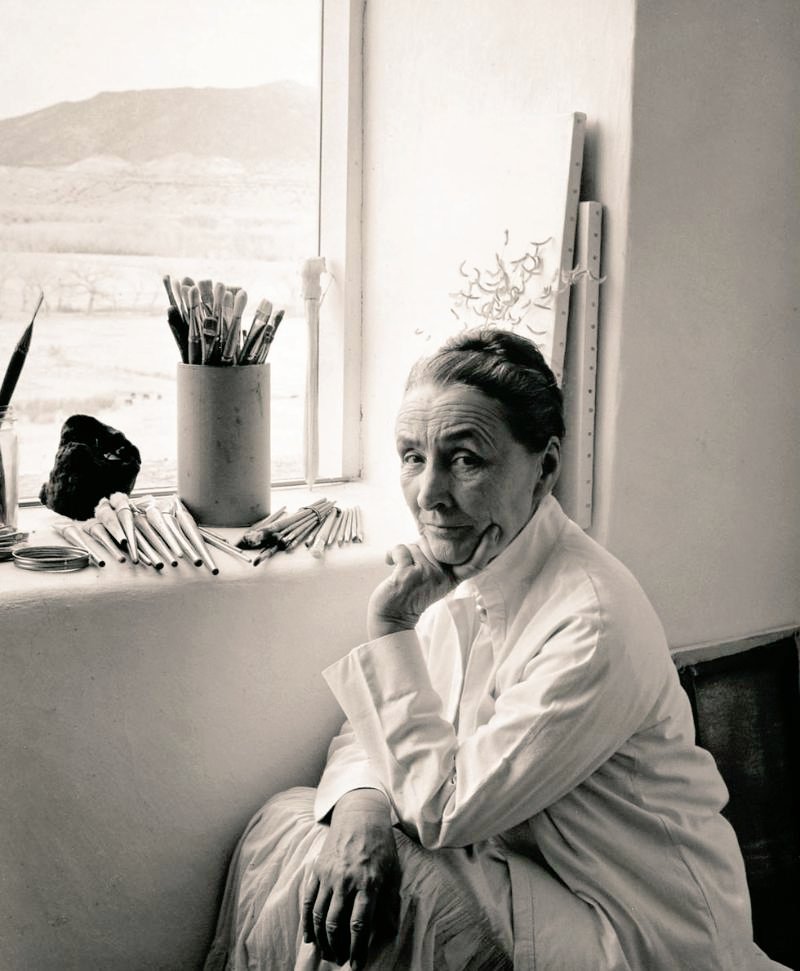
by Laura Gilpin
Stieglitz started photographing O’Keeffe when she visited him in New York City to see her 1917 exhibition. By 1937, when he retired from photography, he had made more than 350 portraits of her. Most of the more erotic photographs were made in the 1910s and early 1920s. In February 1921, forty-five of Stieglitz’s photographs were exhibited in a retrospective exhibition at the Anderson Galleries, including many of O’Keeffe, some of which depicted her in the nude. It created a public sensation. She once made a remark to Pollitzer about the nude photographs which may be the best indication of O’Keeffe’s ultimate reaction to being their subject: “I felt somehow that the photographs had nothing to do with me personally.” In 1978, she wrote about how distant from them she had become: “When I look over the photographs Stieglitz took of me-some of them more than sixty years ago—I wonder who that person is. It is as if in my one life I have lived many lives. If the person in the photographs were living in this world today, she would be quite a different person—but it doesn’t matter—Stieglitz photographed her then.”

by Stieglitz
By 1929, O’Keeffe acted on her increasing need to find a new source of inspiration for her work and to escape summers at Lake George, where she was surrounded by the Stieglitz family and their friends. O’Keeffe had considered finding a studio separate from Lake George in upstate New York and had also thought about spending the summer in Europe, but opted instead to travel to Santa Fe, with her friend Rebecca Strand. The two set out by train in May 1929 and soon after their arrival, Mabel Dodge Luhan moved them to her house in Taos and provided them with studios. O’Keeffe went on many pack trips exploring the rugged mountains and deserts of the region that summer and later visited the nearby D. H. Lawrence Ranch, where she completed her now famous oil painting, The Lawrence Tree, currently owned by the Wadsworth Athenaeum in Hartford, Connecticut.

Stieglitz, Georgia O’Keeffe, platinum print, 1920
Between 1929 and 1949, O’Keeffe spent part of nearly every year working in New Mexico. She collected rocks and bones from the desert floor and made them and the distinctive architectural and landscape forms of the area subjects in her work. She also went on several camping trips with friends, visiting important sites in the Southwest, and in 1961, she and others, including photographers Eliot Porter and Todd Webb, went on a rafting trip down the Colorado River about Glen Canyon, Utah.
 | |
In August of 1934, she visited Ghost Ranch, north of Abiquiú, for the first time and decided to live there. In 1940, she moved into a house on the ranch property. The varicolored cliffs of Ghost Ranch inspired some of her most famous landscapes. In 1977, O’Keeffe wrote: “[the] cliffs over there are almost painted for you—you think—until you try to paint them.” Among guests to visit her at the ranch over the years were Charles and Anne Lindbergh, singer-songwriter Joni Mitchell, poet Allen Ginsberg, and photographer Ansel Adams.

Known as a loner, O’Keeffe explored the land she loved often in her Ford Model A, which she purchased and learned to drive in 1929. She often talked about her fondness for Ghost Ranch and Northern New Mexico, as in 1943, when she explained: “Such a beautiful, untouched lonely feeling place, such a fine part of what I call the ‘Faraway’. It is a place I have painted before … even now I must do it again.”
 Torso by Stieglitz
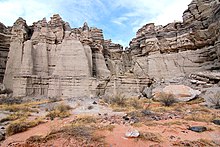
As early as 1936, O’Keeffe developed an intense interest in what is called the “Black Place”, which was about 150 miles west of her Ghost Ranch house. She made an extensive series of paintings of this site in the 1940s. O’Keeffe said that the Black Place resembled “a mile of elephants with gray hills and white sand at their feet.” At times the wind was so strong when she was painting there that she had trouble keeping her canvas on the easel. When the heat from the sun became intense, she crawled under her car for shade. The Black Place still remains remote and uninhabited.

She also made paintings of the “White Place”, a white rock formation located near her Abiquiú house. In 1945, O’Keeffe bought a second house, an abandoned hacienda in Abiquiú, some 18 miles (26 km) south of Ghost Ranch.
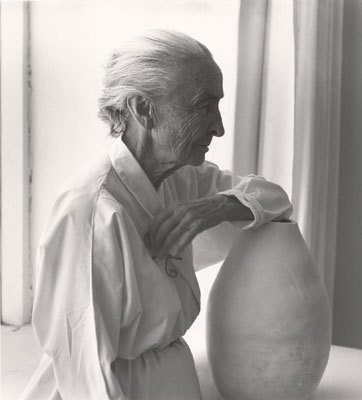
by Laura Gilpin
Shortly after O’Keeffe arrived for the summer in New Mexico in 1946, Stieglitz suffered a cerebral thrombosis. She flew to New York to be with him. He died on July 13, 1946. She buried his ashes at Lake George. She spent the next three years mostly in New York settling his estate, and moved permanently to New Mexico in 1949.
O’Keeffe met photographer Todd Webb in the 1940s. After his move to New Mexico in 1961, he often made photographs of her, as did numerous other important American photographers, who consistently presented O’Keeffe as a “loner, a severe figure and self-made person.” While O’Keeffe was known to have a “prickly personality”, Webb’s photographs portray her with a kind of “quietness and calm” suggesting a relaxed friendship, and revealing new contours of O’Keeffe’s character.
In 1972, O’Keeffe’s eyesight was compromised by macular degeneration, leading to the loss of central vision and leaving her with only peripheral vision. She stopped oil painting without assistance in 1972, but continued working in pencil and charcoal until 1984.
O’Keeffe became increasingly frail in her late 90s. She moved to Santa Fe in 1984, where she died at the age of 98. In accordance with her wishes, her body was cremated and her ashes were scattered to the wind at the top of Pedernal Mountain, over her beloved “faraway”.
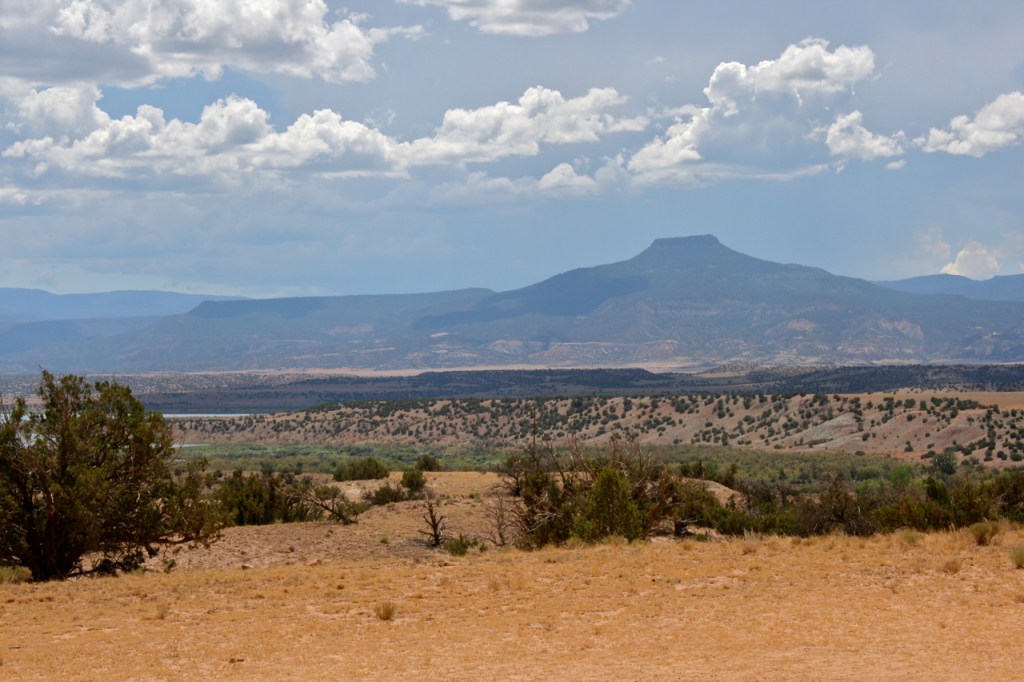
Cerro Pedernal, viewed from Ghost Ranch. This was a favorite subject for O’Keeffe, who once said, “It’s my private mountain. It belongs to me. God told me if I painted it enough, I could have it”
Gallery

blue nude

1917

Nude series VIII, 1917

woman in a blue hat
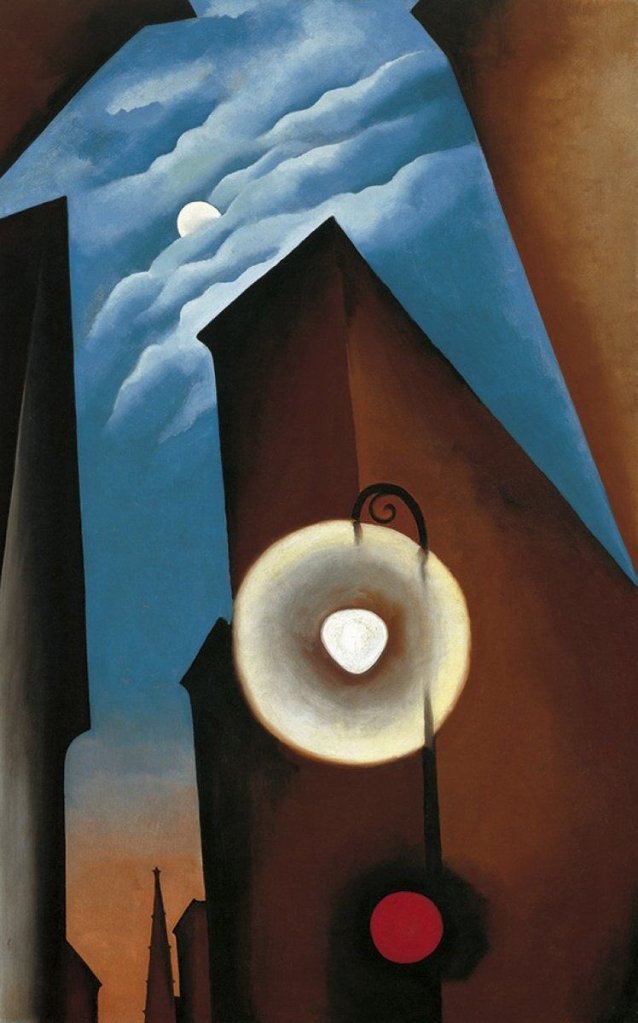
New York with Moon1929

Sunrise, 1916, watercolor on paper

Light Coming on the Plains No. II, 1917, watercolor on newsprint paper, 11+7⁄8 by 8+7⁄8 inches (30 cm × 23 cm), Amon Carter Museum of American Art
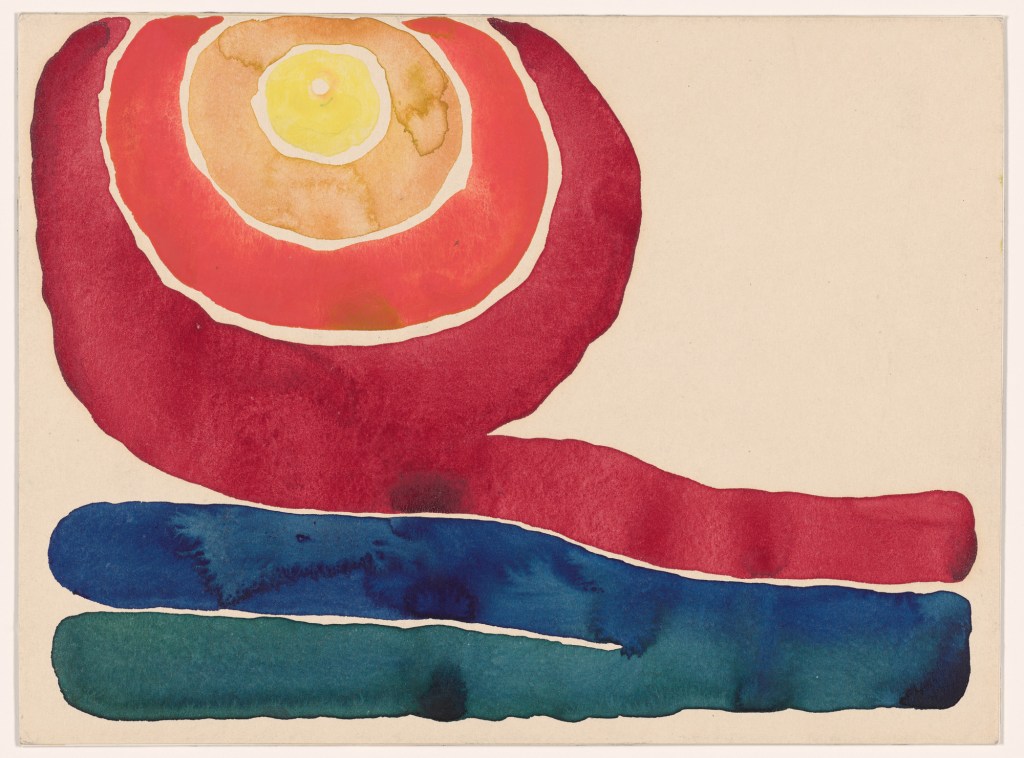
Evening Star No. III. 1917 – Watercolor on paper on board: 8 7/8 x 11 7/8 (22.7 x 30.4 cm). The Museum of Modern Art

Radiator Building–Night, New York, 1927, oil on canvas, The Phillips Collection, Washington, D.C.
 Blue and Green Music, 1921, oil on canvas
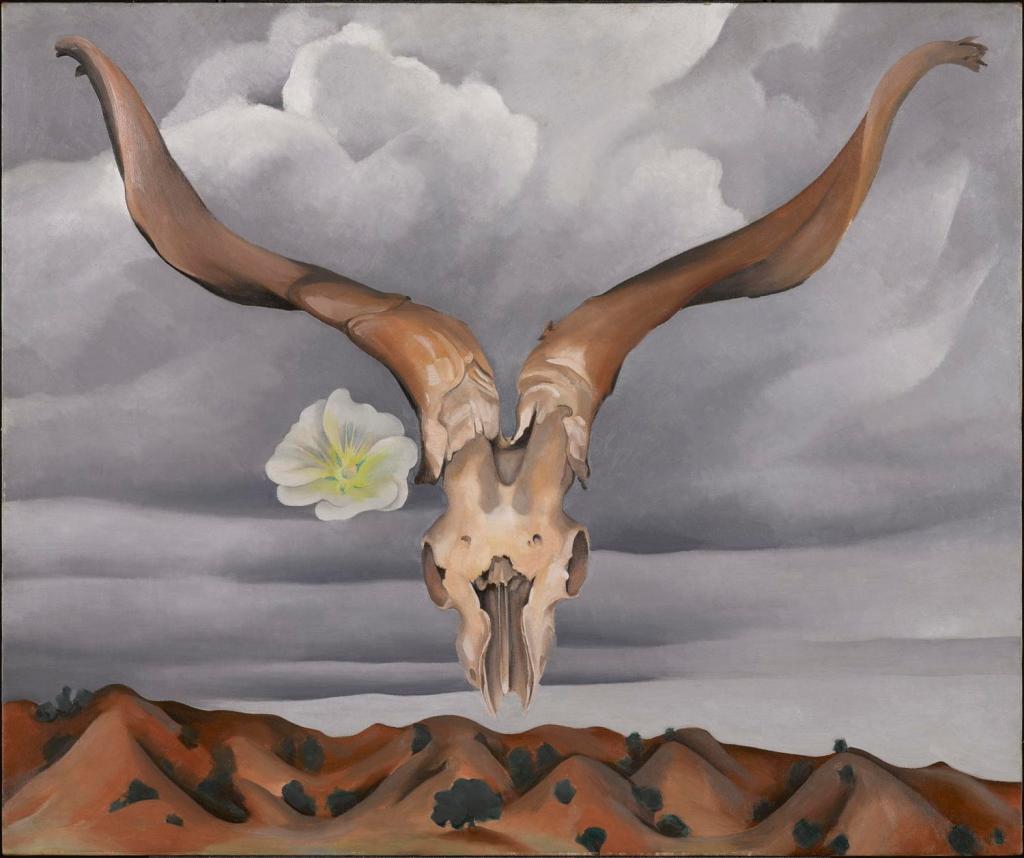
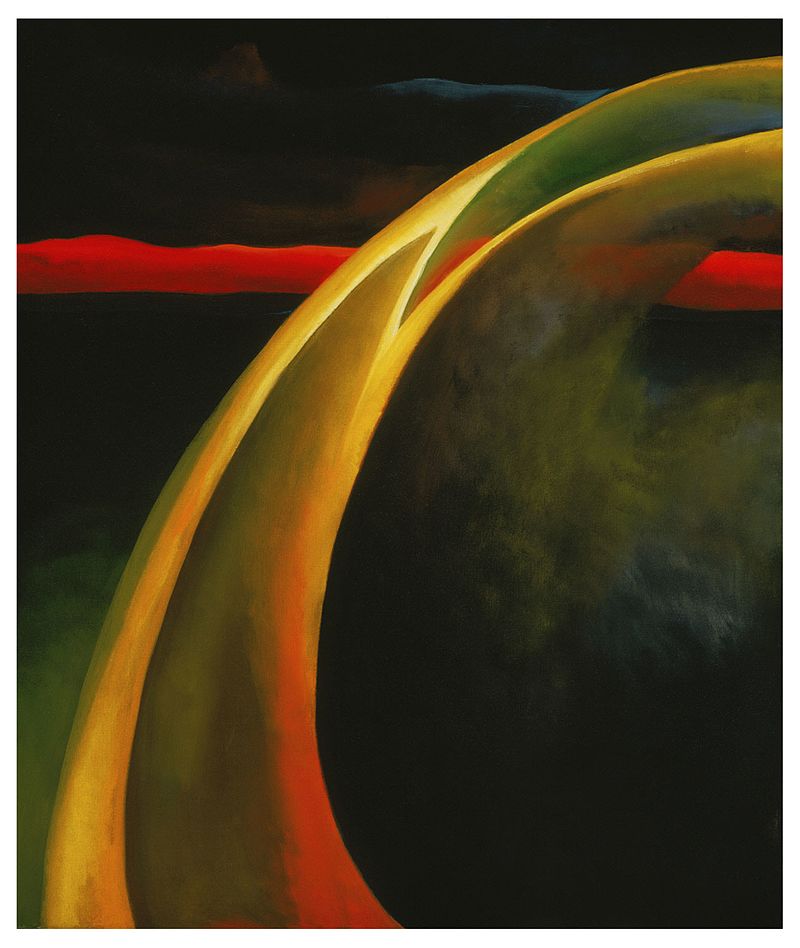
red and orange streak
And today is the birthday of Miriam Schapiro (also known as Mimi) (Toronto; November 15, 1923 – June 20, 2015 Hampton Bays, New York); painter, sculptor, printmaker, and a pioneer of feminist art. She was also considered a leader of the Pattern and Decoration art movement.
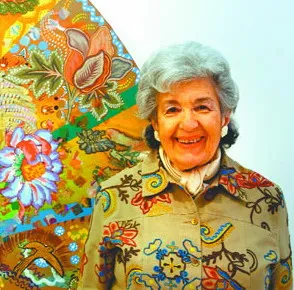
Schapiro’s artwork blurs the line between fine art and craft. She incorporated craft elements into her paintings due to their association with women and femininity. Schapiro’s work touches on the issue of feminism and art: especially in the aspect of feminism in relation to abstract art. Schapiro honed in her domesticated craft work and was able to create work that stood amongst the rest of the high art. These works represent Schapiro’s identity as an artist working in the center of contemporary abstraction and simultaneously as a feminist being challenged to represent women’s “consciousness” through imagery. She often used icons that are associated with women, such as hearts, floral decorations, geometric patterns, and the color pink. In the 1970s she made the hand fan, a typically small woman’s object, heroic by painting it six feet by twelve feet. “The fan-shaped canvas, a powerful icon, gave Schapiro the opportunity to experiment … Out of this emerged a surface of textured coloristic complexity and opulence that formed the basis of her new personal style. The kimono, fans, houses, and hearts were the form into which she repeatedly poured her feelings and desires, her anxieties, and hopes”.
Gallery


Madness of Love

Agony in the Garden (1991), Frida

Mac Tag
thanks for stoppin’ by y’all
And he called loudly to the stars to bend
From their pale thrones and comfort him, but they
Among themselves laugh on and sing alway:
– WB Yeats
 The Lovers’ Chronicle
Leave a comment