
Dear Zazie, Here is today’s Lover’s Chronicle from Mac Tag dedicated to his muse. What are you reachin’ for? Rhett
The Lover’s Chronicle
Dear Muse,
this one originated in 2012
from song lyrics i wrote
“When you started writing
you only wrote lyrics, right”
yes, i am not musical
i do not hear melodies
but when the words started
comin’ they came as lyrics
“You had to write yourself into poetry”
oh yes, definitely on the job trainin’
“You started reaching beyond rhymes”
yes, and now it is time to reach for you
© copyright 2023 mac tag/cowboy coleridge all rights reserved
aside from you, most interested in tryin’ different ways to tell the tales, new formats, more mots en français, open for any changes, i can go whichever way inspiration dictates, whoa hold on change in direction comin’; today’s writin’ done, i reach for you that we may continue our favorite part of the story
© copyright 2022.2023 mac tag/cowboy coleridge all rights reserved
whole new purpose
for that word
often the case,
the change over time
from without to with
puts a different spin
on the proceedin’s
this the same,
as the evenin’ begins
for the right words
to tell this story
this not,
as the evenin’ ends
reachin’ for you to hold
© copyright 2021.2023 mac tag/cowboy coleridge all rights reserved
Pale Love, Pale Rider
against the southern sky
and from within
feelin’ seems near,
i feel the beat
i hear the cry
and the way
i can see
oh, do you
of the poet’s songs,
murmurs of pleasures,
and pains, and words,
the sound of wonder
this is the cry
through all that has been
with us together
© copyright 2020 mac tag/cowboy coleridge all rights reserved
find the place inspired,
heardst thou not music
when she talked and didst
thou not find in her all
that could be hoped for
i passed over
so many times
and did not find
anything
that could put
this unknown
dull, insensible,
couldst not see,
goin’ no where
feelin’ to rest
© copyright 2019 mac tag/cowboy coleridge all rights reserverd
thought about…
yeah, done a lot of that
what was done
and what shoulda been
where i have gone
and where i should be
made plenty
sketchy decisions
but this one
feels right
and the way i see it
there remains
but one choice
left to make…
© copyright 2018 mac tag/cowboy coleridge all rights reserved

sunrise South Dakota y’all
some of that goin’ on here
though not for anyone
mostly for somethin’
to write with
or my computer
or a book
now in the writin’, definitely
some reachin’ goin’ on
tryin’ to say what i want
in as few words as possible
and without sayin’ it directly
so ‘for someone’ has to wait
i have much more to convey
© copyright 2017.2023 mac tag/cowboy coleridge all rights reserved
I much prefer
stars to hearts
Yes, stars can fall,
but hearts can break
and I would rather not
be reminded
of broken hearts
© copyright 2015 mac tag/cowboy coleridge all rights reserved
Tonight; missin’
The tequila,
The food. Pretty
Señoritas
So forgivin’
Of my sins and
The sand that blew
In when I did
Missin’ those nights
So, the good news
Is; I have it
Within me to
Be everything
You could ever
Want. To give you
Everything you
Could ever need
Without a doubt
Never thought I
Would feel this way
Again. To be
Able to see
Someone the way
I see you. To
Be able to
Sketch and paint with
My heart again
© copyright 2014 mac tag/cowboy coleridge all rights reserved
This is the one i told you about, that started comin’ to me while i was watchin’ the film Crazy Heart.
Reachin’ for Nothin’
Thought about comin’ to see you
I thought about callin’
But this feelin’, that is not new,
Has me, again, fallin’
Thought about doin’ what I should
Thought about doin’ right
‘Stead of just doin’ what I could,
Just followin’ the night
Chorus
Instead of doin’ what I should
Instead of reachin’ out to you
Instead of doin’ what I could
Instead of reachin’ for what is true
I am reachin’ for nothin’
I cannot stop this lonely feelin’,
That is with me night and day
That seems to always be stealin’
Me and blockin’ the way
The way to go, I know is clear
I should do what it takes
To git back to you and what is dear
I cannot and my heart breaks
Repeat chorus
© copyright 2012 mac tag/Cowboy Coleridge all rights reserved
The Song of the Day is “Reaching for the Floor” by Breathe Carolina.
| Guido Reni | |
|---|---|
 | |
Today is the birthday of Guido Reni (Bologna 4 November 1575 – 18 August 1642 Bologna); Baroque painter, although his works showed a classical manner. He painted primarily religious works, but also mythological and allegorical subjects. Active in Rome, Naples, and his native Bologna, he became the dominant figure in the Bolognese School that emerged under the influence of the Carracci family.
Reni was entombed in the Rosary Chapel of the Basilica of San Domenico in Bologna; the painter Elisabetta Sirani (whose father had been Reni’s pupil and whom some considered the artistic reincarnation of Reni) was later interred in the same tomb.
Gallery

Bacchus and Ariadne, circa 1619-1620, held in Los Angeles County Museum of Art

David and Abigail, c. 1615

Joseph and Potiphar’s Wife c.1630
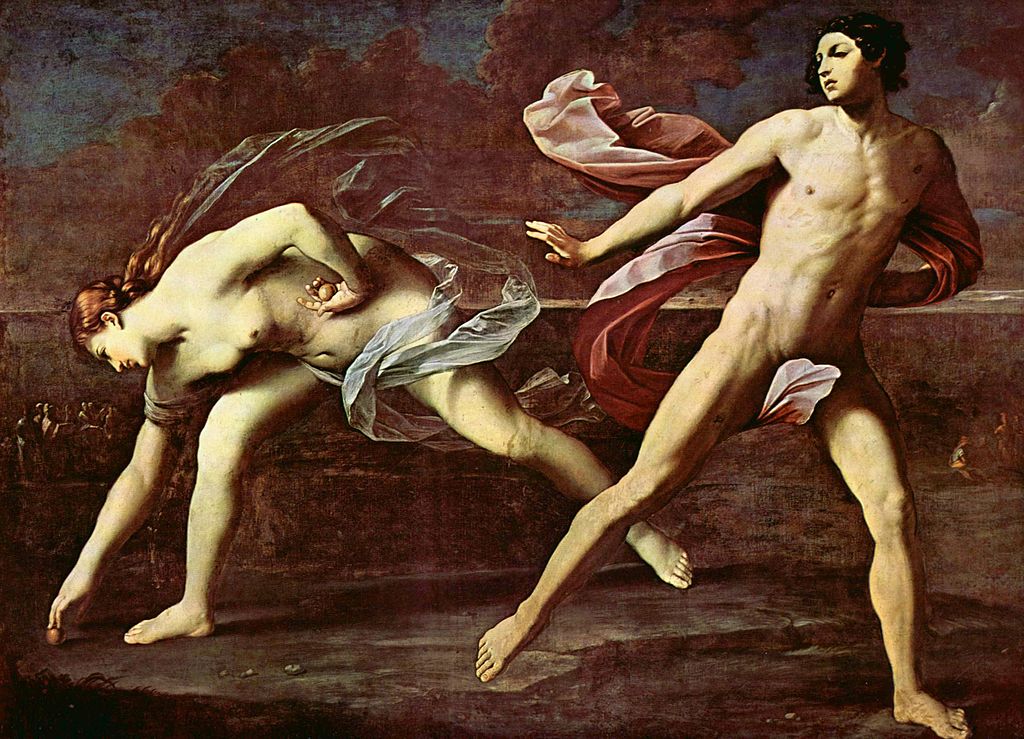
Atalanta e Ippomene, circa 1625, Museo di Capodimonte, Napoli


Europa e il Toro

The Penitent Magdalene, ca. 1635

donna con una rosa

Il suicidio di Cleopatra (circa 1625-1626), Bildergalerie (Sanssouci), Potsdam

Lucretia, 1640–1642
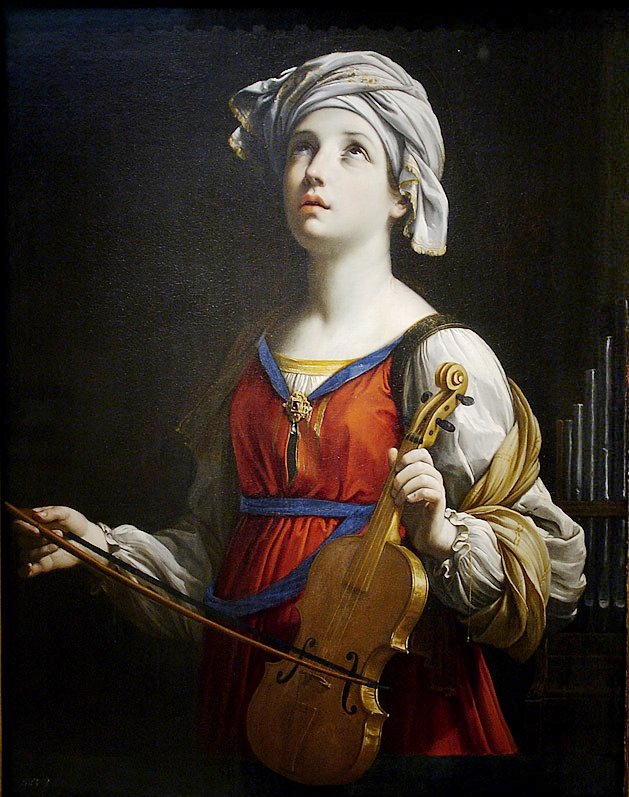
Saint Cecilia
On this day in 1737, the Teatro di San Carlo, the oldest working opera house in Europe, is inaugurated in Naples, Italy.

Exterior of San Carlo Opera House

Real Teatro di San Carlo

Interior view on to the royal box

View from the royal box

The ceiling of the opera house

Royal coat of arms above proscenium
The Real Teatro di San Carlo (Royal Theatre of Saint Charles), its original name under the Bourbon monarchy but known today as simply the Teatro di San Carlo, is an opera house in Naples, Italy. It is located adjacent to the central Piazza del Plebiscito, and connected to the Royal Palace.
It is the oldest continuously active venue for public opera in the world, opening in 1737, decades before both the Milan’s La Scala and Venice’s La Fenice theatres.
The opera season runs from late January to May, with the ballet season taking place from April to early June. The house once had a seating capacity of 3,285, but has now been reduced to 1,386 seats. Given its size, structure and antiquity, it was the model for theatres that were later built in Europe.
At the time, Neapolitan School of opera enjoyed great success all over Europe, not only in the field of opera buffa but also in that of opera seria. The Neapolitan school of opera composers included Feo, Porpora, Traetta, Piccinni, Vinci, Anfossi, Durante, Jommelli, Cimarosa, Paisiello, Zingarelli, and Gazzaniga. Naples became the capital of European music and even foreign composers considered the performance of their compositions at the San Carlo theatre as the goal of their career. These composers included Hasse (who later settled in Naples) Haydn, Johann Christian Bach and Gluck.
Similarly the most prominent singers performed and consolidated their fame at the San Carlo. These included Lucrezia Anguiari, called “La Cocchetta”, the renowned castrati Giovanni Manzuoli, Caffarelli (Gaetano Majorano), Farinelli (Carlo Broschi), Gizziello (Gioacchino Conti) and Gian Battista Velluti, the last castrato. Caffarelli, Farinelli, and Gizziello were products of the local conservatories of Naples
From 1815 to 1822, Gioachino Rossini was house composer and artistic director of the royal opera houses, including the San Carlo. During this period he wrote ten operas which were Elisabetta, regina d’Inghilterra (1815), La gazzetta, Otello, ossia il Moro di Venezia (1816), Armida (1817), Mosè in Egitto, Ricciardo e Zoraide (1818), Ermione, Bianca e Falliero, Eduardo e Cristina, La donna del lago (1819), Maometto II (1820), and Zelmira (1822).
Regular singers of the period included Manuel Garcia and his daughter Maria Malibran, Clorinda Corradi, Giuditta Pasta, Isabella Colbran, Giovanni Battista Rubini, Domenico Donzelli and the two great French rivals Adolphe Nourrit and Gilbert Duprez—the inventor of the C from the chest.
After the composition of Zelmira, Rossini left Naples with Colbran who had previously been the lover of Domenico Barbaia. The couple were married shortly thereafter.
To replace Rossini, Barbaja first signed up Giovanni Pacini and then another rising star of Italian opera, Gaetano Donizetti. As artistic director of the royal opera houses, Donizetti remained in Naples from 1822 until 1838, composing sixteen operas for the theatre, among which Maria Stuarda (1834), Roberto Devereux (1837), Poliuto (1838) and the famous Lucia di Lammermoor (1835), written for soprano Tacchinardi-Persiani and for tenor Duprez.
Vincenzo Bellini, Sicilian by birth, also staged his first work, Bianca e Fernando, at the San Carlo.

Exterior view of the theatre around 1850
Giuseppe Verdi was also associated with the theatre. In 1841, his Oberto Conte di San Bonifacio was performed there and in 1845 he wrote his first opera for the theatre, Alzira; a second, Luisa Miller, followed in 1849. His third should have been Gustavo III, but the censor made such significant changes that it was never performed in that version nor under that title (until a re-created version was given in 2004). It was later performed in Rome with significant revisions to the plot and its location, while the title became Un ballo in maschera.
Among the conductors and composers appointed by the Teatro San Carlo was the famous and eccentric French harpist and composer Nicolas-Charles Bochsa, who was accompanied by his lover, the English prima donna Anna Bishop, with whom he was touring the world. He conducted several operas (1844–1845) in the San Carlo with Anna Bishop as prima donna. She sang there 327 times in 24 operas.
| Carolina “La Belle” Otero | |
|---|---|
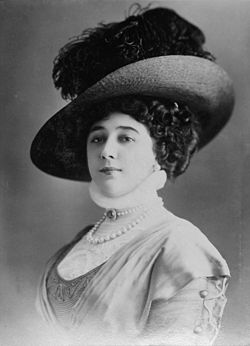 | |
And today is the birthday of Carolina “La Belle” Otero (born Agustina Otero Iglesias; Valga, Spain 4 November 1868 – 12 April 1965 Nice, France); dancer, actress and courtesan. Her family being impoverished, as a child she moved to Santiago de Compostela working as a maid. At ten she was raped, which left her sterile, and at fourteen she left home with her boyfriend and dancing partner, Paco, and began working as a singer/dancer in Lisbon. She reportedly married an Italian nobleman, Count Guglielmo, when she was 14. Her second husband, whom she married in 1906, was René Webb, an English cotton spinner. In 1888 she found a sponsor in Barcelona who moved with her to Marseilles in order to promote her dancing career in France. She soon left him and created the character of La Belle Otero, fancying herself an Romani Andalusian. She wound up as the star of Les Folies Bèrgere productions in Paris.
Otero grew to be the most sought after woman in all of Europe. She began serving as a courtesan to wealthy and powerful men of the day, and she chose her lovers carefully. She associated herself with the likes of Prince Albert I of Monaco, King Edward VII of the United Kingdom, Kings of Serbia, and Kings of Spain as well as Russian Grand Dukes Peter and Nicholas, the Duke of Westminster and writer Gabriele D’Annunzio. Her love affairs made her infamous, and the envy of many other notable female personalities of the day.
Six men reportedly died by suicide after their love affairs with Otero ended, although this has never been substantiated. It is known, however, that two men did fight a duel over her. She was pretty, confident, and intelligent. One of her most famous costumes featured her voluptuous bosom partially covered with glued-on precious gems, and the twin cupolas of the Hotel Carlton built in 1912 in Cannes are popularly said to have been modeled upon her breasts.
It was once said of her that her extraordinarily dark black eyes were so captivating that they were “of such intensity that it was impossible not to be detained before them”.
Otero retired after World War I, purchasing a mansion and property. She had accumulated a fortune over the years but she gambled much of it away over the remainder of her lifetime, enjoying a lavish lifestyle, and visiting the casinos of Monte Carlo often. She lived out her life in a more and more pronounced state of poverty until she died of a heart attack in 1965 in her one-room apartment at the Hotel Novelty in Nice, France. As a neighbor said of Otero’s last days, “She was constantly talking about her past, and I was not listening any more. It was always the same: feasts, princes, champagne.”
Of her heyday and career, Otero once said, “Women have one mission in life: to be beautiful. When one gets old, one must learn how to break mirrors. I am very gently expecting to die.”
Gallery
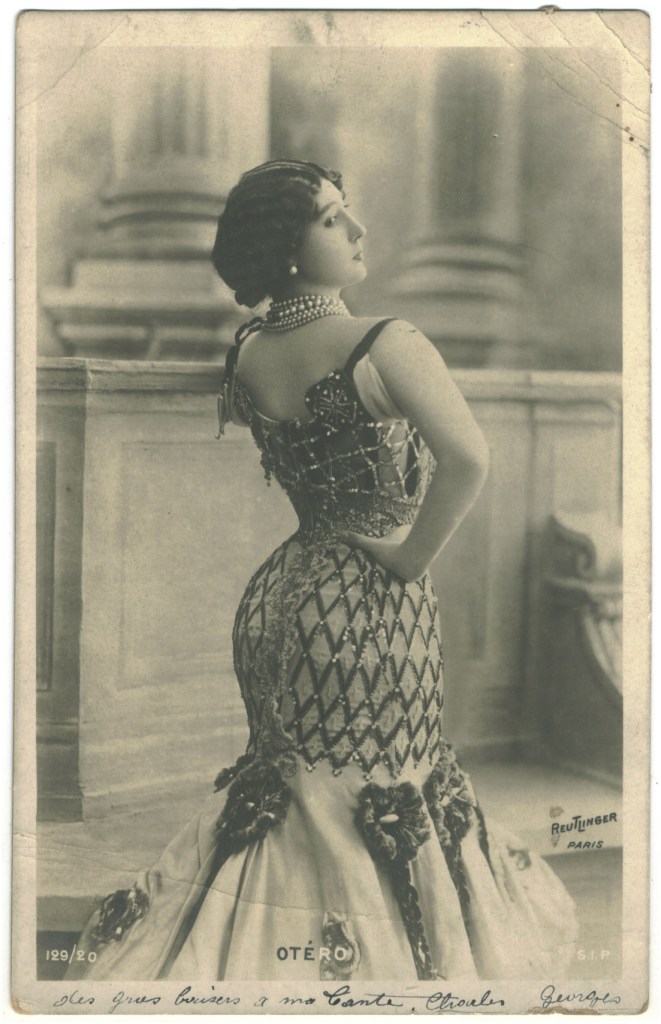
by Léopold-Émile Reutlinger
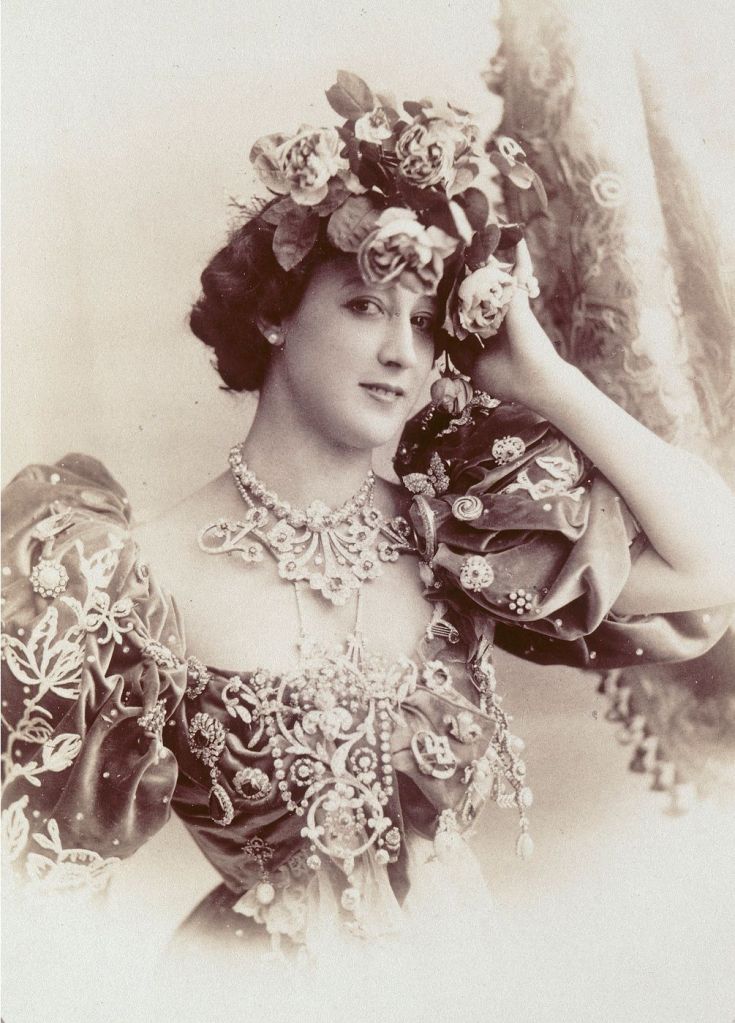
by Léopold-Émile Reutlinger
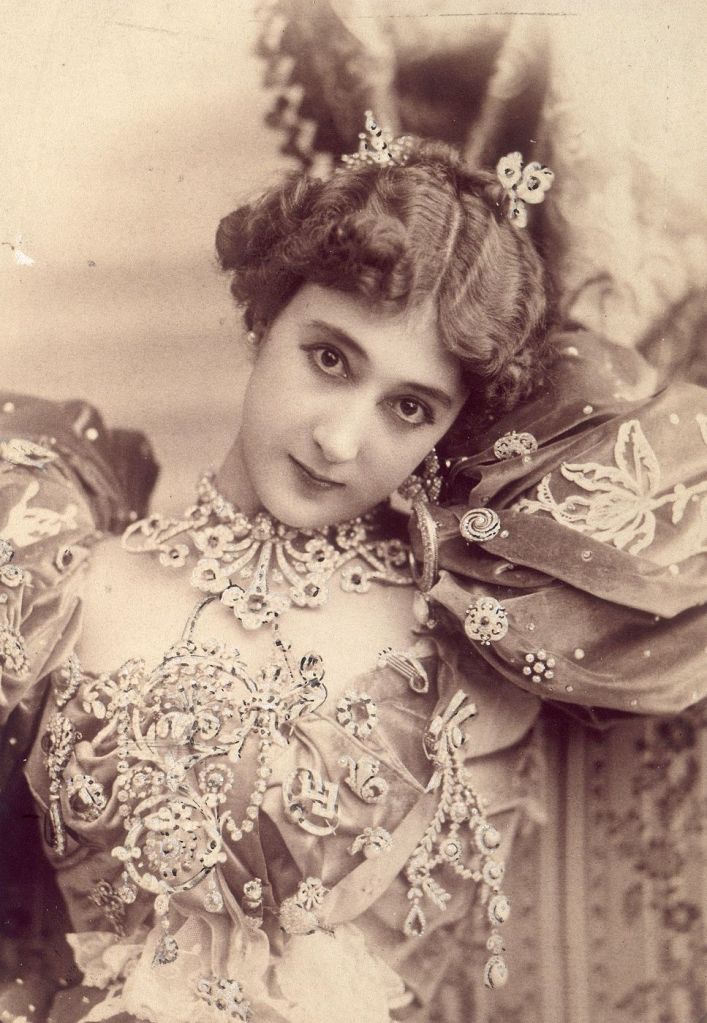
circa 1890

by Jean Reutlinger
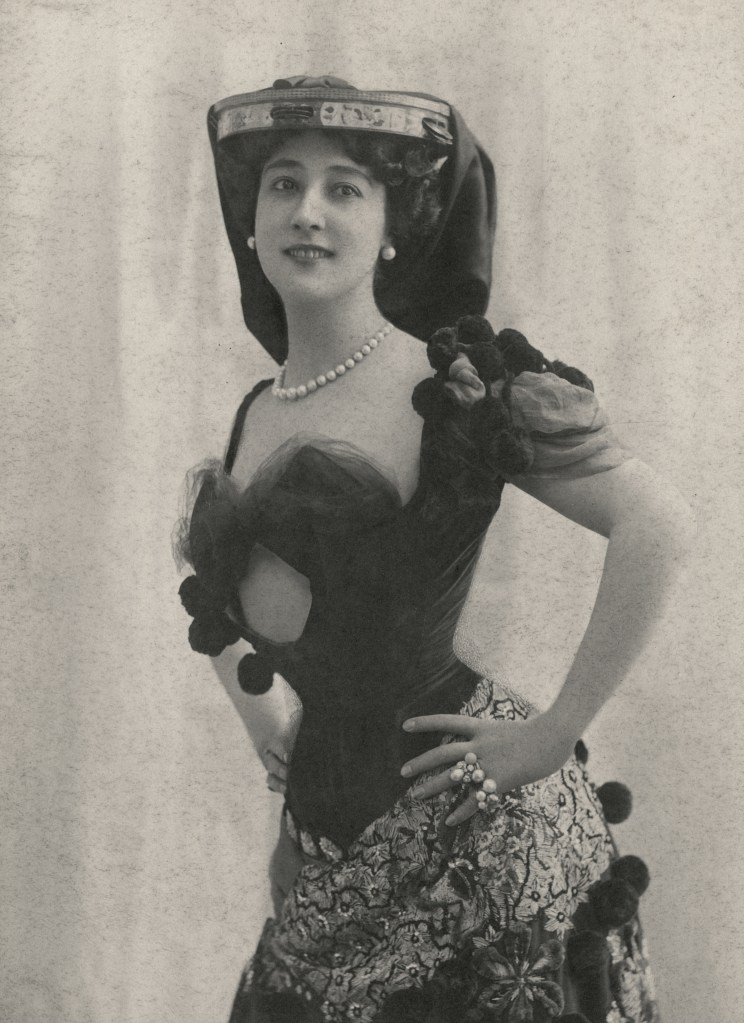
by Léopold-Émile Reutlinger
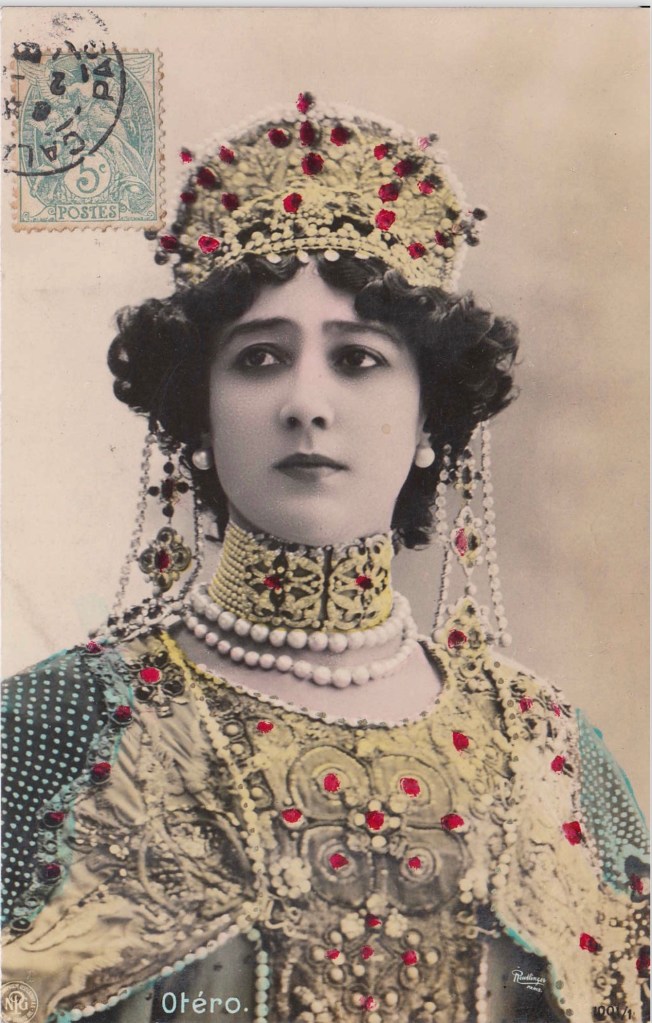
Vintage postcard
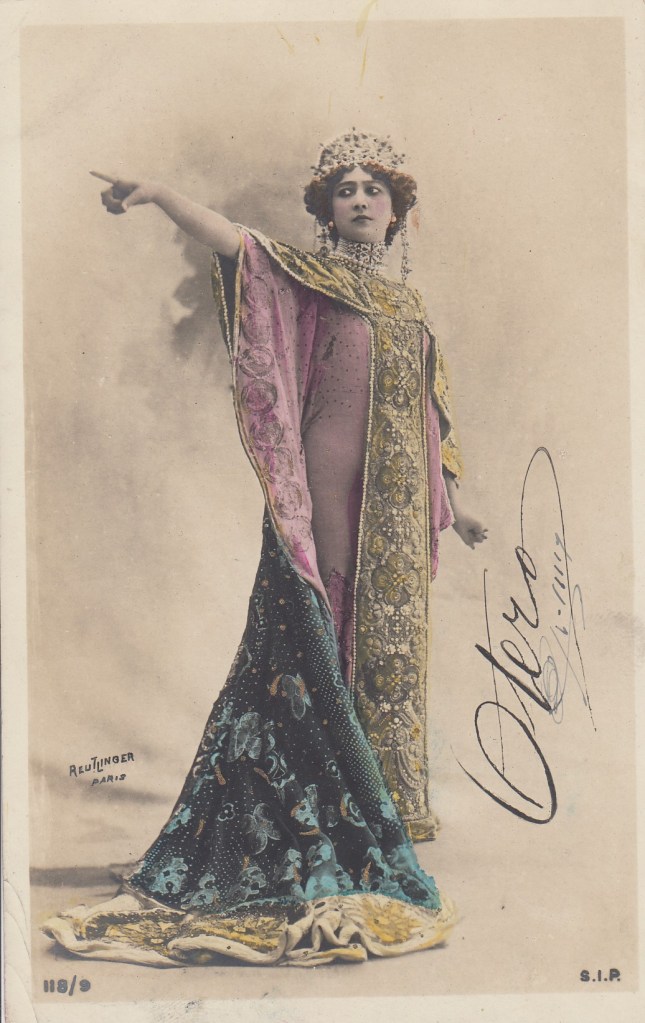
Vintage postcard by Léopold-Émile Reutlinger
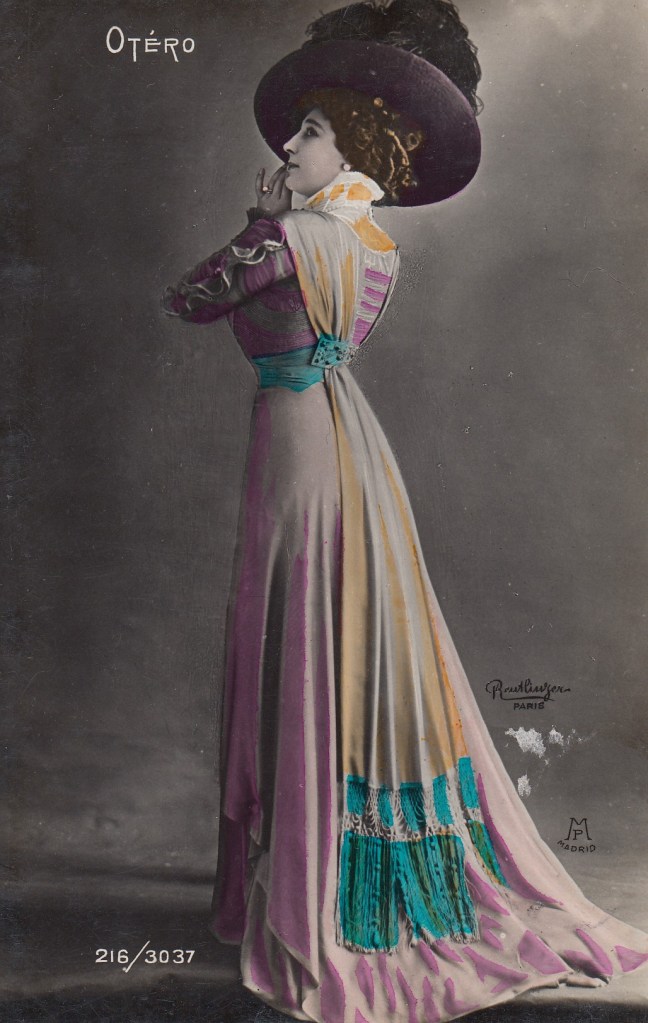
Hand tinted postcard by Léopold-Émile Reutlinger

La Belle Otero, at Folies-Bergère, 1894

Otero appears with Liane de Pougy and Cléo de Merode in a fashionable crowd in the Au Bois de Boulogne drawn by Guth, 1897
Mac Tag
Follow us on twitter @cowboycoleridge
thanks for stoppin’ by y’all
 The Lovers’ Chronicle
Leave a reply to The Lovers’ Chronicle 17 March – survive – art by Mikhail Vrubel – photographs by Léopold-Émile Reutlinger – The Lovers’ Chronicle Cancel reply