
Dear Zazie, Here is today’s Lovers’ Chronicle from Mac Tag dedicated to his muse. Follow us on twitter @cowboycoleridge. Who do you dream about? Rhett
The Lovers’ Chronicle
Dear Muse,
a theme so nice
it required a reprise
another for the Van Halen song,
from A Different Kind of Truth
’’I remember when you played it for me’’
we were in your red convertible VW,
drivin’ on the Blue Ridge Parkway
’’On a beautiful sunny day’’
the song is partly about
livin’ for the moment
’’That’s what we've been doing’’
since we met, takin’ each day
as is and makin’ it ours
© copyright 2023 mac tag/cowboy coleridge all rights reserved
been puttin’ these poems out here, every day, for over five years, as a testament, could be a warnin’; this is what there is, this is who and what, the extent of importance and knowledge, of carin’, with the love of the craft as a tenent; roll it all up and it requires a degree of acceptance as is
© copyright 2022.2023 mac tag/cowboy coleridge all rights reserved
now a different version
than where this started
but how we follow through
now that there is someone
to do this with, acceptance
easily, no more rainy days
and cupid had nothin’
to do with it
as each day is done
requires a degree
of appreciation
for how far
we have come
and holdin’ on
as is
© copyright 2021.2023 mac tag/cowboy coleridge all rights reserved
Pale Love, Pale Rider

the signs are here
try somethin’ different
as it should be
write some verse,
sing a song for you,
sketch our memories
bein’ lost was necessary
in order to be found
been waitin’ all this time
to write a story
i knew the endin’ and now
might be closin’ in on a beginnin’
shall we…
© copyright 2020 mac tag/cowboy coleridge all rights reserved
i know you are bored of this
another long day of work
have food delivered,
probably szechuan,
extra spicy,
mix a martini
as David Lee wrote and sang,
our day is done so
lets have some fun so
no one returnin’ again
will not have to bother
cupid with any sortin’
still gotta accept
as is
© copyright 2019.2023 mac tag/cowboy coleridge all rights reserved
late night
ponderin’,
of as is
sittin’ on the edge of the bed
and let float upon the silence
did you let it all slip away,
on purpose, or because
you had no idea
what the hell
you were doin’
was the not knowin’
just part of bein’ lost
and was it necessary
to be lost in order
to be found
tryin’ to write a book
that would not come
i knew the endin’
and i was tryin’
to write to it
took me
a long dang time to figure out
i had to write the beginnin’ first
shall we…
© copyright 2018 mac tag/cowboy coleridge all rights reserved
hmmm, choices
listen to MNF
or listen to Chris LeDoux
on his birthday
c’mon, whatcha gonna do
with a cowboy darlin’
Hey Siri…

drove on out
to the seven cross
relish the chilly night air
stare at the stars
that never fail
turn the words she said
over and over
the signs are there
plain as day
maybe time to try
somethin’ different,
do nothin’
as opposed
to divin’ head first
into what cannot be
a fallin’ star
streaks across the sky
over the seven cross
make a wish
one never wished before
you cannot be
what you are not
when the sorrow
outweighs the beauty,
best fergit about
saddlin’ that horse again
‘neath the big night sky
over the seven cross
as it should be…
write some verse,
sing a song for you
sketch your memory
accept as is
***
Thunder and lightnin’
Hail and rain
Pourin’ on the plains
And you and I
Without
© copyright 2017 mac tag/cowboy Coleridge all rights reserved
I was so good at fallin’
I was never afraid
I thought I could make anyone fall
Of course, I never knew
What the hell to do once I fell
“You have deserted all”
Do not desert me
“But, you have deserted all”
(Whisperin’,)
Do not desert me
Smoulderin’ like decay
Never rid of it
One dies away
The other leaves
And all that is left
Never diminishes
© copyright 2016 mac tag/cowboy Coleridge all rights reserved
If I had not
rid myself of
all desire and
feelin’s, I would
have, without a
doubt, a never
endin’ desire
to be with you
“But, I am damaged!”
Listen Darlin’; we
are each and every
one of us, damaged
© copyright 2015 mac tag/cowboy Coleridge all rights reserved
In advance of two-hour irrelevant meeting;
pretty sure I have had enough coffee
to kill a small human.
So, evidently, it is true:
All work and no poetry
makes Mac a dull cowboy.
Sorry y’all.
© copyright 2014 mac tag/cowboy Coleridge all rights reserved
A poem for you on a theme we love to explore here at TLC. This was inspired by Hamlet’s soliloquy from Shakespeare‘s play Hamlet. It is called…
To Dream
Ah, to sleep, perchance to dream
To dream where two can be as one
To dream of the one
To dream of losin’ yourself in lastin’ embrace
To dream of lingerin’…
To dream of somethin’ full
To dream of somethin’ complete and never endin’
To dream of lettin’ go and goin’ places you have never been
To dream of bein’ engulfed in a waves and lettin’ those waves carry you away
To dream of fallin’ asleep in the arms of the one and awakenin’ in those same arms.
To dream of knowin’ you will be caught
Ah yes, to sleep, perchance to dream
May the totem never wobble
© copyright 2012 mac tag/cowboy Coleridge all rights reserved
The Song of the Day is “Dreams” by Fleetwood Mac. we do not own the rights to this song. all rights reserved by copyright owner. no copyright infringement intended
Today is the birthday of Hans Thoma (Bernau in the Black Forest, Germany 2 October 1839 – 7 November 1924 Karlsruhe, Germany); painter. In spite of his studies under various masters, his art has little in common with modern ideas, and is formed partly by his early impressions of the simple idyllic life of his native district, partly by his sympathy with the early German masters, particularly with Albrecht Altdorfer and Lucas Cranach the Elder. In his love of the details of nature, in his precise drawing of outline, and in his predilection for local coloring, he has distinct affinities with the Pre-Raphaelites.

Self portrait in a Birch Grove (1899)
Gallery
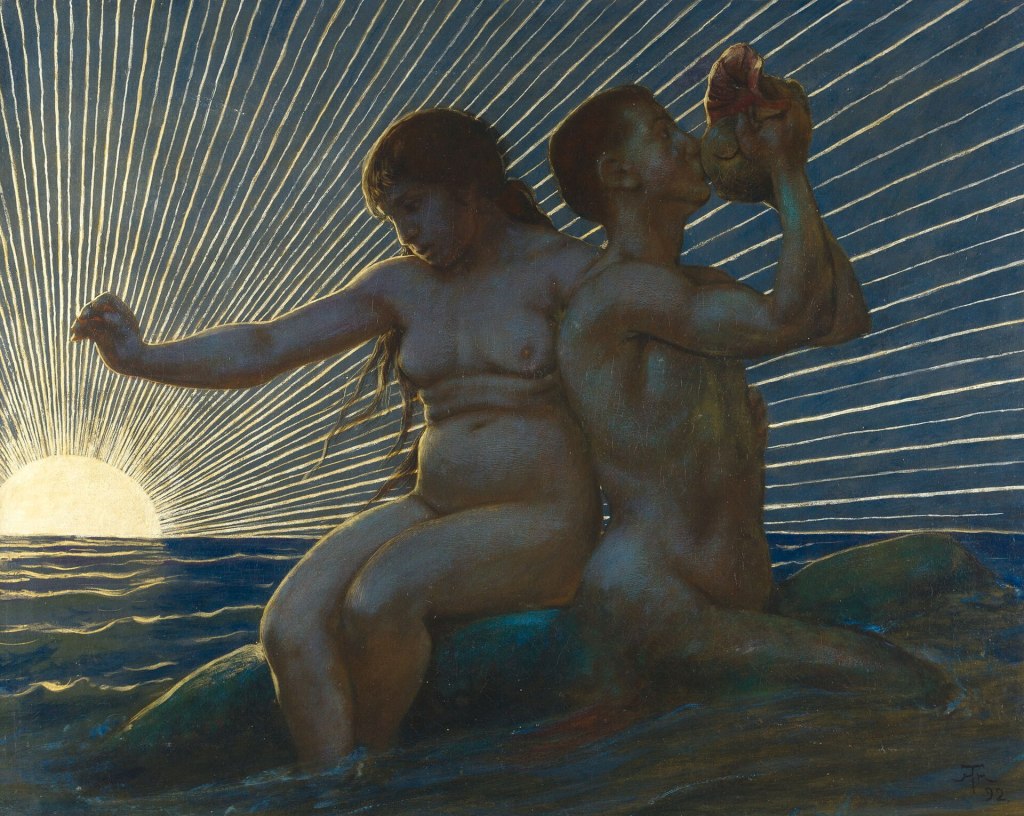
Triton und Nereide
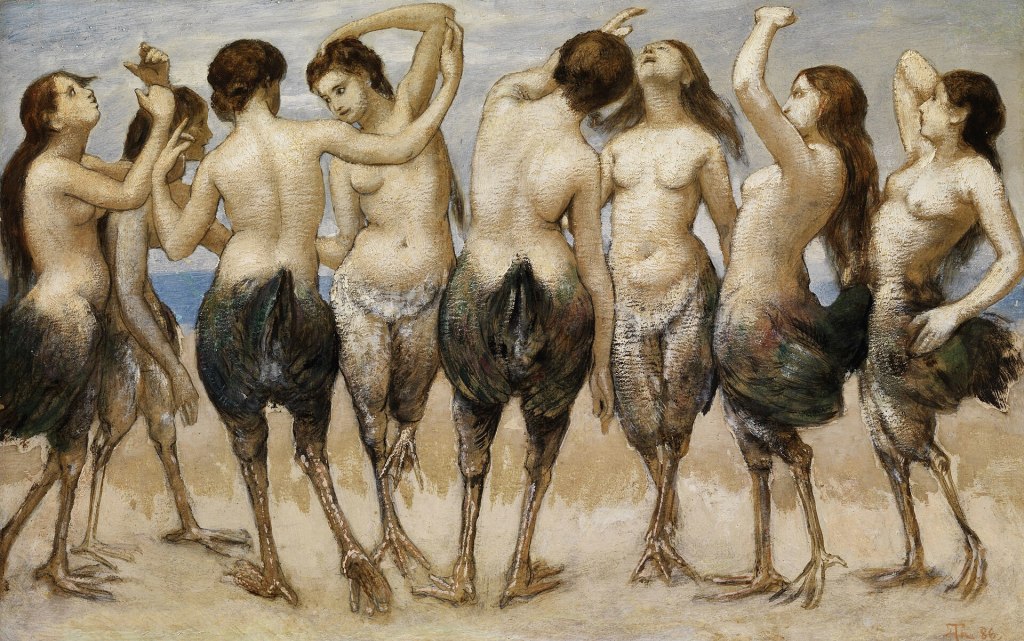
Eight Dancing Maidens in Bird Costumes

A double-sided painting, study
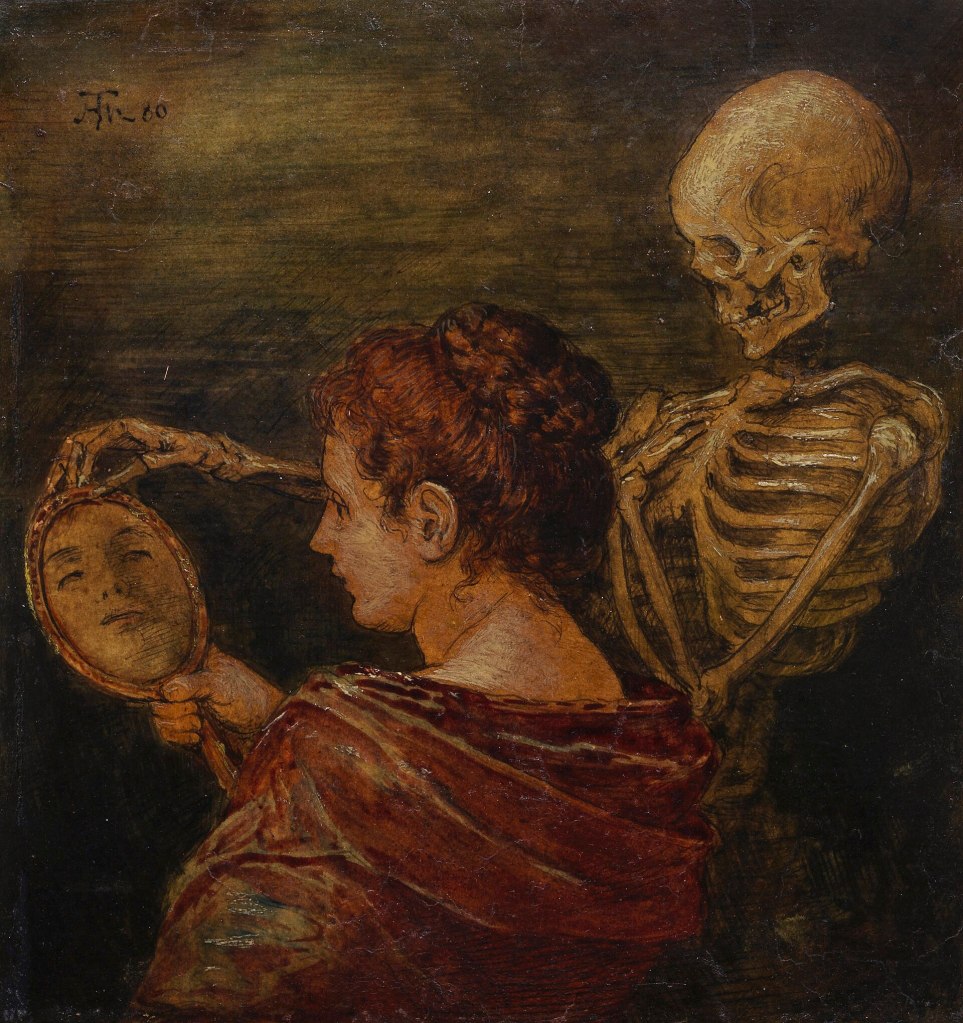
Frau Spiegel und Tod
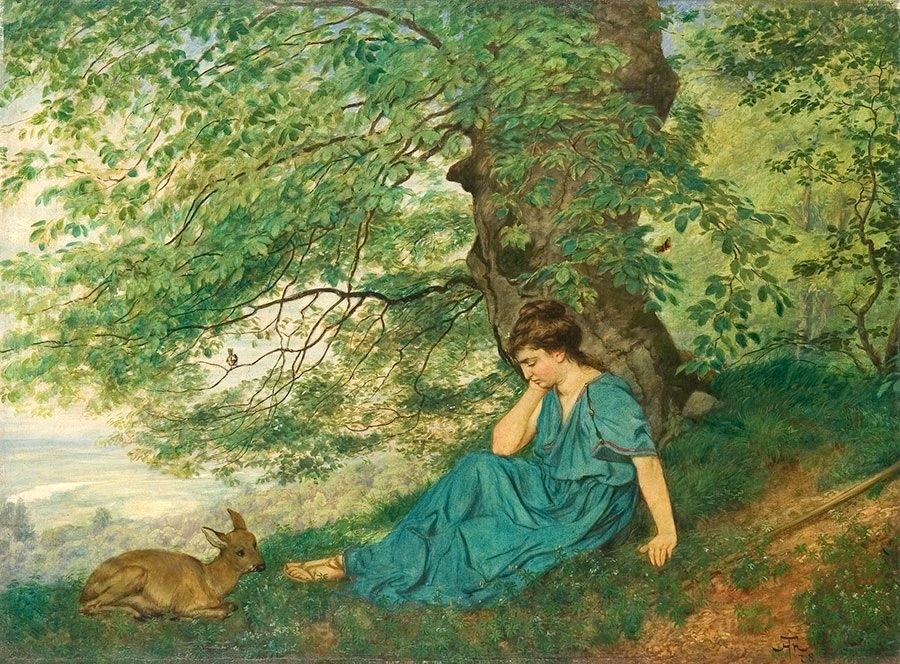
Diana under the tree

The Haag Daughters

Sunday peace

Today is the birthday of Wallace Stevens (Reading, Pennsylvania; October 2, 1879 – August 2, 1955 Hartford, Connecticut); Modernist poet. He was born in Reading, Pennsylvania, educated at Harvard and then New York Law School, and he spent most of his life working as an executive for an insurance company in Hartford, Connecticut. He won the Pulitzer Prize for Poetry for his Collected Poems in 1955.
In 1904 Stevens met Elsie Viola Kachel (1886–1963, also known as Elsie Moll), who had worked as a saleswoman, milliner, and stenographer. After a long courtship, he married her in 1909 over the objections of his parents, who considered her lower-class. As The New York Times reported in an article in 2009, “Nobody from his family attended the wedding, and Stevens never again visited or spoke to his parents during his father’s lifetime.”
Verse
Peter Quince at the Clavier (1915)
I
- Just as my fingers on these keys
- Make music, so the self-same sounds
- On my spirit make a music, too.
- Music is feeling, then, not sound;
And thus it is that what I feel,
Here in this room, desiring you,
Thinking of your blue-shadowed silk,
Is music.
II
- In the green water, clear and warm,
Susanna lay.
She searched
The touch of springs,
And found
Concealed imaginings.
She sighed,
For so much melody. - Upon the bank, she stood
In the cool
Of spent emotions.
She felt, among the leaves,
The dew
Of old devotions. - She walked upon the grass,
Still quavering.
The winds were like her maids,
On timid feet,
Fetching her woven scarves,
Yet wavering. - A breath upon her hand
Muted the night.
She turned —
A cymbal crashed,
Amid roaring horns.
IV
- Beauty is momentary in the mind —
The fitful tracing of a portal;
But in the flesh it is immortal.
The body dies; the body’s beauty lives.
So evenings die, in their green going,
A wave, interminably flowing.
So gardens die, their meek breath scenting
The cowl of winter, done repenting.
So maidens die, to the auroral
Celebration of a maiden’s choral. - Susanna’s music touched the bawdy strings
Of those white elders; but, escaping,
Left only Death’s ironic scraping.
Now, in its immortality, it plays
On the clear viol of her memory,
And makes a constant sacrament of praise.
Death is the mother of beauty
- “Sunday Morning”
Today is the birthday of Alice Prin (Alice Ernestine Prin; Châtillon-sur-Seine, Côte d’Or, France 2 October 1901 – 29 April 1953 Montparnasse), nicknamed the Queen of Montparnasse and often known as Kiki de Montparnasse; model, chanteuse, memoirist and painter during the Jazz Age. She flourished in, and helped define, the liberated culture of Paris in the so-called Années folles (“crazy years” in French). She became one of the most famous models of the 20th century and in the history of avant-garde art.

“Kiki” and Tsuguharu Foujita, Paris, 1926, by Iwata Nakayama
In Autumn 1921, Prin met the American visual artist Man Ray, and the two soon entered into a stormy eight-year relationship. She lived with Man Ray in his studio on rue Campagne-Première until 1929 during which time he made hundreds of portraits of her. She became his muse at the time and the subject of some of his best-known images, including the surrealist image Le Violon d’Ingres (Ingres’ Violin) and Noire et blanche (Black and White).
Prin died at age 51 after collapsing outside her flat apparently of complications of alcoholism or drug dependence. A large crowd of artists and admirers attended her Paris funeral and followed the procession to her interment in the Cimetière parisien de Thiais. Her tomb identifies her as: “Kiki, 1901–1953, singer, actress, painter, Queen of Montparnasse”.
Life magazine featured a three-page obituary of Prin in its 29 June 1953 edition, concluding with a memory from one of her friends who said: “We laughed, my God how we laughed.” Foujita remarked that, with Kiki’s death, the glorious days of Montparnasse were buried forever.
Long after her death, Prin remains the embodiment of the outspokenness, audacity and creativity that marked the interwar period of life in Montparnasse. She represents a strong artistic force in her own right as a woman. In 1989, biographers Billy Klüver and Julie Martin called her “one of the century’s first truly independent women”. In her honor, a daylily has been named Kiki de Montparnasse.
Gallery
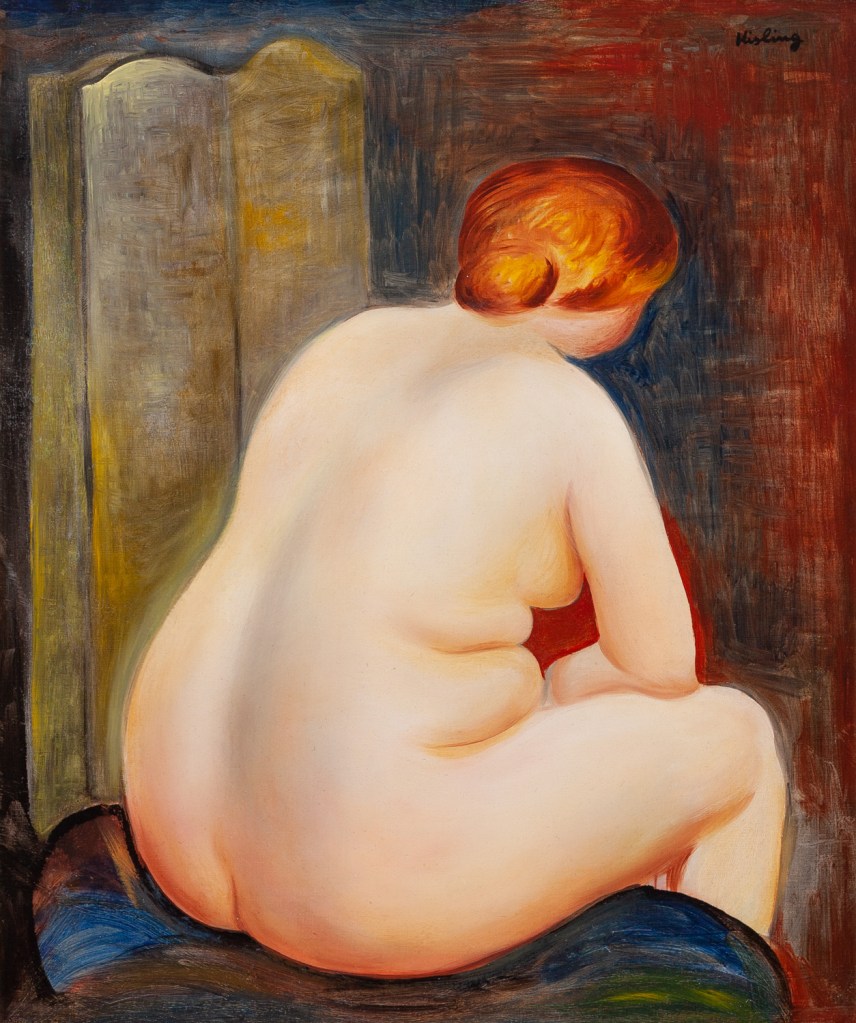

Le Violon d’Ingres, a photo by Man Ray, shows Kiki from the back, nude to below her waist, with two f-holes painted on to make her body resemble a violin.

c. 1920, painted by Gustaw Gwozdecki (1880–1935)
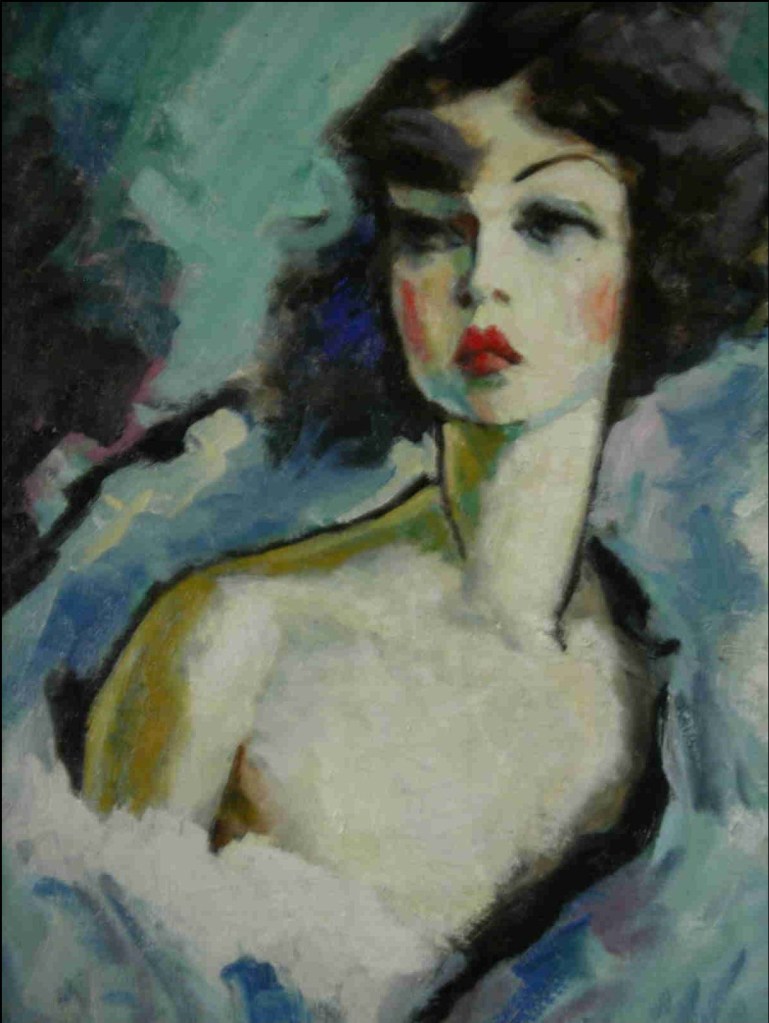
Constant Detré, Portrait of Kiki de Montparnasse, c. 1920–1925

Julien Mandel (1872 – 1935) – Marionnette à fils

c. 1920 by mandel

Postcard, c. 1920 by mandel

by Julien Mandel

French postcard labelled with series number “NP1069” or “PN1069”. Jeune femme au vase, by mandel
And today is the birthday of Graham Greene (Henry Graham Greene; St John’s House boarding house of Berkhamsted School, Hertfordshire, England 2 October 1904 – 3 April 1991 Vevey, Switzerland); writer and journalist, in my opinion, one of the leading English novelists of the 20th century. Combining literary acclaim with widespread popularity, Greene acquired a reputation early in his lifetime as a major writer, both of serious Catholic novels, and of thrillers (or “entertainments” as he termed them). He was shortlisted, in 1966 and 1967, for the Nobel Prize for Literature. Through 67 years of writing, which included over 25 novels, he explored the conflicting moral and political issues of the modern world. He was awarded the 1968 Shakespeare Prize and the 1981 Jerusalem Prize.
Greene was an agnostic, but was baptised into the Catholic faith in 1926 after meeting his future wife Vivien Dayrell-Browning. They were married on 15 October 1927 at St Mary’s Church, Hampstead, north London.
In his discussions with Father Trollope, the priest to whom he went for instruction in Catholicism, Greene argued with the cleric “on the ground of dogmatic atheism”, as Greene’s primary difficulty with religion was what he termed the “if” surrounding God’s existence. He found, however, that “after a few weeks of serious argument the ‘if’ was becoming less and less improbable”, and Greene was converted and baptised after vigorous arguments initially with the priest in which he defended atheism, or at least the “if” of agnosticism. Late in life, Greene called himself a “Catholic agnostic”.
Beginning in 1946, Greene had an affair with Catherine Walston, the wife of Harry Walston, a wealthy farmer and future life peer. That relationship is generally thought to have informed the writing of The End of the Affair, published in 1951, when the relationship came to an end. Greene left his family in 1947, but Vivien refused to grant him a divorce, in accordance with Catholic teaching, and they remained married until Greene’s death in 1991.
Greene lived with manic depression (bipolar disorder). He had a history of depression, which had a profound effect on his writing and personal life. In a letter to his wife, Vivien, he told her that he had “a character profoundly antagonistic to ordinary domestic life,” and that “unfortunately, the disease is also one’s material”.
The End of the Affair (1951)
- If we had not been taught how to interpret the story of the Passion, would we have been able to say from their actions alone whether it was jealous Judas or the cowardly Peter who loved Christ?
- I sat on my bed and I said to God: You’ve taken her, but you haven’t got me yet. I know Your cunning. It’s You who take us up to a high place and offer us the whole universe. You’re a devil, God, tempting us to leap. But I don’t want Your peace and I don’t want Your love. I wanted something very simple and very easy: I wanted Sarah for a lifetime and You took her away. With Your great schemes You ruin our happiness like a harvester ruins a mouse’s nest: I hate You, God, I hate You as though You existed.
- A story has no beginning or end: arbitrarily one chooses that moment from which to look back or from which to look ahead.
- Bk. 1, ch. 1
- To me comfort is like the wrong memory at the wrong place or time: if one is lonely one prefers discomfort.
- Bk. 1, ch. 1
- Sometimes I see myself reflected too closely in other men for comfort, and then I have an enormous wish to believe in the saints, in heroic virtue.
- Bk. 1, ch. 1
- I was trying to write a book that simply would not come. I did my daily five hundred words, but the characters never began to live. So much in writing depends on the superficiality of one’s days. One may be preoccupied with shopping and income tax returns and change conversations, but the stream of the unconscious continues to flow undisturbed, solving problems, planning ahead: one sits down sterile and dispirited at the desk, and suddenly the words come as though from the air: the situations that seemed blocked in a hopeless impasse move forward: the work has been done while one slept or shopped or talked with friends. But this hate and suspicion, this passion to destroy went deeper than the book – the unconscious worked on it instead…
- Bk. 1, ch. 2
- And all that time I couldn’t work. So much of a novelist’s writing, as I have said, takes place in the unconscious: in those depths the last word is written before the first word appears on the paper. We remember details of our story, we do not invent them. War didn’t trouble those deep sea-caves, but not there was something of infinitely greater importance to me than war, than my novel – the end of love. That was being worked out not, like a story: the pointed word that sent her crying, that seemed to have come so spontaneously to the lips, had been sharpened in those underwater caverns. My novel lagged, but my love hurried like inspiration to the end.
- Bk. 1, ch. 6
- The sense of unhappiness is so much easier to convey than that of happiness. In misery we seem aware of our own existence, even though it may be in the form of a monstrous egotism: this pain of mine is individual, this nerve that winces belong to me and to no other. But happiness annihilates us: we lose our identity.
- Bk. 2, ch. 1
- As long as one suffers one lives.
- Bk. 5, ch. 1
Mac Tag
thanks for stoppin’ by y’all

 The Lovers’ Chronicle
Leave a comment