Dear Zazie, Here is today’s Lovers’ Chronicle from Mac Tag dedicated to his muse. Follow us on twitter @cowboycoleridge. Rhett
The Lover’s Chronicle
Dear Muse,
dream moments…
oh a lovely song, he thinks,
the jukebox in my head plays good stuff,
wait, what, i do not recognize this one
ah must be a dreamthis must be a dream
i do not

© copyright 2024 mac tag/cowboy coleridge all rights reserved
this will be on the list
“Our first trip to Hilton Head”
it will be woven in
with the others
in our story
“Good seafood, good views”
a road trip to Savannah
“A walk on the beach”
it was un bon week-end
but i must add,
the bar is kinda low
all of our moments
are très bon
© copyright 2023 mac tag/cowboy coleridge all rights reserved
an attempt to capture each one as they occur so none fall between the cracks, who knows when we will pass this way again; started as soon as i could see and have not stopped, a challenge to convey the magnitude of this evolution, it has been a long way baby and these moments with you are definin’ the way
© copyright 2022.2023 mac tag/cowboy coleridge all rights reserved
the purpose here
not to rhapsodize,
harmonize maybe,
Capote believed
the words made music,
just here to say
there have been many
over the past almost year
each an affirmation
and the ones to come
will keep on burnishin’
what has been started,
these moments
in our story
© copyright 2021.2023 mac tag/cowboy coleridge all rights reserved
Pale Love, Pale Rider

to find
where i belong
or more importantly,
where i do not
moments
in your eyes
i could go
on and on
but you know
how i feel
about that
suffice with this
in your eyes,
if you beckon
i will come
unafraid,
without hesitation
and we will have
what was long
thought denied
© copyright 2020 mac tag/cowboy coleridge all rights reserved
beckons, shinin’,
if that could be so,
and i know i must be
unafraid, not hesitatin’,
pausin’ only as though
somethin’ forgotten,
lookin’ back at all
that was left behind
as you know my dear,
so few things are fulfilled
let us not let this be
an incomplete episode
© Copyright 2019 Mac tag/cowboy Coleridge all rights reserved
followed the heart
without regard
to geography
or boundaries
and why not
how else to find
where you belong
or perhaps
more importantly,
where you do not
i know
few things were fulfilled
and most of the episodes
were never completed
but oh my,
there were some moments
that shine through the darkness
……
in your eyes…
i could go
on and on
but you know
how i feel
about that
suffice with this
in your eyes
the only hope
i have known
……
if you beckon
i will come
unafraid,
without hesitation
and we will have
what was long
thought denied
© copyright 2018 mac tag/cowboy coleridge all rights reserved
the contradictions are staggerin’
c’est la vie
i thought that was guerre
whatever, same difference
and who invited you
wait what, are you talkin’
why do i bother
because i am the only friend you have
rub it in
sure if you insist
just remind me where we were
those moments
when the words follow as we want
that is why i am here

Road trip Destination
Arrived
place of birth
© copyright 2017.2023 mac tag/cowboy coleridge all rights reserved
“I guess they had it coming”
We all have it comin’
She beckoned,
and he knew he must go:
unafraid, unhesitatin’,
pausin’ only at the mesa’s edge,
to look back at the life left behind
Appreciation for solitude
came at an early age
Came fast and complete
Assimilated
from the wide open spaces
© copyright 2016 mac tag/cowboy coleridge all rights reserved
No, but thank you
I have never,
ever needed
anyone. So
I will be fine
© copyright 2015 mac tag/cowboy coleridge all rights reserved
On this day in 1791 – The first performance of The Magic Flute, the last opera by Mozart to make its debut, took place at Freihaus-Theater auf der Wieden in Vienna, Austria.
The Magic Flute (German: Die Zauberflöte), K. 620, is an opera in two acts set to a German libretto by Emanuel Schikaneder. The work is in the form of a Singspiel, a popular form that included both singing and spoken dialogue. The work premiered just two months before Mozart’s premature death.
In the opera the Queen of the Night persuades Prince Tamino to rescue her daughter Pamina from captivity under the high priest Sarastro; instead, he learns the high ideals of Sarastro’s community and seeks to join it. Separately, then together, Tamino and Pamina undergo severe trials of initiation, which end in triumph, with the Queen and her cohorts vanquished. The earthy Papageno, who accompanies Tamino on his quest, fails the trials completely but is rewarded anyway with the hand of his ideal female companion Papagena.
 The arrival of the Queen of the Night. Stage set by Karl Friedrich Schinkel for an 1815 production The arrival of the Queen of the Night. Stage set by Karl Friedrich Schinkel for an 1815 production | |
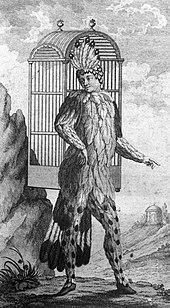
Emanuel Schikaneder, librettist of Die Zauberflöte, shown performing in the role of Papageno. The object on his back is a birdcage; see below.

Playbill for the premiere, 30 September 1791.

Baritone Markus Werba appearing as Papageno. He wears his pipes and carries his magic bells; both instruments are essential to the plot.

The arrival of Sarastro on a chariot pulled by lions, from a 1793 production in Brno. Pamina appears at left, Papageno at right. In the background are the temples of Wisdom, Reason, and Nature.
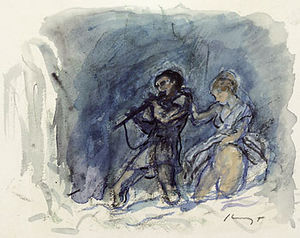
Tamino and Pamina undergo their final trial; watercolor by Max Slevogt (1868–1932)

Today is the premier date of Les pêcheurs de perles (The Pearl Fishers), an opera in three acts by composer Georges Bizet, to a French libretto by Eugène Cormon and Michel Carré. It was premiered on 30 September 1863 at the Théâtre Lyrique in Paris, and was given 18 performances in its initial run. Set in ancient times on the island of Ceylon (Sri Lanka), the opera tells the story of how two men’s vow of eternal friendship is threatened by their love for the same woman, whose own dilemma is the conflict between secular love and her sacred oath as a priestess. The friendship duet “Au fond du temple saint”, generally known as “The Pearl Fishers Duet”, is one of the best-known in Western opera.
At the time of the premiere, Bizet (born on 25 October 1838) was not yet 25 years old, and he had yet to establish himself in the Parisian musical world. The commission to write Les pêcheurs arose from his standing as a former winner of the prestigious Prix de Rome. Despite a good reception by the public, press reactions to the work were generally hostile and dismissive, although other composers, notably Hector Berlioz, found considerable merit in the music. The opera was not revived in Bizet’s lifetime, but from 1886 onwards it was performed with some regularity in Europe and North America, and from the mid-20th century has entered the repertory of opera houses worldwide.
Today is the birthday of Lucien Lévy-Dhurmer (Lucien Lévy; Algiers 30 September 1865 – 24 September 1953 Le Vésinet, France); artist and a leading exponent of fin-de-siècle Symbolism and Art Nouveau. His works include paintings, drawings, ceramics, furniture and interior design.
In 1896 he exhibited his first pastels and paintings under the name Lucien Lévy-Dhurmer; he had added the last two syllables of his mother’s maiden name (Goldhurmer), likely to differentiate himself from other people named Lévy. His paintings soon became popular with the public and among fellow artists as well. He earned high praise for the academic attention to detail with which he captured figures lost in a Pre-Raphaelite haze of melancholy, contrasted with bright Impressionist colouration. After 1901 Lévy-Dhurmer moved away from expressly Symbolist content, incorporating more landscapes into his work because of his travels in Europe and North Africa. He continued to draw inspiration from music and attempted to capture works of great composers such as Beethoven in painted form.
In 1914 Lévy-Dhurmer married Emmy Fournier, who had been an editor of the early feminist newspaper La Fronde. By this time he was working primarily on landscapes, both oil and pastel, in a style similar to Whistler and Monet.
gallery
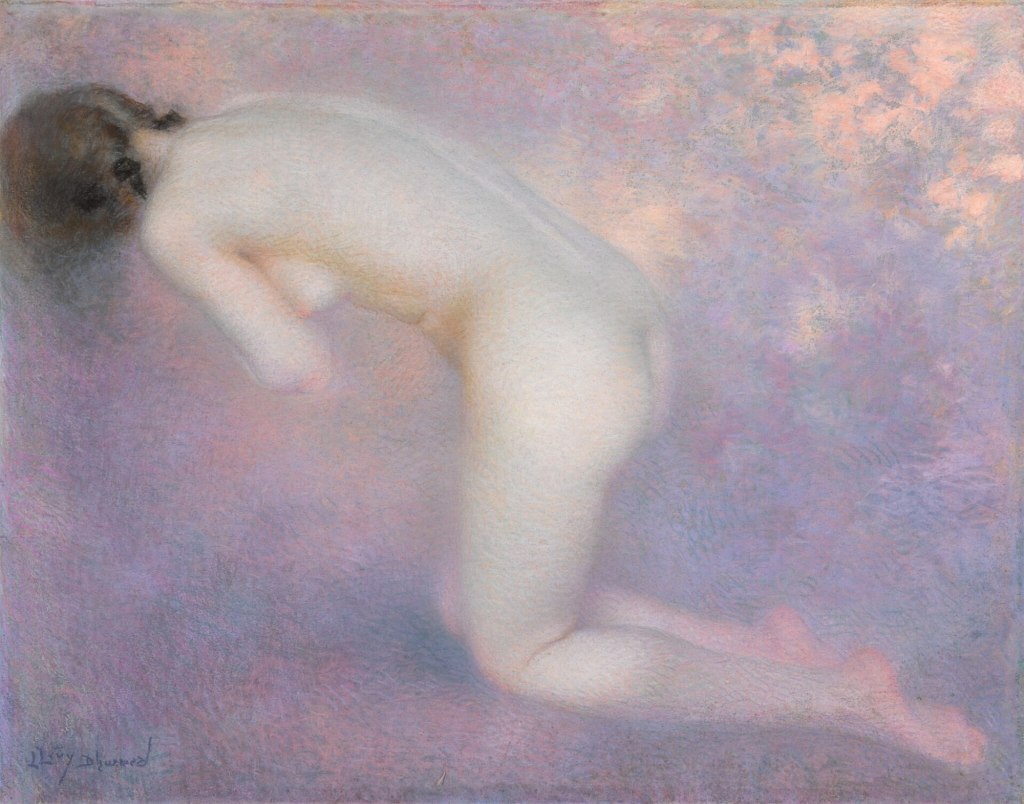
Ariette
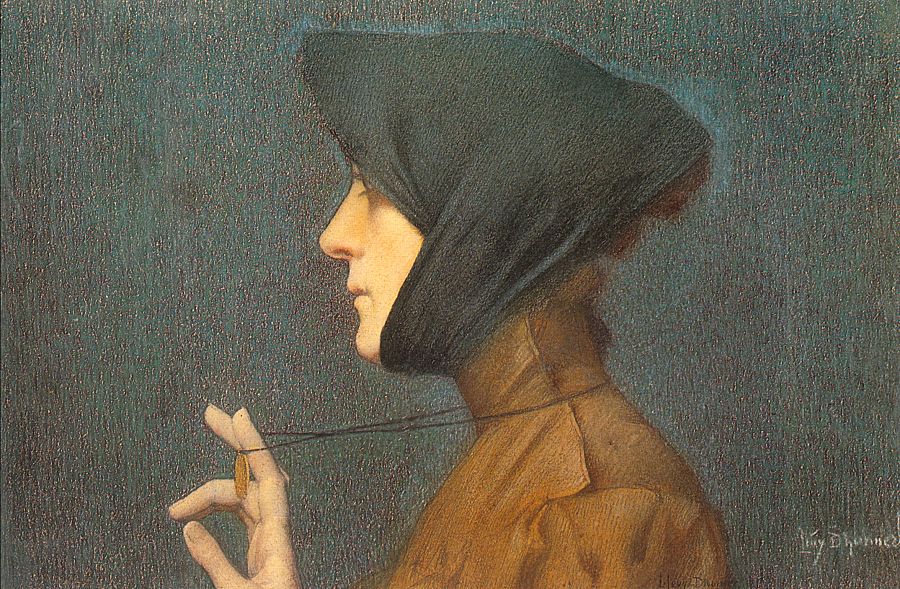
Mystère ou la Femme à la médaille, 1896 – Paris, Musée d’Orsay
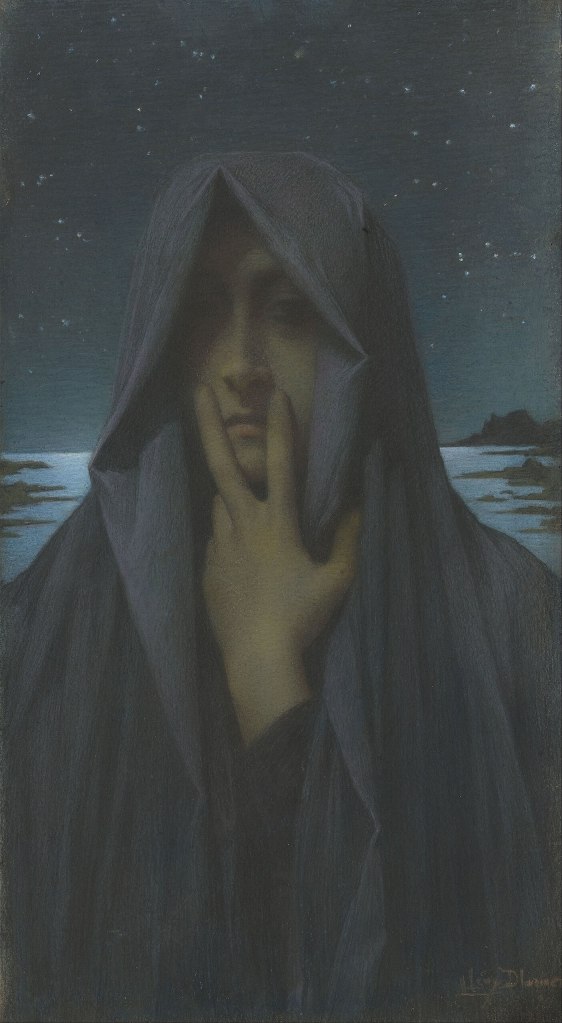
Le Silence, 1895

Les Kitharèdes, 1904
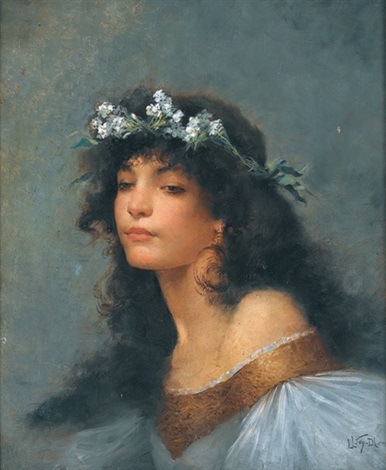
Young Woman with Wreath of Flowers in Hair, 1896
Today is the birthday of Georges Léonnec (Brest, France 30 september 1881 – 15 Oct 1940 (59 years), Finistère, France); artist, brother of the novelist Félix Léonnec, he began his career as a cartoonist selling drawings to newspapers in 1899. After participating in World War I he worked as an illustrator for the magazine La Vie Parisienne. He worked for several other publications including Fantasio and Le Sourire. He was also well known for his advertising illustrations for Byrrh apéritif wine, Dufayel department stores, and the Casino of Paris.
gallery
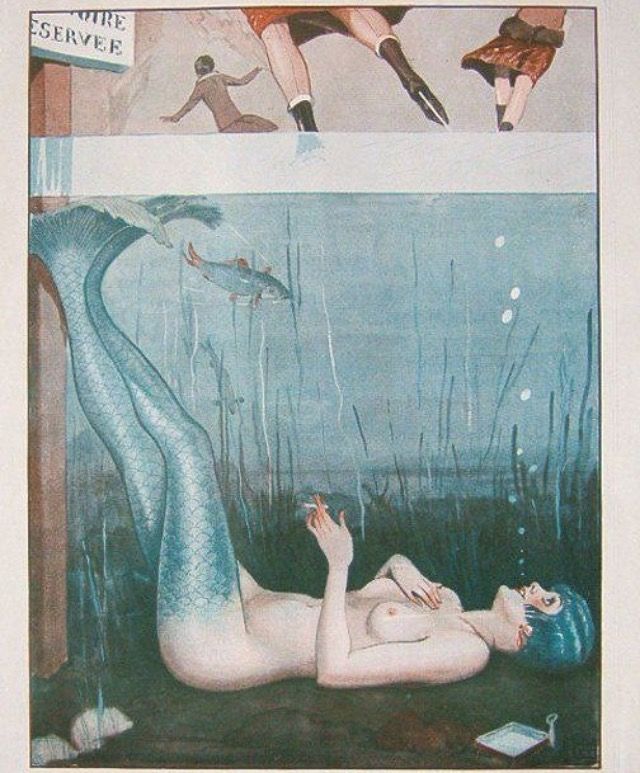
c 1926
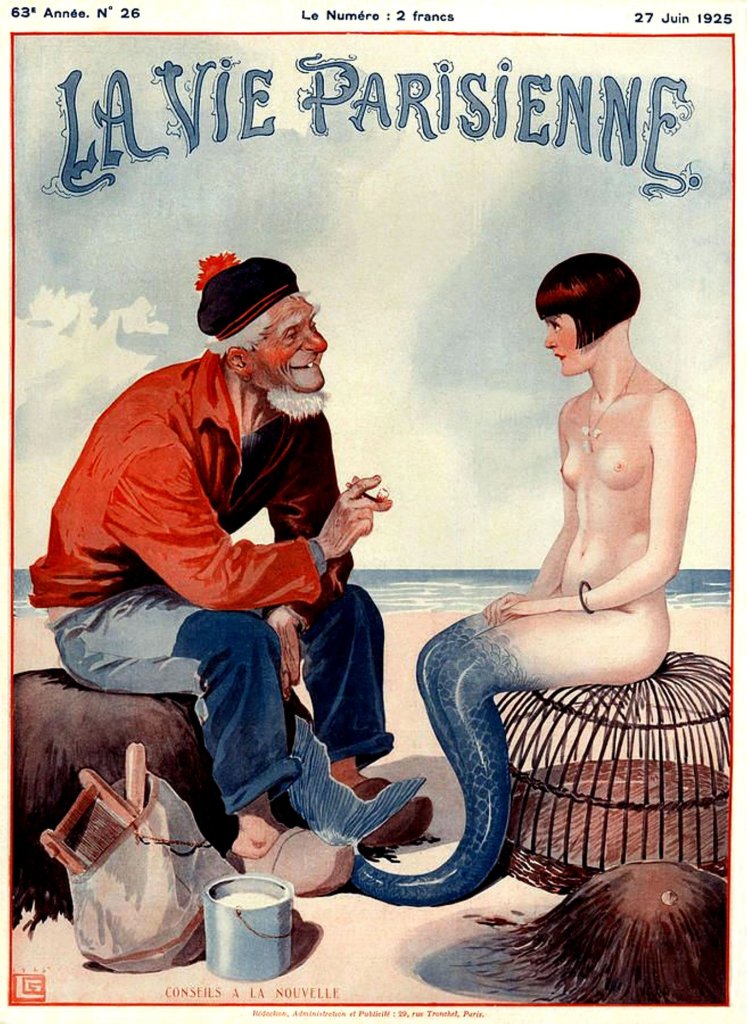

La Vie Parisienne
| Truman Capote | |
|---|---|
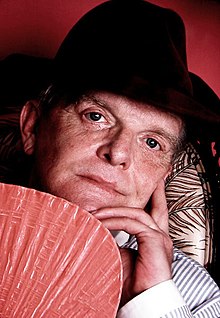 1980 1980 | |
Today is the birthday of Truman Capote (born Truman Streckfus Persons, New Orleans, September 30, 1924 – August 25, 1984 Bel Air, Los Angeles); novelist, short story writer, screenwriter, playwright, and actor. Several of his short stories, novels, and plays are literary classics in my opinion, including the novella Breakfast at Tiffany’s (1958) and the true crime novel In Cold Blood (1966), which he labeled a “nonfiction novel”.
Capote rose above a childhood troubled by divorce, a long absence from his mother, and multiple migrations. He had discovered his calling as a writer as a child and for the rest of his childhood he honed his writing ability. Capote began his professional career writing short stories. The critical success of one story, “Miriam” (1945), attracted the attention of Random House publisher Bennett Cerf, and resulted in a contract to write the novel Other Voices, Other Rooms (1948). Capote earned the most fame with In Cold Blood, a journalistic work about the murder of the Clutter family in their home. Capote spent four years writing the book aided by his lifelong friend Harper Lee, who wrote To Kill a Mockingbird (1960).

photographed by Carl Van Vechten, 1948
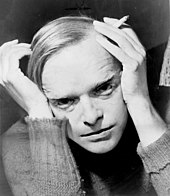
in 1959
One of his first serious lovers was Smith College literature professor Newton Arvin, who won the National Book Award for his Herman Melville biography in 1951 and to whom Capote dedicated Other Voices, Other Rooms. However, Capote spent the majority of his life until his death partnered to Jack Dunphy, a fellow writer. In his book, “Dear Genius …” A Memoir of My Life with Truman Capote, Dunphy attempts both to explain the Capote he knew and loved within their relationship and the very success-driven and, eventually, drug- and alcohol-addicted person who existed outside of their relationship. Although Capote’s and Dunphy’s relationship lasted the majority of Capote’s life, it seems that they both lived, at times, different lives. Their sometimes separate living quarters allowed autonomy within the relationship and, as Dunphy admitted, “spared [him] the anguish of watching Capote drink and take drugs.”
Capote was well known for his distinctive, high-pitched voice and odd vocal mannerisms, his offbeat manner of dress, and his fabrications. He often claimed to know intimately people whom he had in fact never met, such as Greta Garbo. He professed to have had numerous liaisons with men thought to be heterosexual, including, he claimed, Errol Flynn. He traveled in an eclectic array of social circles, hobnobbing with authors, critics, business tycoons, philanthropists, Hollywood and theatrical celebrities, royalty, and members of high society, both in the U.S. and abroad. Part of his public persona was a longstanding rivalry with writer Gore Vidal. Their rivalry prompted Tennessee Williams to complain: “You would think they were running neck-and-neck for some fabulous gold prize.” Apart from his favorite authors (Willa Cather, Isak Dinesen, and Marcel Proust), Capote had faint praise for other writers.
In July 1973, Capote met John O’Shea, the middle-aged vice president of a Marine Midland Bank branch on Long Island, while visiting a New York bathhouse. The married father of three did not identify as homosexual or bisexual. Apparently, O’Shea found Capote’s fortune alluring and harbored aspirations to become a professional writer. After consummating their relationship in Palm Springs, the two engaged in an ongoing war of jealousy and manipulation for the remainder of the decade. Longtime friends were appalled when O’Shea, who was officially employed as Capote’s manager, attempted to take total control of the author’s literary and business interests.
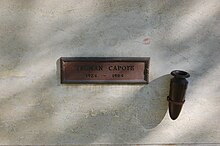
Capote’s marker at Westwood Village Memorial Park

Capote and Dunphy stone at Crooked Pond in the Long Pond Greenbelt in Southampton, New York.
Capote died in Bel Air, Los Angeles, on August 25, 1984, age 59. According to the coroner’s report, the cause of death was “liver disease complicated by phlebitisand multiple drug intoxication.” He died at the home of his old friend Joanne Carson, ex-wife of late-night TV host Johnny Carson, on whose program Capote had been a frequent guest. Vidal responded to news of Capote’s death by calling it “a wise career move.”
Capote was cremated and his remains were reportedly divided between Carson and Jack Dunphy (although Dunphy maintained that he received all the ashes). Carson said she kept the ashes in an urn in the room where he died. Those ashes were reported stolen during a Halloween party in 1988 along with $200,000 in jewels but were then returned six days later, having been found in a coiled-up garden hose on the back steps of Carson’s Bel Air home. The ashes were reportedly stolen again when brought to a production of Tru but the thief was caught before leaving the theatre. Carson bought a crypt at Westwood Village Memorial Park Cemetery in Los Angeles. In 2013 the producers offered to fly Carson and the ashes to New York for a Broadway production of Breakfast at Tiffany’s. Carson declined the offer. Dunphy died in 1992, and in 1994, both his and Capote’s ashes were reportedly scattered at Crooked Pond, between Bridgehampton, New York, and Sag Harbor, New York on Long Island, close to Sagaponack, New York, where the two had maintained a property with individual houses for many years. Crooked Pond was chosen because money from the estate of Dunphy and Capote was donated to the Nature Conservancy, which in turn used it to buy 20 acres around Crooked Pond in an area called “Long Pond Greenbelt.” A stone marker indicates the spot where their mingled ashes were thrown into the pond. In 2016, some of Capote’s ashes previously owned by Joanne Carson were auctioned by Julien’s Auctions.

(1968)
Other Voices, Other Rooms (1948)
- The brain may take advice, but not the heart, and love, having no geography, knows no boundaries: weight and sink it deep, no matter, it will rise and find the surface: and why not? any love is natural and beautiful that lies within a person’s nature; only hypocrites would hold a man responsible for what he loves, emotional illiterates and those of righteous envy, who, in their agitated concern, mistake so frequently the arrow pointing to heaven for the one that leads to hell.
- The true beloveds of this world are in their lover’s eyes lilacs opening, ship lights, school bells, a landscape, remembered conversations, friends, a child’s Sunday, lost voices, one’s favorite suit, autumn and all seasons, memory, yes, it being the earth and water of existence, memory.
- She beckoned to him, shining and silver, and he knew he must go: unafraid, not hesitating, he paused only at the garden’s edge, as though he’d forgotten something, he stopped and looked back at the bloomless, descending blue, at the boy he had left behind.
- But my dear, so few things are fulfilled: what are most lives but a series of incomplete episodes
- Randolf
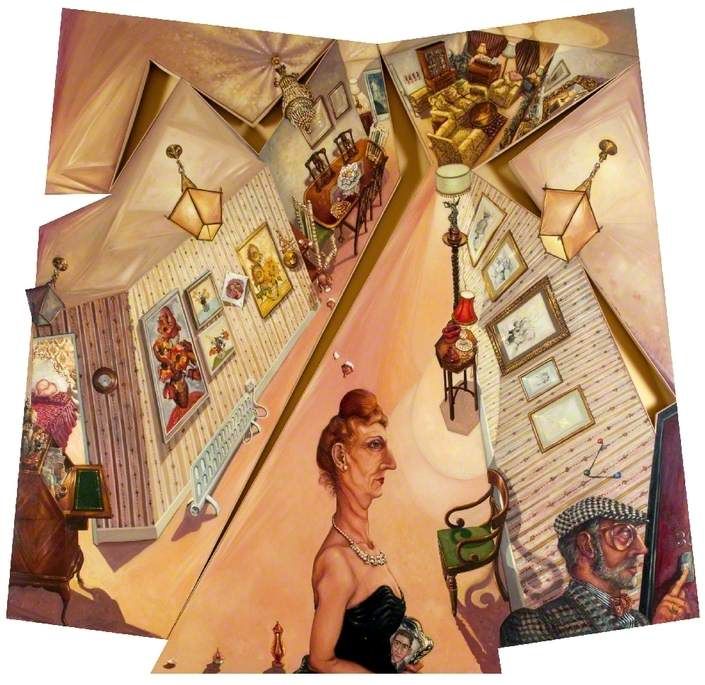
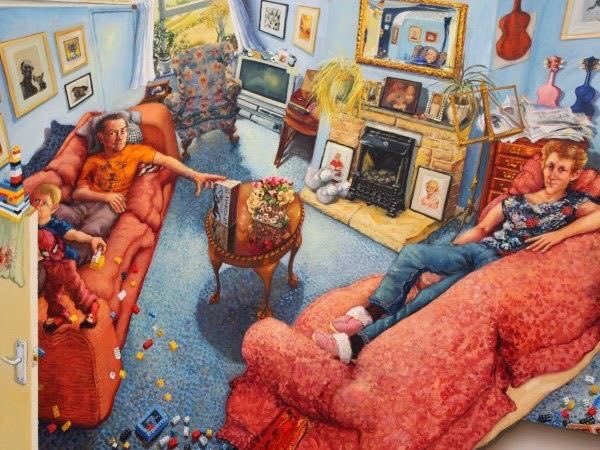
And today is the birthday of Anthony Green (Anthony Eric Sandall Green; Luton, Bedfordshire, England 30 September 1939 – 14 February 2023 Little Eversden, Cambridgeshire, England); realist painter and printmaker best known for his paintings of his own middle-class domestic life. His works sometimes used compound perspectives and polygonal forms—particularly with large, irregularly shaped canvasses. As well as producing oil paintings, he also produced a number of works designed from the start as limited edition prints, which were typically giclée works.

Gallery




Mac Tag
thanks for stoppin’ by y’all
 The Lovers’ Chronicle
Leave a reply to The Lovers’ Chronicle 31 October – without – birth of John Keats & Natalie Barney – art by Marie Laurencin – photographs by Helmut Newton – The Lovers’ Chronicle Cancel reply