
Dear Zazie, Here is Mac Tag‘s Lover’s Chronicle to his muse. Follow us on twitter @cowboycoleridge. Rhett
The Lover’s Chronicle
Dear Muse,
has to be Aretha and a song
she cowrote with Ted White,
’’Think’’
‘’Another excellent choice my love’’
 can not go wrong with Aretha
this theme was inspired
by the last lines in Hemingway’s
novel, ‘’The Sun Also Rises’’
when Brett tells Jake,
they could have had a damned good time
and he says’ ‘’Isn’t it pretty to think so’’
’’I see how you were drawn to that’’
and drawn to Aretha singin’,
 ‘’You’d better think’’
cuz we did and now look at us
havin’ a damned good time

© copyright 2023.2024 mac tag/cowboy coleridge all rights reserved
yes it was, though would not use Hemingway’s word, perhaps pleasant would work, it helped in gittin’ through some tough times but now the focus is on doin’ so, and writin’ so; to be able to come here every day, create somethin’ with words and visions of beauty, all that could be imagined, what else would there be to do, no better place or privilege, the band keeps playin’, the words keep comin’, still with you and havin’ a damned good time doin’ it

© copyright 2022.2024 mac tag/cowboy coleridge all rights reserved
even better, to be so;
here now with what sustains
livin’ what had only been dreamed
tellin’ the tales of the improbable road,
with rhythm and brevity
and sharin’ it with another
what thought could not be
have to say, amazed
that thinkin’ so came true

© copyright 2021.2024 mac tag/cowboy coleridge all rights reserved
Pale Love, Pale Rider
let too much go by
without seein’
course, hard to see
when you do not
know how to look
or what you should
be lookin’ for
“So how did you get here?”
gradually, then suddenly
is it not pretty to think
that we are not lost
that it is not too late
that we can be
© copyright 2020 mac tag/cowboy coleridge all rights reserved
still lookin’
for my Lady Brett
***
tremorous in the wan light
in the fallin’, this is all
that is worth havin’
carried, slowly at first
remember the feelin’s
the pulsatin’, steady
skin on skin friction
deliver us from without
from the white coverlet
here to be cherished
we ride the storm
© copyright 2019 mac tag/cowboy coleridge all rights reserved
ready for repentance
is that not what this is
all about
and regrets,
well sure,
they will be there
for now though,
they are at rest
what of redemption
more like, a third act
gotta get right
what time is left
the only constant
the familiar refrain,
you remain, the only
worth all grantin’
© copyright 2018 mac tag/cowboy coleridge all rights reserved
a little over a month in
feels right
this new High Plains order
the daily ritual
writin’ for you
driven by routine
and it is not failin’
this refrain will appear
on occasion;
the time lost
in searchin’
was not in vain
it was preparation
for this
to think so
and keep it here
© copyright 2017.2023 mac tag/cowboy coleridge all rights reserved

thanks Kelly
a fire consumin’ from within
left in darkness he awaits
her light to eclipse
the flames that plague him
© copyright 2015.2024 mac tag/cowboy coleridge all rights reserved
Today is the birthday of Lovis Corinth (born Franz Heinrich Louis; Tapiau, in Prussia; 21 July 1858 – 17 July 1925 Zandvoort, Netherlands); artist and writer whose mature work as a painter and printmaker realized a synthesis of impressionism and expressionism.

Corinth studied in Paris and Munich, joined the Berlin Secession group, later succeeding Max Liebermann as the group’s president. His early work was naturalistic in approach. Corinth was initially antagonistic towards the expressionist movement, but after a stroke in 1911 his style loosened and took on many expressionistic qualities. His use of color became more vibrant, and he created portraits and landscapes of vitality and power. Corinth’s subject matter also included nudes and biblical scenes.
Corinth moved to Berlin in 1900, and had a one-man exhibition at a gallery owned by Paul Cassirer. In 1902 at the age of 43, he opened a school of painting for women and married his first student, Charlotte Berend, some 20 years his junior. Charlotte was his youthful muse, his spiritual partner, and the mother of his two children. She had a profound influence on him, and family life became a major theme in his art.
Gallery
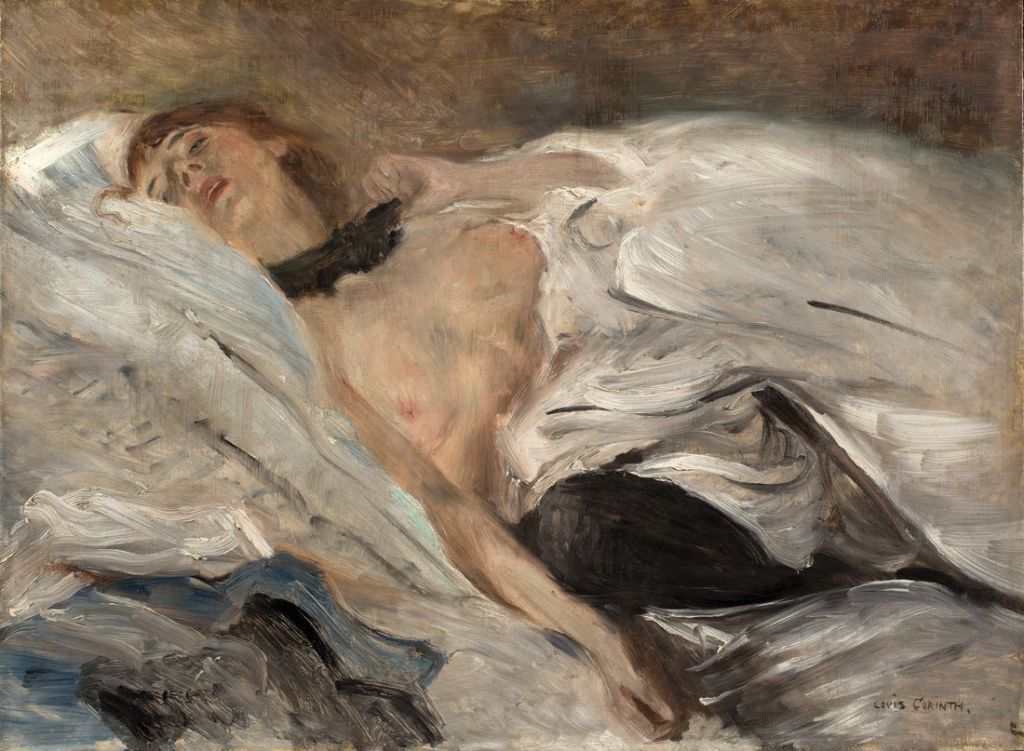

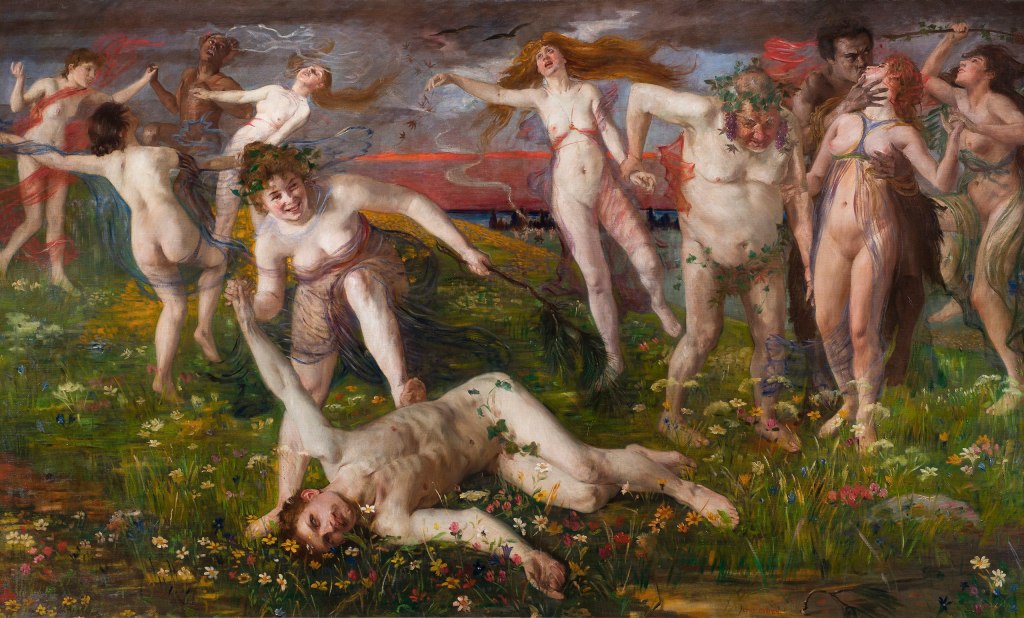
Bacchanalia (1896), oil on canvas, 117 x 204 cm., private collection

group of friends

Reclining Nude (1910), oil on canvas, Landesmuseum Hannover, Hanover
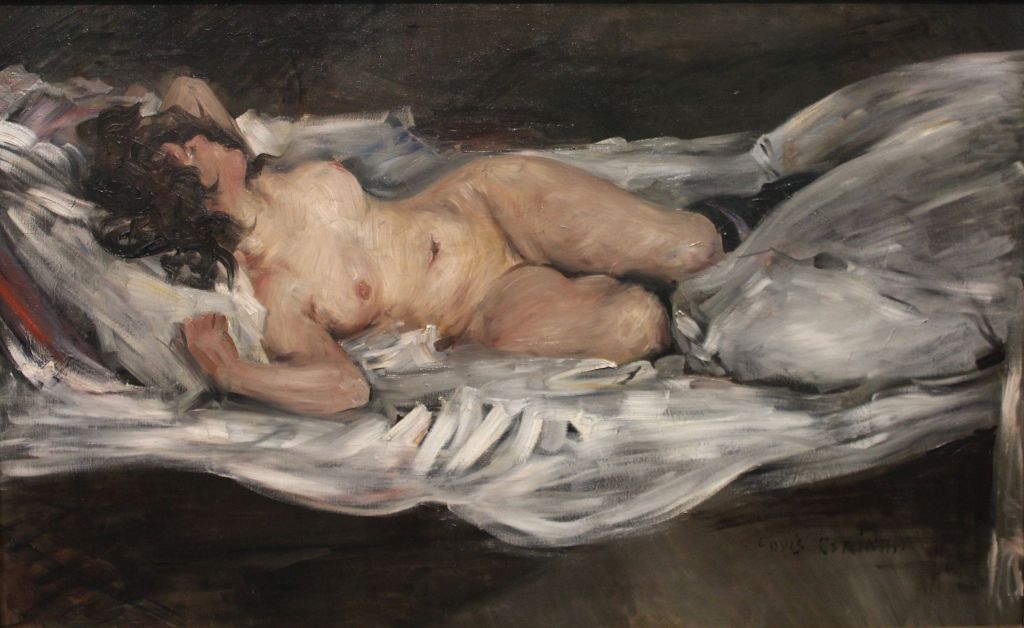
Reclining Female Nude (1899), oil on canvas, 75.5 cm (29.7 in); Width: 120.5 cm., Kunsthalle Bremen

girl before the mirror
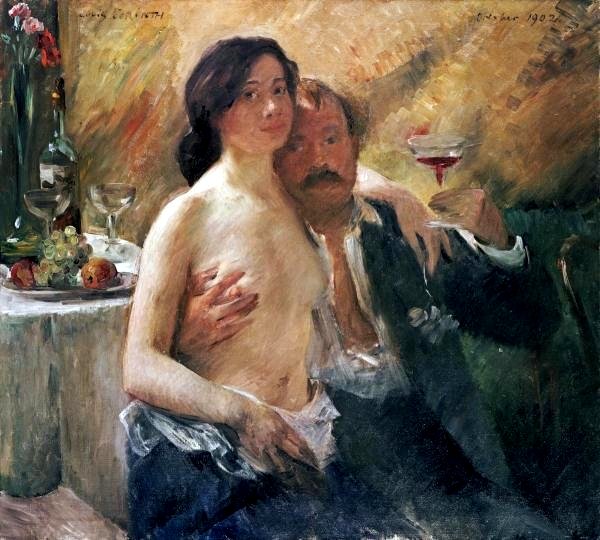
Self Portrait with his wife Charlotte and Champagne Glass (1902), oil on canvas, 97 × 107 cm., private collection

Salome (1900), oil on canvas, 127 × 147 cm., Museum der Bildenden Künste Leipzig


Morning Sunshine, 1910, Hessian State Museum, Darmstadt
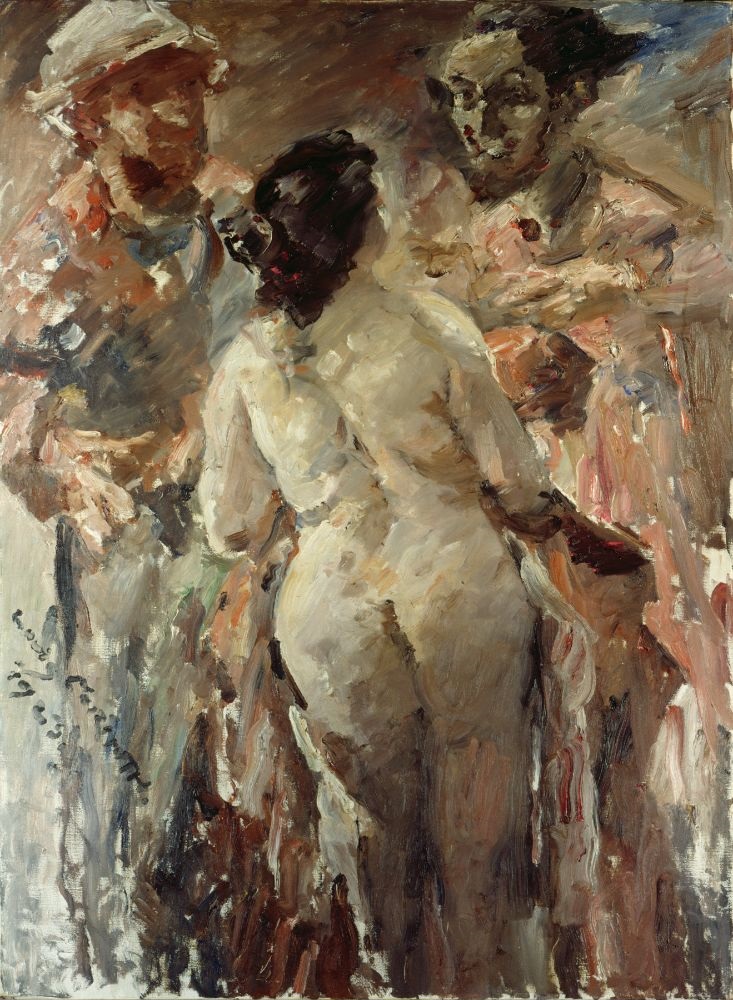
Susanna and the Elders (1923), oil on canvas, 150.5 x 111 cm., Lower Saxony State Museum
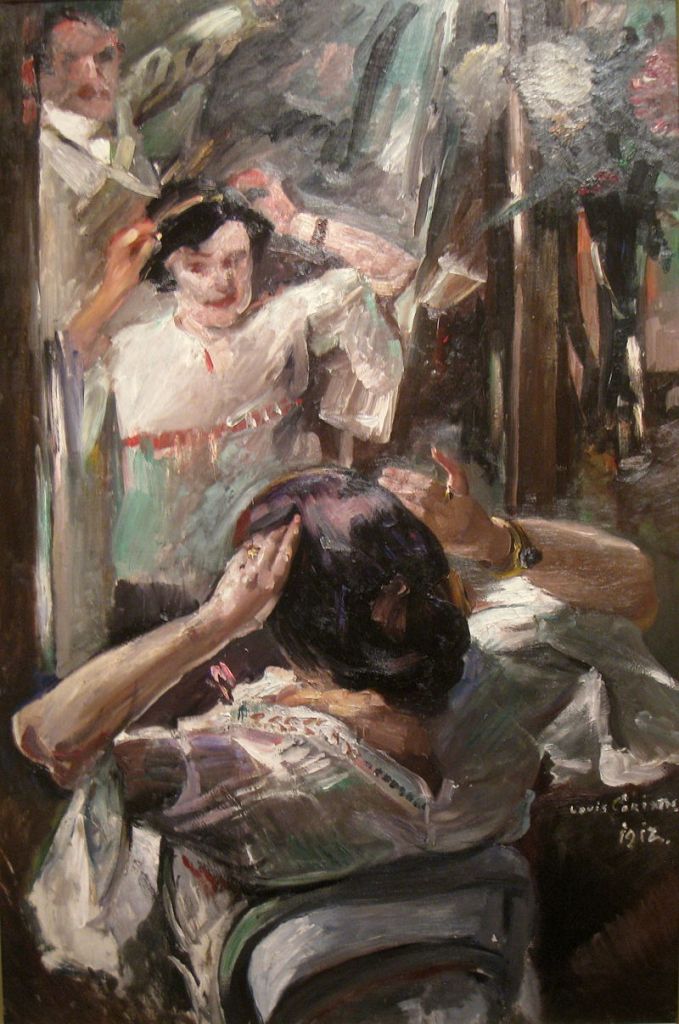
at the mirror

Flowers and Daughter Wilhelmine (1920), oil on canvas, 111 x 150 cm., Kunstmuseum Basel

Lady at the Goldfish Basin (1911), oil on canvas, 74 x 90.5 cm., Österreichische Galerie

Midsummer Night
Today is the birthday of Carlos Schwabe (Émile Martin Charles Schwabe; Altona, kingdom of Prussia; July 21, 1866 – 22 January 1926 Avon, Seine-et-Marne, France); Symbolist painter and printmaker.
 Self portrait, circa 1900
After studying art in Geneva, he relocated to Paris where he worked as a wallpaper designer, and he became acquainted with Symbolist artists, musicians and writers. In 1892, he was one of the painters of the famous Salon de la Rose + Croix at the Galerie Durand-Ruel. His poster for the first Salon is an important symbolic work of the idealist new art. He exhibited at the Société nationale des Beaux-Arts, at the Salon d’automne and was present at the Exposition Universelle of 1900 (Gold Medal), but also in Munich, Zürich, Vienna, and Brussels. His paintings typically featured mythological and allegorical themes with a personal and idealist vision and a social interest. His important work La Vague (The Wave), and its preparatory drawings are a testimony of the engagement of the artist during the “Affaire dreyfus”. He illustrated the novel Le rêve (1892) by Émile Zola, Charles Baudelaire‘s Les Fleurs du mal (1900), Maurice Maeterlinck’s Pelléas et Mélisande (1892), and Albert Samain’s Jardin de l’infante (1908), but also texts by Haraucourt, Mallarmé, Blondel, Mendès, Lamennais etc. The most important works by Schwabe belongs to the Musée d’Orsay in Paris, the Musée d’Art et d’Histoire in Geneva, the Museu Nacional de Belas Artes in Rio de Janeiro, the Van Gogh Museum in Amsterdam, the Musées royaux des Beaux-Arts in Bruxelles and in private collections. Schwabe received the French Légion of Honor in 1902.
Gallery
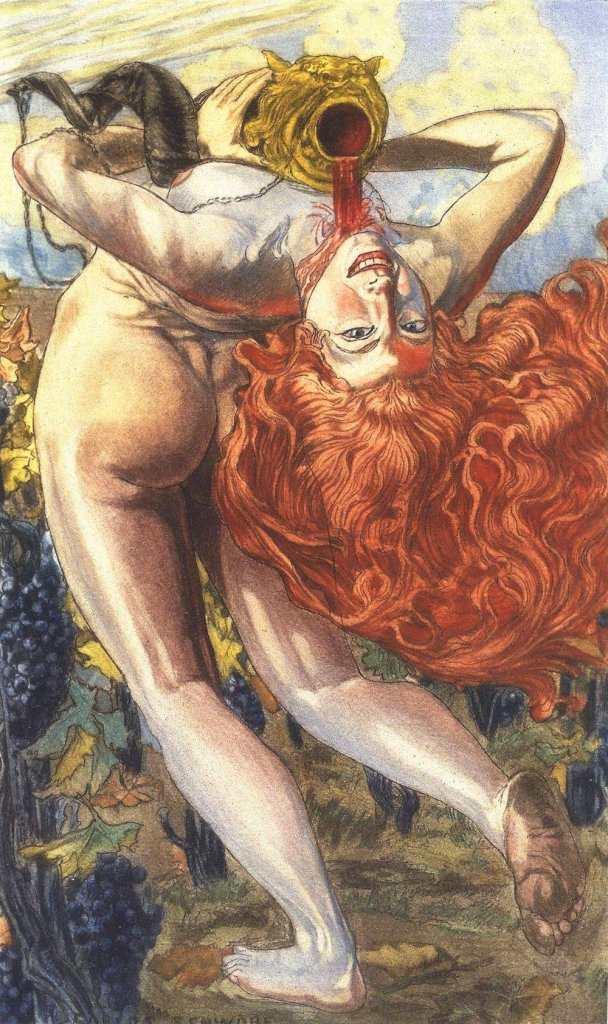
l’Ame du vin, 1900

Illustrations for Baudelaire’s Les Fleur du Mal

Illustrations for Baudelaire’s Les Fleur du Mal

Colors of Evil, 1900

Les Fleurs du mal, 1900

Spleen et Idéal, 1907

Fervaal, 1898

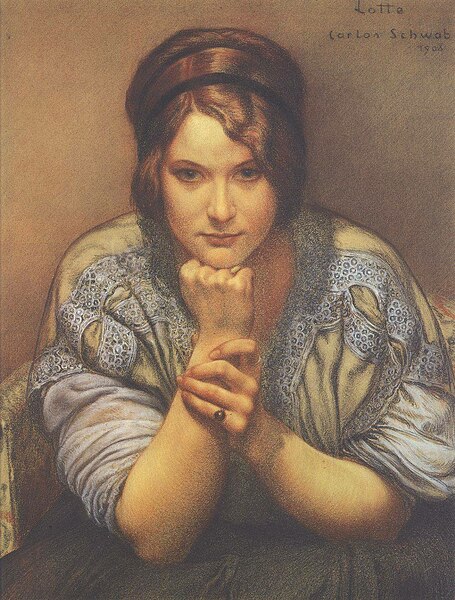
Lotte, the artist’s daughter, 1908

La douleur, 1893
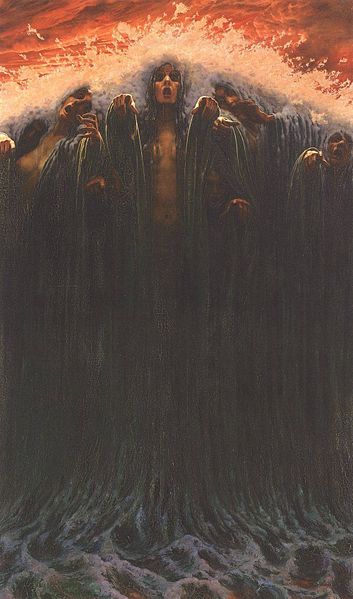
Wave 1906
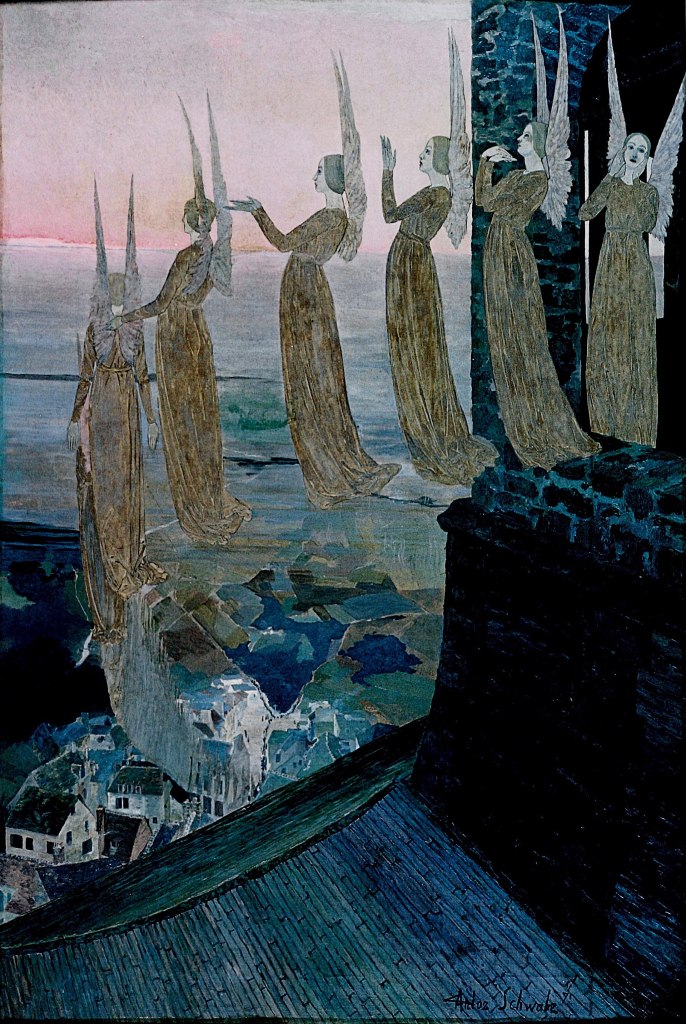
Cloches du soir (Evening bells, 1895)

Death and the Gravedigger, 1895

Elysian Fields, 1903
Today is the birthday of Emil Orlik (Prague 21 July 1870 – 28 September 1932 Berlin); painter, etcher and lithographer. He lived and worked in Prague, Austria and Germany. He first studied art at the private art school of Heinrich Knirr, where one of his fellow pupils was Paul Klee. From 1891, he studied at the Munich Academy under Wilhelm Lindenschmit. Later he learned engraving from Johann Leonhard Raaband proceeded to experiment with various printmaking processes.
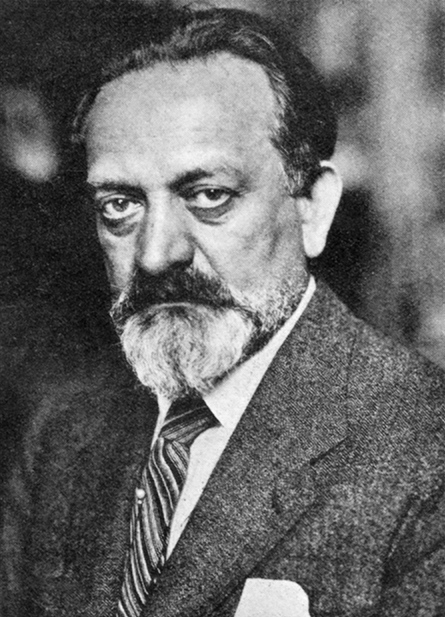
in 1932
After completing his military service in Prague, he returned to Munich, where he worked for the magazine Jugend. He spent most of 1898, travelling through Europe, visiting the Netherlands, Great Britain, Belgium, and Paris. During this time he became aware of Japanese art, and the impact it was having in Europe, and decided to visit Japan to learn woodcut techniques.
Gallery

Model, 1904


Parfumerie Gottlieb Taussig, Wien 1897

Claire Waldoff

Unknown woman, 1917
Today is the birthday of Hart Crane (born Harold Hart Crane; Garrettsville, Ohio; July 21, 1899 – April 27, 1932 At sea, off the Florida coast); poet. Finding both inspiration and provocation in the poetry of T. S. Eliot, Crane wrote modernist poetry that was difficult, highly stylized, and ambitious in its scope. In his most ambitious work, The Bridge, Crane sought to write an epic poem, in the vein of The Waste Land, that expressed a more optimistic view of modern, urban culture than the one that he found in Eliot’s work. In the years following his suicide at the age of 32, Crane has been hailed by playwrights, poets, and literary critics alike as being one of the most influential poets of his generation.

1930 as photographed by Walker Evans
I am not ready for repentance;
Nor to match regrets. For the moth
Bends no more than the still
Imploring flame. And tremorous
In the white falling flakes
Kisses are,
The only worth all granting.
Excerpted from “Legend”
published in White Buildings (1926)
The willows carried a slow sound,
A sarabande the wind mowed on the mead.
I could never remember
That seething, steady leveling of the marshes
Till age had brought me to the sea.
From “Repose of Rivers”
from White Buildings (1926)
- His thoughts, delivered to me
From the white coverlet and pillow,
I see now, were inheritances—
Delicate riders of the storm.- Praise for an Urn (l. 5-8). In The Norton Anthology of Modern Poetry, by Richard Ellmann and Robert O’Clair (1988)
- There are no stars to-night
But those of memory.
Yet how much room for memory there is
In the loose girdle of soft rain.- My Grandmother’s Love Letters (l. 1-4). In The Norton Anthology of Modern Poetry, by Richard Ellmann and Robert O’Clair (1988)
- And Thee, across the harbor, silver-paced
As though the sun took step of thee, yet left
Some motion ever unspent in thy stride,
Implicitly thy freedom staying thee!- The Bridge. In The Norton Anthology of Modern Poetry, by Richard Ellmann and Robert O’Clair (1988)
- O harp and altar, of the fury fused,
(How could mere toil align thy choiring strings!)
Terrific threshold of the prophet’s pledge,
Prayer of pariah, and the lover’s cry,- To Brooklyn Bridge, Stanza 8; from The Bridge
- O Sleepless as the river under thee,
Vaulting the sea, the prairies’ dreaming sod,
Unto us lowliest sometime sweep, descend
And of the curveship lend a myth to God.- To Brooklyn Bridge, Stanza 11; from The Bridge
| Ernest Hemingway | |
|---|---|
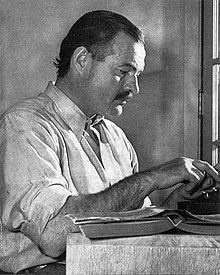 | |
Today is the birthday of Ernest Hemingway (Ernest Miller Hemingway; Oak Park, Illinois; July 21, 1899 – July 2, 1961 Ketchum, Idaho); novelist, short story writer, and journalist. His economical and understated style had a strong influence on 20th-century fiction, while his life of adventure and his public image influenced later generations. Hemingway produced most of his work between the mid-1920s and the mid-1950s, and won the Nobel Prize in Literature in 1954. He published seven novels, six short story collections, and two non-fiction works. Additional works, including three novels, four short story collections, and three non-fiction works, were published posthumously. Many of his works are considered classics of American literature.
After high school, he reported for a few months for The Kansas City Star, before leaving for the Italian front to enlist with the World War I ambulance drivers. In 1918, he was seriously wounded and returned home. His wartime experiences formed the basis for his novel A Farewell to Arms (1929).
In 1921, he married Hadley Richardson, the first of his four wives. The couple moved to Paris, where he worked as a foreign correspondent and fell under the influence of the modernist writers and artists of the 1920s “Lost Generation” expatriate community. He published his first novel, The Sun Also Rises, in 1926. After his 1927 divorce from Hadley Richardson, Hemingway married Pauline Pfeiffer; they divorced after he returned from the Spanish Civil War where he had been a journalist, and after which he wrote For Whom the Bell Tolls (1940). Martha Gellhorn became his third wife in 1940; they separated when he met Mary Welsh in London during World War II. He was present at the Normandy landings and the liberation of Paris.
Shortly after the publication of The Old Man and the Sea (1952), Hemingway went on safari to Africa, where he was almost killed in two successive plane crashes that left him in pain or ill health for much of his remaining life. Hemingway maintained permanent residences in Key West, Florida (1930s) and Cuba (1940s and 1950s), and in 1959, he bought a house in Ketchum, Idaho, where he committed suicide in the summer of 1961. Perhaps my favorite writer. During the month of July, every year, I re-read his short stories.
| If a writer of prose knows enough of what he is writing about he may omit things that he knows and the reader, if the writer is writing truly enough, will have a feeling of those things as strongly as though the writer had stated them. The dignity of movement of an ice-berg is due to only one-eighth of it being above water. A writer who omits things because he does not know them only makes hollow places in his writing. |
| —Death in the Afternoon |
| I was always embarrassed by the words sacred, glorious, and sacrifice and the expression in vain. We had heard them … and had read them … now for a long time, and I had seen nothing sacred, and the things that were glorious had no glory and the sacrifices were like the stockyards at Chicago if nothing was done with the meat except to bury it. There were many words that you could not stand to hear and finally only the names of places had dignity … Abstract words such as glory, honor, courage or hallow were obscene beside the concrete names of villages, the numbers of roads, the names of rivers, the numbers of regiments and the dates. |
| —A Farewell to Arms |
| The world breaks everyone and afterward many are strong in the broken places. But those that will not break it kills. It kills the very good and the very gentle and the very brave impartially. If you are none of these you can be sure it will kill you too but there will be no special hurry. |
| —A Farewell to Arms |
The Sun Also Rises (1926)

You are an expatriate, see? You hang around cafés.
- ‘Listen Jake… don’t you ever get the feeling that all your life is going by and you are not taking advantage of it?’
- Robert Cohn to Jake Barnes, in Book 1, Ch. 2
- A bottle of wine was good company.
- All right. Have it your own way. Road to hell paved with unbought stuffed dogs. Not my fault.
- This wine is too good for toast-drinking, my dear. You don’t want to mix emotions up with a wine like that. You lose the taste.
- Count Mippipopolous, in Book 1, Ch. 7
- You’re an expatriate. You’ve lost touch with the soil. You get precious. Fake European standards have ruined you. You drink yourself to death. You become obsessed by sex. You spend all your time talking, not working. You are an expatriate, see? You hang around cafés.
- Bill Gorton to Jake Barnes, in Book 2, Ch. 12
- ‘How did you go bankrupt?’ Bill asked.
‘Two ways,’ Mike said. ‘Gradually and then suddenly.’- Book 2, Ch. 13
- Mike’s response is often misquoted as “It occurs first very slowly, then all at once.”
- ‘You know it makes one feel rather good deciding not to be a bitch.’
‘Yes.’
‘It’s sort of what we have instead of God.’- Lady Brett Ashley to Jake Barnes, in Book 3, Ch. 19
- ‘Oh, Jake,’ Brett said, ‘we could have had such a damned good time together.’
Ahead was a mounted policeman in khaki directing traffic. He raised his baton. The car slowed suddenly pressing Brett against me.
‘Yes,’ I said. ‘Isn’t it pretty to think so?’- Book 3, Ch. 19 (the last lines of the novel)
For Whom the Bell Tolls (1940)
The title of this work comes from “Meditation XVII” by John Donne
Any man’s death diminishes me,
Because I am involved in mankind,
And therefore never send to know for whom the bell tolls;
It tolls for thee.
John Donne
- I am no romantic glorifier of the Spanish woman, nor did I ever think of a casual piece as anything much other than a casual piece in any country. But when I am with Maria I love her so that I feel, literally, as though I would die and I never believed in that or thought that it could happen.
- Ch. 13
- What a business. You go along your whole life and they seem as though they mean something and they always end up not meaning anything. There was never any of what this is. You think that is one thing you will never have. And then, on a lousy show like this, co-ordinating two chicken-crut guerilla bands to help you blow a bridge under impossible conditions, to abort a counter-offensive that will probably already be started, you run into a girl like this Maria.
- Ch. 13
- ‘But are there not many Fascists in your country?’
‘There are many who do not know they are Fascists, but will find it out when the time comes’.- Ch. 16
- He was just a coward and that was the worst luck any man could have.
- Ch. 30
- If we win here we will win everywhere. The world is a fine place and worth the fighting for and I hate very much to leave it.
- Ch 43
- There’s no one thing that’s true. It’s all true.
- Ch 43
- For him it was a dark passage which led to nowhere, then to nowhere, then again to nowhere, once again to nowhere, always and forever to nowhere, heavy on the elbows in the earth to nowhere, dark, never any end to nowhere, hung on all time always to unknowing nowhere, this time and again for always to nowhere, now not to be borne once again always and to nowhere, now beyond all bearing up, up, up and into nowhere, suddenly, scaldingly, holdingly all nowhere gone and time absolutely still and they were both there, time having stopped and he felt the earth move out and away from under them.
- Ch. 13
- If every one said orders were impossible to carry out when they were received where would you be? Where would we all be if you just said, “Impossible,” when orders came?
- Today is only one day in all the days that will ever be. But what will happen in all the other days that ever come can depend on what you do today. It’s been that way all this year. It’s been that way so many times. All of war is that way.
- That tomorrow should come and that I should be there.
And today is the birthday of Russell Lee (Ottawa, Illinois; July 21, 1903 – August 28, 1986 Austin); photographer and photojournalist, best known for his work for the Farm Security Administration (FSA). His technically excellent images documented the ethnography of various American classes and cultures.
 c. 1942
In 1947 Lee moved to Austin and continued photography. In 1965 he became the first instructor of photography at the University of Texas there.
Gallery

Jack Whinery, homesteader, with his wife and the youngest of his five children, Pie Town, New Mexico

Migrant farmers in Pie Town, New Mexico, 1940

Quilt, Pie Town, New Mexico

Food at the Pie Town, New Mexico fair, 1940
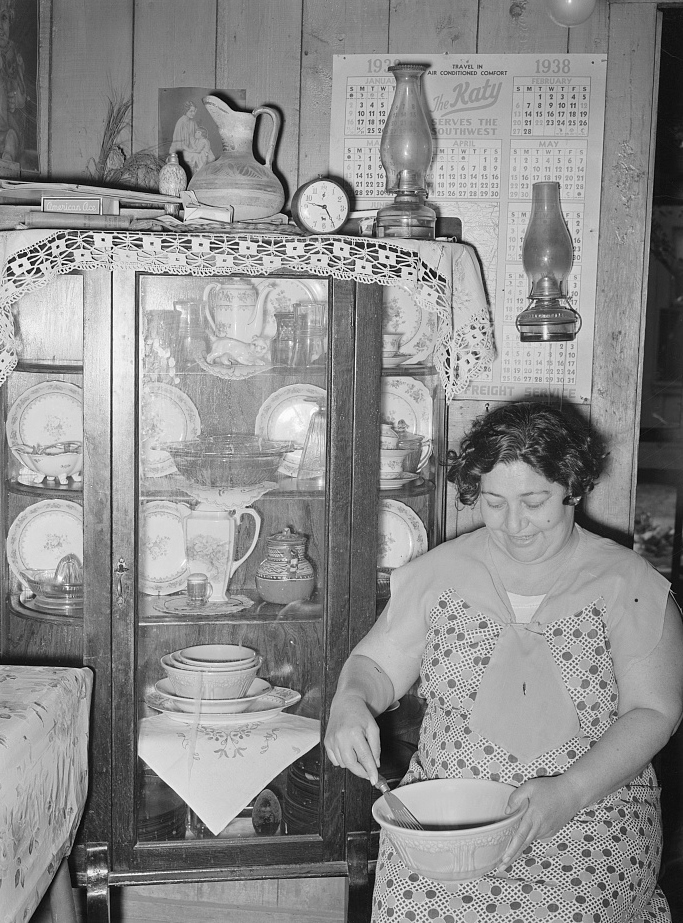
San Antonio 1938/39

Montana shepherd

eagle pass, Texas 1938/39
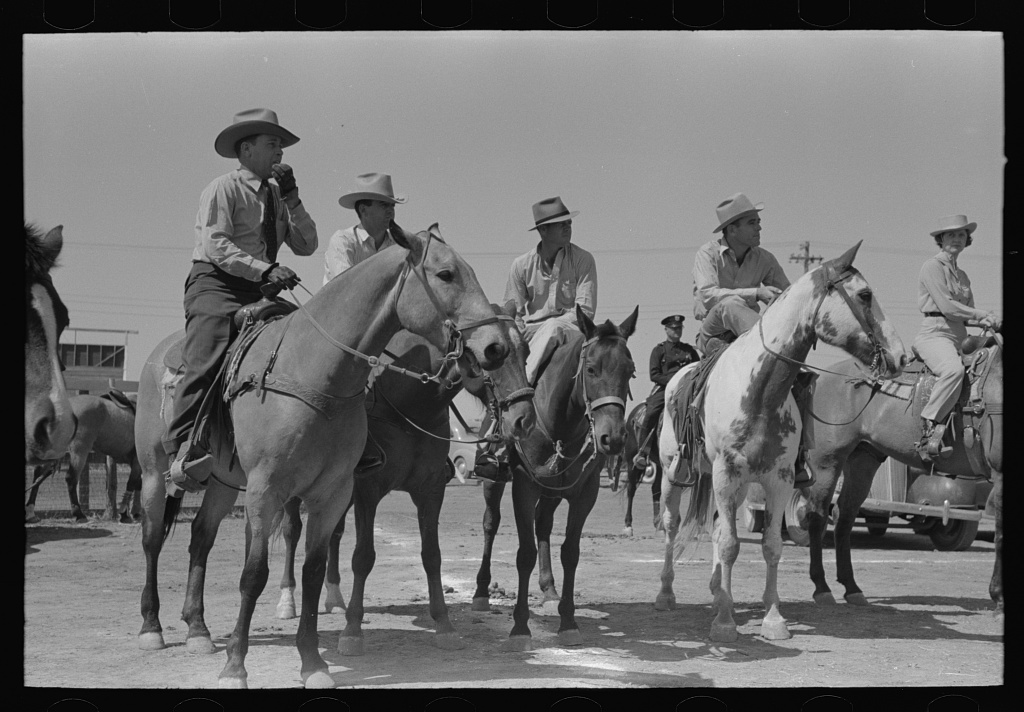
Abilene 1939
Mac Tag
thanks for stoppin’ by y’all
 The Lovers’ Chronicle
Leave a reply to The Lovers’ Chronicle 4 January – wishin’ you – art by Marsden Hartley, Augustus John & Guy Pène du Bois – The Lovers’ Chronicle Cancel reply