
Dear Zazie, Howzit goin’? Same here. Git some early porch time in before the day heats up. Tend to the chores. Maybe go down to the swimmin’ hole. Cook up somethin’ good. Drink some mezcal. Do some readin’ and writin’. The life of a cowboy poet. Here is today’s Lovers’ Chronicle from Mac Tag to his muse. Follow us on twitter @cowboycoleridge. Well, the last line, “For he makes a fine end who dies loving well.”, certainly makes me pause to reflect. What do you think? And, I love the song of the day; even if, even if I am no good at forgiveness! Be good, Rhett
The Lover’s Chronicle
Dear Muse,
oh this could be
about the opposite,
as in, come on baby…
“Light my fire”
well done my love
more fun to go that way
than with the drama
of Petrarch and Laura
“Right, unrequited love
is not our thing”
ours is as requited as it gets
“But we both had to go through
the extinguished phase”
meanwhile, shall we try
to set the night on fire
© copyright 2023 mac tag/cowboy coleridge all rights reserved
an ode on this day for Petrarch and Laura, feels appropriate, though the form and direction it takes, we shall see; the unrequited love drama seized my attention, aside from havin’ been there, the fact that he channeled his feelin’s into all those poems; the poets highest praise, paid to the one who lights his fire
© copyright 2022.2023 mac tag/cowboy coleridge all rights reserved
never
a word i do not
just throw about
aside from possibly
bein’ overly dramatic,
it tends to be
a really long time
yet i feel quite comfortable
in usin’ it in the followin’;
i never would have thought
the flame extinguished
these many years
could be relit
but it has with you
© copyright 2021.2023 mac tag/cowboy coleridge all rights reserved
one could argue
that my entire
output of verse
is an “Il Canzoniere”
for you, dear reader
it has been enough
for it must be
this vision
this pursuit
these words for you
brings to my thoughts,
comfort, understandin’
sufferin’, solace
this can be counted on
and not taken away
© copyright 2020 mac tag/cowboy coleridge all rights reserved
the breeze, blowin’ your hair
stirrin’, bein’ stirred in turn,
scatterin’ then gatherin’ again
linger ’round, pierces till i feel
and i seem to find you, then
i realise how far away you are
now comforted, now despair,
now longin’, now seein’
© copyright 2019 mac tag/cowboy coleridge all rights reserved
“And you,
how do you survive?”
i take pleasure
in great beauty
now in the twilight
this is enough
for it must be
this vision
this pursuit
these words for you
this can be counted on
and not taken away
© copyright 2018 mac tag/cowboy coleridge all rights reserved
“Have you known unrequited love?”
oh yes, several
one might say it is my speciality
it is perhaps the best of all
the loves for me
one could argue
that my entire output of verse
is an “Il Canzoniere”
for the Laura’s i have known
in my youth
i struggled constantly
with the notion that the one
was out there waitin’ for me
i would still be strugglin’
had not repeated heartbreak,
bitter but salutary for me,
extinguished the coolin’ flames
***
have to think about
EBITDA, cash flow
for new business venture
wanna think about
writin’ verse for you
© copyright 2017 mac tag/cowboy Coleridge all rights reserved
Leave me
“Leave you?
What has not left you?
Do you want me
To make the bed?
I’m paid to do that”
Leave me
“My poet”
And this
And this
And this
© copyright 2016 mac tag/cowboy Coleridge all rights reserved
If i said i could
not stop, would it make
a difference. If i
said i just wanted
to hear you say it,
would it not matter
© copyright 2015 mac tag/cowboy Coleridge all rights reserved
| Petrarch | |
|---|---|
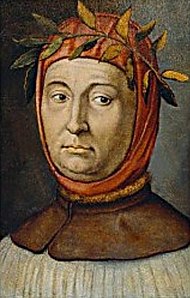 | |
Today is the birthday of Francesco Petrarca (Arezzo, Italy; July 20, 1304 – July 19, 1374 Arquà, Padua, Italy); commonly anglicized as Petrarch; Italian scholar and poet in Renaissance Italy, and one of the earliest humanists. Petrarch’s rediscovery of Cicero’s letters is often credited for initiating the 14th-century Renaissance. Petrarch is often considered the founder of Humanism. In the 16th century, Pietro Bembo created the model for the modern Italian language based on Petrarch’s works, as well as those of Giovanni Boccaccio, and, to a lesser extent, Dante Alighieri. Petrarch would be later endorsed as a model for Italian style by the Accademia della Crusca. Petrarch’s sonnets were admired and imitated throughout Europe during the Renaissance and became a model for lyrical poetry. He is also known for being the first to develop the concept of the “Dark Ages.”

On 6 April 1327, after Petrarch gave up his vocation as a priest, the sight of a woman called “Laura” in the church of Sainte-Claire d’Avignon awoke in him a lasting passion, celebrated in the Rime sparse (“Scattered rhymes”). Later, Renaissance poets who copied Petrarch’s style named this collection of 366 poems Il Canzoniere (“Song Book”). Laura may have been Laura de Noves, the wife of Count Hugues de Sade (an ancestor of the Marquis de Sade). There is little definite information in Petrarch’s work concerning Laura, except that she is lovely to look at, fair-haired, with a modest, dignified bearing. Laura and Petrarch had little or no personal contact. According to his “Secretum”, she refused him because she was already married. He channeled his feelings into love poems that were exclamatory rather than persuasive, and wrote prose that showed his contempt for men who pursue women. Upon her death in 1348, the poet found that his grief was as difficult to live with as was his former despair. Later in his “Letter to Posterity”, Petrarch wrote: “In my younger days I struggled constantly with an overwhelming but pure love affair – my only one, and I would have struggled with it longer had not premature death, bitter but salutary for me, extinguished the cooling flames. I certainly wish I could say that I have always been entirely free from desires of the flesh, but I would be lying if I did”.
Laura
Sonnet 227
| Original Italian | English translation by A. S. Kline |
|---|---|
| Aura che quelle chiome bionde et crespe cercondi et movi, et se’ mossa da loro, soavemente, et spargi quel dolce oro, et poi ’l raccogli, e ’n bei nodi il rincrespe,tu stai nelli occhi ond’amorose vespe mi pungon sí, che ’nfin qua il sento et ploro, et vacillando cerco il mio thesoro, come animal che spesso adombre e ’ncespe:ch’or me ’l par ritrovar, et or m’accorgo ch’i’ ne son lunge, or mi sollievo or caggio, ch’or quel ch’i’ bramo, or quel ch’è vero scorgo.Aër felice, col bel vivo raggio rimanti; et tu corrente et chiaro gorgo, ché non poss’io cangiar teco vïaggio? | Breeze, blowing that blonde curling hair, stirring it, and being softly stirred in turn, scattering that sweet gold about, then gathering it, in a lovely knot of curls again,you linger around bright eyes whose loving sting pierces me so, till I feel it and weep, and I wander searching for my treasure, like a creature that often shies and kicks:now I seem to find her, now I realise she’s far away, now I’m comforted, now despair, now longing for her, now truly seeing her.Happy air, remain here with your living rays: and you, clear running stream, why can’t I exchange my path for yours? |
Love, who lives and reigns in my thought and keeps his principal seat in my heart, comes like an armed warrior into my forehead, there places himself and there sets up his banner. She who teaches me to love and to suffer and who wishes that reason, modesty and reverence should restrain my great desire and burning hope, thrusts aside and disdains our ardour. Wherefore Love in terror flies to my heart, abandoning all his enterprise, and laments and trembles; there he hides himself and no more appears without. What can I do, when my lord is afraid, except stay with him until the last hour? For he makes a fine end who dies loving well.
And today is the birthday of Max Liebermann (Berlin 20 July 1847 – 8 February 1935 Berlin); painter and printmaker, and one of the leading proponents of Impressionism in Germany.
In addition to his activity as an artist, he also assembled an important collection of French Impressionist works.
 in 1904
The son of a Jewish banker, Liebermann studied art in Weimar, Paris, and the Netherlands. After living and working for some time in Munich, he returned to Berlin in 1884, where he remained for the rest of his life. He later chose scenes of the bourgeoisie, as well as aspects of his garden near Lake Wannsee, as motifs for his paintings. Noted for his portraits, he did more than 200 commissioned ones over the years, including of Albert Einstein and Paul von Hindenburg.
Liebermann was honored on his 50th birthday with a solo exhibition at the Prussian Academy of Arts in Berlin, and the following year he was elected to the academy. From 1899 to 1911 he led the premier avant-garde formation in Germany, the Berlin Secession. Beginning in 1920 he was president of the Prussian Academy of Arts. On his 80th birthday, in 1927, Liebermann was celebrated with a large exhibition, declared an honorary citizen of Berlin and hailed in a cover story in Berlin’s leading illustrated magazine. But such public accolades were short-lived. In 1933 he resigned when the academy decided to no longer exhibit works by Jewish artists, before he would have been forced to do so under laws restricting the rights of Jews. His art collection, which his wife inherited after his death, was looted by the Nazis after her death in 1943.
In his various capacities as a leader in the artistic community, Liebermann spoke out often for the separation of art and politics. In the words of arts reporter and critic, Grace Glueck, he “pushed for the right of artists to do their own thing, unconcerned with politics or ideology.” His interest in French Realism was offputting to conservatives, for whom such openness suggested what they thought of as Jewish cosmopolitanism.
He was married in 1884 to Martha Marckwald (1857–1943).
Gallery
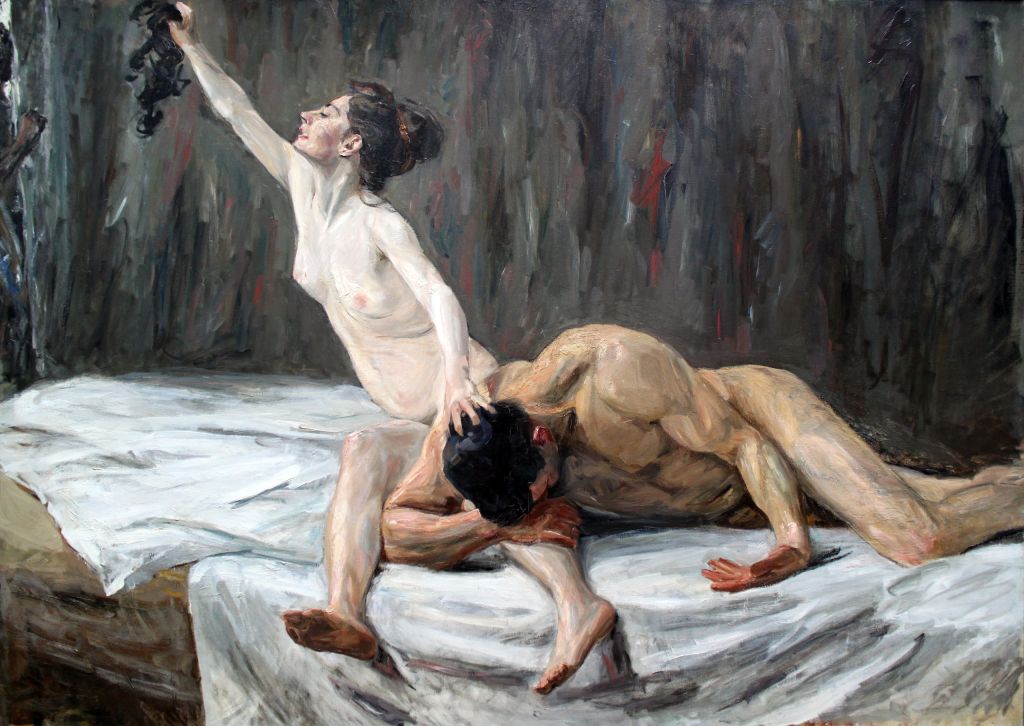
Sampson and Delila, 1902

love scene
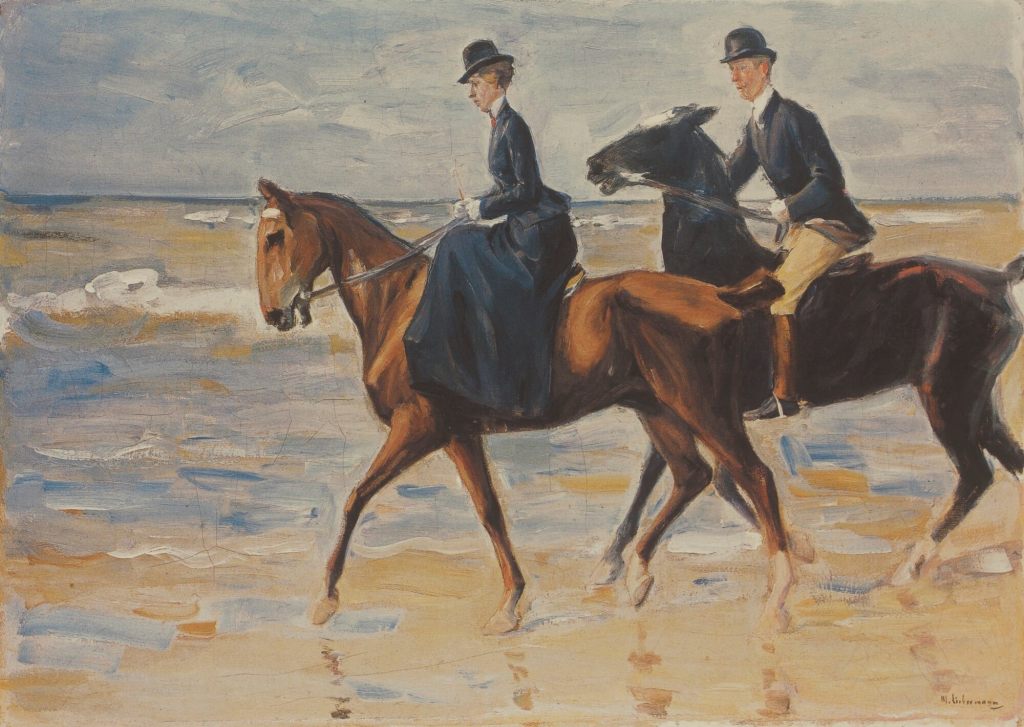
Two riders on the beach, 1903, Wallraf–Richartz Museum

woman walking in the surf
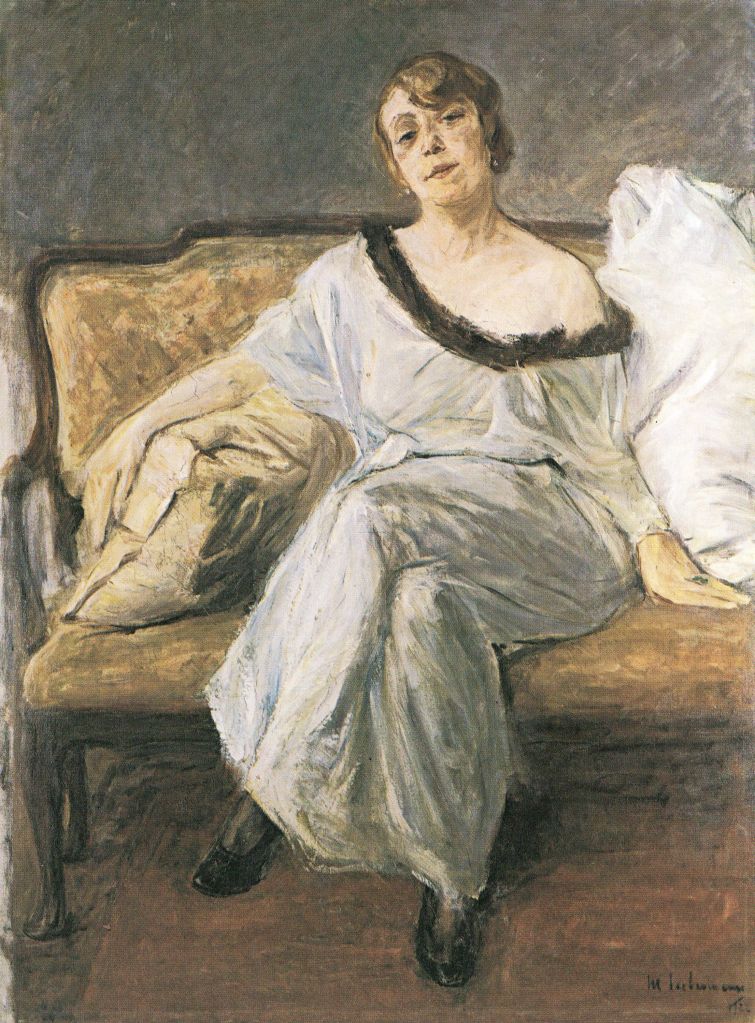
Lola Leder, 1922
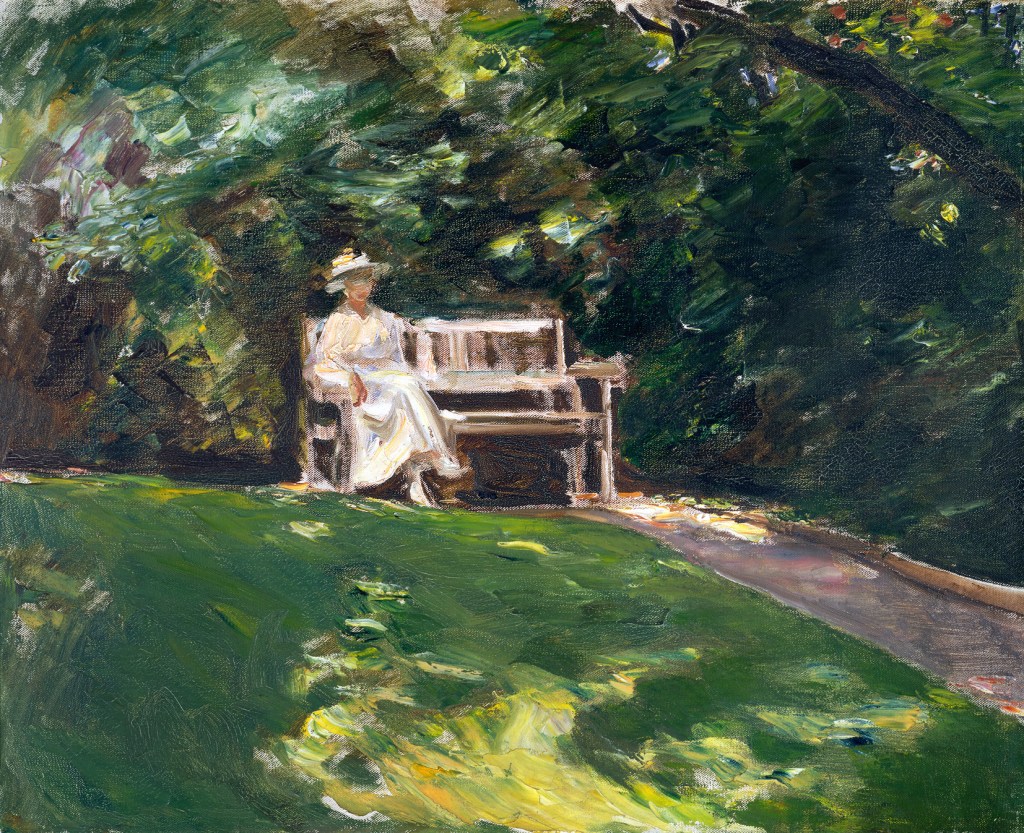
The garden bench, 1916, Alte Nationalgalerie
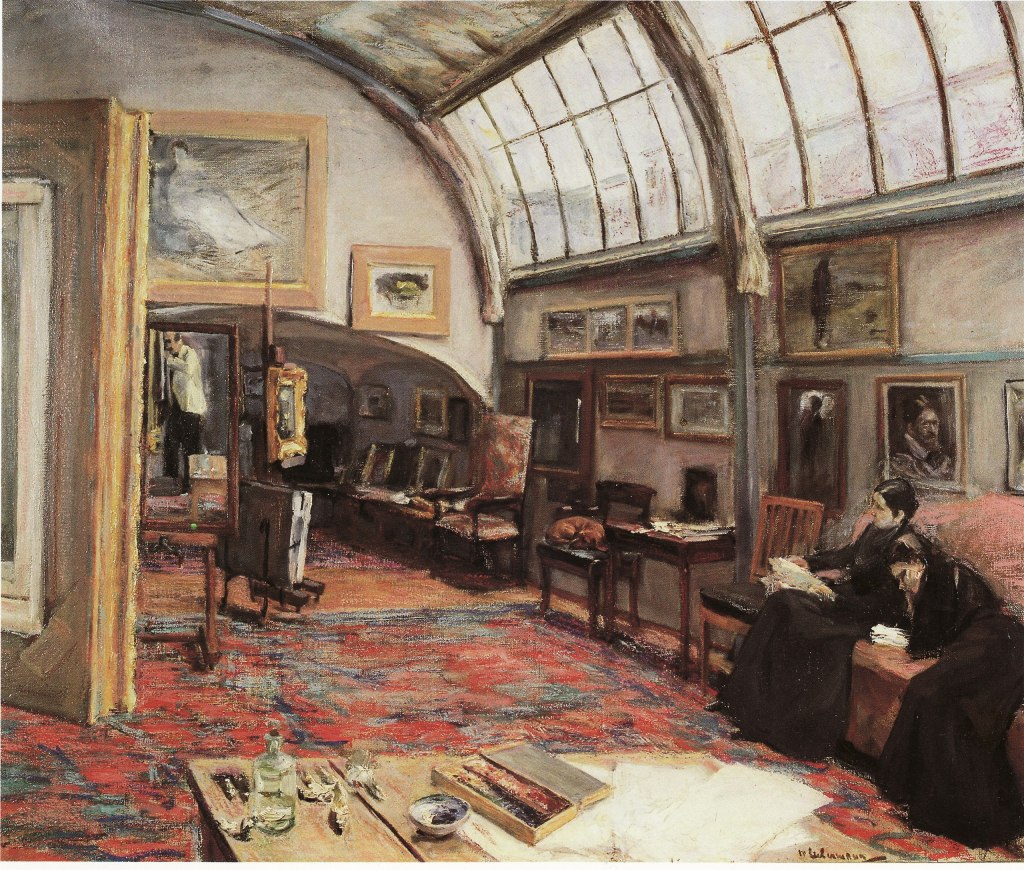
The Artist’s Studio, 1902
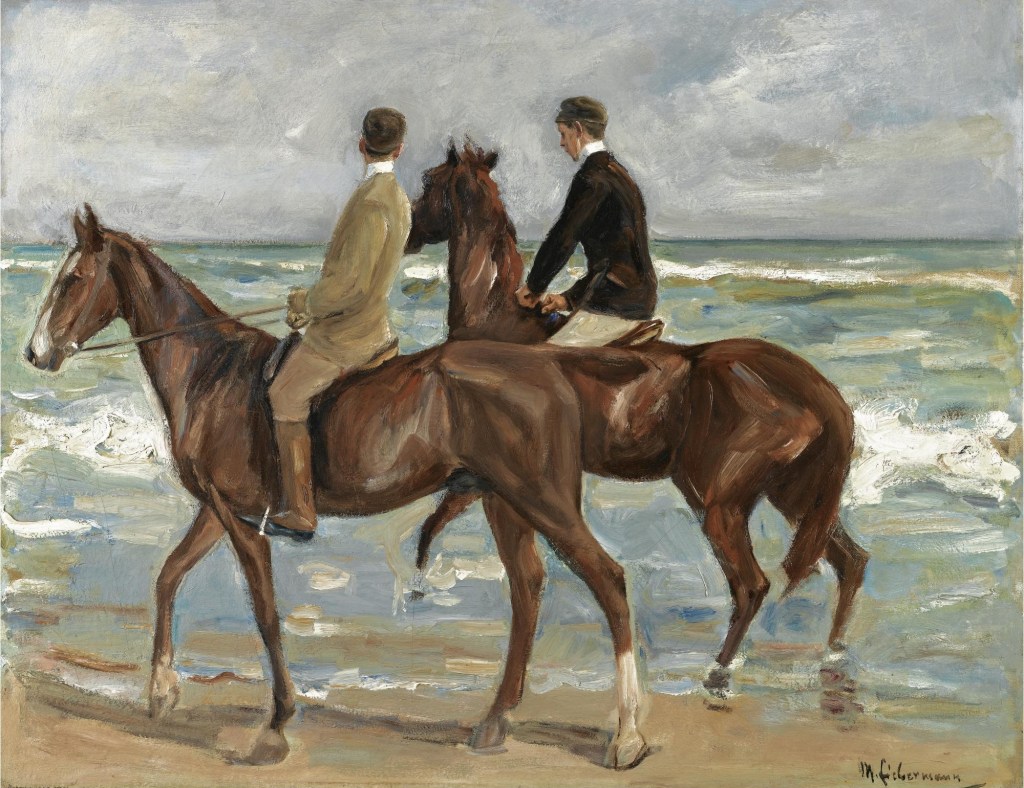
Two Riders on the Beach, 1901
For the song of the day, Don Henley – “The Heart of the Matter”
Always,
Mac Tag
thanks for stoppin’ by y’all
 The Lovers’ Chronicle
Leave a reply to The Lovers’ Almanac 21 July – to think so – art by Lovis Corinth, Carlos Schwabe & Emil Orlik – birth of Hart Crane and Ernest Hemingway – photography by Russell Lee – The Lovers’ Chronicle Cancel reply