Dear Zazie, Here is today’s Lovers’ Chronicle from Mac Tag to his muse. Be sure and read the Modigliani-Hébuterne love story below. It is literally, to die for. Follow us on twitter @cowboycoleridge. Have you loved a full woman or man. Best, Rhett
The Lovers’ Chronicle
Dear Muse,
plenty of woman songs
but searched until i found one
i think is a good fit, written by
Chips Moman and Dan Penn,
and recorded by Aretha;
‘’If you want a do right all days woman
You gotta be a do right all night man’’
’’Great song and sound advice’’
right, they were writin’ about a full woman
’’A recurring theme for you in your poems’’
yes, someone i was always lookin’ for
and i am continually amazed that i found one
and that she is sittin’ next to me as i write this

© copyright 2023.2024 mac tag/cowboy coleridge all rights reserved
full of actually livin’ life as opposed to sittin’ on the sidelines watchin’ it all go by; never said the boy could not be taken out of the routine; the words will come, they are never far and one day i will have them and, how convenient
is this, i reach across the couch, voilà, a full woman
© copyright 2022.2023 mac tag/cowboy coleridge all rights reserved
this should be easy
i just need to read the title
and ride the inspiration
for you are that and more
everything i have written
over the past year
has come from you
the level of devotion
i espouse is well considered
and i will not take for granted
that which you have allowed
© copyright 2021 mac tag/cowboy coleridge all rights reserved
Pale Love, Pale Rider
full bar
pen full of inspiration
check and check
ready for whatever
this bein’ a sunday
calls for a martini,
probably a vesper,
followed by pizza
and red wine later
oh and my friends,
solitude and whoever
is in the movie i watch
one belongs
where one belongs
no use fightin’ it
© copyright 2020.2023 mac tag/cowboy coleridge all rights reserved
after, long months later,
the beauty and sorrow
of havin’ (do i still)
after you in me
and me in you
hold your arms between
mine and my body
on your body
you are even
more than before
i see how much
without knowin’
i am there
here i am,
and you
***
“… and for a moment” (wait, who are we kiddin’, it ain’t no moment, it is always) “a strange feeling of loneliness and empty space gripped his heart.”
© copyright 2019 mac tag/cowboy coleridge all rights reserved
what brilliance
between two as one
this full woman
and this lucky man
on a journey
not taken lightly
a journey charged
with findin’
and followin’
and exceedin’
their dreams
© copyright 2018 mac tag/cowboy coleridge all rights reserved
the only thing full
around here is the bar
as it should be
too many pieces to pick up
and put back together
to even consider
any romantic notions
oh and this full,
my pen with words
all i have to do
is follow it across
the page
it is effortless
and i am grateful
© copyright 2017.2023 mac tag/cowboy coleridge all rights reserved
The followin’ poem was inspired by Pablo Neruda’s “Full Woman, Fleshy Apple, Hot Moon”:
Full Woman
Full woman, supple flesh, hot moon
Thick smell of pine trees down by the river
What obscure brilliance opens between two lovers
What ancient need does a woman touch with her senses
Lovin’ this full woman is a journey not taken lightly
A journey frought with charged passion and sudden storms
With clashes of dreams and desires and lightnin’ strikes
That can leave you defeated with a single touch of her lips
© Cowboy Coleridge mac tag copyright 2012 all rights reserved
Today is the birthday of Eugène Boudin (Eugène Louis Boudin; Honfleur, France 12 July 1824 – 8 August 1898 Deauville, France); painter and one of the first French landscape painters to paint outdoors. Boudin was a marine painter, rendering of all that goes upon the sea and along its shores. His pastels, garnered the eulogy of Baudelaire. Corot called him the “king of the skies”.
 Boudin, c. 1890
On 14 January 1863 he married the 28-year-old Breton woman Marie-Anne Guédès in Le Havre and set up home in Paris.
Gallery

Madame Juliette dans le jardin
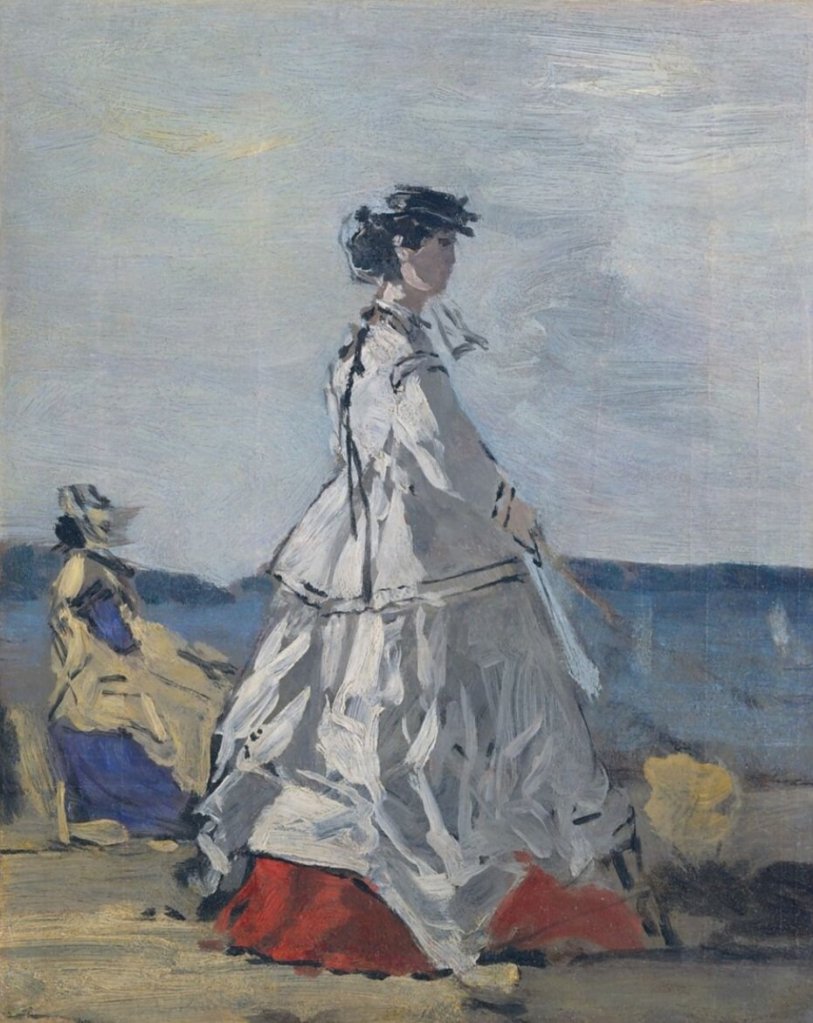
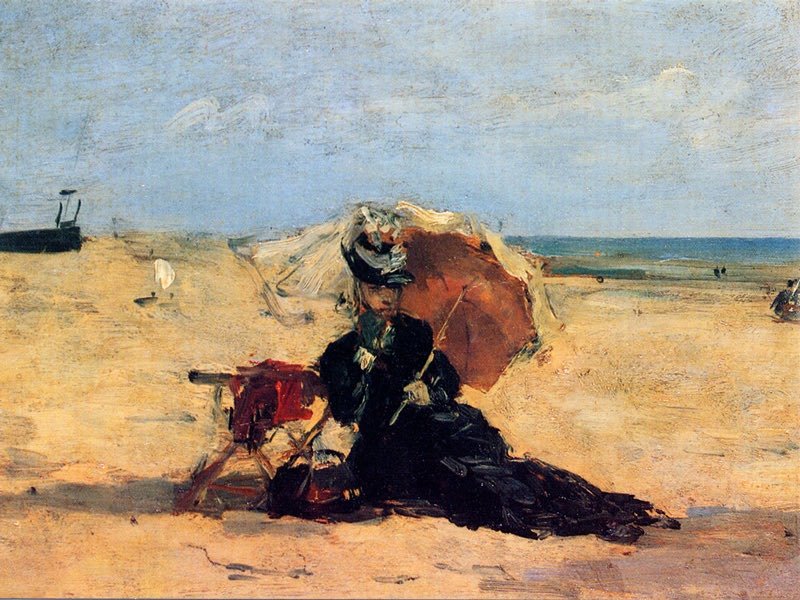
Honfleur, la plage

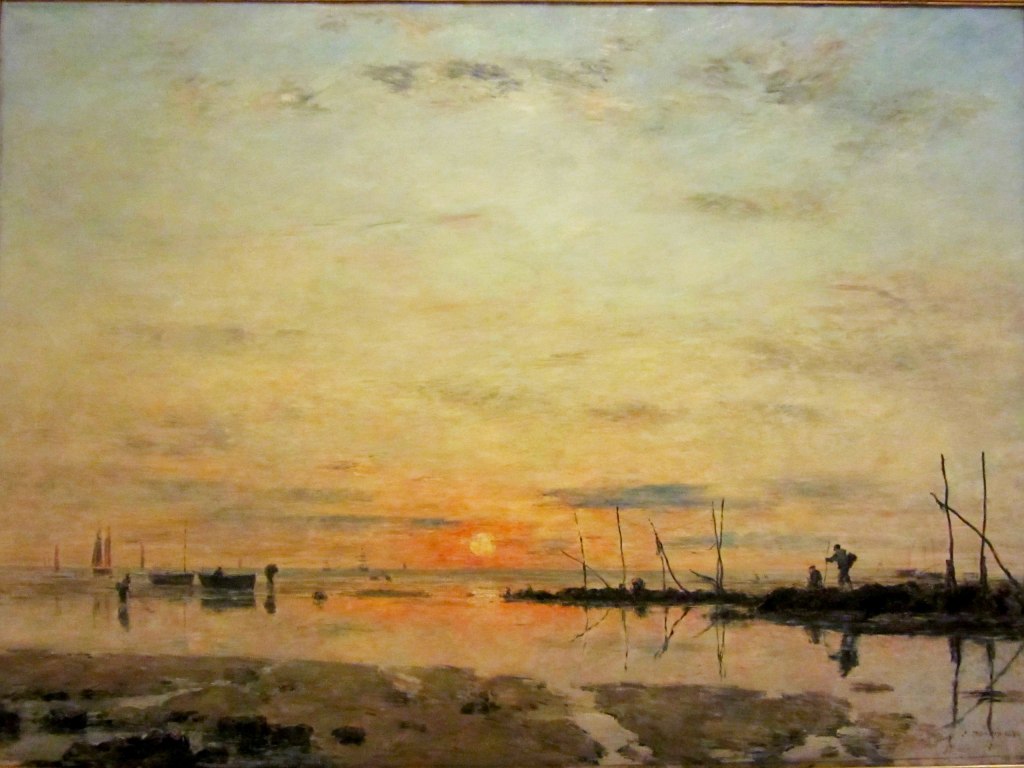
Coucher de soleil à marée basse

Coucher de soleil sur la Canche, Etaples
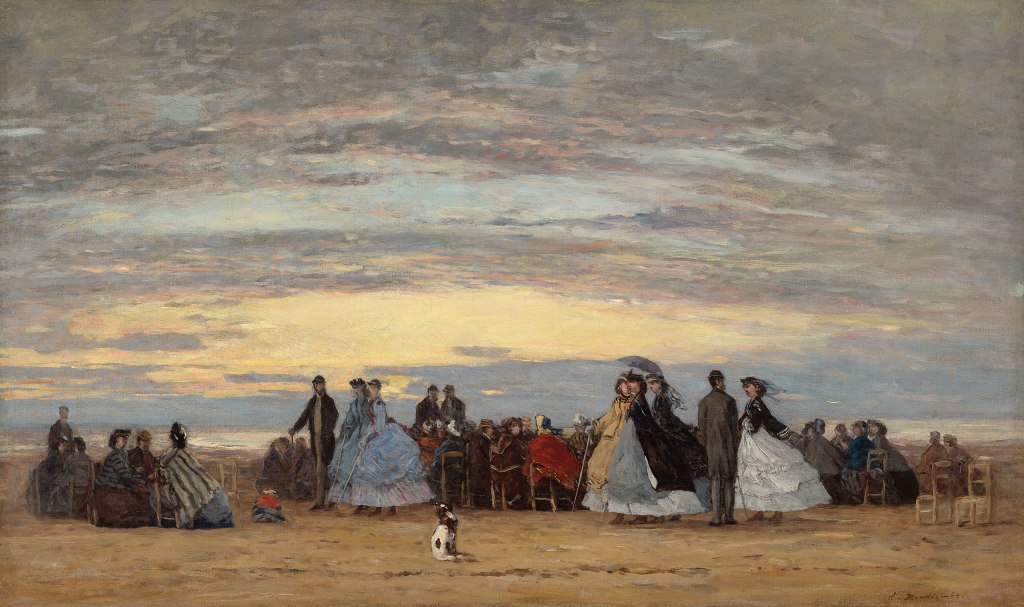
The Beach at Villerville, 1864. Oil on canvas. National Gallery of Art, Washington D.C.
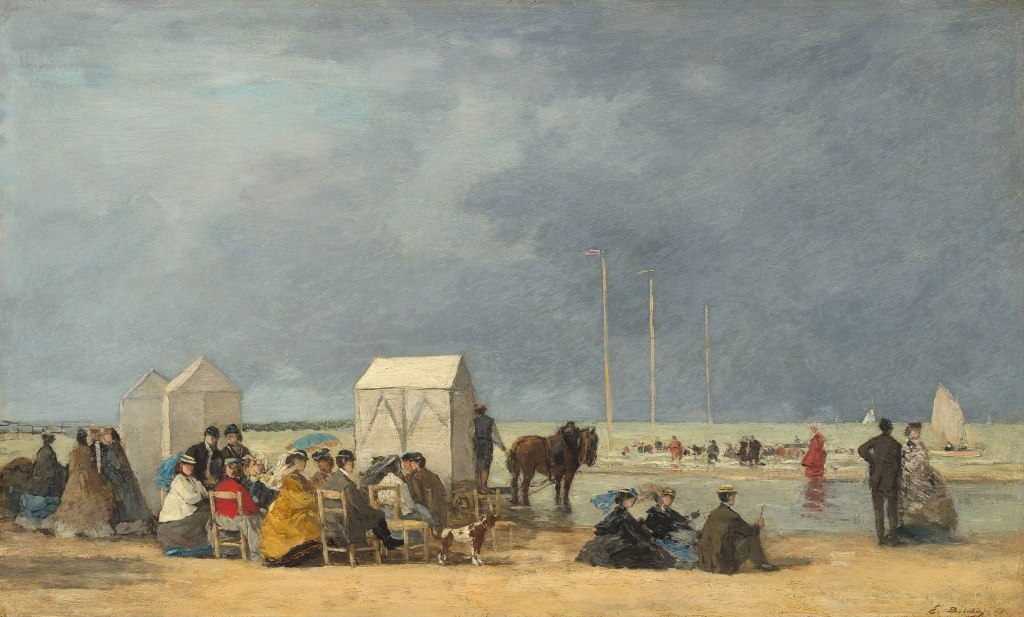
L’Heure du bain à Deauville (1865), Washington, National Gallery of Art
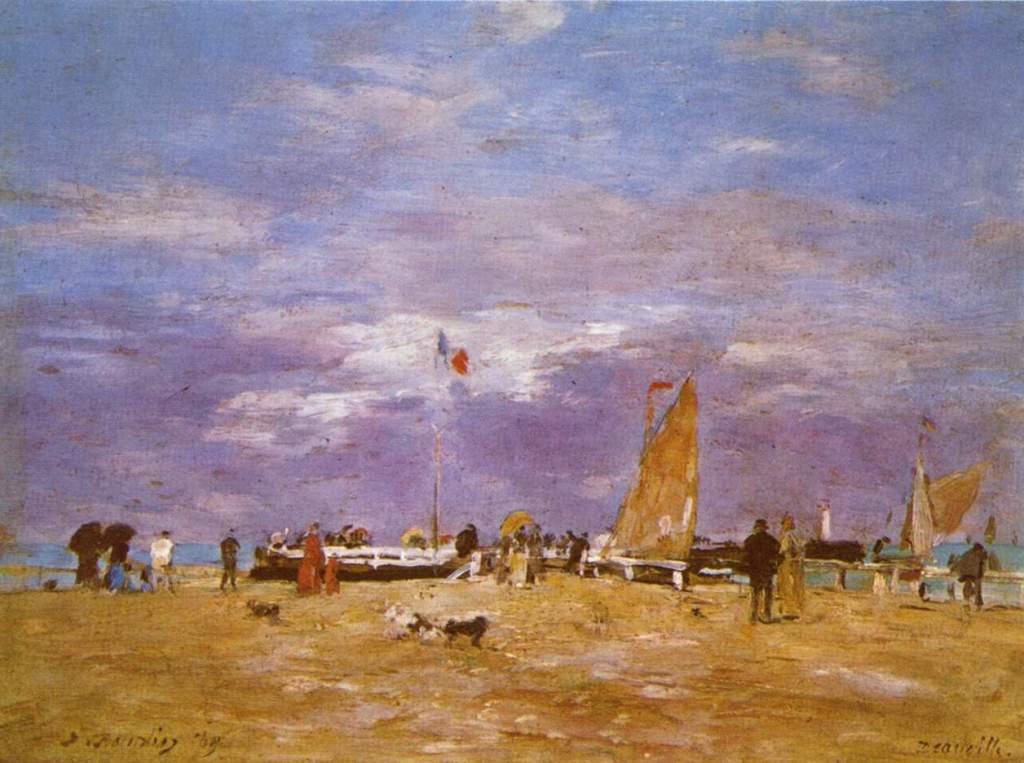
La Jetée de Deauville (1869), Paris, musée d’Orsay

The Beach near Trouville, circa 1865

La Plage à Trouville. L’impératrice Eugénie et sa suite (1863), Glasgow, collection Burrell
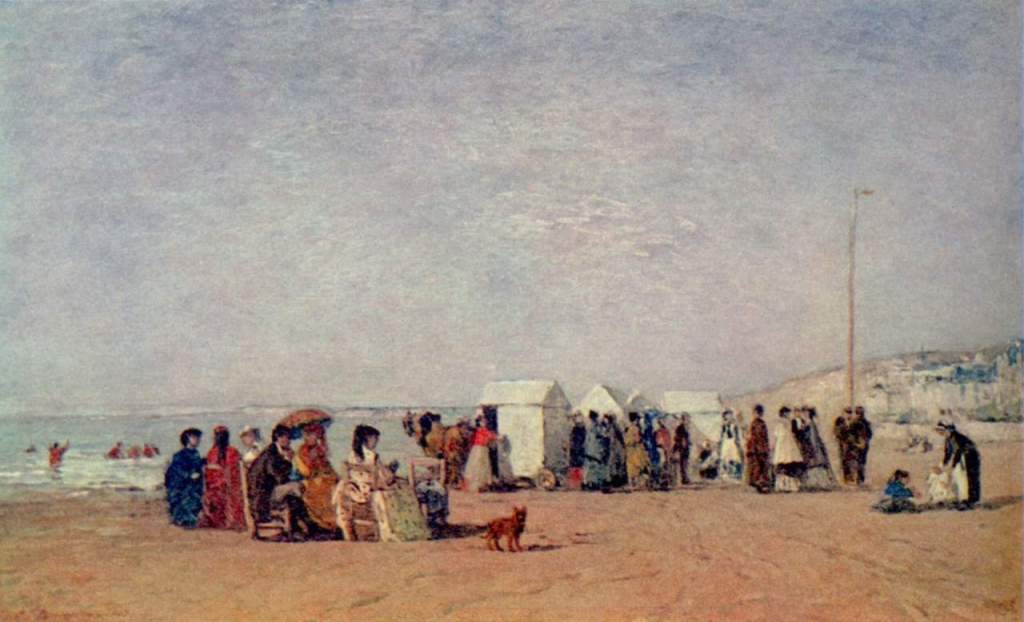
La Plage de Trouville (1868)), Paris, collection particulière

La Plage de Trouville (1863), New York, collection particulière

La Plage de Trouville (1864), Washington, National Gallery of Art

Sailboats at Trouville, 1884, Yale University Art Gallery, Collection of Mr. and Mrs. Paul Mellon.
Today is the birthday of Max Jacob (Quimper, Finistère, Brittany, France 12 July 1876 – 5 March 1944 Drancy Deportation Camp, France); poet, painter, writer, and critic. Max Jacob is regarded as an important link between the symbolists and the surrealists, as can be seen in his prose poems Le cornet à dés (The Dice Box, 1917 – the 1948 Gallimard edition was illustrated by Jean Hugo) and in his paintings. His writings include the novel Saint Matorel (1911), the verses Le laboratoire central (1921), and Le défense de Tartuffe (1919), which expounds his philosophical and religious attitudes.
 photographed by Carl van Vechten
He was one of the first friends Pablo Picasso made in Paris. They met in the summer of 1901, and it was Jacob who helped the young artist learn French. Later, on the Boulevard Voltaire, he shared a room with Picasso, who remained a lifelong friend (and was represented as the monk in his painting Three Musicians, which Picasso painted in 1921). Jacob introduced him to Guillaume Apollinaire, who in turn introduced Picasso to Georges Braque. He would become close friends with Jean Cocteau, Jean Hugo, Christopher Wood and Amedeo Modigliani (see below), who painted his portrait in 1916. He also befriended and encouraged the artist Romanin, otherwise known as French politician, and future Resistance leader Jean Moulin. Moulin’s famous nom de guerre Max is presumed to be selected in honor of Jacob.
Having moved outside of Paris in May, 1936, to settle in Saint-Benoît-sur-Loire, Loiret, Jacob was arrested on 24 February 1944 by the Gestapo, and interned at Orléans prison. Jewish by birth, Jacob’s brother Gaston had been previously arrested in January, 1944, deported to Auschwitz concentration camp, and gassed upon arrival with his sister Myrthe-Lea. Following his incarceration at Orléans, Max was then transferred to Drancy internment camp from where he was to be transported in the next convoy to Auschwitz in Poland. However, said to be suffering from bronchial pneumonia, Jacob died in the infirmary. First interred in Ivry, after the war ended in 1949 his remains were transferred by his artist friends Jean Cassou and René Iché (who sculpted the tomb of the poet) to the cemetery at Saint-Benoît-sur-Loire in the Loiret department.
quotes
| Après la mort de mon amour, oh ! de longs mois après, la douleur et la joie d’avoir aimé (t’aimè-je encore ?) après l’obscur charnier des ruptures sanglantes, et morte et mort et toi en moi et moi en toi, et morte et mort, moi que voici et toi là-bas, je te parlai, ô l’angélique, je te parlai de cette visite dans la neige à la porte de ta maison en ce Paris de velours blanc, pierre de lune, ombre et lumière en chaque rue.« Je savais que vous êtes fou, car tous les médecins vous le diront, les plus vrais fous sont les plus calmes. »Et morte et mort, et toi en moi et moi en toi, et morte et mort, moi que voici, et toi là-bas |
| Ballade de la visite nocturne, un des plus célèbres poèmes de Max Jacob. La « femme » en question est René Dulsou. |
| […] mon Dieu joli. Je tiens tes bras entre mes bras et mon corps sur ton corps. […] Tu es encore plus beau qu’auparavant, chéri […]. J’aime à sentir ton corps dans mes bras […]. Ton ventre est dur aussi. […] Je suis amoureux de ton cadavre et je vois combien je t’aimais sans le savoir […] jeune homme plus que charmant, plus que séduisant […]. |
| Mise au tombeau, hymne amoureux de Max Jacob au corps du Christ descendu de la croix. |
| Ah! L’envie me démangeDe te faire un ange,De te faire un angeEn fourrageant ton sein,Marie Laurencin,Marie Laurencin! |
| Chansonnette galante de Max Jacob, vers 1908. |
| Marianne avait un cheval blancRouge par derrière noir par devantIl avait une crinièreComme une crémaillèreIl avait une étoile au frontDu crin sur les boulonsIl avait des sabots grenatsDe la même couleur que vos basOù allez vous MarianneAvec votre alezane(…) |
| La Chanson de Marianne, mise en musique et chantée après guerre par Jacques Douai, est un des dix huit poèmes publiés en 1925 |
| A ParisSur un cheval grisA NeversSur un cheval vertA IssoireSur un cheval noirAh! Qu’il est beau, qu’il est beau!Ah! Qu’il est beau, qu’il est beau!Tiou!(…) |
| « Pour les enfants et les raffinés », Œuvres Burlesques et Mystiques de Frère Matorel 1912 |
Gallery


Apollinaire et sa muse


 “Le pardon de Sainte-Anne”.
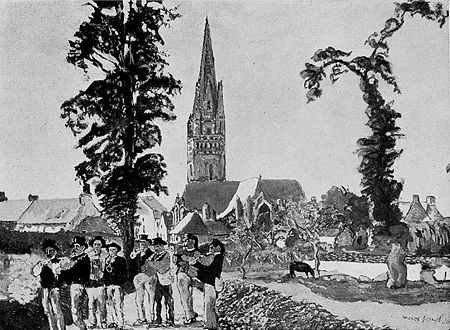 “Le clocher de Ploaré”
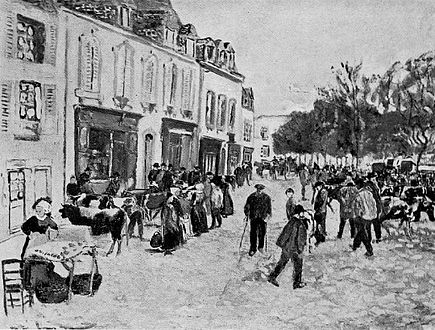 “Le marché à Pont-l’Abbé”
 “Le calvaire de Guengat”. Quimper’s Musée des beaux-arts
Today is the birthday of Amedeo Modigliani (Amedeo Clemente Modigliani; Livorno, Tuscany 12 July 1884 – 24 January 1920 Paris); painter and sculptor who worked mainly in France. He is known for portraits and nudes in a modern style characterized by elongation of faces and figures, that were not received well during his lifetime, but later found acceptance. Modigliani spent his youth in Italy, where he studied the art of antiquity and the Renaissance, until he moved to Paris in 1906. Modigliani’s œuvre includes paintings and drawings. From 1909 to 1914, however, he devoted himself mainly to sculpture. During his life, Modigliani had little success, but after his death he achieved greater popularity. He died at age 35 of tubercular meningitis.
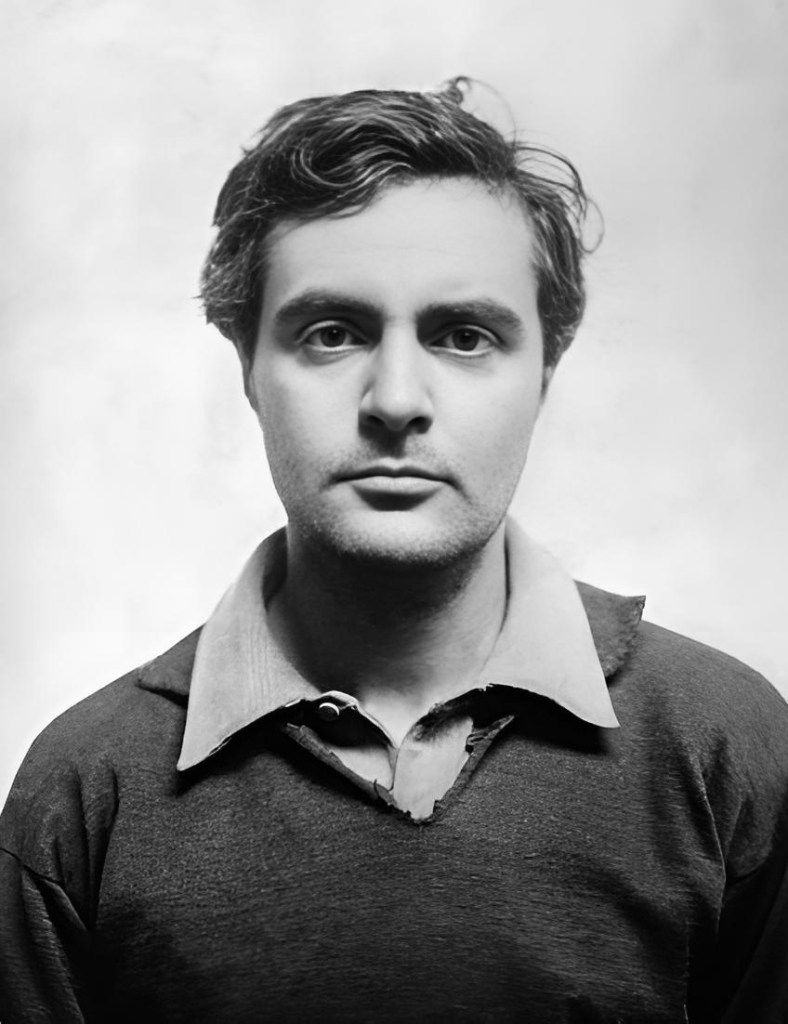
in 1918
He met the first serious love of his life, Russian poet Anna Akhmatova, in 1910, when he was 26. They had studios in the same building, and although 21-year-old Anna was recently married, they began an affair. Anna was tall (as Modigliani was only 5 foot 5 inches) with dark hair (like Modigliani’s), pale skin and grey-green eyes, she embodied Modigliani’s aesthetic ideal and the pair became engrossed in each other. After a year, however, Anna returned to her husband.

In the spring of 1917, the Russian sculptor Chana Orloff introduced him to a beautiful 19-year-old art student named Jeanne Hébuterne. From a conservative bourgeois background, Hébuterne was renounced by her devout Roman Catholic family for her liaison with Modigliani, whom they saw as little more than a debauched derelict. Despite her family’s objections, soon they were living together. Modigliani ended his relationship with the English poet and art critic Beatrice Hastings and a short time later Hebuterne and Modigliani moved together into a studio on the Rue de la Grande Chaumière. Jeanne began to pose for him and appears in several of his paintings. Hébuterne became a principal subject for Modigliani’s art. Towards the end of the First World War, early in 1918, Modigliani left Paris with Hébuterne to escape from the war and travelled to Nice and Cagnes-sur-Mer. They would spend a year in France. In May 1919 they returned to Paris with their infant daughter and moved into an apartment on the rue de la Grande Chaumière. After Hébuterne became pregnant again, Modigliani got engaged to her, but Jeanne’s parents were against the marriage, especially because of Modigliani’s reputation as an alcoholic and drug user. The wedding plans were shattered independently of Jeanne’s parents’ resistance when Modigliani discovered he had a severe form of tuberculosis.
After not hearing from him for several days, a neighbour checked on the family and found Modigliani in bed delirious and holding onto Hébuterne. A doctor was summoned, but little could be done because Modigliani was in the final stage of his disease. He died at the Hôpital de la Charité. There was an enormous funeral, attended by many from the artistic communities in Montmartre and Montparnasse. When Modigliani died, twenty-one-year-old Hébuterne was eight months pregnant with their second child. A day later, Hébuterne was taken to her parents’ home. There, inconsolable, she threw herself out of a fifth-floor window, a day after Modigliani’s death, killing herself and her unborn child. Modigliani was buried in Père Lachaise Cemetery. Hébuterne was buried at the Cimetière de Bagneux near Paris, and it was not until 1930 that her embittered family allowed her body to be moved to rest beside Modigliani. A single tombstone honors them both. His epitaph reads: “Struck down by Death at the moment of glory”. Hers reads: “Devoted companion to the extreme sacrifice”. Managing only one solo exhibition in his life and giving his work away in exchange for meals in restaurants, Modigliani died destitute.
Gallery
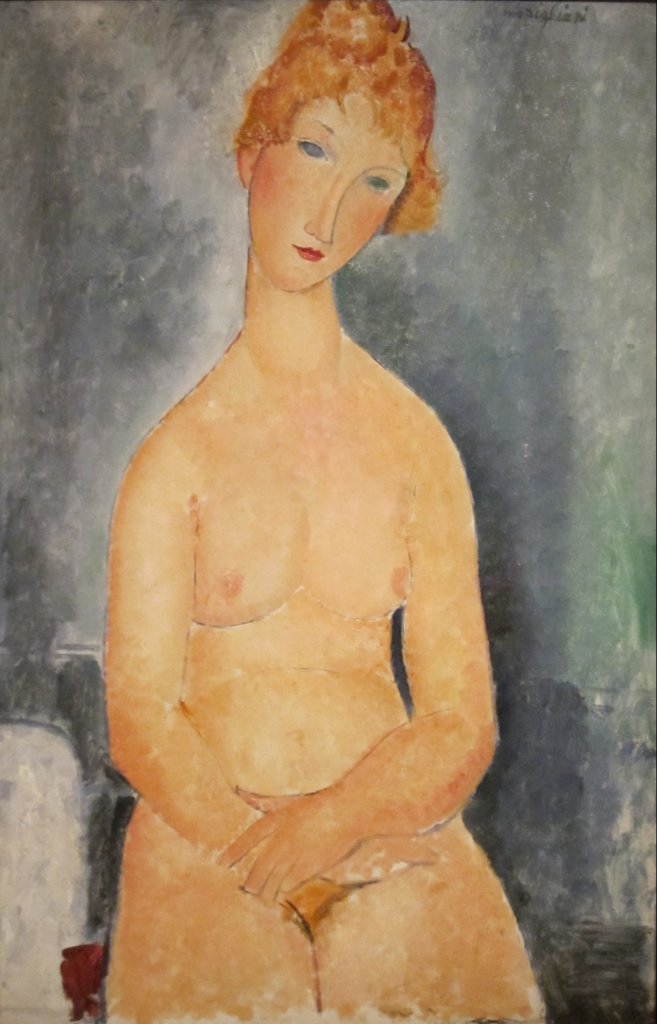
Assise nue, 1918, Honolulu Museum of Art

Portrait de Jeanne assise de profil, 1918, huile sur toile, 100 × 65 cm, coll. priv

Portrait de Jeanne (tête de face), 1919, huile sur toile, 55 × 38 cm, coll. priv

Jeanne 1919, huile sur toile, 91,5 × 73 cm, New York, Metropolitan Museum of Art

Jeanne assise


Jeanne with Yellow Sweater, 1918
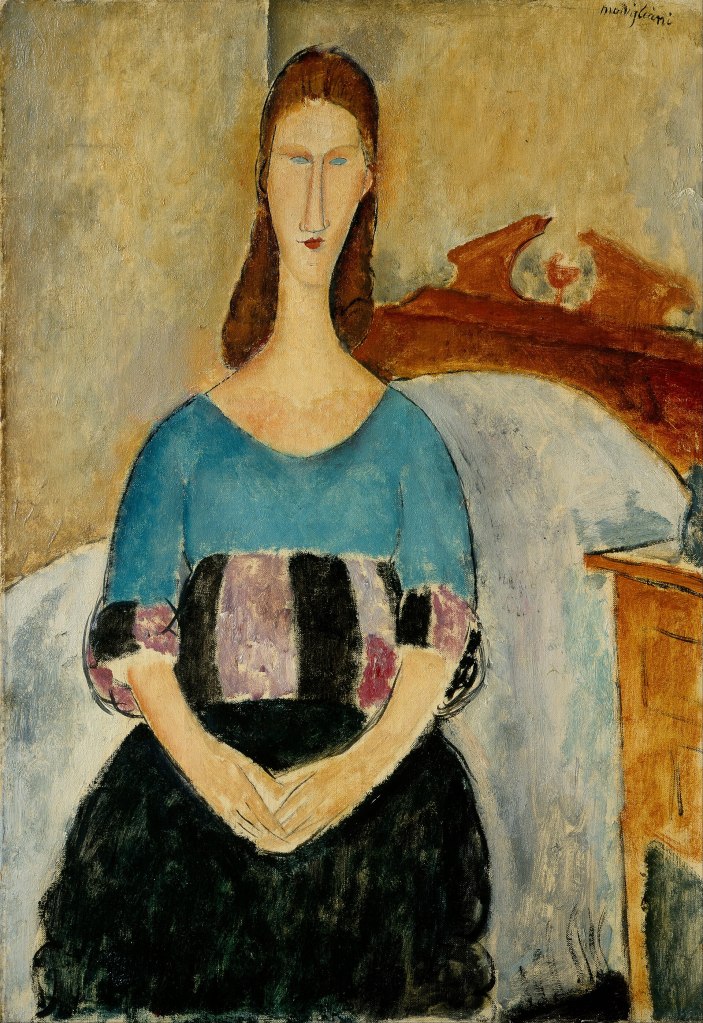
Portrait of Jeanne, Seated, 1918, Israel Museum, Jerusalem

Retrato de Nina Hamnett
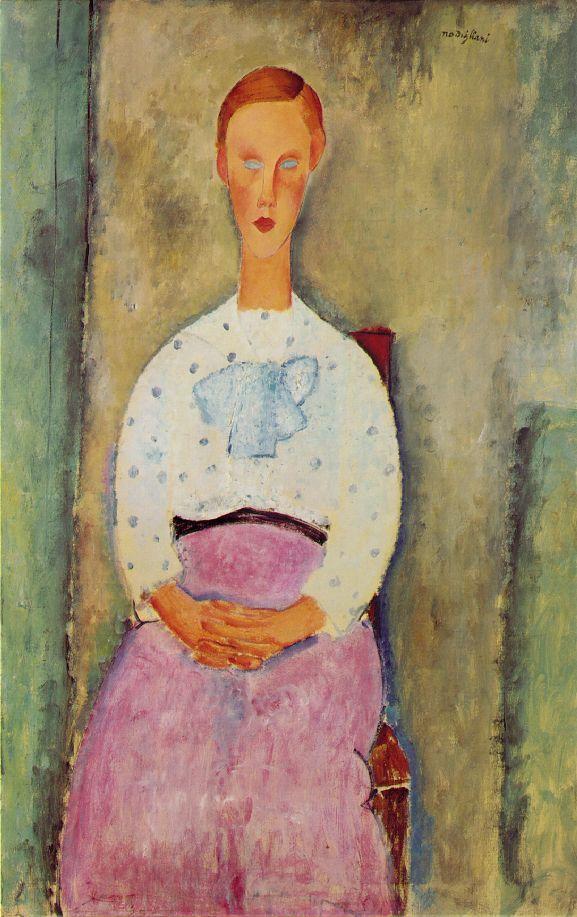
Ragazza in camicetta a pois (1919)

La Blouse rose, 1918, huile sur toile, 98 × 64 cm, Avignon, musée Angladon
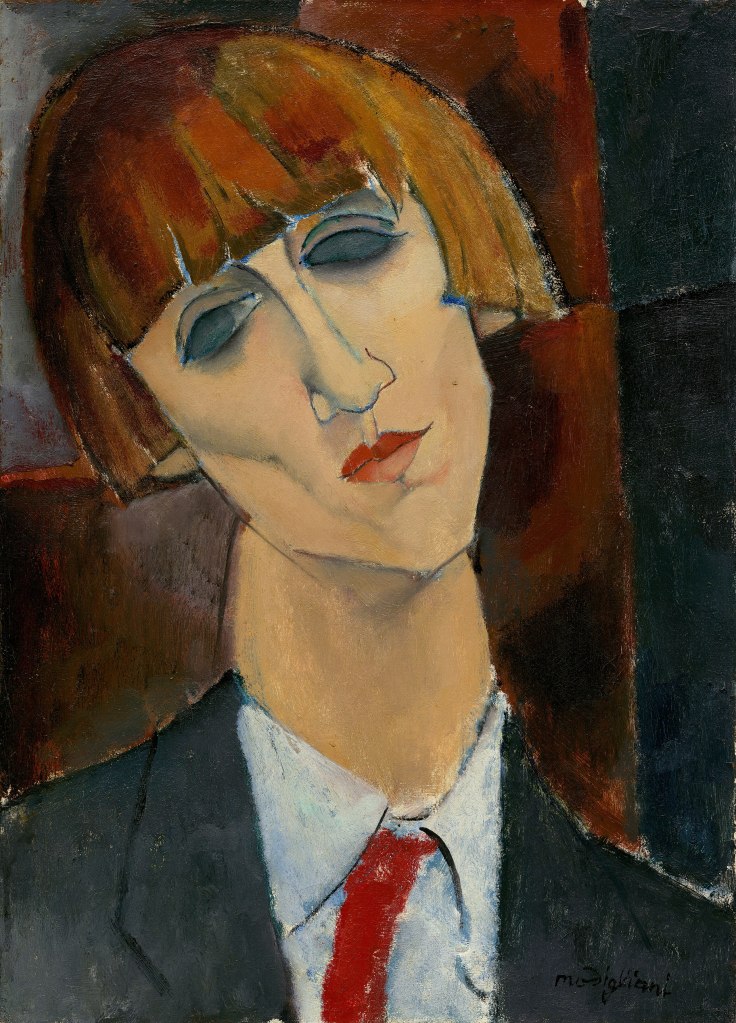
Madame Kisling, 1917

Nu couché, 1917-18
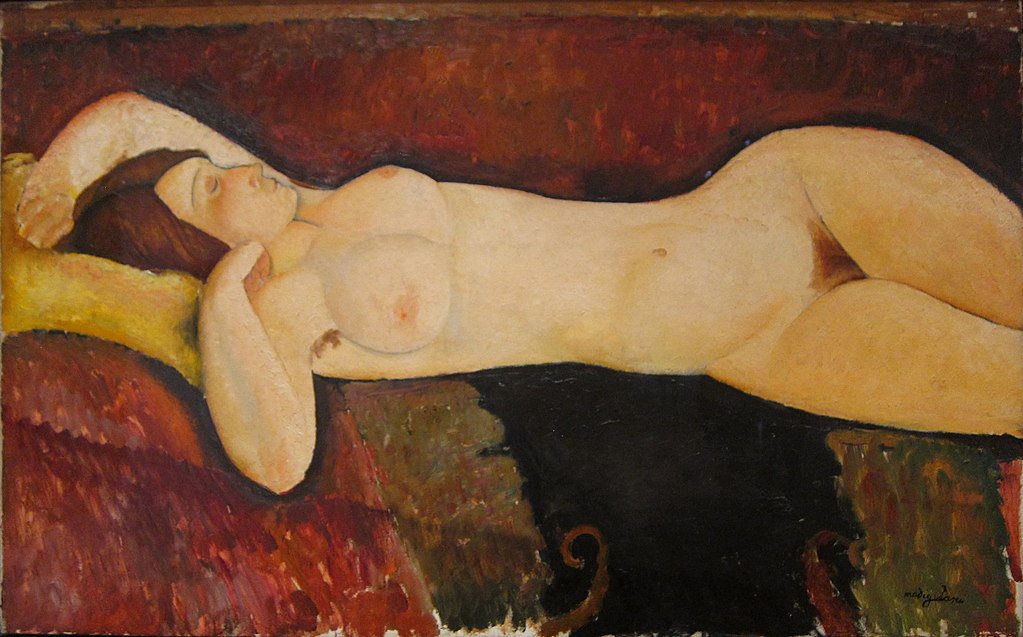
Grande nudo disteso
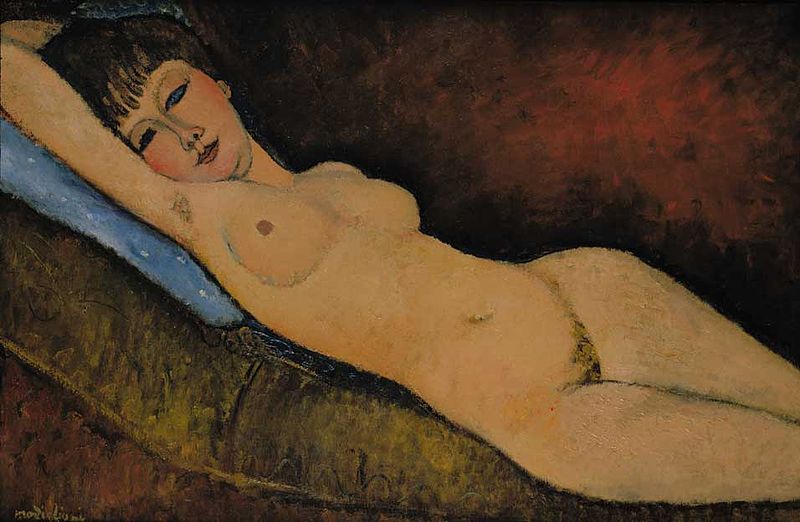
Nu Couché au coussin Bleu, one of the finest examples of reclining nudes by Modigliani, 1916

Nu allongé sur un oreiller blanc, vers 1917, huile sur toile, 60 × 92 cm, Stuttgart, Staatsgalerie

Nu couché les bras derrière la tête, 1917, huile sur toile, 60,5 × 92,5 cm, coll. priv.
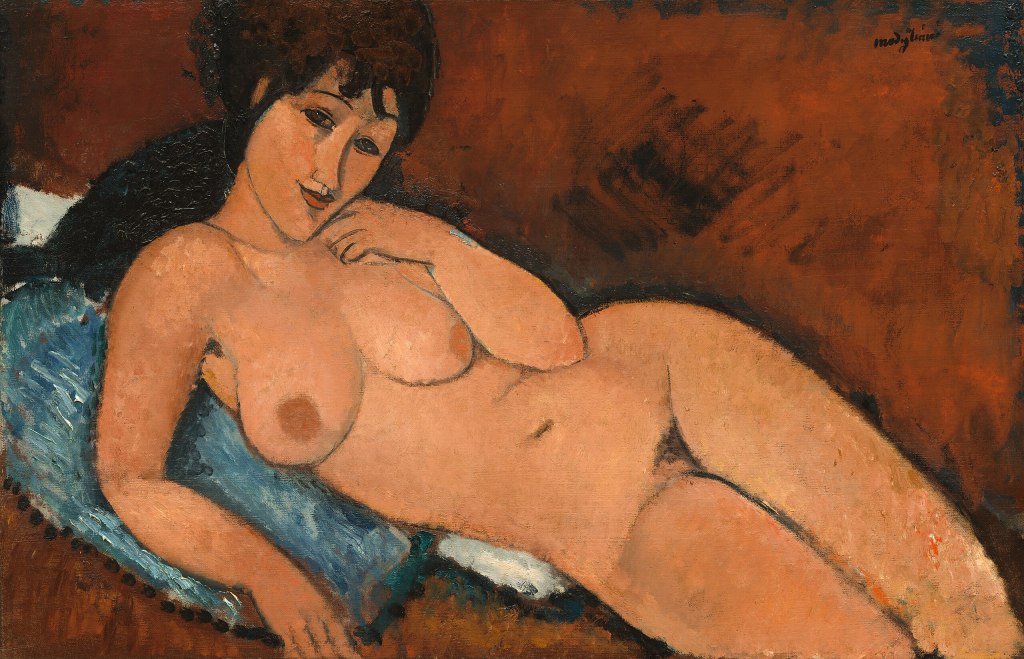
Nu sur un coussin bleu, 1917, huile sur toile, 65,5 × 101 cm, Washington, National Gallery of Art

Nu couché (sur le côté gauche), 1917, huile sur toile, 89 × 146 cm, coll. priv
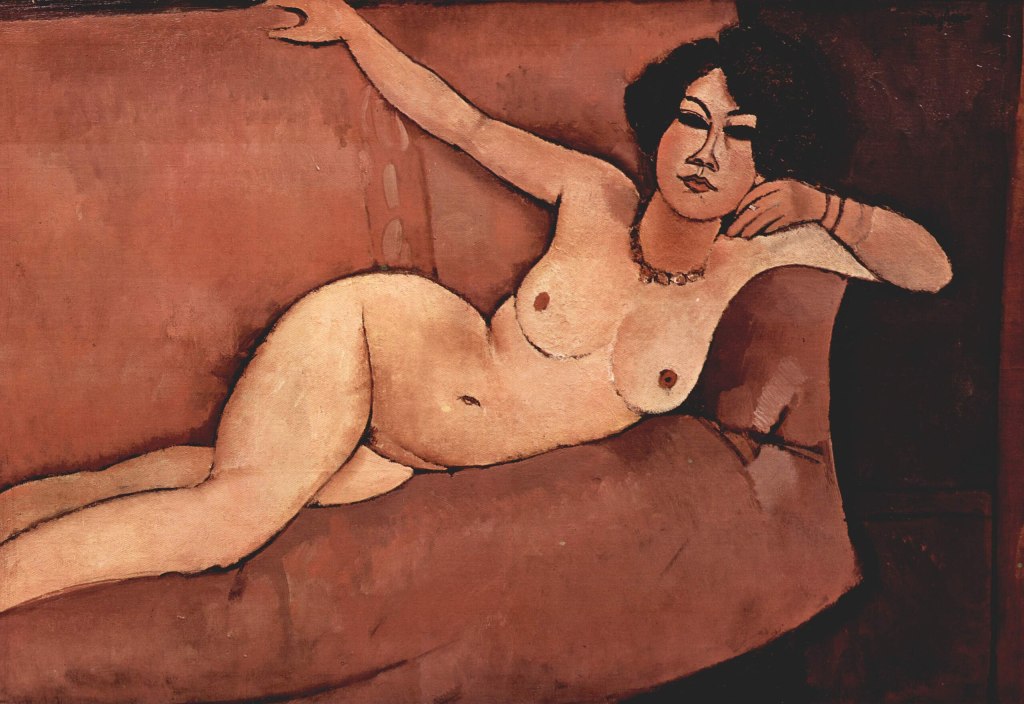
Nu au sofa (Almaïsia), 1916, 81 × 116 cm, coll. priv.

Nu assis, 1917, Musée des Beaux-Arts de Lyon

Nu assis sur un divan (La Belle Romaine), 1918, huile sur toile, 100 × 65 cm, coll. priv
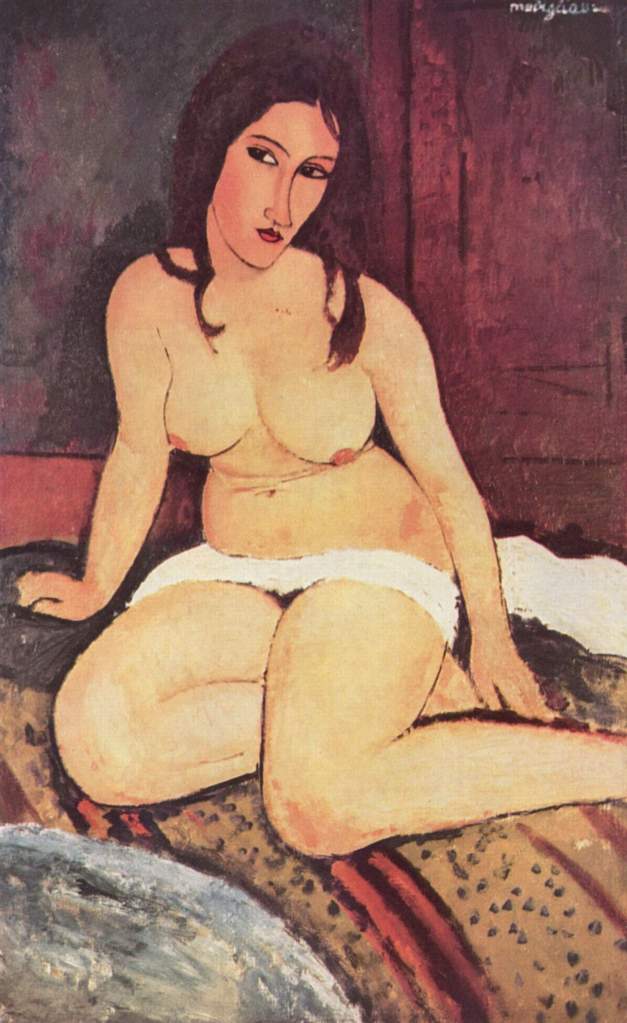
Nu assis, 1917, Musée royal des Beaux-Arts d’Anvers

Iris Tree, c. 1916, Courtauld Institute of Art

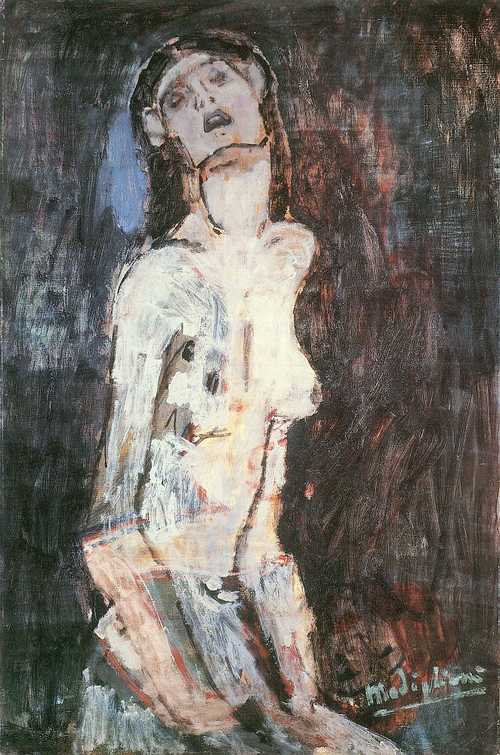

Jeanne with Hat and Necklace, 1917

Jeanne, 1918
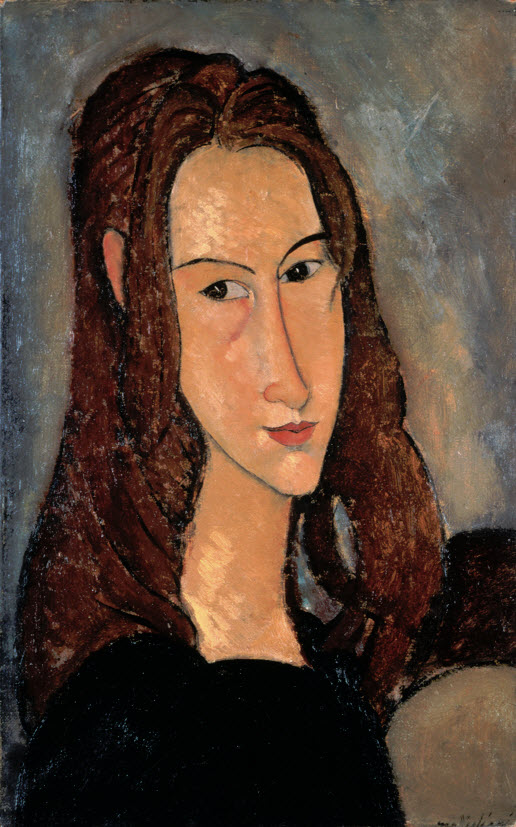
Portrait de Jeanne (tête de profil), 1918, huile sur toile, 46 × 29 cm, coll. priv

portrait of Jeanne

Portrait de Jeanne au grand chapeau, 1918-1919, huile sur toile, 54 × 37,5 cm, coll. priv
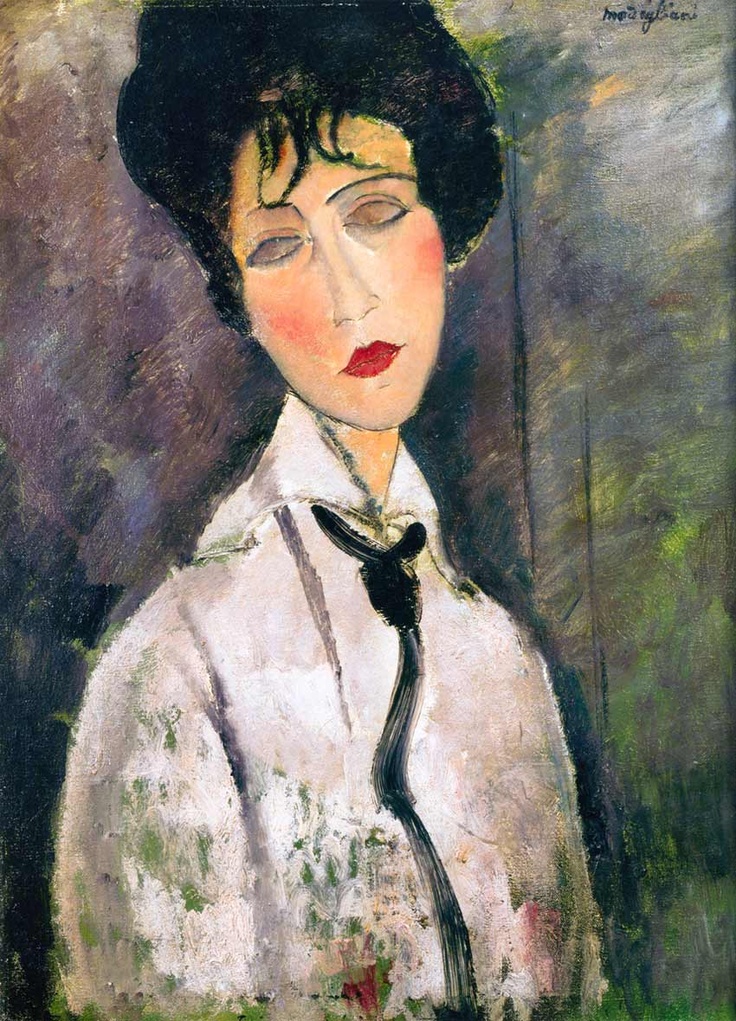
Femme à la cravate noire, 1917, huile sur toile, 65,5 × 50,5 cm, coll. priv.

Portrait of a Young Woman, 1918, New Orleans Museum of Art

La Femme à l’éventail (Lunia Czechowska), 1919, huile sur toile, 100 × 65 cm, musée d’Art moderne de Paris

Portrait of Beatrice Hastings, 1916
| Pablo Neruda | |
|---|---|
 | |
Today is the birthday of Pablo Neruda (Ricardo Eliécer Neftalí Reyes Basoalto; JParral, Maule Region; July 12, 1904 – September 23, 1973Santiago). He derived his pen name from the Czech poet Jan Neruda. Neruda won the Nobel Prize for Literature in 1971. He wrote in a variety of styles, including surrealist poems, historical epics, overtly political manifestos, a prose autobiography, and passionate love poems. He often wrote in green ink, which was his personal symbol for desire and hope. The Colombian novelist Gabriel García Márquez once called Neruda “the greatest poet of the 20th century in any language.” I highly recommend his erotically-charged love poems such as the ones in his 1924 collection Veinte poemas de amor y una canción desesperada (Twenty Love Poems and a Song of Despair).
Neruda married three times: Marijke Antonieta Hagenaar Vogelzan (m. 1930; div. 1942), Delia del Carril (m. 1943; div. 1955), Matilde Urrutia Cerda (m. 1966).
Neruda met Urrutia in Santiago in 1946, when she was working as a physical therapist in Chile. She was the first woman in Latin America to work as a pediatric therapist. Urrutia was the inspiration behind Neruda’s later love poems beginning with Los Versos del Capitan in 1951, which the poet withheld publication until 1961 to spare the feelings of his previous wife; as well as 100 Love Sonnets which includes a beautiful dedication to her.
Neruda built a house in Santiago called “La Chascona”, for Urrutia, which served as a secret love den for the two, as news that Neruda was having an affair would not have been received well by the Chilean public. In his house, there is a portrait of Urrutia painted by Diego Rivera, given to her by Neruda depicting a two-faced Urrutia with her famously long, bright red hair. What is remarkable about this painting is that one face depicts Urrutia as the singer the public knew, and the other depicts the lover Neruda knew. The painting also has a hidden image; the profile view of Neruda’s face is hidden in her hair, showing their continuous secret relationship.
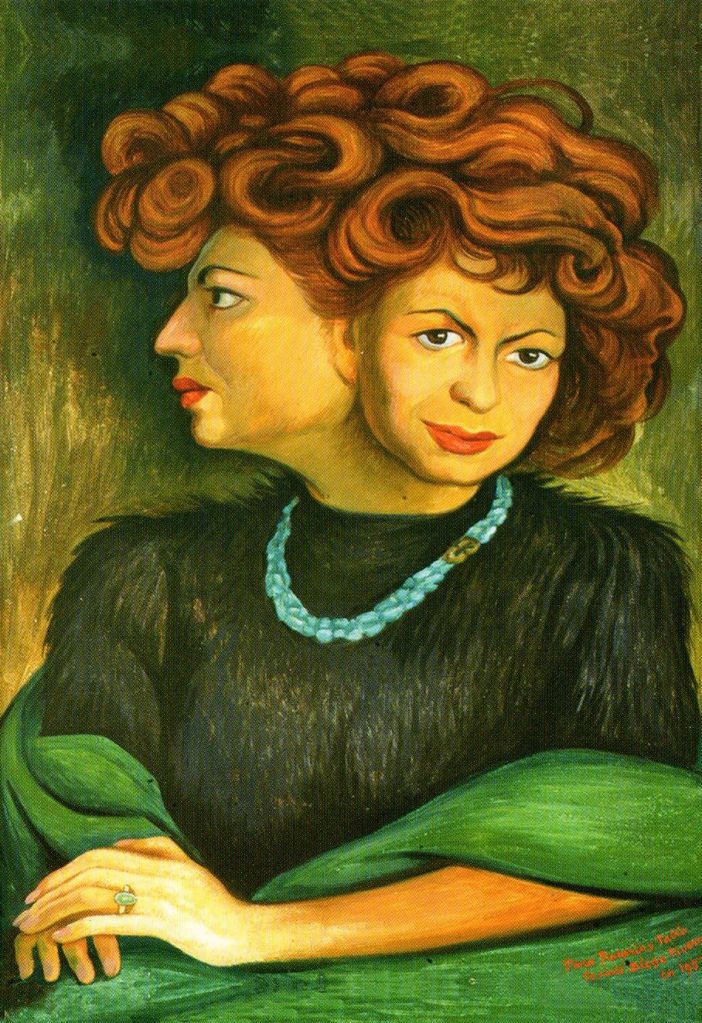
Urrutia by Rivera
After Neruda’s death, Urrutia edited for publication his memoir, Confieso que he vivido (“I confess that I have lived”). This and other activities brought her into conflict with the government of Augusto Pinochet, which tried to suppress the memory of Neruda, an outspoken communist, from the collective consciousness.
In November 2018, the Cultural Committee of Chile’s lower house voted in favor of renaming Santiago’s main airport after Neruda. The decision sparked protests from feminist groups who highlighted a passage in Neruda’s memoirs describing raping a woman in 1929 in Ceylon (Sri Lanka). Several feminist groups, bolstered by a growing #MeToo and anti-femicide movement, stated that Neruda should not be honored by his country, describing the passage as evidence of rape. Neruda remains a controversial figure for Chileans, and especially for Chilean feminists.
Her own memoir, My Life with Pablo Neruda, ISBN 0-8047-5009-2, was published posthumously in 1986.
- Debajo de tu piel vive la luna.
- The moon lives in the lining of your skin.
- Oda a la Bella Desnuda (Ode to a Beautiful Nude), from Nuevas Odas Elementales (1956), trans. Nathaniel Tarn in Selected Poems by Pablo Neruda [Houghton Mifflin, 1990, ISBN 0-395-54418-1] (p. 349).
- Mi amor se nutre de tu amor, amada
- My love feeds on your love, beloved
- From “Si Tu Me Olvidas” (If You Forget Me)
- My love feeds on your love, beloved
Es la hora, amor mío, de apartar esta rosa sombría,
cerrar las estrellas, enterrar la ceniza en la tierra:
y, en la insurrección de la luz, despertar con los que despertaron
o seguir en el sueño alcanzando la otra orilla del mar que no tiene otra orilla.
- It is time, love, to break off that sombre rose,
shut up the stars and bury the ash in the earth;
and, in the rising of the light, wake with those who awoke
or go on in the dream, reaching the other shore of the sea which has no other shore. - La Barcarola Termina (The Watersong Ends) (1967), trans. Anthony Kerrigan in Selected Poems by Pablo Neruda [Houghton Mifflin, 1990, ISBN 0-395-54418-1] (p. 500).
Veinte Poemas de Amor y una Canción Desesperada (Twenty Love Poems and a Song of Despair) (1924)
trans. William S. Merwin [Penguin Classics, 1993, ISBN 0-140-18648-4]
- ¿Quién escribe tu nombre con letras de humo entre las estrellas del sur?
Ah déjame recordarte cómo eras entonces, cuando aún no existías.- Who writes your name in letters of smoke among the stars of the south?
Oh let me remember you as you were before you existed. - “Every Day You Play” (Juegas Todos los Días), XIV, p. 35.
- Who writes your name in letters of smoke among the stars of the south?
- Quiero hacer contigo lo que la primavera hace con los cerezos.
- I want to do with you what spring does with cherry trees.
- “Every Day You Play” (Juegas Todos las Días), XIV, p. 35.
- Me gustas cuando callas porque estás como ausente,
y me oyes desde lejos, y mi voz no te toca.- I like for you to be still: it is as though you were absent,
and you hear me from far away and my voice does not touch you. - “I Like for You to be Still” (Me Gustas Cuando Callas), p. 37.
- I like for you to be still: it is as though you were absent,
- Puedo escribir los versos más tristes esta noche.
- Tonight I can write the saddest lines.
- “Tonight I Can Write” (Puedo Escribir), XX, p. 49.
- Es tan corto el amor y tan largo el olvido.
- Love is so short and forgetting is so long.
- “Tonight I Can Write” (Puedo Escribir), XX, p. 51.
And today is the birthday of Andrew Wyeth; (Andrew Newell Wyeth; Chadds Ford, Pennsylvania July 12, 1917 – January 16, 2009 Chadds Ford); visual artist, primarily a realist painter, working predominantly in a regionalist style. He was one of the best-known U.S. artists of the middle 20th century.

In his art, Wyeth’s favorite subjects were the land and people around him, both in his hometown of Chadds Ford, Pennsylvania, and at his summer home in Cushing, Maine. Wyeth often said: “I paint my life.” One of the best-known images in 20th-century American art is his tempera painting Christina’s World, currently in the collection of the Museum of Modern Art in New York City, which was painted in 1948, when Wyeth was 31 years old.
On May 15, 1940, Wyeth married Betsy James, whom he met in 1939 in Maine. Christina Olson, who was to become the model for Christina’s World, met Wyeth through an introduction by Betsy. Betsy, had an influence on Andrew as strong as that of his father, such that N. C. Wyeth began to resent her. She played an important role managing his career. She was once quoted as saying, “I am a director and I had the greatest actor in the world.”
In 1986, extensive coverage was given to the revelation of a series of 247 studies of the German-born Helga Testorf, whom Wyeth met while she was attending to Karl Kuerner at his farm. Wyeth painted her over the period 1971 to 1985 without the knowledge of either his wife or Helga’s husband, John Testorf. Helga, a caregiver with nursing experience, had never modeled before but quickly became comfortable with the long periods of posing, during which he observed and painted her in intimate detail. She is nearly always portrayed as unsmiling and passive. This extensive study of one subject in differing contexts and emotional states is unique in American art.
Wyeth died in his sleep after a brief illness. He was 91 years old. Betsy died on April 21, 2020, at the age of 98.
Gallery
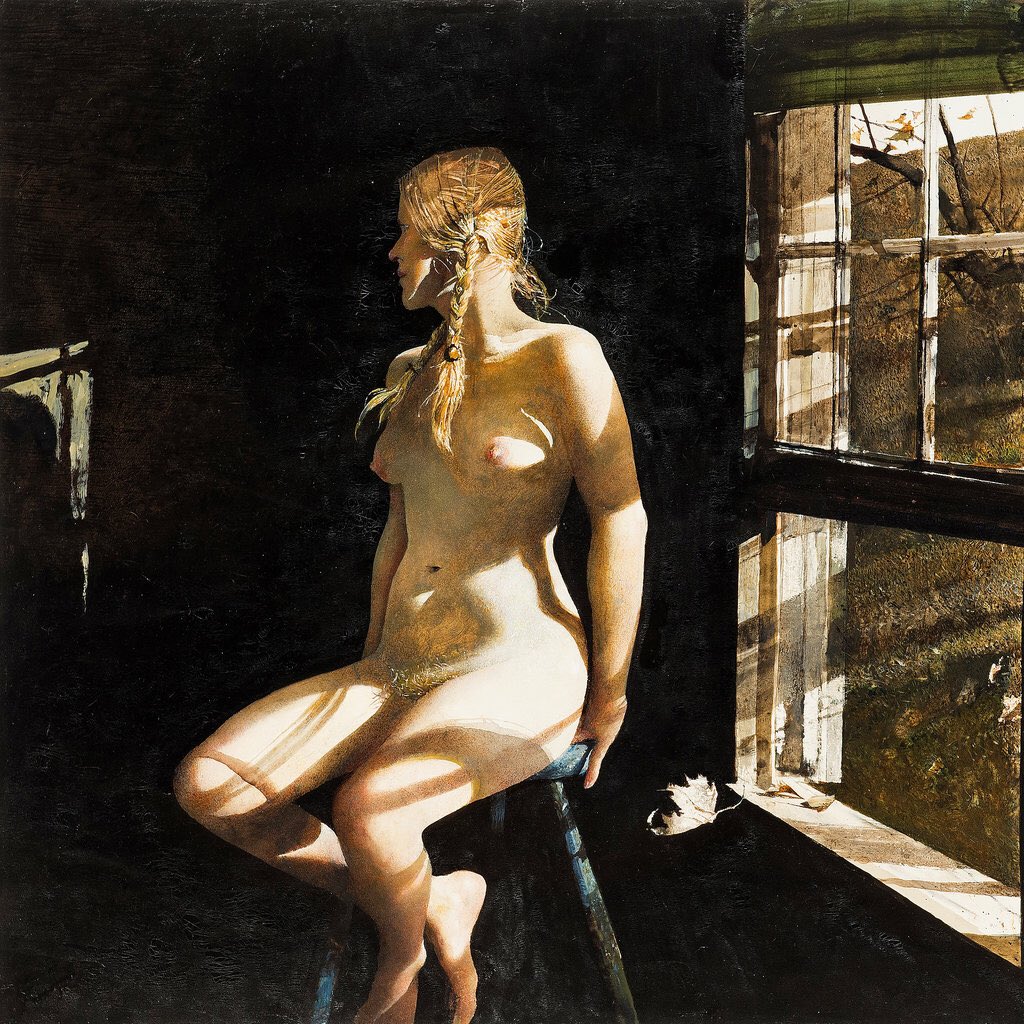
Lovers 1981 helga
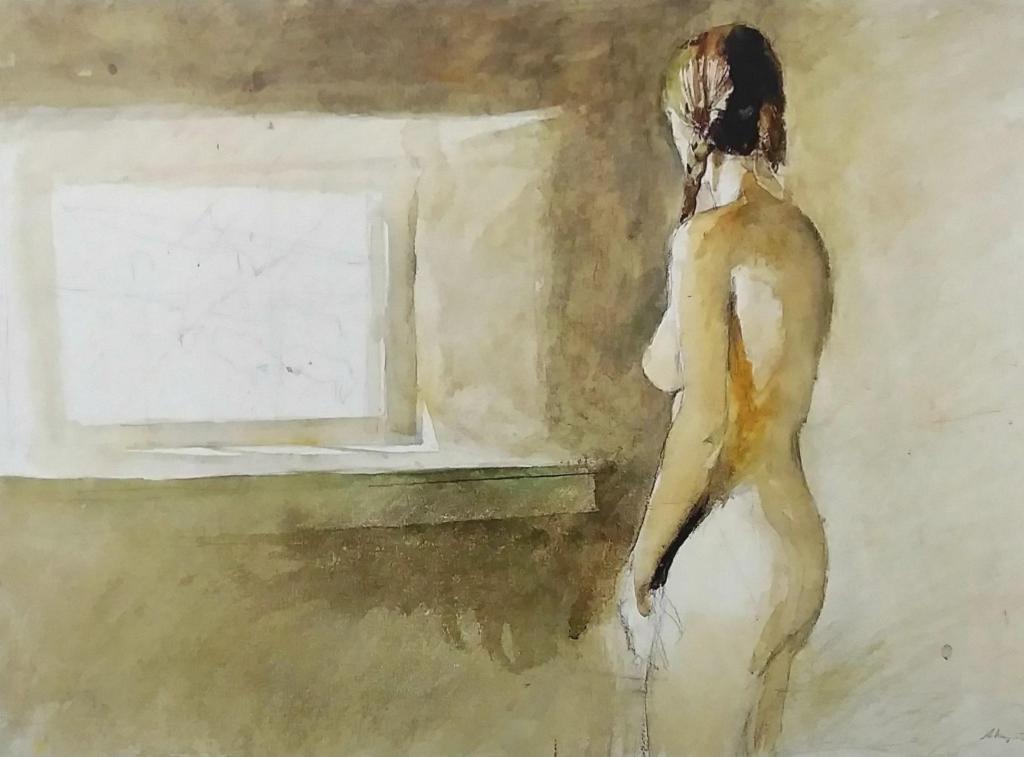
Helga Nudes #2941 (1979)
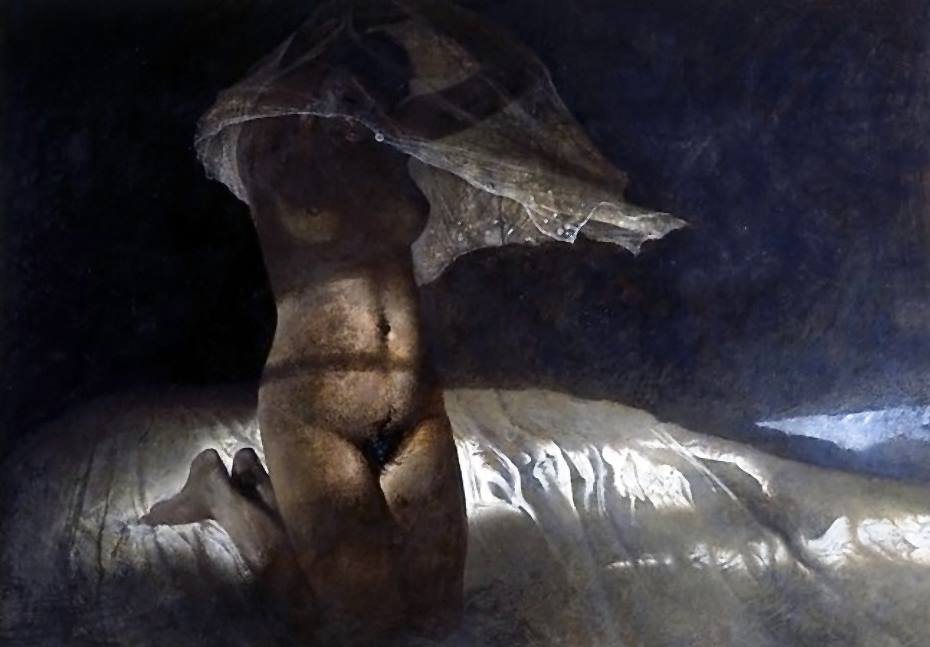

Rêve de jour. 1980

Christina’s world

Seated Woman, 1942
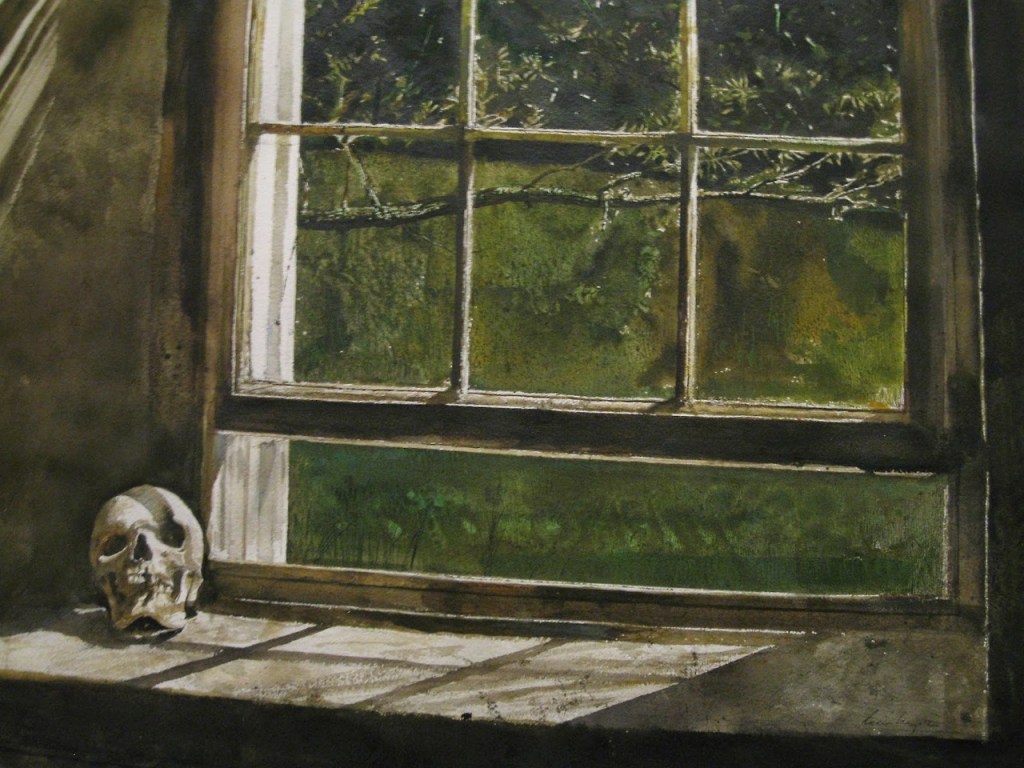

Crescent Moon, 1979
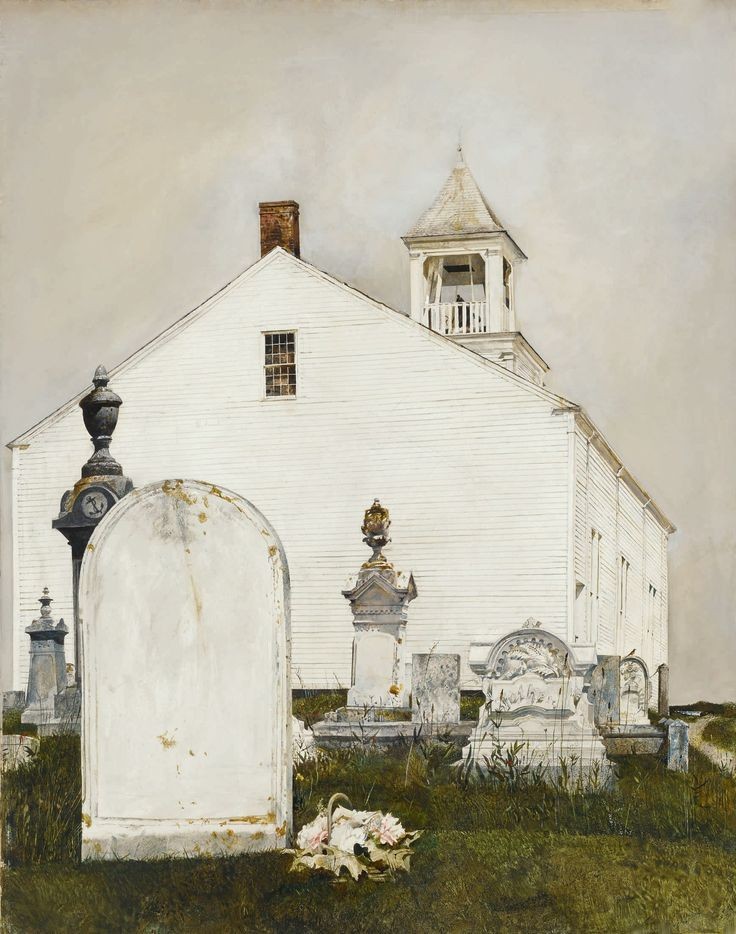
Perpetual Care, 1961
Mac Tag
thanks for stoppin’ by y’all
The song of the day goes out to The Rolling Stones who played their first gig on this day in 1962: “Angie” http://www.youtube.com/watch?v=rXRExocnpUw
Weary with toil, I haste me to my bed, The dear repose for limbs with travel tired; But then begins a journey in my head. – Shakespeare
Having inherited a vigorous mind / From my old fathers, I must nourish dreams / And leave a woman and a man behind / As vigorous of mind… – W.B. Yeats
I am learning how to compromise the wild dream ideals and the necessary realities without such screaming pain. – Sylvia Plath
I was just interested, endlessly interested, foolishly, unadulteratedly, with unparalleled vigor. – Gay Talese
Tonight I can write the saddest lines… – Pablo Neruda
I thought the most beautiful thing in the world must be shadow, the million moving shapes and cul-de-sacs of shadow. – Sylvia Plath
 The Lovers’ Chronicle
Leave a comment