Dear Zazie, Here is today’s Lovers’ Chronicle from Mac Tag. What do you choose? Rhett
The Lovers’ Chronicle
Dear Muse,

sunrise Kona Kai marina, shelter island, San diego

shadows on the sand, la jolla
dream choosin’…
© copyright 2024 mac tag/cowboy coleridge all rights reserved
did not think of an obvious song
so lets choose a Johnny and June
tune written by Boudleaux Bryant;
’’Now I’ve got schemes
And you’ve got schemes
Let’s get together and dream some dreams
Let’s go
Times a wastin’’’
‘’Fabulous on June’s birthday’’
could listen to them every day
’’And what a great love story’’
that is our purpose here
to tell the tales of two
choosin’ to be one
‘’How about another purpose’’
yes, come here, times a wastin’

© copyright 2023.2024 mac tag/cowboy coleridge all rights reserved
i do, to come here everyday, to create for you a vision in words and pictures of beauty and yes, sorrow, for where would one be without the other, it is a two-step, sometimes forward, sometimes backwards and even side to side but always movin’, explorin’, seekin’ out the finest life has to offer, facin’ joy and sadness whichever one comes, with these words to accompany us, amid the wonder we chose this, and we continue in step with the rhythm
© copyright 2022.2024 mac tag/cowboy coleridge all rights reserved
how ’bout this
for a premonition…
“Those moments
when your arm
drapes across me
before we fall asleep”
“It tells me
what you do not say”
“I just want to feel
your heartbeat
and fall asleep
with you holding me”
© copyright 2021.2023 mac tag/cowboy coleridge all rights reserved
Pale Love, Pale Rider
“And you,
choiceless as the moon,
will continue to orbit
the same mistakes
and disappointments.”
thanks Karen
you were right
of course
so choices have been made
and some fancy chances
have been taken
at least
the verse
has benefited
and the best choice
continues to be here
© copyright 2020 mac tag/cowboy coleridge all rights reserved
apropos
1200 miles
a world apart
but necessary
and perhaps
to get closer
to those moments
that tell you
what need not be said
© copyright 2019 mac tag/cowboy coleridge all rights reserved
how about this
for a choice…
those moments
when your arm
drapes across me
before we fall asleep
it tells me
what you do not say
just want to feel
your heartbeat
and fall asleep
whisperin’ your name
© copyright 2018 mac tag/cowboy coleridge all rights reserved
“You shouldn’t stare.”
well, you should not look like that
“Given all of the available choices
why does a man choose solitude?”
it is like one of my tailored suits
i wear it well
“Is this really what you want?
Living in shadows? Alone?”
i try not to think about it
“Why, because you would stop?”
i believe, i have no choice
“You’re wrong. We all have choices.”
© copyright 2017 mac tag/cowboy Coleridge all rights reserved
tremulous night
lucid visions
yet not so
who was that woman
what was her name
oh yes right there
just, just like that
***
tristo a me,
io t’ho insegnato a cantare,
e tu voui suonare
© copyright 2016 mac tag/cowboy Coleridge all rights reserved
As if it matters
As if ever in
the history of
anything decent
could it even for
a minute, matter
Echoes. A mournful
bagpipe, somewhere in
the distance. A drum
bangin’ on slowly
A dream incomplete
Without is without
And the dirge plays on
Without is without
There is nothin’ you
can do about that
If you wrote the dirge
You damn well better
dance to it, whether
you like it or not
“I thought that I
could save you. I
thought that you would
want to be saved.”
No, not really.
“Give me your pain!”
No! I need it!
It has been the
one true constant
in my life. My
pain defines me
Sorry y’all. I will pull outta these blues and write somethin’ beautiful in a day or two. Or an eternity, give or take.
Hey! I thought
of somethin’
beautiful
to write: You
© copyright 2015 mac tag/cowboy Coleridge all rights reserved
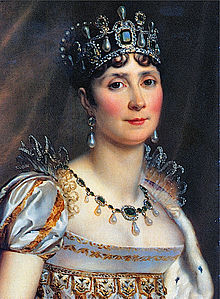
Today is the birthday of Joséphine de Beauharnais (born Marie-Josèphe-Rose Tascher de la Pagerie; Les Trois-Îlets, Martinique 23 June 1763 – 29 May 1814 Rueil-Malmaison, France); the first wife of Napoleon I, and thus the first Empress of the French as Joséphine.

at the château de Malmaison. 1801. By François Gérard
Her marriage to Napoleon I was her second; her first husband, Alexandre de Beauharnais, was guillotined during the Reign of Terror, and she was imprisoned in the Carmes prison until five days after his execution. Her two children by Beauharnais became significant to royal lineage. Through her daughter, Hortense, she was the maternal grandmother of Napoleon III. Through her son, Eugène, she was the great-grandmother of later Swedish and Danish kings and queens. The reigning houses of Belgium, Norway and Luxembourg also descend from her. She did not bear Napoleon any children; as a result, he divorced her in 1810 to marry Marie Louise of Austria.
Joséphine was the recipient of numerous love letters written by Napoleon, many of which still exist. Her Château de Malmaison was noted for its magnificent rose garden, which she supervised closely, owing to her passionate interest in roses, collected from all over the world.

Bust, c. 1808 CE. Marble, from Paris, France. By Joseph Chinard. Bequeathed by Miss F.H. Spiers. The Victoria and Albert Museum, London
Madame de Beauharnais had affairs with several leading political figures, including Paul François Jean Nicolas Barras. In 1795, she met Napoleon Bonaparte, six years her junior, and became his mistress. In a letter to her in December, he wrote, “I awake full of you. Your image and the memory of last night’s intoxicating pleasures has left no rest to my senses.” In January 1796, Napoleon Bonaparte proposed to her and they were married on 9 March. Until meeting Bonaparte, she was known as Rose, but Bonaparte preferred to call her Joséphine, the name she adopted from then on.
The marriage was not well received by Napoleon’s family, who were shocked that he had married an older widow with two children. His mother and sisters were especially resentful of Joséphine, as they felt clumsy and unsophisticated in her presence. Two days after the wedding, Bonaparte left Paris to lead a French army into Italy. During their separation, he sent her many love letters. In February 1797, he wrote: “You to whom nature has given spirit, sweetness, and beauty, you who alone can move and rule my heart, you who know all too well the absolute empire you exercise over it!”
Joséphine, left behind in Paris, in 1796 began an affair with a handsome Hussar lieutenant, Hippolyte Charles. Rumors of the affair reached Napoleon; he was infuriated, and his love for her changed.
In 1798, Napoleon led a French army to Egypt. During this campaign, Napoleon started an affair of his own with Pauline Fourès, the wife of a junior officer, who became known as “Napoleon’s Cleopatra.” The relationship between Joséphine and Napoleon was never the same after this. His letters became less loving. No subsequent lovers of Joséphine are recorded, but Napoleon had sexual affairs with several other women. In 1804, he said, “Power is my mistress.”
In December 1800, Joséphine was nearly killed in the Plot of the rue Saint-Nicaise, an attempt on Napoleon’s life with a bomb planted in a parked cart. On December 24, she and Napoleon went to see a performance of Joseph Haydn’s Creation at the Opéra, accompanied by several friends and family. The party travelled in two carriages. Joséphine was in the second, with her daughter, Hortense; her pregnant sister-in-law, Caroline Murat; and General Jean Rapp. Joséphine had delayed the party while getting a new silk shawl draped correctly, and Napoleon went ahead in the first carriage. The bomb exploded as her carriage was passing. The bomb killed several bystanders and one of the carriage horses, and blew out the carriage’s windows; Hortense was struck in the hand by flying glass. There were no other injuries and the party proceeded to the Opéra.

kneeling before Napoleon during his coronation at Notre Dame. Detail from the oil painting (1806–7) by David and Rouget
The coronation ceremony, officiated by Pope Pius VII, took place at Notre Dame de Paris, on 2 December 1804. Following a pre-arranged protocol, Napoleon first crowned himself, then put the crown on Joséphine’s head, proclaiming her empress.
Shortly before their coronation, there was an incident at the Château de Saint-Cloud that nearly sundered the marriage between the two. Joséphine caught Napoleon in the bedroom of her lady-in-waiting, Élisabeth de Vaudey, and Napoleon threatened to divorce her as she had not produced an heir. Eventually, however, through the efforts of her daughter Hortense, the two were reconciled.
When after a few years it became clear she could not have a child, Napoleon, while still loving Joséphine, began to think very seriously about the possibility of divorce. The final die was cast when Joséphine’s grandson Napoléon Charles Bonaparte who had been declared Napoleon’s heir, died of croup in 1807. Napoleon began to create lists of eligible princesses. At dinner on 30 November 1809, he let Joséphine know that—in the interest of France—he must find a wife who could produce an heir.
Joséphine agreed to the divorce so the Emperor could remarry in the hope of having an heir. The divorce ceremony took place on 10 January 1810 and was a grand but solemn social occasion, and each read a statement of devotion to the other.

Miniature portrait of the Empress by Jean Baptiste Isabey on an 18k gold snuff box crafted by the Imperial goldsmith Adrien-Jean-Maximilien Vachette. Circa 1810

Portrait of Joséphine later in life by Andrea Appiani
After the divorce, Joséphine lived at the Château de Malmaison, near Paris. She remained on good terms with Napoleon, who once said that the only thing to come between them was her debts. (Joséphine remarked privately, “The only thing that ever came between us was my debts; certainly not his manhood.”—Andrew Roberts, Napoleon)
Joséphine died soon after walking with Tsar Alexander in the gardens of Malmaison. She was buried in the nearby church of Saint Pierre-Saint Paul in Rueil. Her daughter Hortense is interred near her.
Napoleon learned of her death via a French journal while in exile on Elba, and stayed locked in his room for two days, refusing to see anyone. He claimed to a friend, while in exile on Saint Helena, that “I truly loved my Joséphine, but I did not respect her.” Despite his numerous affairs, eventual divorce, and remarriage, the Emperor’s last words on his death bed at St. Helena were: “France, the Army, the Head of the Army, Joséphine.”(“France, l’armée, tête d’armée, Joséphine”).
Today is the birthday of Carl Milles (Lagga, Sweden; 23 June 1875 – 19 September 1955 Lidingö församling, Sweden); sculptor. He was married to artist Olga Milles (née Granner) and brother to Ruth Milles and half-brother to the architect Evert Milles. Carl Milles sculpted the Gustaf Vasa statue at the Stockholm Nordic Museum, the Poseidon statue in Gothenburg, the Orpheus group outside the Stockholm Concert Hall, and the Fountain of Faith in Falls Church, Virginia. His home near Stockholm, Millesgården, became his resting place and is now a museum.
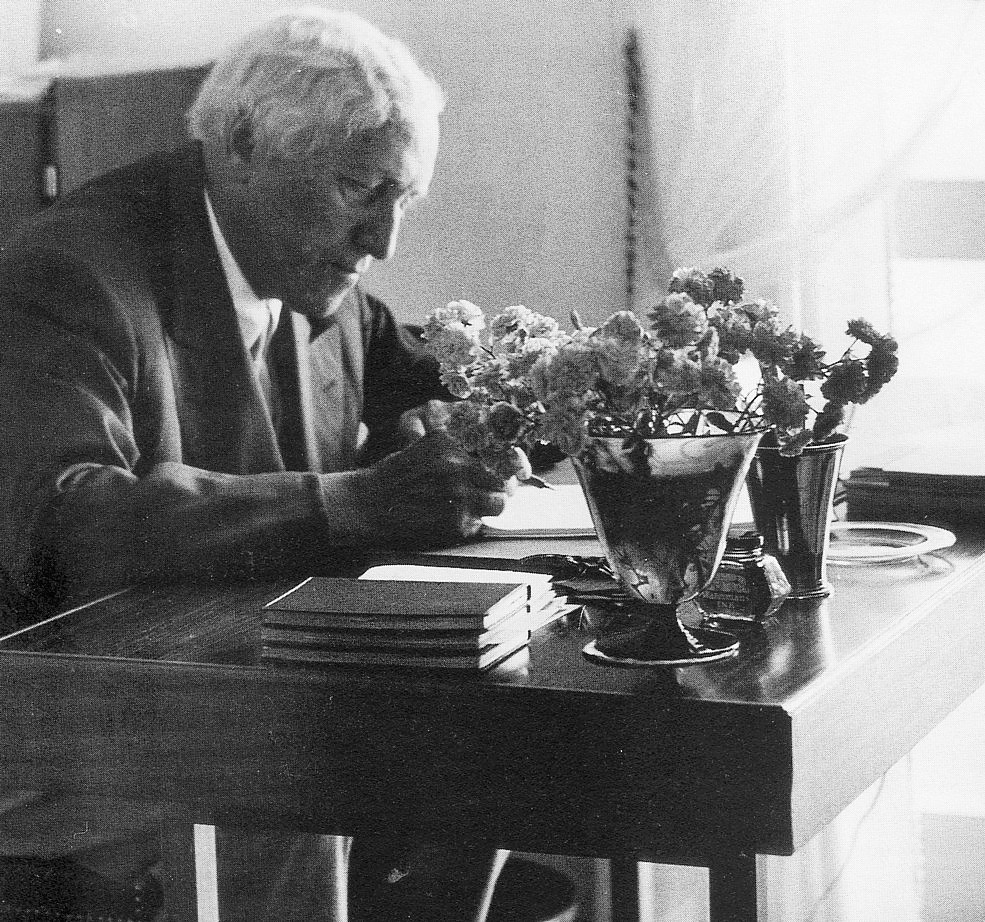
at his desk in the Millesgården in Sweden 1955
Gallery
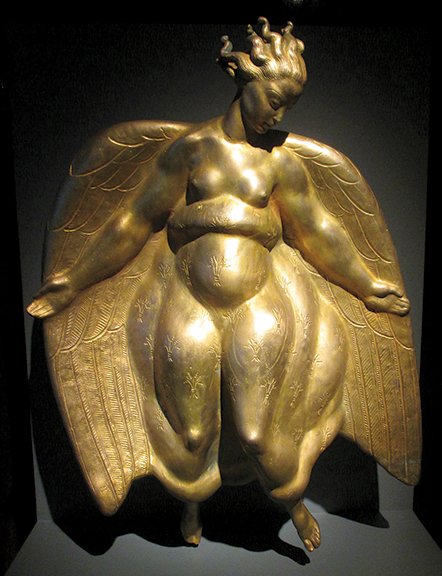
angel

The Angel of Death. Skogskyrkogården in Stockholm
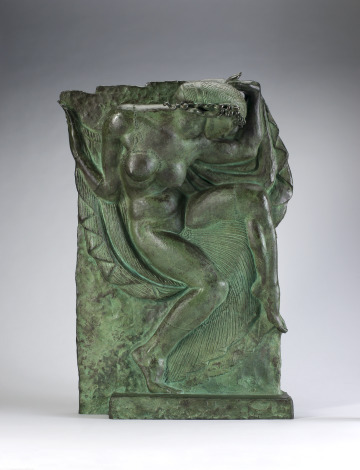
Dancing Maenad, c.1913

Two Dancers, Götaplatsen, Gothenburg

Two Dancers, Götaplatsen, Gothenburg
Today is the birthday of Anna Akhmatova (Anna Andreyevna Gorenko 23 June; Odessa, now Ukraine [O.S. 11 June] 1889 – 5 March 1966 Moscow); in my opinion, one of the most significant poets of 20th century. She was shortlisted for the Nobel Prize in 1965 and received second-most (three) nominations for the award the following year.

Portrait by Kuzma Petrov-Vodkin, 1922
Akhmatova was considered a great beauty and intellect. In Paris, she met the artist Amedeo Modigliani, who painted more than 20 paintings of her, several of them nudes. He was passionately in love her, and for the rest of her life, no matter where she lived or what her circumstances, she kept one of his nude portraits of her above her couch.

Modigliani, portrait d’Anna Akhmatova
When the 1917 Revolution began in what was then Petersburg, Russia, many of Akhmatova’s friends fled, but she stayed, and lived through what became known as “The Terror,” and the time after, which was known as “The Thaw.” Her work was censored and she wasn’t allowed to publish, but she was so beloved in Russia that Stalin didn’t dare attack her. He did, however, imprison her son and common-law husband. She spent 17 months waiting in line outside the Kresty Holding Prison with thousands of wives and daughters, waiting to catch a glimpse of their loved ones and to give them bread. One day, a woman asked her, “Could one ever describe this?” And Akhmatova answered, “I can.” From that day on, she began composing what would become her masterpiece, a poem called Requiem. She worked on it for more than 30 years, writing down fragments. She was too terrified of being discovered by the regime to write a whole manuscript, so she had devoted friends memorize the fragments, and then she would burn the pieces of paper.
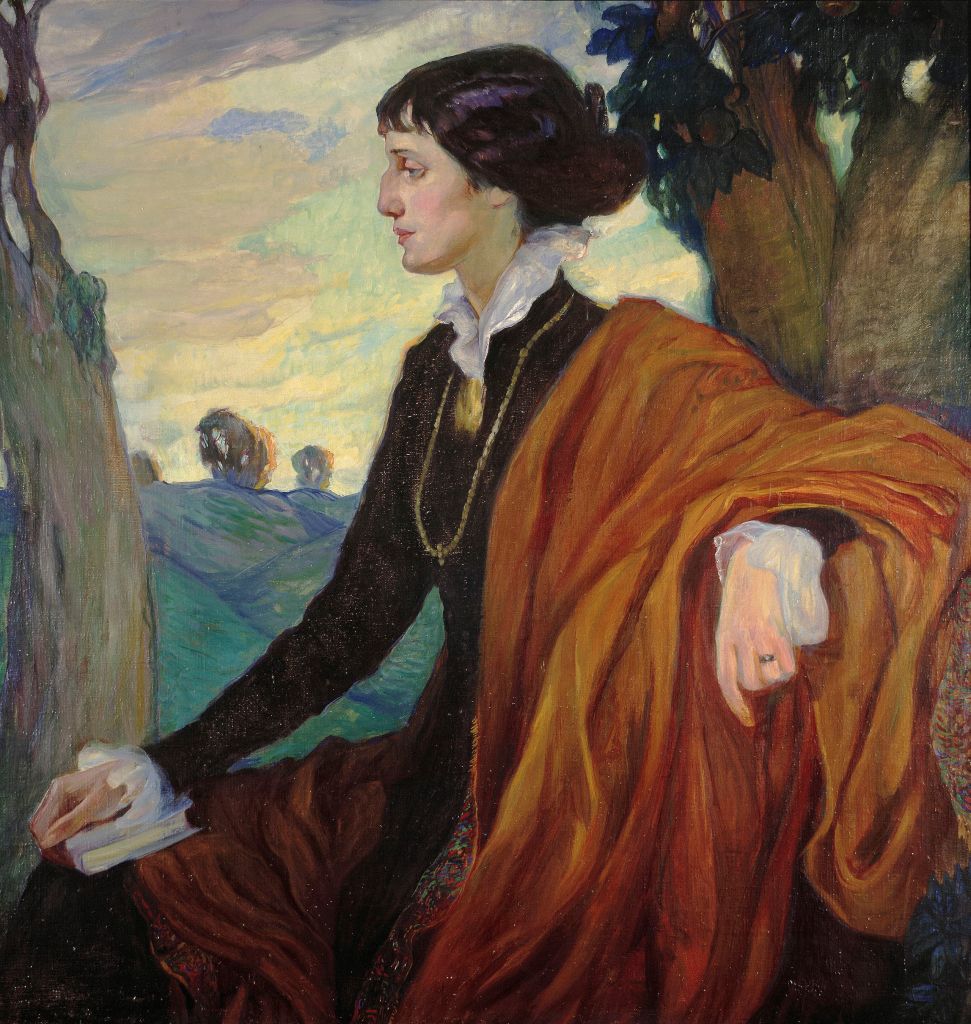
Portrait by Olga Della-Vos-Kardovskaya
Requiem was first published in Germany in 1963, but didn’t appear in its entirety in Russia until 1987. By then Akhmatova was long dead. American singer Iris DeMent set some of the poems in Requiem to music for her album The Trackless Woods. There’s a statue of Akhmatova across from the Kresty Prison.
Akhmatova wrote, “I am in the middle of it: chaos and poetry; poetry and love and again, complete chaos. Pain, disorder, occasional clarity; and at the bottom of it all: only love; poetry. Sheer enchantment, fear, humiliation. It all comes with love.”
Verse
- O let the organ, many-voiced, sing boldly,
O let it roar like spring’s first thunderstorm!
My half-closed eyes over your young bride’s shoulder
Will meet your eyes just once and then no more.- Translated by Irina Zheleznova
- I go forth to seek —
To seek and claim the lovely magic garden
Where grasses softly sigh and Muses speak.- Translated by Irina Zheleznova
- You thought I was that type:
That you could forget me,
And that I’d plead and weep
And throw myself under the hooves of a bay mare…- “You Thought I Was That Type”
- Damn you! I will not grant your cursed soul
Vicarious tears or a single glance.
And I swear to you by the garden of the angels,
I swear by the miracle-working icon,
And by the fire and smoke of our nights:
I will never come back to you.- “You Thought I Was That Type”
- I don’t know if you’re alive or dead.
Can you on earth be sought,
Or only when the sunsets fade
Be mourned serenely in my thought?- “I Don’t Know If You’re Alive Or Dead” (1915)
- No-one was more cherished, no-one tortured
Me more, not
Even the one who betrayed me to torture,
Not even the one who caressed me and forgot.- “I Don’t Know If You’re Alive Or Dead” (1915)
- Why is this century worse than those others?
Maybe, because, in sadness and alarm,
It only touched the blackest of the ulcers,
But couldn’t heal it in its span of time.- “Why is this century worse than those others?” (1919), translated by Yevgeny Bonver (2000)
- All has been looted, betrayed, sold;
black death’s wing flashed ahead.- “Looted” (1921), as translated by Dmitri Obolensky
- You will hear thunder and remember me,
And think: she wanted storms. The rim
Of the sky will be the colour of hard crimson,
And your heart, as it was then, will be on fire.- “You will hear thunder and remember me…”, translated by D. M. Thomas
Today is the birthday of Edith Hamlin (Edith Ann Hamlin; Oakland June 23, 1902 – February 18, 1992 San Francisco); landscape and portrait painter, and muralist. Perhaps best known for her social realism murals created while working with the Public Works of Art Project, Federal Art Project and the Section of Painting and Sculpture during the Great Depression era in the United States and for her decorative style paintings of the American desert.

She maintained a studio in San Diego throughout the 1920s. In 1933, Hamlin established a studio in San Francisco, and was briefly married to artist Albert Barrows. By 1936 they divorced.
During the early 1930s, she traveled around New Mexico and Arizona. She was selected to paint murals for the Public Works of Art Project at the Coit Tower, and completed a WPA Federal Art Project mural for Mission High School in San Francisco. On the second floor of Coit Tower, she completed a mural named “Sports and Hunting in California”. It currently has limited public access due to its location. She worked with Maynard Dixon on the murals, and married him in 1937.
She and Dixon moved to Tucson in 1939 and maintained a summer home in Mt. Carmel, Utah. In Tucson, she completed numerous public murals including two for the Santa Fe Railroad. After Dixon died in 1946, Hamlin had his ashes buried on a hill near their house where she also constructed a studio for herself. She married the artist Frank Knight Dale who did not live long and she returned to San Francisco in 1953, where she died.
Gallery
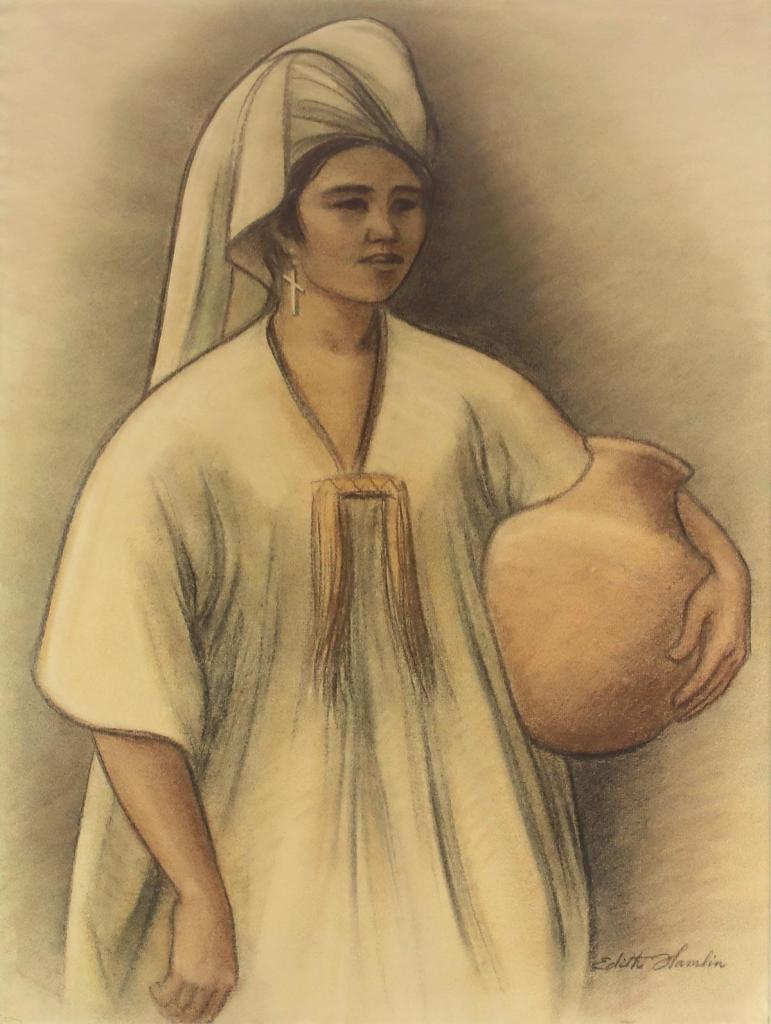
water carrier
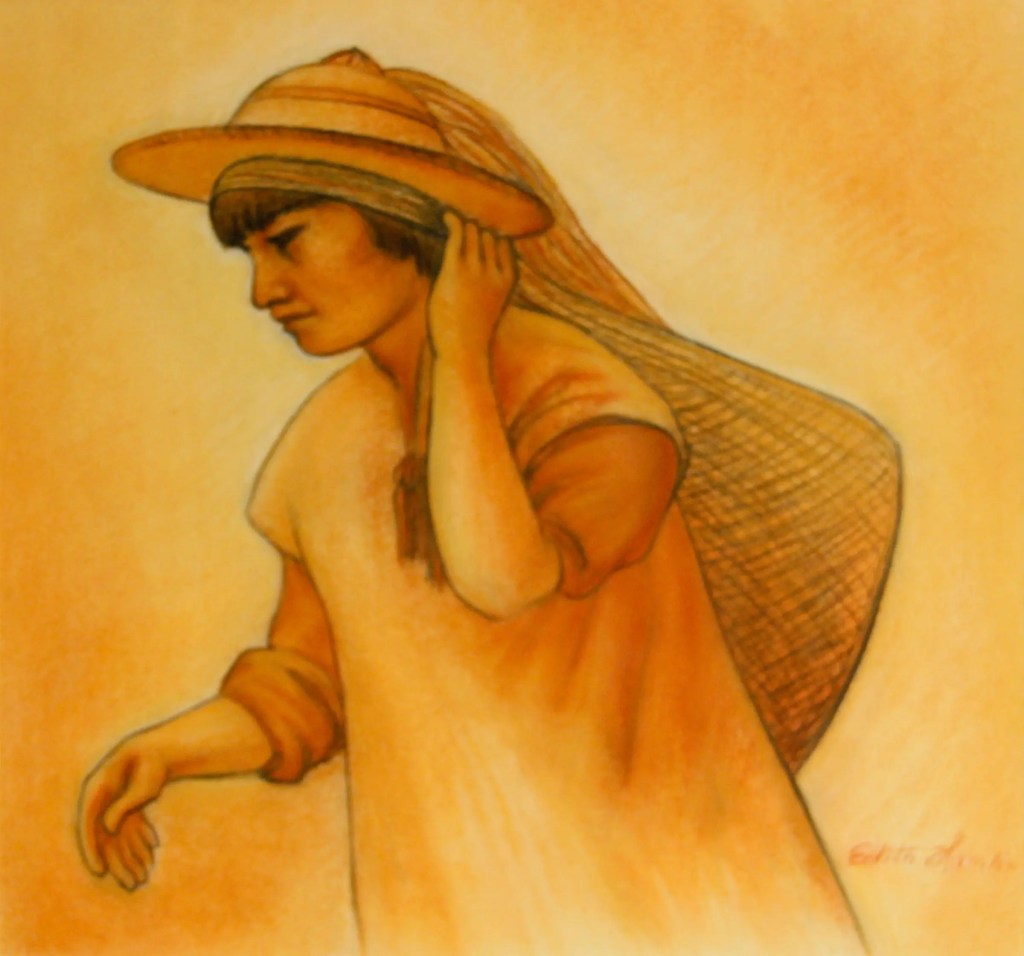
Niña del mercado

Morning on the Rillito, Arizona”, c. 1937, oil on canvas

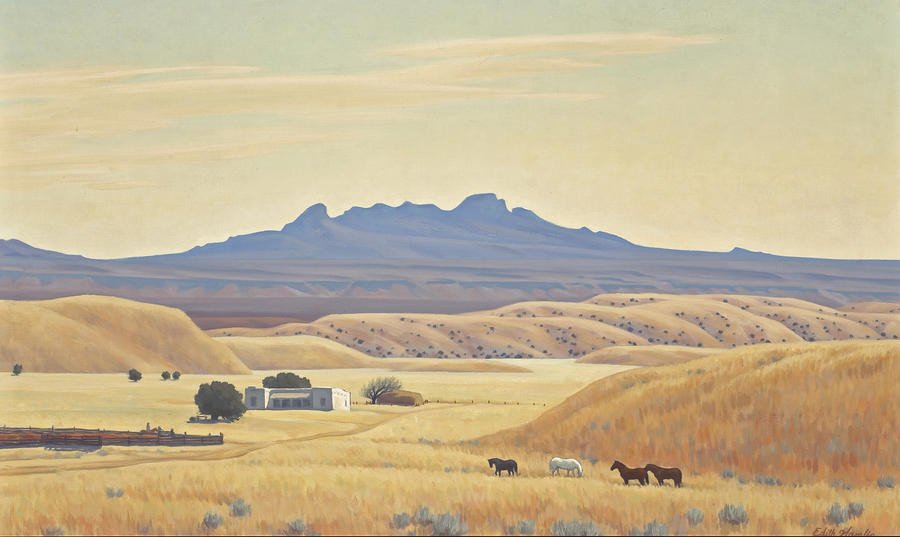
Arizona grassland
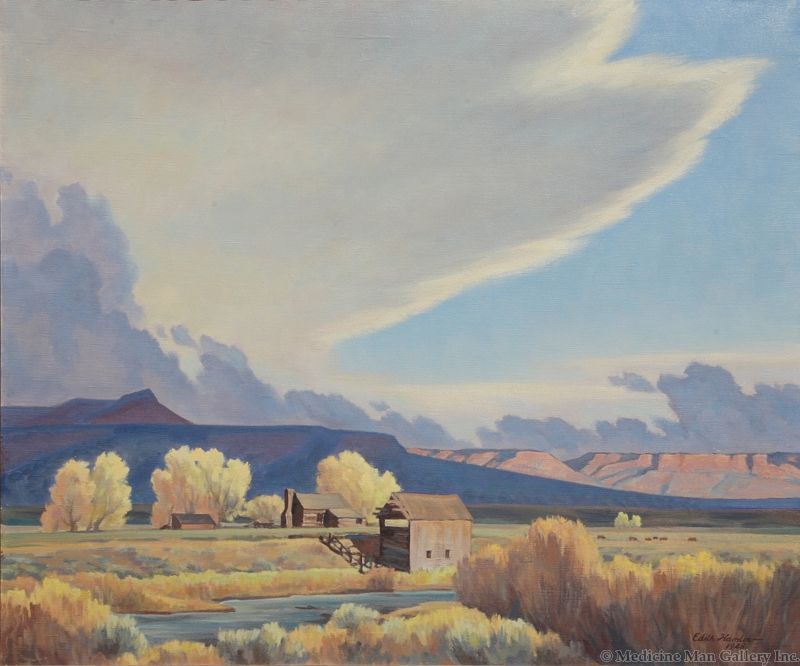
Homestead on the Sevier
today is the birthday of June Carter Cash (Valerie June Carter, Maces Spring, Virginia; June 23, 1929 – May 15, 2003 Nashville); singer, dancer, songwriter, actress, comedian, and author who was a member of the Carter Family and the second wife of Johnny Cash. She played the guitar, banjo, harmonica, and autoharp, and acted in several films and television shows. Carter Cash won five Grammy Awards and was inducted into the Christian Music Hall of Fame in 2009.
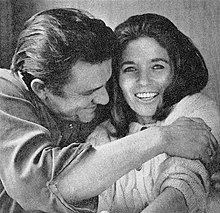
In the early 1960s, Carter Cash wrote the song “Ring of Fire”, which would later go on to be a hit for her future husband. She co-wrote the song with fellow songwriter, Merle Kilgore. June wrote the lyrics about her relationship with Cash and she offered the song to her sister Anita, who would be the first singer to record the song. In 1963, Cash recorded the song with the Carter Family singing backup, and added mariachi horns. The song would become a number one hit and would go on to become one of the most recognizable songs in the world of country music.
Her first notable studio performance with Cash occurred in 1964 when they sang a duet on “It Ain’t Me Babe”, a Bob Dylan composition, that was released as a single and on Cash’s album Orange Blossom Special. In 1967, the two found more success with their recording of “Jackson”, which was followed by a collaboration album, Carryin’ On with Johnny Cash and June Carter. All these releases predated their marriage. She continued to work with Cash on record and on stage for the rest of her life, recording a number of duets with Cash for his various albums and being a regular on The Johnny Cash Show from 1969-1971 and on Cash’s annual Christmas specials. After Carryin’ On, Carter Cash recorded one more direct collaboration album, Johnny Cash and His Woman, released in 1973, and along with her daughters was a featured vocalist on Cash’s 1974 album The Junkie and the Juicehead Minus Me. She also shared sleeve credit with her husband on a 2000 small-label gospel release, Return to the Promised Land.
Carter Cash was married three times. She was married first to honky-tonk singer Carl Smith from July 9, 1952, until their divorce in 1956. Together they wrote “Time’s A-Wastin”. Her second marriage was to Edwin “Rip” Nix, a former football player, police officer, and race car driver, on November 11, 1957. In 1968, Johnny proposed to June during a live performance at the London Ice House in London, Ontario, Canada. They married on March 1 in Franklin, Kentucky, and remained married until her death in May 2003, just four months before Cash died.

in 1999.
Carter Cash was played by Reese Witherspoon in Walk the Line, a 2005 biographical film of Johnny Cash (played by Joaquin Phoenix). The film largely focused on the development of their relationship over the course of 13 years, from their first meeting to her acceptance of his proposal of marriage. Witherspoon performed all vocals for the role, singing many of June’s famous songs, including “Juke Box Blues” and “Jackson” with Phoenix. Witherspoon won an Academy Award, Golden Globe, BAFTA and Screen Actors Guild Award for Best Actress in the role.
And on this day in 1969, Bells Are Ringing an American romantic comedy-musical film directed by Vincente Minnelli and starring Judy Holliday and Dean Martin, premiers. Based on the successful 1956 Broadway production of the same name by Betty Comden, Adolph Green and Jule Styne, the film focuses on Ella Peterson, based on the life of Mary Printz, who works in the basement office of a telephone answering service.

thanks for stoppin’ by y’all
Mac Tag
 The Lovers’ Chronicle
Leave a reply to The Lovers’ Chronicle 11 April – dawnin’ – premiere of Henry Purcell´s opera, Dido and Aeneas – art by Jean-Baptiste Isabey – The Lovers’ Chronicle Cancel reply