Dear Zazie, Here is today’s Lovers’ Chronicle from Mac Tag. What are you findin’? Rhett
The Lovers’ Chronicle
Dear Muse,
our song, of course;
”Trust I seek and I find in you”
”Hell yes Metallica baby”
in my top three bands
”With Van Halen and…”
Megadeth
”You cowboy hat, boot wearin’,
pearl snap, metal head you”
‘tis true, i listen to almost every
genre but that one moves me most
”Let’s tell the story again”
we were drivin’ in Atlanta in your
red VW convertible with the top down
and the radio up, on a beautiful fall day
when “Nothing Else Matters” came on,
we both started singin’ along right away,
that was it, that was the beginnin’
of nothin’ else matterin’ for us

© copyright 2023.2024 mac tag/cowboy coleridge all rights reserved
this has been an arc, a line of poems over two thousand long to git here, definin’ a search for self, for reasons and purpose; the discoveries along the way frequently seismic, often astoundin’, thought it would not be, Waylon wrote about it happenin’ when it was too late and Willie wrote about the surprise of survivin’, now look at us, findin’ this, not too late, with our minds still fairly sound, and nothin’ left to do just to satisfy each other
© copyright 2022.2024 mac tag/cowboy coleridge all rights reserved
sometimes when i need a little boost
i start with a line Waylon wrote,
where do we take it from here;
indeed where, this red headed,
beautiful city belle and this man
of the High Plains, not a cliche
to call him a drifter, and not
a miracle that he made it
but somewhere close,
who woulda thought
found together

© copyright 2021.2024 mac tag/cowboy coleridge all rights reserved
Pale Love, Pale Rider
visions of,
dare we say
born here, found, after
a life spent searchin’
came through trials
where some fear to tread,
moved by a not understood,
doomed with its wakin’ need
i can believe,
echoes of hopes
for what you bring,
by the voice
yearnin’ to be heard
© copyright 2020 mac tag/cowboy coleridge all rights reserved
this is the culmination
of a journey
y’all cannot believe
the tale will unwind
over time
suffice to say
i am blessed
i know, no truer gift
than friendship
(arms uplifted in thanks)
wait, can i ask one more thing
can i git some sleep tonight
***
took a moment
to revel in gratitude for friends
who have found themselves,
and another, in a good place
may y’all always ride the groove
© copyright 2019 mac tag/cowboy coleridge all rights reserved
findin’
visions
dreams
come
moved by
the extraordinary
believin’
echoes of hope
once thought vain
but for you
this would not
be happenin’
so i vow
to continue
to strive
to bring you
nearer
to seek
beyond
the ordinary
© copyright 2018 mac tag/cowboy coleridge all rights reserved
“Well hello there
My it’s been a long, long time
How am I doin’”
well, i believe
i am beginnin’
to feel again
one year on from havin’
a cold, cold heart damn near stop
and one week in on a new beginnin’
cannot tell you how it feels
to find that hope did not
give up on me even though
i gave up on her, long ago
cannot say it any better than Willie did…
“It’s been rough and rocky travelin’
But I’m finally standing upright on the ground”
“After takin’ several readings I’m surprised
To find my mind’s still fairly sound”
and i do believe i am beginnin’
to find myself
***
I would be sorely remiss
if I did not thank my twitter friends
for your support durin’ my tryin’ times
Just knowin’ you were there
to read what I wrote
was a comfort
© copyright 2017 mac tag/cowboy Coleridge all rights reserved
Ridin’ up the canyon,
Twilight gathers under the walls
Gradually the objects low down
turned black, and this blackness
moved up the walls till night
enfolded the pass
The sky darkened; stars began
to show, first pale, then bright
Now unsaddled, camp made,
composed to await sleep
Night on the High Plains
most satisfyin’
The night’s wildness, loneliness;
When the full silence sets in,
and the deep darkness,
and trains of radiant stars
shine cold and calm, sleep
comes with the familiar ache
***
Doctor says
Home tomorrow
Heart on the mend
I knew I had
A cold, cold heart
But I never
Thought the damn thing
Would up and try
To quit workin’
© copyright 2016 Mac tag/cowboy coleridge all rights reserved
Relationship
philosophy:
Don’t start nothin’
Won’t be nothin’
Or better yet:
Do not start one
Will not be one
© copyright 2015 Mac tag/cowboy coleridge all rights reserved
Today is the birthday of Lisa del Giocondo (née Gherardini; Via Maggio, Florence 15 June 1479 – 15 July 1542 or ca. 1551 Convent of Saint Orsola, Florence) also known as Lisa Gherardini, Lisa di Antonio Maria (or Antonmaria) Gherardini and Mona Lisa; a member of the Gherardini family of Florence and Tuscany in Italy. Her name was given to Mona Lisa, her portrait commissioned by her husband and painted by Leonardo da Vinci during the Italian Renaissance.
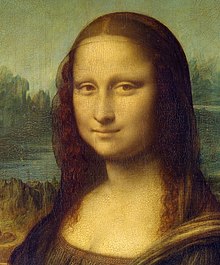
Married in her teens to a cloth and silk merchant who later became a local official, she was a mother to five children and led what is thought to have been a comfortable and ordinary middle-class life.
Centuries after Lisa’s death, Mona Lisa became one of the world’s most famous paintings and took on a life separate from Lisa, the woman.
Today is the birthday of Adah Isaacs Menken (Adelaide or Ada McCord; New Orleans or Memphis; June 15, 1835 – August 10, 1868 Paris); actress, painter and poet. Perhaps best known for her performance in the melodrama Mazeppa, with a climax that featured her apparently nude and riding a horse on stage. After success for a few years with the play in New York and San Francisco, she appeared in a production in London and Paris, from 1864 to 1866. After a brief trip back to the United States, she returned to Europe. However, she became ill within two years and died in Paris at the age of 33.
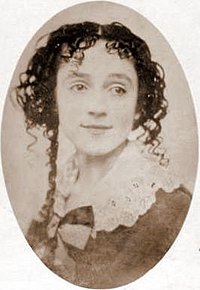
As Menken told so many versions of her origins, including her name, place of birth, ancestry, and religion, historians have differed in their accounts. Most have said she was born a Louisiana Creole Catholic of mixed race, with European and African ancestry. She married several times and was also known for her affairs.
Even though she was better known as an actress, Menken wanted to be known as a writer. She published about 20 essays, 100 poems, and a book of her collected poems, from 1855 to 1868 (the book was published posthumously). Her collection Infelicia, went through several editions and was in print until 1902.
She was married for the first time in Galveston County, Texas in February 1855, to G. W. Kneass, a musician. The marriage had ended by sometime in 1856, when she met and in 1856 married the man more generally considered her first husband, Alexander Isaac Menken, a musician who was from a prominent Reform Jewish family in Cincinnati, Ohio.
Her third husband was John C. Heenan, a popular Irish-American prizefighter whom she married in 1859. Some time after their marriage, the press discovered she did not yet have a legal divorce from Menken and accused her of bigamy. She had expected Menken to handle the divorce, which he eventually did. As Heenan was one of the most famous and popular figures in America, the press also accused Menken of marrying for his celebrity. She billed herself as Mrs. Heenan in Boston, Providence, Baltimore, and Philadelphia, using his name despite their divorce within a year of marriage. They had a son, who died soon after birth.
When Menken met Charles Blondin, notable for crossing Niagara Falls on a tightrope, the two were quickly attracted to each other. She suggested she would marry him if they could perform a couple’s act above the falls. Blondin refused, saying that he would be “distracted by her beauty.” The two had an affair, during which they conducted a vaudeville tour across the United States.
In 1862, she married Robert Henry Newell, a humorist and editor of the Sunday Mercury in New York, who had recently published most of her poetry. They were together about three years. Next she wed James Paul Barkley, a gambler, in 1866, but soon returned without him to France, where she was performing. There she had their son, whom she named Louis Dudevant Victor Emanuel Barkley. The baby’s godmother was the author George Sand (A. F. Lesser). Louis died in infancy.
Playing in a sold-out run of Les pirates de la savane in Paris in 1866, Menken had an affair with the French novelist Alexandre Dumas, père, considered scandalous as he was more than twice her age. Returning to England in 1867, she struggled to attract audiences to Mazeppa and attendance fell off. During this time she had an affair with the English poet Algernon Charles Swinburne.
She fell ill in London and was forced to stop performing, struggling with poverty as a result. Few realized that she was ill until she collapsed during rehearsal and died a few weeks later. She began preparing her poems for publication and moved back to Paris, where she died. She had just written to a friend:
I am lost to art and life. Yet, when all is said and done, have I not at my age tasted more of life than most women who live to be a hundred? It is fair, then, that I should go where old people go.
How long she had been a consumptive no one knew but, from what is known, she was dead at 33 – the flamelike quality that Charles Dickens had called the “world’s delight” extinguished forever. They buried her in a corner of the little Jewish cemetery in Montparnasse, and on her grave stone are the words, “Thou Knowest,” an epitaph she had chosen from Swinburne, the poet who had said of her, “A woman who has such beautiful legs need not discuss poetry.”
Dreams Of Beauty
Visions of Beauty, of Light, and of Love,
Born in the soul of a Dream,
Lost, like the phantom-bird under the dove,
When she flies over a stream-
Come ye through portals where angel wings droop,
Moved by the heaven of sleep?
Or, are ye mockeries, crazing a soul,
Doomed with its waking to weep?
I could believe ye were shadows of earth,
Echoes of hopes that are vain,
But for the music ye bring to my heart,
Waking its sunshine again.
And ye are fleeting. All vainly I strive
Beauties like thine to portray;
Forth from my pencil the bright picture starts,
And-ye have faded away.
Like to a bird that soars up from the spray,
When we would fetter its wing;
Like to the song that spurns Memory’s grasp
When the voice yearneth to sing;
Like the cloud-glory that sunset lights up,
When the storm bursts from its height;
Like the sheet-silver that rolls on the sea,
When it is touched by the night-
Bright, evanescent, ye come and are gone,
Visions of mystical birth;
Art that could paint you was never vouchsafed
Unto the children of earth.
Yet in my soul there’s a longing to tell
All you have seemed unto me,
That unto others a glimpse of the skies
You in their sorrow might be.
Vain is the wish. Better hope to describe
All that the spirit desires,
When through a cloud of vague fancies and schemes
Flash the Promethean fires.
Let me then think of ye, Visions of Light,
Not as the tissue of dreams,
But as realities destined to be
Bright in Futurity’s beams.
Ideals formed by a standard of earth
Sink at Reality’s shrine
Into the human and weak like ourselves,
Losing the essence divine;
But the fair pictures that fall from above
On the heart’s mirror sublime
Carry a signature written in tints,
Bright with the future of time.
And the heart, catching them, yieldeth a spark
Under each stroke of the rod-
Sparks that fly upward and light the New Life,
Burning an incense to God!
Today is the birthday of Peter Stackpole (San Francisco; June 15, 1913 – May 11, 1997 Novato, California); photojournalist. He was one of Life magazine’s first staff photographers and remained with the publication until 1961. Stackpole shot 26 cover portraits for the magazine.
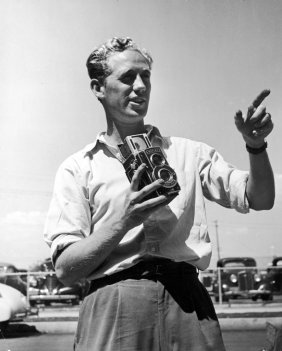
He first gained notice for his photos of bridge construction in the San Francisco Bay in the 1930s. Hired by Life magazine, he captured many notable snapshots of film stars in the 1940s and 1950s. During World War II, his combat camera work during the Battle of Saipan was praised. He won a George Polk Award in 1953 for a photograph of a diver 100 feet under water, and he taught photography at the Academy of Art University. He also wrote a column in U.S. Camera for fifteen years. He was the son of sculptor Ralph Stackpole.
Stackpole married Dutch-born artist Hebe Daum in 1937. One year his senior, she was a photographer, muralist and painter known for her New Deal artwork as an assistant to Suzanne Scheuer. While living in Los Angeles, their daughter Katharine was born in 1941, another daughter Trena (known as Anne) in 1946, and their son Timothy was born in 1949. In 1951, Stackpole shifted to Life magazine’s New York office, and the family took up residence in nearby Darien, Connecticut. Upon retiring in 1961, Stackpole returned to live in the Oakland Hills with Hebe. After losing their home to the Oakland firestorm of 1991, the Stackpoles moved to Novato, California, where Hebe died in 1993. He died of congestive heart failure four years later.
Gallery
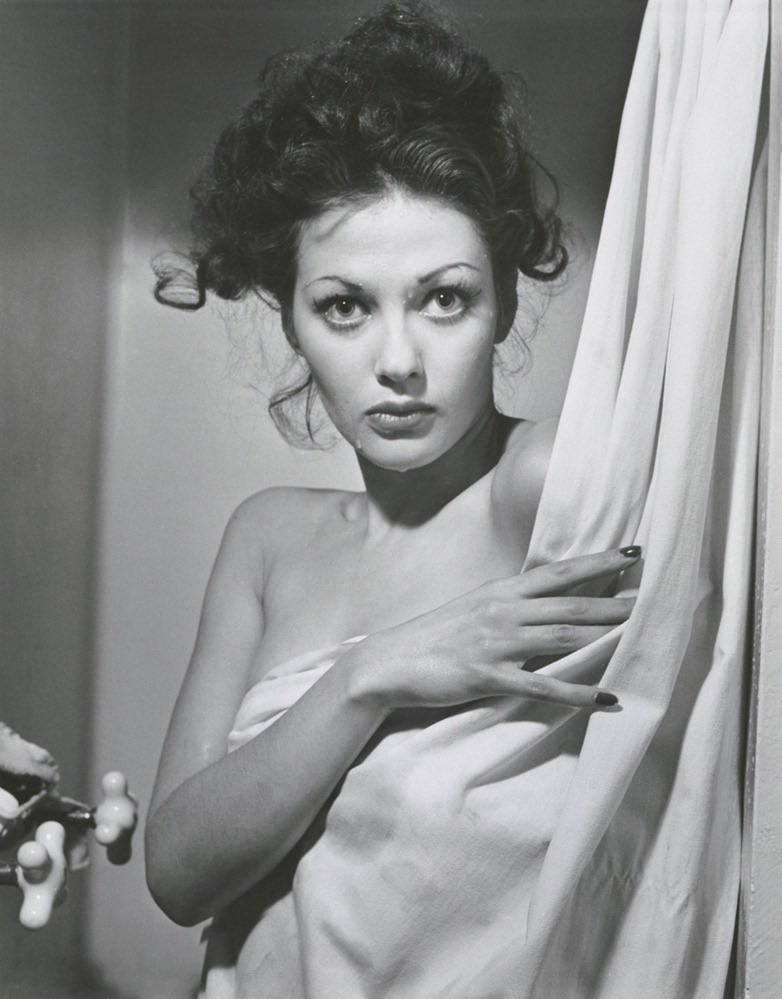
Yvonne de Carlo
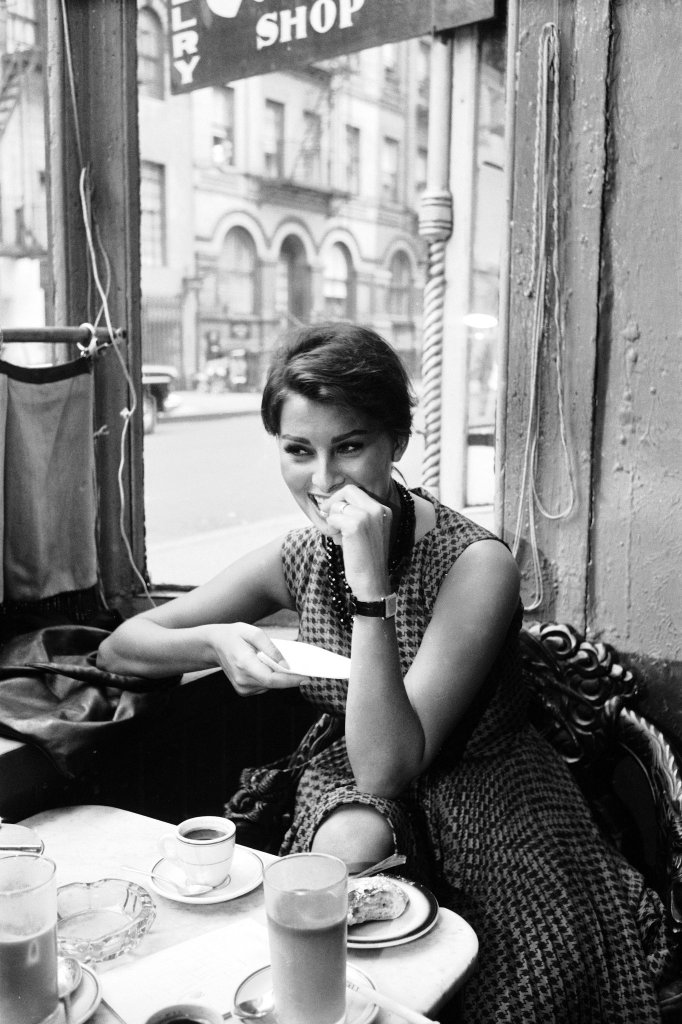
Sophia Loren
June 23, 1958
Vintage Life Magazine
Morning coffee
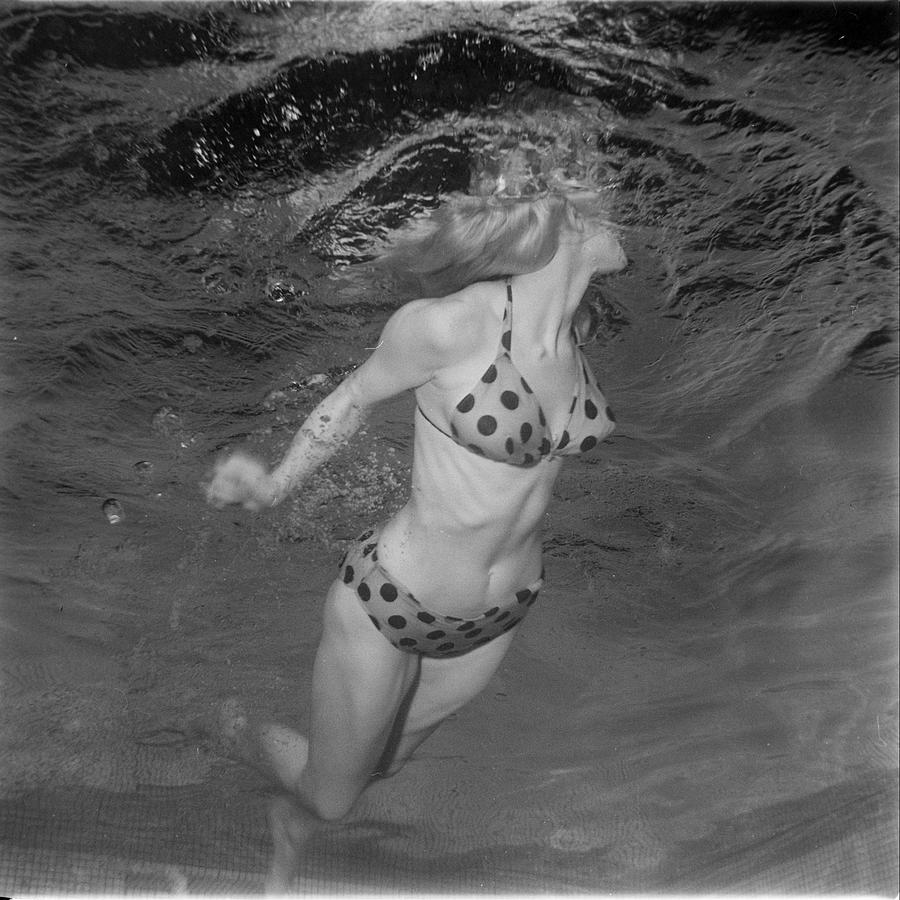

Jane Greer in a photo for LIFE magazine, 1947

Jayne Mansfield

New York City, 1949
Today is the birthday of Lillian Bassman (Brooklyn; June 15, 1917 – February 13, 2012 Manhattan); photographer and painter.

self portrait
From the 1940s until the 1960s Bassman worked as a fashion photographer for Junior Bazaar and later at Harper’s Bazaar where she promoted the careers of photographers such as Richard Avedon, Robert Frank, Louis Faurer and Arnold Newman. Under the guidance of the Russian emigrant, Alexey Brodovitch, she began to photograph her model subjects primarily in black and white. Her work was published for the most part in Harper’s Bazaar from 1950 to 1965.
By the 1970s Bassman’s interest in pure form in her fashion photography was out of vogue. She turned to her own photo projects and abandoned fashion photography. In doing so she tossed out 40 years of negatives and prints—her life’s work. A forgotten bag filled with hundreds of images was discovered over 20 years later. Bassman’s fashion photographic work began to be re-appreciated in the 1990s.
She worked with digital technology and abstract color photography into her nineties to create a new series of work. She used Photoshop for her image manipulation.
The most notable qualities about her photographic work are the high contrasts between light and dark, the graininess of the finished photos, and the geometric placement and camera angles of the subjects. Bassman became one of the last great woman photographers in the world of fashion. A generation later, Bassman’s pioneering photography and her mentor Brodovitch’s bold cropping and layout innovations were a seminal influence on Sam Haskins and his black and white work of the sixties.
Gallery
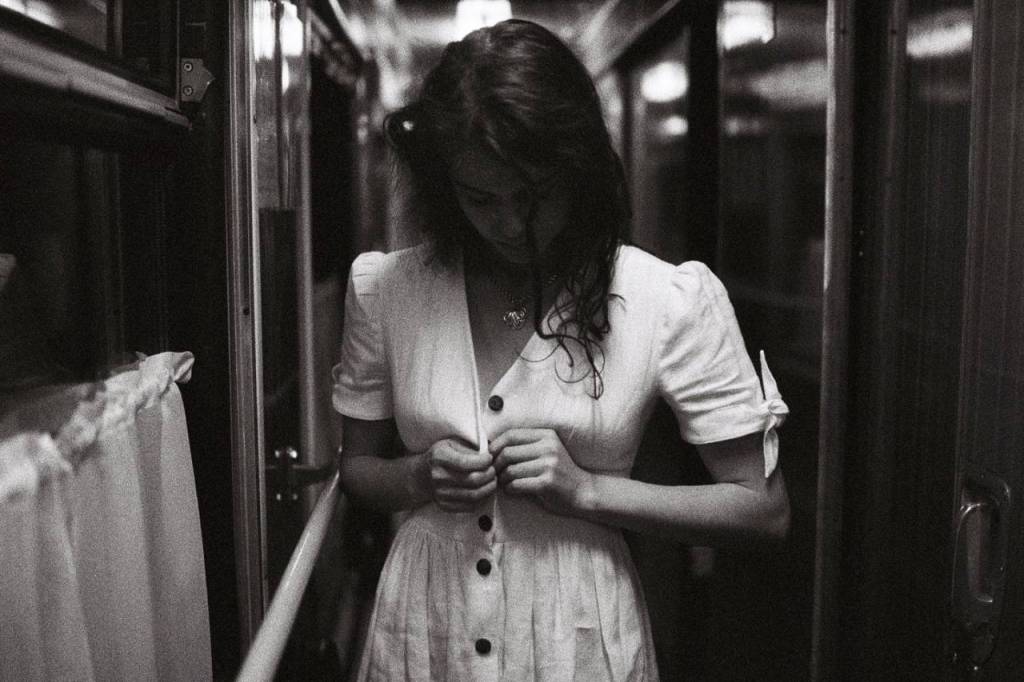
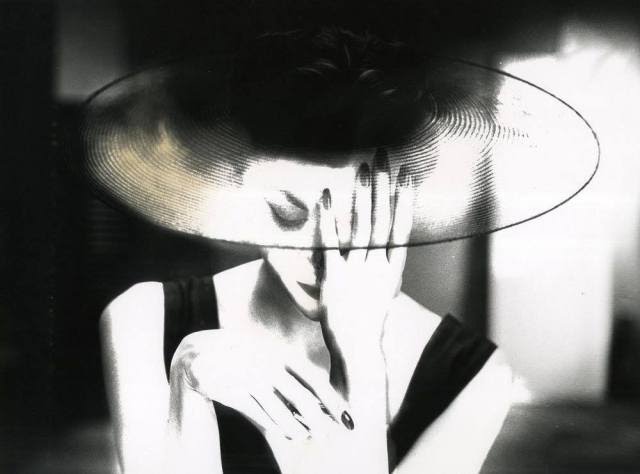
Mary Jane Russell, New York, Harper’s Bazaar, 1950

wonders of water

Anne Sainte-Marie, 1958
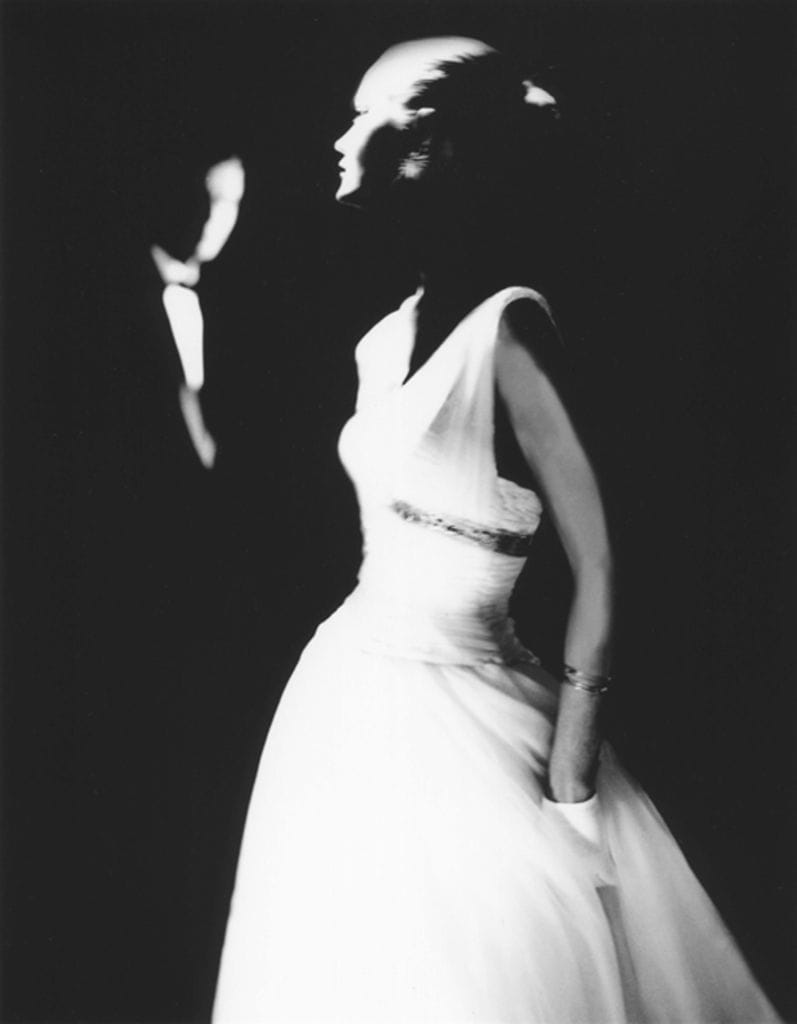
Margie Cato , Junior Bazaar 1950

Barbara Mullen
Eiffel Tower
Circa 1950

1949: Paris Gala Night: Barbara Mullen in a Dress by Patou, Harper’s Bazaar, Paris
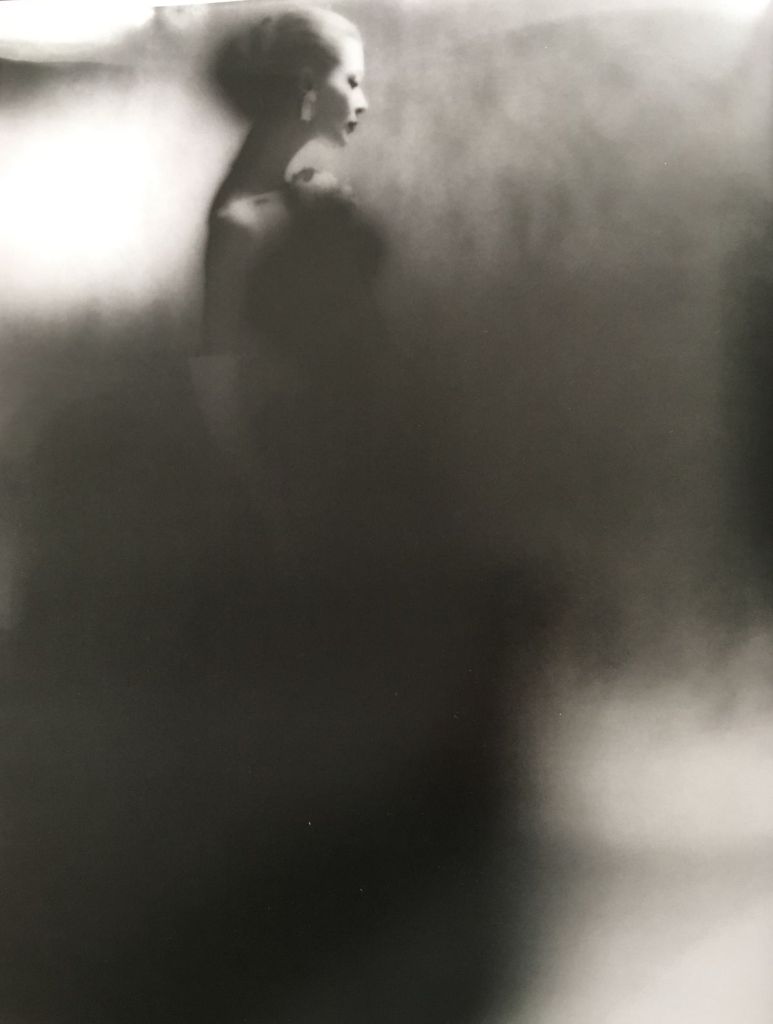
Barbara Mullen

dawn
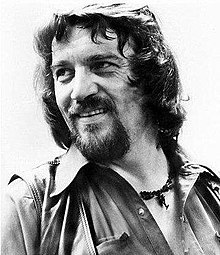
And today is the birthday of Waylon Jennings (Waylon Arnold Jennings; Littlefield, Texas; June 15, 1937 – February 13, 2002 Chandler, Arizona); singer, songwriter, musician, and actor. In 1958, Buddy Holly arranged Jennings’s first recording session, of “Jole Blon” and “When Sin Stops (Love Begins)”. Holly hired him to play bass. In Clear Lake, Iowa, Jennings gave up his seat on the ill-fated flight that crashed and killed Holly, J. P. Richardson, Ritchie Valens, and pilot Roger Peterson. The day of the flight was later known as the Day the Music Died. During the 1970s, Jennings joined the Outlaw Country movement. He released critically acclaimed albums Lonesome, On’ry and Mean and Honky Tonk Heroes followed by hit albums Dreaming My Dreams and Are You Ready for the Country. In 1976, he released the album Wanted! The Outlaws with Willie Nelson, Tompall Glaser, and Jessi Colter, the first platinum country music album. That success was followed by Ol’ Waylon and the hit song “Luckenbach, Texas.” Later, he joined the country supergroup The Highwaymen with Nelson, Kris Kristofferson, and Johnny Cash, which released three albums between 1985 and 1995. Jennings also appeared in movies and television series. He was the balladeer for The Dukes of Hazzard, composing and singing the show’s theme song.
Jennings was married four times and had six children. He married Maxine Caroll Lawrence in 1956 at age 18, with whom he had four children. Jennings married Lynne Jones on December 10, 1962, and they adopted a daughter, but divorced in 1967. He married Barbara Elizabeth Rood the same year. He composed the song “This Time” about the trials and tribulations of his marriages and divorces, it went on to become his first number 1 chart-topping song upon release in 1974.
Jennings married singer Jessi Colter in Phoenix, Arizona, on October 26, 1969. The couple had a son in 1979, Waylon Albright, known as Shooter. In the early 1980s, Colter and Jennings nearly divorced due to his abuse of drugs and alcohol.
Just to Satisfy You
Someone’s gonna get hurt before you’re through
Someone’s gonna pay for the things you do
How many hearts must break, how many will it take
To satisfy you, just to satisfy you
Another love, another fool
To play your game
Another love, another fool
They’re all the same
Someone’s gonna get hurt before you’re through
Don’t be surprised if that someone is you
You’re gonna find when it’s too late, a heart that just won’t break
To satisfy you, just to satisfy you
How many tears were cried, how many dreams have died
To satisfy you, just to satisfy you
Songwriters: DON BOWMAN, WAYLON JENNINGS
© Universal Music Publishing Group
For non-commercial use only
thanks for stoppin’ by y’all
Mac Tag
 The Lovers’ Chronicle
Leave a reply to The Lovers’ Chronicle 10 August – maybe – art by William Harnett – death of The Menken – verse by Jorge Amado – The Lovers’ Chronicle Cancel reply