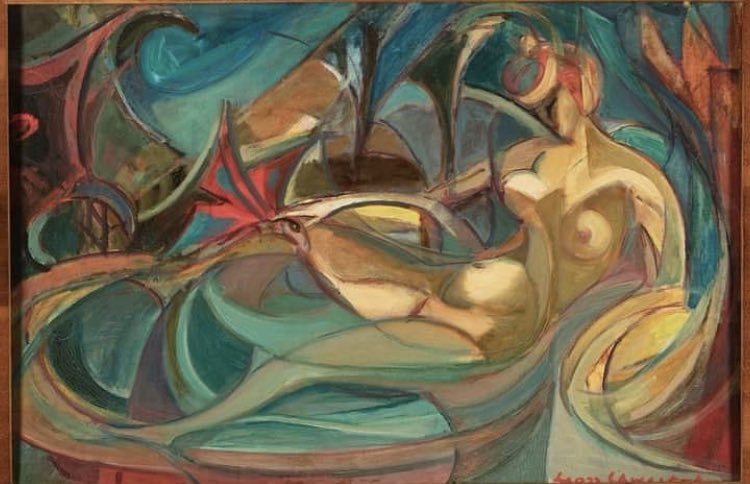
Dear Zazie, Here is today’s Lovers’ Chronicle from Mac Tag. Has someone spread their dreams and words at your feet? Have you spread your dreams and words at someone’s feet? Rhett
The Lovers’ Chronicle
Dear Muse,
had to search for a song
decided to come at this
from another angle
with today’s theme
as treadin’ water
”Because you felt like you’ve done a lot of that”
yes, for years, just tryin’ to keep from goin’ under
i found a song that Syd Barrett wrote called
”Dark Globe”, recorded by Syd and R.E.M.;
“My head kissed the ground
I was half way down, treading the sand”
i think i was all the way down, more than once
“And had to do some heavy treading”
as said before, that was then
”Now, it is an easy swim from here”
and there are no dark globes

© copyright 2023.2024 mac tag/cowboy coleridge all rights reserved
today’s inspiration comes from somethin’ Yeats wrote about the vulnerability he felt spreadin’ his dreams before the one he loved, scary thing, showin’ someone what is inside, only ever opened for a peek, never all the way, a nature and nurture question, both, life taught the folly of trustin’ another, yet when it came to writin’, did not hesitate to pour it all on the page, and here we are, still spreadin’ whatever i have for you to tread on


© copyright 2022.2024 mac tag/cowboy coleridge all rights reserved
more new ground, every day with you
tried it every which way but this one
after careful consideration i have
determined that this way is better
and we have only just begun,
apologies for usin’ a worn line
but it fits, now lets go darlin’
to see what awaits

© copyright 2021.2024 mac tag/cowboy coleridge all rights reserved
Pale Love, Pale Rider
of the soft look
tread softly
in my arms, disbelief
there beauty lay
and did
such pleasure take
now this, only
all that is left
simply my way of bein’ alone
can i wish for anything more
apart from this,
the memories have within
all the desire ever needed
***
“You’re not going
to let me back in there.
You’ve got your
armour back on.
That’s that.”
‘fraid so
© copyright 2020 mac tag/cowboy coleridge all rights reserved
on new ground, movin’ to ga
and why not, every day gravy
now two years out
from almost havin’ the big one,
might as well take a fancy chance
no tellin’ what lies ahead
not the past mistakes
but plenty of verse
shall we begin

© copyright 2019.2024 mac tag/cowboy coleridge all rights reserved
desire
i have this
this vision
and this way
of bein’ alone
cannot wish nor will
for anything else,
this dream
no more pretendin’
of what was felt
of the inescapable
of what is essential
now, clear
in thinkin’,
and feelin’
to tread not softly
but boldly forward
© copyright 2018 mac tag/cowboy coleridge all rights reserved
a year to the day
since i almost went away
settlin’ in to takin’ each day
as a gift, comin’ here routinely
to start the process of figurin’ out
the how, the who, what and why
join me, treadin’ on new ground

© copyright 2017.2024 mac tag/cowboy coleridge all rights reserved
Hey do y’all reckon I can git
Any inspiration from stayin’
In the hospital
Seems I had me a little ‘ol
Heart attack this mornin’
© copyright 2016 mac tag/cowboy coleridge all rights reserved
You deserve a better
story, a better poem,
a better tear. But i
cannot see past the fear
and the damn bitterness
© copyright 2015 mac tag/cowboy coleridge all rights reserved
Tread Softly
Here is a poem for William Butler Yeats, Maud Gonne and you. I spread my dreams and words at your feet, so please ……
Had I silver and gold, rubies and pearls,
Wrapped up in pretty paper and ribbons,
And everything in the world that was good
Of time and truth and of heaven and hope,
I would give it all to see you again:
But I have only my dreams and my words;
So I spread my dreams and words on the wind;
And pray that darkness treads softly on them
© copyright 2013 mac tag/Cowboy Coleridge All rights reserved
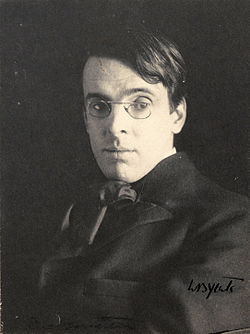
Today is the birthday of one of our favorite poets, William Butler Yeats (Sandymount, County Dublin, Ireland 13 June 1865 – 28 January 1939 Hôtel Idéal Beauséjour in Roquebrune-Cap-Martin, near Menton, France). He lived during great political and social changes in his home country, but he spent much of his life obsessed not with politics but with mysticism.
He got involved in the London Theosophical Society in 1887 and later joined the Order of the Golden Dawn, a group that performed a variety of ancient magic rituals. He attended séances and tarot card readings. Seeing the performances of mediums and learning about reincarnation inspired him to study Celtic myths and folklore.
In 1889, he met Maud Gonne, a beautiful actress who had become an activist and who spoke out for Irish independence. She became the love of his life, and though she refused his proposal of marriage, she believed that they were spiritually married, that they could communicate telepathically, and that they had been brother and sister in a past life. She helped him gather folklore from the peasants, and to learn about ancient Celtic culture. Yeats came to believe that if he could get in touch with the deep, mythic history of the Irish people, he could pull the country together with the power of poetry. Yeats spent years writing plays about Irish nationalism for Gonne to star in.
Many of Yeats’s poems are inspired by her, or mention her. He wrote the plays The Countess Cathleen and Cathleen Ní Houlihan for her. His poem Aedh wishes for the Cloths of Heaven ends with a reference to her:
But I, being poor, have only my dreams;
I have spread my dreams beneath your feet;
Tread softly because you tread on my dreams
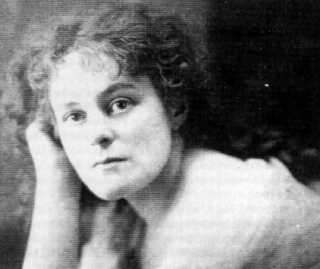
Few poets have celebrated a woman’s beauty to the extent Yeats did in his lyric verse about Gonne. From his second book to Last Poems, she became the Rose, Helen of Troy (in No second Troy), the Ledaean Body (Leda and the Swan and Among School Children), Cathleen Ní Houlihan, Pallas Athene and Deirdre. Gonne turned down several proposals from Yeats before marrying John McBride with whom she would have a son, Seán MacBride. She and MacBride would separate in 1904. Gonne and Yeats finally consummated their relationship in Paris in 1908. Yeats’ long years of fidelity, so to speak, were rewarded at last, although Yeats would later remark that “the tragedy of sexual intercourse is the perpetual virginity of the soul.” The relationship did not develop into a new phase after their night together. Soon afterwards, Gonne wrote to the poet indicating that despite the physical consummation, they could not continue as they had been: “I have prayed so hard to have all earthly desire taken from my love for you and dearest, loving you as I do, I have prayed and I am praying still that the bodily desire for me may be taken from you too.” By January 1909, Gonne was sending Yeats letters praising the advantage given to artists who abstain from sex. Nearly twenty years later, Yeats recalled the night with Gonne in his poem “A Man Young and Old”:
My arms are like the twisted thorn
And yet there beauty lay;
The first of all the tribe lay there
And did such pleasure take;
She who had brought great Hector down
And put all Troy to wreck.
I never tire of tellin’ that story. So he had a muse and a great unrequited love. And then to have consummated that love at long last; in Paris! How could life be any better! And then to lose her! How could life be more bitter! How well I know the better and the bitter. If Gonne was correct about the advantage given to artists who abstain from sex, then I can look forward to a writing windfall.
After Maud refused Yeats’ last proposal, his thoughts shifted with surprising speed to her daughter. Iseult Gonne was Maud’s second child with Lucien Millevoye, and at the time was twenty-one years old. She had lived a sad life to this point; conceived as an attempt to reincarnate her short-lived brother, for the first few years of her life she was presented as her mother’s adopted niece. When Maud told her that she was going to marry, Iseult cried and told her mother that she hated MacBride. When Gonne took action to divorce MacBride in 1905, the court heard allegations that he had sexually assaulted Iseult, then eleven. At fifteen, she proposed to Yeats. In 1917, he proposed to Iseult but was rejected.
That September, Yeats proposed to 25-year-old Georgie Hyde-Lees (1892–1968), known as George, whom he had met through Olivia Shakespear. Despite warnings from her friends—”George … you can’t. He must be dead”—Hyde-Lees accepted, and the two were married on 20 October 1917. Their marriage was a success, in spite of the age difference, and in spite of Yeats’s feelings of remorse and regret during their honeymoon. The couple went on to have two children, Anne and Michael. Although in later years he had romantic relationships with other women, Georgie herself wrote to her husband “When you are dead, people will talk about your love affairs, but I shall say nothing, for I will remember how proud you were.”
quotes
Only two topics can be of the least interest to a serious and studious mind… sex and the dead.
Think where man’s glory most begins and ends
And say my glory was I had such friends.
Does the imagination dwell the most
Upon a woman won or woman lost?
Too long a sacrifice
Can make a stone of the heart.
How many loved your moments of glad grace,
And loved your beauty with love false or true,
But one man loved the pilgrim soul in you,
And loved the sorrows of your changing face.
Words are always getting conventionalized to some secondary meaning. It is one of the works of poetry to take the truants in custody and bring them back to their right senses.
The friends that have it I do wrong
Whenever I remake a song
Should know what issue is at stake,
It is myself that I remake.
Everything that man esteems
Endures a moment or a day
Love’s pleasure drives his love away
The painter’s brush consumes his dreams
For he would be thinking of love
Till the stars had run away
And the shadows eaten the moon.
But, dear, cling close to me; since you were gone,
My barren thoughts have chilled me to the bone.
Crying amid the glittering sea,
Naming it with the ecstatic breath,
Because it had such dignity,
By the sweet name of Death
Murmur, a little sadly, how Love fled
And paced upon the mountains overhead
And hid his face amid a crowd of stars
A pity beyond all telling
Is hid in the heart of love
That is no country for old men. The young
In one another’s arms, birds in the trees
—Those dying generations—at their song
Man is in love and loves what vanishes,
What more is there to say?
Now that my ladder’s gone
I must lie down where all the ladders start
In the foul rag and bone shop of the heart.
We make out of the quarrel with others, rhetoric, but of the quarrel with ourselves, poetry.
I dream of the soft look
Your eyes had once, and of their shadows deep.
Hmmm, given up on tryin’ to win someone’s love. Somethin’ we know a lot about her at TLC.
The Song of the Day is “Tread Softly” by Gráda. We do not own the rights to this song. All rights reserved by the rightful owner
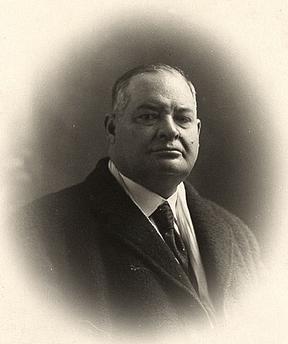
Today is the birthday of Joseph Stella (Giuseppe Michele Stella; Muro Lucano, Italy; June 13, 1877 – November 5, 1946 New York City); Futurist painter best known for his depictions of industrial America, especially his images of the Brooklyn Bridge. He is also associated with the American Precisionist movement of the 1910s–1940s.
Stella returned to Italy in 1909. He was unhappy with America, writing that he longed to be back in his native land after “an enforced stay among enemies, in a black funereal land over which weighed … the curse of a merciless climate.” By 1911, he had departed Italy, where the omnipresence of the Renaissance presented its own kind of obstacle for contemporary painters, and relocated to Paris. When he arrived, “Fauvism, Cubism, and Futurism were in full swing,” he wrote, and “[there] was in the air the glamor of a battle.” It was the right place to be, at just the right time, for a man of Stella’s curiosity, openness to new trends, and ambition.

Man Ray, 1920, Three Heads (Stella and Marcel Duchamp, painting bust portrait of Man Ray above Duchamp), gelatin silver print, 20.7 x 15.7 cm, Museum of Modern Art, New York
In Paris, Stella attended the salon of Gertrude Stein, where he met many other painters. “[Stein] found the big and boisterous painter rather like [her friend, the poet] Apollinaire; they both had a fund of sarcastic wit that was frequently turned on their hosts.” Stella’s view of his hostess was indeed sarcastic: she sat, he wrote, “enthroned on a sofa in the middle of the room,” surrounded by her Cézannes and Picassos, “with the forceful solemnity of a pythoness or a sibyl … in a high and distant pose.”
Gallery
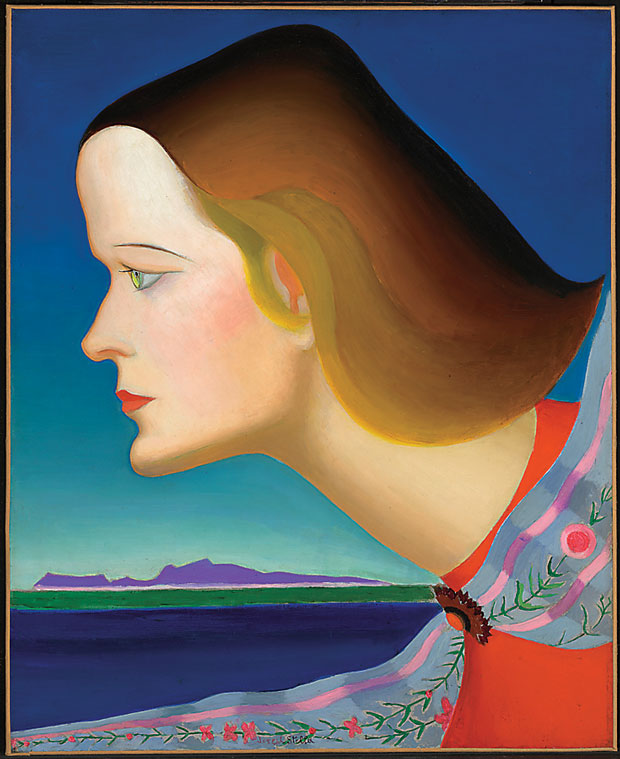
The Amazon 1925-1926

The virgin

A Vision, Art Institute of Chicago
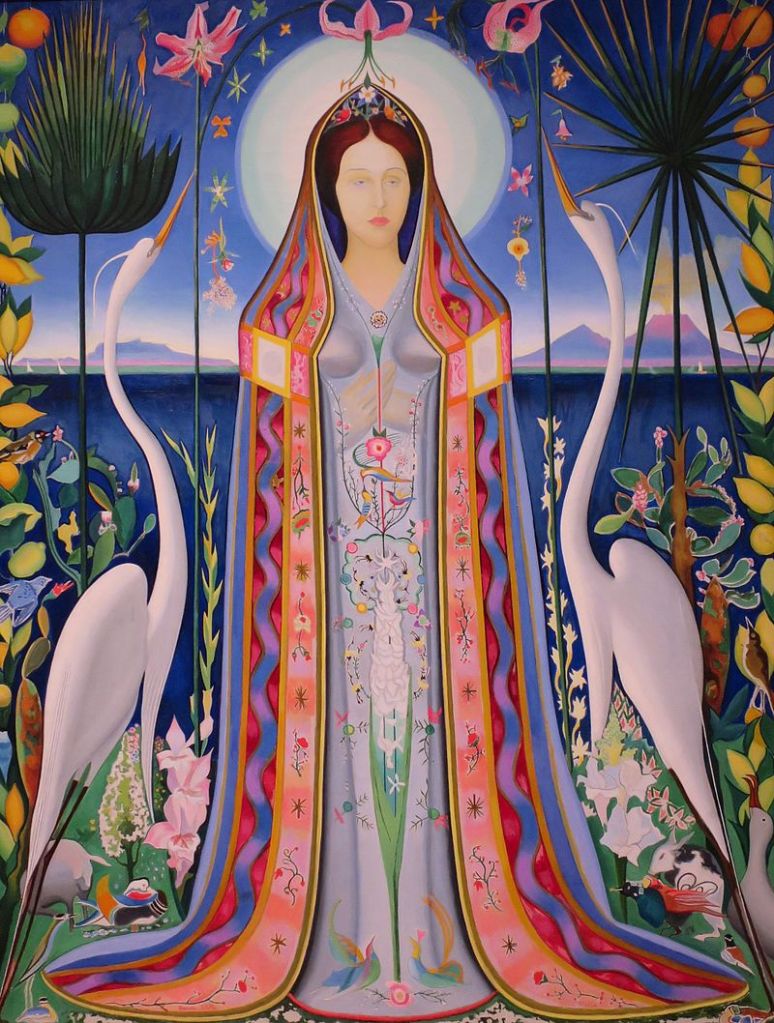
Purissima, oil on canvas, High Museum of Art

The Birth of Venus

Stella drew his friend Clara Fasano on numerous occasions, creating casual studies and posed portraits such as this bold, formal image. Her fashionable hat, flowing black veil, and dramatic red lips and scarf clearly place her in the 1940s.
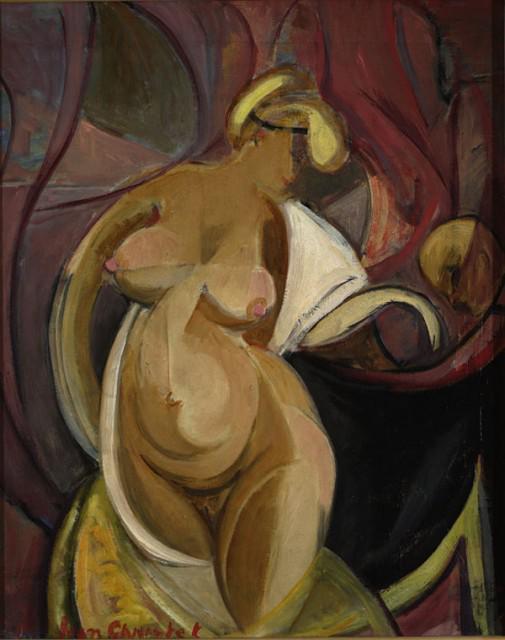
Today is the birthday of Leon Chwistek (Kraków, Austria-Hungary, 13 June 1884 – 20 August 1944, Barvikha near Moscow, Russia); avant-garde painter, theoretician of modern art, literary critic, logician, philosopher and mathematician.
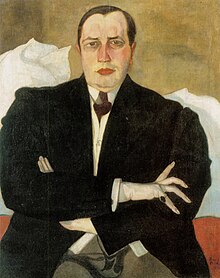
Portrait by Witkacy, 1913
Gallery

female nude – butterflies
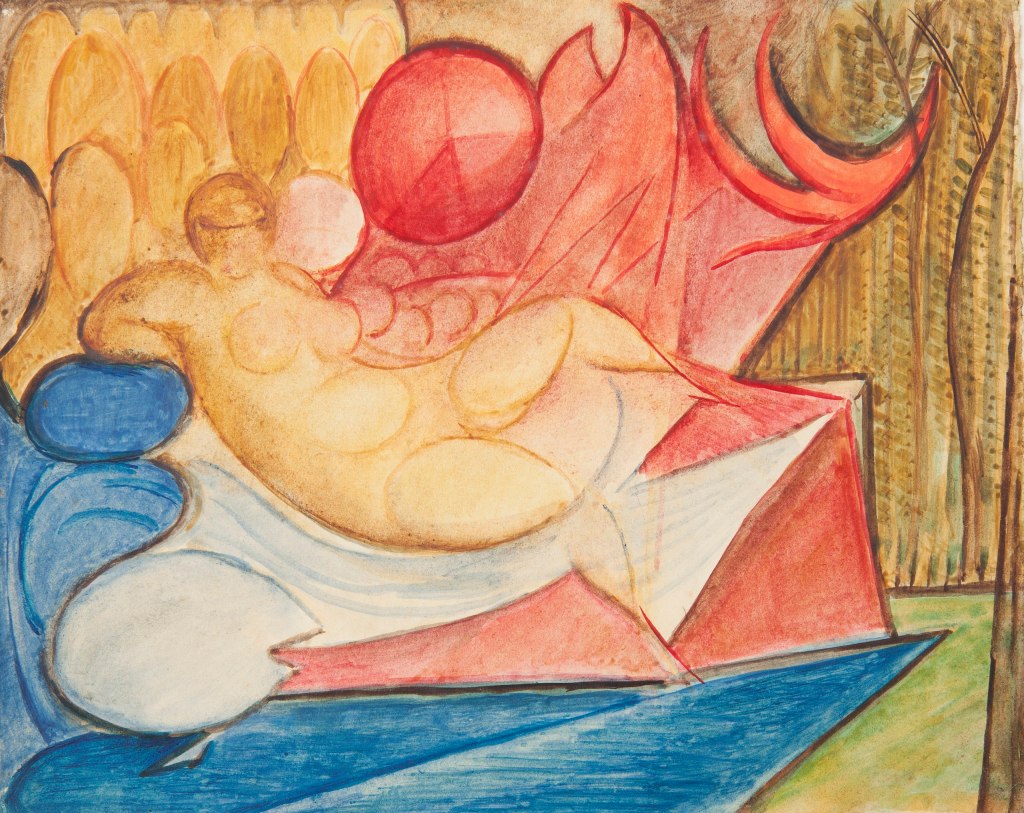
Reclining Female Nude, c.1922

Venus 1928

Bathers, c.1920
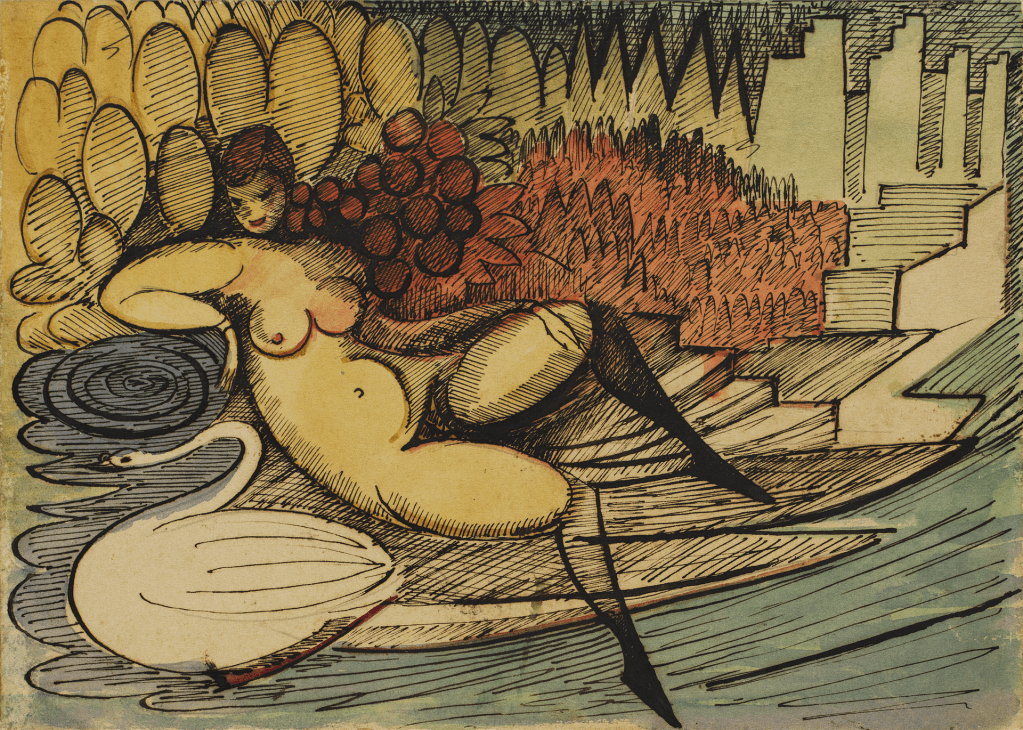
Leda, c.1925

Nude 1939

Feast, 1925
And today is the birthday of Fernando Pessoa (Fernando António Nogueira Pessoa; Lisbon; June 13, 1888 – November 30, 1935 Lisbon); poet, writer, literary critic, translator, publisher and philosopher, in my opinion one of the most significant literary figures of the 20th century and one of the greatest poets in the Portuguese language. He also wrote in and translated from English and French.

Pessoa was a prolific writer, and not only under his own name, for he dreamed up approximately seventy-five others. He did not call them pseudonyms because he felt that did not capture their true independent intellectual life and instead called them heteronyms. These imaginary figures sometimes held unpopular or extreme views.
Verse
Não tenho ambições nem desejos
Ser poeta não é uma ambição minha
É a minha maneira de estar sozinho.
- I have no ambitions nor desires.
To be a poet is not my ambition,
It’s simply my way of being alone. - Alberto Caeiro (heteronym), O Guardador de Rebanhos (“The Keeper of Herds”, tr. Richard Zenith) in Athena, January 1925.
- Não sou nada.
Nunca serei nada.
Não posso querer ser nada.
À parte isso, tenho em mim todos os sonhos do mundo.- I am nothing.
I shall never be anything.
I cannot even wish to be anything.
Apart from this, I have within me all the dreams of the world. - Álvaro de Campos (heteronym), Tabacaria (“The Tobacconist’s” or “The Tobacco Shop”), January 15, 1928.
- Variant translation:I am nothing.
Never shall be anything.
Cannot will to be anything.
This apart, I have in me all the dreams of the world.
- I am nothing.
- A metafísica é uma consequência de estar mal disposto.
- Metaphysics is a consequence of being indisposed.
- Tabacaria (1928)

- O poeta é um fingidor.
Finge tão completamente
Que chega a fingir que é dor
A dor que deveras sente.- The poet is a pretender.
He pretends so completely,
that he even pretends that it is pain
the pain he really feels. - “Autopsicografia”, in Presença, No. 36 (November 1932)
- Richard Zenith’s translation:
- The poet is a faker
Who’s so good at his act
He even fakes the pain
Of pain he feels in fact.
- The poet is a faker
- Richard Zenith’s translation:
- The poet is a pretender.
- O amor é que é essencial.
O sexo é só um acidente.- It’s love that is inescapable.
Sex is the merest accident. - Poem (5 April 1935), reported in Poesias inéditas (1930-1935), p. 192.
- Variant translation:Love is essential. Sex, a mere accident.
- It’s love that is inescapable.
Clear in thinking, and clear in feeling,
and clear in wanting
- Original: Claro em pensar, e claro no sentir,
e claro no querer - Poem “D. Pedro”, verses 1-2
Without madness what is man
more than the healthy beast,
corpse adjourned that procreates?
- Original: Sem a loucura que é o homem
Mais que a besta sadia,
Cadáver adiado que procria? - Poem “D. Sebastião”, verses 8-10
thanks for stoppin’ by y’all
Mac Tag
Follow us on twitter @cowboycoleridge
 The Lovers’ Chronicle
Leave a reply to The Lovers’ Chronicle 30 January – missin’ – The Day of Saudade – art by Amrita Sher-Gil – The Lovers’ Chronicle Cancel reply