Dear Zazie, Here is today’s Lovers’ Chronicle from Mac Tag. Do you have all of that? Rhett
The Lovers’ Almanac
Dear Muse,
one of the easiest song choices, written by
Gerald Marks and Seymour Simons in 1931
and covered by almost everyone, but another
easy choice in choosin’ Willie’s version,
“All of me
Why not take all of me?”
“That was the first song I thought of”
but with us there are no goodbyes
”Only hellos”
right, and we are good for each other
“So why not give all we have”
absolutely

© copyright 2023.2024 mac tag/cowboy coleridge all rights reserved
live from San Juan, Puerto Rico y’all
when i had nothin’ to give i had opportunities, then when i finally had somethin’ to give, very few open doors, is that the usual story, not sure, just took it as further proof of not meant to be, of course givin’ has degrees, how much, well not much, have to be with someone worth it, that did not happen, but kept the armor on and the wall too high, so no one could git close enough, resigned to spendin’ the rest of the ride watchin’, writin’, had no way of knowin’ i was just gittin’ ready to give it all for you

© copyright 2022.2024 mac tag/cowboy coleridge all rights reserved
see at last, all that could
be wrung from the years
spent in darkness
the verse is the purpose
to wake to, to live in
the world and its life
dancin’ with dreams
so this is all that can be offered,
my vision, in stories and visuals
and my heart sealed for you
© copyright 2021 mac tag/cowboy coleridge all rights reserved
Pale Love, Pale Rider
had to learn this,
only write them
if you know
what you want to say
and i want to say
not one thing,
but everything
not just the reason,
this is the way it is
to one who can hear
this is the source
of everlastin’ attraction,
for those who want,
who dare to have it all
***
all the time
that is left
to be spent
goin’ wherever
the muses take us
© copyright 2020 mac tag/cowboy coleridge all rights reserved
inspiration
wrung from experience
pain and pleasure, words
flung about, the only remedy
nothin’ comes from nothin’
the night
to wake to,
our dreams,
variations
on the way it could be
a scene on a canvas,
verse in a letter
sealed for us
the reason for it all
© copyright 2019 mac tag/cowboy coleridge all rights reserved
all
of you, for you,
about you
callin’ to you
and a feelin’
you must be callin’ too
your voice, a song
not a phantom…
all about followin’
the inspiration
come what may
all the words
to be written
all the unfound
melodies
all the moments
to stop and try
to capture the light
all the time
that is left
to be spent
goin’ wherever
the muses take us
***
readin’ The Sun Also Rises,
again, while livin’ near El Paso
when all i could count on
were books,
the wind,
and the big
West Texas sky

as long as
there are tequila nights
and Topo Chico mornin’s,
it will be all right y’all
© copyright 2018 mac tag/cowboy coleridge all rights reserved
So that is where I went wrong
I have been celebratin’
Cray-O de Every Day-o
Instead of Cinco de Mayo
***
Your words will never
Be enough
I need your verses
What do I want…
Just to write verse for you
Remember us,
Dancin’ naked
In the High
Hill Country rain
© copyright 2017 mac tag/cowboy coleridge all rights reserved
Tried to tell her not to be afraid
She never put her fears aside
Never unwrapped the words
Never said what I longed to hear
© copyright 2015 mac tag/cowboy coleridge all rights reserved
Yet another from the archives. I once had it. I wish I still had……
All of That
Trust and belief
And hope and faith
Beauty and truth
And all of that
Dreams and passion
And awe and bliss
Magic and light
And all of that
Fun and wonder
And lust and laughs
Rapture and love
And all of that
Man and woman
Lovers and friends
Lucky are they
Who have all that
© Copyright 2011 Cowboy Coleridge All rights reserved
The Song of the Day is “All That I Am” by Parachute. We do not own the rights to this song. All rights reserved by the rightful owner. No copyright infringement intended.

Today is the birthay of Gaston Leroux (Gaston Louis Alfred Leroux, Paris, 6 May 1868 – 15 April 1927 Nice); journalist and author. In the English-speaking world, perhaps best known for writing the novel The Phantom of the Opera (Le Fantôme de l’Opéra, 1910). Le Fantôme de l’Opéra was first published as a serialization in Le Gaulois from 23 September 1909, to 8 January 1910. It was published in volume form in late March 1910 by Pierre Lafitte. The novel is partly inspired by historical events at the Paris Opera during the nineteenth century and an apocryphal tale concerning the use of a former ballet pupil’s skeleton in Carl Maria von Weber’s 1841 production of Der Freischütz. It has been successfully adapted into various stage and film adaptations, most notable of which are the 1925 film depiction featuring Lon Chaney, and Andrew Lloyd Webber’s 1986 musical. The love story triangle between the Phantom, Christine and Raoul, is one of my favorite books. His 1907 novel Le mystère de la chambre jaune (The Mystery of the Yellow Room) is one of the most celebrated locked-room mysteries.
Leroux married twice, first to Marie Lefranc from whom he separated in 1902. Following his separation, he then lived with Jeanne Cayatte from Lorraine, with whom he had a son, Gaston, nicknamed Milinkij, and daughter Madeleine; they married in 1917 after Lefranc’s death. In 1918, he founded a film production company, Société des Cinéromans with René Navarre and debuted two films Tue-la-Mortand Il etait deux petits enfants, in which his daughter played the lead role.
Le Mystère de la chambre jaune, 1907
Il n’existe pas d’arts mineurs. Seules existent les noces étranges du conscient et de l’inconscience, la foudre exquise produite par le contact de la sagesse et de ce schizophrène que chacun porte en soi et dont il a généralement honte.
La poésie, c’est le monstre, né de ces noces mystérieuses, de ce mariage brutal entre la surprise et les habitudes. Et peu importe la taille et la force musculaire du monstre.
L’essentiel est qu’il naisse. Je n’en demande pas davantage.
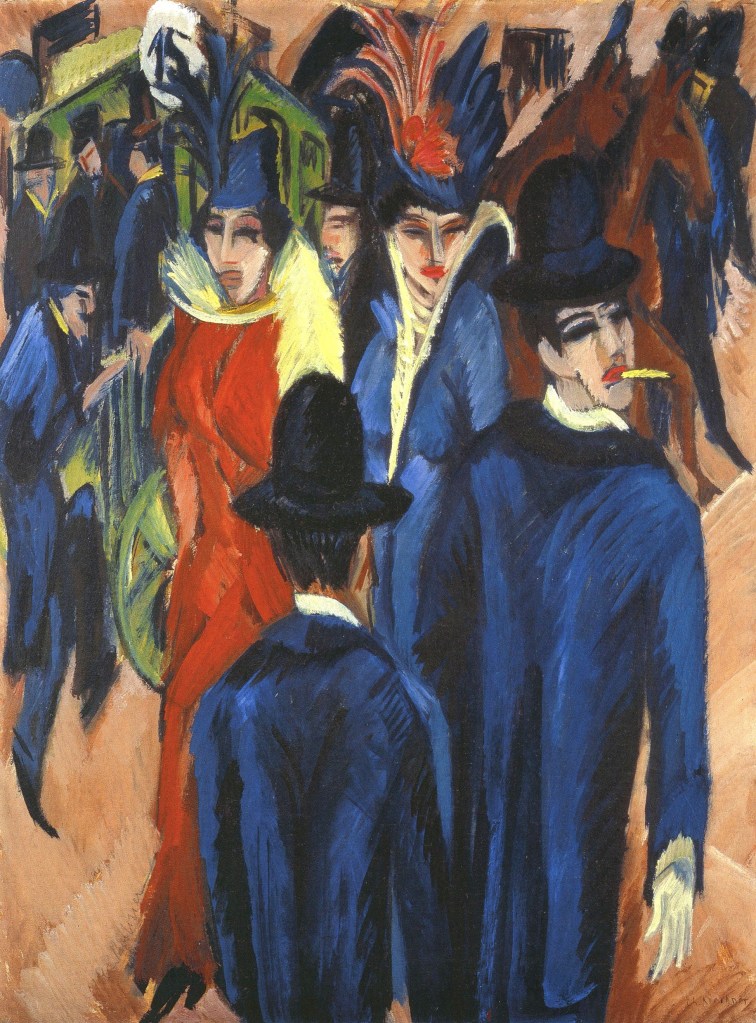
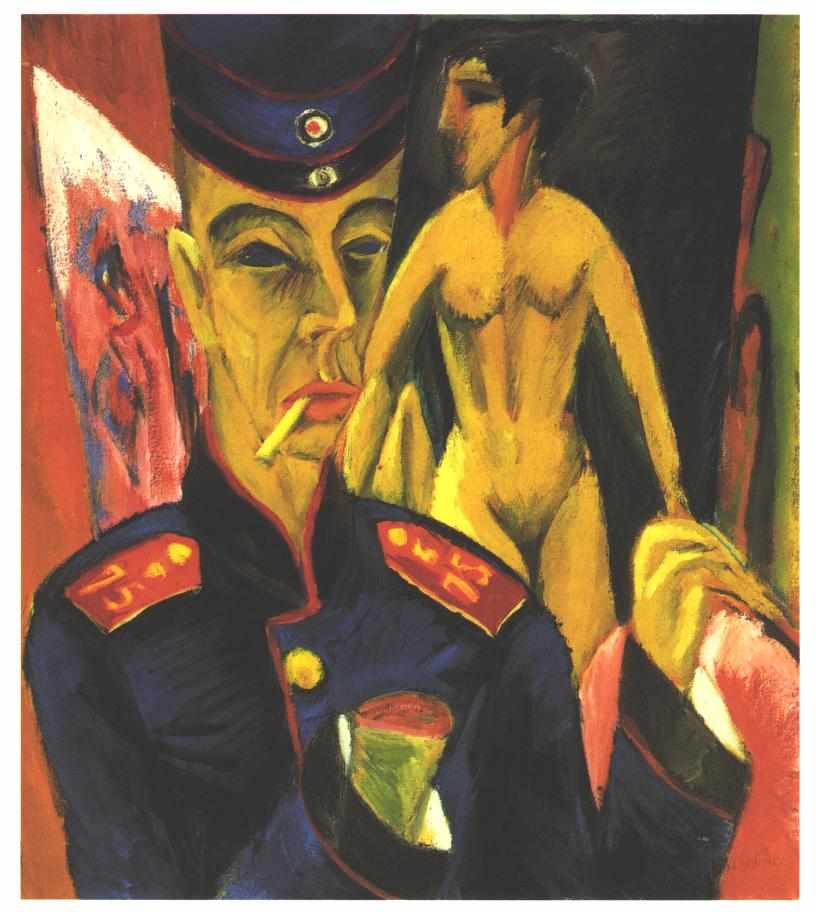
Today is the birthday of Ernst Ludwig Kirchner (Aschaffenburg, Kingdom of Bavaria, German Empire 6 May 1880 – 15 June 1938 Frauenkirch-Wildboden, Switzerland); expressionist painter and printmaker. One of the founders of the artists group Die Brücke or “The Bridge”, a key group leading to the foundation of Expressionism in 20th-century art. In 1933, his work was branded as “degenerate” by the Nazis and in 1937 over 600 of his works were sold or destroyed.
 | |
Kirchner’s studio became a venue which overthrew social conventions to allow casual love-making and frequent nudity. Group life-drawing sessions took place using models from the social circle, rather than professionals, and choosing quarter-hour poses to encourage spontaneity. Bleyl described one such model, Isabella, a fifteen-year-old girl from the neighbourhood, as “a very lively, beautifully built, joyous individual, without any deformation caused by the silly fashion of the corset and completely suitable to our artistic demands, especially in the blossoming condition of her girlish buds.”
A group manifesto written by Kirchner in 1906 stated that “Everyone who reproduces, directly and without illusion, whatever he senses the urge to create, belongs to us”.
In September and October 1906, the first group exhibition was held, focused on the female nude, in the showroom of K.F.M. Seifert and Co. in Dresden.
In 1906, he met Doris Große, who was his favoured model until 1911. Between 1907 and 1911, he stayed during the summer at the Moritzburg lakes and on the island of Fehmarn (which he revisited until 1914) with other Brücke members; his work featured the female nude in natural settings. In 1911, he moved to Berlin, where he founded a private art school, MIUM-Institut, in collaboration with Max Pechstein with the aim of promulgating “Moderner Unterricht im Malen” (modern teaching of painting). This was not a success and closed the following year, when he also began a relationship with Erna Schilling that lasted the rest of his life.
In 1913, his writing of Chronik der Brücke (Brücke chronicle) led to the ending of the group. At this time, he established an individual identity with his first solo exhibition, which took place at the Essen Folkwang Museum. During the next two years, he painted a series of “Straßenszenen” (street scenes) showing the streets of Berlin, with the central characters of street walkers.
He died by suicide (gunshot).
Gallery

Two Nudes in the Forest II

Street, Berlin (1913), one of a series on this theme, depicting prostitutes

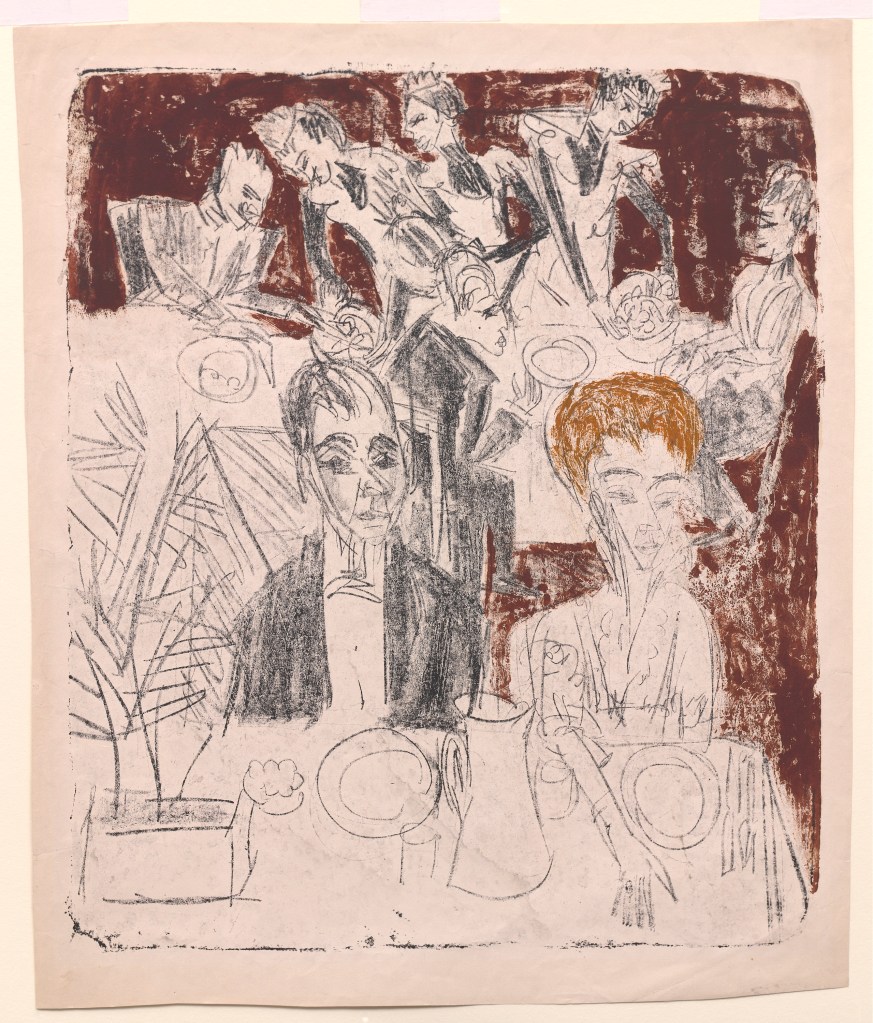


Marzella (1909–10)
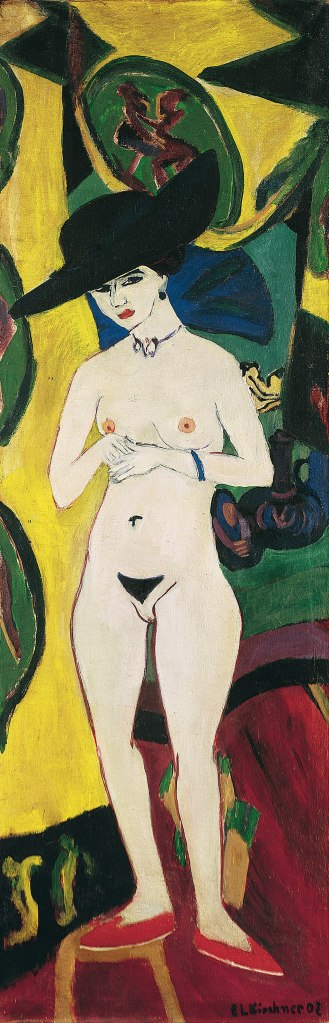
Standing Nude with Hat, 1910
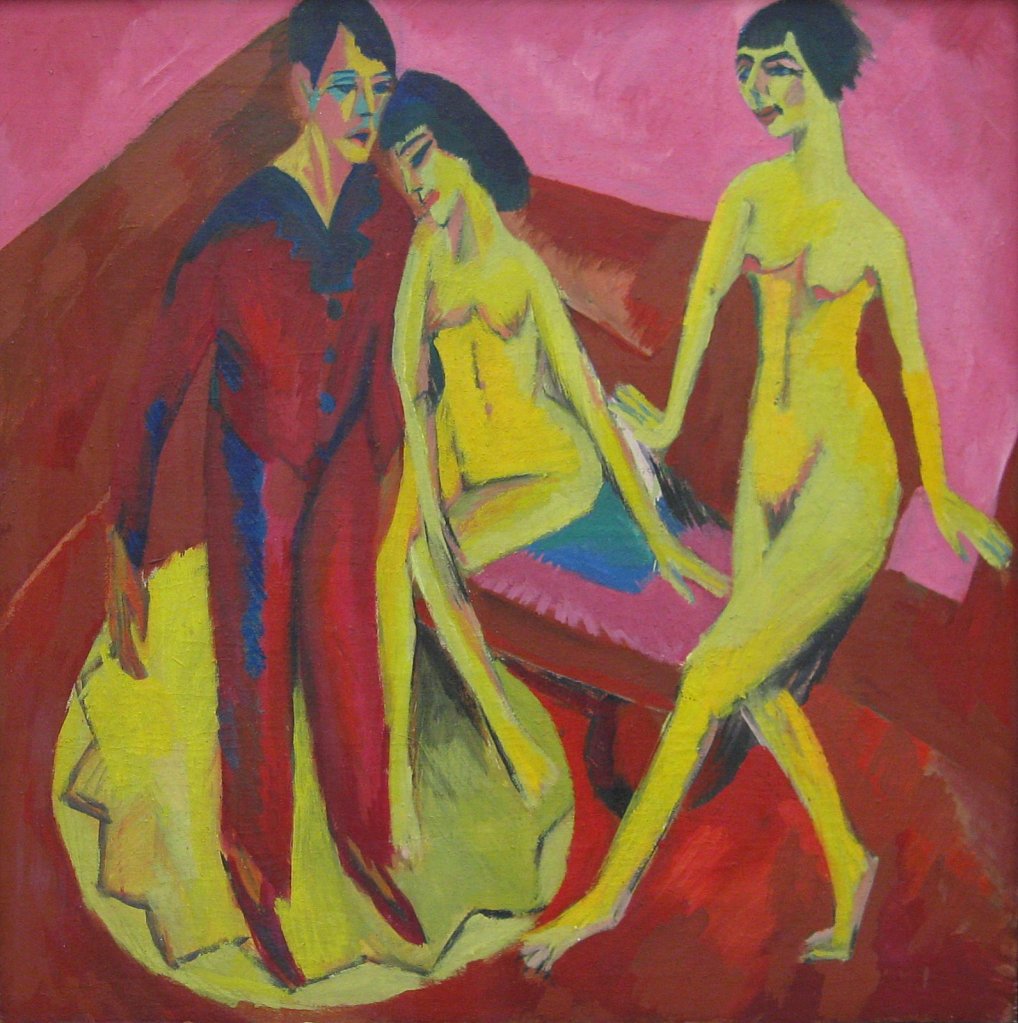
Dance School, 1914, Pinakothek der Moderne

Colorful Dance, 1932

Sitting Woman (Dodo), 1907, Pinakothek der Moderne, Munich
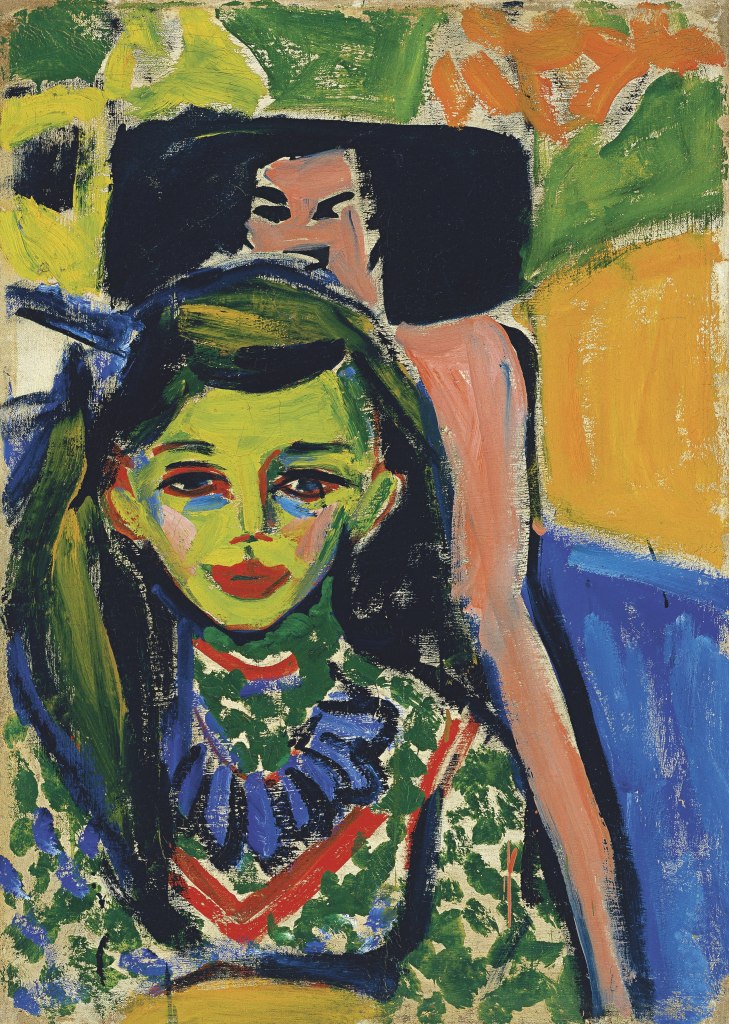
Fränzi in front of Carved Chair, 1910, Museo Thyssen-Bornemisza, Madrid

Potsdamer Platz, 1914, Neue Nationalgalerie, Berlin



Today is the birthday of Randall Jarrell (Nashville May 6, 1914 – October 14, 1965 Chapel Hill, North Carolina); poet, literary critic, children’s author, essayist, novelist, and the 11th Consultant in Poetry to the Library of Congress, a position that now bears the title Poet Laureate.

Jarrell taught at the University of Texas at Austin from 1939 to 1942, where he began to publish criticism and where he met his first wife, Mackie Langham. In 1942 he left the university to join the United States Army Air Forces. According to his obituary, he “[started] as a flying cadet, [then] he later became a celestial navigation tower operator, a job title he considered the most poetic in the Air Force.” His early poetry, in particular The Death of the Ball Turret Gunner, would principally concern his wartime experiences in the Air Force.
The Jarrell obituary goes on to state that “after being discharged from the service he joined the faculty of Sarah Lawrence College in Bronxville, N.Y., for a year. During his time in New York, he also served as the temporary book review editor for The Nation magazine”. Jarrell was uncomfortable living in the city and “claimed to hate New York’s crowds, high cost of living, status-conscious sociability, and lack of greenery.” He soon left the city for the Woman’s College of the University of North Carolina where, as an associate professor of English, he taught modern poetry and “imaginative writing”.
Jarrell divorced his first wife and married Mary von Schrader, a young woman whom he met at a summer writer’s conference in Colorado, in 1952. They first lived together while Jarrell was teaching for a term at the University of Illinois Urbana-Champaign. Then the couple settled back in Greensboro with Mary’s daughters from her previous marriage. The couple also moved temporarily to Washington D.C. in 1956 when Jarrell served as the consultant in poetry at the Library of Congress for two years, returning to Greensboro and the University of North Carolina after his term ended.
Blood for a Stranger (1942)
- I see at last that all the knowledge
- I wrung from the darkness — that the darkness flung me —
- Is worthless as ignorance: nothing comes from nothing,
The darkness from the darkness. Pain comes from the darkness
And we call it wisdom. It is pain.- “90 North,” lines 28-32
- The nurse is the night
To wake to, to die in: and the day I live,
The world and its life are her dreams.- “Variations,” lines 31-33
- And the world said, Child, you will not be missed.
You are cheaper than a wrench, your back is a road;
Your death is a table in a book.
You had our wit, our heart was sealed to you:
Man is the judgment of the world.- “Variations,” lines 40-44
thanks for stoppin’ by y’all
Mac Tag
 The Lovers’ Chronicle
Leave a reply to The Lovers’ Chronicle 31 July – bear away – art by Jacques Villon & Erich Heckel – The Lovers’ Chronicle Cancel reply