Dear Zazie Lee,
Here is today’s Lovers’ Chronicle from Mac Tag.
Rhett
The Lovers’ Chronicle
Dear Muse,
dream outlaws…
-He and the fabulous redhead are sitting at the bar
in the Buffalo Bodega Saloon in Deadwood having a drink-
Cheers my love
cheers my dear
The dream Goddess did not have to call wardrobe,
she just pulled the hat and boots from your closet
yes, she did not have to go far,
and the same for you
We look marvelous,
ha, as usual
But why are we in dream Deadwood
we are in a saloon where Wild Bill
used to come drink and play cards,
i think because of one of the songs
today’s theme brings to mind
Oh I get it, dead or alive
yep, and though we are not wanted
as outlaws, we are both wanted
You by me, and me by you
the only want we need

© copyright 2024 mac tag/cowboycoleridge all rights reserved
a chorus of various wants
compete for attention;
”I want you to want me”,
”I want you!”,
”Wanted, dead or alive”
perhaps you can come up
with loftier choices
”Hmm let me think on it”
anyway, how convenient
that want finally found
it’s place with us
”Yes, my love, a full circle journey”
shall we indulge in some wanton wants

© copyright 2023.2024 mac tag/cowboycoleridge all rights reserved
been all over on this one; from not knowin’ what to thinkin’ i knew what, to realizin’ i had no idea and then finally knowin’; from not thinkin’ i could be to needin’ to  be then not carin’ if i was to finally acceptin’ i could be; from denyin’ it’s existence to embracin’ it; from knowin’ i was to the hard fact that i was not; quite the ride, i was reconciled to not carin’ and would have rode that and the verse till the end, then you showed me what it meant to want, that i could be wanted and that i could accept wantin’

© copyright 2022.2024 mac tag/cowboycoleridge all rights reserved
before, when knowin’
what was wanted
was thought
to be certain
a life spent knowin’
exactly what they wanted
without realizin’ that want
is about givin’
and not takin’
then you
then want became you
© copyright 2021.2023 mac tag/cowboycoleridge all rights reserved
Pale Love, Pale Rider
before, when knowin’
what was wanted
was certain
a life spent knowin’
exactly what they wanted
without realizin’ that want
is about givin’
and not takin’
then you
then want became you
but since you
no longer wantin’
nor wanted
© copyright 2020 mac tag/cowboycoleridge all rights reserved
but since you
no longer wantin’
nor wanted
and all that is left
plays out in dreams
all that is left of you,
is in the wantin’
and the waitin’
till want goes away
© 2019 copyright mac tag/cowboycoleridge all rights reserved
Before, when he thought he knew
just what he wanted
He had spent his entire life
thinkin’ he knew exactly
what they wanted for themselves
Not realizin’ that what
he wanted for them
was what he wanted
Then she walked into his life
and changed everything
And then she was gone
And everything changed
He became weathered and worn,
wistful and wantin’,
no longer wanted
He wanted no one
for she was the only one
he ever wanted
Now he knows, but now too late
And nothin’ has changed
All that he has left to him
of what he wanted,
plays out in his dreams
All that he has left of her,
of what she wanted,
is in the wantin’
And he waits
Till he wants no more
© copyright 2018 mac tag/cowboycoleridge all rights reserved
A life spent thinkin’
he knew exactly
what they wanted
for themselves
Not realizin’ that what
he wanted for them
was what he wanted
© copyright 2017 mac tag/cowboycoleridge all rights reserved
Not realizin’ that what
he wanted for them
was what he wanted
© copyright 2016 mac tag/cowboycoleridge all rights reserved
complete; 600 miles in the rearview.
And 68 oz of coffee and two
extra strength 5 Hour Energies.
***
Damn near ruined
myself chasin’
what i thought i
was supposed to
have. Just could not
see; none of that
was meant for me
***
Lost, lost. Hidden
With countenance bold
At it’s discretion governin’ the thunder
Tramplin’, defeatin’
Had that happen, and happen again
Found
Then; she came
Felt young, in the shadow of her beauty
The most charmin’ dreams have nothin’
Comparable, nothin’ comparable
© copyright 2015 mac tag/cowboycoleridge all rights reserved
Today is the birthday of Emma Hamilton, Lady Hamilton (born Amy Lyon; Neston, Cheshire, England 26 April 1765 – 15 January 1815 Calais, France); maid, model, dancer and actress. She began her career in London’s demi-monde, becoming the mistress of a series of wealthy men, culminating in the naval hero Lord Nelson, and was the favourite model of the portrait artist George Romney.
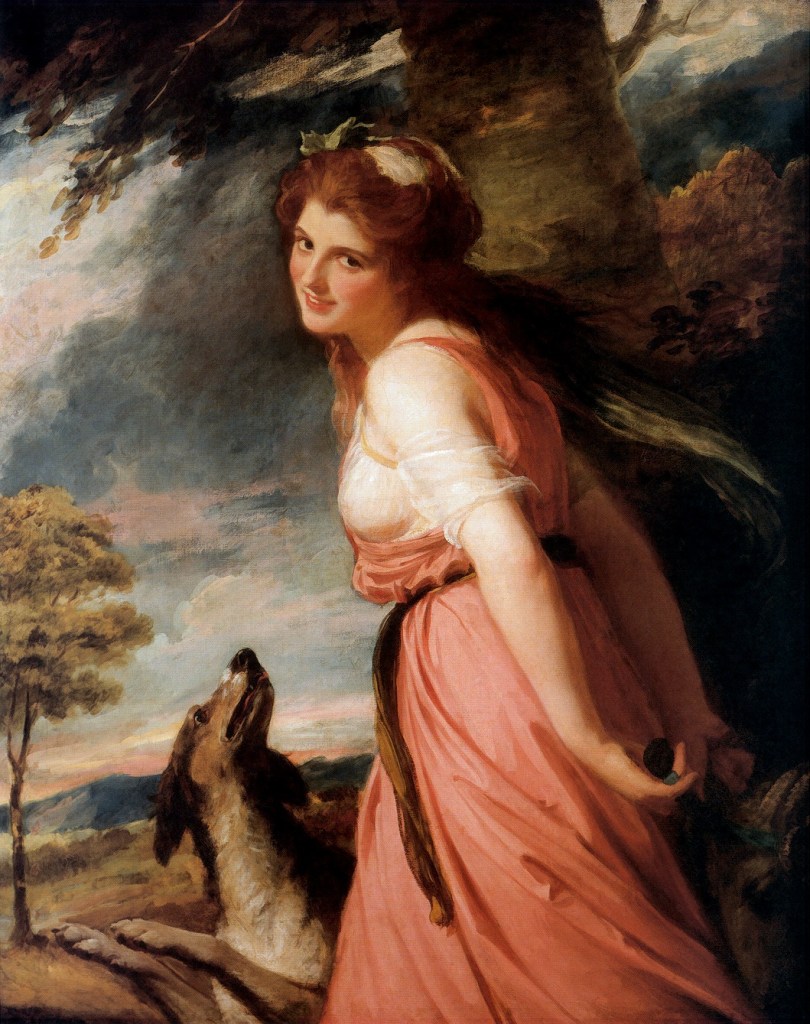
Emma as a Bacchante, by George Romney, 1785
In 1791, at the age of 26, she married Sir William Hamilton, British ambassador to the Kingdom of Naples, where she was a success at court, befriending the queen, the sister of Marie Antoinette, and meeting Nelson.
At 15, Emma met Sir Harry Fetherstonhaugh, who hired her for several months as hostess and entertainer at a lengthy stag party at Fetherstonhaugh’s Uppark country estate in the South Downs. She is said to have danced nude on his dining room table. Fetherstonhaugh took Emma there as a mistress, but frequently ignored her in favour of drinking and hunting with his friends. Emma soon befriended the dull but sincere Honourable Charles Francis Greville (1749–1809). It was about this time (late June-early July 1781) that she conceived a child by Fetherstonhaugh. Greville took her in as his mistress, on condition that the child was fostered out.
Seeing an opportunity to make some money by taking a cut of sales, Greville sent her to sit for his friend, the painter George Romney, who was looking for a new model and muse. It was then that Emma became the subject of many of Romney’s most famous portraits, and soon became London’s biggest celebrity. So began Romney’s lifelong obsession with her, sketching her nude and clothed in many poses that he later used to create paintings in her absence. Through the popularity of Romney’s work and particularly of his striking-looking young model, Emma became well known in society circles, under the name of “Emma Hart”. She was witty, intelligent, a quick learner, elegant and, as paintings of her attest, extremely beautiful. Romney was fascinated by her looks and ability to adapt to the ideals of the age. Romney and other artists painted her in many guises, foreshadowing her later “attitudes”.
In 1783, Greville needed to find a rich wife to replenish his finances, and found a fit in the form of eighteen-year-old heiress Henrietta Middleton. Emma would be a problem, as he disliked being known as her lover (this having become apparent to all through her fame in Romney’s artworks), and his prospective wife would not accept him as a suitor if he lived openly with Emma Hart. To be rid of Emma, Greville persuaded his uncle, younger brother of his mother, Sir William Hamilton, British Envoy to Naples, to take her off his hands.
Greville’s marriage would prove useful to Sir William, as it relieved him of having Greville as a poor relation. To promote his plan, Greville suggested to Sir William that Emma would make a very pleasing mistress, assuring him that, once married to Henrietta Middleton, he would come and fetch Emma back. Sir William, then 55 and newly widowed, had arrived back in London for the first time in over five years. Emma’s famous beauty was by then well known to Sir William, so much so that he even agreed to pay the expenses for her journey to ensure her speedy arrival. He had long been happily married until the death of his wife in 1782, and he liked female companionship. His home in Naples was well known all over the world for hospitality and refinement. He needed a hostess for his salon, and from what he knew about Emma, he thought she would be the perfect choice.
Greville did not inform Emma of his plan, but instead in 1785 suggested the trip as a prolonged holiday in Naples while he (Greville) was away in Scotland on business, not long after Emma’s mother had suffered a stroke. Emma was thus sent to Naples, supposedly for six to eight months, little realising that she was going as the mistress of her host. Emma set off for Naples with her mother and Gavin Hamilton on 13 March 1786 overland in an old coach, and arrived in Naples on her 21st birthday on 26 April.
After about six months of living in apartments in the Palazzo Sessa with her mother (separately from Sir William) and begging Greville to come and fetch her, Emma came to understand that he had cast her off. She was furious when she realised what Greville had planned for her, but eventually started to enjoy life in Naples and responded to Sir William’s intense courtship just before Christmas in 1786. They fell in love, Sir William forgot about his plan to take her on as a temporary mistress, and Emma moved into his apartments, leaving her mother downstairs in the ground floor rooms.
They were married on 6 September 1791 at St Marylebone Parish Church, then a plain small building, having returned to England for the purpose and Sir William having gained the King’s consent. She was twenty-six and he was sixty. Although she was obliged to use her legal name of Amy Lyon on the marriage register, the wedding gave her the title Lady Hamilton which she would use for the rest of her life. Hamilton’s public career was now at its height and during their visit he was inducted into the Privy Council. Shortly after the ceremony, Romney painted his last portrait of Emma from life, The Ambassadress, after which he plunged into a deep depression and drew a series of frenzied sketches of Emma. The newly married couple returned to Naples after two days.
Sharing Sir William Hamilton’s enthusiasm for classical antiquities and art, she developed what she called her “Attitudes”—tableaux vivants in which she portrayed sculptures and paintings before British visitors. Emma developed the attitudes, also known as mimoplastic art, by using Romney’s idea of combining classical poses with modern allure as the basis for her act.
With the aid of her shawls, Emma posed as various classical figures from Medea to Queen Cleopatra, and her performances charmed aristocrats, artists such as Élisabeth-Louise Vigée-Le Brun, writers—including the great Johann Wolfgang von Goethe—and kings and queens alike, setting off new dance trends across Europe and starting a fashion for a draped Grecian style of dress.
As wife of the British Envoy, Emma welcomed Nelson (who had been married to Fanny Nisbet for about six years at that point) after his arrival in Naples on 10 September 1793, when he came to gather reinforcements against the French. When he set sail for Sardinia on 15 September after only five days in Naples, it was clear that he was smitten with Emma.
Nelson returned to Naples five years later, on 22 September 1798 a living legend, after his victory at the Battle of the Nile in Aboukir, with his step-son Josiah Nisbet, then 18 years old. By this time, Nelson’s adventures had prematurely aged him; he had lost an arm and most of his teeth, and was afflicted by coughing spells. Emma and Sir William escorted Nelson to their home, the Palazzo Sessa.
Emma nursed Nelson and arranged a party with 1,800 guests to celebrate his 40th birthday on 29 September. After the party, Emma became Nelson’s secretary, translator and political facilitator. They soon fell in love and began an affair. Hamilton showed admiration and respect for Nelson, and vice versa; the affair was tolerated. By November, gossip from Naples about their affair reached the English newspapers. Emma Hamilton and Horatio Nelson were famous.
Today is the birthday of Eugène Delacroix (Ferdinand Victor Eugène Delacroix; Charenton-Saint-Maurice in Île-de-France, near Paris 26 April 1798 – 13 August 1863 Paris); Romantic artist regarded from the outset of his career as the leader of the French Romantic school.
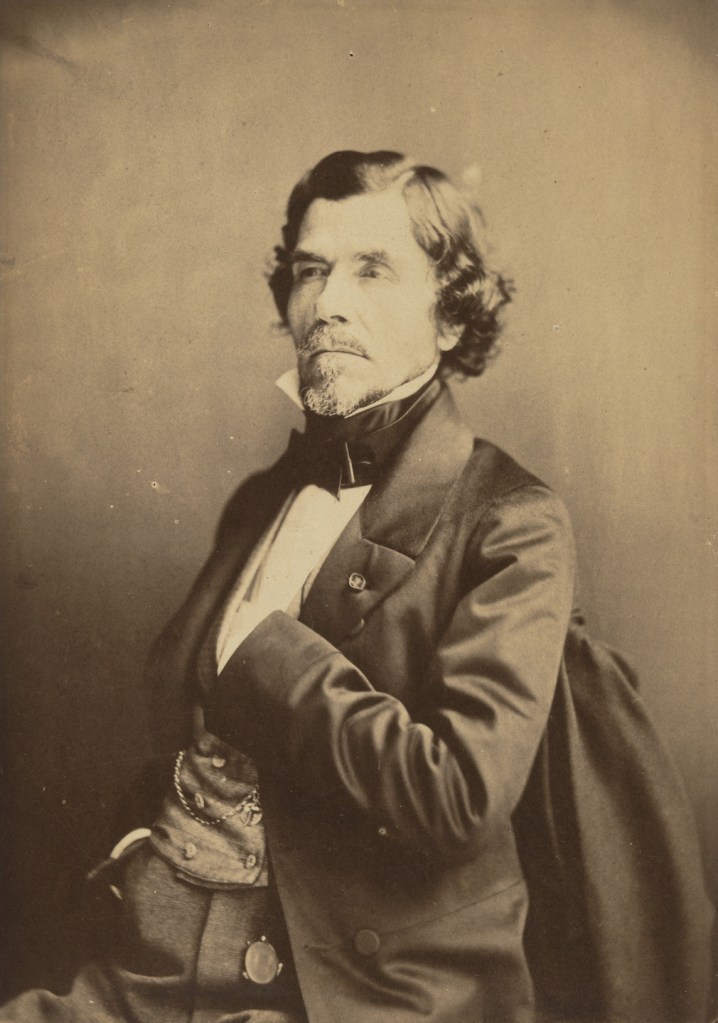
Portrait by Nadar, c. 1857
In contrast to the Neoclassical perfectionism of his chief rival Ingres, Delacroix took for his inspiration the art of Rubens and painters of the Venetian Renaissance, with an attendant emphasis on colour and movement rather than clarity of outline and carefully modelled form. Dramatic and romantic content characterized the central themes of his maturity, and led him not to the classical models of Greek and Roman art, but to travel in North Africa, in search of the exotic. Friend and spiritual heir to Théodore Géricault, Delacroix was also inspired by Lord Byron, with whom he shared a strong identification with the “forces of the sublime”, of nature in often violent action.
However, Delacroix was given to neither sentimentality nor bombast, and his Romanticism was that of an individualist. In the words of Baudelaire, “Delacroix was passionately in love with passion, but coldly determined to express passion as clearly as possible.” Together with Ingres, Delacroix is considered one of the last old Masters of painting and is one of the few who was ever photographed.
As a painter and muralist, Delacroix’s use of expressive brushstrokes and his study of the optical effects of colour profoundly shaped the work of the Impressionists, while his passion for the exotic inspired the artists of the Symbolist movement. A fine lithographer, Delacroix illustrated various works of William Shakespeare, the Scottish author Walter Scott, and the German author Johann Wolfgang von Goethe.
In addition to his home in Paris, from 1844 he also lived at a small cottage in Champrosay, where he found respite in the countryside. From 1834 until his death, he was faithfully cared for by his housekeeper, Jeanne-Marie le Guillou, who zealously guarded his privacy, and whose devotion prolonged his life and his ability to continue working in his later years.
Gallery
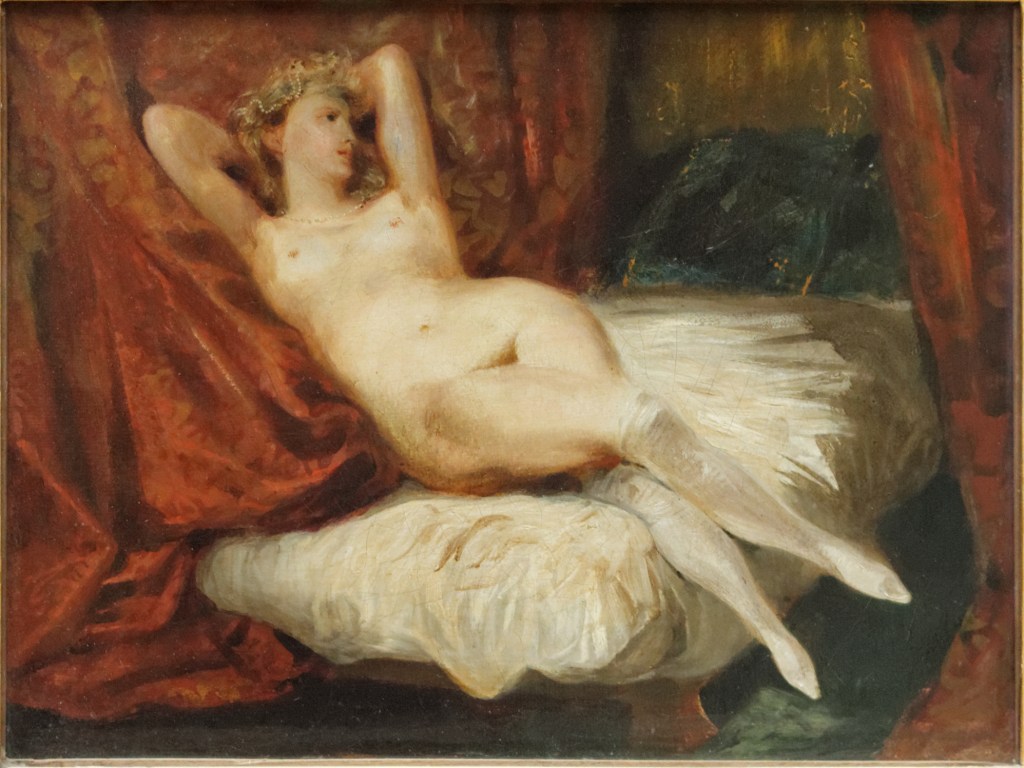
femme avec chaussettes blanches
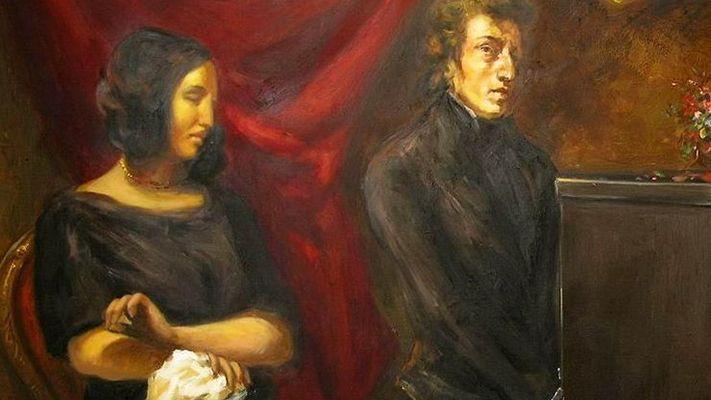
George Sand and Frederic Chopin
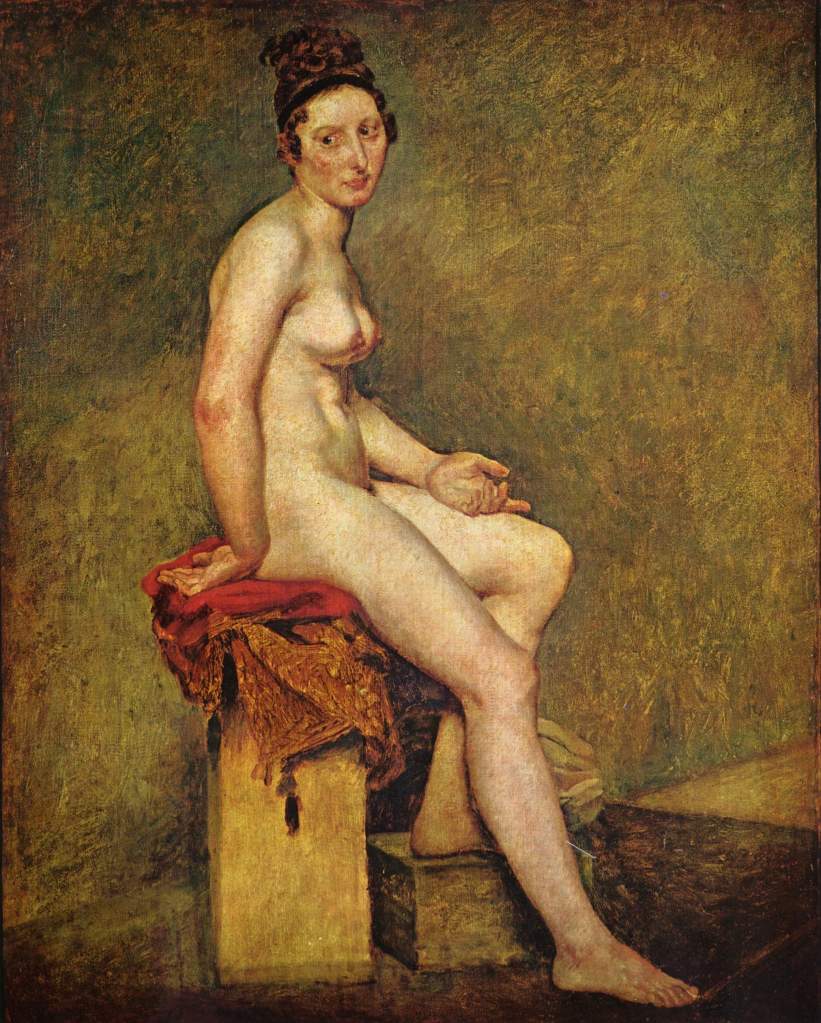
Mademoiselle Rose, 1817–1824, Louvre
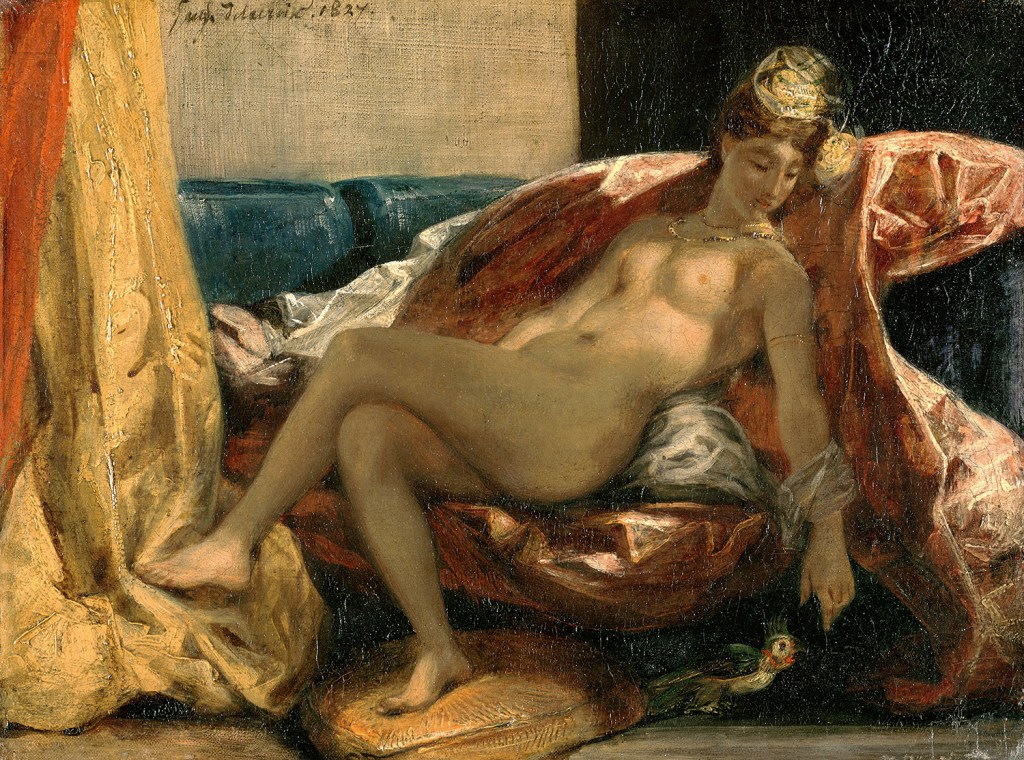
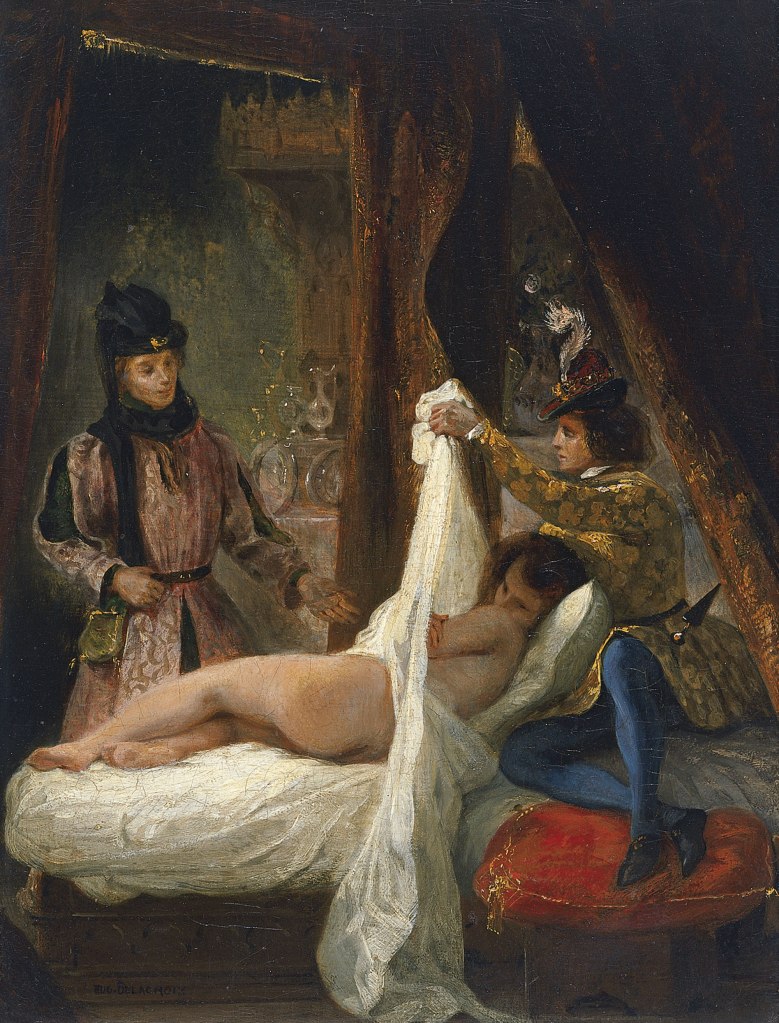
Louis of Orléans Unveiling his Mistress, c. 1825–26, Thyssen-Bornemisza Collection
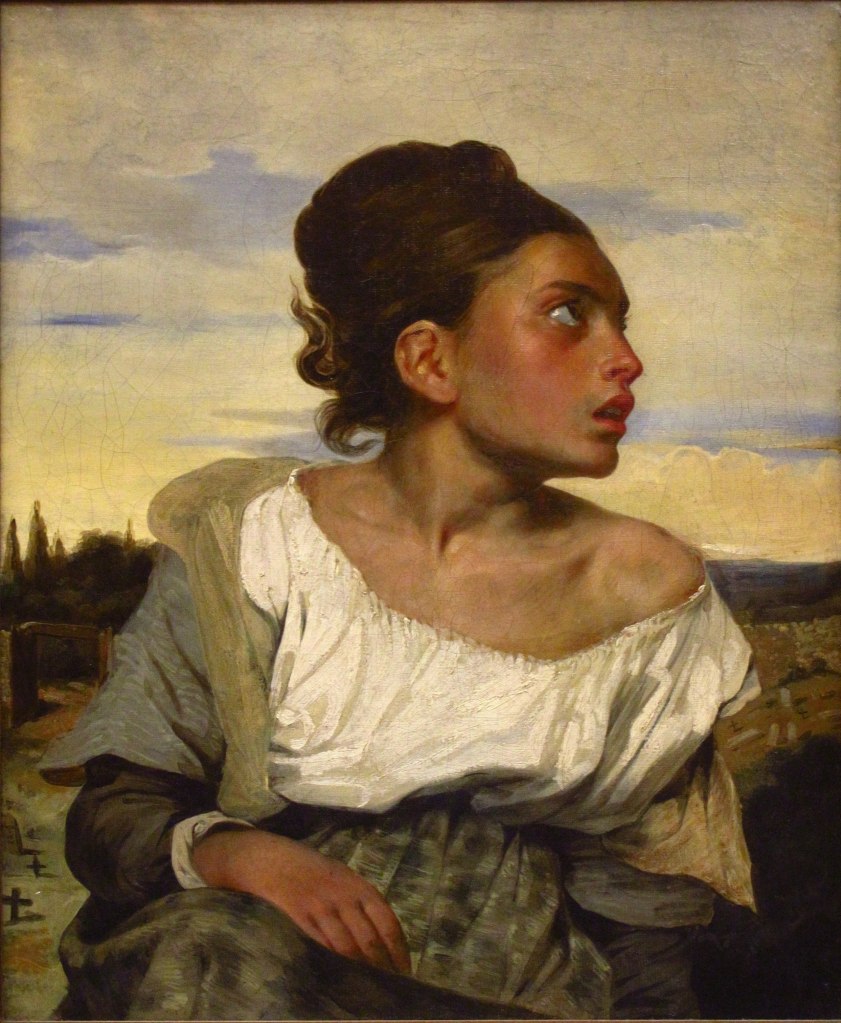
Jeune orpheline au cimetière 1824 Louvre
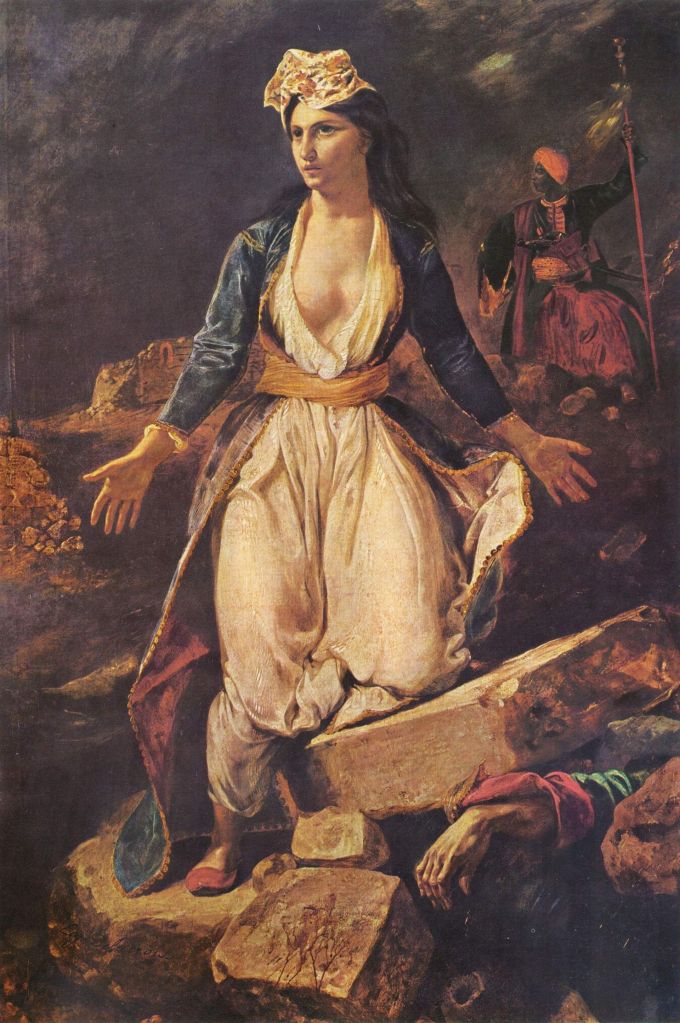
Greece on the Ruins of Missolonghi (1826), Musée des beaux-arts de Bordeaux
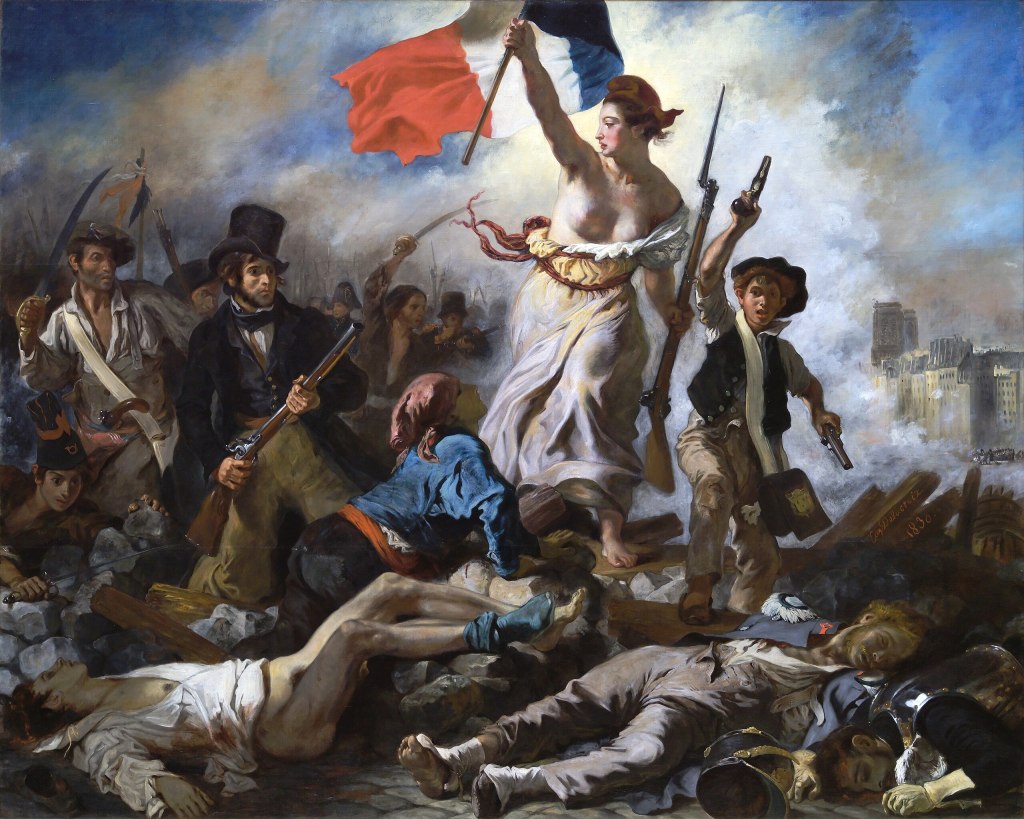
La Liberté guidant le peuple (1830), Paris, musée du Louvre
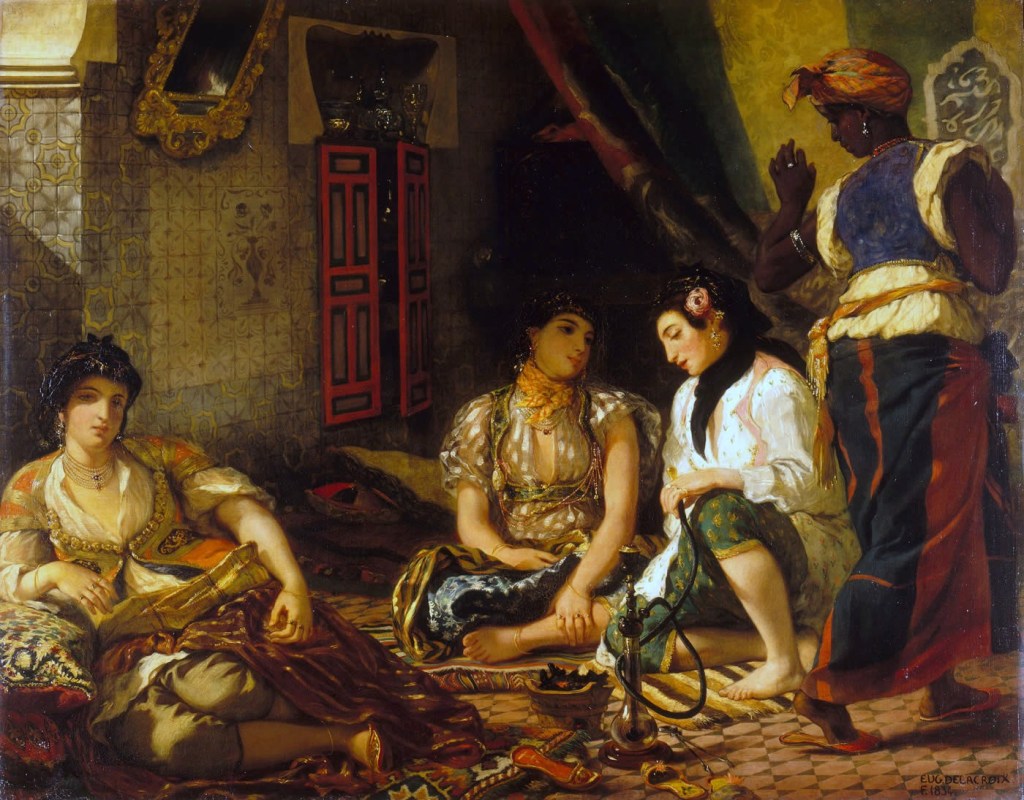
Women of Algiers
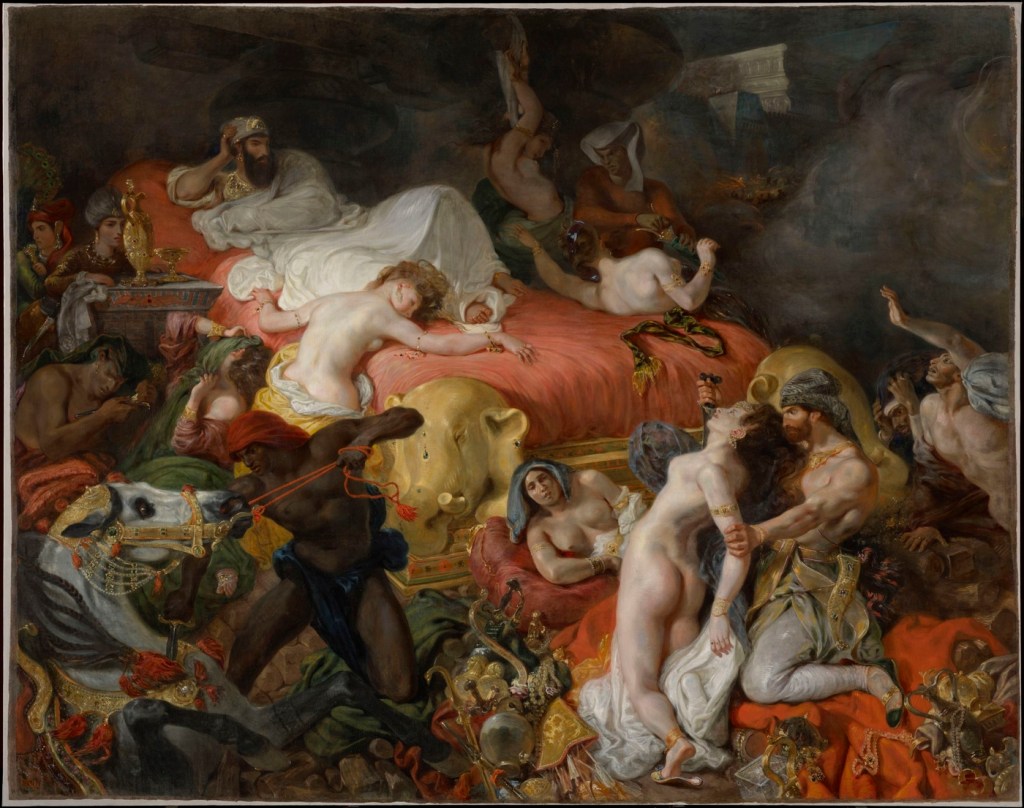
La Mort de Sardanapale, huile sur toile, 390 × 490 cm, musée du Louvre (1827)
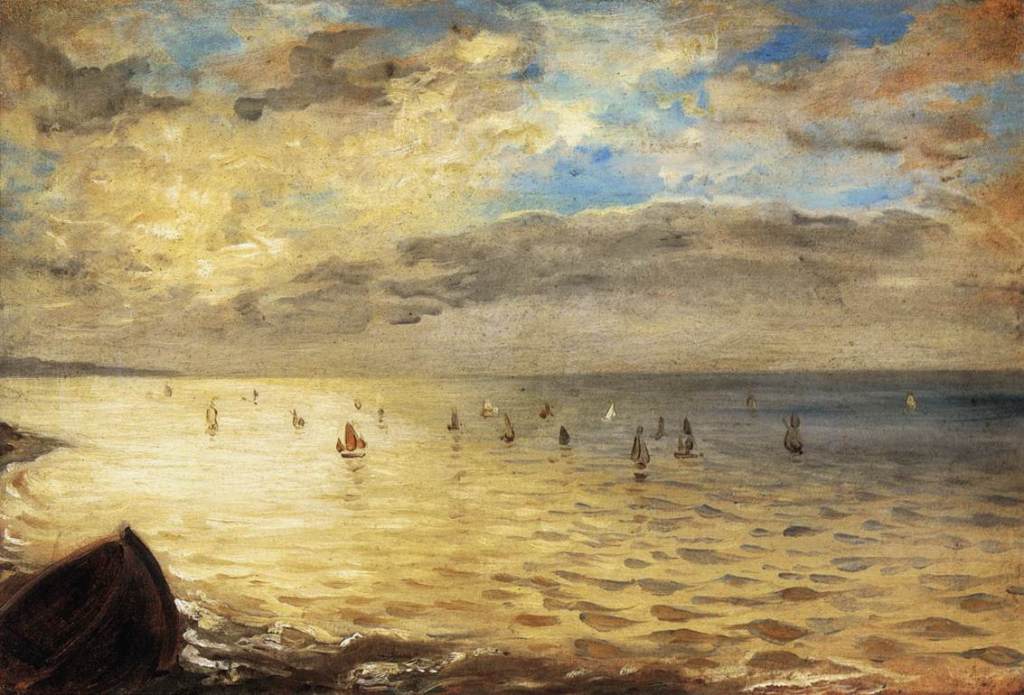
La Manche depuis les hauteurs de Dieppe, 1852, huile sur toile
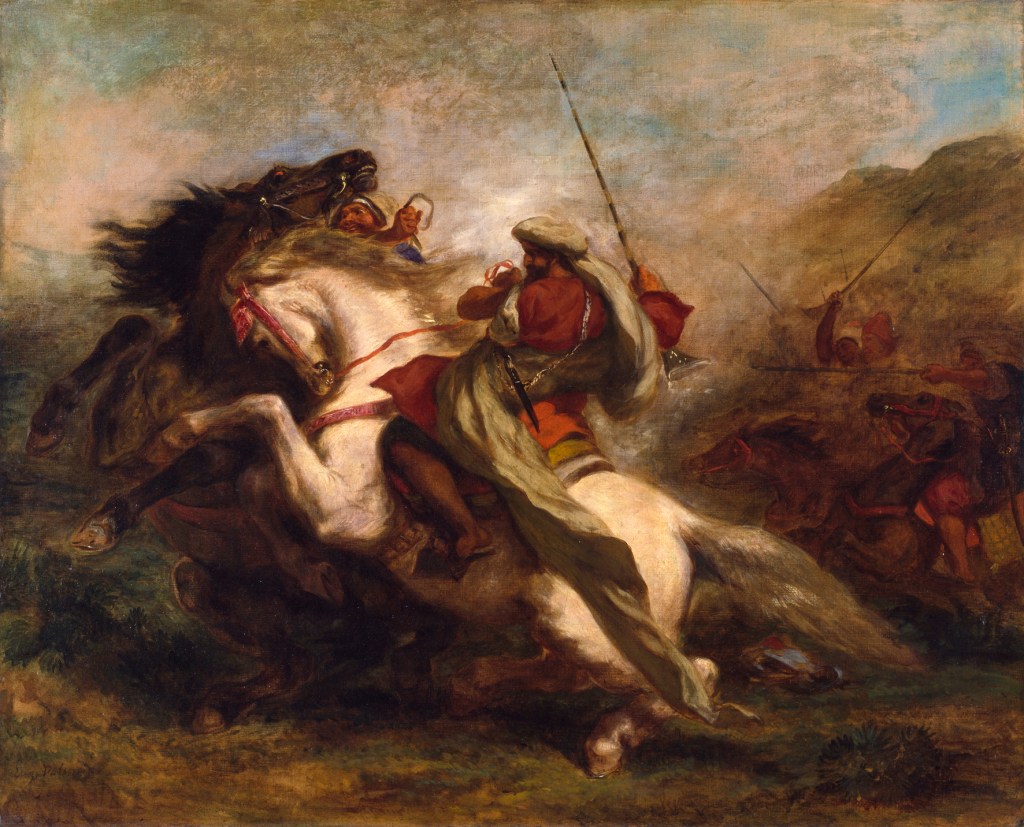
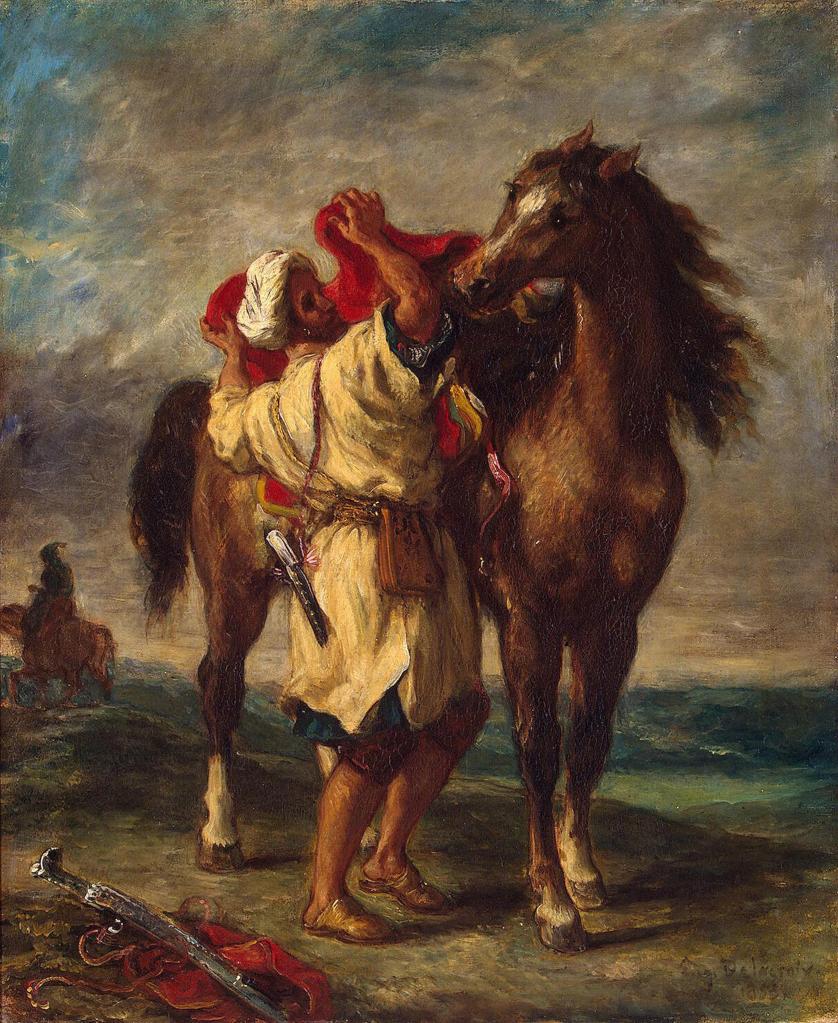
Moroccan Saddles His Horse, 1855, Hermitage Museum
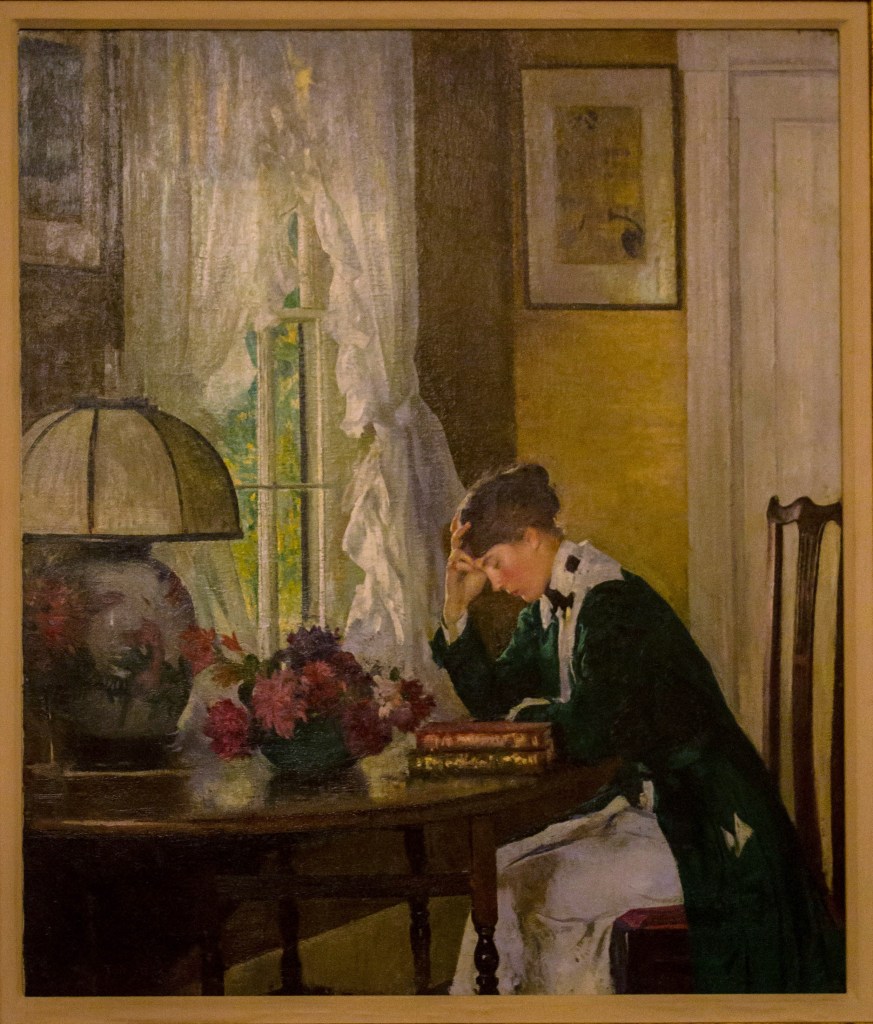
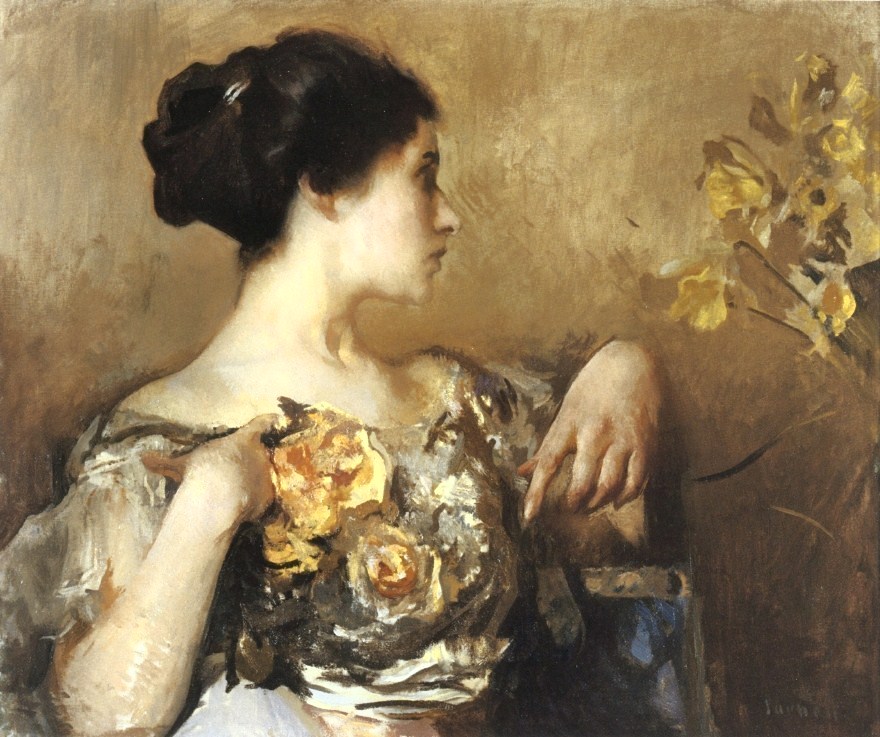
And today is the birthday of Edmund Tarbell (Edmund Charles Tarbell; Groton, Massachusetts; April 26, 1862 – August 1, 1938 New Castle, New Hampshire); Impressionist painter. A member of the Ten American Painters, his work hangs in the Boston Museum of Fine Arts, Metropolitan Museum of Art, National Gallery of Art, Smithsonian American Art Museum, Corcoran Gallery of Art, DeYoung Museum, National Academy Museum and School, New Britain Museum of American Art, Worcester Art Museum, and numerous other collections. He was a leading member of a group of painters which came to be known as the Boston School.
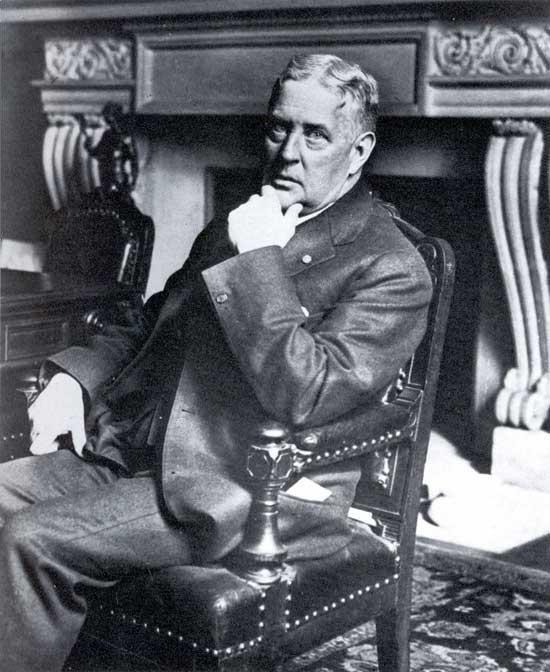
In 1888, Tarbell married Emeline Arnold Souther, an art student and daughter of a prominent Dorchester family. Preferring to work from posed models, Tarbell often painted those immediately at hand—his wife, four children (Josephine, Mercie, Mary and Edmund Arnold Tarbell), and grandchildren. The paintings illustrate their lives.
While teaching at the Museum School in Boston, Tarbell and his family lived from 1886 until 1906 in the Ashmont section of Dorchester, the house belonging to his stepfather, David Frank Hartford. Then they lived on Commonwealth Avenue in Boston at the Hotel Somerset, located beside The Fens and not far from his atelier in the Fenway Studios on Ipswich Street.
In 1905, they bought as a summer residence a Greek Revival house in New Castle, New Hampshire, an island on the Atlantic coast. Tarbell built his studio perched on the bank of the Piscataqua River, ambling there each morning along gardens of peonies, iris and hollyhocks. Through his north-facing wall of glass he could sketch sailboats as they tacked the busy shipping channel between Portsmouth and the ocean. He was an early and avid proponent of the Colonial Revival movement, collecting American antiques (back when most were considered used furniture) and arranging them with Chinese ceramics, Japanese prints and other objets d’art as studio props. Tarbell also collected salvaged architectural elements; his studio’s facade featured a Federal fanlight doorway. In the new living room added to the main house, he installed a Georgian mantelpiece attributed to Ebenezer Dearing (1730–1791), a master Portsmouth ship woodcarver. The Tarbells eventually would retire to New Castle.
Gallery
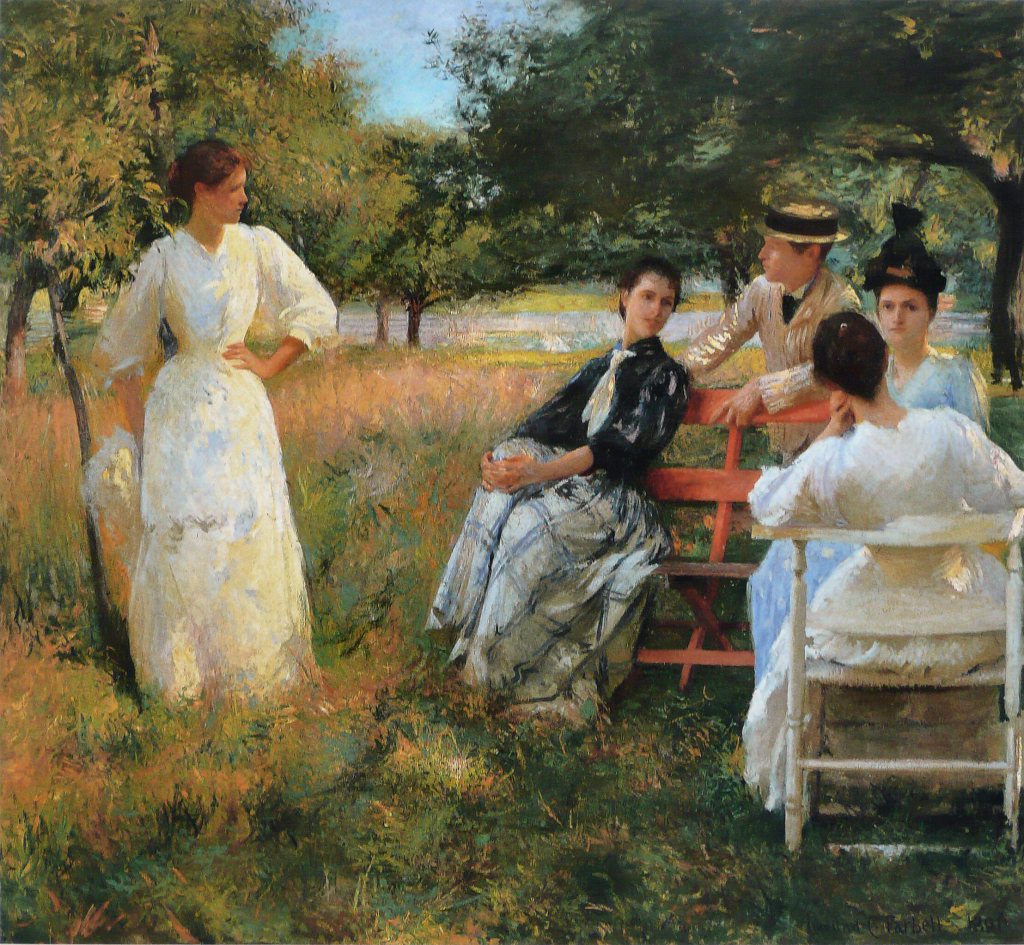
In the Orchard, 1891; Souther siblings, Mrs. Tarbell at far right

Woman with a blue veil
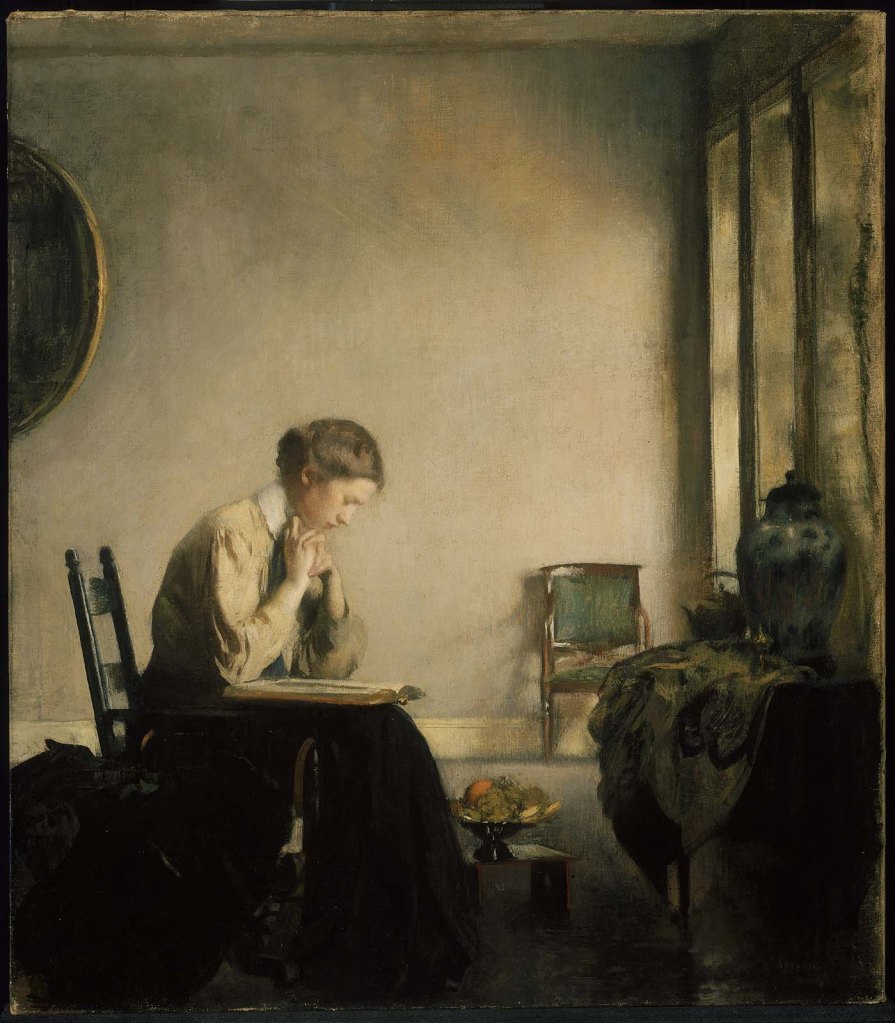
Girl Reading, 1909
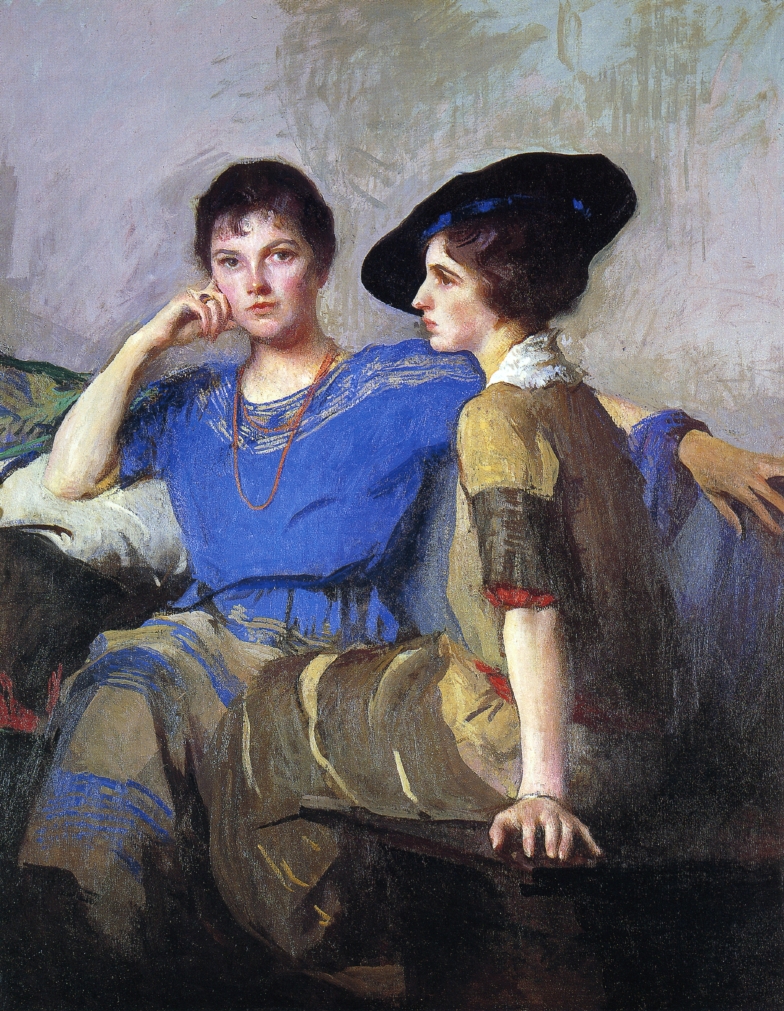
The Sisters, 1921; Josephine and Mary
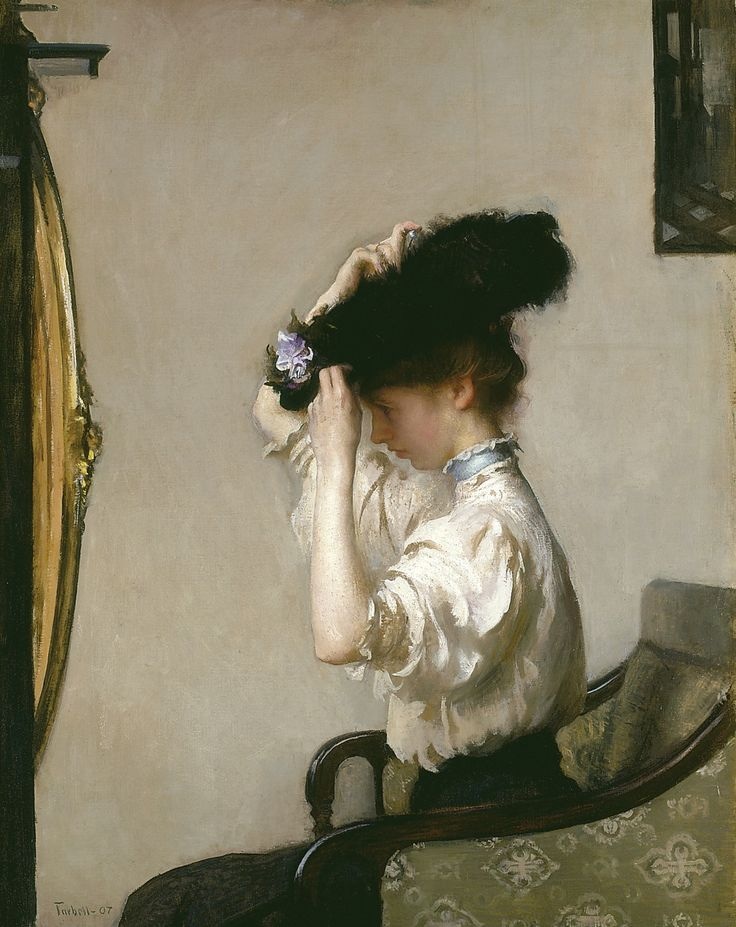
Preparing for the Matinee, 1907
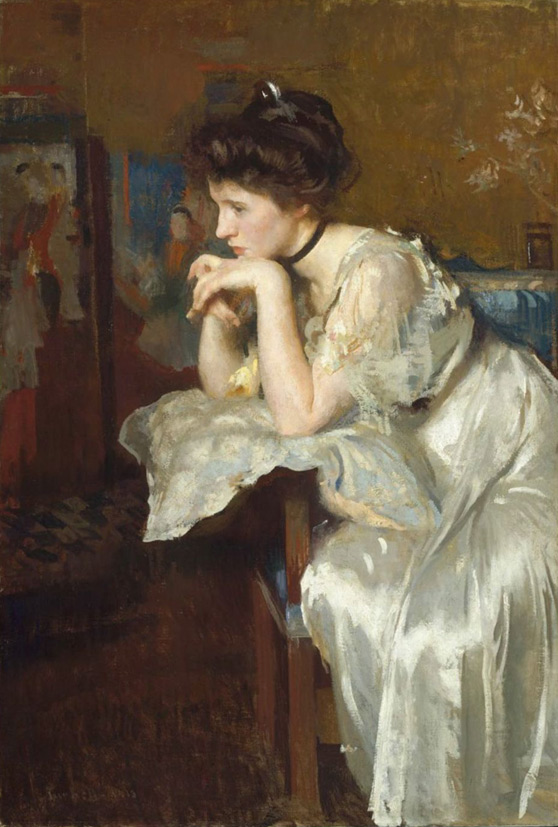
Reverie, 1913
thanks for stoppin’ by y’all
Mac tag
 The Lovers’ Chronicle
Leave a reply to The Lovers’ Chronicle 1 November – Día de los Muertos – Shakespeare’s Othello & The Tempest – art by William Merritt Chase, Louis Dewis, & Konrad Mägi – verse by Stephen Crane – The Lovers’ Chronicle Cancel reply