Dear Zazie, Here is today’s Lovers’ Chronicle from Mac Tag. How do you celebrate beauty and the Bard? Who do you see walkin’ down the street? I see a pretty woman! Rhett
The Lovers’ Chronicle
Dear Muse,
the inspiration for the line is clear
and the song perhaps not so,
but it was the first that appeared;
Metallica’s “Chasing Light”
”Wow a far cry from Will”
yeah i thought we would steer clear
of anything breakin’ through yonder
windows, though you are far more fair
“Oh thanks my dear,
You know that is one of the few
Metallica songs i don’t know”
from their last album 72 Seasons
i like the title because that could describe
what i have been doin’ here for six years,
art and photography are all about
the right light and the verse as well,
but since you it would have to be
changed to findin’ the light

© copyright 2023.2024 mac tag/cowboy coleridge all rights reserved
a fine topic this; from first to last, from the moon full or otherwise, by candle or camp fire, or soft and muted in a cocktail lounge, perhaps hardest to find from stars, and most recently from the eclipse; a chaser from an early age probably as a result of growin’ up with so much of it on the High Plains with the long vistas, mostly sunny days and few trees to block the views, of course gittin’ used to risin’ every day before the sun helped, but nothin’ i have seen compares to whatever light is radiatin’ off of you or from you

© copyright 2022.2024 mac tag/cowboy coleridge all rights reserved
yes, there is this,
but soft, what light
put on the costume
for many years
played the part
gave what was wanted
laughed at the broken
trail left behind,
at the grief
that poisoned
i know what i say,
what i write
and what i do
for thou art more fair
than all that came before
© copyright 2021 mac tag/cowboy coleridge all rights reserved
Pale Love, Pale Rider
act, while in this state,
at least still know what to write,
if not what to do
so necessary to make an effort
are you not
what you say you are
put it on
they expect it, they want you to be happy
and if Harlequin shall steal your Columbina,
shrug it off, so they can keep believin’
© copyright 2020 mac tag/cowboy coleridge all rights reserved
a sonnet that tells
how still as it was
on the day
when first seen
or a song that asks
how to compare
what knows
no comparison
perhaps some verse
that speaks,
but soft, of light
that breaks
all ’round
and none as fair
of dreams
and fond adieu
till we meet again
© copyright 2019 mac tag/cowboy coleridge all rights reserved
the best there is, here on the High Plains
yes a biased and not well traveled opinion,
and i could easily be convinced otherwise
should that light be anywhere in the world
gleamin’ off the hair of a woman, of course
here in solitude have to be content with
imaginin’ what breaks through windows

© copyright 2018.2024 mac tag/cowboy coleridge all rights reserved
Road trip y’all
Plenty coffee
And you
On my mind
***
It is ok
You can break on me
I will help put you back
Together
And leave
When you ask
***
Perhaps my biggest flaw:
You will git out of me
Only what you put in
Put in nothin’, git nothin’
Put in all you have
Git all that I have
© copyright 2016 mac tag/cowboy coleridge all rights reserved
Lost then found then lost
This is the story
Against the assembled odds
Life blood flowin’
Like water on earth spreadin’
Of a sudden, a voice
© copyright 2015 mac tag/cowboy coleridge all rights reserved
for J
Today marks Shakespeare’s birth
Plus or minus a day
But the date matters not
The question before us;
To celebrate or not
To celebrate? We shall!
How about a sonnet
That tells of thy beauty
A beauty to be woo’d
How thy beauty is still
As it was on the day
When first your eye I eyed
Or a sonnet that asks
How shall I compare thee?
Whatever that may be,
Whether ’tis summer’s day,
It matters not a whit
For thou art more lovely
I could compose some verse
That speaks, but soft, of light
That breaks from your window
As though thou were the sun,
A light that can shame stars
And which none is as fair
Perhaps a toast will do
To the Bard and beauty
And to such stuff as dreams
And wishes are made of
For now bid fond adieu
Till the twain meet again
© Copyright 2011 Mac Tag. All rights reserved.

Today is the day that Shakespeare’s birthday is traditionally celebrated. We do not know for certain when he was born but we know he was baptised on 26 April 1564. Back then infants were usually baptised two or three days after birth. We have Shakespeare to thank for the now common phrase, “love is blind”. Indeed, it can be. I often quote him in my writing and speech. A few of the best;
All the world’s a stage,
and all the men and women merely players:
they have their exits and entrances;
and one man in his time plays many parts…
–As You Like It, Act II, Scene 7
But soft, what light through yonder window breaks?
It is the east, and Juliet is the sun.
Arise, fair sun, and kill the envious moon,
Who is already sick and pale with grief
That thou, her maid, art far more fair than she.
–Romeo And Juliet Act 2, scene 2
And Caesar’s spirit, raging for revenge,
With Ate by his side come hot from hell,
Shall in these confines with a monarch’s voice
Cry “Havoc!” and let slip the dogs of war,
That this foul deed shall smell above the earth
With carrion men, groaning for burial.
–Julius Caesar Act 3, scene 1
Once more unto the breach, dear friends, once more;
Or close the wall up with our English dead.
In peace there’s nothing so becomes a man
As modest stillness and humility;
But when the blast of war blows in our ears,
Then imitate the action of the tiger. . . .
–Henry The Fifth Act 3, scene 1
today is the birthday of J. M. W. Turner (Joseph Mallord William Turner; London 23 April 1775 – 19 December 1851 London), known in his time as William Turner; Romantic painter, printmaker and watercolourist. He is known for his expressive colouring, imaginative landscapes and turbulent, often violent marine paintings. His artistic style developed over his lifetime, moving away from Romanticism — bypassing the following rising style of Realism — and, instead, with his later works being a significant precursor of and presaging the later Impressionist and Abstract Art movements that arose in the decades after his death. He left behind more than 550 oil paintings, 2,000 watercolours, and 30,000 works on paper. He was championed by the leading English art critic John Ruskin from 1840, and is today regarded as having elevated landscape painting to an eminence rivaling history painting.

Self portrait oil on canvas, c. 1799
As Turner grew older, he became more eccentric. He had few close friends except for his father, who lived with him for 30 years and worked as his studio assistant. His father’s death in 1829 had a profound effect on him, and thereafter he was subject to bouts of depression. He never married but had a relationship with an older widow, his housekeeper Sarah Danby. He is believed to have been the father of her two daughters Evelina Dupuis and Georgiana Thompson. Evelina married Joseph Dupuis on 31 October 1817. It was recorded that her mother, Sarah Danby, was a witness along with Charles Thompson.
Turner formed a relationship with Sophia Caroline Booth after her second husband died, and from 1846 he lived with her as “Mr Booth” or “Admiral Booth” in her house at 6 Davis’s Place (now Cheyne Walk) in Chelsea, until his death.
His painting, The Fighting Temeraire (see below) is used in the 2012 James Bond film Skyfall to be symbolic of Bond’s age and standing within MI6.
Gallery

The Fighting Temeraire tugged to her last berth to be broken up, 1838, oil on canvas, National Gallery, London
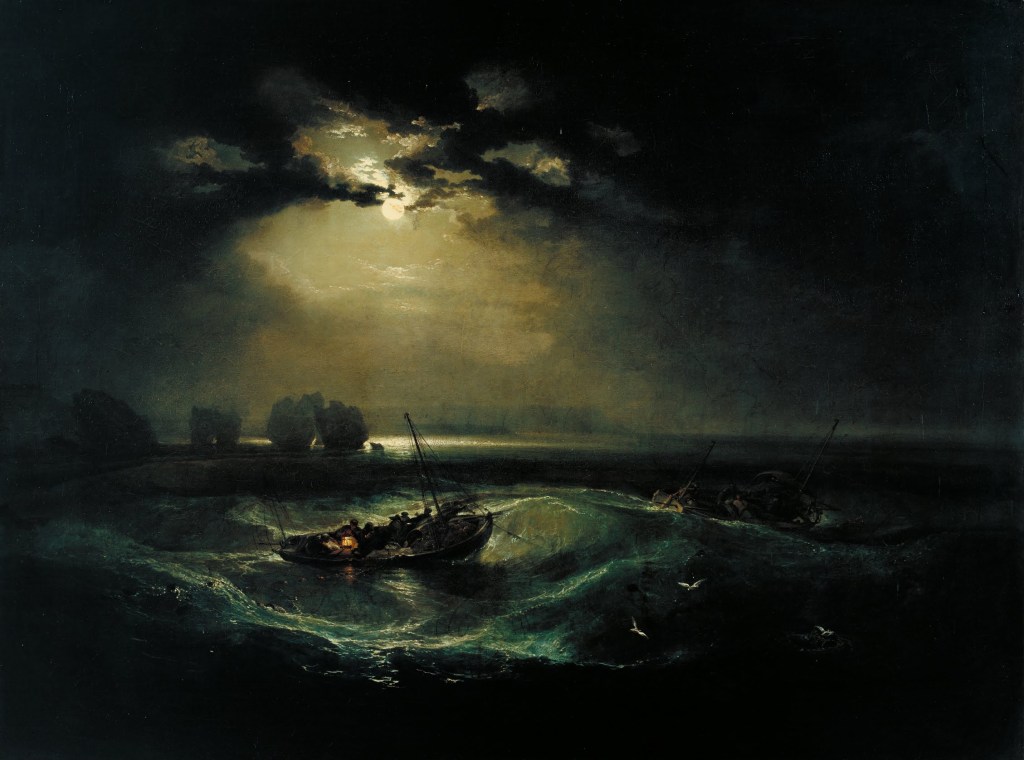
Fishermen at Sea
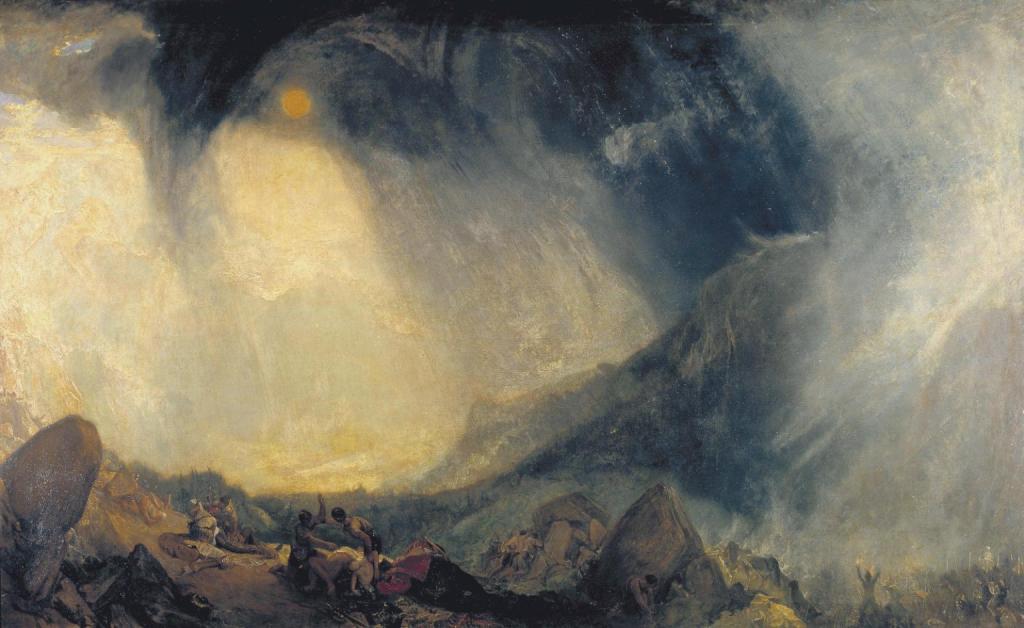
Snow Storm: Hannibal and his Army Crossing the Alps, 1812, oil on canvas, Tate Britain
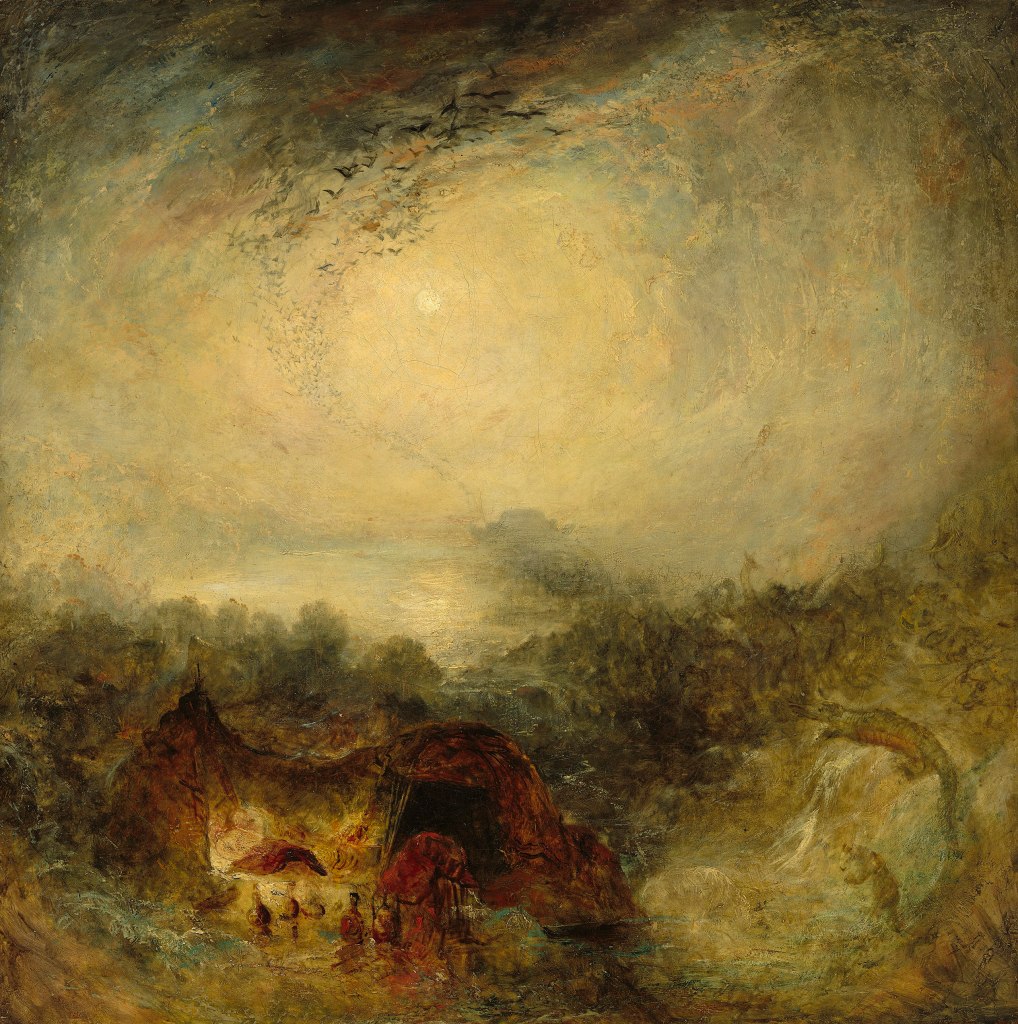
The Evening of the Deluge, c. 1843, National Gallery of Art, Washington D.C.
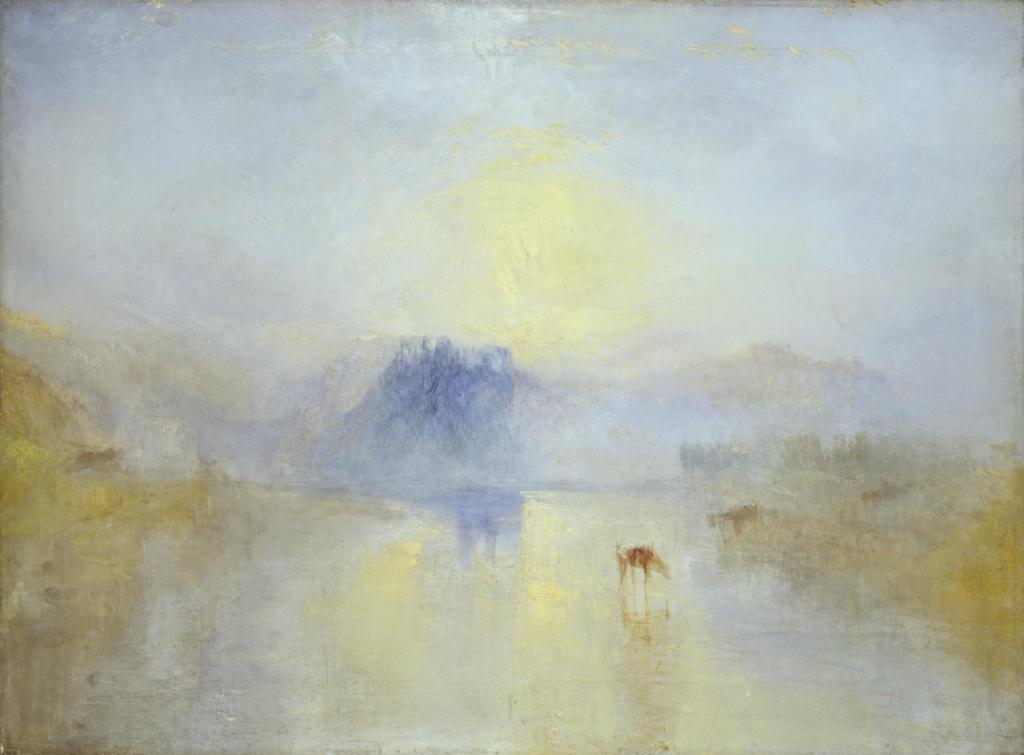
Norham Castle, Sunrise, c. 1845, oil on canvas, Tate Britain
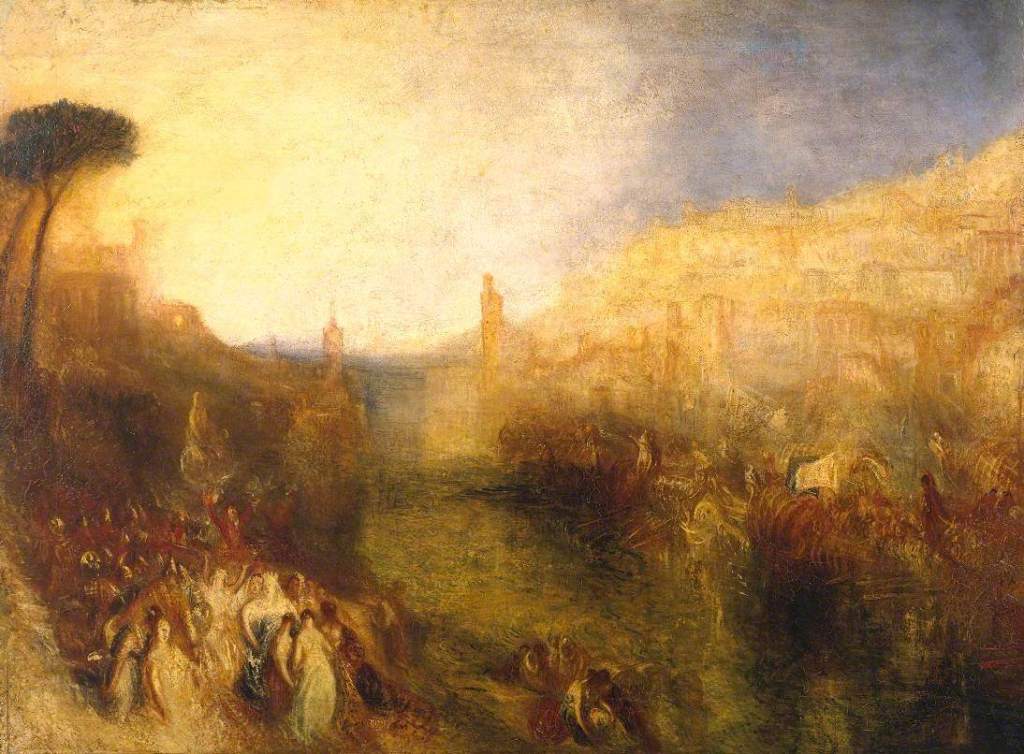


Today is the birthday of Ruggero (or Ruggiero) Leoncavallo (Naples 23 April 1857 – 9 August 1919 Tuscany); opera composer and librettist. Although he would produce numerous operas and other songs throughout his career it is his two-act work Pagliacci (1892) that remains his lasting contribution. Pagliacci, is one of the most popular works in the opera repertory. His other well known works include the song “Mattinata”, popularized by Enrico Caruso, as well as the symphonic poem La nuit de mai.
Pagliacci (meaning “Clowns”) is an Italian opera in a prologue and two acts, with music and libretto by Leoncavallo. It is the only Leoncavallo opera that is still widely performed. It is often staged by opera companies as a double bill with Cavalleria rusticana by Pietro Mascagni, known as Cav and Pag. Pagliacci premiered at the Teatro Dal Verme in Milan on 21 May 1892, conducted by Arturo Toscanini, with Adelina Stehle as Nedda, Fiorello Giraud as Canio, Victor Maurel as Tonio, and Mario Ancona as Silvio. Nellie Melba played Nedda in London in 1892, soon after the Italian premiere, and it was given in New York on 15 June 1893, with Agostino Montegriffo as Canio.

Cover of the first edition of Pagliacci
“Vesti la giubba” (“Put on the costume”, sometimes translated as “On With the Motley”) is a tenor aria from Pagliacci. “Vesti la giubba” is sung at the conclusion of the first act, when Canio discovers his wife’s infidelity, but must prepare for his performance as Pagliaccio the clown because “the show must go on”. The aria is often regarded as one of the most moving in the operatic repertoire. The pain of Canio is portrayed in the aria and exemplifies the entire notion of the “tragic clown”: smiling on the outside but crying on the inside. This is still displayed today, as clown makeup sometimes features the painted-on tear running down the cheek of the performer. The 1902 recording of the aria, sung by Enrico Caruso, was the first million-selling record in history.
 | “Vesti la giubba”Performed by Enrico Caruso, recorded on March 17, 1907 |
| Recitar! Mentre preso dal delirio, non so più quel che dico, e quel che faccio! Eppur è d’uopo, sforzati! Bah! Sei tu forse un uom? Tu se’ Pagliaccio!Vesti la giubba e la faccia infarina. La gente paga, e rider vuole qua. E se Arlecchin t’invola Colombina, ridi, Pagliaccio, e ognun applaudirà! Tramuta in lazzi lo spasmo ed il pianto in una smorfia il singhiozzo e ‘l dolor, Ah!Ridi, Pagliaccio, sul tuo amore infranto! Ridi del duol, che t’avvelena il cor! | Act! While in delirium, I no longer know what I say, or what I do! And yet it’s necessary… make an effort! Bah! Are you not a man? You are a clown!Put on your costume, powder your face. The people pay to be here, and they want to laugh. And if Harlequin shall steal your Columbina, laugh, clown, so the crowd will cheer! Turn your distress and tears into jest, your pain and sobbing into a funny face – Ah!Laugh, clown, at your broken love! Laugh at the grief that poisons your heart! |

Today is the birthday of singer and songwriter, the Big O, the Caruso of Rock, Roy Orbison (Roy Kelton Orbison; Vernon, Texas 23 April 1936 – 6 December 1988 Hendersonville, Tennessee). By the time he was seven, he knew that music was his calling. He later said, “I was finished, you know, for anything else.” Clearly one of my songwriting heroes. My list of favorite Orbison songs includes; “Only the Lonely”, “Crying”, “Oh, Pretty Woman”, “Running Scared”, “Blue Bayou”, and “In Dreams”.
His career ignited in 1960 with a song that had been turned down by Elvis Presley and the Everly Brothers. “Only the Lonely” was the antithesis of the typical rock and roll song of the period, with no driving beat or teenage defiance; it was mournful and plaintive, with a string section backing up Orbison’s operatic voice. He had severe stage fright, and performed dressed all in black, hiding behind a pair of thick prescription Wayfarer sunglasses. He said: “I wasn’t trying to be weird, you know? … But the image developed of a man of mystery and a quiet man in black, somewhat of a recluse, although I never was, really.”
One day, during a songwriting session with his partner Bill Dees, Orbison asked his wife, Claudette Frady Orbison, if she needed any money for her upcoming trip to Nashville. Dees remarked, “Pretty woman never needs any money.” Forty minutes later, Orbison’s most famous hit, “Oh, Pretty Woman,” had been written.
Of Orbison, Bruce Springsteen said; “He was the true master of the romantic apocalypse you dreaded, and knew was coming after the first night you whispered ‘I Love You’ to your first girlfriend. You were going down. Roy was the coolest uncool loser you’d ever seen. With his Coke-bottle black glasses, his 3-octave range, he seemed to take joy sticking his knife deep into the hot belly of your teenage insecurities.”

And today is the birthday of Lee Miller (Elizabeth Miller; Poughkeepsie, New York 23 April 1907 – 21 July 1977 Chiddingly, East Sussex, Great Britain); model, muse, photographer, and photojournalist. She was a fashion model in New York City in the 1920s before going to Paris, where she became a fashion and fine art photographer. During the Second World War, she was a war correspondent for Vogue, covering events such as the London Blitz, the liberation of Paris, and the concentration camps at Buchenwald and Dachau.
In 1929, Miller traveled to Paris with the intention of apprenticing herself to the surrealist artist and photographer Man Ray. Although, at first, he insisted that he did not take students, Miller soon became his model and collaborator (announcing to him, “I’m your new student”), as well as his lover and muse.
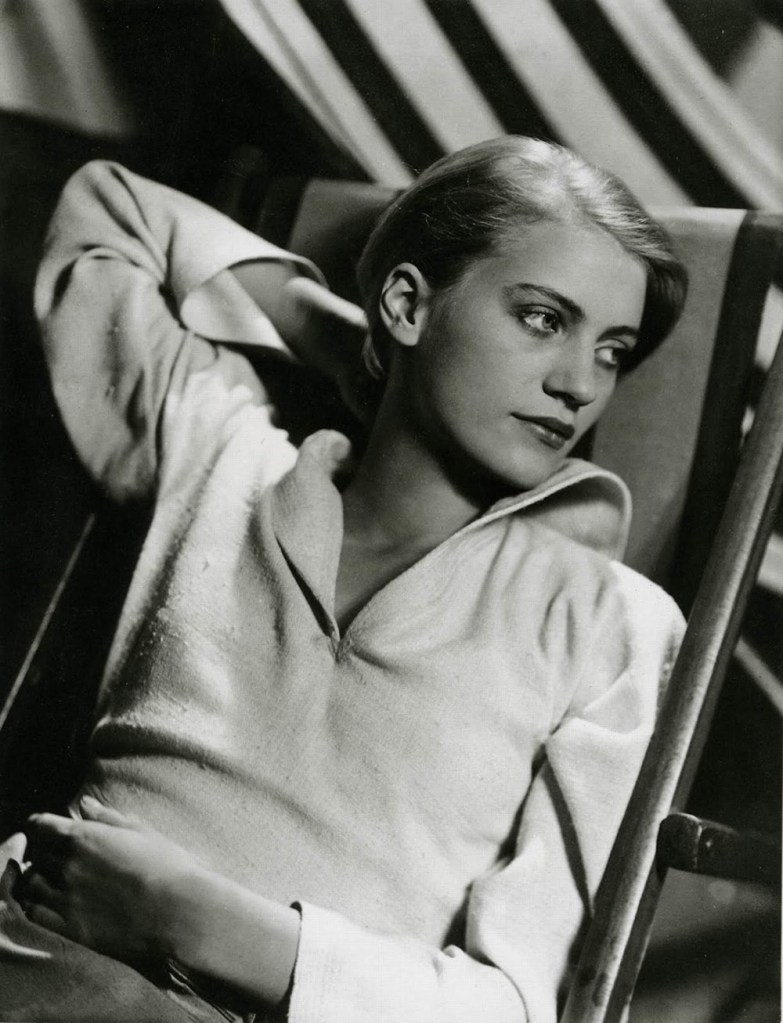
by man ray
In 1934, Miller abandoned her studio to marry the Egyptian businessman and engineer Aziz Eloui Bey, who had come to New York City to buy equipment for the Egyptian National Railways. Although she did not work as a professional photographer during this period, the photographs she took while living in Egypt with Eloui, including Portrait of Space, are regarded as some of her most striking surrealist images. In Cairo, Miller took a photograph of the desert near Siwa that Magritte saw and used as inspiration for his 1938 painting “Le Baiser.”
By 1937, Miller had grown bored with her life in Cairo and returned to Paris, where she met the British surrealist painter and curator Roland Penrose, whom she later would marry.
At the outbreak of World War II, Miller was living in Hampstead in London with Penrose when the bombing of the city began. Ignoring pleas from friends and family to return to the US, Miller embarked on a new career in photojournalism as the official war photographer for Vogue, documenting the Blitz. She traveled to France less than a month after D-Day and recorded the first use of napalm at the siege of St. Malo, as well as the liberation of Paris, the Battle of Alsace, and the horror of the Nazi concentration camps at Buchenwald and Dachau.
After returning to Britain from central Europe, Miller started to suffer from severe episodes of clinical depression and what later became known as Post traumatic stress disorder (PTSD). She began to drink heavily, and became uncertain about her future. In 1946, she traveled with Penrose to the United States, where she visited Ray in California. After she discovered she was pregnant by Penrose with her only son, she divorced Bey and, on May 3, 1947, married Penrose. Their son, Antony Penrose, was born in September 1947.
In 1949, the couple bought Farley Farm House in Chiddingly, East Sussex. During the 1950s and 1960s, Farley Farm became a sort of artistic Mecca for visiting artists such as Picasso, Ray, Henry Moore, Eileen Agar, Jean Dubuffet, Dorothea Tanning, and Max Ernst. While Miller continued to do the occasional photo shoot for Vogue, she soon discarded the darkroom for the kitchen, becoming a gourmet cook. According to her housekeeper Patsy she specialized in “historical food” like roast suckling pig as well as fare such as marshmallows in a cola sauce (especially made to annoy English critic Cyril Connolly who told her Americans could not cook). She also provided photographs for biographies Penrose wrote on Picasso and Antoni Tàpies. However, images from the war, especially the concentration camps, continued to haunt her and she started on what her son later described as a “downward spiral”. Her depression may have been accelerated by her husband’s long affair with the trapeze artist Diane Deriaz.
Miller was investigated by the British security service MI5 during the 1940s and 1950s, on suspicion of being a Soviet spy.
In October 1969, Miller was asked in an interview with a New York Times reporter what it was that drew her to photography. Her response was that it was “a matter of getting out on a damn limb and sawing it off behind you.”
Gallery


hitler’s bathtub
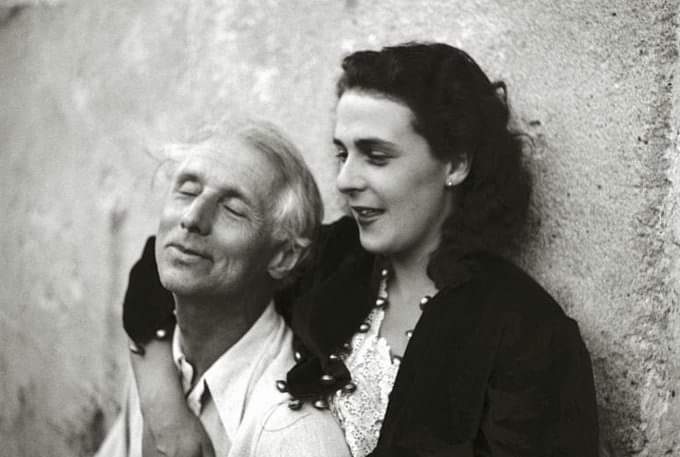
Max Ernst & Leonora Carrington, France 1939


Man Ray & Ady Fidelin

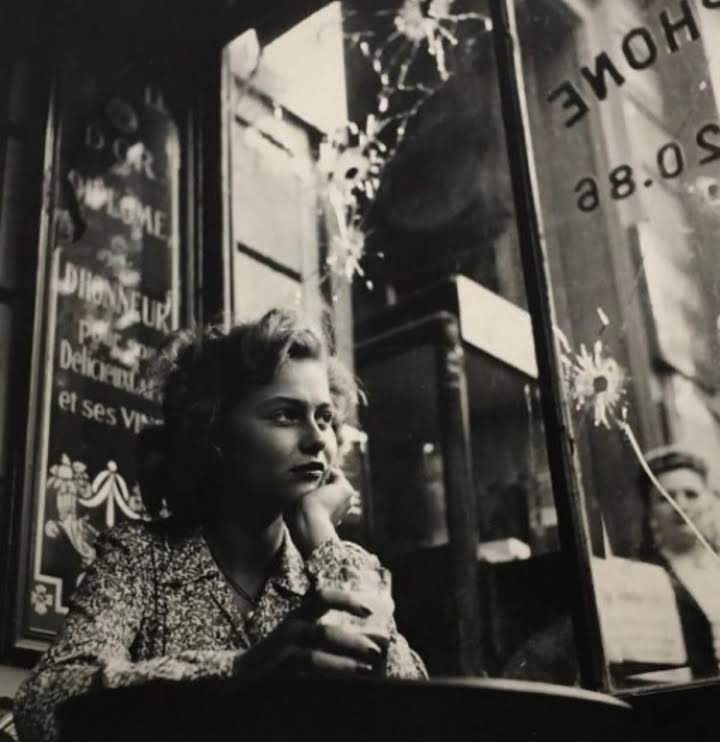
paris 1944
thanks for stoppin’ by y’all
Mac Tag
 The Lovers’ Chronicle
Leave a reply to The Lovers’ Chronicle 26 February – chances – verse by Christopher Marlowe – art by Honoré Daumier & Annie Swynnerton – birth of Victor Hugo – The Lovers’ Chronicle Cancel reply