Dear Zazie,
Here is today’s Lovers’ Chronicle from Mac Tag.
Rhett
The Lovers’ Chronicle
three am dream…
-A melody pierces his vale of sleep;
what is that melody, so faint, wait, yes,
Donna non vidi mai, from Puccini’s Manon Lescaut,
 never before have i beheld a woman, such as this,
speakin’ of, he reaches for the lovely redhead
Hello my darling, she says, dreaming again
yes, do you hear Caruso as de Grieux, singin’
to Manon at a square near the Paris gate in Amiens
It is lovely, you know…
-Just then he wakes up, slowly adjusting
to the change in consciousness,
he looks at the time on his Fitbit,
3 a.m.
no, done with those days, he thinks
-He rolls over, up close to her,
kisses her back
and falls into a deep sleep

© copyright 2024 mac tag/cowboycoleridge all rights
that happened often back then
“I thought it was from personal experience”
yes, not fiction sadly, also had Escovedo’s
”Pissed Off 2 A.M.” playin’ in my head
i was the walkin’ definition of fatigue
“Not anymore my dear”
no, so now if i wake up at three, definitely not
pissed off, but grateful and i roll close to you and fall
back asleep
© copyright 2023 mac tag/cowboycoleridge all rights
those days are past; became a matter of unwanted routine, though it did lead to some decent verse; myriad reasons why, all of which have been plumbed ad nauseum, no need for a rewind; just leave it here, doin’ well, not gonna count the ways but heap gratitude where due and not just at three in the mornin’
© copyright 2022 mac tag/cowboycoleridge all rights reserved
sometimes i wake up
i do not expect too much
all the lights are off now
it is only three
how i wish you were near
it would not hurt so much,
would you be up, babe
it is only three
if you were here, awake
the barricades and reasons
they would mean nothin’
would you hold me then
© copyright 2021 mac tag/cowboy coleridge all rights reserved
Pale Love, Pale Rider
paint a portrait
someone
whose attention
you captivate
someone
who just wants
to understand
between expectations
and meant to be
searched and found
desire, faith, hope
everlastin’
amen
always
take the measure
accordin’ to the means
of followin’ through
at three in the mornin’
© copyright 2020 mac tag/cowboy coleridge all rights reserved
the limit of the song
is this prelude
to the journey inward,
the penetratin’ verse,
music, art, books,
movies, good light,
the way out shaped
by you, the days
purpose themselves
as necessary, everything
here and you readin’ this
at three in the mornin’
what more to ask
at 3 am
© copyright 2019 mac tag/cowboy coleridge all rights reserved
a promise
made a little closer
or more accurately,
a confession
wantin’ to be confirmed
an accent on the verb
we both need
it takes your breath
from my mouth
to your ear
a moment
can you hear it
a communion
where will it take us
no idea
but we should go
it is only three
© copyright 2018 mac tag/cowboy coleridge all rights reserved
how can you find yourself…
paint a portrait
someone you know
someone whose attention
you cannot catch
someone you feel you understand
but certainly you cannot see
inside their complicated mind
*shrugs *
ambiguous,
mix of virtues and vices
perpetual conflict
between expectations
and what was meant to be
search and find
only to wander from
fall on base desire
faithless, false, unforgiven
everlastin’ lack thereof
amen
always
take the measure
accordin’ to the means
of satisfyin’ desires
3 a.m. thoughts
© copyright 2017 Mac Tag All rights reserved
my attention
can be caught
but not held
3 am again
© copyright 2016 Mac Tag All rights reserved

Today is the birthday of John Wilmot, 2nd Earl of Rochester (Ditchley, 1 April 1647 – 26 July 1680 Woodstock); poet and courtier of King Charles II’s Restoration court. The Restoration reacted against the “spiritual authoritarianism” of the Puritan era. Rochester was the embodiment of the new era, and he is as well known for his rakish lifestyle and poetry.
Wilmot courted Elizabeth Malet, and defying her family’s wishes, Malet eloped with Wilmot in January 1667, and they were married at the Knightsbridge chapel. Teenage actress Nell Gwyn “almost certainly” took him as her lover; she was later to become the mistress of Charles II. Gwyn remained a lifelong friend and political associate, and her relationship with the King gave Wilmot influence and status within the Court. Wilmot’s life was divided between domesticity in the country and a riotous existence at court, where he was renowned for drunkenness, vivacious conversation, and “extravagant frolics” as part of the Merry Gang. In 1673, Wilmot began to train Elizabeth Barry as an actress. She went on to become the most famous actress of her age. He took her as his mistress in 1675. The relationship lasted for around five years, and produced a daughter, before descending into acrimony after Wilmot began to resent her success. Wilmot wrote afterwards, “With what face can I incline/To damn you to be only mine? … Live up to thy mighty mind/And be the mistress of mankind”.
By the age of 33, Wilmot was dying from what is usually described as the effects of tertiary syphilis, gonorrohea, or other venereal diseases, combined with the effects of alcoholism; or renal failure due to chronic nephritis (Bright’s disease).
A few of my favorite Wilmot verses:
Lest, once more wandering from that heaven,
I fall on some base heart unblest,
Faithless to thee, false, unforgiven,
And lose my everlasting rest.
- Absent from thee, I languish still, ll. 13-16.
- Naked she lay, clasped in my longing arms,
I filled with love, and she all over charms;
Both equally inspired with eager fire,
Melting through kindness, flaming in desire.
With arms, legs, lips close clinging to embrace.- The Imperfect Enjoyment (published 1680).
- Thou treacherous, base deserter of my flame,
False to my passion, fatal to my fame,
Through what mistaken magic dost thou prove
So true to lewdness, so untrue to love?- The Imperfect Enjoyment.
- But oh, how slowly minutes roll
When absent from her eyes,
That feed my love, which is my soul:
It languishes and dies.- The Mistress: A Song, ll. 5–8.

Today is the birthday of Antoine-François Prévost d’Exiles (Hesdin, Artois, France; April 1 1697 – November 25 1763 Chantilly, Picardy, France), also known as the Abbé Prévost; novelist, historian and journalist. His best-known story, L’Histoire du chevalier des Grieux et de Manon Lescaut, has formed the basis of several operas, most notably Puccini‘s Manon Lescaut. One of my favorite books and operas.
citations
J’ai à peindre…un caractère ambigu, un mélange de vertus et de vices, un contraste perpétuel de bons sentiments et d’actions mauvaises.
- The portrait I have to paint is of…an ambiguous character, a mixture of virtues and vices, a perpetual contrast between good impulses and bad actions.
- Combien trouve-t-on de déserteurs de la sévère vertu et combien en trouvez-vous peu de l’amour?
- How many deserters there are from the rigours of virtue, how few from the cause of love!
- Il faut compter ses richesses par les moyens qu’on a de satisfaire ses désirs.
- We should measure our wealth according to the means we have of satisfying our desires.
- Un cœur de père est le chef-d’œuvre de la nature.
- A father’s heart is nature’s finest work.
- Rien n’est plus capable d’inspirer du courage à une femme que l’intrépidité d’un homme qu’elle aime.
- Nothing inspires more courage in a woman than fearlessness in the man she loves.
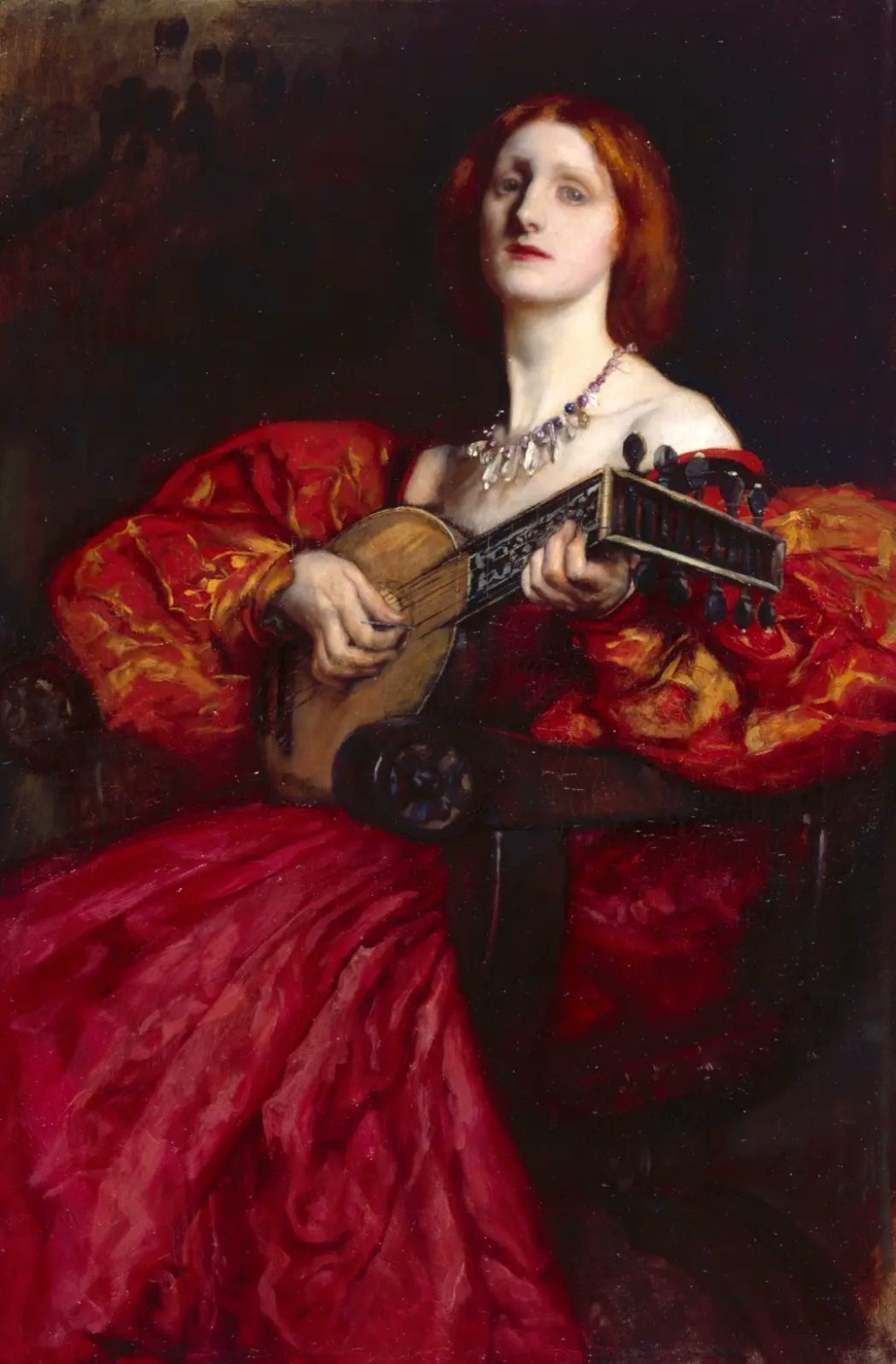
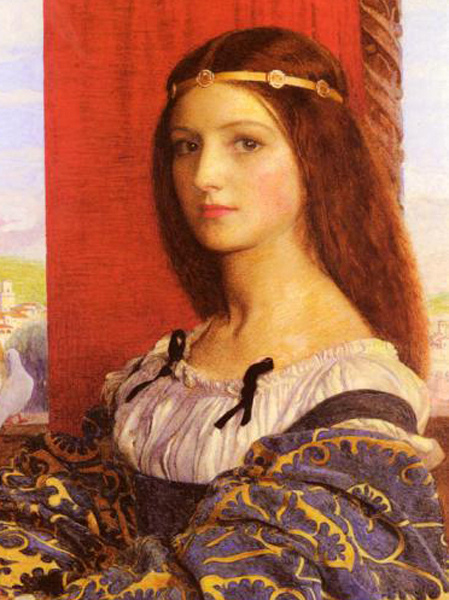
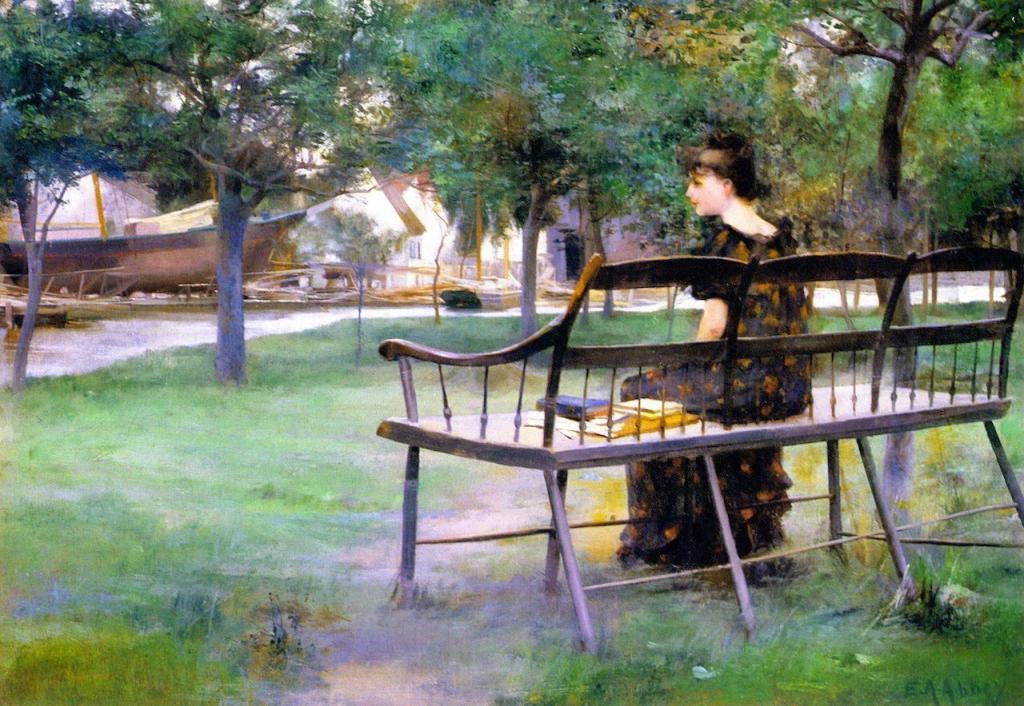
Today is the birthday of Edwin Austin Abbey (Philadelphia, April 1, 1852 – August 1, 1911 London); muralist, illustrator, and painter. He flourished at the beginning of what is now referred to as the “golden age” of illustration, and is perhaps best known for his drawings and paintings of Shakespearean and Victorian subjects, as well as for his painting of Edward VII’s coronation. His most famous set of murals, The Quest and Achievement of the Holy Grail, adorns the Boston Public Library.
In 1890, Edwin married Gertrude Mead, the daughter of a wealthy New York merchant. Mrs Abbey encouraged her husband to secure more ambitious commissions, although with their marriage commencing when both were in their forties, the couple remained childless. After her husband’s death, Gertrude was active in preserving her husband’s legacy, writing about his work and giving her substantial collection and archive to Yale. She was a sponsor of the Survey of London.
Gallery
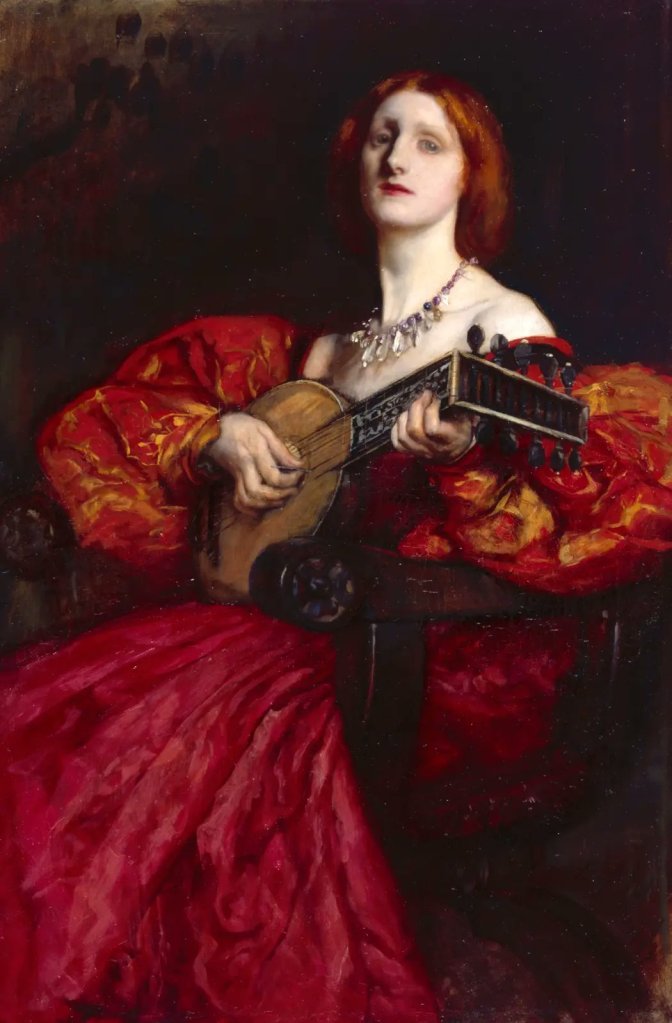
a lute player
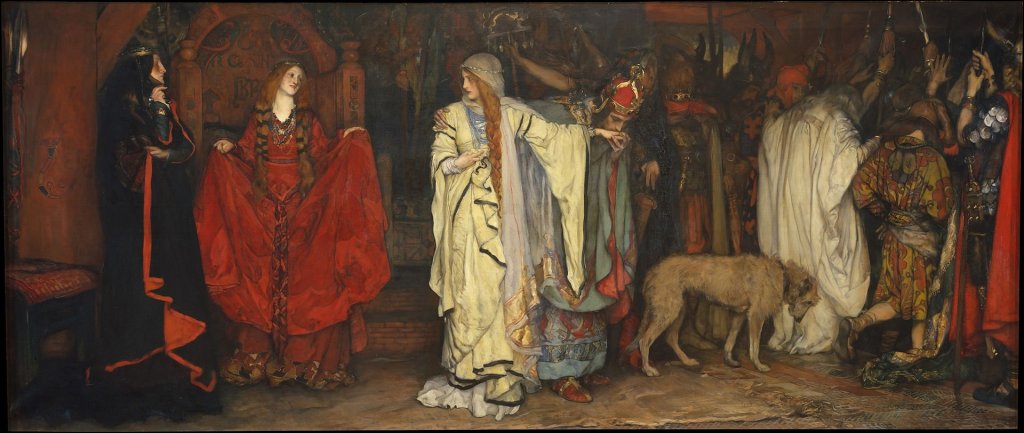
King Lear, Act I, Scene I (1897-98), metropolitan Museum of Art
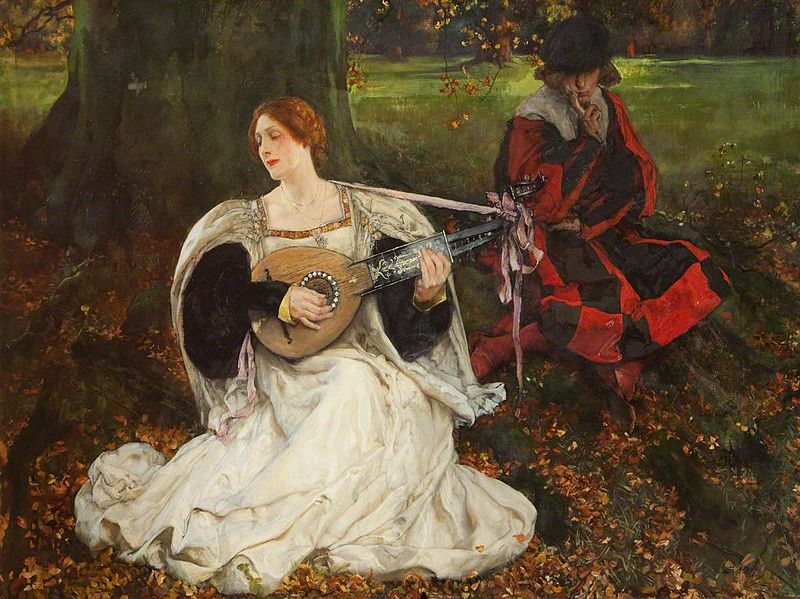
fair is my love
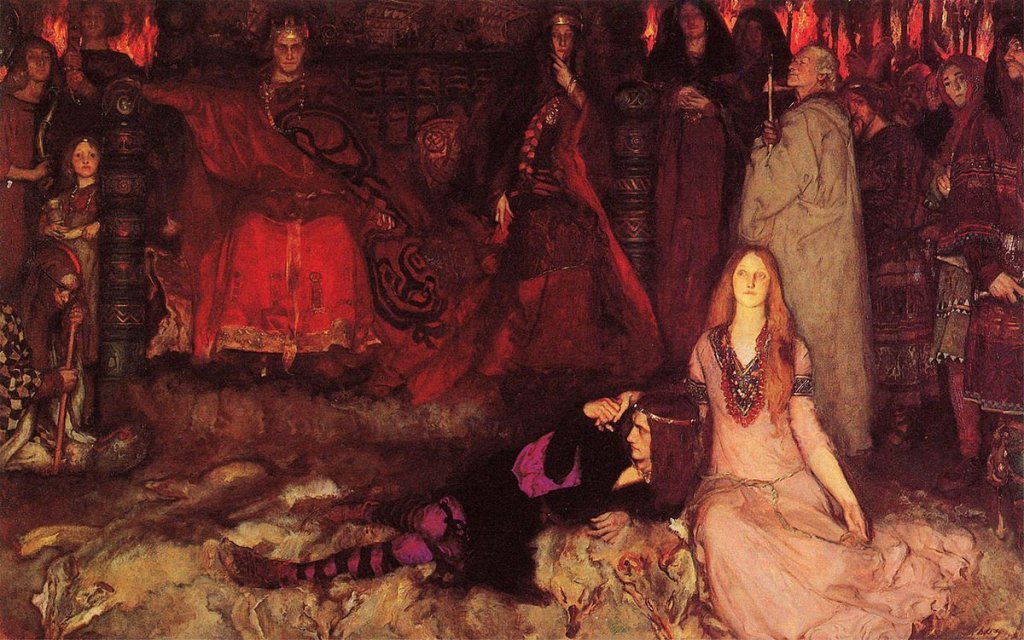
The Play Scene in Hamlet, 1897
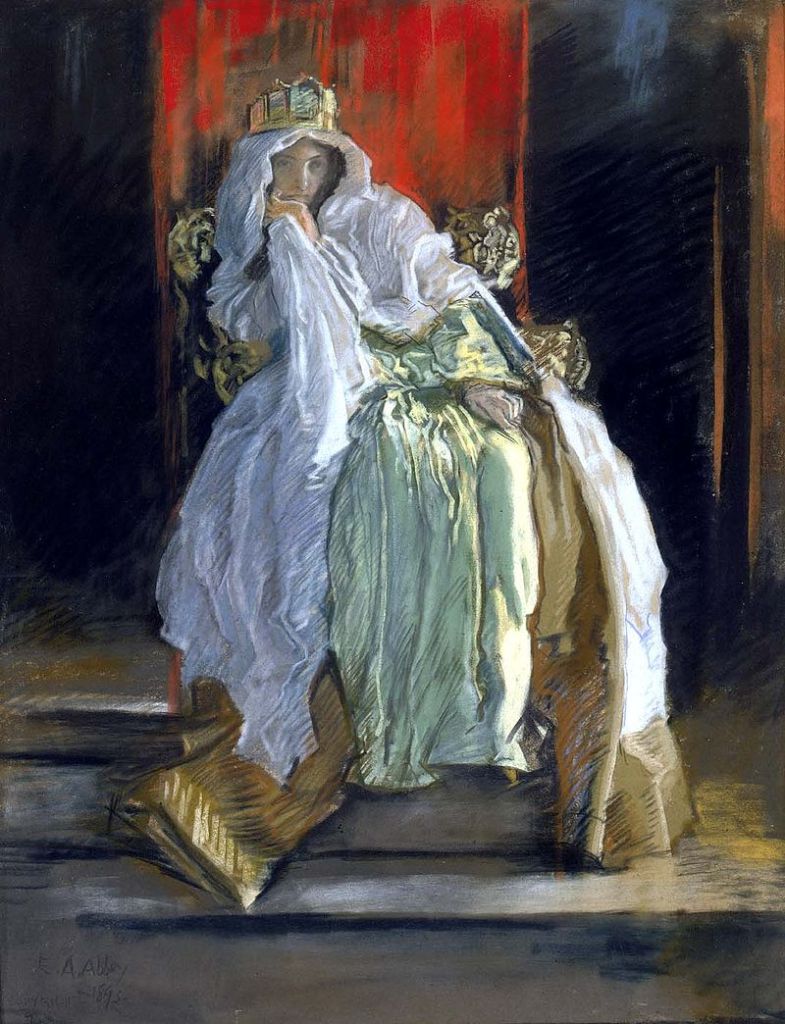
The Queen in Hamlet (c. 1897)
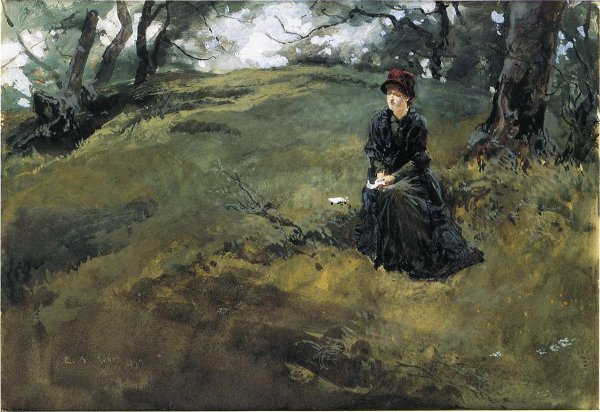
Young Woman in the Woods
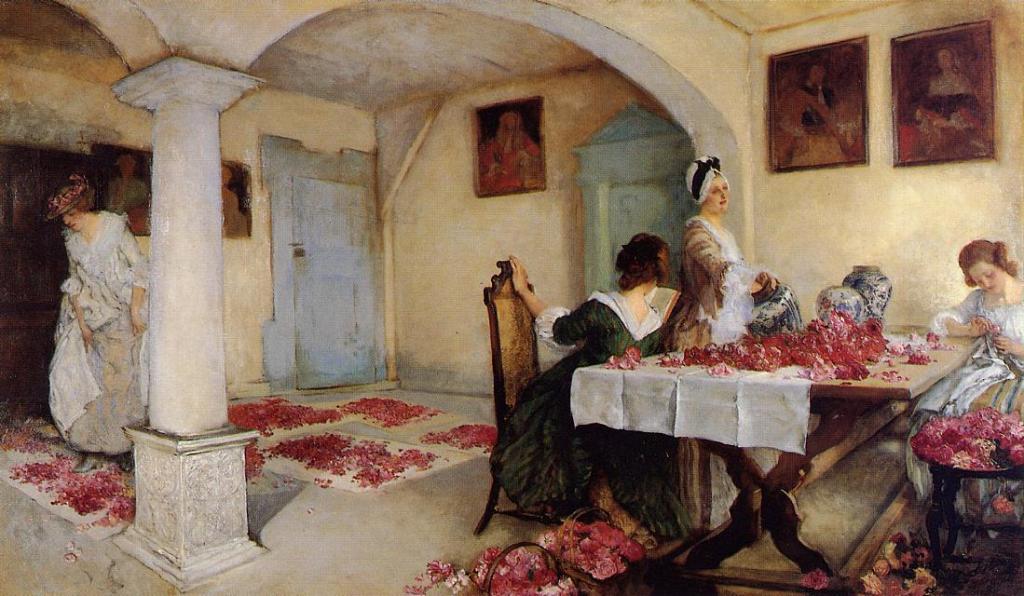
Potpourri 1899
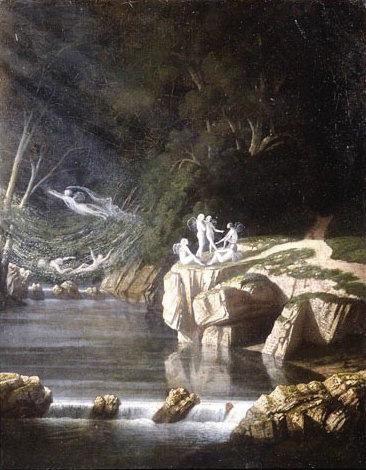

And today is the birthday of Edmond Rostand (Edmond Eugène Alexis Rostand; Marseille, 1 April 1868 – 2 December 1918 Paris); poet and dramatist perhaps best known for his fictional play Cyrano de Bergerac, based upon the life of Cyrano de Bergerac. Rostand’s romantic plays contrasted with the naturalistic theatre popular during the late nineteenth century. Another of Rostand’s works, Les Romanesques (1894), was adapted to the 1960 musical comedy The Fantasticks.
Rostand was married to the poet and playwright Rosemonde-Étienette Gérard who, in 1890, published Les Pipeaux: a volume of verse commended by the Academy. The couple had two sons, Jean and Maurice.
During the 1900s, Rostand came to live in the Villa Arnaga in Cambo-les-Bains in the French Basque Country, seeking a cure for his pleurisy. The house is now a heritage site and a museum of Rostand’s life and Basque architecture and crafts. Rostand died a victim of the flu pandemic, and is buried in the Cimetière de Marseille.
excerpts from cyrano
Cyrano de Bergerac : Eh bien ! oui, c’est mon vice.
Déplaire est mon plaisir. J’aime qu’on me haïsse.
Cyrano de Bergerac : Que dites-vous ?… C’est inutile ?… Je le sais !
Mais on ne se bat pas dans l’espoir du succès !
Non ! non, c’est bien plus beau lorsque c’est inutile !
Cyrano de Bergerac : Un baiser, mais à tout prendre, qu’est-ce ?
Un serment fait d’un peu plus près, une promesse
Plus précise, un aveu qui veut se confirmer,
Un point rose qu’on met sur l’i du verbe aimer ;
C’est un secret qui prend la bouche pour oreille,
Un instant d’infini qui fait un bruit d’abeille,
Une communion ayant un goût de fleur,
Une façon d’un peu se respirer le cœur,
Et d’un peu se goûter, au bord des lèvres, l’âme !
- Cyrano de Bergerac, Edmond Rostand, éd. Pocket, 2005, acte III, scène 10
Cyrano de Bergerac : Et voilà que je suis tué dans une embûche,
Par-derrière, par un laquais, d’un coup de bûche !
C’est très bien. J’aurai tout manqué, même ma mort.
- Cyrano de Bergerac, Edmond Rostand, éd. Pocket, 2005, acte V, scène 5
thanks for stoppin’ by y’all
mac tag
 The Lovers’ Chronicle
Leave a reply to The Lovers’ Chronicle 1 February – cold outside – art by Thomas Cole – premiere of Puccini’s Manon Lescaut & La bohème – birth of Langston Hughes – photography by Vivian Maier – premiere of The Broadway Cancel reply