Dear Zazie, Here is today’s Lovers’ Chronicle from Mac Tag. Whose arms would you like to die in? Who are you thinkin’ and dreamin’ off? Rhett
The Lovers’ Chronicle
Dear Muse,
(i just) dreamed in your arms…
’’It must have been something I said’’
-As the Cutting Crew song plays in the background;
Where are we my love, asks the radiant redhead
in Florence at the Casa Buonarroti museum
chasin’ Michelangelo’s ghost on his birthday
Interesting, the only arms he knew well, were marble
unlike the fictional Cyrano who knew Roxanne’s arms
Alas too late for them, but Elizabeth and Robert knew
well how it felt to be in each other’s arms, she said
and presumably like Márquez who knew what it was like
to be in the arms of something else, led to a unknown space
where his clothes were removed and he was tossed about,
where he knew something he thought would never happen
would finally happen, something he wanted, but not knowin’
what he was doin’ because he could not find his feet, or his head…
Wait what, are going all magical realism on me
oh sorry, not your favorite
I have a better idea, come here
so we can live in each other’s arms

© copyright 2024.2025 mac tag/cowboycoleridge all rights reserved
my favorite place
“Mine too”
where we end each day
“I like the days we start there”
this one comes from where
Cyrano and Elizabeth died
“In Roxanne’s and Robert’s
respectively I presume”
if you gotta go
hard to imagine
a better place
“I know where we should go now”
yes *pullin’ you close in my arms*
© copyright 2023 mac tag/cowboycoleridge all rights reserved
what and how we remember, had not stopped desirin’, but not found in dark bedrooms, would make materialize from the past, from books and movies, channeled through here, that was how, sufferin’ and survivin’ in self-imposed exile, carryin’ on, a life, comfortable, safe, uncomplicated, wrapped in the power of solitude, not lost, an honorable pact was made, and it worked, it served its purpose, until desire was rediscovered in your arms
© copyright 2022.2024 mac tag/cowboycoleridge all rights reserved
“Guess now who holds thee?”—
“Death,” I said. But there
The silver answer rang—
“Not Death, but Love.”
those who have been followin’
know that word has been scarce around here
if thou must, let it be for the sake
of havin’ never been there before
and how it feels to be here with you
© copyright 2021 mac tag/cowboy coleridge all rights reserved
Pale Love, Pale Rider
several ways to go with this one
how do we love us
uh, no
dyin’ in our arms
what a way not to go
no, i like what Marquez said
about what matters;
not what happens
but what and how we remember
validatin’ when i read that
so important to make peace
with the past
and since we have not another
so we can lie in the arms of the past

© copyright 2020.2024  tag/cowboy coleridge all rights reserved

i understand it now
there was a time
i did not
i do not condone it
but i sure do understand it
no seriously, i git it
i do not need daily
damn reminders
so can you please
tell me somethin’ good
tell me how it felt
© copyright 2019 mac tag/cowboy coleridge all rights reserved
it is the way
you look at things
findin’ beauty
even in imperfection
it is how you happen
how we remember
the letters written
the nights spent
by dyin’ embers
“But I have scars.”
show me…
(touchin’ them)
no, you are perfect
all that matters
who we are
together
a ghost,
come in
“How are you?”
lonely
only you ghosts
come to see me
© copyright 2018 mac tag/cowboy coleridge all rights reserved
a peaceful source
wave on wave
every beauty
that i have seen
comes from you
a painful force
wave on wave
every fear
i have known
follows me home
it snows and i am thinkin’
in you, and i am dreamin’
but you will not come
and the emptiness
clenches
© copyright 2017 Mac tag/cowboy Coleridge all rights reserved
I am sorry
My plan was different
© copyright 2016 Mac tag/cowboy Coleridge all rights reserved
For this one I combined my two favorite things; day in history notes and poetry. Hope you like……
Dyin’ In Your Arms
On this day; happy birthday
to Gabriel García Márquez
Who said; ‘What matters in life
Is not what happens to you
But what you remember
And how you remember it.’
And born on this day in Paris
Cyrano de Bergerac,
Who Edmond Rostand decided
Would make a fine heroic
And romantic subject for a play
Bergerac, soldier and poet,
A man to be admired indeed
At least the fictional version
Secretly writin’ love letters
To Roxanne, the woman he loves,
For Christian, a fellow soldier
Alas, poor Cyrano, Roxanne
Realizes, as he’s dyin’,
Who wrote her the letters
And who she really loves
At least Rostand permits
Poor Cyrano to have the fate
That any soldier and poet,
That any man, dearly longs for
To die in the arms of his love
Also on this day, the birth
Of poet Elizabeth Barrett
Fellow poet Robert Browning
Was so moved by her poetry
That he wrote her a fan letter
Which led to a passionate
Correspondence, secret courtship,
Then elopement to Italy
Where they lived and loved happily
Where she composed beloved poems
Where she died in Florence
In the arms of her love
And on this day, the sixth of March,
(Still without you, still missin’ you)
As I look back and reflect, I
Remember all of the good times,
The very best times of my life,
With you, when we were together
I remember we were happy
And I make this wish, this prayer…
Would it were that I were allowed
To die in the arms of your love
© 2013 Cowboy Coleridge – All rights reserved
My idea of Super Twosday; a bottle of port and Elizabeth Barrett Browning’s poems.
© 2012 Cowboy Coleridge – All rights reserved
The Song of the Day is a cover of Cutting Crew‘s “Died In Your Arms” by Ashley Cutler. All rights reserved by the rightful owner. No copyright infringement intended.

Today is the birthday of Michelangelo (Michelangelo di Lodovico Buonarroti Simoni; Caprese near Arezzo, Republic of Florence (present-day Tuscany, Italy) 6 March 1475 – 18 February 1564 Rome); sculptor, painter, architect, and poet of the High Renaissance who exerted an unparalleled influence on the development of Western art. In my opinion, the greatest living artist of his lifetime, one of the greatest artists of all time. His versatility in the disciplines he took up was of such a high order that he is often considered a contender for the title of the archetypal Renaissance man, along with his rival and fellow Florentine Medici client, Leonardo da Vinci.
He sculpted two of his best-known works, the Pietà and David, before the age of thirty. Despite holding a low opinion of painting, Michelangelo also created two of the most influential frescoes in the history of Western art: the scenes from Genesis on the ceiling of the Sistine Chapel in Rome, and The Last Judgment on its altar wall. As an architect, Michelangelo pioneered the Mannerist style at the Laurentian Library. At the age of 74, he succeeded Antonio da Sangallo the Younger as the architect of St. Peter’s Basilica. Michelangelo transformed the plan so that the western end was finished to his design, as was the dome, with some modification, after his death.
In his lifetime he was often called Il Divino (“the divine one”). One of the qualities most admired by his contemporaries was his terribilità, a sense of awe-inspiring grandeur. The attempts by subsequent artists to imitate Michelangelo’s impassioned and highly personal style resulted in Mannerism, the next major movement in Western art after the High Renaissance.
Michelangelo died three weeks before his 89th birthday. His body was taken from Rome for entombment at the Basilica of Santa Croce, fulfilling the maestro’s last request to be buried in his beloved Florence.
Gallery
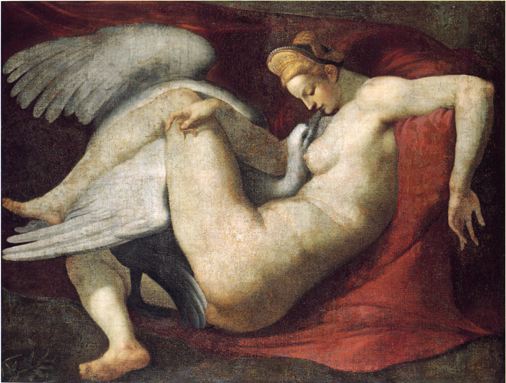
Copia dalla Leda e il cigno di Michelangelo, alla National Gallery di Londra

The Libyan Sibyl (1511)

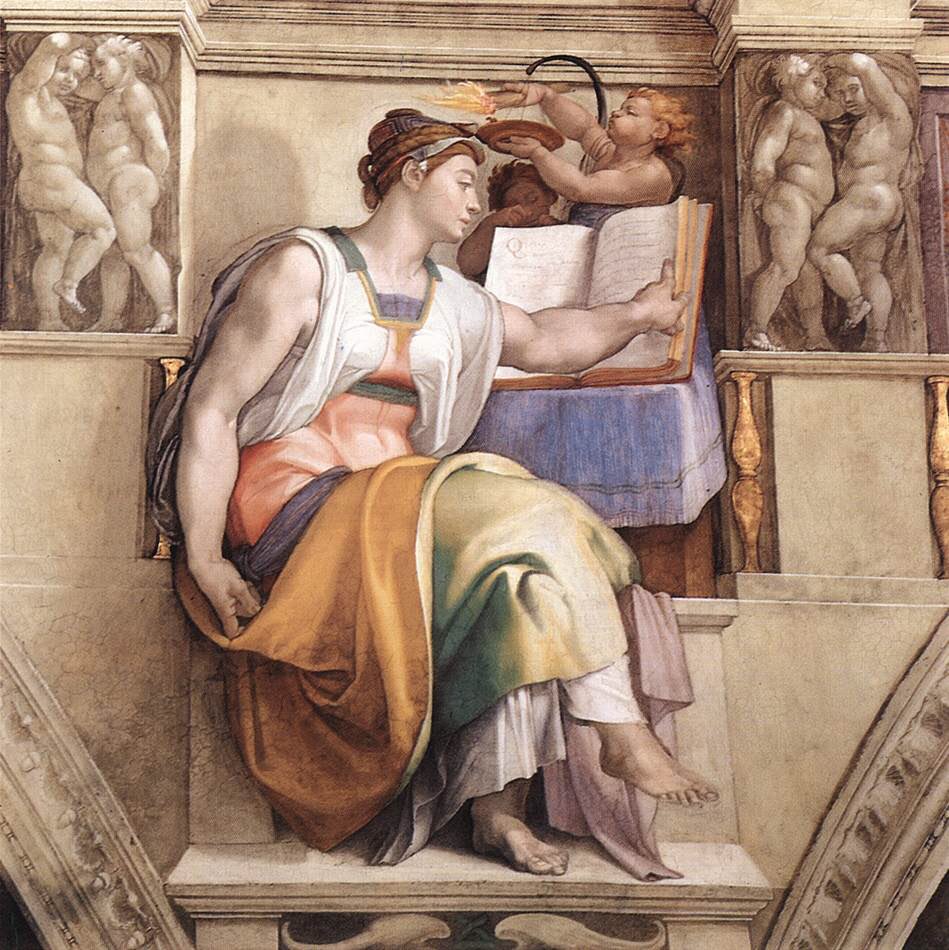
Erythraean Sibyl, Sistine Chapel ceiling
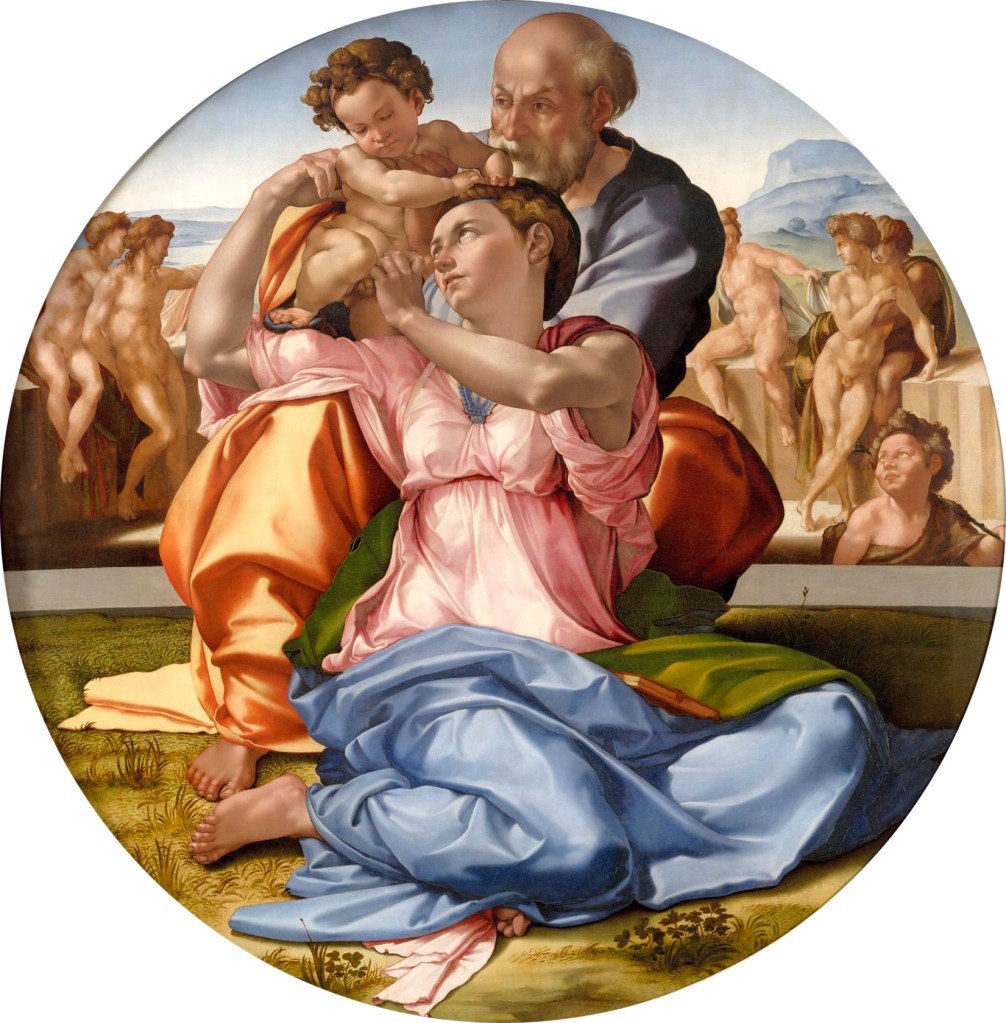
Doni Tondo (1504–1506)

The Madonna of the Stairs (1490–92), his earliest known work

Pietà, St Peter’s Basilica (1498–99)

The Statue of David, completed in 1504, is one of the most renowned works of the Renaissance.

the ceiling of the Sistine Chapel; the work took approximately four years to complete (1508–12)
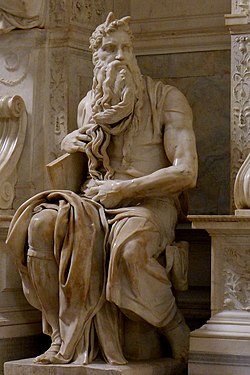
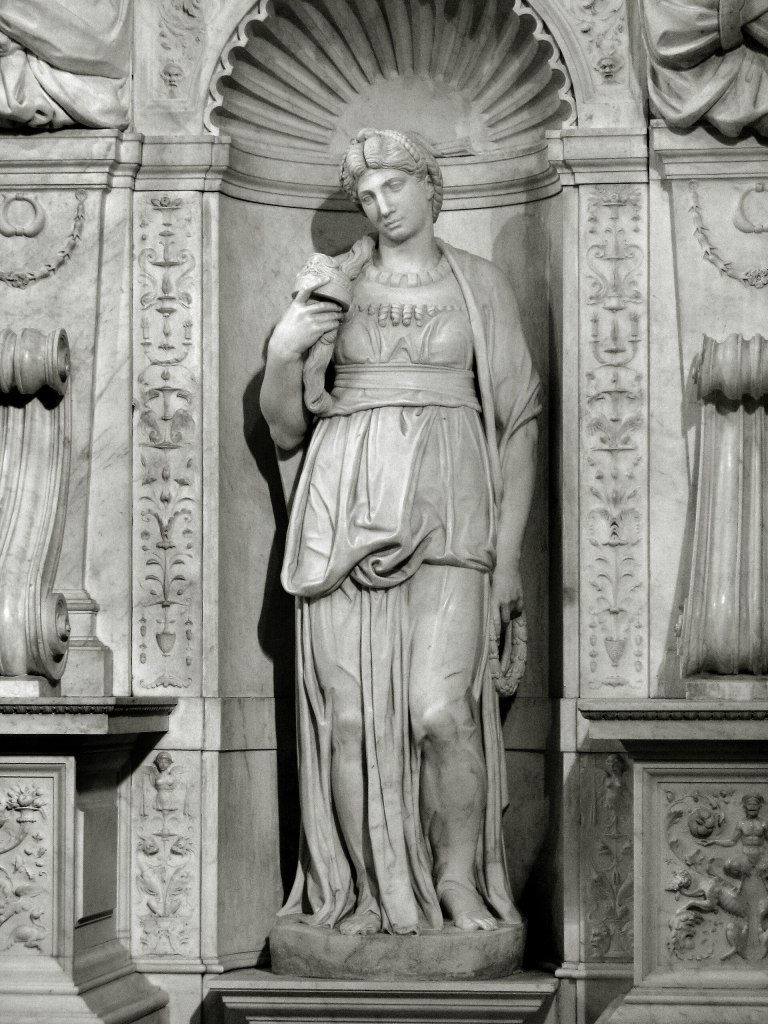
Moses for the tomb of Pope Julius II

The Last Judgement (1534–41)

The dome of St Peter’s Basilica

Ignudo fresco from 1509 on the Sistine Chapel ceiling
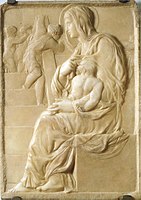 The Madonna of the Steps (1490–92)
 The Taddei Tondo (1502)
 Madonna and Child. Bruges, Belgium (1504)
 Angel early work (1494–95)
 Bacchus early work (1496–97)
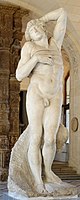 Dying slave, Louvre (1513)
 Bound slave, known as Atlas (1530–34)

The Sistine Chapel Ceiling (1508–12)
 The Drunkenness of Noah
 The Deluge (detail)
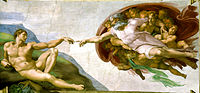 The Creation of Adam (1510)
 The First day of Creation
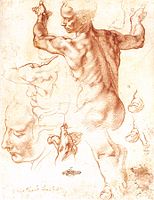 Studies for The Libyan Sibyl
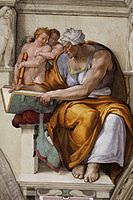 The Cumaean Sibyl
 The Prophet Jeremiah (1511)
 Ignudo
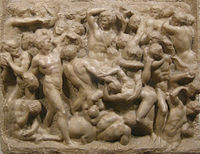 Battle of the Centaurs (1492)
 Copy of the lost Battle of Cascina by Bastiano da Sangallo
 The Last Judgment, detail of the Redeemed
 The Crucifixion of St. Peter
 The vestibule of the Laurentian Library has Mannerist features which challenge the Classical order of Brunelleschi’s adjacent church.
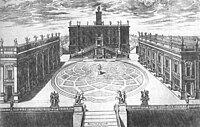 Redesign of the ancient Capitoline Hill included a complex spiralling pavement with a star at its centre.
 Design for St Peter’s is both massive and contained, with the corners between the apsidal arms of the Greek Cross filled by square projections.
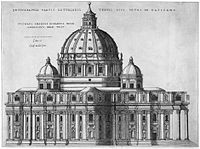 The exterior is surrounded by a giant order of pilasters supporting a continuous cornice. Four small cupolas cluster around the dome.
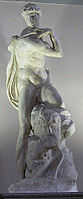 Statue of Victory (1534), Palazzo Vecchio, Florence
 The Pietà of Vittoria Colonna (c. 1540)
 Michelangelo and Tiberio Calcagni, Pietà Firenze (c. 1550–61)
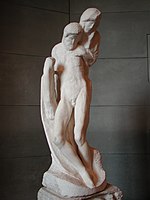 The Rondanini Pietà (1552–64)
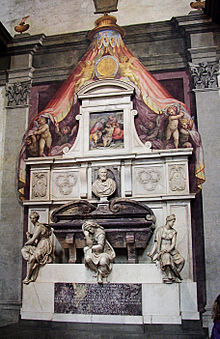
Michelangelo’s tomb in the Basilica of Santa Croce, Florence
Verse
A quel pietoso fonte, onde siam tutti,
S’assembra ogni beltà che qua si vede,
Più c’altra cosa alle persone accorte
| Cyrano de Bergerac | |
|---|---|
 | |
Today is the birthday of Cyrano de Bergerac (Savinien de Cyrano de Bergerac; Paris 6 March 1619 – 28 July 1655 Sannois, France); novelist, playwright, epistolarian and duelist.

A bold and innovative author, his work was part of the libertine literature of the first half of the seventeenth century. Perhaps best known as the inspiration for Edmond Rostand’s most noted drama Cyrano de Bergerac which, although it includes elements of his life, also contains myth.
Cyrano’s short life is poorly documented.
| Elizabeth Barrett Browning | |
|---|---|
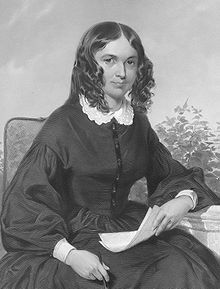 | |
Today is the birthday of Elizabeth Barrett Browning (née Moulton-Barrett; Kelloe, Durham, England; 6 March 1806 – 29 June 1861 Florence); in my opinion, one of the most prominent poets of the Victorian era, popular in Britain and the United States during her lifetime.
In the 1830s Elizabeth was introduced to literary society through her cousin, John Kenyon. Her first adult collection of poems was published in 1838 and she wrote prolifically between 1841 and 1844, producing poetry, translation and prose. She campaigned for the abolition of slavery and her work helped influence reform in the child labour legislation. Her prolific output made her a rival to Tennyson as a candidate for poet laureate on the death of Wordsworth.
Elizabeth’s volume Poems (1844) brought her great success, attracting the admiration of the writer Robert Browning. Their correspondence, courtship and marriage were carried out in secret, for fear of her father’s disapproval. Following the wedding she was disinherited by her father. The couple moved to Italy in 1846, where she would live for the rest of her life. They had one son, Robert Barrett Browning, whom they called Pen. A collection of her last poems was published by her husband shortly after her death.
Elizabeth’s work had a major influence on prominent writers of the day, including the American poets Edgar Allan Poe and Emily Dickinson. She is remembered for such poems as “How Do I Love Thee?” (Sonnet 43, 1845) and Aurora Leigh (1856).
Verse
How Do I Love Thee?
How do I love thee? Let me count the ways.
I love thee to the depth and breadth and height
My soul can reach, when feeling out of sight
For the ends of being and ideal grace.
I love thee to the level of every day’s
Most quiet need, by sun and candle-light.
I love thee freely, as men strive for right.
I love thee purely, as they turn from praise.
I love thee with the passion put to use
In my old griefs, and with my childhood’s faith.
I love thee with a love I seemed to lose
With my lost saints. I love thee with the breath,
Smiles, tears, of all my life; and, if God choose,
I shall but love thee better after death.
Sonnet XLIII
from Sonnets from the Portuguese, 1845 (published 1850)
Sonnets from the Portuguese (1850)
- “Guess now who holds thee?”—”Death,” I said. But there
The silver answer rang—”Not Death, but Love.”- No. I
- Thou hast thy calling to some palace-floor,
Most gracious singer of high poems! where
The dancers will break footing, from the care
Of watching up thy pregnant lips for more.- No. IV
- Hush, call no echo up in further proof
Of desolation! there’s a voice within
That weeps . . . as thou must sing . . . alone, aloof.- No. IV
- Go from me. Yet I feel that I shall stand
Henceforward in thy shadow.- No. VI
- If thou must love me, let it be for nought
Except for love’s sake only. Do not say
“I love her for her smile —her look —her way
Of speaking gently,—for a trick of thought
That falls in well with mine, and certes brought
A sense of pleasant ease on such a day” –
For these things in themselves, Beloved, may
Be changed, or change for thee,—and love, so wrought,
May be unwrought so. Neither love me for
Thine own dear pity’s wiping my cheeks dry,—
A creature might forget to weep, who bore
Thy comfort long, and lose thy love thereby!
But love me for love’s sake, that evermore
Thou may’st love on, through love’s eternity.- No. XIV
- When our two souls stand up erect and strong,
Face to face, silent, drawing nigh and nigher,
Until the lengthening wings break into fire
At either curvèd point, — what bitter wrong
Can the earth do to us, that we should not long
Be here contented?- No. XXII
- God only, who made us rich, can make us poor.
- No. XXIV
- Because God’s gifts put man’s best dreams to shame.
- No. XXVI
- Instruct me how to thank thee! Oh, to shoot
My soul’s full meaning into future years,
That they should lend it utterance, and salute
Love that endures, from life that disappears!- No. LXI
- I seek no copy now of life’s first half:
Leave here the pages with long musing curled,
And write me new my future’s epigraph,
New angel mine, unhoped for in the world!- No. LXII

- Here’s ivy! — take them, as I used to do
Thy flowers, and keep them where they shall not pine.
Instruct thine eyes to keep their colours true,
And tell thy soul, their roots are left in mine.- No. LXIV
| Gabriel García Márquez | |
|---|---|
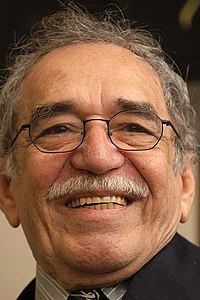 | |
And today is the birthday of Gabriel García Márquez
(Gabriel José de la Concordia García Márquez; Arcataca, Columbia 6 March 1927 – 17 April 2014 Mexico City); novelist, short-story writer, screenwriter and journalist, known affectionately as Gabo or Gabito throughout Latin America. In my opinion, one of the most significant authors of the 20th century and one of the best in the Spanish language. He was awarded the 1972 Neustadt International Prize for Literature and the 1982 Nobel Prize in Literature. He pursued a self-directed education that resulted in his leaving law school for a career in journalism.
In 1958, he married Mercedes Barcha.
García Márquez started as a journalist, and wrote many acclaimed non-fiction works and short stories. Perhaps he is best known for his novels, such as One Hundred Years of Solitude (1967), The Autumn of the Patriarch (1975), and Love in the Time of Cholera (1985). His works have achieved significant critical acclaim and widespread commercial success, most notably for popularizing a literary style labeled as magic realism, which uses magical elements and events in otherwise ordinary and realistic situations. Some of his works are set in a fictional village called Macondo (the town mainly inspired by his birthplace Aracataca), and most of them explore the theme of solitude.
Prose/Verse
Cien años de soledad (1967)
“- ¡Carajo!- gritó.
Amaranta, que empezaba a meter la ropa en el baúl, creyó que la había picado un alacrán.
– ¿Dónde está? – preguntó alarmada.
– ¿Qué?
– ¡El animal!
Úrsula se puso un dedo en el corazón.
– Aquí- dijo. “
Ti amo non per chi sei Ma per come sono io quando sono con te.
Llueve. Y estoy pensando
en ti. Y estoy soñando.
Nadie vendrá esta tarde
a mi dolor cerrado.
“Voy a buscar un gran quizás”
Si alguien llama a tu puerta
y estás triste,
abre que es el amor,
amiga mía.
One Hundred Years of Solitude (Spanish: Cien años de soledad)
- Entonces se confió a aquella mano, y en un terrible estado de agotamiento se dejó llevar hasta un lugar sin formas donde le quitaron la ropa y lo zarandearon como un costal de papas y lo voltearon al derecho y al revés, en una oscuridad insondable en la que le sobraban los brazos, donde ya no olía más a mujer, sino a amoníaco, y donde trataba de acordarse del rostro de ella y se encontraba con el rostro de Úrsula, confusamente consciente de que estaba haciendo algo que desde hacía mucho tiempo deseaba que se pudiera hacer, pero que nunca se había imaginado que en realidad se pudiera hacer, sin saber cómo lo estaba haciendo porque no sabía imaginado que en realidad se pudiera hacer, sin saber cómo lo estaba haciendo porque no sabía dónde estaban los pies y dónde la cabeza, ni los pies de quién ni la cabeza de quién, y sintiendo que no podía resistir más el rumor glacial de sus riñones y el aire de sus tripas, y el miedo, y el ansia atolondrada de huir al mismo tiempo de quedarse para siempre en aquel silencio exasperado y aquella soledad espantosa.
- Then he [José Arcadio (II)] gave himself over to that hand [Pilar Ternera’s], and in a terrible state of exhaustion he let himself be led to a shapeless place where his clothes were taken off and he was heaved about like a sack of potatoes and thrown from one side to the other in a bottomless darkness in which his arms were useless, where it no longer smelled of woman but of ammonia, and where he tried to remember her face and found before him the face of Úrsula, confusedly aware that he was doing something that for a very long time he had wanted to do but that he had imagined could really never be done, not knowing what he was doing because he did not know where his feet were or where his head was, or whose feet or whose head, and feeling that he could no longer resist the glacial rumbling of his kidneys and the air of his intestines, and fear, and the bewildered anxiety to flee and at the same time stay forever and ever in that exasperated silence and that fearful solitude.
- Chapter III, p. 40
thanks for stoppin’ by y’all
mac tag
 The Lovers’ Chronicle
Leave a reply to The Lovers’ Chronicle 14 February – be mine – verse by Shakespeare & Elizabeth Barrett Browning – birth of Nina Hamnett – The Lovers’ Chronicle Cancel reply