Dear Zazie, Here is today’s Lovers’ Chronicle from Mac Tag dedicated to his muse. Follow us on twitter @cowboycoleridge. Rhett
The Lovers’ Chronicle
Dear Muse,
London homesick dream…
buckle up dear, could be a long ride
Where are we going, asks the fabulous redhead
i was readin’ the poetry of Marlowe and Hugo today, so could be 1590’s London or 1800’s Paris
Oh I hope it’s London, if we could find Marlowe maybe we could clear up some mysteries
yes, does he look like the Corpus Christi College portrait
And is he the true author of Shakespeare
and was he stabbed for bein’ a spy
-They suddenly find themselves walking on a street towards what looks to be a theatre-
ah, we are in luck, that is The Rose and Marlowe could be inside
-Entering the theatre, they see a man sitting at a table who resembles the man in the portrait, they approach him and ask if they may join him, he stands and offers them a seat, they are soon engaged in a hushed conversation-
-sometime later he and the redhead exit the theatre-
That was fascinating, she says
wow, how ‘bout that, i was right, Marlowe confirmed my theory that Shakespeare was able to write everything because he was an alien and Marlowe feared for his life because he was gonna reveal the secret
Well should we take any other fancy chances while we are here
can you catch bubonic plague in a dream
Don’t think so, but maybe we should go
i got this, hey Jerry Jeff Walker and Gary P. Nunn, sing us outta hear
”I wanna go home with the armadillo
Good country music from Amarillo and Abilene.
The friendliest people and the prettiest women
you've ever seen.”

© copyright 2024 mac tag/cowboycoleridge all rights reserved
-gonna try to put myself
back in that place again-
always starts with
london homesick blues
“I know that song”
sure have taken
some fancy ones
“I’m glad you did
because they led you here”
absolutely, the good,
the bad and the ugly
“The necessary”
well put, now
what are my chances
© copyright 2023 mac tag/cowboycoleridge all rights reserved
evidently all the right ones were taken, if the destination justifies the means, or the right ones were not taken, proof the past is not past, it is here in where we are, how we got here, perhaps in how we recall what happened, formed and shaped to allow its acceptance, to keep us from abandonment, chances are would repeat it all to be here
© copyright 2022.2024 mac tag/cowboycoleridge all rights reserved
oh where do i go
let me count the ways
premonition or dream
chances taken now come
round and i hardly know
how, when, or even what
this was never supposed
to happen, this destiny
i wrote so often, but never
thought could save me
and yet i turn to look
and there you are
© copyright 2021 mac tag/cowboy coleridge all rights reserved
Pale Love, Pale Rider
a good place here
knowin’ what lies ahead
embracin’ these feelin’s,
closer every day
so fortunate
to have found
someone wonderful,
and deeply groundin’
and this undeniable
bond, woven together
through the years
belief undid disbelief
and restored faith
to the verse,
to us
© copyright 2020 mac tag/cowboy coleridge all rights reserved
passeth away
frail, our words
shall play the parts
what will be
hath not limits
where we are
must we ever be
turnin’ an eye to the past
inconsolable otherwise
i keep lookin’
at that moment
Hugo said,
aimer c’est agir
shall we
© copyright 2019 mac tag/cowboy coleridge all rights reserved
“C’est ici le combat
du jour et de la nuit…
Je vois de la lumière noire”
this is the battle
between day and night…
i see black light
what makes night
within us
may leave stars…
come make night
with me
jouir en bien
literally,
enjoy in good
idiomatically…
well, come with me
and together
we will find out
after all,
time gits away
© copyright 2018 mac tag/cowboy coleridge all rights reserved
time, too much perhaps,
spent turnin’ an eye
towards the past
the broken trail behind
the chances taken
and not taken
not so much
a review of regret
have those stacked
up like cord wood,
dealt and done with
but, there is one
chance not taken,
one regret, one moment
i keep lookin back on
i will see that moment
clearly, for whatever
is left of my days,
you walkin’ away
on that stormy evenin’
***
a struggle
for damn sure
between light and dark
i see black
time gits away
and life is frail
© copyright 2017 mac tag/cowboy Coleridge all rights reserved
hall of wreckage
splintered hopes lie
beside shattered dreams
nothin’ is ever thrown away
all set in rows
fadin’ in the rearview
they look alike now. reckon
time makes heartbreaks
commonplace
these pictures here
each craved ever after,
immortalized alone
on a shelf, like unread books
never to be taken down
were I better at this…
so much more you could see
with nothin’ inside
locks with no keys
would that we could go
this hill has the view
look at that sunset
it is for you
© copyright 2016 mac tag/cowboy Coleridge all rights reserved
That night in Taos
Pueblo. Holdin’
you tight. I felt
the nearness of
permanence. I
knew damn well it
was not to be
But there it was
***
Wait, before you
start bitchin’; I
need some “give a
damn” therapy
© copyright 2015 mac tag/cowboy Coleridge all rights reserved
| Christopher Marlowe | |
|---|---|
 | |
Today is the baptismal day of Christopher Marlowe, also known as Kit Marlowe (Canterbury, Kent; baptised 26 February 1564 – 30 May 1593 Deptford, Kent); playwright, poet and translator of the Elizabethan era. Marlowe was the foremost Elizabethan tragedian of his day. He greatly influenced William Shakespeare, who was born in the same year as Marlowe and who rose to become the pre-eminent Elizabethan playwright after Marlowe’s mysterious early death. Marlowe’s plays are known for the use of blank verse and their overreaching protagonists.
A warrant was issued for Marlowe’s arrest on 18 May 1593. No reason was given for it, though it was thought to be connected to allegations of blasphemy—a manuscript believed to have been written by Marlowe was said to contain “vile heretical conceipts”. On 20 May, he was brought to the court to attend upon the Privy Council for questioning. There is no record of their having met that day, however, and he was commanded to attend upon them each day thereafter until “licensed to the contrary”. Ten days later, he was stabbed to death by Ingram Frizer. Whether the stabbing was connected to his arrest has never been resolved.
Verse
Come live with me and be my Love,
And we will all the pleasures prove
That hills and valleys, dales and fields,
Or woods or steepy mountain yields.
And we will sit upon the rocks,
And see the shepherds feed their flocks
By shallow rivers, to whose falls
Melodious birds sing madrigals.
And I will make thee beds of roses
And a thousand fragrant posies.
- The Passionate Shepherd to His Love (unknown date), stanzas 1 and 2
Tamburlaine (c. 1588)
- Time passeth swift away;
Our life is frail, and we may die to-day.- Mycetes, Act I, scene i, line 68
- Our swords shall play the orators for us.
- Techelles, Act I, scene ii, line 132
- Accurst be he that first invented war.
- Mycetes, Part 1, Act II, scene iv, line 1
- Let Earth and Heaven his timeless death deplore,
For both their worths shall equal him no more.- Amyras, Part 2, Act V, scene iii, lines 252–253
Doctor Faustus (c. 1593)
- Che serà, serà:
What will be, shall be.- Faustus, Act I, scene i, lines 47–58
- Hell hath no limits, nor is circumscrib’d
In one self place; but where we are is hell,
And where hell is, there must we ever be.- Mephistopheles, Act II, scene i, line 118
- When all the world dissolves,
And every creature shall be purified,
All places shall be hell that are not heaven.- Mephistopheles, Act II, scene i, line 120. In the first line, Marlowe references Isaiah in Isaiah 24:19 and 34:4; in the second line, he references Daniel in Daniel 12:10.
- Was this the face that launch’d a thousand ships,
And burnt the topless towers of Ilium?
Sweet Helen, make me immortal with a kiss!- Faustus, Act V, scene i, lines 91–93
- Pray for me! and what noise soever ye hear, come not unto me, for nothing can rescue me.
- Faustus, Act V, scene ii, lines 57–58
- He that loves pleasure, must for pleasure fall.
- Evil Angel, Act V, scene iv
Hero and Leander (published 1598)
- A pleasant-smiling cheek, a speaking eye,
A brow for love to banquet royally.- First Sestiad
- It lies not in our power to love or hate,
For will in us is overruled by fate.- First Sestiad
- Who ever loved that loved not at first sight?
- First Sestiad. The same statement occurs in As You Like It (1600) by William Shakespeare, and a similar one in The Blind Beggar of Alexandria (1596) by George Chapman.
- Like untuned golden strings all women are,
Which long time lie untouch’d, will harshly jar.
Vessels of brass, oft handled, brightly shine.- First Sestiad
- All women are ambitious naturally.
- First Sestiad
- Love always makes those eloquent that have it.
- Second Sestiad
- Above our life we love a steadfast friend.
- Second Sestiad
| Victor Hugo | |
|---|---|
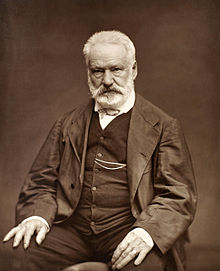 |
Today is the birthday of Victor Hugo (Victor Marie Hugo; Besançon, Doubs, France 26 February 1802 – 22 May 1885 Paris); poet, novelist, and dramatist of the Romantic movement. In my opinion, one of the greatest and best-known French writers. Outside France, his best-known works are the novels Les Misérables, 1862, and The Hunchback of Notre-Dame (French: Notre-Dame de Paris), 1831. In France, Hugo is known primarily for his poetry collections, such as Les Contemplations (The Contemplations) and La Légende des siècles (The Legend of the Ages). He produced more than 4,000 drawings and also campaigned for social causes such as the abolition of capital punishment.
Hugo married Adèle Foucher in October 1822. Despite their respective affairs, they lived together for nearly 46 years until she died in August 1868. Hugo, who was still banished from France, was unable to attend her funeral in Villequier, where their daughter Léopoldine was buried. From 1830 to 1837, Adèle had an affair with Charles-Augustin Sainte Beuve, a reviewer and writer.

Portrait of Drouet by Charles-Émile-Callande de Champmartin
From February 1833 until her death in 1883, Juliette Drouet devoted her whole life to Hugo, who never married her even after his wife died in 1868. He took her on his numerous trips and she followed him in exile on Guernsey. There Hugo rented a house for her near Hauteville House, his family home. She wrote some 20,000 letters in which she expressed her passion or vented her jealousy on her womanizing lover. On 25 September 1870 during the Siege of Paris (19 September 1870 – 28 January 1871) Hugo feared the worst. He left his children a note reading as follows:
“J.D. She saved my life in December 1851. For me she underwent exile. Never has her soul forsaken mine. Let those who have loved me love her. Let those who have loved me respect her. She is my widow.” V.H.
For more than seven years, Léonie d’Aunet, who was a married woman, was involved in a love relationship with Hugo. Both were caught in adultery on 5 July 1845. Hugo, who had been a Member of the Chamber of Peers since April, avoided condemnation whereas his mistress had to spend two months in prison and six in a convent. Many years after their separation, Hugo made a point of supporting her financially.
Hugo gave free rein to his libido until a few weeks before his death. He sought a wide variety of women of all ages, be they courtesans, actresses, prostitutes, admirers, servants or revolutionaries like Louise Michel for sexual activity. Both a graphomaniac and erotomaniac, he systematically reported his casual affairs using his own code, as Samuel Pepys did, to make sure they would remain secret. For instance, he resorted to Latin abbreviations (osc. for kisses) or to Spanish (Misma. Mismas cosas: The same. Same things). Homophones are frequent: Seins (Breasts) becomes Saint; Poële (Stove) actually refers to Poils (Pubic hair). Analogy also enabled him to conceal the real meaning: A woman’s Suisses (Swiss) are her breasts—because Switzerland is renowned for its milk. After a rendezvous with a young woman named Laetitia he would write Joie (Happiness) in his diary. If he added t.n. (toute nue) he meant she stripped naked in front of him. The initials S.B. discovered in November 1875 may refer to Sarah Bernhardt.
Though a committed royalist when he was young, Hugo’s views changed as the decades passed, and he became a passionate supporter of republicanism; his work touches upon most of the political and social issues and the artistic trends of his time.
Verse
Hélas ! vers le passé tournant un œil d’envie,
Sans que rien ici-bas puisse m’en consoler,
Je regarde toujours ce moment de ma vie
Où je l’ai vue ouvrir son aile et s’envoler!
Je verrai cet instant jusqu’à ce que je meure,
L’instant, pleurs superflus !
Où je criai : L’enfant que j’avais tout à l’heure,
Quoi donc ! je ne l’ai plus !
Alas! turning an envious eye towards the past,
inconsolable by anything on earth,
I keep looking at that moment of my life
when I saw her open her wings and fly away!
I will see that instant until I die,
that instant—too much for tears!
when I cried out: “The child that I had just now—
what! I don’t have her any more!”
C’est ici le combat du jour et de la nuit… Je vois de la lumière noire.
- This is the battle between day and night… I see black light.
Aimer, c’est agir
- To love is to act
- Last words of his diary, written two weeks before his death, published in Victor Hugo : Complete Writings (1970)
- La musique…est la vapeur de l’art. Elle est à la poésie ce que la rêverie est à la pensée, ce que le fluide est au liquide, ce que l’océan des nuées est à l’océan des ondes.
- Music…is the vapour of art. It is to poetry what revery is to thought, what the fluid is to the liquid, what the ocean of clouds is to the ocean of waves.
- Part I, Book II, Chapter IV
- Music…is the vapour of art. It is to poetry what revery is to thought, what the fluid is to the liquid, what the ocean of clouds is to the ocean of waves.
- Ce qu’on ne peut dire et ce qu’on ne peut taire, la musique l’exprime.
- Music expresses that which cannot be said and on which it is impossible to be silent.
- Part I, Book II, Chapter IV
- Music expresses that which cannot be said and on which it is impossible to be silent.

in 1853

Portrait of “Cosette” by Émile Bayard, from the original edition of Les Misérables (1862)

Among the Rocks on Jersey (1853–55)
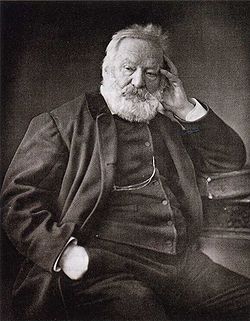
Photogravure, 1883.

Hugo on his deathbed, 1885

Catafalque below the Arc de Triomphe in Paris, 1 June 1885
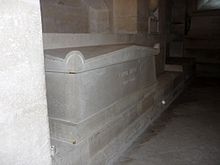
Tomb at the Panthéon
Two days before dying, he left a note with these last words: “Aimer, c’est agir” (To love is to act). Hugo’s death from pneumonia at the age of 83, generated intense national mourning. He was not only revered as a towering figure in literature, he was a statesman who shaped the Third Republic and democracy in France. More than two million people joined his funeral procession in Paris from the Arc de Triomphe to the Panthéon, where he was buried. He shares a crypt within the Panthéon with Alexandre Dumas and Émile Zola.
Hugo left five sentences as his last will, to be officially published:
Je donne cinquante mille francs aux pauvres. Je veux être enterré dans leur corbillard.
Je refuse l’oraison de toutes les Églises. Je demande une prière à toutes les âmes.
Je crois en Dieu.
“I leave 50,000 francs to the poor. I want to be buried in their hearse.
I refuse [funeral] orations of all churches. I beg a prayer to all souls.
I believe in God.”
C’est ici le combat du jour et de la nuit… Je vois de la lumière noire.
- This is the battle between day and night… I see black light.
- Last words
Gallery
 Crépuscule (“Twilight”), Jersey, 1853–1855.
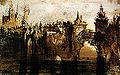 Ville avec le pont de Tumbledown, (“Town with Tumbledown Bridge”),1847.
 Pieuvre avec les initiales V.H., (“Octopus with the initials V.H.”), 1866.
 Le phare (“The Lighthouse”)
 Gavroche a onze ans, (“Gavroche is eleven years old”).
Today is the birthday of Honoré-Victorin Daumier (Marseille February 26, 1808 – February 10, 1879 Valmondois, France); painter, sculptor, and printmaker, whose many works offer commentary on the social and political life in France, from the Revolution of 1830 to the fall of the second Napoleonic Empire in 1870. He earned a living throughout most of his life producing caricatures and cartoons of political figures and satirizing the behavior of his countrymen in newspapers and periodicals, for which he became well known in his lifetime and is still known today. He was a republican democrat who attacked the bourgeoisie, the church, lawyers and the judiciary, politicians, and the monarchy. He was jailed for several months in 1832 after the publication of Gargantua, a particularly offensive and discourteous depiction of King Louis-Philippe. Daumier was also a serious painter, loosely associated with realism.
Gallery
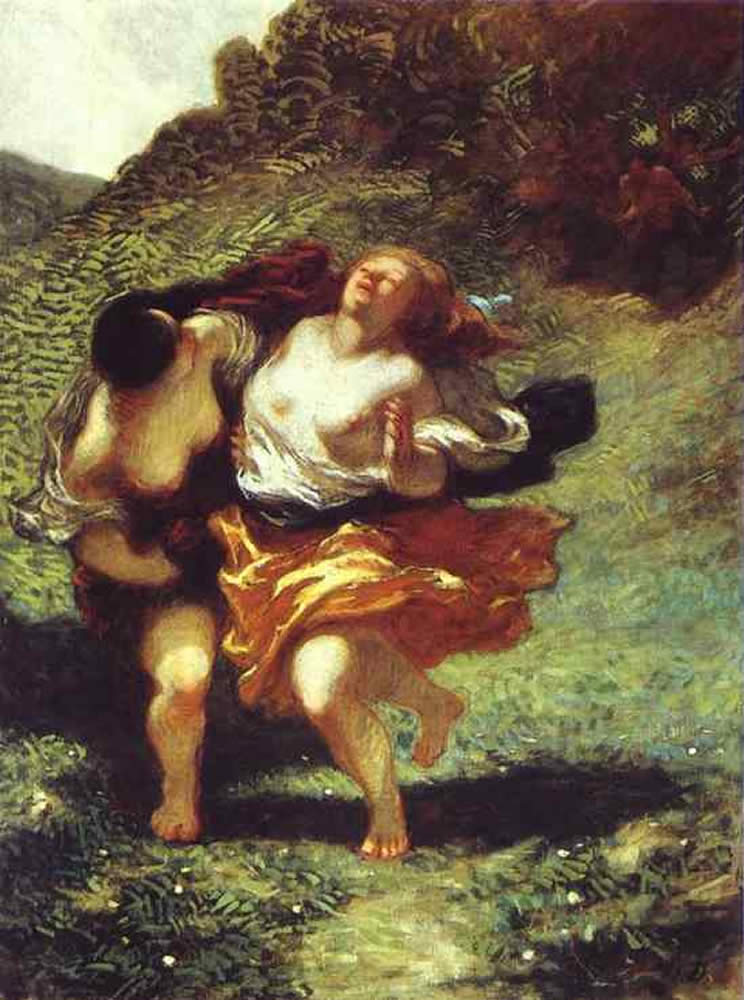
Femmes poursuivies par des satyres

The First Class Carriage (1864), watercolor, ink, & charcoal. 20.5 x 30 cm. Walter Art Museum, Baltimore
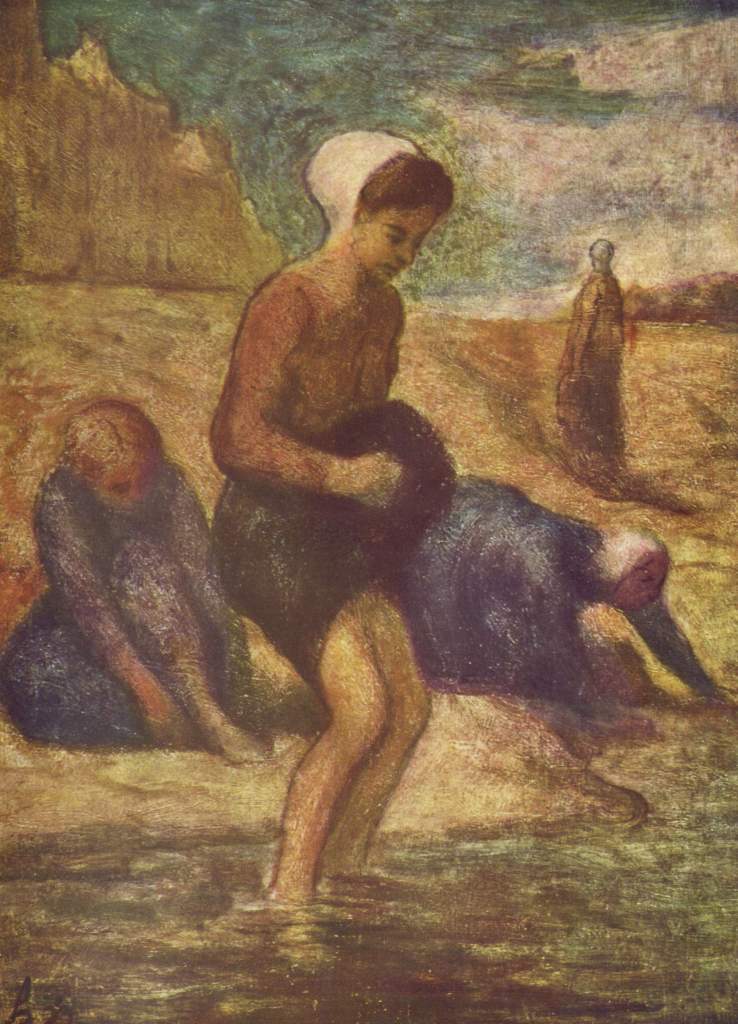
Les baigneuses
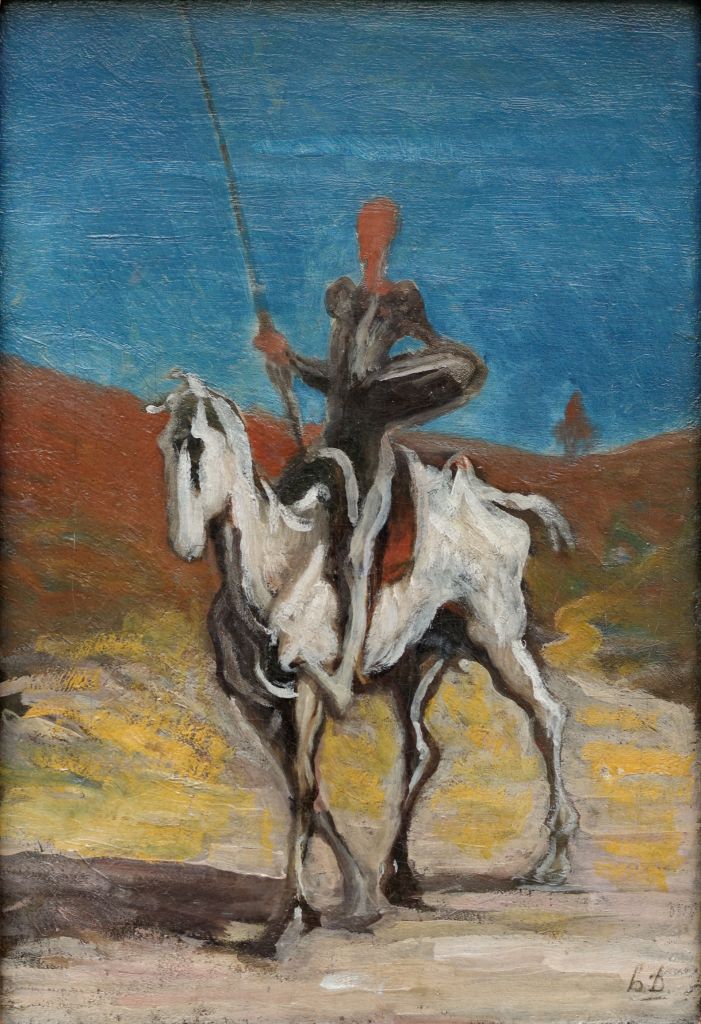
Don Quijote and Sancho Panza (c. 1868), oil on canvas, 51 x 32 cm., Neue Pinakothek, Munich
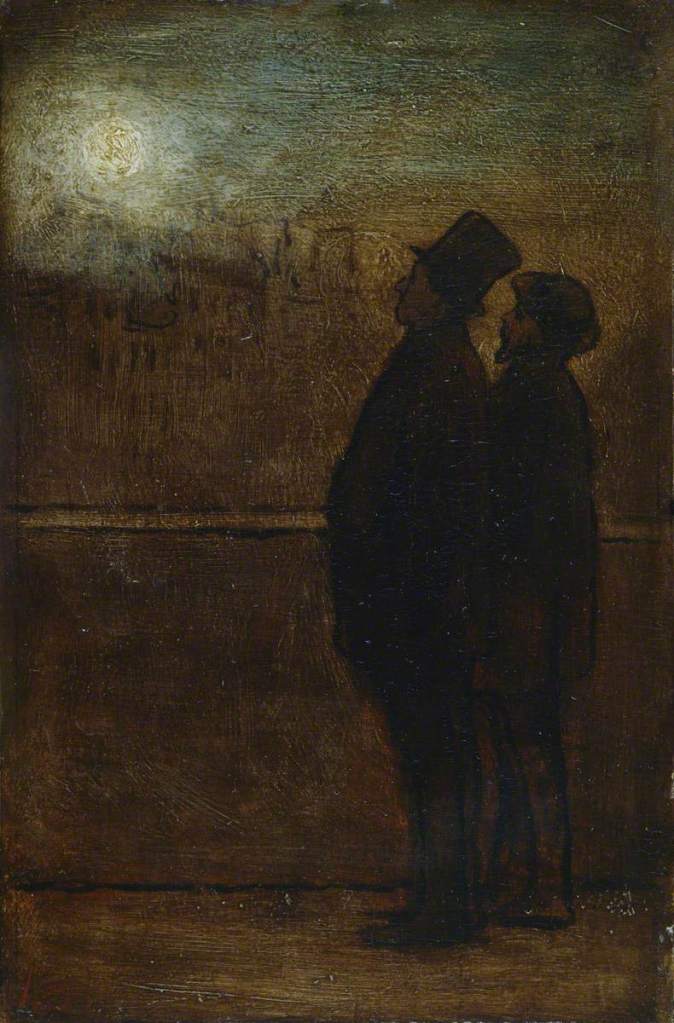
The Night Walkers (c. 1842–47), oil on panel, 28.9 x 18.7 cm. Museum Wales
 Passants, vers 1858-1860, musée des Beaux-Arts de Lyon
. Figure sedute
 théâtre
And today is the birthday of Annie Swynnerton (Annie Louisa Robinson; Hulme, Manchester, England 26 February 1844 – 24 October 1933 Hayling Island, England); painter perhaps best known for her portrait and symbolist works. She studied at Manchester School of Art and at the Académie Julian, before basing herself in the artistic community in Rome with her husband, the monumental sculptor Joseph Swynnerton. Swynnerton was influenced by George Frederic Watts and Sir Edward Burne-Jones. John Singer Sargent appreciated her work and helped her to become the first elected woman member at the Royal Academy of Arts in 1922. Swynnerton painted portraits of Henry James and Millicent Fawcett. Her main public collection of works are in Manchester Art Gallery. Shewas a close friend of leading suffragists of the day, notably the Pankhurst family.

Gallery

glow worm
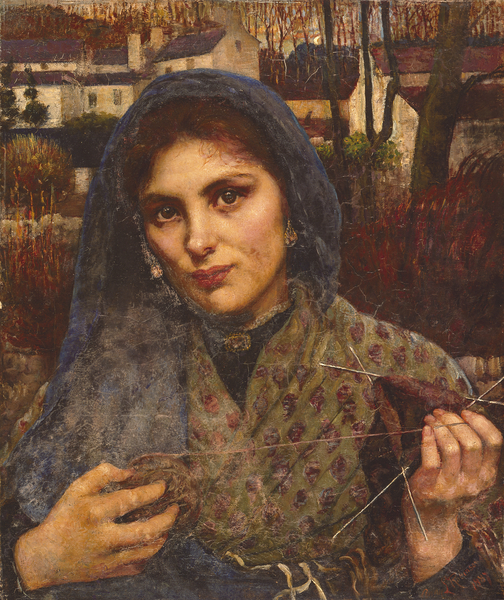
the dreamer
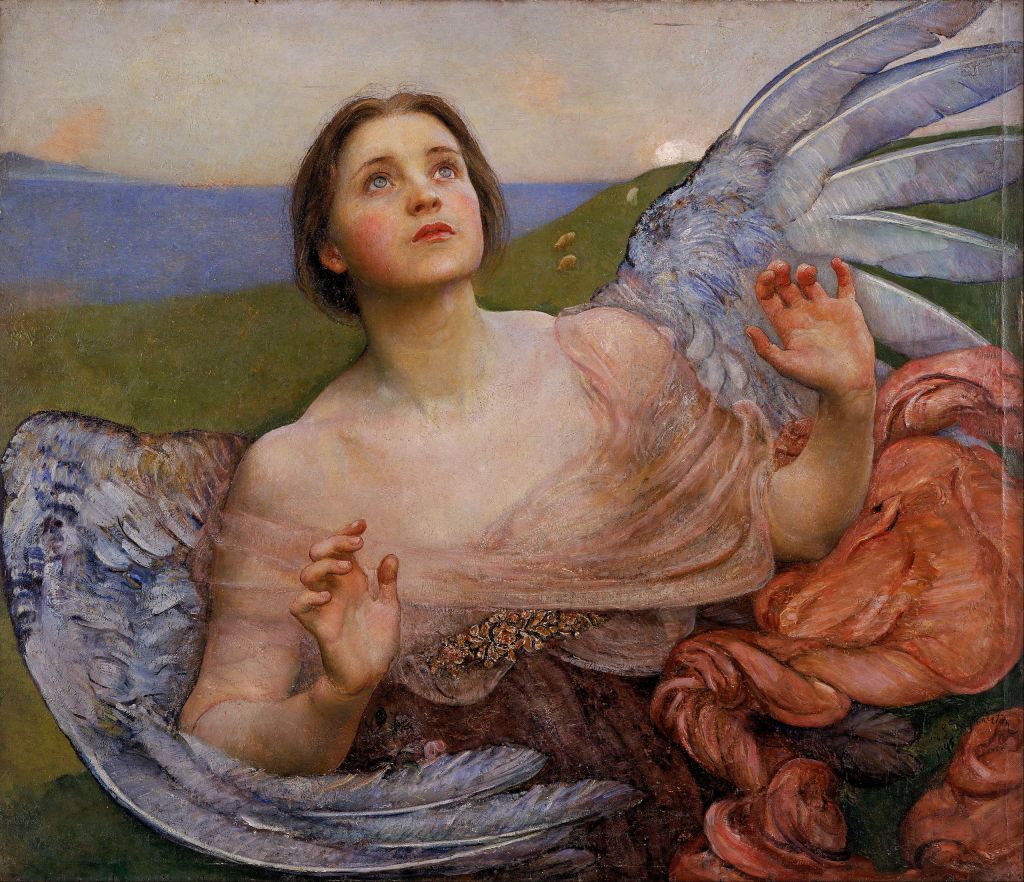
The Sense of Sight, oil on canvas, 1895, National Museums Liverpool
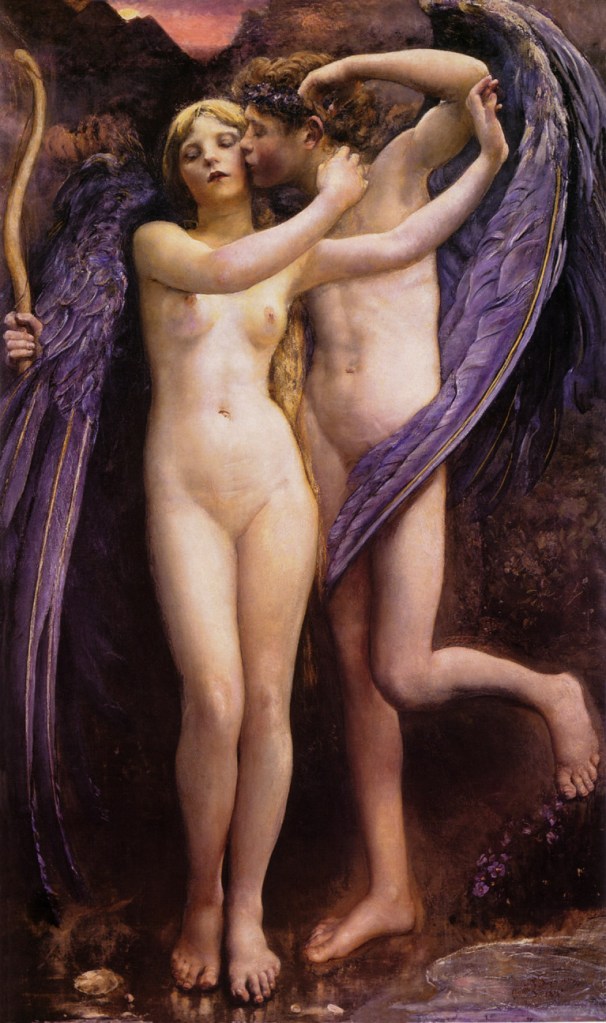
Cupid and Psyche, 1890, Gallery Oldham
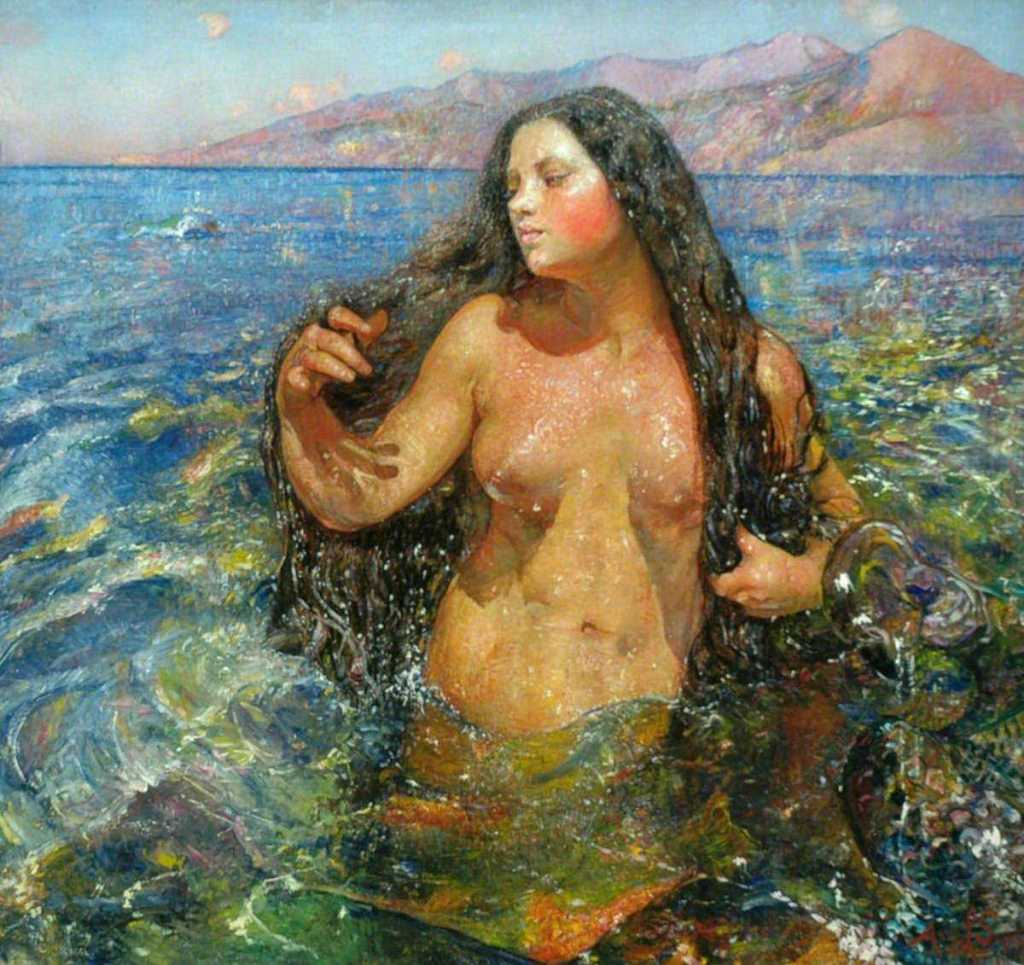
Oceanid
thanks for stoppin’ by y’all
mac tag
 The Lovers’ Chronicle
Leave a reply to The Lovers’ Chronicle 11 March – fall – birth of Torquato Tasso – art by Louis Boulanger & Susanna Clark – premiere of Verdi’s Rigoletto & Don Carlos – The Lovers’ Chronicle Cancel reply