
Dear Zazie, Here is today’s Lovers’ Chronicle from Mac Tag dedicated to his muse. Follow us on twitter @cowboycoleridge. Who or what are you waiting’ for? Rhett
The Lovers’ Chronicle
Dear Muse,
Così dream…
where do we take it from here, we can always count on Waylon, but wait, this music, it is Così fan tutte, are we gonna run into Mozart down here, or up, not sure about direction here
maybe this guy knows where we are
hey Wolfie, where are we
Vienna, last time I checked
and why are we here
She said I should detain you, look I have a piano, I can play for you
do you know chopsticks
This elicits a blank stare, then he starts playing the No. 1 Terzetto from Così
how is it, you are waitin’ for somethin’, you know not what, but you do not mind waitin’, how can that be
Because you are waiting for me, says the lovely redhead
you ready my dear
Andiamo
© copyright 2024 mac tag/cowboy coleridge all rights reserved
there is a line in a Chris Isaak song
worth writin’ about;
“Here I stand and I’m waiting”
“We could have said that
to each other when we met”
you know we almost waited too long
“Well, love almost waited too long for us”
right, and we did not waste any time
“Time is ticking and cannot be wasted”
yes, time is awaistin’, come here
© copyright 2023.2024 mac tag/cowboy coleridge all rights reserved
there could be a long story behind this one, but lets keep it short; blessed or cursed with an inordinate amount of patience, friends shook their heads at the level they saw it taken too, almost spent a lifetime waitin’ for somethin’ to happen, but it got me here, then with you it became clear that we were all done with waitin’
© copyright 2022.2024 mac tag/cowboy coleridge all rights reserved
cannot wait to see
what you have
planned next
you are unlike
any other
stimulation of sight,
sound, mind, feelin’s
never before like this
to know and have a sense,
these thoughts of bein’ with
and it does matter
startin’ to believe
this is the way out
it waits for us
© copyright 2021 mac tag/cowboy coleridge all rights reserved
Pale Love, Pale Rider
cannot wait to be here
you see, it is still a wonder
writin’ and sharin’
the effect,
goin’ on ten years,
is all contained
in this verse
a long, hopefully
charmin’, love letter
explorin’ this, weavin’
you in and out of time
buildin’ the ties that bind
and bringin’ us back
© copyright 2020 mac tag/cowboy coleridge all rights reserved
‘’If you go on ignoring the beat,
you will never find what is necessary.’’
to know and have a sense
of everything worth doin’
thoughts of bein’ here or there
startin’ to wonder
if there is a way out
from goin’ futher in
or if that even matters
do not wait for me
© copyright 2019 mac tag/cowboy coleridge all rights reserved
oh here comes
one of my favorite dreams…
you in that killer black dress
and those Louboutin shoes
me in my boots and my
white dinner jacket tux
where we go
or what we do
does not matter
the night is ours
to do with as we please
it is enough,
for awhile, to keep
the black night at bay
that and a Vesper Martini
© copyright 2018 mac tag/cowboy coleridge all rights reserved
délier son âme
dans la rue la plus noire
qu’il pût trouver…
n’attendez pas pour moi ce soir,
pour la nuit sera noire
vision returns
intense, hauntin’
reflective of madness
diminished to ochres and blacks
nocturnal, unreal, devourin’
no way out
or no will
matters not
resigned
to keep on goin’
further in
pour la nuit sera noire
© copyright 2017 mac tag/cowboy Coleridge all rights reserved
in darkness She came
in the valley
inseguimento
into the earth
l’ estasi
d’ fantasmi
cold as revenge
this January morn
nothin’ better
in this world
than hot coffee
and winter sunrises
cannot write
and not hear it
so pull together
all that i have
though not qualified
provin’ wrong each day
excitement and terror
icy road beckons
snow drifts down
peace comes on
sighs and dreams
***
Just part of the bargain
Pine away, die alone
Today you can hear
Legends of it, from Texas
To North Carolina
To Nebraska
I am just here
To give you the full
Particulars
“But what was your point?”
Blamed if I know
I expect it was
The whiskey
Thinkin’ about those eyes…
“No …. You can’t come with me….
Get off your horse….
The passengers are all staring….”
The fire in the great stone
Fireplace flickered quietly,
Its gleams now and again
Touchin’ the paintin’
Of her on the wall
The way we are now
Can keep bein’ enough
For you, it cannot for me
To me it is — a torture
I ache and grieve
all over when I go
© copyright 2016 mac tag/cowboy Coleridge all rights reserved
A Lakota
Woman told me
That there were two
Spirits in me;
One evil, one
Good, killin’ each
Other, and that
Was what made me
Sick and alone
She said, I would
Regret that choice:
No doubt this was
wise counsel; but,
One should have been
Wise oneself to
Have followed it
© copyright 2015 mac tag/cowboy Coleridge all rights reserved
Today is the premier date in 1790 of Così fan tutte, ossia La scuola degli amanti (All Women Do It, or The School for Lovers), K. 588; an Italian-language opera buffa in two acts by Wolfgang Amadeus Mozart first performed at the Burgtheater in Vienna, Austria. The libretto was written by Lorenzo Da Ponte who also wrote Le nozze di Figaro and Don Giovanni.
The short title, Così fan tutte, literally means “So do they all”, using the feminine plural (tutte) to indicate women. It is usually translated into English as “Women are like that”. The words are sung by the three men in act 2, scene 3, just before the finale; this melodic phrase is also quoted in the overture to the opera. Da Ponte had used the line “Così fan tutte le belle” earlier in Le nozze di Figaro (in act 1, scene 7).
Mozart and Da Ponte use the theme of “fiancée swapping”, which dates back to the 13th century; notable earlier versions are found in Boccaccio’s Decameron and Shakespeare’s play Cymbeline. Elements from Shakespeare’s The Taming of the Shrew are also present. Furthermore, it incorporates elements of the myth of Procris as found in Ovid’s Metamorphoses, vii. The opera takes place in Naples.
Today is the birthday of Louis Anquetin (Étrépagny, France 26 January 1861 – 19 August 1932 Paris); painter.

Autoportrait à la pipe, self-portrait, 1892
In 1882 he came to Paris and began studying art at Léon Bonnat’s studio, where he met Henri de Toulouse-Lautrec. The two artists later moved to the studio of Fernand Cormon, where they befriended Émile Bernard and Vincent van Gogh.
Around 1887, Anquetin and Bernard developed a painting style that used flat regions of color and thick, black contour outlines. This style, named cloisonnism by critic Edouard Dujardin, was inspired by both stained glass and Japanese ukiyo-e. One example of this can be seen in Avenue de Clichy: Five O’Clock in the Evening.
He eventually opted to study the methods of the Old Masters. Thus, Anquetin’s works following the mid-1890s, such as Rinaldo and Armida, were especially Rubensian and allegorical in nature. In 1907 he met Jacques Maroger, a young artist who shared his interest, with whom he collaborated.
Later in life, Anquetin wrote a book on Rubens, which was published in 1924.
Gallery

femme a sa toilette

Woman with Umbrella, 1891


Reading Woman, 1890, pastel on paper
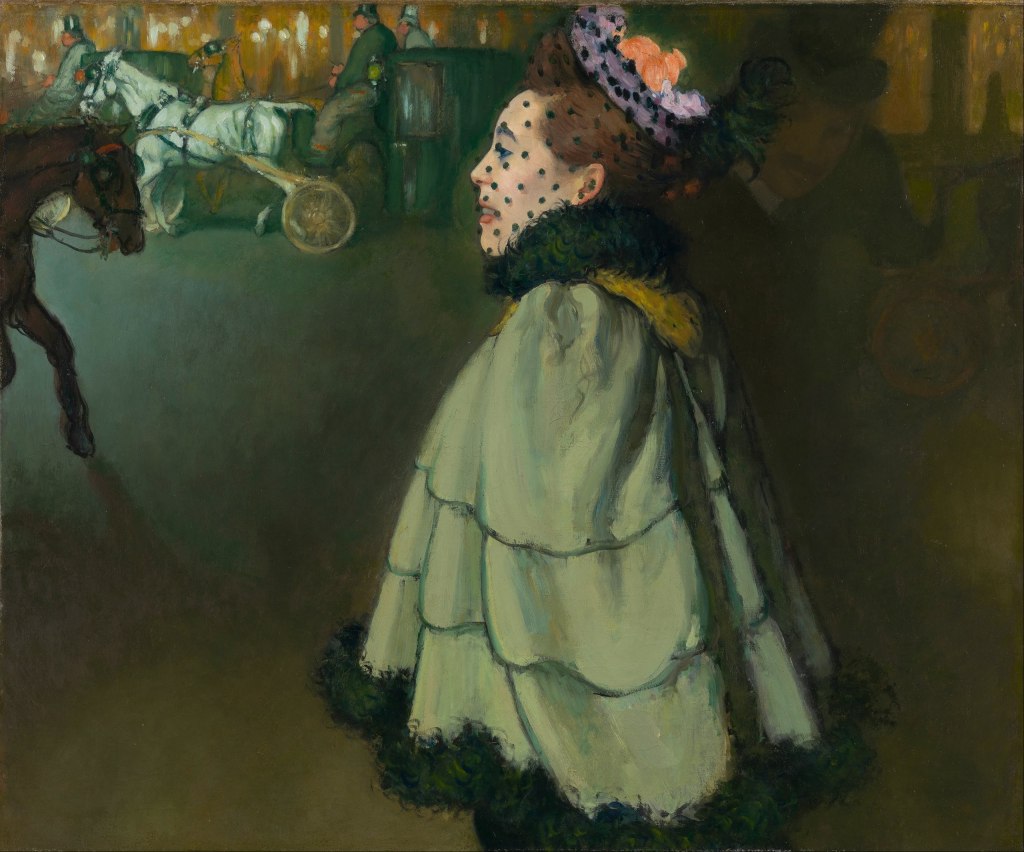
Woman at the Champs-Élysées by Night, c. 1889–93

Yvette Guilbert (1893) Musée Toulouse-Lautrec Albi
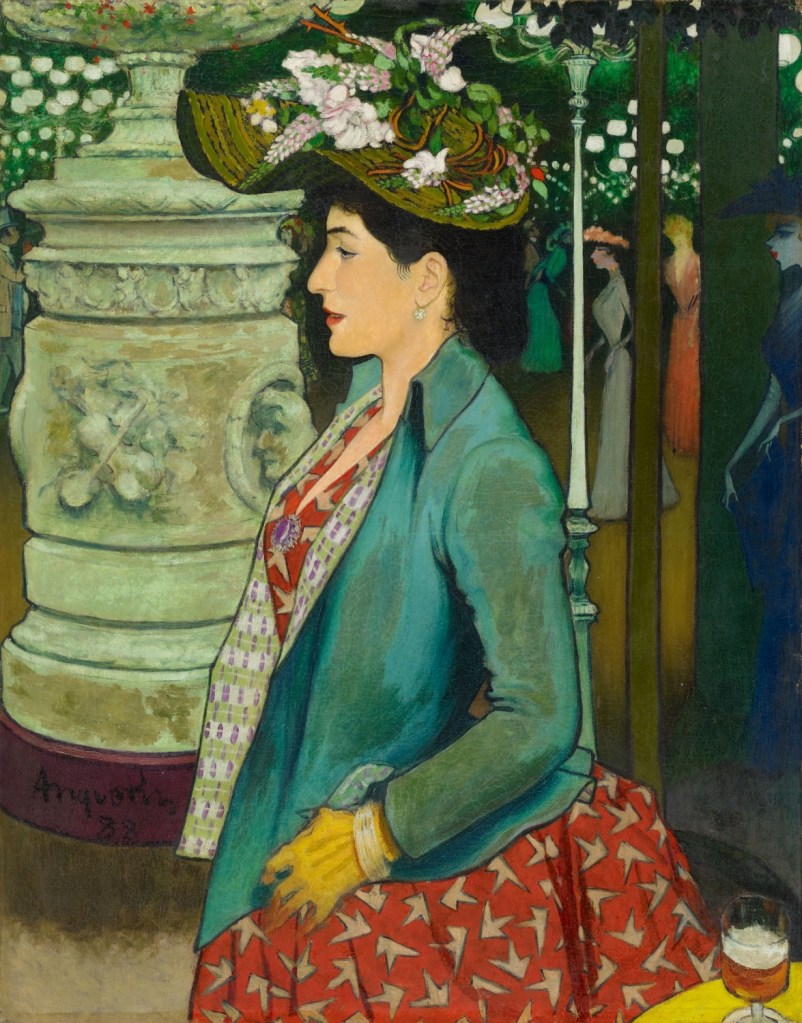
Elégante de profil au Bal Mabille, 1888

Inside Bruant’s Mirliton, 1886-1887

Moulin Rouge, 1893
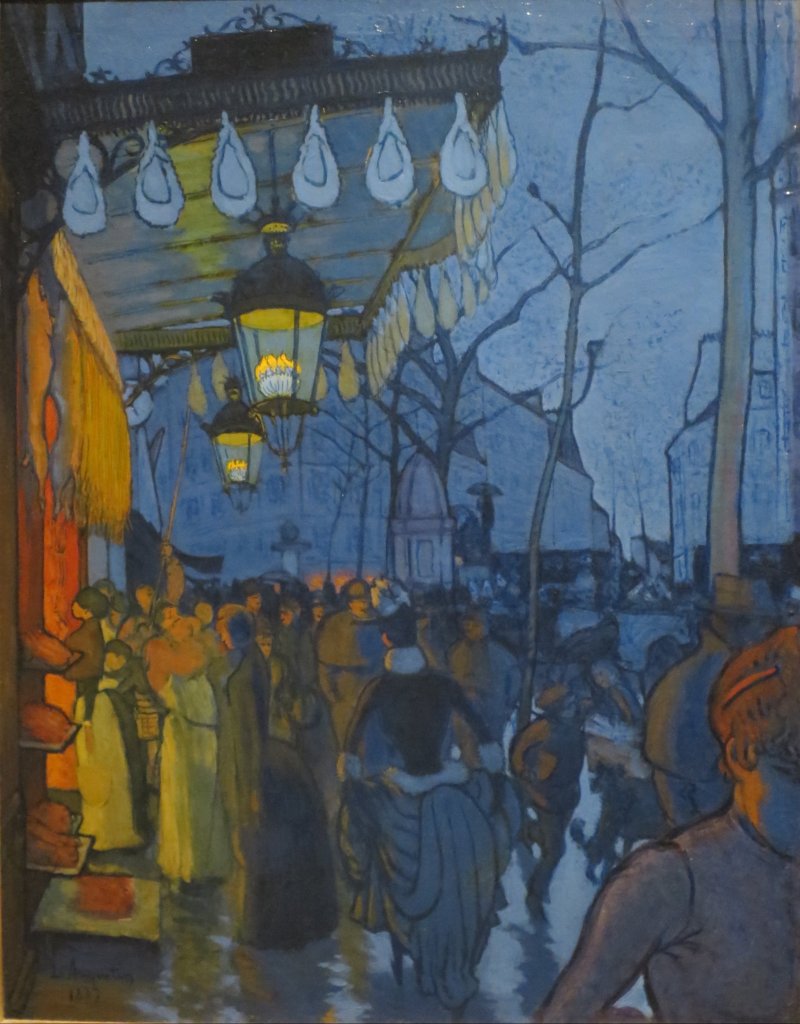
L’Avenue de Clichy, cinq heures du soir, 1887

Poster in Les Maîtres de l’Affiche
And today is the birthday of Kees van Dongen (Cornelis Theodorus Maria van Dongen; Delfshaven, Rotterdam 26 January 1877 – 28 May 1968 Monte Carlo); painter who was one of the leading Fauves. Van Dongen’s early work was influenced by the Hague School and symbolism and it evolved gradually into a rough pointillist style. From 1905 onwards – when he took part at the controversial 1905 Salon d’Automne exhibition – his style became more and more radical in its use of form and colour. The paintings he made in the period of 1905–1910 are considered by some to be his most important works. The themes of his work from that period are predominantly centered on the nightlife; he paints dancers, singers, masquerades, and theatre. Van Dongen gained a reputation for his sensuous – at times garish – portraits of especially women.

in his studio c. 1910
In 1892, at age 16, Kees van Dongen started his studies at the Royal Academy of Fine Arts in Rotterdam, working with J. Striening and J.G. Heyberg. During this period (1892–97), Van Dongen frequented the Red Quarter seaport area, where he drew scenes of sailors and prostitutes. He met Augusta Preitinger “Guus” at the Academy, a fellow painter. In 1897, Van Dongen lived in Paris for several months, where there was a large emigre community. He moved back to Rotterdam but in December 1899, he returned to Paris, where Guus had moved before him and found work.
They married on 11 July 1901. They had two children together: a son died a couple of days after birth in December 1901; their daughter Augusta, called “Dolly”, was born 18 April 1905. Around that time, Van Dongen produced a painting of Fernande Olivier, which was the reason why — according to Gertrude Stein in her 1933 book The Autobiography of Alice B. Toklas — he broke into notoriety. Apparently, according to Stein:
Van Dongen did not admit that this picture was a portrait of Fernande, although she had sat for it and there was in consequence much bitterness. Van Dongen in these days was poor, he had a dutch wife who was a vegetarian and they lived on spinach. Van Dongen frequently escaped from the spinach to a joint in Montmartre where the girls paid for his dinner and his drinks.
Guus took Dolly to see their families in Rotterdam in the summer of 1914, where they were caught by the outbreak of World War I. They were not able to return to Paris until 1918. Preitinger and Van Dongen divorced in 1921.
In 1917, Van Dongen had become involved with a married socialite, the fashion director Léa Alvin, also known as Jasmy Jacob. Their relationship lasted until 1927.
Gallery
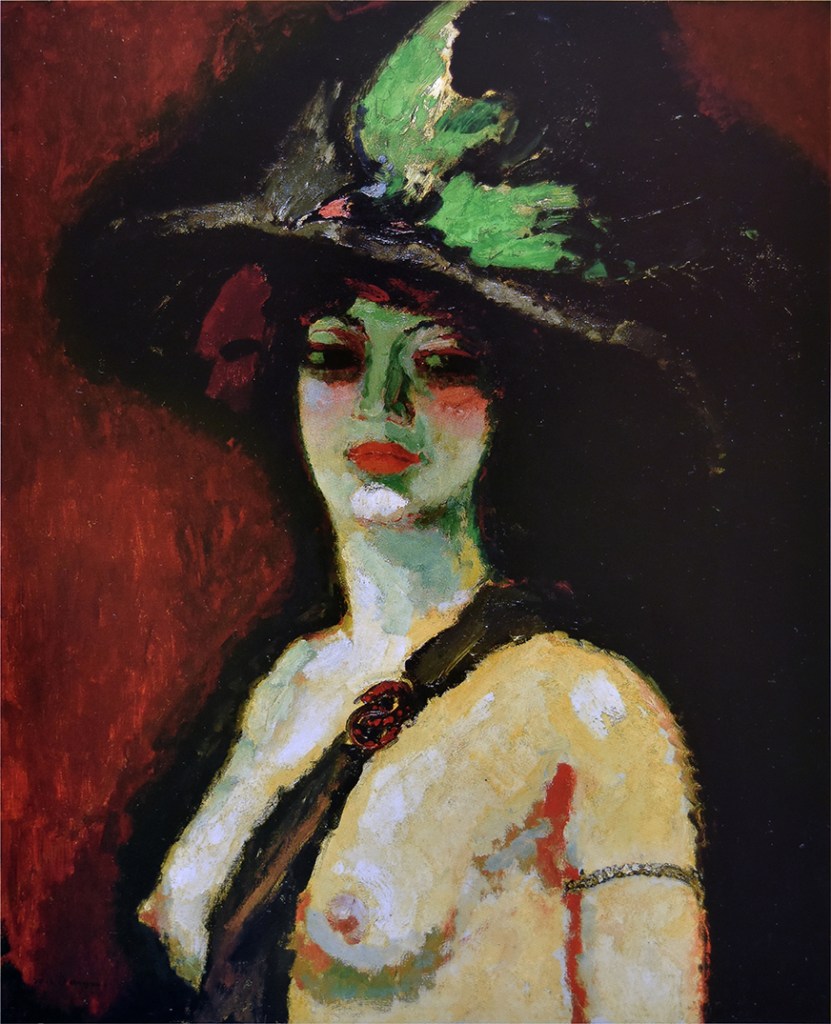
Woman with Large Hat (Femme au grand chapeau), 1906, oil on canvas, 100 cm × 81 cm (39 in × 32 in)

La Femme au Jabot (Woman with Frill), c. 1911, oil on canvas, 98 cm × 79 cm (39 in × 31 in)
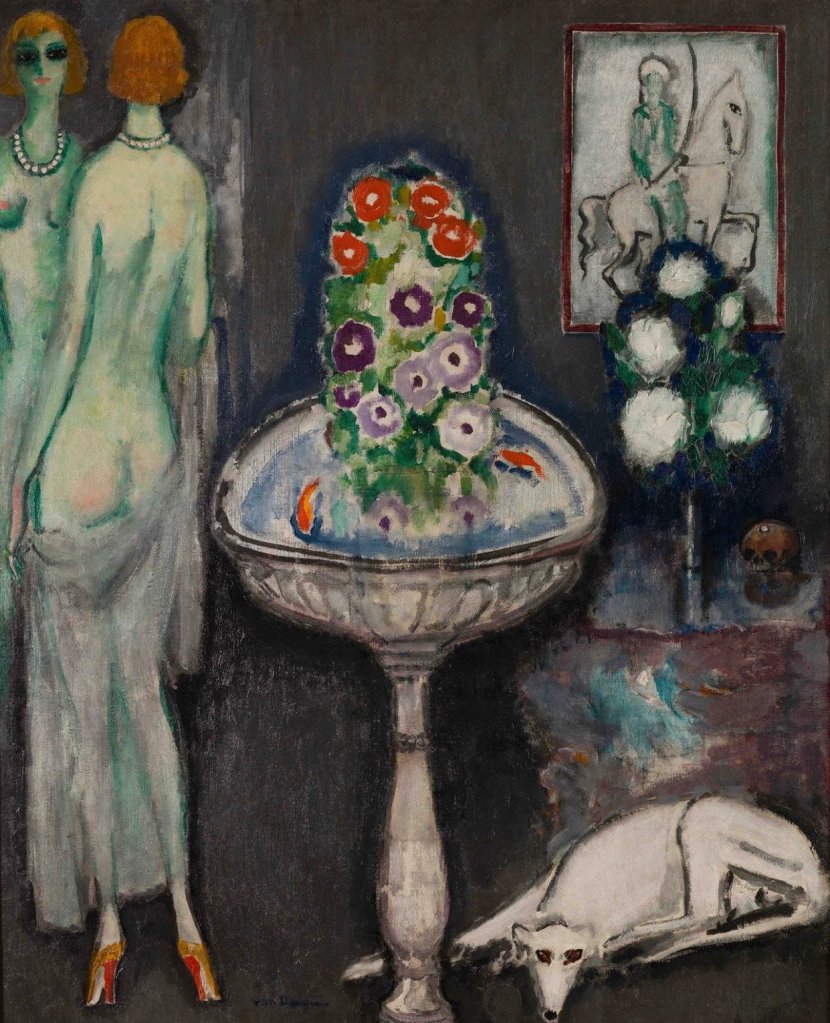
La vasque fleurie
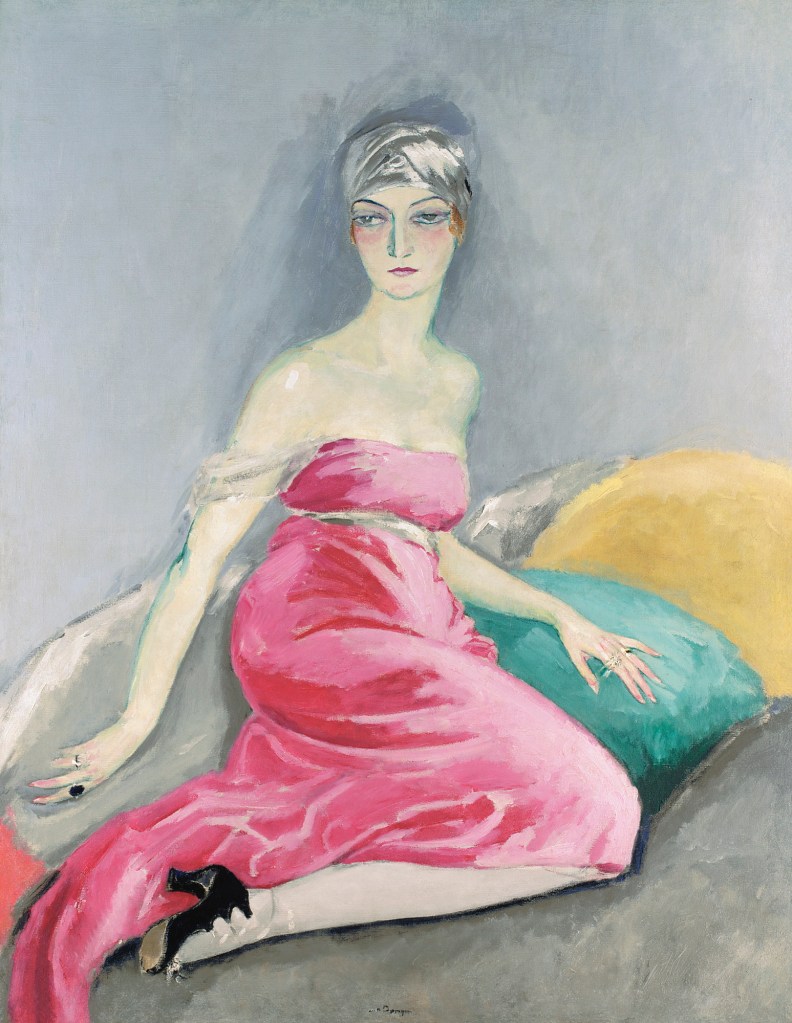
La robe rose (Ève Francis), c. 1919, oil on canvas

Femme aux bas noirs (Woman with Black Stockings), c. 1907, oil on canvas
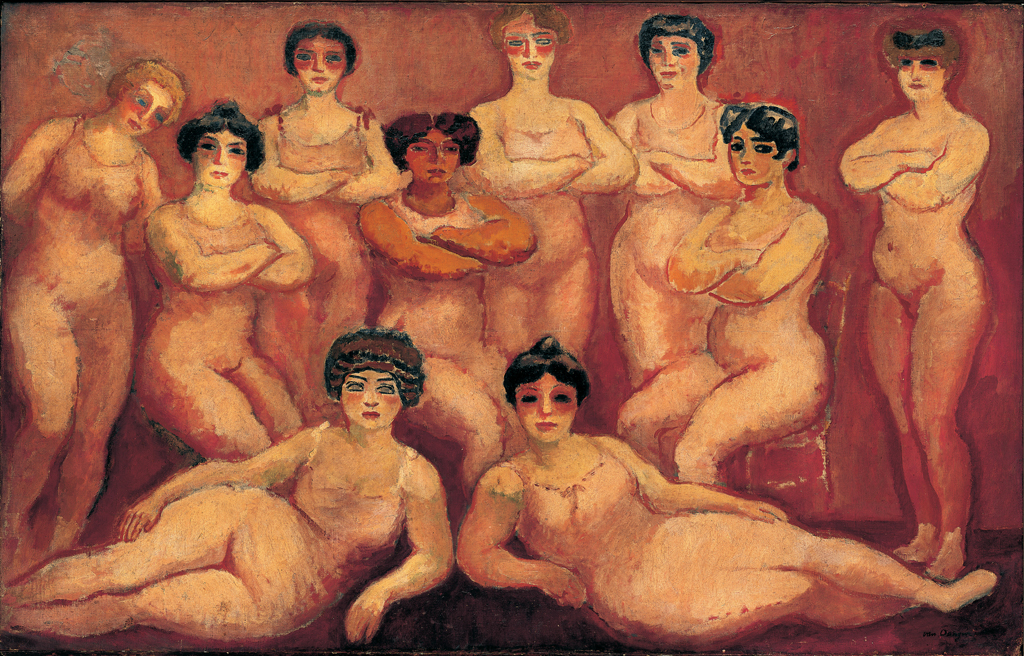
Les lutteuses (Lutteuses du Tabarin), 1907–08, oil on canvas, 105.5 cm × 164 cm (41.5 in × 64.6 in), Nouveau Musée National de Monaco

Lucie and her Dance-Partner, 1911, oil on canvas, 130 cm × 96.5 cm (51.2 in × 38.0 in), Hermitage Museum

Le lévrier bleu (Le chien bleu, Portrait de Mlle Dumarest), 1919, oil on canvas

La femme au foulard, before 1920, oil on canvas
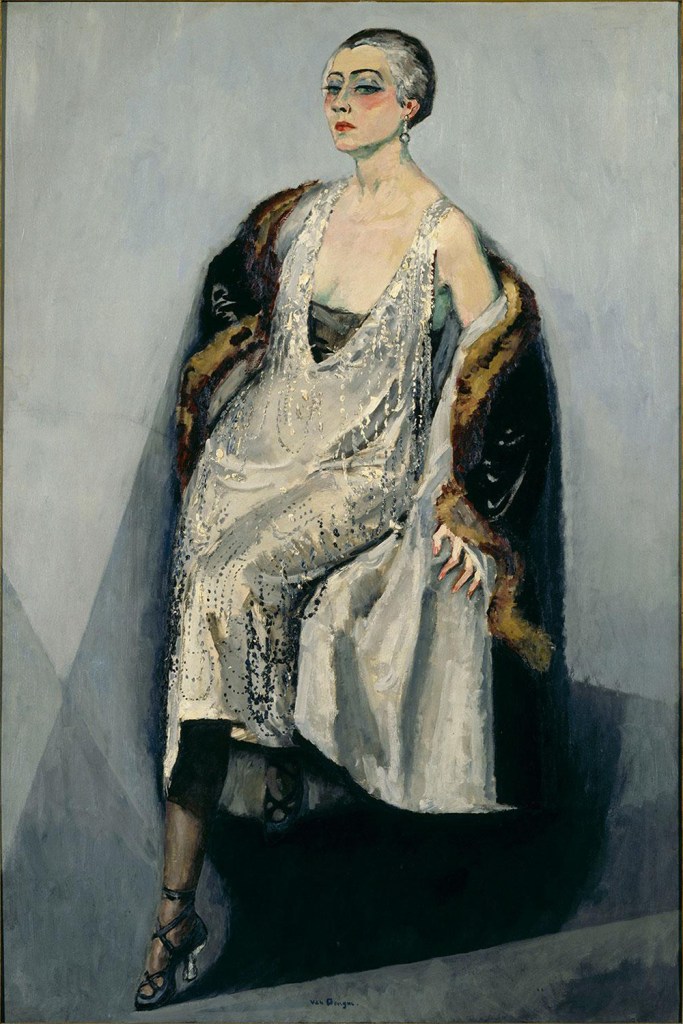
Mme Jasmy Alvin, before 1920, oil on canvas, 195 cm × 131.5 cm (76.8 in × 51.8 in), Musée national d’art moderne

The Sphinx, 1920, oil on canvas, 146 cm × 113 cm (57 in × 44 in), Musée d’Art Moderne de Paris
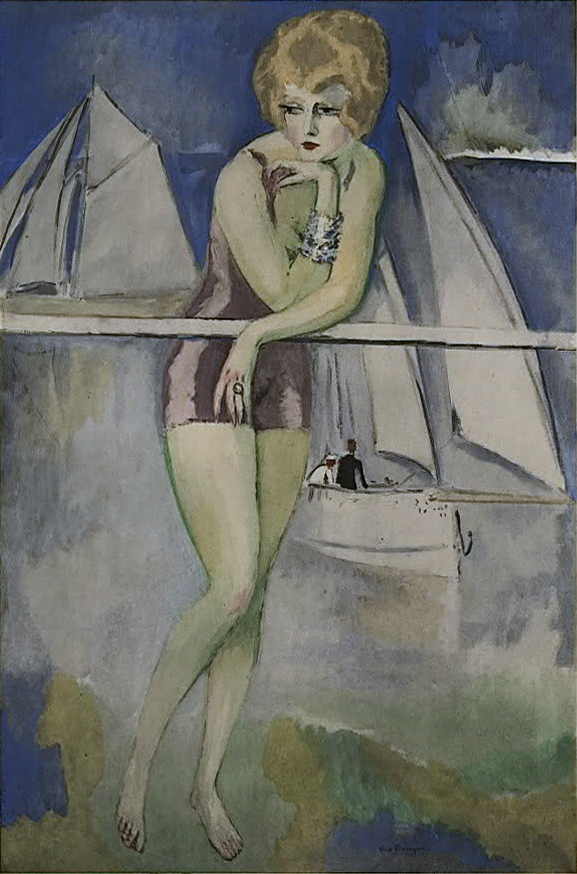
La Baigneuse, Deauville, 1920, oil on canvas
thanks for stoppin’ by y’all
Mac Tag
 The Lovers’ Chronicle
Leave a comment