
Dear Zazie, Here is today’s Lovers’ Chronicle from Mac Tag dedicated to his muse. Follow us on twitter @cowboycoleridge. Is it gittin’ colder where you are? Rhett
The Lovers’ Chronicle
Dear Muse,
Dubliners dream…
at a pub in Dublin drinking a Guinness, he is listening to a man who is wearing an eyepatch, he nods, occasionally interjects a few words, this goes on for how long he is not quite sure, then the man excuses himself, leaving a book on the table, and says; In the particular is contained the universal.
the ravishing redhead sits down and says;
Well, how was it
fascinatin’, though i think i only understood about twelve percent of what he said
Twelve
givin’ myself two percent because i did not ask him what the hell was goin’ on in Finnegans Wake
Quite the dream
yes, turned out that way, i was able to take the reins and steer it away from where it was goin’
Nice, some lucid dreaming
had to, it started with me walkin’ down to a river with a guy, and when we stopped to pick up a canoe i realized it was Burt Reynolds
Ha, fabulous
yeah not so, i heard banjo music and said, oh i gotta go, then i was here with Joyce
Well done, now dream us someplace warmer before it gets any colder
absolutely
© copyright 2024 mac tag/cowboy coleridge all rights reserved
the theme today might give you the chills
“I know you will keep me warm”
Annie Lennox has a song called “Cold”;
“(Cold, cold, cold)
Everything I possess
Given with tenderness”
“Nice, I could listen to her every day”
the theme originated from my High Plains days,
where it actually gits cold, and is a reference
to how cold my heart had become
“That was then”
yes, frozen no more
“Good because I’m cold, warm me up”
absolutely
© copyright 2023.2024 mac tag/cowboy coleridge all rights reserved
a stream for Joyce, yes, a day spent in typical fashion, began in our bed, then exercisin’, readin’, work, then back to you for supper, cocktails, and writin’, tryin’ to git it right, this feelin’, you near, doin’ what i want, not sure about destiny, but if it is a thing, this is it, and yes, if it turns colder, i will keep you warm
© copyright 2022.2024 mac tag/cowboy coleridge all rights reserved
facin’ down the trail
perceptions flash
as the cold touch
of the breeze
blows past
colder and tighter
stretches the skin
over my face
and steadier
becomes the will
as what came before
recedes behind me
and i feel at last
this cold, hard heart
growin’ warmer
© copyright 2021 mac tag/cowboy coleridge all rights reserved
Pale Love, Pale Rider
everything is relative
or at least has to be put in context
that Dickey considered poetry so important
tempted to follow Joyce through his maze
is it gittin’ colder
no, not sure, you know i am not sensitive
savin’ that up i s’pose
just tryin’ to git by one more day
and tell another tale
whatever the weather
© copyright 2020.2024 mac tag/cowboy coleridge all rights reserved
for myself,
what else is there
to write about
if i can just get
to the heart of it
stretch full
by the fire
as the chill
settles in
ever callin’
ever unanswered
as through the silence
descendin’ thoughts
for you gather, whisperin’
your name yes again
gittin’ colder
© copyright 2019 mac tag/cowboy coleridge all rights reserved
it is not “like” anything
so stop writin’ that it is
a kiss
on a boat at a private lake
on a ranch in the high plains
dancin’ naked
in the high hill country rain
makin’ love
‘neath a waterfall in belize
bein’ half of a whole
that, is what it is
not quite
as cold today
***
only the insatiable
need apply
© copyright 2018 mac tag/cowboy coleridge all rights reserved
then, facin’ down the trail
ridin’ toward the hills
perceptions flash
cold touch of the breeze
cold rush of flowin’ water
from the nearby river
sun shinin’ out of a cold sky
song of a hawk coldly distant
everything cold and intangible
colder and tighter
stretches the skin
over my face
colder and harder
grows the heart
colder and steadier
becomes the will
as the past recedes behind me
© copyright 2017 Mac tag/cowboy Coleridge all rights reserved
cannot save
cannot bring back
the greediness
that gnawin’,
that longin’
that carried you
to the next time until
there was no next time
you never see it comin’
but you always see it leavin’
it waits
marks the distance
between when you could
and now that you cannot
it waits
marks the distance
between the last time
and the next time,
which you know
will never come
gonna git colder
© copyright 2016 Mac tag/cowboy Coleridge all rights reserved
Today is the birthday of José Guadalupe Posada (Aguascalientes City, Mexico; José Guadalupe Posada Aguilar; 2 February 1852 – 20 January 1913 Mexico City); political printmaker who used relief printing to produce popular illustrations. His work has influenced numerous Latin American artists and cartoonists because of its satirical acuteness and social engagement. He used skulls, calaveras, and bones to show political and cultural critiques.

posada and his son
Largely forgotten by the end of his life, Posada died of gastroenteritis. Three of his neighbors certified his death, although only one of them knew his full name. He reportedly died penniless and was ultimately buried in an unmarked pauper’s grave.
Gallery


La Calavera Catrina
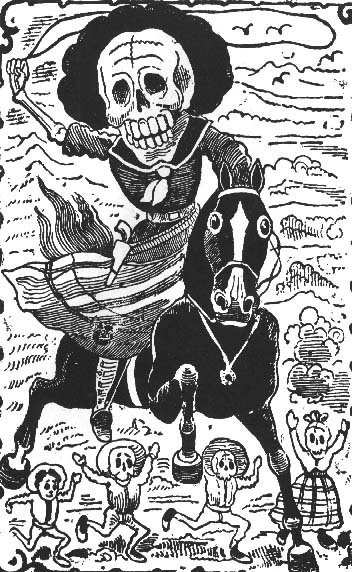
La Adelita

female soldier standing
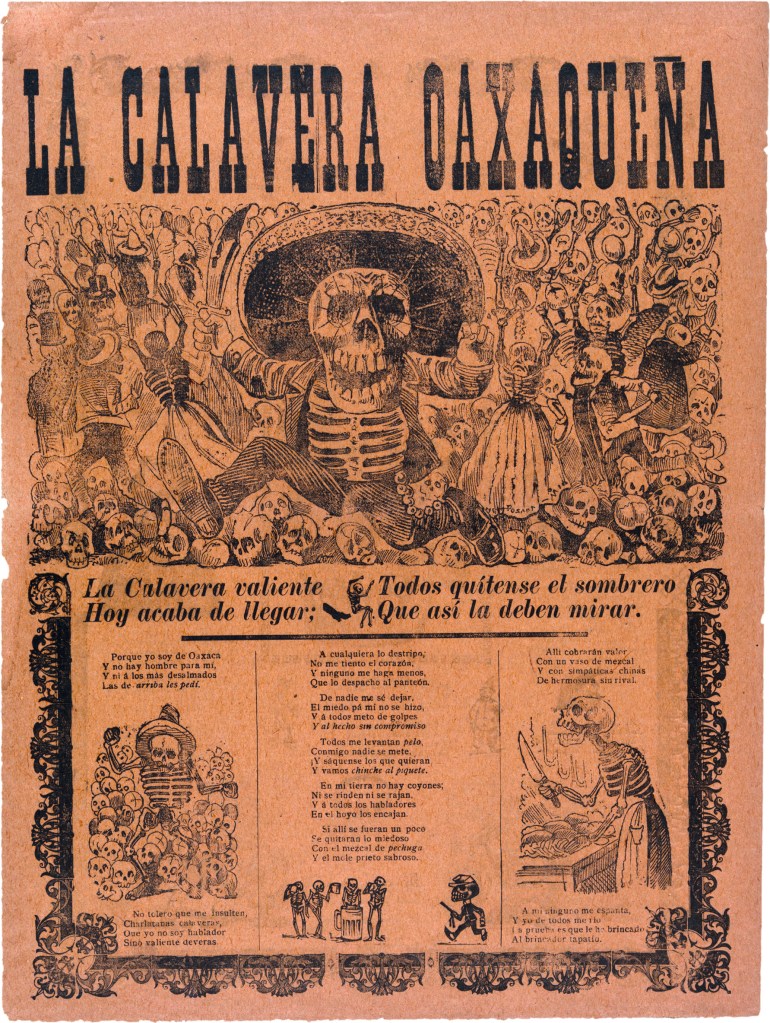
Calavera oaxaqueña, 1903, one of his many broadsheets
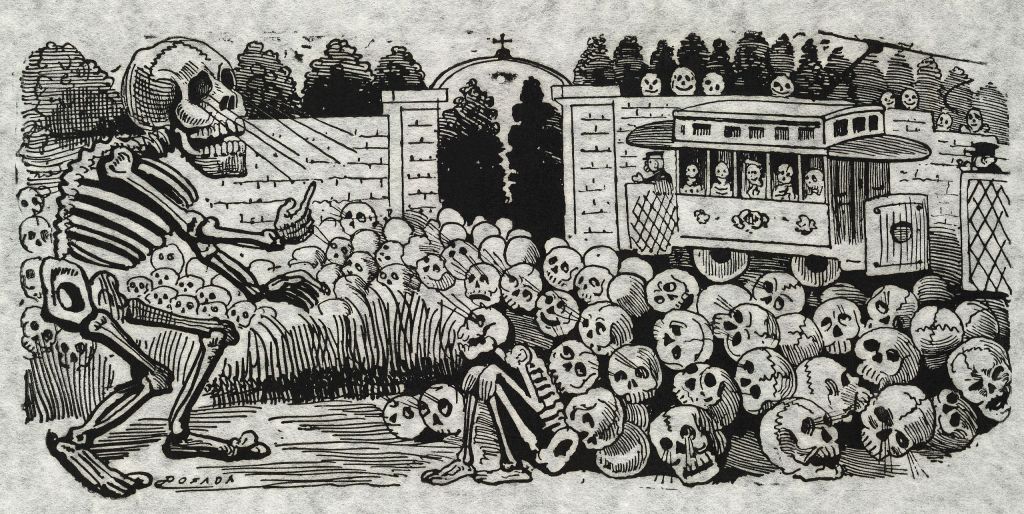
Reproduction of the restored Gran calavera eléctrica (Grand electric skull), 1900–1913
Today is the birthday of Enrique Simonet (Enrique Simonet Lombardo; Valencia; February 2, 1866 – April 20, 1927 Madrid); painter.
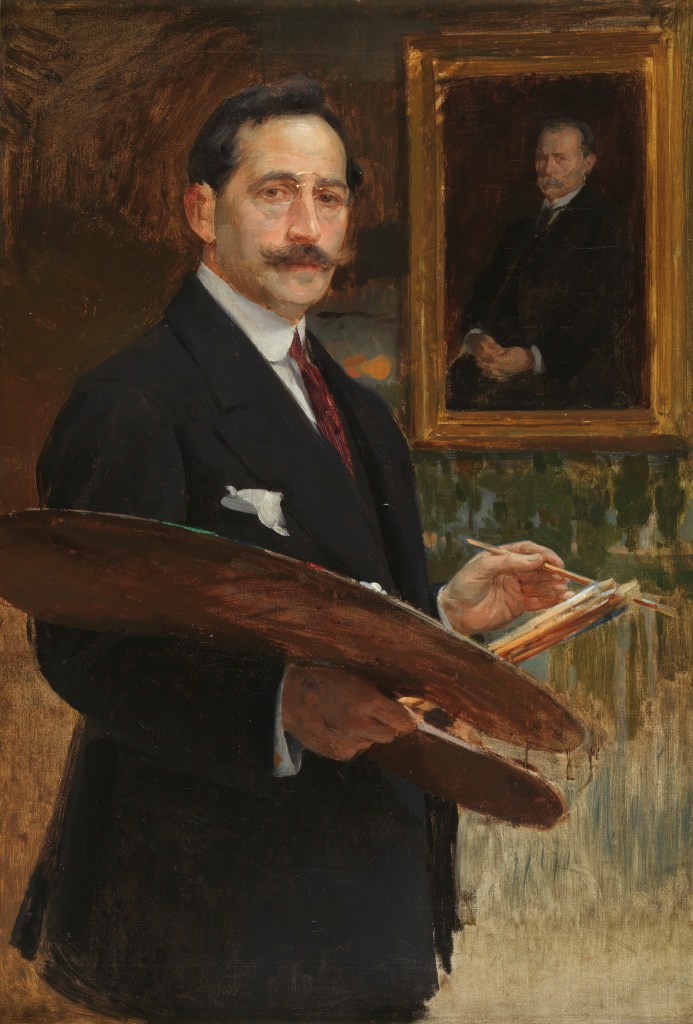
In 1887 Simonet obtained a grant to study painting in the Fine Arts Academy in Rome, where he painted in 1890 Heart’s Anatomy; a painting that would bring him international recognition and which won him several prizes. Taking advantage of his stay Simonet traveled throughout Italy, visited Paris several times and in 1890 he made a tour of the Mediterranean. He also traveled to the Holy Land, where he painted his monumental work Flevit super illam (painting) [es]; work for which he received numerous medals including Madrid in 1892, Chicago in 1893, Barcelona in 1896 and Paris in 1900. In 1893 and 1894 Simonet traveled to Morocco as a war correspondent for the magazine La Ilustración Española y Americana.
Gallery
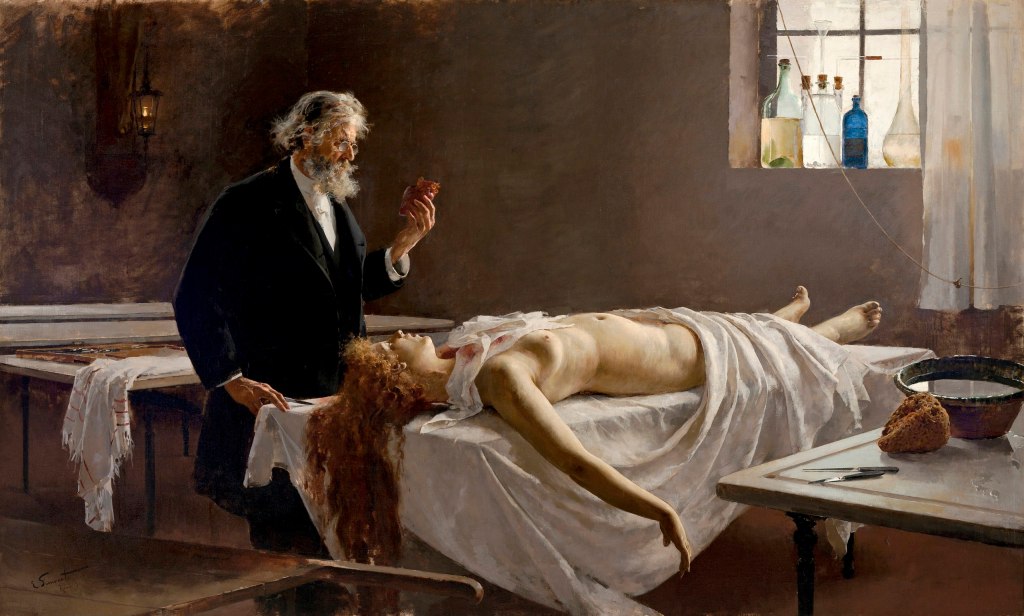
Anatomía del corazón
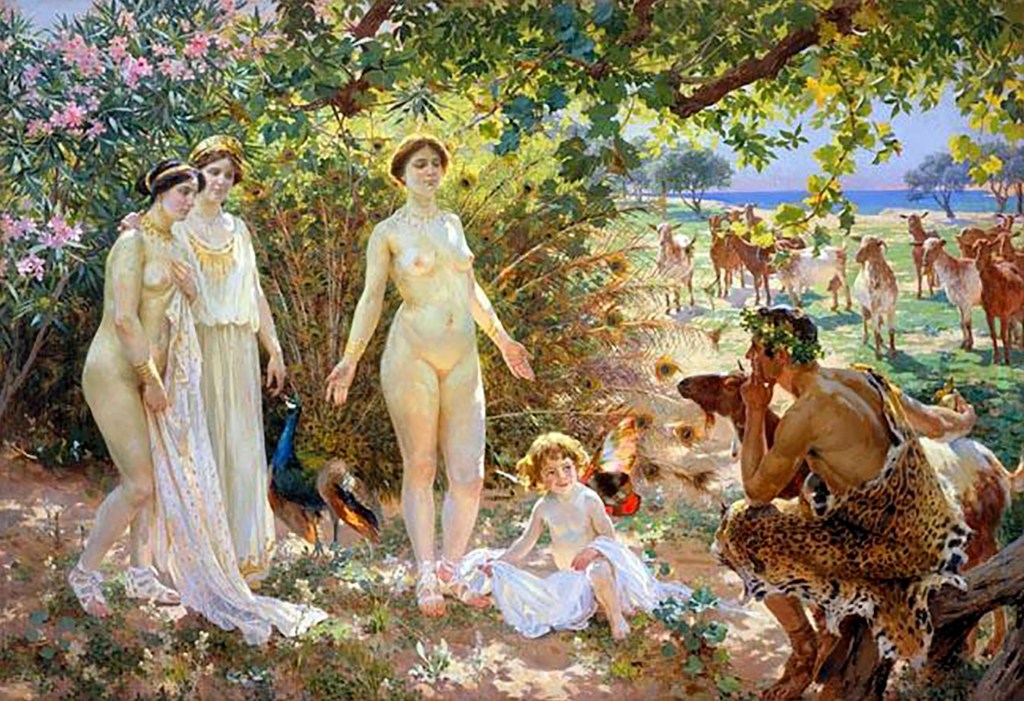
Judgment of Paris. 215 x 331 cm 1904

Danza de los velos » (1896)

Sappho

Ciociara – 1889
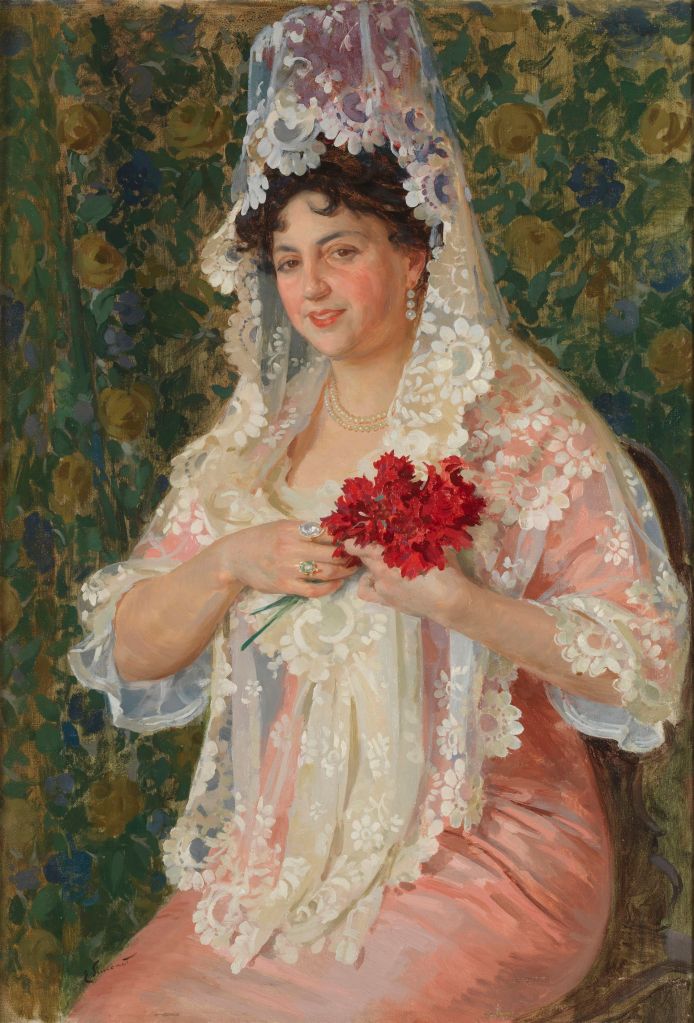
Retrato de Asunción Castro, esposa del pintor
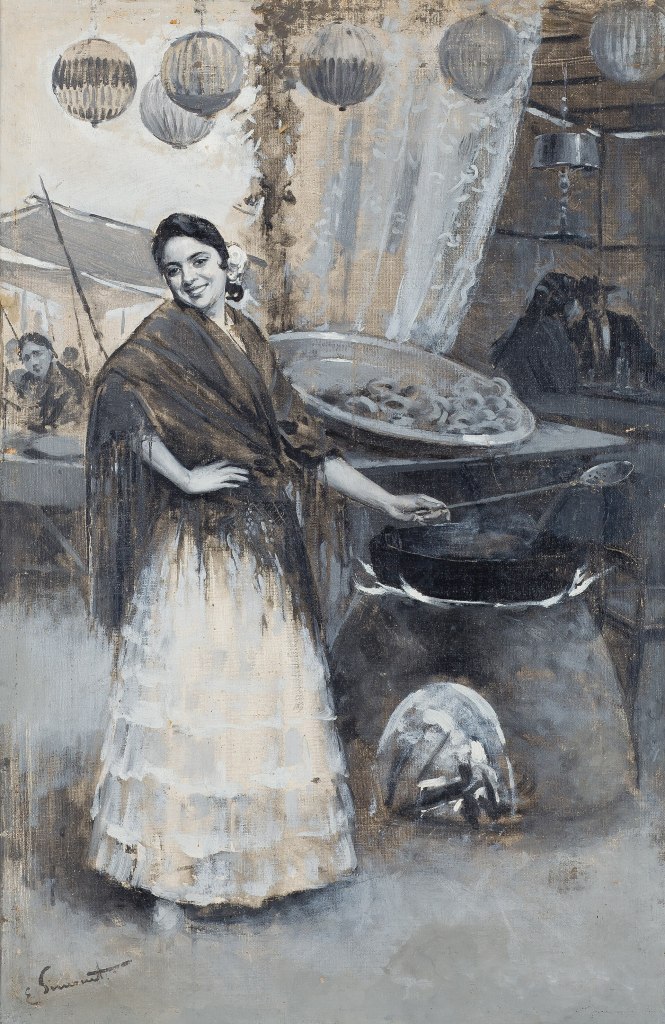
Bunuelos
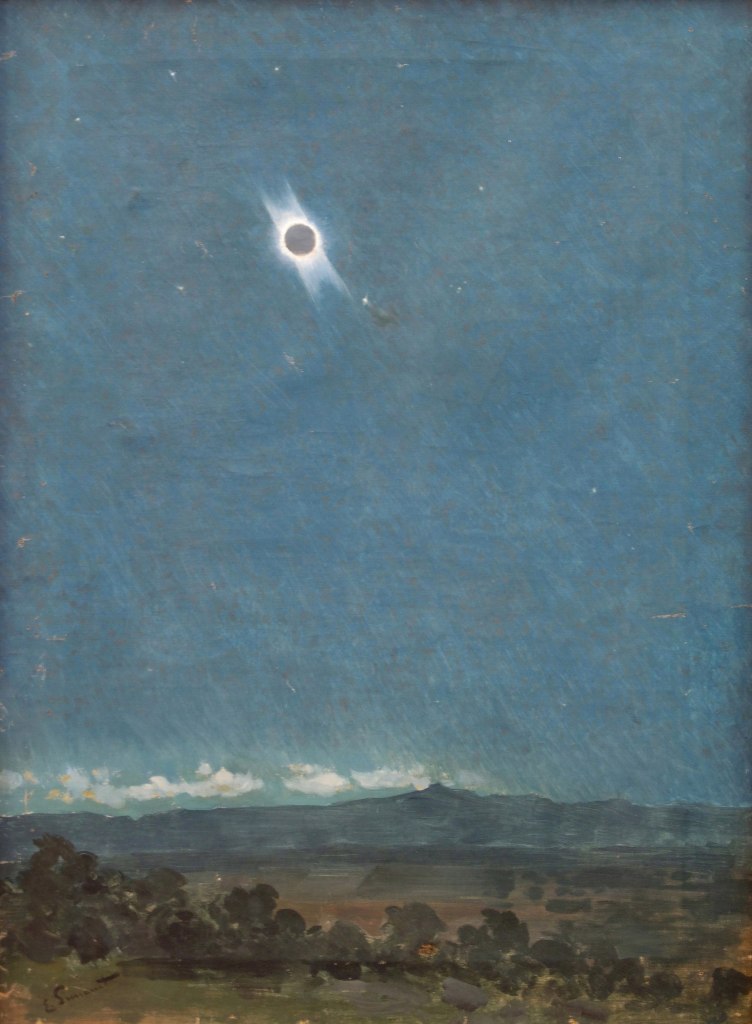
the Solar eclipse of August 30, 1905
Today is the birthday of James Joyce (James Augustine Aloysius Joyce; Dublin 2 February 1882 – 13 January 1941 Zurich); novelist, short story writer, and poet. He contributed to the modernist avant-garde and, in my opinion, is one of the most influential and important authors of the 20th century.

Joyce in Zurich, c. 1918
Perhaps best known for Ulysses (1922), see below. Other well-known works are the short-story collection Dubliners (1914), and the novels A Portrait of the Artist as a Young Man (1916) and Finnegans Wake (1939). His other writings include three books of poetry, a play, occasional journalism and his published letters.
In 1904, in his early twenties, Joyce emigrated permanently to continental Europe with his partner (and later wife) Nora Barnacle. They lived in Trieste, Paris and Zurich. Though most of his adult life was spent abroad, Joyce’s fictional universe centres on Dublin, and is populated largely by characters who closely resemble family members, enemies and friends from his time there. Ulysses in particular is set with precision in the streets and alleyways of the city. Shortly after the publication of Ulysses, he elucidated this preoccupation somewhat, saying, “For myself, I always write about Dublin, because if I can get to the heart of Dublin I can get to the heart of all the cities of the world. In the particular is contained the universal.”
Verse
Pomes Penyeach (1927)
- Boor, bond of thy herd,
Tonight stretch full by the fire!- Tilly, p. 9
- Loveward above the glancing oar
- Watching The Needleboats At San Sabba, p. 10
- Frail the white rose and frail are
Her hands that gave- A Flower Given To My Daughter, p. 11
- How soft, how sad his voice is ever calling,
Ever unanswered, and the dark rain falling,- She Weeps Over Rahoon, p. 12
- The fragrant hair,
Falling as through the silence falleth now
Dusk of the air.- Tutto E Sciolto, p. 13
- Around us fear, descending
Darkness of fear above- On The Beach At Fontana, p. 14
- And mine a shielded heart for her
Who gathers simples of the moon.- Simples, p. 15
- Vast wings above the lambent waters brood
Of sullen day.- Flood, p. 16
- Seraphim,
The lost hosts awaken- Nightpiece, p. 17
- The sly reeds whisper to the night
A name — her name —- Alone, p. 18
- Your lean jaws grin with. Lash
Your itch and quailing, nude greed of the flesh.- A Memory Of The Players In A Mirror At Midnight, p. 19
- Again!
- A Prayer, p. 21
Today is the birthday of Paul-Émile Bécat (11e arrondissement de Paris 2 February 1885 – 1 January 1960 14e arrondissement de Paris); painter, printmaker and engraver, and was awarded first prize in the Prix de Rome in 1920. He was a student of Gabriel Ferrier and François Flameng and exhibitioned at the Salon de Paris in 1913. Returning from his travels to the Congo, Gabon, and the Sudan, he specialised from 1933 in the technique of drypoint in his erotic works. Today he is best known for his portraits of French writers, and his erotic works.
gallery

the fifth kiss
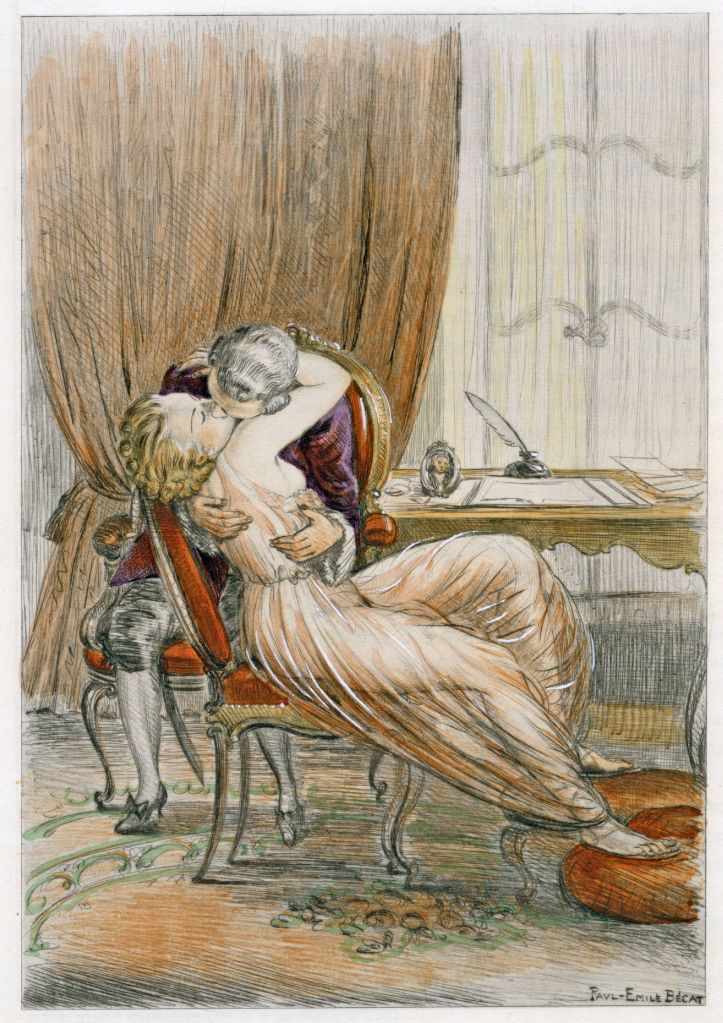

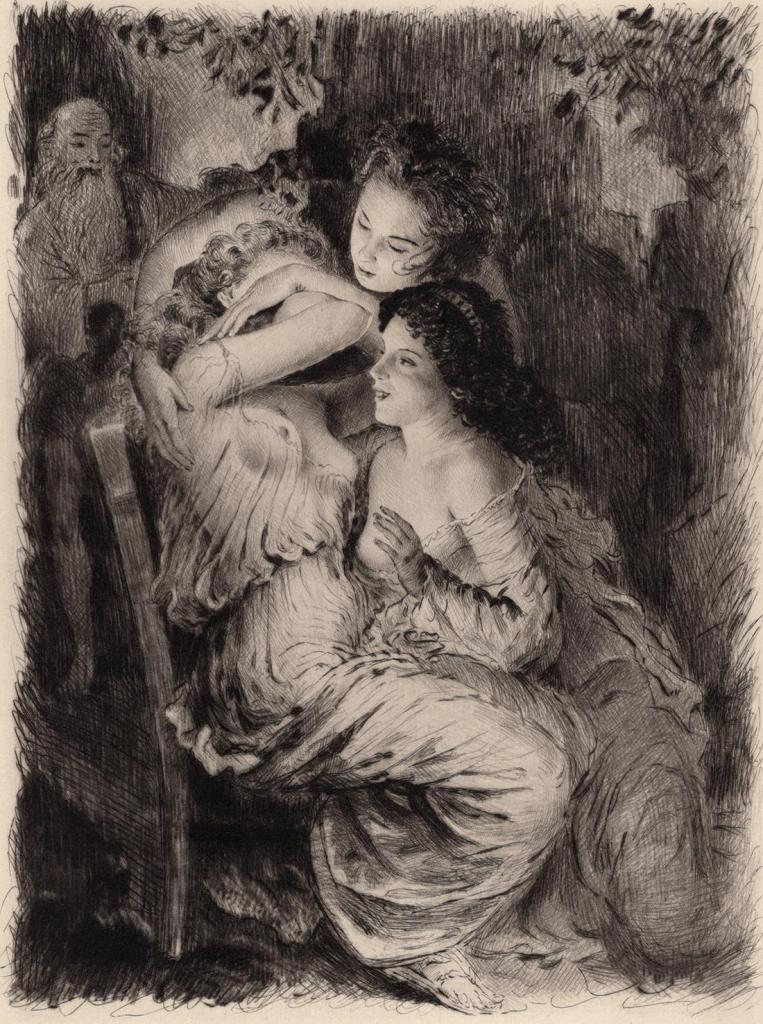
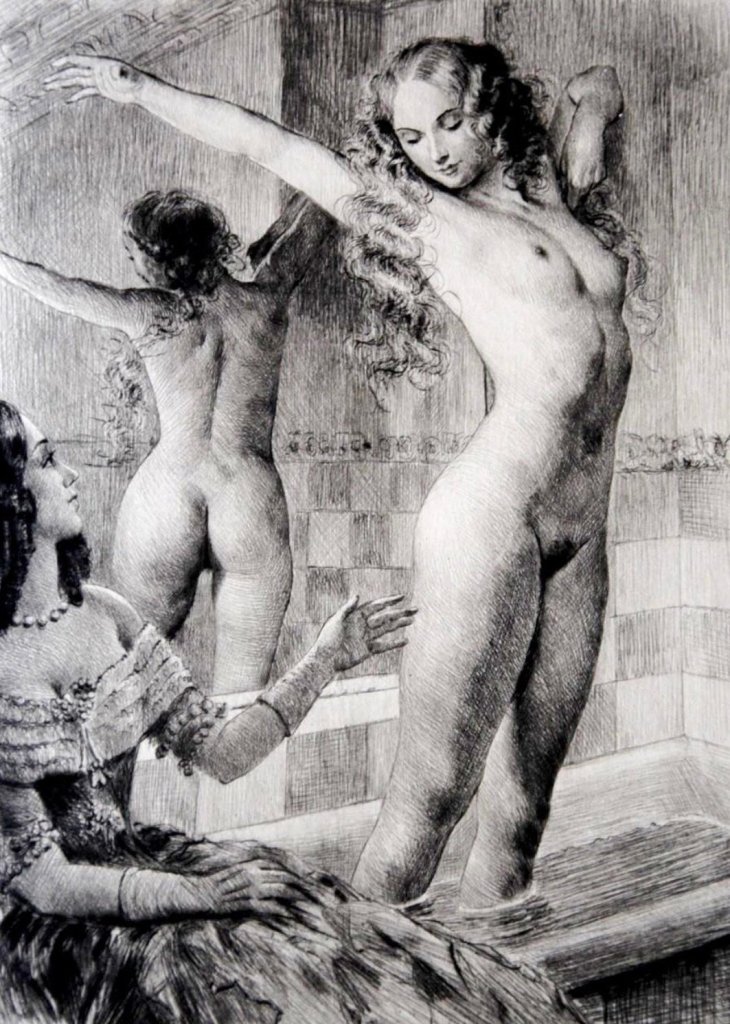

Recumbent Nu in the artist’s studio, c.1938

Today is the premiere date in 1900 of Louise, a “musical novel,” or “roman musical,” in four acts and five scenes by Gustave Charpentier. It can be considered an opera. The composer himself penned the French libretto with contributions from Saint-Pol-Roux, a symbolist poet and inspiration of the surrealists. It is an atmospheric story of working-class life in Paris, with the city itself invoked along the way: young Louise, a seamstress living with her parents, loves Julien, an artist; she desires freedom, associated in her mind with him and the city. (Charpentier would later write a sequel, the opera Julien, describing the artist’s aspirations.) Musically the work is verismo, it marks the beginning of naturalism in French opera.
On this day in 1922, Ulysses by James Joyce is published.
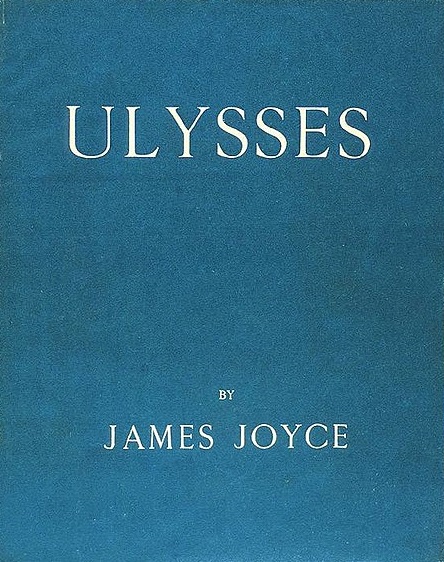
first edition
Ulysses is a modernist novel, first serialised in parts in the American journal The Little Review from March 1918 to December 1920, and then published in its entirety by Sylvia Beach in Paris. In my opinion, one of the most important works of modernist literature.
Ulysses chronicles the peripatetic appointments and encounters of Leopold Bloom in Dublin in the course of an ordinary day, 16 June 1904. Ulysses is the Latinized name of Odysseus, the hero of Homer’s epic poem Odyssey, and the novel establishes a series of parallels between the poem and the novel, with structural correspondences between the characters and experiences of Leopold Bloom and Odysseus, Molly Bloom and Penelope, and Stephen Dedalus and Telemachus
Ulysses is approximately 265,000 words in length and is divided into eighteen episodes. Since publication, the book has attracted controversy and scrutiny, ranging from early obscenity trials to protracted textual “Joyce Wars”. Ulysses‘ stream-of-consciousness technique, careful structuring, and experimental prose, full of puns, parodies, and allusions, as well as its rich characterisation and broad humour, made the book a highly regarded novel in the modernist pantheon. Joyce fans worldwide now celebrate 16 June as Bloomsday.
- I love flowers Id love to have the whole place swimming in roses God of heaven theres nothing like nature the wild mountains then the sea and the waves rushing then the beautiful country with the fields of oats and wheat and all kinds of things
- Ch. 18: Penelope; This is a portion of the famous passage often known as “Molly Bloom’s Soliloquy” which ends the book.
- the sun shines for you he said the day we were lying among the rhododendrons on Howth head in the grey tweed suit and his straw hat the day I got him to propose to me yes first I gave him the bit of seedcake out of my mouth and it was leapyear like now yes 16 years ago my God after that long kiss I near lost my breath yes he said I was a flower of the mountain yes so we are flowers all a womans body yes that was one true thing he said in his life and the sun shines for you today yes that was why I liked him because I saw he understood or felt what a woman is and I knew I could always get round him and I gave him all the pleasure I could leading him on till he asked me to say yes and I wouldnt answer first only looked out over the sea and the sky I was thinking of so many things he didnt know
- Ch. 18: Penelope
- I was a Flower of the mountain yes when I put the rose in my hair like the Andalusian girls used or shall I wear a red yes and how he kissed me under the Moorish wall and I thought well as well him as another and then I asked him with my eyes to ask again yes and then he asked me would I yes to say yes my mountain flower and first I put my arms around him yes and drew him down to me so he could feel my breasts all perfume yes and his heart was going like mad and yes I said yes I will Yes.
- Ch. 18: Penelope. Last lines

And today is the birthday of James Dickey (James Lafayette Dickey; Atlanta; February 2, 1923 – January 19, 1997 Columbia, South Carolina); poet and novelist. He was appointed the eighteenth United States Poet Laureate in 1966. He also received the Order of the South award.
Dickey is perhaps best known for his novel Deliverance (1970), which was adapted into the acclaimed 1972 film of the same name.
In 1942, he enrolled at Clemson Agricultural College of South Carolina and played on the football team as a tailback. After one semester, he left school to enlist in the military. During World War II, Dickey served with the U.S. Army Air Forces, where he flew thirty-eight missions in the Pacific Theater as a P-61 Black Widow radar operator with the 418th Night Fighter Squadron, an experience that influenced his work, and for which he was awarded five Bronze Stars. He later served in the U.S. Air Force during the Korean War. Between the wars, he attended Vanderbilt University, where he was elected to Phi Beta Kappa and graduated magna cum laude with a degree in English and philosophy (as well as minoring in astronomy) in 1949. He also received an M.A. in English from Vanderbilt in 1950.
His first book, Into the Stone and Other Poems, was published in 1960. Drowning with Others was published in 1962, which led to a Guggenheim Fellowship (Norton Anthology, The Literature of the American South). Buckdancer’s Choice (1965) earned him a National Book Award for Poetry. Among his better-known poems are “The Performance”, “Cherrylog Road”, “The Firebombing”, “May Day Sermon”, “Falling”, and “For The Last Wolverine”. He published his first volume of collected poems, Poems 1957-1967 in 1967 after being named a poetry consultant for the Library of Congress.
In November 1948 Dickey married Maxine Syerson. Two months after Maxine died in 1976, Dickey married one of his students, Deborah Dodson. Dickey died aged 73, six days after his last class at the University of South Carolina, where from 1968 he taught as poet in residence.
Verse
The Whole Motion; Collected Poems, 1945-1992 (1992)
- Drunk on the wind in my mouth,
Wringing the handlebar for speed,
Wild to be wreckage forever.- Cherrylog Road (l. 106–108).
- Dust fanned in scraped puffs from the earth
Between his arms, and blood turned his face inside out,
To demonstrate its suppleness
Of veins, as he perfected his role.- The Performance (l. 13–16).
- It was something like love
From another world that seized her
From behind, and she gave, not lifting her head
Out of dew, without ever looking, her best
Self to that great need.- The Sheep Child (l. 31–35).
- I saw for a blazing moment
The great grassy world from both sides,
Man and beast in the round of their need.- The Sheep Child (l. 41–43).
- I have just come down from my father.
Higher and higher he lies
Above me in a blue light
Shed by a tinted window.- The Hospital Window (l. 1–4).
- With the plane nowhere and her body taking by the throat
The undying cry of the void falling living beginning to be something
That no one has ever been and lived through screaming without enough air.- Falling (l. 9–11).
- She is watching her country lose its evoked master shape watching it lose
And gain get back its houses and peoples watching it bring up
Its local lights single homes lamps on barn roofs.- Falling (l. 66–68).
- Here they are. The soft eyes open.
If they have lived in a wood
It is a wood.
If they have lived on plains
It is grass rolling
Under their feet forever.- The Heaven of Animals (l. 1–6).
- These hunt, as they have done
But with claws and teeth grown perfect,
More deadly than they can believe.- The Heaven of Animals (l. 20–22).
- Those that are hunted
Know this as their life,
Their reward: to walk
Under such trees in full knowledge
Of what is in glory above them,
And to feel no fear.- The Heaven of Animals (l. 29–34)
thanks for stoppin’ by y’all
mac tag

 The Lovers’ Chronicle
Leave a comment