Dear Zazie, Here is today’s Lovers’ Chronicle from Mac Tag dedicated to his muse. Does someone tread on your dreams? Do you hide your face in a crowd of stars, in a promise? Rhett
The Lovers’ Chronicle
Dear Muse,
you will like the first song
that came to mind, though
not one that applies to us;
“He gets his lovin’ every night for free
He’s out there rockin’ like you wouldn’t believe”
“All right, any Aerosmith, anytime”
the phrase the song uses as a title
of course means a quick and careless
attempt to do somethin’
“Two things we don’t do”
no lick and a promise,
a kiss and fulfillment for us
© copyright 2023 mac tag/cowboy coleridge all rights reserved
i may i might, but probably not, does depend on the category though, with you and the verse, find it best to be genuine and follow through with what should be done, lookin’ back, too many made that could not be backed up, not gonna head in that direction, no not sayin’ it, just doin’ it
© copyright 2022.2023 mac tag/cowboy coleridge all rights reserved
leanin’ towards,
the easin’ venerates
this pale face to the awakenin’
listen to the music in the distance
clear night with chord changes,
and awareness ripples through
to the rhythms of our bodies
entwined for the descent
our eyes towards the meanin’,
from this languid place
© copyright 2021 mac tag/cowboy coleridge all rights reserved
Pale Love, Pale Rider
so
not gonna ask if,
but rather how,
as in how sick are y’all
of always readin’
about bein’ without
well, against all odds
and to no one’s greater
disbelief than mine,
it is time to write about with
© copyright 2020 mac tag/cowboy coleridge all rights reserved
leanin’ towards…
yeah, well be careful
what could go wrong
you’re feelin’s, but you don’t care about ’em
you are correct, they are irrelevant
s’pose it will make for a good story
exactly, either way it goes, i promise to tell
one thing, do not let the wall down all the way
there is a deep flaw that prevents that
ok tough guy, go ahead
© copyright 2019.2023 mac tag/cowboy coleridge all rights reserved
leanin’ towards…
the softenin’ light
a pale face to the need
listen in the distance
to the music
clear night to the chords,
weariness lulls the want
to the fragrant rhythm
the descent of eyes,
the will grows weak
towards the horizon,
adornment immacolata
in this promise
© copyright 2018 mac tag/cowboy coleridge all rights reserved
a wish to the stars
i wish i may,
someone
to share
these dreams
one here to stay
to believe
to need
more
to want
everything
this life
has to offer
stretch on
starry night
what are you now
a promise
a wish
that you will stay
***
“Poets should never marry.”
― Maud Gonne
best advice
never followed
but goin’ forward,
best advice
never to be forgotten
© copyright 2017 mac tag/cowboy coleridge all rights reserved
desert stretches on
starry night above
unfolds on and on
mescal buzz comin’
unfurls… effortless
what am i now
voices promise
you need not say a word
you are a dream
© copyright 2016 mac tag/cowboy Coleridge all rights reserved
Just the smell of her perfume.
© copyright 2015 mac tag/cowboy Coleridge all rights reserved
Today is the birthday of Achille Vianelli or Vianelly (Porto Maurizio, near Genoa 21 December 1803 – 2 April 1894 Benevento); painter of landscapes with genre scenes, often in watercolor.
In 1819, he moved to Naples, where he first worked in the Royal Topographic Office, where he met Giacinto Gigante. With Gigante, he began training first under Jakob Wilhelm Hüber, then in the Academy under Pitloo. He published (with Gigante and others) a series of lithographs in a Viaggio pittorico nel Regno delle Due Sicilie (1829–1834). In 1848, he moved to Benevento, where he continued drawing and painting. He married Gigante’s sister, and vice versa, and is considered a member of the School of Posillipo. His son, Alberto Vianelli, also a landscape painter moved to Paris. Vianelli’s sister, Flora, married Theodore Witting, a German landscape artist and engraver. His nephew Gustavo Witting, also became a landscape painter. He was a knight of the Order of Francesco I of the Two Sicilies, and honorary professor of the Academy of Fine Arts of Naples.
Gallery

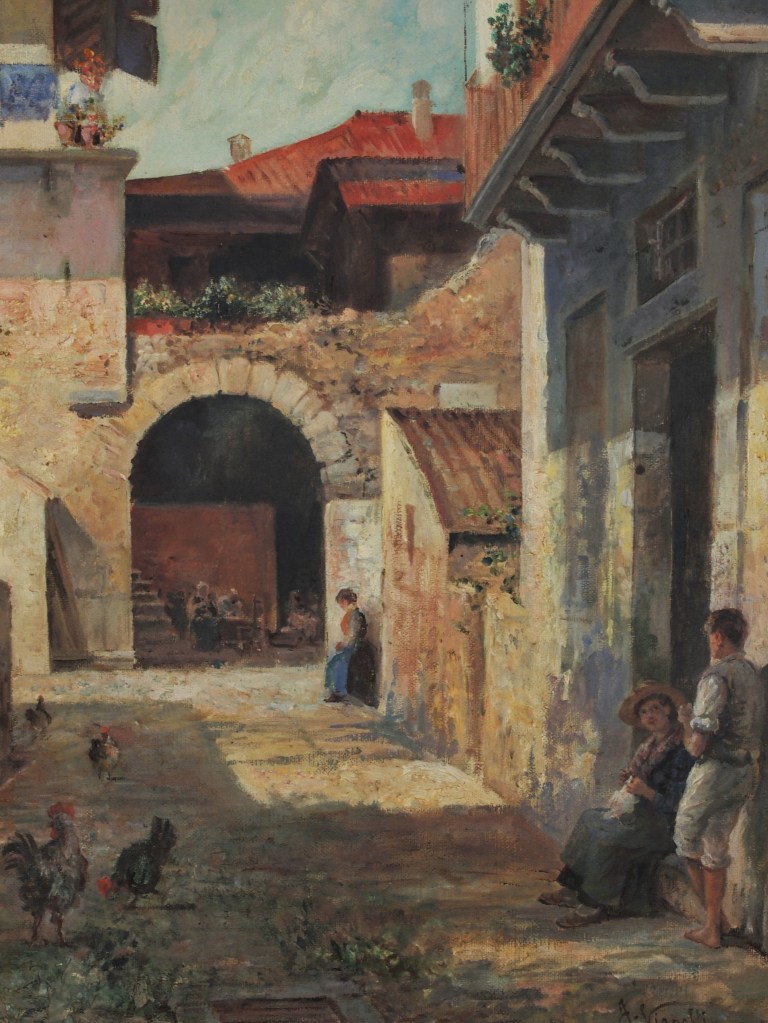

Figure e barche
“Vedute e Paesaggi”
| Thomas Couture | |
|---|---|
 | |
Today is the birthday of Thomas Couture (Senlis, Oise 21 December 1815 – 30 March 1879 Villiers-le-Bel, Val-d’Oise); painter and teacher.
He failed the prestigious Prix de Rome competition at the École six times, but he felt the problem was with the École, not himself. Couture finally did win the prize in 1837.
In 1840 he began exhibiting historical and genre pictures at the Paris Salon, earning several medals for his works, in particular for his masterpiece, Les Romains de la décadence (1847). Shortly after this success, Couture opened an independent atelier meant to challenge the École des Beaux-Arts by turning out the best new history painters.
Couture’s innovative technique gained much attention, and he received Government and Church commissions for murals during the late 1840s through the 1850s. He never completed the first two commissions, and the third met with mixed criticism. Upset by the unfavorable reception of his murals, in 1860 he left Paris, for a time returning to his hometown of Senlis, where he continued to teach young artists who came to him. In 1867 he thumbed his nose at the academic establishment by publishing a book on his own ideas and working methods called Méthode et entretiens d’atelier (Method and Workshop Interviews). It was also translated to Conversations on Art Methods in 1879, the year he died.
Asked by a publisher to write an autobiography, Couture responded: ”La biographie est l’exaltation de la personnalité – et la personnalité est le fléau de notre époque.”
He was interred in Père Lachaise Cemetery, Paris.
Gallery
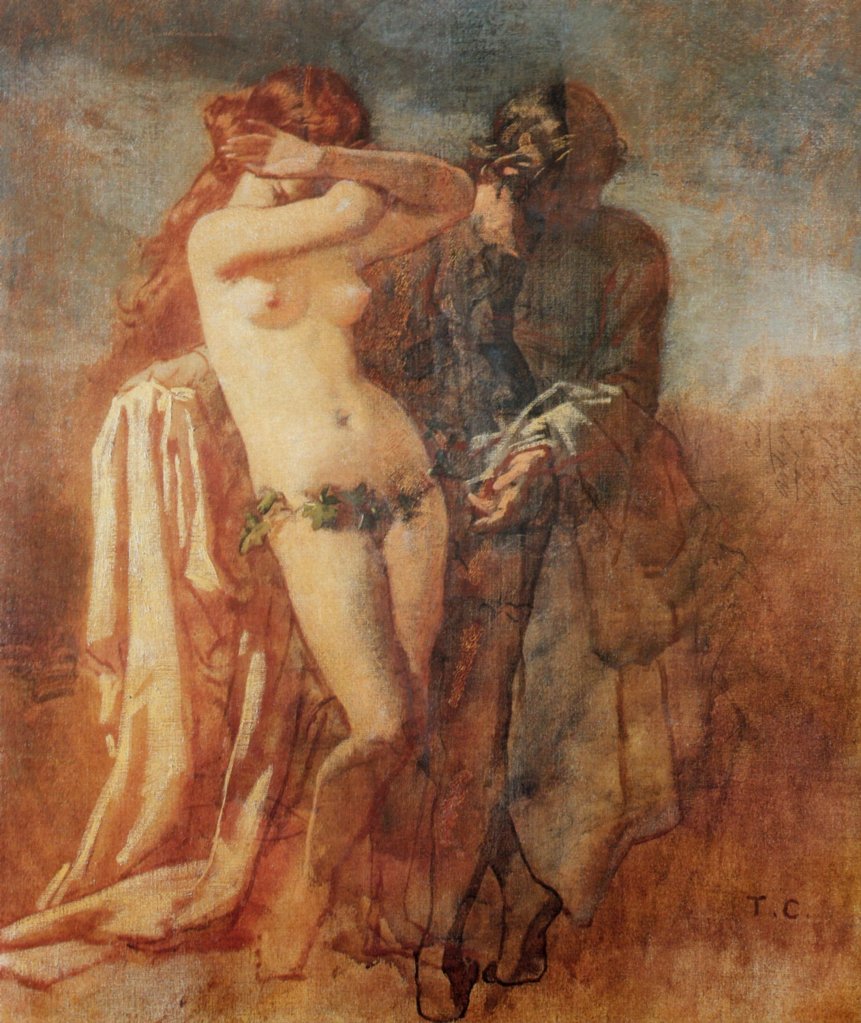
Courtesan and her Mother” 1857
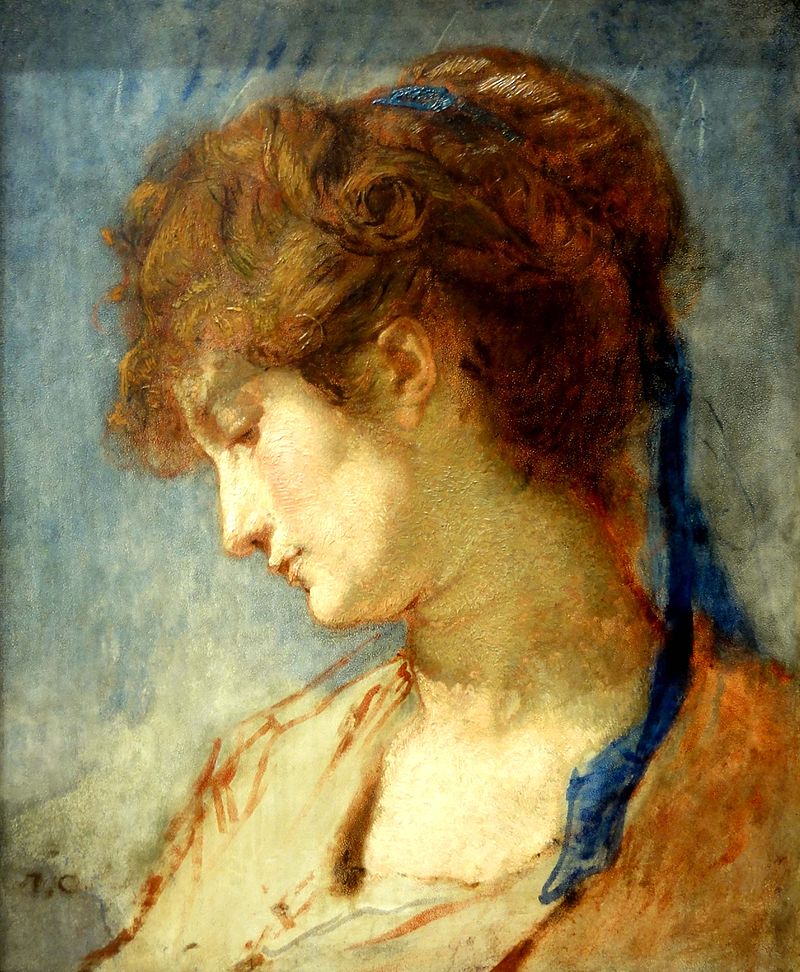
Tête de femme au ruban bleu, vers 1873 Musée d’Orsay
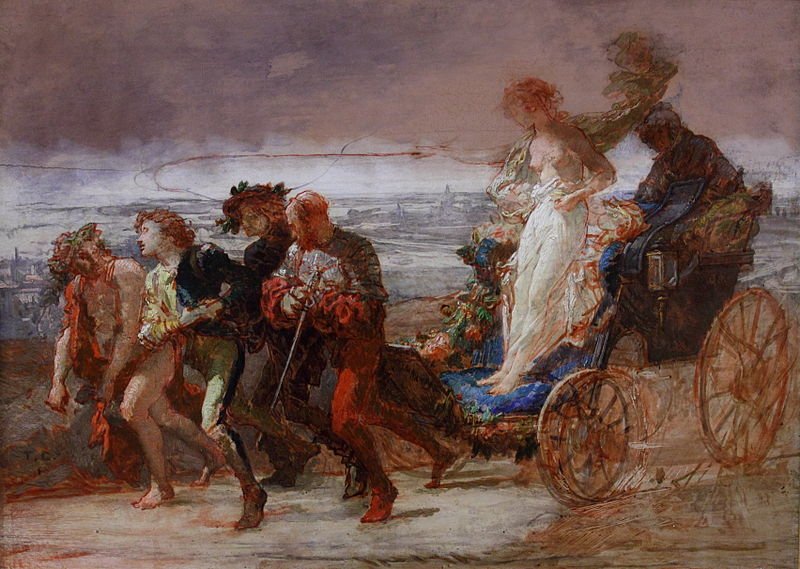
La Courtisane – Louvre

La Soif de l’or (1844), musée des Augustins de Toulouse
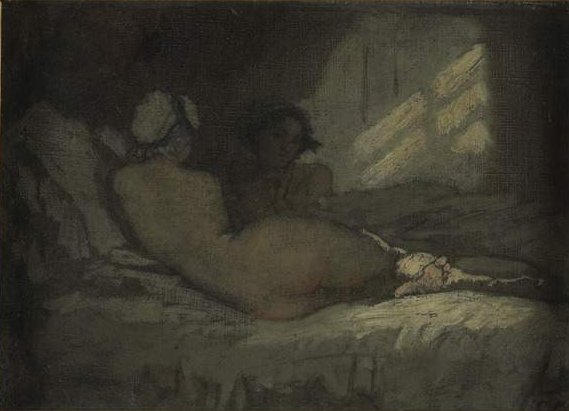
Etude de nu, huile sur toile, 17 x 24, Musée d’Orsay, Paris

The Thorny Path (1872)

Portrait of a Seated Woman (1850-1855)[

Mevlana, a widow


Les Romains de la décadence

contemplation
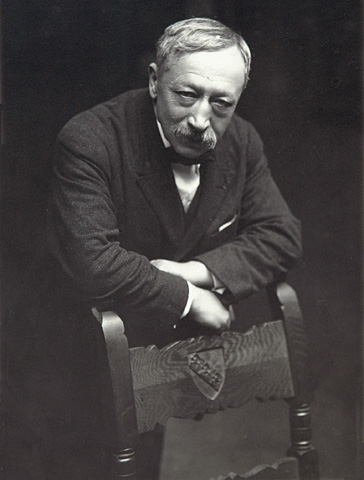
Today is the birthday of Gustave Kahn (21 December 1859, in Metz – 5 September 1936, in Paris); Symbolist poet and art critic. He claimed to have invented the term vers libre, or free verse; he was one of the first European exponents of the form. His principal publications include Les Palais nomades, 1887, Domaine de fée, 1895, and Le Livre d’images, 1897. Kahn also made a contribution to the history of the Symbolist movement with his book Symbolistes et décadents, 1902.
Verse
Les Paons
Se penchant vers les dahlias,
Des paons cabraient des rosaces lunaires,
L’assouplissement des branches vénère
Son pâle visage aux mourants dahlias.
Elle écoute au loin les brèves musiques
Nuit claire aux ramures d’accords,
Et la lassitude a bercé son corps
Au rythme odorant des pures musiques.
Les paons ont dressé la rampe ocellée
Pour la descente de ses yeux vers le tapis
De choses et de sens
Qui va vers l’horizon, parure vermiculée
De son corps alangui.
En l’âme se tapitle flou désir molli de récits et d’encens.
Now a celebration of muses and unrequited love! I so enjoy readin’ about men, and women, who were able to take words and gather them together in such a way as to create somethin’ timeless, which is what I aspire to create. Today is the birthday of the woman who inspired this verse by W.B. Yeats:
“Had I the heavens’ embroidered cloths,
Enwrought with golden and silver light,
The blue and the dim and the dark cloths
Of night and light and the half light,
I would spread the cloths under your feet:
But I, being poor, have only my dreams;
I have spread my dreams under your feet;
Tread softly because you tread on my dreams.”

That is Maud Gonne (21 December 1866 Tongham, England – 27 April 1953 Clonskeagh, Ireland) whom Yeats was addressing. We have written of their relationship before here at TLC. She was born just six months after Yeats was born in Dublin. They first met when they were 25 years old. Yeats later referred to the day he met her as “when the troubling of my life began.” She was an Irish revolutionary, independent-minded, graceful, and reared in affluence. She was tall, red-headed, and exquisitely beautiful. In his Memoirs, Yeats wrote: “I had never thought to see in a living woman such great beauty. It belonged to famous pictures, to poetry, to some legendary past. A complexion like the blossom of apples, and yet face and body had the beauty of lineaments which Blake calls the highest beauty because it changes least from youth to age, and a stature so great that she seemed of a divine race.” She wore long black dresses and she kept singing birds as pets. He asked her to marry him over and over again. She refused, over and over again. She once told him: “You would not be happy with me. … You make beautiful poetry out of what you call your unhappiness and you are happy in that. Marriage would be such a dull affair. Poets should never marry.” In a letter to him in 1911, she wrote, “Our children were your poems of which I was the father sowing the unrest & storm which made them possible & you the mother who brought them forth in suffering & in the highest beauty.” Yeats wrote about her:
When you are old and grey and full of sleep,
And nodding by the fire, take down this book,
And slowly read, and dream of the soft look
Your eyes had once, and of their shadows deep;
How many loved your moments of glad grace,
And loved your beauty with love false or true,
But one man loved the pilgrim soul in you,
And loved the sorrows of your changing face;
And bending down beside the glowing bars,
Murmur, a little sadly, how Love fled
And paced upon the mountains overhead
And hid his face amid a crowd of stars.
The Song of the Day is “Crowd of Stars” by Feeder. I do not own the rights to this song. No copyright infringement intended.
And it was on this day in 1908 that Arnold Schoenberg’s Quartet No. 2 for strings and soprano, premiered in Vienna, by the Rosé Quartet with soprano Marie Gutheil-Schoder.
 Wien Museum, Inventarnummer HMW 78103
This work in four movements was written during an emotional time in Schoenberg’s life. Though it bears the dedication “to my wife”, it was written during Mathilde Schoenberg’s affair with their friend and neighbour, artist Richard Gerstl, in 1908. (For more on Gerstl and his sad end search Gerstl on TLC).
The second movement quotes the Viennese folk song, “O du lieber Augustin”. The third and fourth movements are quite unusual for a string quartet, as they also include a soprano singer, using poetry written by Stefan George. On setting George, Schoenberg himself later wrote, “I was inspired by poems of Stefan George, the German poet, to compose music to some of his poems and, surprisingly, without any expectation on my part, these songs showed a style quite different from everything I had written before. … New sounds were produced, a new kind of melody appeared, a new approach to expression of moods and characters was discovered.”
The string quartet is in four movements:
- Mäßig (Moderate), F♯ minor
- Sehr rasch (Very brisk), D minor
- “Litanei”, langsam (“Litany”, slow), E♭minor, though from a Schenkerian perspective, “in spite of the decisive bass reading, the upper voice fails to unfold a fundamental line from the structural “
- or G♭ major
- “Entrückung”, sehr langsam (“Rapture”, very slow), No key
Text
The latter two movements of the Second String Quartet are set to poems from Stefan George’s collection Der siebente Ring (The Seventh Ring), which was published in 1907.
Litanei
Tief ist die trauer die mich umdüstert,
Ein tret ich wieder, Herr! in dein haus.
Lang war die reise, matt sind die glieder,
Leer sind die schreine, voll nur die qual.
Durstende zunge darbt nach dem weine.
Hart war gestritten, starr ist mein arm.
Gönne die ruhe schwankenden schritten,
Hungrigem gaume bröckle dein brot!
Schwach ist mein atem rufend dem traume,
Hohl sind die hände, fiebernd der mund.
Leih deine kühle, lösche die brände.
Tilge das hoffen, sende das licht!
Gluten im herzen lodern noch offen,
Innerst im grunde wacht noch ein schrei.
Töte das sehnen, schliesse die wunde!
Nimm mir die liebe, gib mir dein glück!
Litany
Deep is the sadness that gloomily comes over me,
Again I step, Lord, in your house.
Long was the journey, my limbs are weary,
The shrines are empty, only anguish is full.
My thirsty tongue desires wine.
The battle was hard, my arm is stiff.
Grudge peace to my staggering steps,
for my hungry gums break your bread!
Weak is my breath, calling the dream,
my hands are hollow, my mouth fevers.
Lend your coolness, douse the fires,
rub out hope, send the light!
Still active flames are glowing inside my heart;
in my deepest insides a cry awakens.
Kill the longing, close the wound!
Take love away from me, and give me your happiness!
Entrückung
Ich fühle luft von anderem planeten.
Mir blassen durch das dunkel die gesichter
Die freundlich eben noch sich zu mir drehten.
Und bäum und wege die ich liebte fahlen
Dass ich sie kaum mehr kenne und du lichter
Geliebter schatten—rufer meiner qualen—
Bist nun erloschen ganz in tiefern gluten
Um nach dem taumel streitenden getobes
Mit einem frommen schauer anzumuten.
Ich löse mich in tönen, kreisend, webend,
Ungründigen danks und unbenamten lobes
Dem grossen atem wunschlos mich ergebend.
Mich überfährt ein ungestümes wehen
Im rausch der weihe wo inbrünstige schreie
In staub geworfner beterinnen flehen:
Dann seh ich wie sich duftige nebel lüpfen
In einer sonnerfüllten klaren freie
Die nur umfängt auf fernsten bergesschlüpfen.
Der boden schüffert weiss und weich wie molke.
Ich steige über schluchten ungeheuer.
Ich fühle wie ich über letzter wolke
In einem meer kristallnen glanzes schwimme—
Ich bin ein funke nur vom heiligen feuer
Ich bin ein dröhnen nur der heiligen stimme.
Rapture
I feel air from another planet.
The faces that once turned to me in friendship
Pale in the darkness before me.
And trees and paths that I once loved fade away
So that I scarcely recognize them, and you bright
Beloved shadow—summoner of my anguish—
Are now extinguished completely in deeper flames
In order, after the frenzy of warring confusion,
To reappear in a pious display of awe.
I lose myself in tones, circling, weaving,
With unfathomable thanks and unnamable praise;
Bereft of desire, I surrender myself to the great breath.
A tempestuous wind overwhelms me
In the ecstasy of consecration where the fervent cries
Of women praying in the dust implore:
Then I see a filmy mist rising
In a sun-filled, open expanse
That includes only the farthest mountain retreats.
The land looks white and smooth like whey.
I climb over enormous ravines.
I feel like I am swimming above the furthest cloud
In a sea of crystal radiance—
I am only a spark of the holy fire
I am only a whisper of the holy voice.
thanks for stoppin’ by y’all
Mac Tag
thanks for stoppin’ by y’all
Keep love in your heart. A life without it is like a sunless garden when the flowers are dead. – Oscar Wilde
Follow us on twitter @cowboycoleridge
 The Lovers’ Chronicle

Leave a comment