Dear Zazie, Here is today’s Lovers’ Chronicle from Mac Tag dedicated to his muse. Are you askin’ Sandman to let someone come to you in your dreams, to come softly ever the same? Rhett
The Lovers’ Chronicle
Dear Muse,
had to search but i found
a Neil Young song;
“I love the sound of laughter
And music in the air
And in the ever after
I know it’s always there”
“Not one I know but any
of his songs anytime”
it is not clear
whether he was writin’
about the romantic kind,
or the afterlife kind
i have not written about
the ever after of two as one,
somethin’
i came not to believe in
but now i look around
and i see, we are there
© copyright 2023 mac tag/cowboy coleridge all rights reserved
agree with Flaubert, the pursuit of “le mot juste” is what matters, goin’ on seven years in my search, balancin’ the flow with findin’ the right ones, but that is as far as i want to follow Flaubert, he flamed out at fifty-eight, perhaps he never met “la bonne femme”, might have changed things for the better for him, it did for me
© copyright 2022.2023 mac tag/cowboy coleridge all rights reserved
definitely not the same
if the years had themes
last year would be, transitions
this year would be, acceptance
finished with fictional encounters,
stories created to pass the night
no need for dream rendezvous
just have to reach over and say,
hey baby with feelin’s
ever the same
© copyright 2021.2023 mac tag/cowboy coleridge all rights reserved
Pale Love, Pale Rider
we are readin’ poetry to each other
while the wind blows and the snow falls
i pause from readin’
to look at you
your great eyes
fix on me
we have so much to say to each other
but in this moment it does not occur,
to tell each other how we feel
or wonder why
we just are…
© copyright 2020 mac tag/cowboy coleridge all rights reserved
enterin’ solitude,
obsessed
with these thoughts
that you will come
last night it worked
you came and hugged me,
felt myself flowin’ into you
told you it had been so, so long
sayin’ nothin’ you just held on
asked you to stay, but you left
always askin’
ever holdin’ on
all i ask
allow this
my only comfort
to be with you
ever the same
© copyright 2019 mac tag/cowboy coleridge all rights reserved
obsessed with these thoughts,
this solitude, ever the same
come, let yourself go
it has been so long
words flowin’, hold on
to what emerges,
to this occurrence
of everything
these feelin’s
at last carry
the meanin’
of all that will be
© copyright 2018 mac tag/cowboy coleridge all rights reserved
come to me
the totem spins…
oh hold on,
not sure which way
this one is goin’…
sittin’ by a fireplace
in a mountain cabin
we are readin’ poetry
to each other
while the wind blows
and the snow falls
i pause from readin’
to look at you
your great eyes
fix on me
have we nothin’ more
to say to each other
not hardly
but certainly we know
more meaningful
ways to talk
it does not occur,
to tell each other
how we feel
or wonder why
we just are…
ah, damnit,
losin’ it…
the flames die down
either exhausted or choked
little by little, quenched
by absence
and regret,
smothered
by routine
the fiery glow
vanishes
© copyright 2017 mac tag/cowboy coleridge all rights reserved
Cain’t be handled
But maybe held;
For a little while
So if you want;
Come on and hold on
So, that is what you want
“Yes”
Well, you just never know
“Why”
Well, you just never know,
which way the wind
is gonna blow
The lies that were told
The lines that were blurred
The lives that were used
About, regret
About, too late
About what now
bodies
together
in the darkness
flesh
trembles
into this dream
thoughts
to return
into the arms
© copyright 2015 mac tag/cowboy coleridge all rights reserved
Come To Me Ever The Same
Enterin’ the dark solitude
Obsessed with this thought, this hope, this…
That you will come to me in dreams
Some nights it works, some it will not
Blessed by the Sandman last evenin’
You came to me and you hugged me
Felt myself flowin’ into you
Told you it had been so, so long
Sayin’ nothin’ you just held on
Asked you to stay but no you left
Always askin’, askin’ Sandman…
All I ask is this, all I ask
Allow this my only comfort:
To plunge into dreams into you
To be with you ever the same
To fall asleep in your shadow
To come to me ever the same
To come softly ever the same
To come to me, to come softly
Ever the same, ever the same
© 2012 Cowboy Coleridge
The Song of the Day is “Come to Me Softly” by Jimmy James and the Vagabonds.
| Gustave Flaubert | |
|---|---|
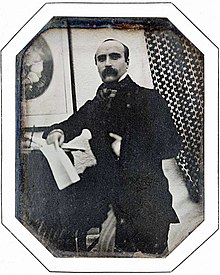 | |
Today is the birthday of Gustave Flaubert (Rouen 12 December 1821 – 8 May 1880 Croisset, Rouen); novelist who, in my opinion, was the leading exponent of literary realism in France. Perhaps best known for his first published novel, Madame Bovary (1857), for his Correspondence, and for his devotion to his style and aesthetics. The short story writer Guy de Maupassant was a protégé of Flaubert. Flaubert believed in, and pursued, the principle of finding “le mot juste” (“the right word”), which he considered as the key means to achieve quality in literary art.
From 1846 to 1854, Flaubert had a relationship with the poet Louise Colet. According to his biographer Émile Faguet, his affair with Colet was his only serious romantic relationship. From Rouen, he made occasional visits to Paris and England, where he apparently had a mistress. Flaubert never married.
With his lifelong friend Maxime Du Camp, he traveled in Brittany in 1846. In 1849–50 he went on a long journey to the Middle East, visiting Greece and Egypt. In Beirut he contracted syphilis. He spent five weeks in Istanbul in 1850. He visited Carthage in 1858 to conduct research for his novel Salammbô. Flaubert was very open about his sexual activities with prostitutes in his writings on his travels.
He died from a cerebral hemorrhage at the age of 58. He was buried in the family vault in the cemetery of Rouen. A monument to him by Henri Chapu was unveiled at the museum of Rouen.
Quotes
Madame Bovary, 1857
C’est la faute de la fatalité !
- Phrase récurrente
- Madame Bovary (1857), Gustave Flaubert, éd. Éditions Garnier Frères, coll. « Classiques Garnier », 1955, partie 3, chap. XI, p. 323
[…], la parole est un laminoir qui allonge toujours les sentiments.
- Madame Bovary (1857), Gustave Flaubert, éd. Éditions Garnier Frères, coll. « Classiques Garnier », 1955, partie 3, chap. I, p. 218 (texte intégral sur Wikisource).
Le plus médiocre libertin a rêvé des sultanes, chaque notaire porte en soi les débris d’un poète.
- Madame Bovary (1857), Gustave Flaubert, éd. Eugène Fasquelle, 1905, p. 264
Cette lâche docilité qui est pour bien des femmes comme le châtiment tout à la fois la rançon de l’adultère
- Madame Bovary (1857), Gustave Flaubert, éd. Eugène Fasquelle, 1905, p. 314
Il y a toujours après la mort de quelqu’un comme une stupéfaction qui se dégage, tant il est difficile de comprendre cette survenue du néant et de se résigner à y croire.
- Madame Bovary (1857), Gustave Flaubert, éd. Eugène Fasquelle, 1905, p. 379
Il ne faut pas toucher aux idoles, la dorure en reste aux mains.
- Madame Bovary (1857), Gustave Flaubert, éd. Éditions Garnier Frères, coll. « Classiques Garnier », 1955, partie 3, chap. VI, p. 263
| Edvard Munch | |
|---|---|
 A photograph of Munch A photograph of Munch | |
And today is the birthday of Edvard Munch (Ådalsbruk, Løten, Norway 12 December 1863 – 23 January 1944 Oslo); painter and printmaker whose intensely evocative treatment of psychological themes built upon some of the main tenets of late 19th-century Symbolism and greatly influenced German Expressionism in the early 20th century. One of his most well-known works is The Scream of 1893.

Munch spent most of his last two decades in solitude at his nearly self-sufficient estate in Ekely, at Skøyen, Oslo. Many of his late paintings celebrate farm life, including several in which he used his work horse “Rousseau” as a model. Without any effort, Munch attracted a steady stream of female models, whom he painted as the subjects of numerous nude paintings. He likely had sexual relations with some of them.
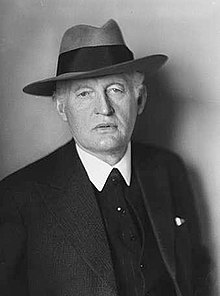
To the end of his life, Munch continued to paint unsparing self-portraits, adding to his self-searching cycle of his life and his unflinching series of takes on his emotional and physical states. In the 1930s and 1940s, the Nazis labeled Munch’s work “degenerate art” (along with that of Picasso, Paul Klee, Matisse, Gauguin and many other modern artists) and removed his 82 works from German museums.
Munch died in his house at Ekely near Oslo, about a month after his 80th birthday. His Nazi-orchestrated funeral suggested to Norwegians that he was a Nazi sympathizer, a kind of appropriation of the independent artist.
From my rotting body,
flowers shall grow
and I am in them
and that is eternity.
Gallery

Death of Marat I (1907)

the death of marat

Ashes. 1894. Oil on canvas. 120.5 × 141 cm. Nasjonalgalleriet, Oslo

Vampire. 1895. 91 × 109 cm. Munch Museum, Oslo
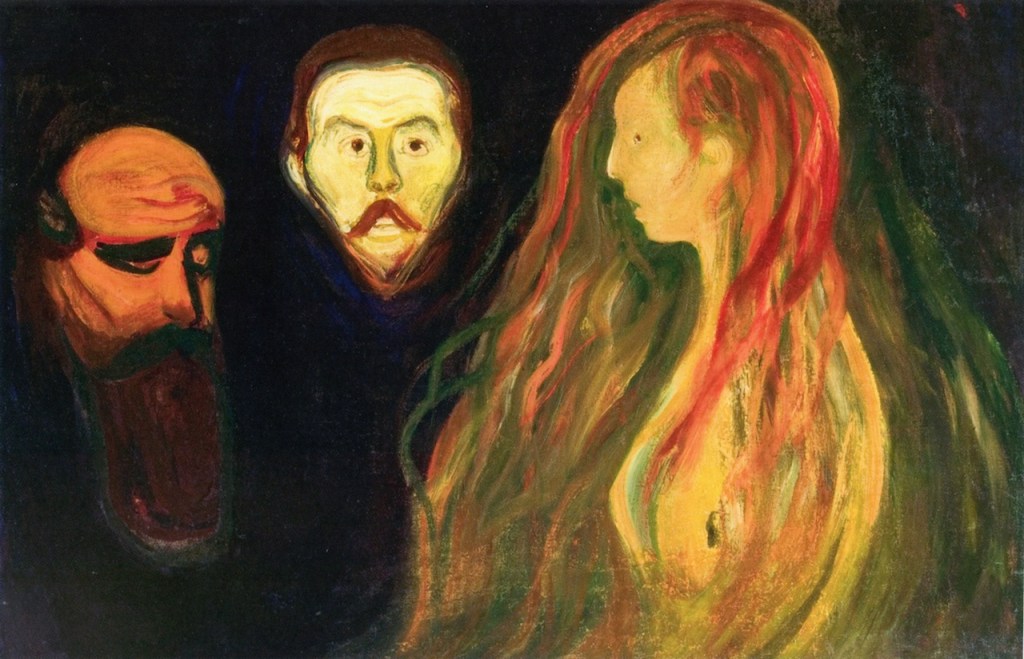
tragedy

Metabolism, 1898–1899, 172 cm × 142 cm (67+3⁄4 in × 56 in), Munch Museum, Oslo

The Dance of Life, 1899–1900, oil on canvas, 126 cm × 191 cm (49+1⁄2 in × 75 in), Nasjonalgalleriet, Oslo

Kiss IV, 1902, woodcut print on wood, 47 cm × 47 cm (18+1⁄2 in × 18+1⁄2 in), Munch Museum, Oslo

Red and White, 1899–1900, 93 cm × 129 cm (36+1⁄2 in × 50+3⁄4 in), Munch Museum, Oslo
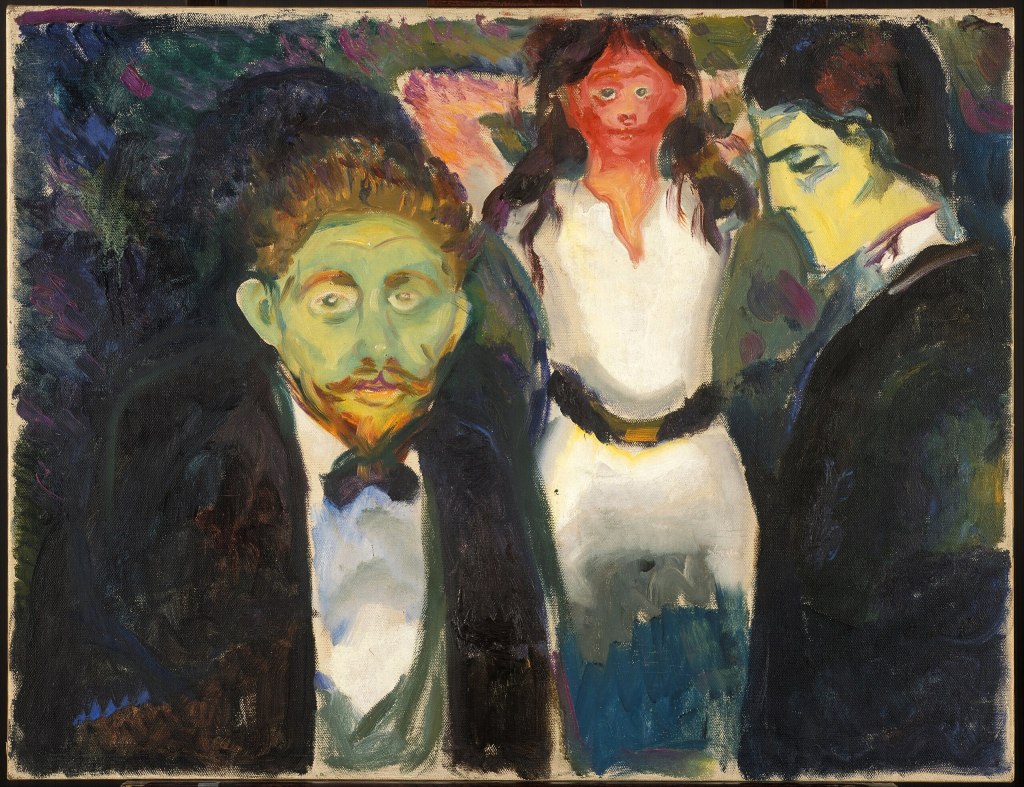
Jealousy, 1907, 75 cm × 98 cm (29+1⁄2 in × 38+1⁄2 in), Munch Museum, Oslo
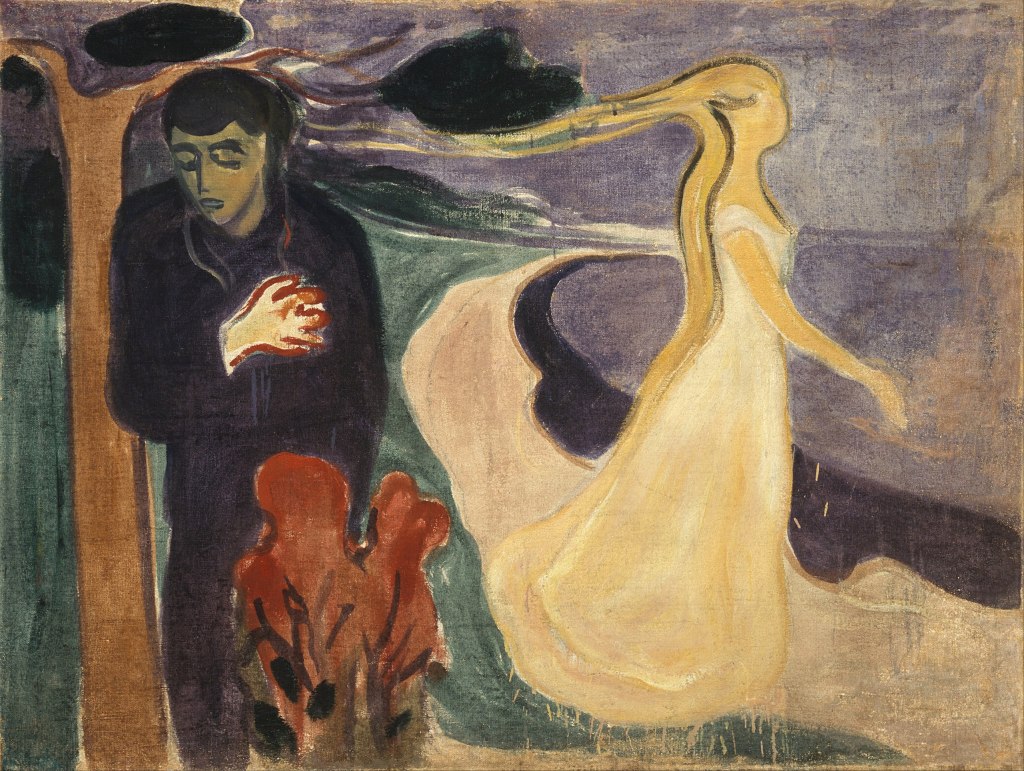
Separation, 1896, 96 cm × 127 cm (37+3⁄4 in × 50 in), Munch Museum, Oslo

Weeping Woman, 1907–1909, oil on canvas, private collection
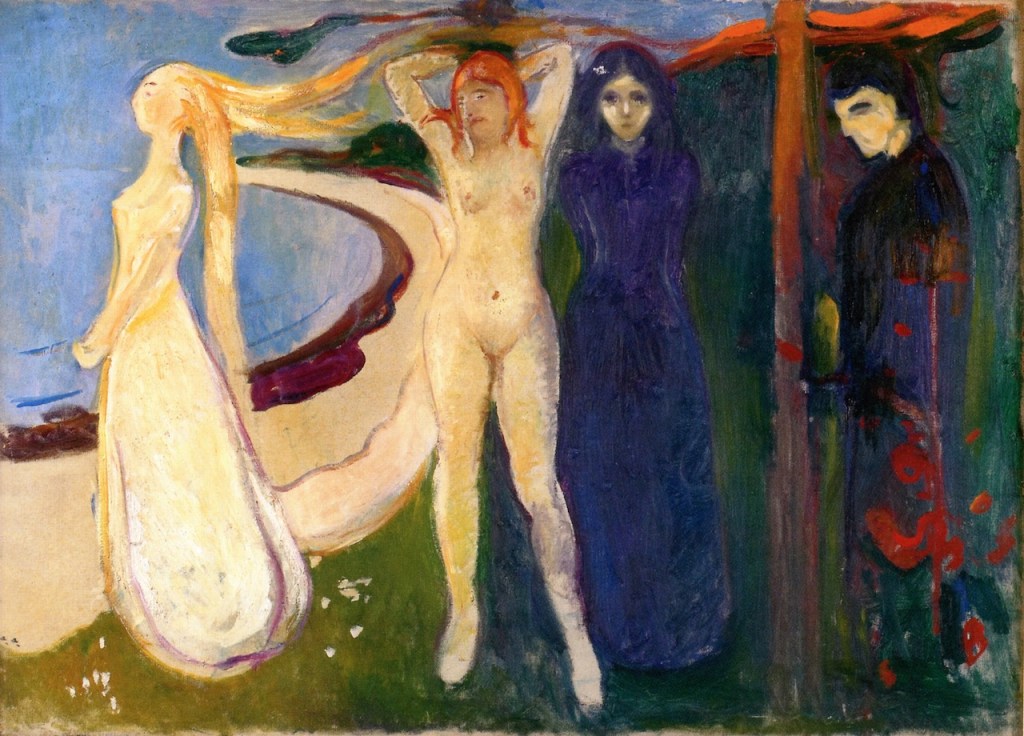
Woman, Sphinx
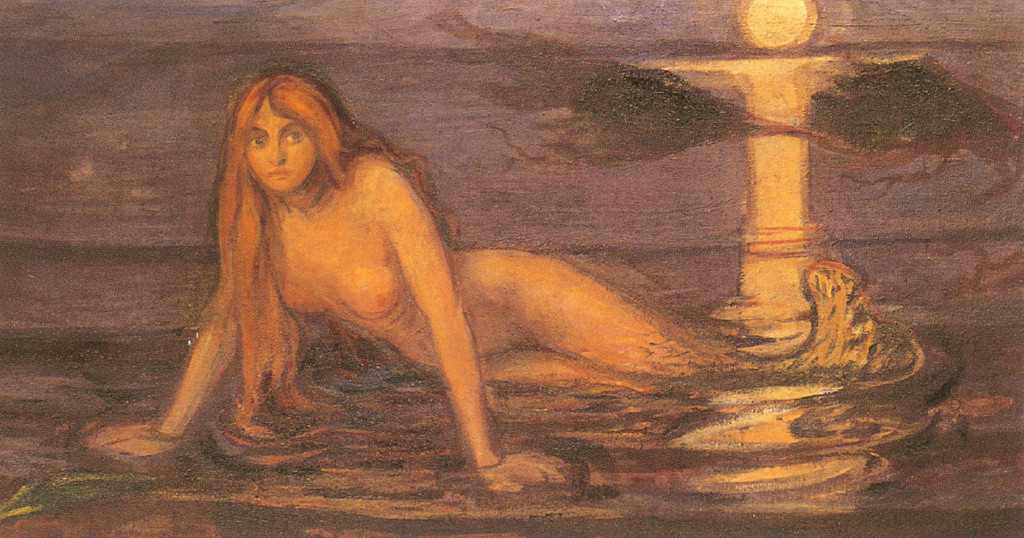
Lady From the Sea (detail), 1896, oil on canvas. 100 cm × 320 cm (39+1⁄2 in × 126 in)

Weeping Nude, 1913–1914, 110 cm × 135 cm (43+1⁄4 in × 53+1⁄4 in), Munch Museum, Oslo

Morning Yawn, 1913, oil on canvas, 108 × 98 cm, Art Museums of Bergen

Model by the Wicker Chair, 1919–1921, oil on canvas, 122.5 × 100 cm, Munch Museum, Oslo

Although it is a highly unusual representation, this painting might be of the Virgin Mary. Whether the painting is specifically intended as a representation of Mary is disputed. Munch used more than one title, including both Loving Woman and Madonna.

The Hands, 1893, oil on canvas, 91 x 77 cm, Munch Museum, Oslo

The Sick Child (1907)

The Voice / Summer Night, 1896, 90 cm × 119 cm (35+1⁄2 in × 46+3⁄4 in), Munch Museum, Oslo

The Scream (1893), National Gallery, Oslo

At the Deathbed’ by Edvard Munch, 1895, Bergen Kunstmuseum
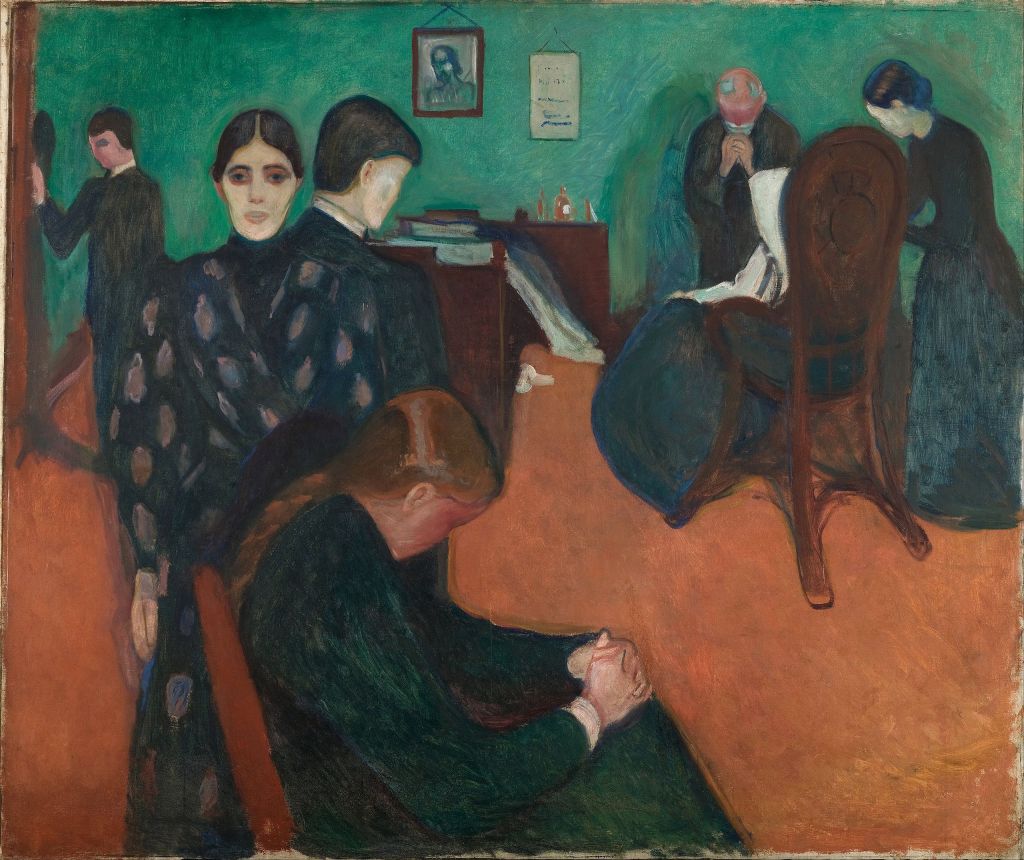
Death in the Sickroom, 1893, 134 cm × 160 cm (52+3⁄4 in × 63 in), Munch Museum, Oslo

Death in the Sickroom, c. 1895, oil on canvas, 150 cm × 168 cm (59 in × 66 in), Nasjonalgalleriet, Oslo
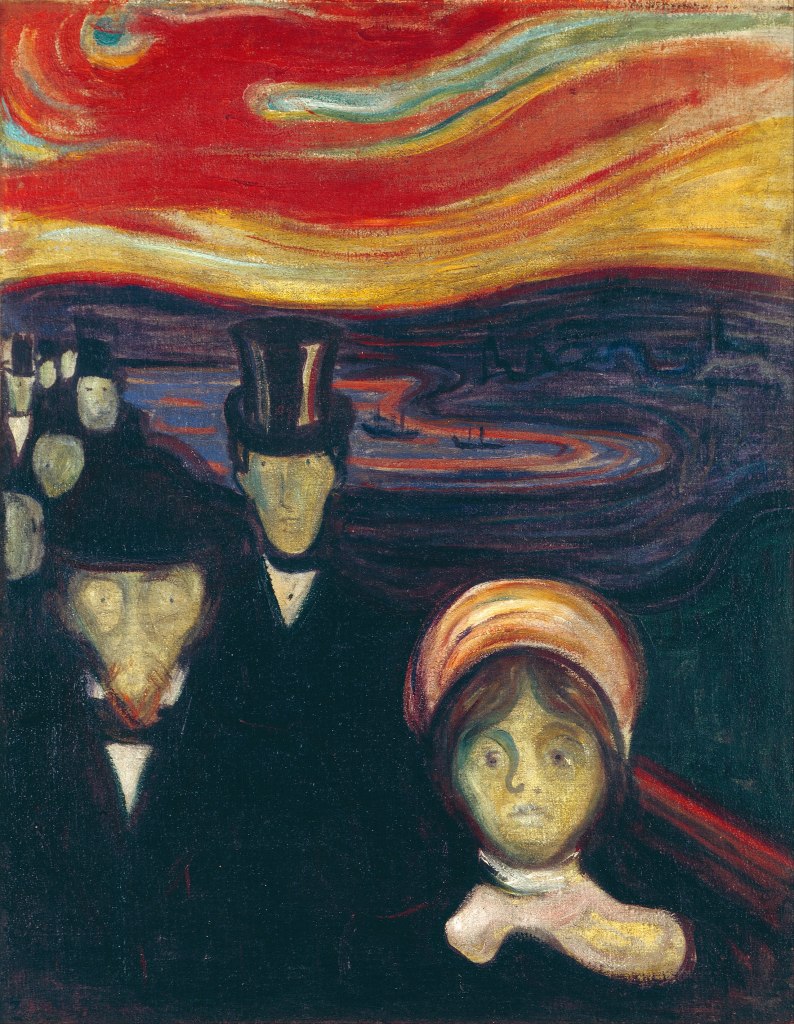
Anxiety, 1894, 94 cm × 74 cm (37 in × 29+1⁄4 in), Munch Museum, Oslo

Starry Night, 1893, 135.6 cm × 140 cm (53+1⁄2 in × 55 in), J. Paul Getty Museum

Starry Night, 1922–1924, oil on canvas, 120.5 x 100 cm, Munch Museum, Oslo


The Sun, 1910–1911, 450 cm × 772 cm (177+1⁄4 in × 304 in), Munch Museum, Oslo

Galloping Horse, 1910–12, 148 cm × 120 cm (58+1⁄4 in × 47+1⁄4 in), Munch Museum, Oslo
thanks for stoppin’ by y’all
Mac Tag
 The Lovers’ Chronicle
Leave a comment