Dear Zazie, Here is today’s Lovers’ Chronicle from Mac Tag dedicated to his muse. Do you have wayward dreams? Have you met a wayward angel? Rhett
The Lovers’ Chronicle
Dear Muse,
switchin’ from the simple past form
of today’s word, the choice was easy;
’’Can anybody find me’’
’’Yes, Freddie every day please’’
absolutely
’’I was hoping you weren’t going with
the obvious ‘found’ song’’
oh no, we maintain our secularity,
besides kinda danced around that last year,
but back to anybody findin’ somebody,
’’We didn’t ask that question’’
no, we just kept lookin’ until we found
’’Not just anybody, but somebody’’

© copyright 2023.2024 mac tag/cowboy coleridge all rights reserved
i once was lost, wait what, stop, once, you must be kiddin’, more like, i often was lost, or i was mostly lost, but i think not alone there, there ain’t no manual, no do-it-yourself guidebook, we do the best we can, some of us the worst we can outta stubbornness i suppose, of course luck has to be figured, and if i could lodge a complaint with management, that shit is not dished out evenly, but perhaps i was savin’ mine up so i could be found with you

© copyright 2022.2024 mac tag/cowboy coleridge all rights reserved
resist the pull, though difficult,
to get dramatic with the topic
and on Blake’s birthday,
never seekin’ to tell
but there is no need
we, with what we have,
yes, with what we found
we will have it our way
now that we can see

© copyright 2021.2024 mac tag/cowboy coleridge all rights reserved
Pale Love, Pale Rider
two wayward solitudes
find a way
no longer confused, and weary
over many whispered words,
bewilderment at what enfolds
do you hear
do you know
there is no stoppin’
we seek more
bodies drawn together
no longer unto the night
will we appear alone
what was given up
can be found
© copyright 2020 mac tag/cowboy coleridge all rights reserved
till you burn with desire
know no fixed lot,
unbound from spells
of draggin’ the chain
of life in weary lust
unafraid of woe,
and with night will welcome
i turn my back from whence
comforts have increased
languid strings
do scarcely move
the sound is forced,
the notes are few
© copyright 2019 mac tag/cowboy coleridge all rights reserved
last night
a wayward angel,
or somethin’ pretty close,
came to visit
how sweet we roamed
from dream to dream
a consummated
spectral rendezvous
seek to tell
what we thought
could not be told
seek to become
only what we can be
seek and find
and not just
in our dreams
© copyright 2018 mac tag/cowboy coleridge all rights reserved
last night, a dream cast shadow
not an angel, but damn near
and two wayward solitudes
find a way
no longer troubled, forlorn
nor confused, and weary
over many whispered words,
bewilderment at what enfolds
do you hear their sighs
do you know at what cost
there is no stoppin’
they seek no more
a different kind of tear
bodies drawn together
no longer unto the night
will they appear alone
what was given up for gone
can be found
© copyright 2017 mac tag/cowboy Coleridge all rights reserved
dream cast shadow
over all too empty bed,
wayward, wanderin’,
weary she appeared
Over mumbled words,
soundin’ heart-broke,
she spoke to me
Wayward dreams do they cry
Do they hear the lover’s sigh
Do they see what we have lost
 Stay Frosty II
© copyright 2016 mac tag/cowboy Coleridge all rights reserved

Nebraska sunset clouds

Nebraska sunset clouds one
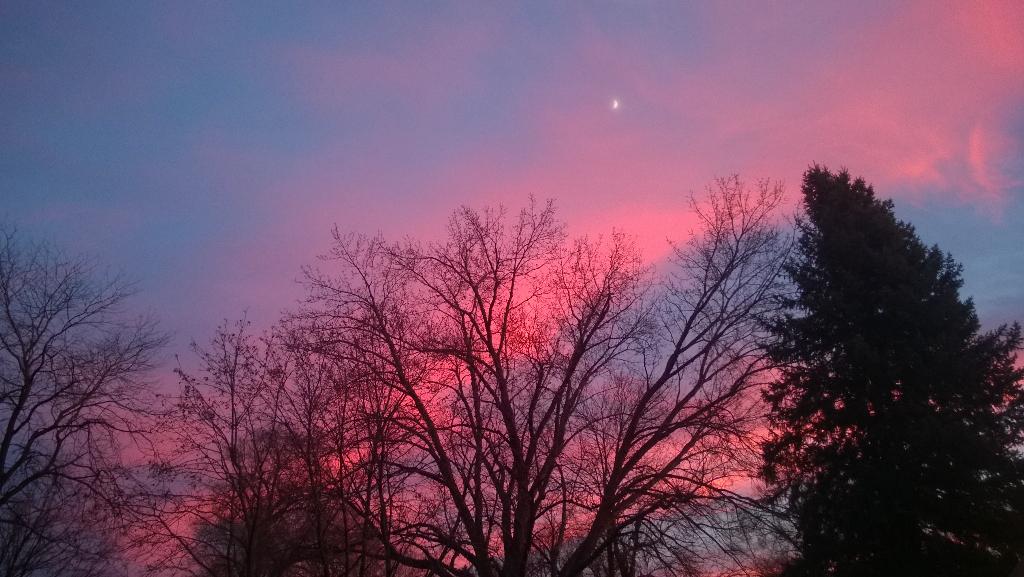
Moon and Sunset Clouds over Nebraska
© copyright 2014 mac tag/cowboy Coleridge all rights reserved
Wayward Dreams
Last night a dream cast a shadow
Over my all too empty bed,
That an angel had lost her way
A wayward woman wanderin’
Troubled, bewildered, and forlorn,
Dark, confused, weary she appeared
Over many a mumbled word,
Soundin’ heart-broke, I heard her say:
‘Oh my wayward dreams! do they cry,
Do they hear their lover sighin’
Do they not see what we have lost,
Will they not stop and weep for me’
Her tears fell as I came closer
I took her hand and drew her near,
And said, Wail not into the night
For your plight and mine are the same
That which was once held can be found,
That which was once found can be ours
Follow me, we will find the way
Back to our wayward dreams and home
© copyright 2012 mac tag/cowboy Coleridge all rights reserved
The Song of the Day is “Wayward Angel” by Kasey Chambers
| William Blake | |
|---|---|
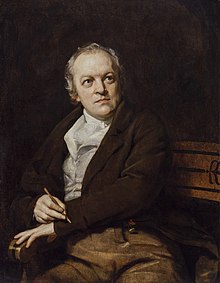 | |
Today is the birthday of William Blake (Soho, London 28 November 1757 – 12 August 1827 Charing Cross, London); poet, painter, and printmaker. In my opinion, one of the seminal figures in the history of the poetry and visual arts of the Romantic Age. His paintings and poetry have been characterised as part of the Romantic movement and as “Pre-Romantic”. Reverent of the Bible but hostile to the Church of England, Blake was influenced by the ideals and ambitions of the French and American Revolutions. The singularity of Blake’s work makes him difficult to classify.
Blake met Catherine Boucher in 1782 when he was recovering from a relationship that had culminated in a refusal of his marriage proposal. He recounted the story of his heartbreak for Catherine and her parents, after which he asked Catherine, “Do you pity me?” When she responded affirmatively, he declared, “Then I love you.” Blake married Catherine – who was five years his junior – on 18 August 1782 in St Mary’s Church, Battersea. Illiterate, Catherine signed her wedding contract with an X. Later, in addition to teaching Catherine to read and write, Blake trained her as an engraver. Throughout his life she proved an invaluable aid, helping to print his illuminated works and maintaining his spirits throughout numerous misfortunes.
Blake’s last years were spent at Fountain Court off the Strand (the property was demolished in the 1880s, when the Savoy Hotel was built). On the day of his death (12 August 1827), Blake worked relentlessly on his Dante series. Eventually, it is reported, he ceased working and turned to his wife, who was in tears by his bedside. Beholding her, Blake is said to have cried, “Stay Kate! Keep just as you are – I will draw your portrait – for you have ever been an angel to me.” Having completed this portrait (now lost), Blake laid down his tools and began to sing hymns and verses. At six that evening, after promising his wife that he would be with her always, Blake died. Catherine paid for Blake’s funeral with borrowed money. He was buried five days after his death – on the eve of his 45th wedding anniversary – at the Dissenter’s burial ground in Bunhill Fields, in what is today in the Borough of Islington, London. Following Blake’s death, Catherine believed she was regularly visited by Blake’s spirit. She continued selling his illuminated works and paintings, but entertained no business transaction without first “consulting Mr. Blake”. On the day of her death, in October 1831, she was as calm and cheerful as her husband, and called out to him “as if he were only in the next room, to say she was coming to him, and it would not be long now”.
Blake is sometimes considered (along with Mary Wollstonecraft and her husband William Godwin) a forerunner of the 19th-century “free love” movement, a broad reform tradition starting in the 1820s that held that marriage is slavery, and advocated the removal of all state restrictions on sexual activity such as homosexuality, prostitution, and adultery, culminating in the birth control movement of the early 20th century. Blake was critical of the marriage laws of his day, and generally railed against traditional Christian notions of chastity as a virtue. At a time of tremendous strain in his marriage, in part due to Catherine’s apparent inability to bear children, he directly advocated bringing a second wife into the house. His poetry suggests that external demands for marital fidelity reduce love to mere duty rather than authentic affection, and decries jealousy and egotism as a motive for marriage laws. Poems such as “Why should I be bound to thee, O my lovely Myrtle-tree?” and “Earth’s Answer” seem to advocate multiple sexual partners. In his poem “London” he speaks of “the Marriage-Hearse” plagued by “the youthful Harlot’s curse”, the result alternately of false Prudence and/or Harlotry. Visions of the Daughters of Albion can be read as a tribute to free love since the relationship between Bromion and Oothoon is held together only by laws and not by love. For Blake, law and love are opposed, and he castigates the “frozen marriage-bed”. In Visions, Blake writes:
Till she who burns with youth, and knows no fixed lot, is bound
In spells of law to one she loathes? and must she drag the chain
Of life in weary lust? (5.21-3, E49)
Gallery
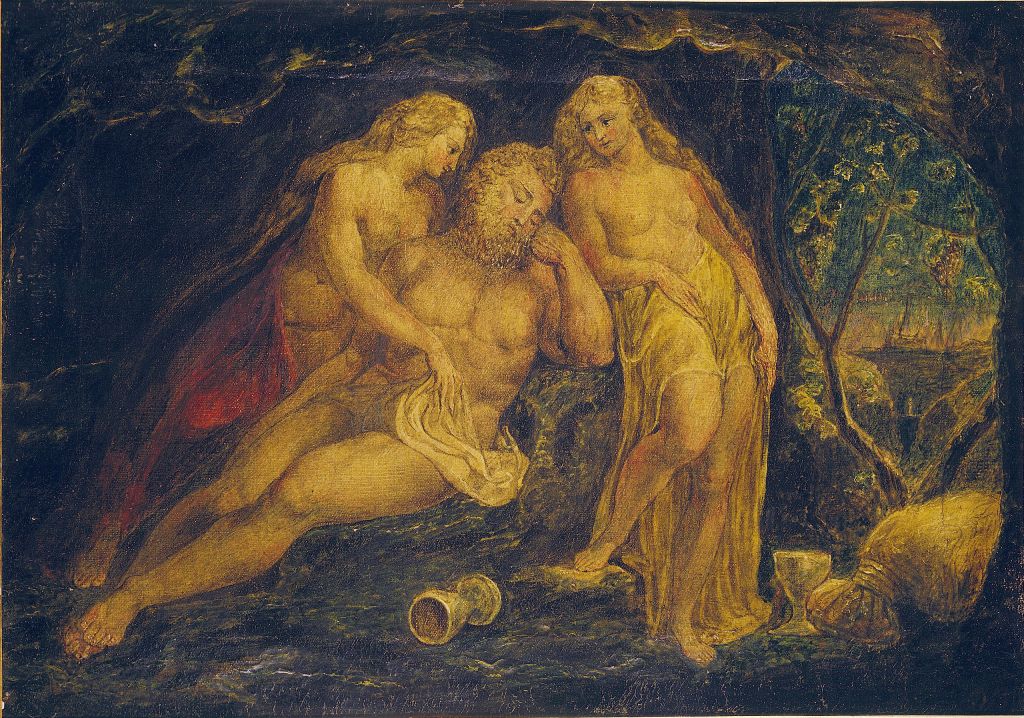
Lot and His Daughters, c. 1799-1800

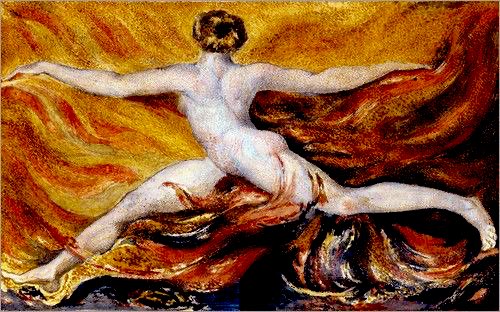
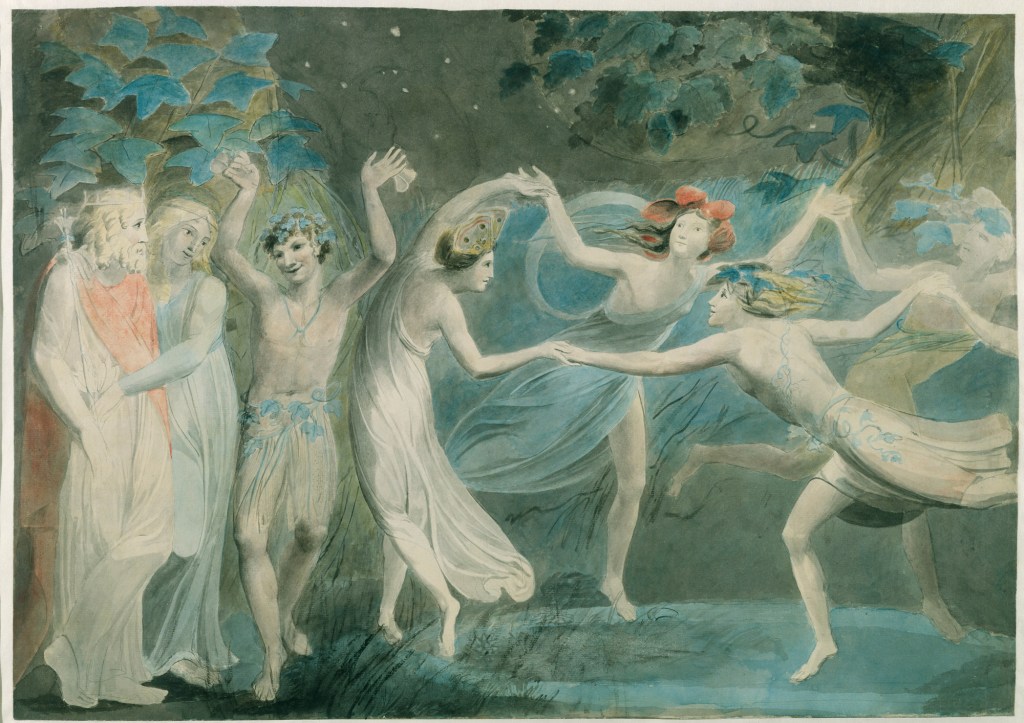
Oberon, Titania and Puck with Fairies Dancing (1786)
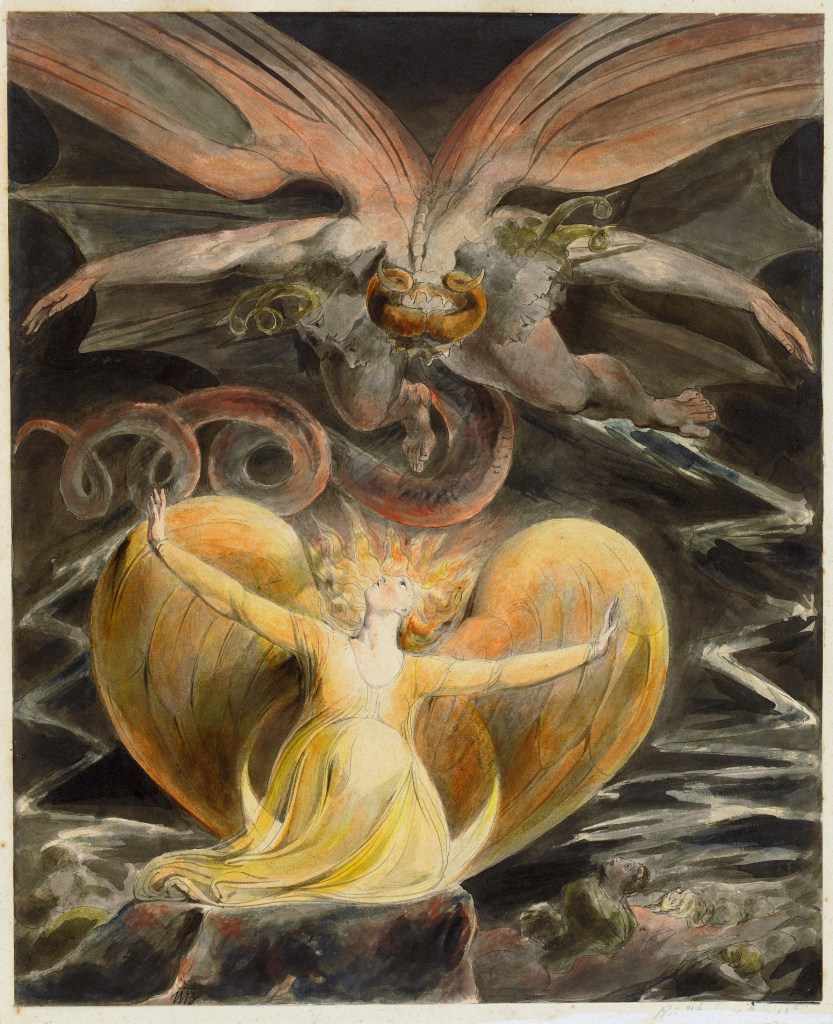
The Great Red Dragon and the Woman Clothed with Sun (1805) is one of a series of illustrations of Revelation 12
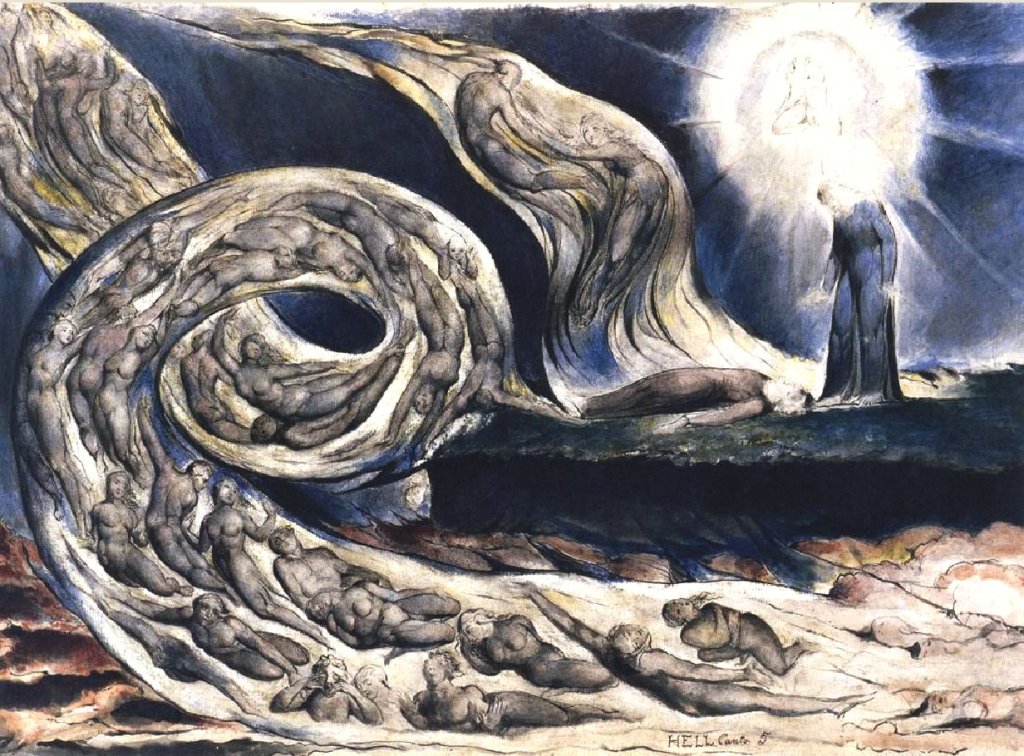
The Lovers’ Whirlwind illustrates Hell in Canto V of Dante’s Inferno
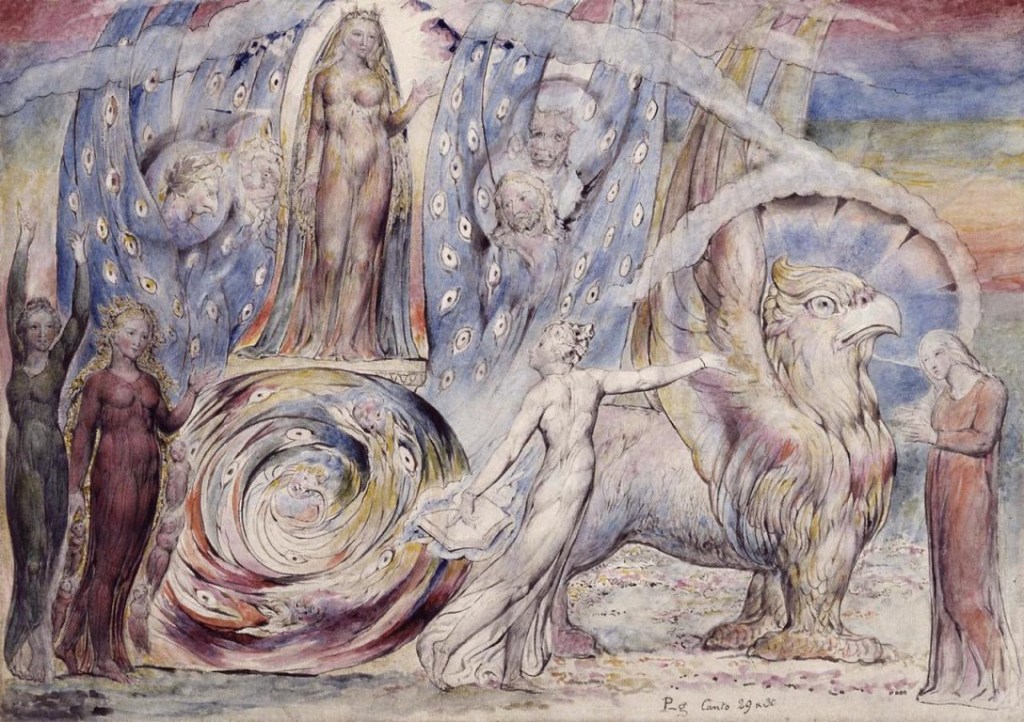
Beatrice Addressing Dante from the Car
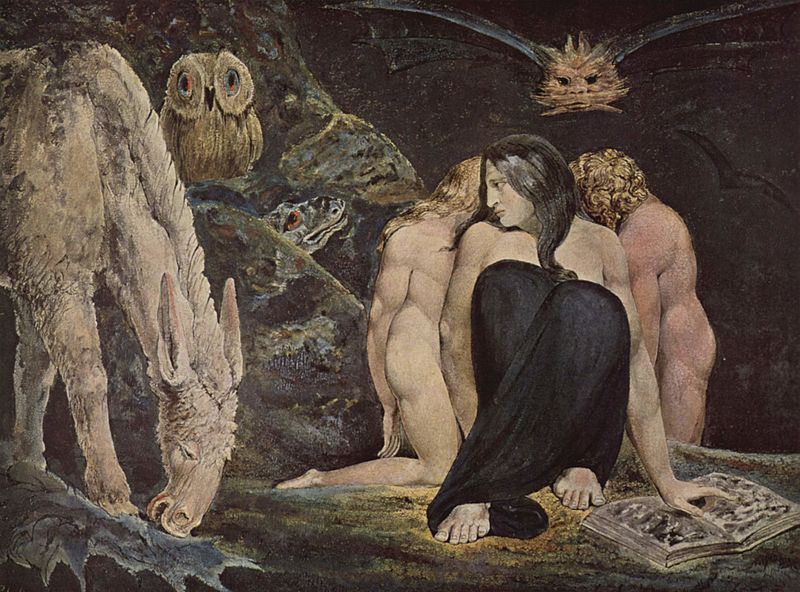
The Night of Enitharmon’s Joy, 1795. Blake’s vision of Hecate, Greek goddess of black magic and the underworld
Verse
- How sweet I roamed from field to field,
And tasted all the summer’s pride,
Till I the prince of love beheld,
Who in the sunny beams did glide!- Song (How Sweet I Roamed), st. 1
- He loves to sit and hear me sing,
Then, laughing, sports and plays with me;
Then stretches out my golden wing,
And mocks my loss of liberty.- Song (How Sweet I Roamed), st. 4
- My silks and fine array,
My smiles and languished air,
By love are driv’n away;
And mournful lean Despair
Brings me yew to deck my grave:
Such end true lovers have.- Song (My Silks and Fine Arrays), st. 1
- Like a fiend in a cloud,
With howling woe,
After night I do crowd,
And with night will go;
I turn my back to the east,
From whence comforts have increased;
For light doth seize my brain
With frantic pain.- Mad Song, st. 3
- How have you left the ancient love
That bards of old enjoyed in you!
The languid strings do scarcely move!
The sound is forced, the notes are few!- To the Muses, st. 4
Poems from Blake’s Notebook (c. 1791-1792)
- Never seek to tell thy love
Love that never told can be;
For the gentle wind does move
Silently, invisibly. - I told my love, I told my love,
I told her all my heart;
Trembling, cold, in ghastly fears—
Ah, she doth depart. - Soon as she was gone from me
A traveler came by
Silently, invisibly—
Oh, was no deny.- Never Seek to Tell
- I asked a thief to steal me a peach:
He turned up his eyes.
I asked a lithe lady to lie her down:
Holy and meek, she cries. - As soon as I went
An angel came.
He winked at the thief
And smiled at the dame— - And without one word said
Had a peach from the tree,
And still as a maid
Enjoyed the lady.- I Asked a Thief
- Sleep, sleep, beauty bright,
Dreaming o’er the joys of night.
Sleep, sleep: in thy sleep
Little sorrows sit and weep.- A Cradle Song, st. 1
- Why art thou silent and invisible,
Father of Jealousy?- To Nobodaddy, st. 1
- Love to faults is always blind,
Always is to joys inclined,
Lawless, winged, and unconfined,
And breaks all chains from every mind.- Love to Faults
- The sword sung on the barren heath,
The sickle in the fruitful field;
The sword he sung a song of death,
But could not make the sickle yield.- The Sword Sung
- Abstinence sows sand all over
The ruddy limbs and flaming hair,
But desire gratified
Plants fruits of life and beauty there.- Abstinence Sows Sand
- If you trap the moment before it’s ripe,
The tears of repentance you’ll certainly wipe;
But if once you let the ripe moment go
You can never wipe off the tears of woe.- If You Trap the Moment
- Then old Nobodaddy aloft
Farted and belched and coughed,
And said, “I love hanging and drawing and quartering
Every bit as well as war and slaughtering.”- Let the Brothels of Paris, st. 2
Several Questions Answered
- He who binds to himself a joy
Does the wingèd life destroy;
But he who kisses the joy as it flies
Lives in eternity’s sunrise.- No. 1, He Who Binds
- The look of love alarms
Because ’tis filled with fire;
But the look of soft deceit
Shall win the lover’s hire.- No. 2, The Look of Love
- What is it men in women do require?
The lineaments of gratified desire.
What is it women do in men require?
The lineaments of gratified desire.- No. 4, What Is It
- You’ll quite remove the ancient curse.
- No. 5, An Ancient Proverb
Poems from Blake’s Notebook (c. 1804)
- My specter around me night and day
Like a wild beast guards my way,
My emanation far within
Weeps incessantly for my sin.- My Specter, st. 1
- And throughout all eternity
I forgive you, you forgive me.- My Specter, st. 14
Mac Tag
thanks for stoppin’ by y’all
 The Lovers’ Chronicle
Leave a comment