Dear Zazie, Here is today’s Lovers’ Chronicle from Mac Tag dedicated to his muse. What stirs you? Rhett
The Lovers’ Chronicle
Dear Muse,
this comes from a line in McLintock!
when John Wayne’s character turns
to Maureen O’Hara’s character and says
“Half the people in the world are women.
Why does it have to be you that stirs me?”
“They were great together”
yes, and the concept of what stirs
stuck and found its way here
“Good place for it”
because we stir each other
“Absolutely”
© copyright 2023 mac tag/cowboy coleridge all rights reserved
on our last night in Mexico Beach; everything that does has been covered here before, now the two that matter most, either in hand or next to me, the two that inspire every day, to git done what has to be done so full attention can be turned to you and makin’ sure these words keep rollin’ across the page
© copyright 2022.2023 mac tag/cowboy coleridge all rights reserved
let me count the ways
on Mexico Beach waitin’ for sunset
you in my arms
bathed in the golden hour light
searchin’ for the right words
in the right order,
then suddenly it works
lyin’ next to you readin’ poems,
others and mine,
and we turn to each other,
eyes lockin’, we know
all we need to
© copyright 2021.2023 mac tag/cowboy coleridge all rights reserved
Pale Love, Pale Rider
there beyond, a vision
you, drawin’ near
and upon me gaze
‘Your time is now!’
and i follow
become ever more
the way it will be
could this be true,
could this vision,
no longer doubt
“Come and see,
what was thought denied,
only awaits.”
from this, i stir
© copyright 2020 mac tag/cowboy coleridge all rights reserved
lone i muse,
but feel not lonely,
solitude suits well
for my company,
my thoughts
and nothin’ more
with, has fled
and not heard from since
but life is short
while one tries,
everything is lackin’
when one does not,
everything is superfluous
when is enough,
enough
never
© copyright 2019 mac tag/cowboy coleridge all rights reserved
a pale blue eyed wanderer
in a field of dreams
there beyond, a vision
you, drawin’ near
and upon me gaze
‘My time is now!’
and i followed
become ever more
the way it was
could this be true,
could this vision,
no longer doubt
be the same,
now in sight
my muse
as last seen,
darkness falls,
this, or the lack thereof
walkin’ slowly towards
now dancin’ ’round
as the light of the moon
illuminates all movements
“Come, come and see,
what was thought denied,
only awaits.”
from this, i stir
***
“But you’ll be alone.”
i have been alone before
and i will be fine
© copyright 2018 mac tag/cowboy coleridge all rights reserved

Sunset High Plains fence post
sometimes
nothin’ will do
but to hit the road
and head west
chasin’ the sunset
warnin’: will brake
for good light
for verse
that cannot wait
to be written
for thoughts of you
that overwhelm so
typical road trip…
wide open two lane blacktops
good music, good coffee
composin’ verse in my head
stopped to watch the sunset
then at midnight
stopped to stare at the stars
and all the while
wishin’ you were there

high plains audi
© copyright 2017 mac tag/cowboy Coleridge all rights reserved
twilight falls
lie with strainin’ eyes
hear the wind moanin’
across the plains
night, interminably long,
yet prayin’
to hold back the dawn
long have eyes been dry
long have feelin’s been numb
cold settles in
windmill squeaks
train whistle blows
boot heals clunk
on wooden floors
nothin’ left
but the waitin’
hear a deep, mutterin’ curse, under breath,
and then the tinklin’ of spurs, movin’ away
 Stay Frosty I
© copyright 2016 mac tag/cowboy Coleridge all rights reserved
Now, in Her trance; to direct punishment
Had i accepted; vengeance satisfied
No. Would have little beyond reproach. Attempt on life
And I want that; how it wrongly keeps me
Me, kept undone; a motive for Her darkness
Indeed it is my soul that She remits to eternity
© copyright 2015 mac tag/cowboy Coleridge all rights reserved
Sorry, Dark Muse in full control here.
The Lack Thereof
Amid the mystic fields of dreams
I wandered, and came on a grave
Breathlessly still was all around
Yet breathin’ with an easy heart
And there beyond, in wooded grove,
Were visions, all so much the same,
They became one. A girl drew near,
And on me gazed with wistful eye,
Yet would have passed, but that I called,
Clappin’ my hands above my head,
‘My time is now!’ and I followed
After the beautiful spirit
And bade her stop and look at me
And so I called her lovelier
Than any else, only because
She only then before me was
And, while we stood and gazed, a change,
Diversely strange, was seen in her:
She became ever more and more
The one I loved before, ago;
Could this be true, could this vision,
Such that I could no longer doubt,
Be the same, who was now to sight
My muse, as lovely as last seen,
As outer darkness starts to fall,
Is this her or the lack thereof
And what of, the abandoned grave,
The girl now walks slowly towards
And blindly circles, in half-turns,
Now dances she round the tomb site;
And, as the light of the moon glows
Illuminatin’ her movements
Of diviner motion, she said,
“Come, come and see, see what awaits
That which could not be kept or held,
Seekin’ reason, aspires to die,
And, unspeakably, profoundly
Unrequited desire is crowned”
From this exaltation I stir
As my eyes look at the marker
And comprehend the epitaph:
Here Lies Love and the Lack Thereof
To the same old tune, but softer
The maiden sang, ‘What did you do,
Then, for love, for the lack thereof
Of such an ineffectual flame
As ill consumes the sacrifice’
© copyright 2012 mac/tag Cowboy Coleridge all rights reserved
The Song of the Day is “Pale Blue Eyes” (Velvet Underground cover) by Bret Mosley and Danielle Howle bretmosley.com.

Today is the birthday of Karl Philipp Fohr (Heidelberg, Germany 26 November 1795 – 29 June 1818 Tiber River, Rome); painter.
Fohr dropped out of the academy of Munich to travel on foot to northern Italy, and arrived in Rome in 1816, he briefly joined the circles of the Nazarenes and the Deutsch-Römer. In Rome, where Fohr increasingly developed his own style, he shared a studio with the landscape painter Joseph Anton Koch, whose heroic Italian landscapes influenced his own works. Like many of the Nazarenes, Deutsch-Römer, Lukasbrüder (as a sub-group of the Nazarenes was called Lukasbund ), and other northern artists and writers in Rome, he frequented the Caffé Greco – many of them twice a day or more: in 1817 for example, 82 German artists stayed in Rome, a record says. By the end of the year 1817, Fohr started with single portrait drawings as preparation for his renowned group portrait of the artists in Rome at the Café Greco, which belongs to his most important works and is one of the most important contributions to the romantic cult of friendship, which arose around 1800. First approach in developing the group portrait were, as Wilhelm Schlink has widely discussed, two designs of the composition in its entirety (Frankfurt am Main, Städel Museum). Single portrait studies followed (lots of them in Heidelberg, Kurpfälzisches Museum), among them portraits of fellow artists like Peter Cornelius, Johann Friedrich Overbeck, Theodor Rehbenitz, Philipp Veit, the copperplate engraver and draftsman Carl Johann Barth, or the architect Johannes Buck, but also the admired landscape painter and teacher Joseph Anton Koch, the landscape painter Martin von Rohden, the architect Kaspar Waldmann, the poet and writer Friedrich Rückert, and not least Fohr himself. Although Fohr obviously intended to depict the crowd of artists that gathered in the Caffé Greco, the design should not – with respect to the cult of friendship mentioned above – be considered as a snap-shot or a realistic impression. Fohr was actually more a landscape painter than a portraitist. Whatever the intention of the group portrait was, maybe a copper engraving to be sold to friends and colleagues, the project was stopped by Fohr’s tragic death.
Fohr drownd whilst bathing in the river Tiber with his friends Carl Johann Barth, Johann Anton Ramboux, and Samuel Amsler. To raise funds for a monument in his memory, they created a print after a drawing of Fohr by Barth. Samuel Amsler produced the print, as Barth was too distressed to make the print himself. Fohr is buried in the Protestant Cemetery in Rome.
Gallery

Landscape near Subiaco, 1817, now in the Schlossmuseum Darmstadt

Knight before the Charcoal Burner’s Hut, 1816, now in the Alte Nationalgalerie

The Waterfalls of Tivoli

Heidelberg castle
 The lost knight (1816)
Today is the birthday of Herbert James Draper (London 26 November 1863 – 22 September 1920 London); Neoclassicist painter whose career began in the Victorian era and extended through the first two decades of the 20th century.

He focused mainly on mythological themes from ancient Greece. His draftsmanship was excellent in sensuous portrayals of both male and female nudes.
In 1891, he married Ida (née Williams), with whom he had a daughter, Yvonne. He died of arteriosclerosis at the age of 56, in his home on Abbey Road.
Gallery
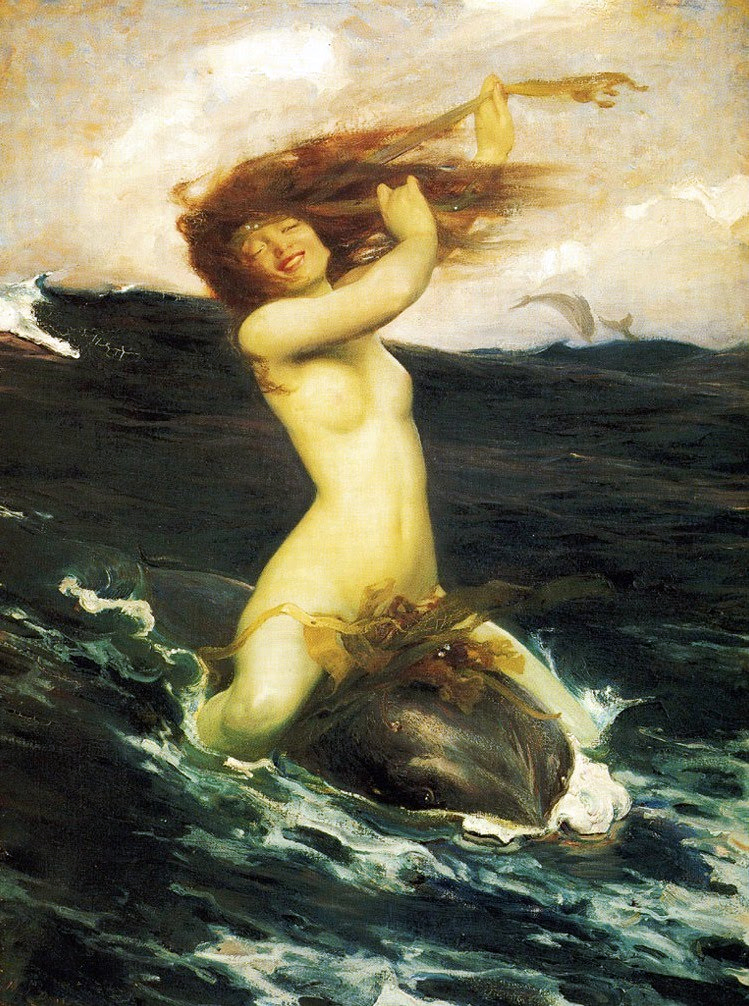
The Foam Sprite, 1896

Art and the Jade, 1906
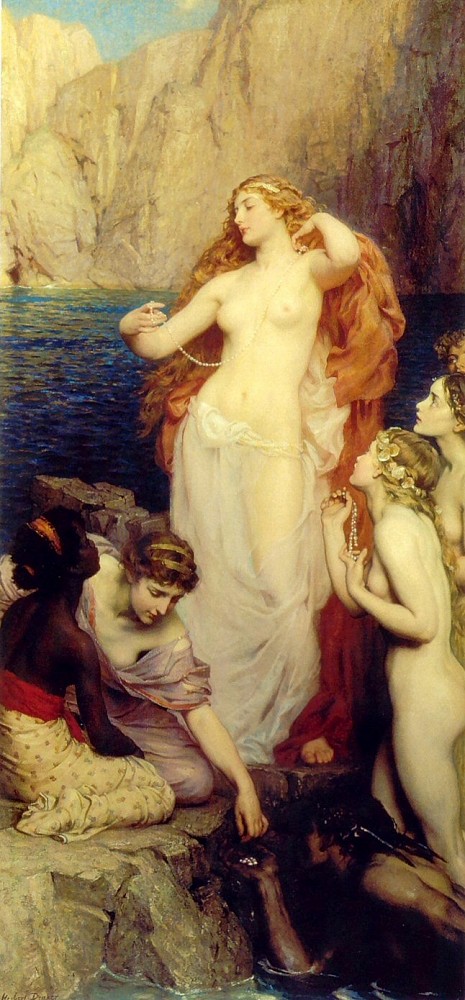
The Pearls of Aphrodite, 1907
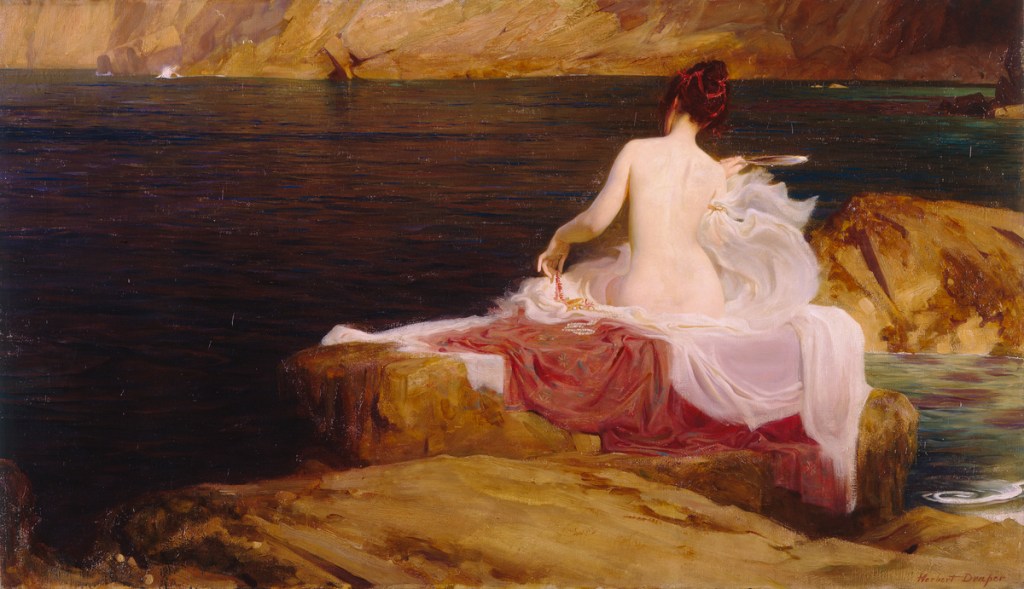
Calypso’s Isle, 1897

flying fish

The Lament for Icarus, 1898

The Vintage Morn, 1896
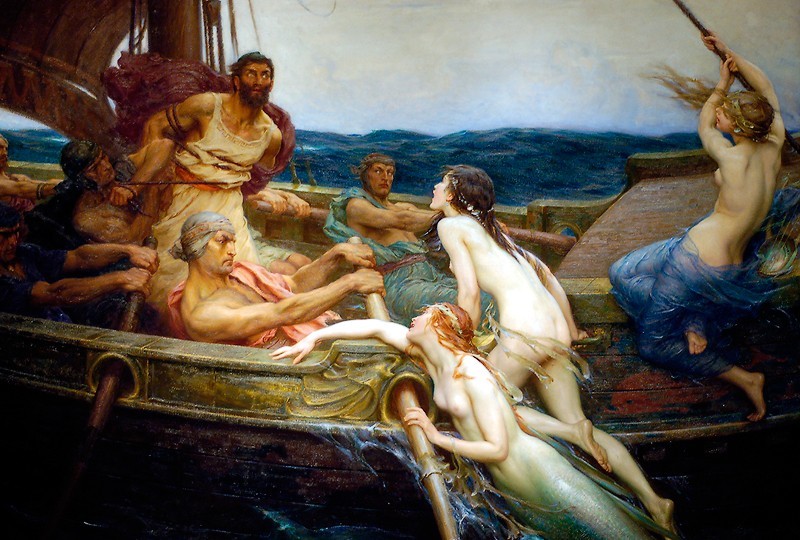
Ulysses and the Sirens, 1909

Sea Melodies, 1904
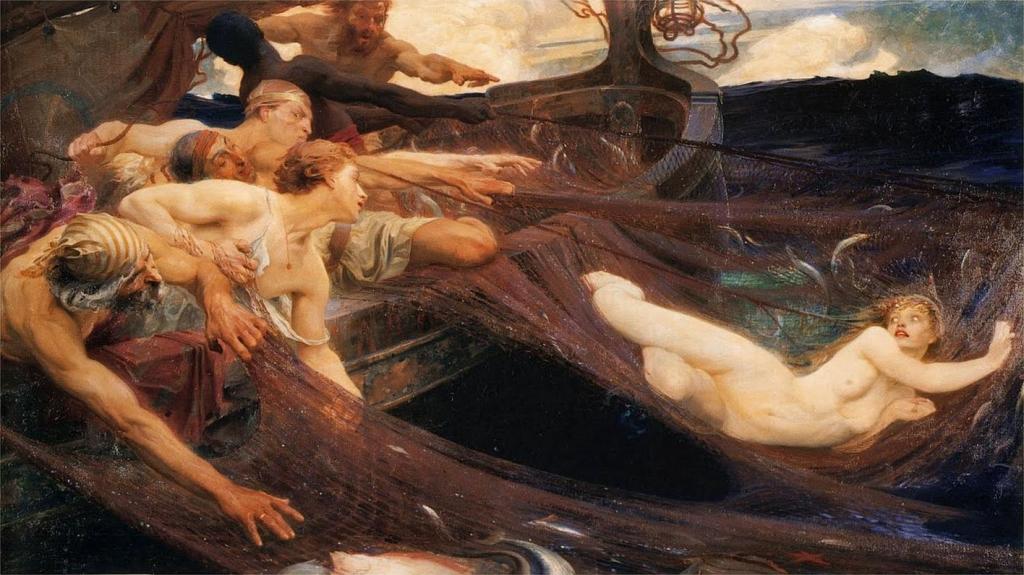
The Sea Maiden, 1894

The Water Nymph, 1908

The Kelpie, 1903

Halcyone, 1915

In the Studio

By Summer Seas, 1912
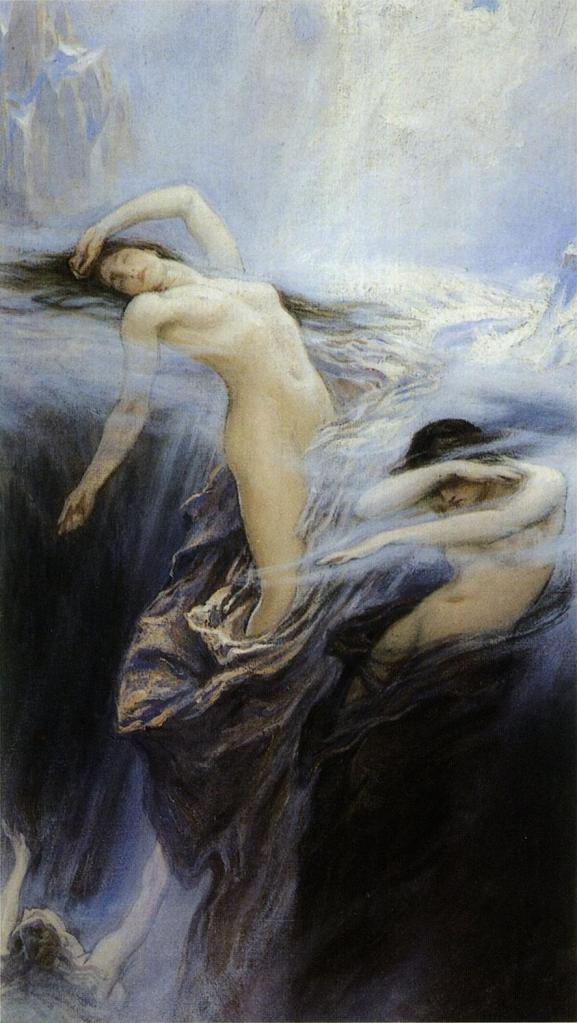
Clyties of the Mist, 1912
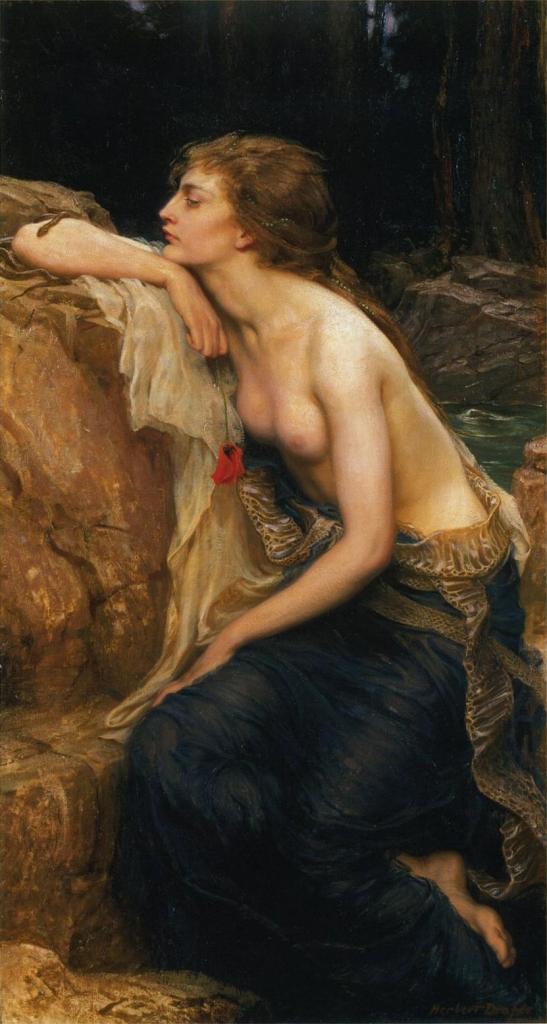
The Lamia, 1909

Go Lovely Rose! Tell her that Wastes her Time and Mine

Gates of Dawn, 1900
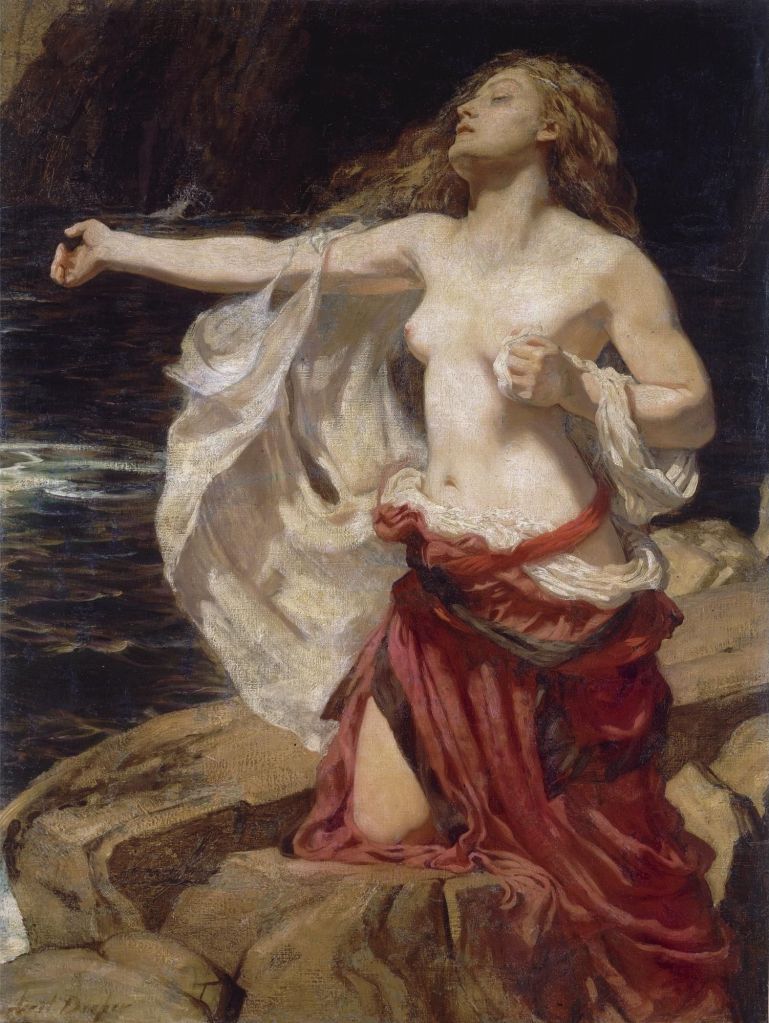
Ariadne, c. 1905

Bather, 1896
Today is the birthday of Nicolai Fechin (Nikolai Ivanovich Feshin; Kazan, Russia 26 November 1881 – 5 October 1955 Santa Monica, California); painter known for his portraits and works featuring Native Americans. After graduating with the highest marks from the Imperial Academy of Arts and traveling in Europe under a Prix de Rome, he returned to his native Kazan, where he taught and painted. He exhibited his first work in the United States in 1910 in an international exhibition in Pittsburgh, Pennsylvania.
In 1913, with his position at the school secure, Fechin married Alexandra Belkovitch (c. 1893–1983), the daughter of the director of the Kazan School of Art. They had a daughter, Eya (1914–2002). In 1933 they divorced and Eya lived with her father most of the time.

self portrait
After immigrating with his family to New York in 1923 and working there for a few years, Fechin developed tuberculosis and moved West for a drier climate. He and his family settled in Taos, New Mexico, where he became fascinated by Native Americans and the landscape. The adobe house which he renovated in Taos is listed on the National Register of Historic Places and houses the Taos Art Museum. After leaving Taos in 1933, Fechin eventually settled in southern California.
Gallery

toilette 1923

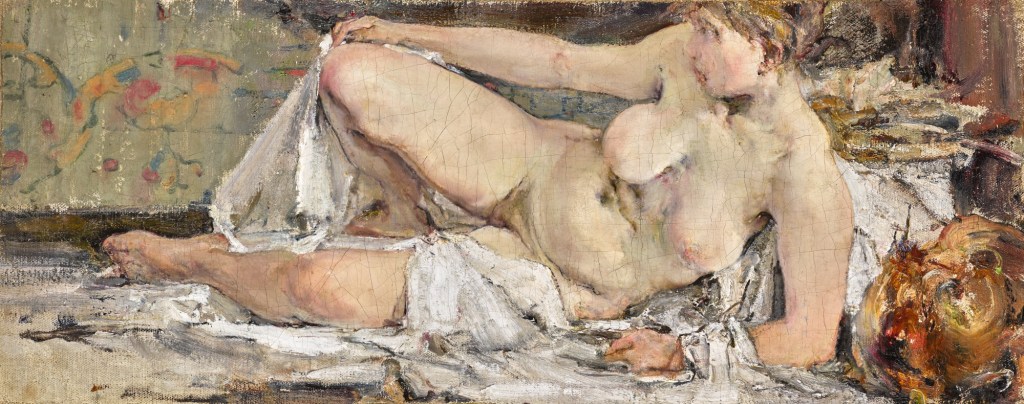
RECLINING NUDE

portrait of student 1913

woman with mirror 1915

Portrait of an Unknown (Lady in purple)
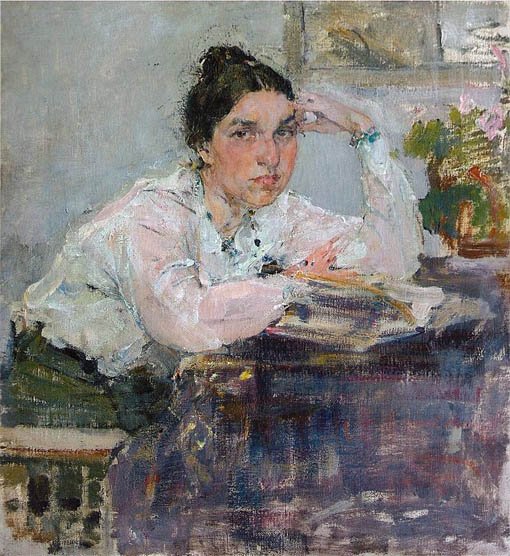
Portrait of N.M. Sapozhnikova
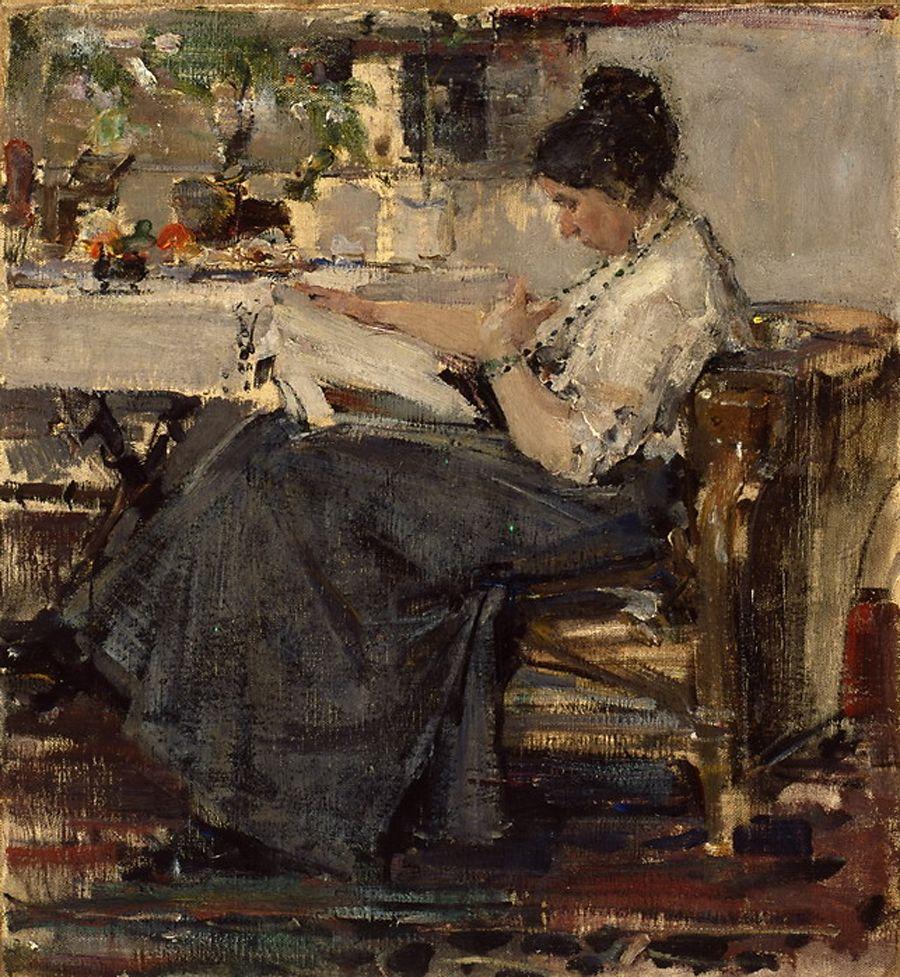
Portrait of N. V. Sapozhnikova (1915), State Art Museum of Tatarstan, Kazan

Portrait of an Unknown (Lady in purple)
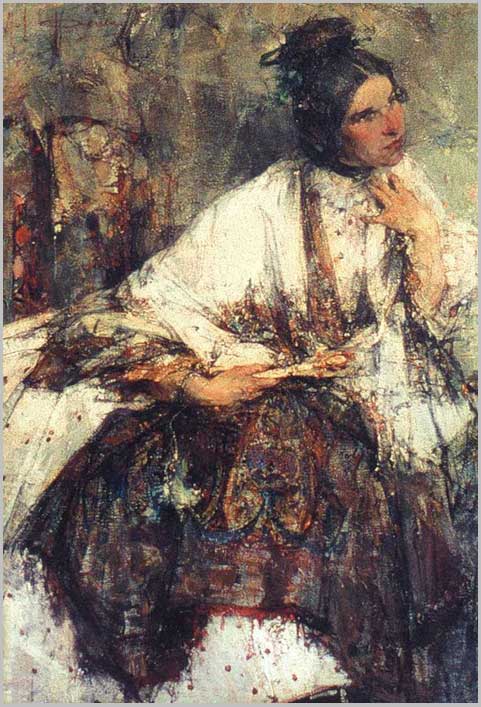
“Portrait of N. Min S. in a shawl.” 1908

And on this day in 1942 – Casablanca, the movie starring Humphrey Bogart and Ingrid Bergman, premieres in New York City.
Casablanca is a 1942 American romantic drama film directed by Michael Curtiz based on Murray Burnett and Joan Alison’s unproduced stage play Everybody Comes to Rick’s. The film stars Humphrey Bogart, Ingrid Bergman, and Paul Henreid. It also features Claude Rains, Conrad Veidt, Sydney Greenstreet, Peter Lorre, and Dooley Wilson. Set during contemporary World War II, it focuses on an American expatriate who must choose between his love for a woman and helping her and her husband, a Czech Resistance leader, escape from the Vichy-controlled city of Casablanca to continue his fight against the Nazis.
Warner Bros. story editor Irene Diamond convinced producer Hal B. Wallis to purchase the film rights to the play in January 1942. Brothers Julius and Philip G. Epstein were initially assigned to write the script. However, despite studio resistance, they left to work on Frank Capra’s Why We Fight series early in 1942. Howard Koch was assigned to the screenplay until the Epsteins returned a month later. Principal photography began on May 25, 1942, ending on August 3. The film was shot entirely at Warner Bros. Studios in Burbank, California with the exception of one sequence at Van Nuys Airport in Van Nuys, Los Angeles.
Although Casablanca was an A-list film with established stars and first-rate writers, no one involved with its production expected it to be anything other than one of the hundreds of ordinary pictures produced by Hollywood that year. Casablanca was rushed into release to take advantage of the publicity from the Allied invasion of North Africa a few weeks earlier. It was released nationally in the United States on January 23, 1943. The film was a solid if unspectacular success in its initial run.
Exceeding expectations, Casablanca went on to win the Academy Award for Best Picture, while Curtiz was selected as Best Director and the Epsteins and Koch were honored for writing the Best Adapted Screenplay—and gradually its reputation grew. Its lead characters, memorable lines, and pervasive theme song have all become iconic, and the film consistently ranks near the top of lists of the greatest films in history. It is of course, one of our favorite films here at TLC.

From left to right: Henreid, Bergman, Rains and Bogart
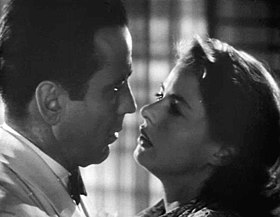
Bogart and Bergman
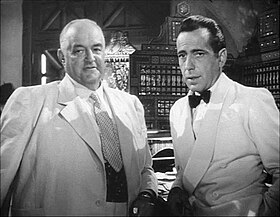
Greenstreet and Bogart
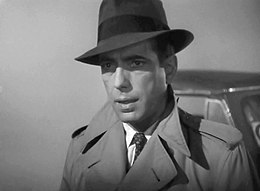
Bogart in the airport scene

Of all the gin joints in all the towns in all the world, she walks into mine.

Play it, Sam. Play As Time Goes By.
- Of all the gin joints in all the towns in all the world, she walks into mine.
- [repeated line] I stick my neck out for nobody.
- [after inspecting a dossier about him] Are my eyes really brown?
- [on Captain Renault] Oh, he’s just like any other man, only more so.
Ilsa Lund
- [to Rick, in Paris as the Germans are invading] I love you so much. And I hate this war so much. Oh, it’s a crazy world. Anything can happen. If you shouldn’t get away, I mean, if something should keep us apart, wherever they put you and wherever I’ll be, I want you to know that…I Love you. Kiss me as if it were the last time.
- You want to feel sorry for yourself, don’t you? With so much at stake, all you can think of is your own feelings. One woman has hurt you, and you take your revenge on the rest of the world. You’re a coward and a weakling.
Yvonne: Where were you last night?
Rick: That’s so long ago, I don’t remember.
Yvonne: Will I see you tonight?
Rick: I never make plans that far ahead.
Ilsa: Play it once, Sam, for old times’ sake.
Sam: I don’t know what you mean, Miss Ilsa.
Ilsa: [whispered] Play it, Sam. Play As Time Goes By.
Sam: Why, I can’t remember it, Miss Ilsa. I’m a little rusty on it.
Ilsa: I’ll hum it for you. [Ilsa hums two bars. Sam starts to play] Sing it, Sam.
Sam: [singing] You must remember this
A kiss is just a kiss
A sigh is just a sigh
The fundamental things apply
As time goes by.
And when two lovers woo
They still say, ‘I love you’
On that you can rely
No matter what the future brings
As Time Goes By.
Lyrics and Music by Herman Hupfeld (1931).
Ilsa: I wasn’t sure you were the same. Let’s see, the last time we met was…
Rick: La Belle Aurore.
Ilsa: How nice, you remembered. But of course, that was the day the Germans marched into Paris.
Rick: Not an easy day to forget.
Ilsa: No.
Rick: I remember every detail. The Germans wore gray, you wore blue.
Ilsa: Yes. I put that dress away. When the Germans march out, I’ll wear it again.
Rick: Your unexpected visit isn’t connected by any chance with the letters of transit? Seems as long as I have those letters, I’ll never be lonely.
Ilsa: You can ask any price you want, but you must give me those letters.
Rick: I went all through that with your husband. It’s no deal.
Ilsa: I know how you feel about me, but I’m asking you to put your feelings aside for something more important.
Rick: Do I have to hear again what a great man your husband is? What an important Cause he’s fighting for?
Ilsa: It was your cause too. In your own way, you were fighting for the same thing.
Rick: I’m not fighting for anything anymore except myself. I’m the only Cause I’m interested in.
Ilsa: Richard, we loved each other once. If those days meant anything at all to you…
Rick: I wouldn’t bring up Paris If I were you. It’s poor salesmanship.
Ilsa: I can’t fight it anymore. I ran away from you once. I can’t do it again. Oh, I don’t know what’s right any longer. You have to think for both of us. For all of us.
Rick: All right, I will. Here’s looking at you, kid.
Ilsa: [smiles] I wish I didn’t love you so much.
Rick: Because you’re getting on that plane.
Ilsa: I don’t understand. What about you?
Rick: I’m staying here with him [Renault] ’til the plane gets safely away.
Ilsa: No, Richard. No. What has happened to you? Last night…
Rick: Last night, we said a great many things. You said I was to do the thinking for both of us. Well, I’ve done a lot of it since then and it all adds up to one thing. You’re getting on that plane with Victor where you belong.
Ilsa: But Richard, no, I’ve…
Rick: Now, you’ve got to listen to me. Do you have any idea what you have to look forward to if you stayed here? Nine chances out of ten, we’d both wind up in a concentration camp. Isn’t that true, Louis?
Renault: I’m afraid Major Strasser would insist.
Ilsa: You’re saying this only to make me go.
Rick: I’m saying it because it’s true. Inside of us, we both know you belong with Victor. You’re part of his work, the thing that keeps him going. If that plane leaves the ground and you’re not with him, you’ll regret it. Maybe not today, maybe not tomorrow, but soon and for the rest of your life.
Ilsa: But what about us?
Rick: We’ll always have Paris. We didn’t have it before…we’d…we’d lost it until you came to Casablanca. We got it back last night.
Ilsa: When I said I would never leave you…
Rick: And you never will. But I’ve got a job to do too. Where I’m going, you can’t follow. What I’ve got to do, you can’t be any part of. Ilsa, I’m no good at being noble, but it doesn’t take much to see that the problems of three little people don’t amount to a hill of beans in this crazy world. Someday you’ll understand that. Now, now. Here’s looking at you, kid.
Mac Tag
thanks for stoppin’ by y’all
 The Lovers’ Chronicle
Leave a comment