
Dear Zazie, Here is today’s Lovers’ Chronicle from Mac Tag dedicated to his muse. Are you adrift? Rhett
The Lovers’ Chronicle
Dear Muse,
we can talk about the opposite
of today’s topic
after seein’ a big Gulf Coast sunset
on Mexico Beach
“And an almost full moon”
yes that does not happen often
“Another moment to add to our list”
now that we are anchored
and the closest we will git
to bein’ adrift is if we choose
to spend time there together
© copyright 2023 mac tag/cowboy coleridge all rights reserved
a consequence of no purpose, mostly directionless for decades, not a wonder made it this far but pretty close, almost drifted away, but to be fair there was a course just not the right one, because it would not have led here to you
© copyright 2022.2023 mac tag/cowboy coleridge all rights reserved
no longer
moored now
in what i thought
would never be
i had given up
just knew the broken
trail would preclude
anything like this
then you walked in
and you smiled
and we sat
on that bench
and began to fall
and this cold, cold
heart started to thaw
and i am thankful
© copyright 2021 mac tag/cowboy coleridge all rights reserved
Pale Love, Pale Rider
another for the
that was then this is now file
kinda went to sleep one day
and woke up there
was susceptible to fallin’
into someone’s orbit
and it waned from relatively
calm to chaotic
till i finally dropped anchor
some of us just need more time
and someone like you
to come along
© copyright 2020.2023 mac tag/cowboy coleridge all rights reserved
to turn your face
to disregard delight
in bein’ hurt
to believe
to devote yourself
to bein’ disillusioned
this is it;
whoever
has tasted it,
knows
since after all,
it is us who pays
what am i, that,
with unceasin’ care,
thou didst seek after me,
that thou didst wait
© copyright 2019 mac tag/cowboy coleridge all rights reserved
thanks Sheli
she wrote a story
about a man
adrift after the death
of his lover
no, not my story
you know me,
i woulda told ya
i never let anyone
get close enough
to feel that way
well,
the unrequited ones
came close
funny,
or is it sad,
that those did
but the ones
where i was wanted
did not
© copyright 2018 mac tag/cowboy coleridge all rights reserved
thanks Lisa,
“Minor thing that annoys the shit out of me:
“Wifey”
Major thing that used to annoy the shit outta me…
Havin’ a wifey.
***
in a sea of despair
partly or mostly to blame
not seekin’ sympathy
just want to tell the tale
not to worry
will keep the drama
to a minimum
set a course that could not be followed,
hindsight affords that knowledge,
once there, had no idea how to git out
chose what appeared to be the best route
and then held on and can you believe it
actually made it, surprised even myself
© copyright 2017.2023 mac tag/cowboy coleridge all rights reserved
Long have eyes been dry
Long have feelin’s been numb
twilight falls
lie with strainin eyes
hear the wind moanin
across the plains
night, interminably long,
yet prayin
to hold back the dawn
hear a deep, mutterin’ curse, under breath,
and then the tinklin’ of spurs, movin’ away
Cold settles in
Windmill squeaks
Train whistle blows
Boot heals clunk
On wooden floors
Nothin’ left
But the waitin’
© copyright 2016 mac tag/cowboy coleridge all rights reserved
Maybe that was my problem
I was never afraid
Of anything
A man who is
Good with a rope
Has no excuse
For lettin’ himself
Git tied down
© copyright 2015 mac tag/cowboy coleridge all rights reserved
Weary after a long hard ride
Horse rubbed down, fed
Wood hauled in, fire started.
Fix some bacon and beans.
Time now for whiskey
And the words for you
So many words
Have I for you
So little time
© copyright 2014 mac tag/cowboy coleridge all rights reserved
| Lope de Vega | |
|---|---|
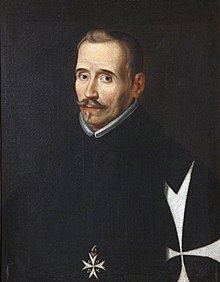 | |
Today is the birthday of Lope de Vega (Félix Lope de Vega y Carpio; Madrid; 25 November 1562 – 27 August 1635 Madrid); playwright, poet and novelist. He was one of the key figures in the Spanish Golden Century of Baroque literature. His reputation in the world of Spanish literature is second only to that of Miguel de Cervantes, while the sheer volume of his literary output is unequalled, making him one of the most prolific authors in the history of literature.
Nicknamed: Fénix de los Ingenios (The Phoenix of Wits) and Monstruo de la Naturaleza (Prodigy of Nature) by Cervantes, Lope de Vega renewed the Spanish theatre at a time when it was starting to become a mass cultural phenomenon. He is regarded as one of the greatest dramatists in Western literature, his plays still being produced worldwide. He was also one of the best lyric poets in the Spanish language, and author of several novels. Some 3,000 sonnets, 3 novels, 4 novellas, 9 epic poems, and about 500 plays are attributed to him.
Verse
Huir el rostro al claro desengaño,
beber veneno por licor süave,
olvidar el provecho, amar el daño;
creer que un cielo en un infierno cabe,
dar la vida y el alma a un desengaño;
esto es amor. Quien lo probó lo sabe.
- To turn your face from clear proofs of deceit,
To drink poison as if it were a soothing liquor,
To disregard gain and delight in being injured.
To believe that heaven can lie contained in hell;
To devote your life and soul to being disillusioned;
This is love; whoever has tasted it, knows. - Sonnet, “Desmayarse, atreverse, estar furioso”, line 9, from Rimas (1602); cited from José Manuel Blecua (ed.) Lírica (Madrid: Clásicos Castalia, [1981] 1999) p. 136. Translation from Eugenio Florit (ed.) Introduction to Spanish Poetry (New York: Dover, [1964] 1991) p. 65.
- Como las paga el vulgo, es justo
hablarle en necio para darle gusto.- Since after all, it is the crowd who pays,
Why not content them when you write your plays? - Arte nuevo de hacer comedias en este tiempo, line 47. (1609). Translation from Marvin A. Carlson Theories of the Theatre (Ithaca: Cornell Univ. Press, [1984] 1993) p. 62.
- Since after all, it is the crowd who pays,
- Armonía es puro amor, porque el amor es concierto.
- Harmony is pure love, for love is complete agreement.
- Fuenteovejuna (1613), Barrildo, Act I.
- Lord, what am I, that, with unceasing care,
Thou didst seek after me, — that Thou didst wait,
Wet with unhealthy dews, before my gate,
And pass the gloomy nights of winter there?- Reported in Josiah Hotchkiss Gilbert, Dictionary of Burning Words of Brilliant Writers (1895), p. 89.
La Dorotea (1632)
- A mis soledades voy,
de mis soledades vengo,
porque para andar conmigo
me bastan mis pensamientos.- Lone I muse but feel not lonely,
Covert solitude’s my lore;
For my company I only
Want my thoughts and nothing more. - Act I, sc. iv. Translation from John Armstrong Crow An Anthology of Spanish Poetry (Baton Rouge: Louisiana State Univ. Press, 1979) p. 107.
- Lone I muse but feel not lonely,
- Dijeron que antiguamente
se fue la verdad al cielo;
tal la pusieron los hombres,
que desde entonces no ha vuelto.
En dos edades vivimos
los propios y los ajenos:
la de plata los estraños,
y la de cobre los nuestros.- In ancient days they said truth had fled to heaven: attacked on every side, it’s not been heard of since. We live in different ages, non-Spaniards and ourselves: they in the age of silver, we in the age of brass.
- Act I, sc. iv. Translation from Alan S. Trueblood and Edwin Honig (ed. and trans.) La Dorotea (Cambridge, MA: Harvard Univ. Press, 1985) p. 23.
- Pero la vida es corta:
viviendo, todo falta;
muriendo, todo sobra.- But life is short: while one lives, everything is lacking; when one is dead, everything is superfluous.
- Act III, sc. vii. Translation from Arthur Terry Seventeenth-Century Spanish Poetry (Cambridge: CUP, 1993) p. 118.

Today is the birthday of Maurice Denis (Granville, Manche, Normandy, France; 25 November 1870 – 13 November 1943 Paris); painter, decorative artist and writer, who was an important figure in the transitional period between impressionism and modern art. He was associated with Les Nabis then the Symbolist movement, and then with a return to neo-classicism. His theories contributed to the foundations of cubism, fauvism, and abstract art. Following the First World War, he founded the Ateliers d’Art Sacré (Workshops of Sacred Art), decorated the interiors of churches, and worked for a revival of religious art.
A major event in the life of Denis was his meeting with Marthe Meurier in October 1890. From June 1891 they had a long romance, meticulously documented in his journal, and were married on 12 June 1893. She became an important part of his art, appearing in many pictures and also in decorative works, such painted fans, often as an idealized figure representing purity and love.
Beginning in 1891, shortly after his engagement, Denis made Marthe the most frequent subject of his paintings; she was depicted, in purified and idealized form, doing household tasks, taking naps, and at the dining room table. She appeared in his landscapes, and in his most ambitious works of the time, The series called The Muses, which he began in 1893, and showed at the Salon of Independents in 1893.
His wife played the piano, and throughout the 1890s Denis had a growing interest in the connections between music and art. He painted a portrait of her at the piano in 1890. He designed a flowing lithograph, featuring Marthe, for the cover for the sheet music of La Damoiselle élue by Claude Debussy, as well as another lithograph for the poem Pelléas et Mélisande by Maurice Maeterlinck, which Debussy transformed into an opera; and in 1894 he painted La Petit Air, based on the poem Princesse Maleine by Stéphane Mallarmé, the most prominent literary proponent of symbolism. In 1893 made a collaborative project with the writer André Gide, which combined art and literature; he provided a series of thirty lithographs to accompany a long essay by Gide, called Le Voyage d’Urien. The Lithographs did not illustrate the text, but approached the same topics from an artist’s point of view.
Another topic he addressed in this period was the relationship between sacred love and profane love. The painting had three female figures, two nude and one clothed, following the model of Le Concert Champêtre and L’Amour Sacré et L’Amour Profane of Titian and Déjeuner sur l’herbe by Manet. The setting is his own garden, with the viaduct of Saint-Germain-en-Laye in the background. The nude figures represented sacred love, and he clothed figure profane love. He made another painting, this time of Marthe nude in the garden, representing both sacred and profane love in one figure.
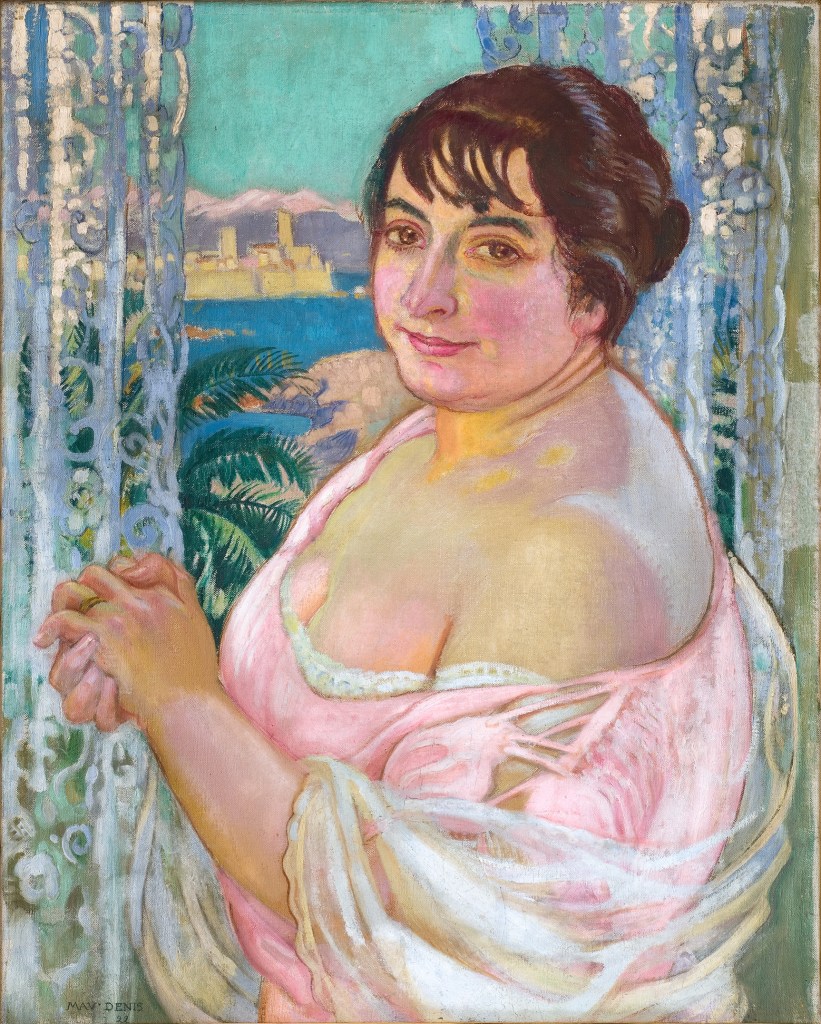
Following Marthe’s death in 1919, Denis painted a chapel dedicated to her memory. He married again on February 22, 1922 to Elisabeth Graterolleore, whom he had used as a model for one of the figures in the cupola of the Théâtre des Champs-Elysées. Elisabeth also features in several paintings of Denis, sometimes alongside Marthe.
Gallery

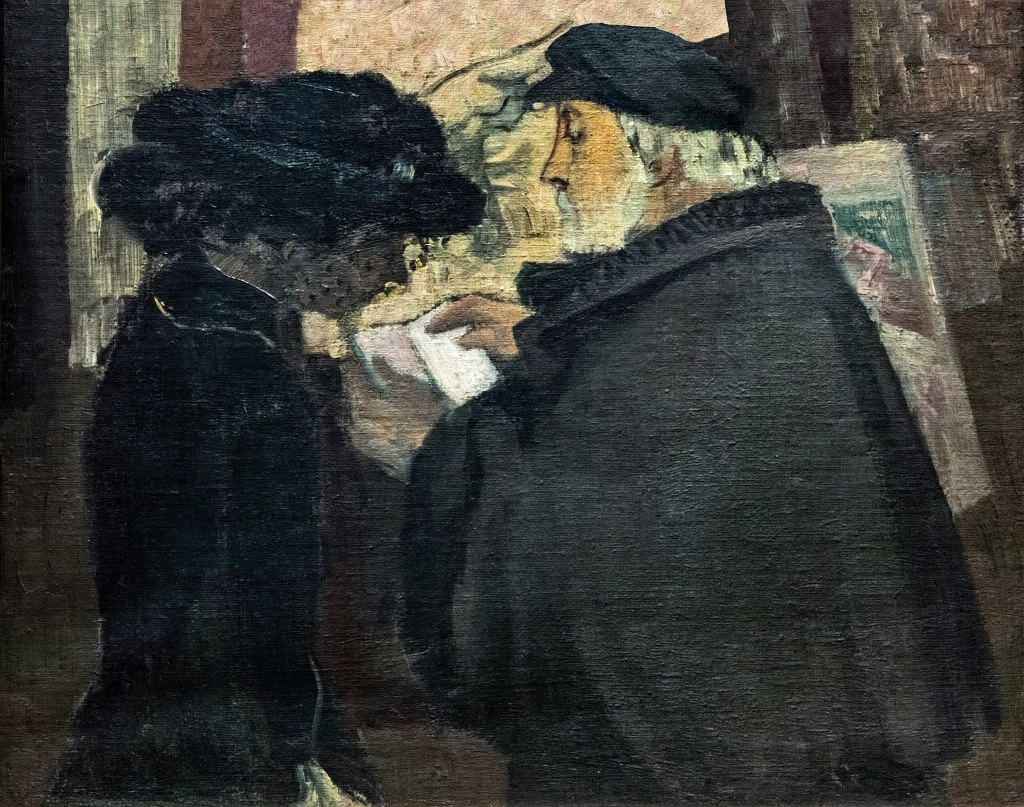
Degas et son modèle, 1906; huile sur toile, Paris, musée d’Orsay

Wave (1916)
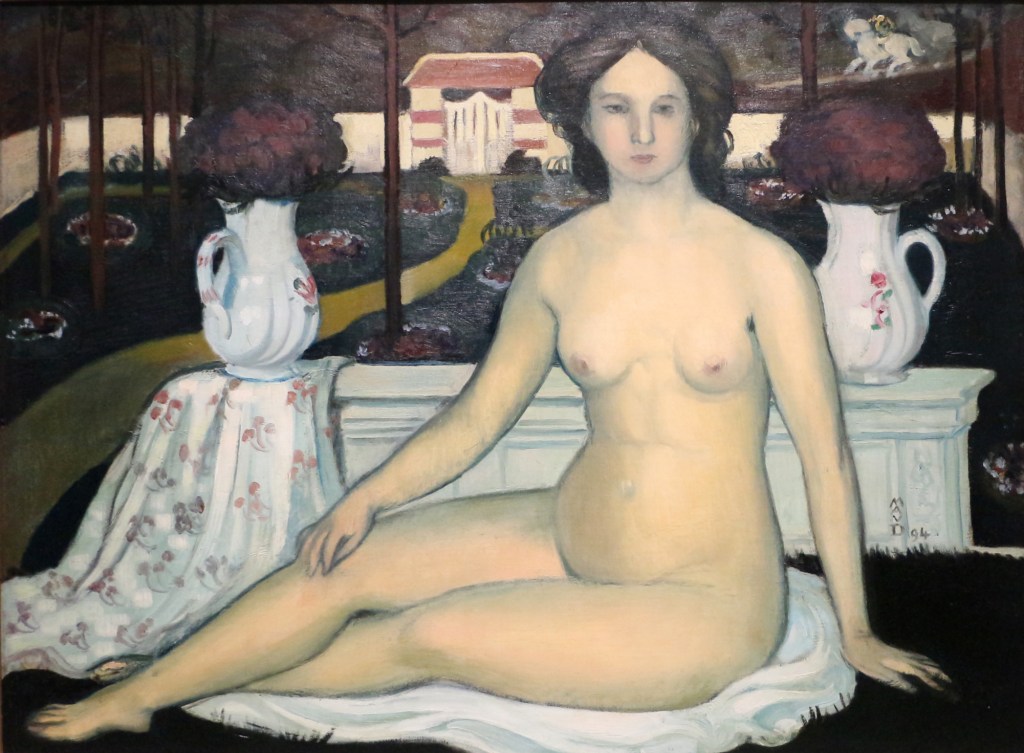
Nude with Bouquet of Violets (1894)

Portrait of Marthe, (1893)
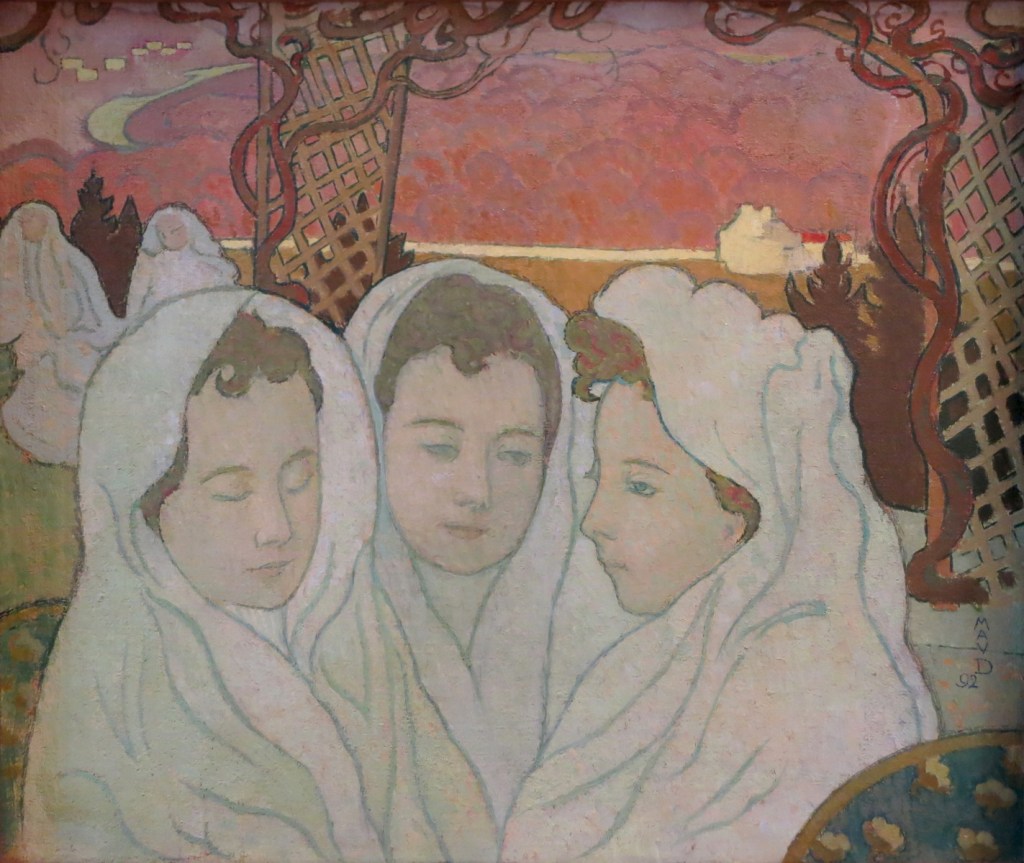
Triple Portrait of Marthe (1892)
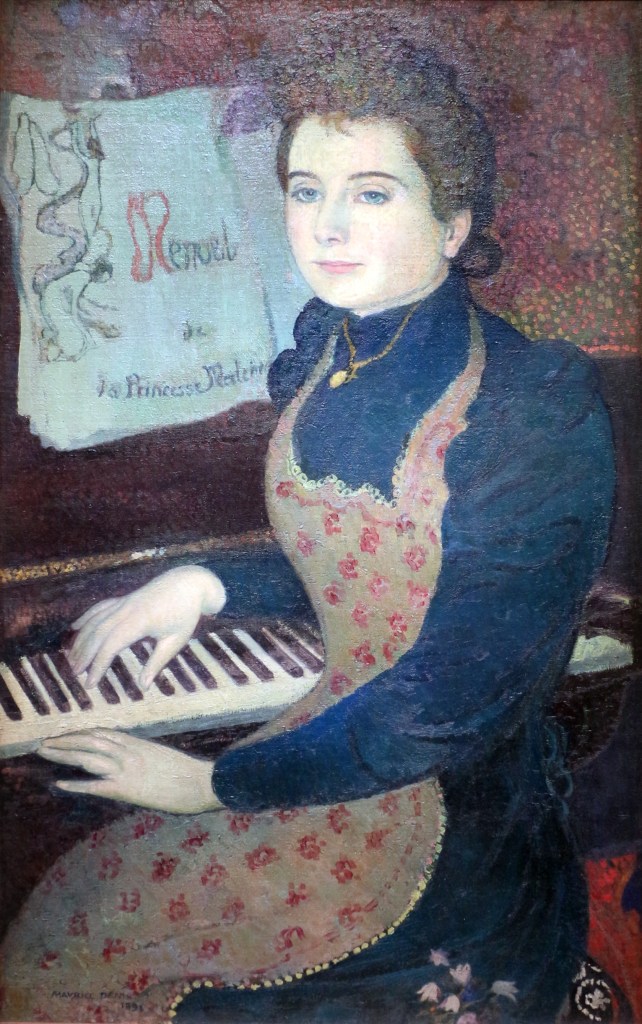
Marthe at the Piano (1891)

Zéphyr transporte Psyché sur l’île du bonheur (1908), Moscou, palais Morozov
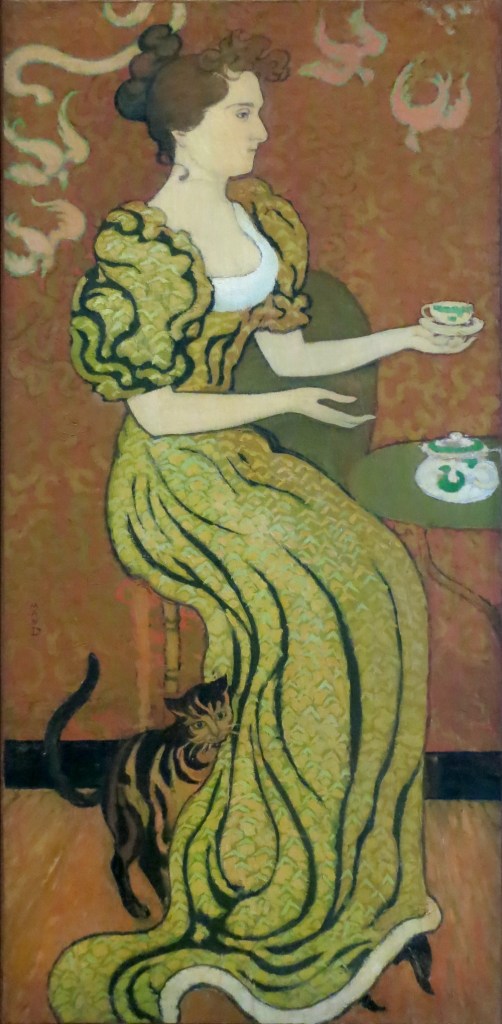
Madame Ranson au chat (1892), huile sur toile, 89 × 45 cm, Saint-Germain-en-Laye, musée Maurice Denis

Portrait of Yvonne Lerolle in Three Aspects (1897)
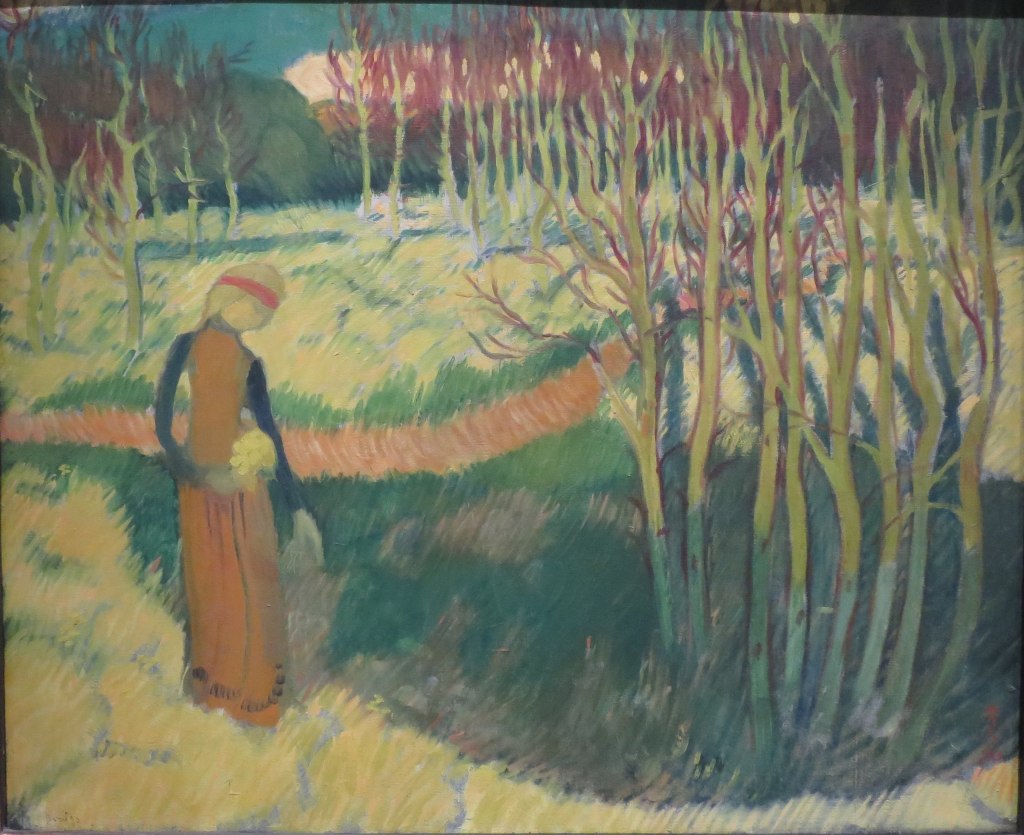
Motif Romanesque (1890), Los Angeles County Museum of Art

September Evening, (1891), Musée d’Orsay
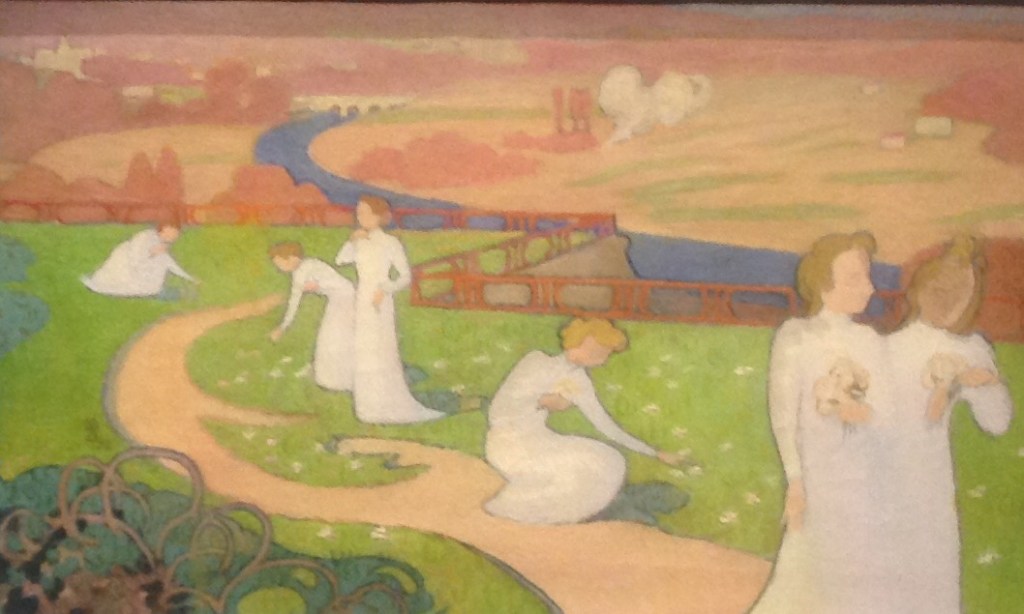
April or The Road of Life, one of four panels for the bedroom of a young girl (1892)
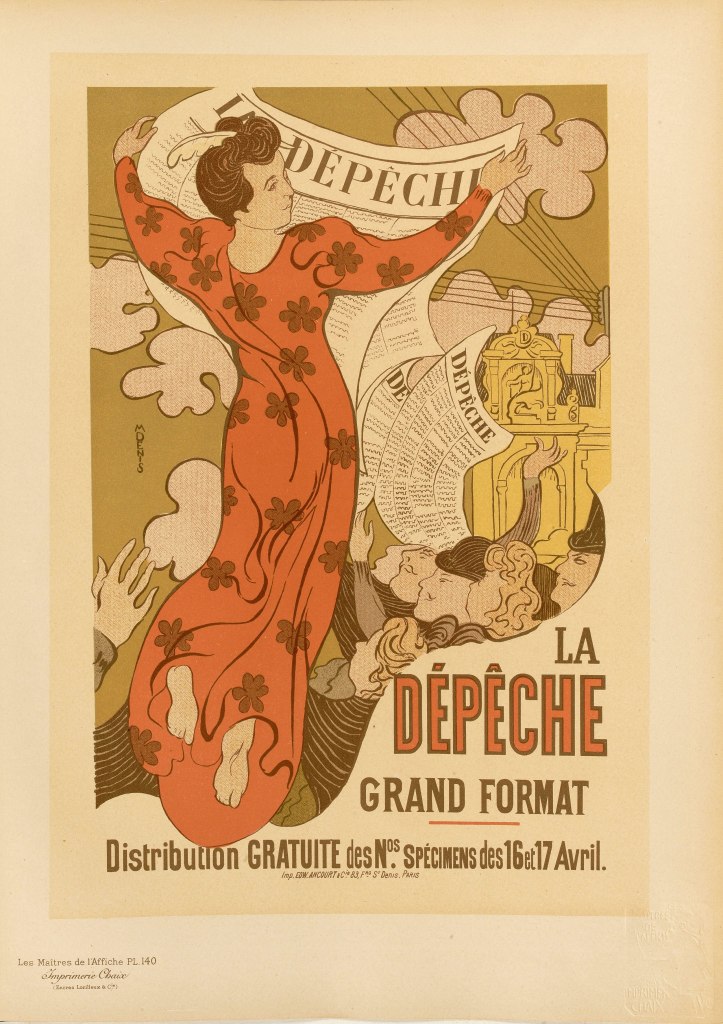
Poster published in Les Maîtres de l’Affiche


“L’Échelle dans la foliage” (“The Ladder in the Foliage”) (1892)
And today is the birthday of Sonya Noskowiak (Leipzig, Germany; November 1900 – 28 April 1975 Greenbrae, California); photographer and member of the San Francisco photography collective Group f/64 that included Ansel Adams and Edward Weston. In my opinion, an important figure in one of the great photographic movements of the twentieth century. Throughout her career, Noskowiak photographed landscapes, still lifes, and portraits. Her most well-known, though unacknowledged, portraits are of the author John Steinbeck. In 1936, Noskowiak was awarded a prize at the annual exhibition of the San Francisco Society of Women Artists. She was also represented in the San Francisco Museum of Art’s “Scenes from San Francisco” exhibit in 1939. Ten years before her death, Noskowiak’s work was included in a WPA exhibition at the Oakland Museum in Oakland, California.
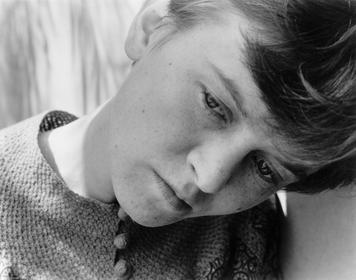
In early April 1929, Noskowiak met Weston at a party, and the two began a relationship immediately; she eventually became his model, muse, pupil, and assistant. Weston first taught her to “spot’ photos——touching up flaws in prints——before giving her her first professional camera. This camera contained no film, and for several months Noskowiak worked with Weston, pretending to photograph while he taught her the mechanics of photography. During her time with Weston, Noskowiak’s photography developed greatly, suggesting her understanding of craftsmanship as well as expressing her own style. Several of Weston’s works, such as Red Cabbage Halved and Artichoke Halved, were inspired by Noskowiak’s early negatives. Weston once said: “Any of these I would sign as my own.” They broke up in 1935.
Gallery


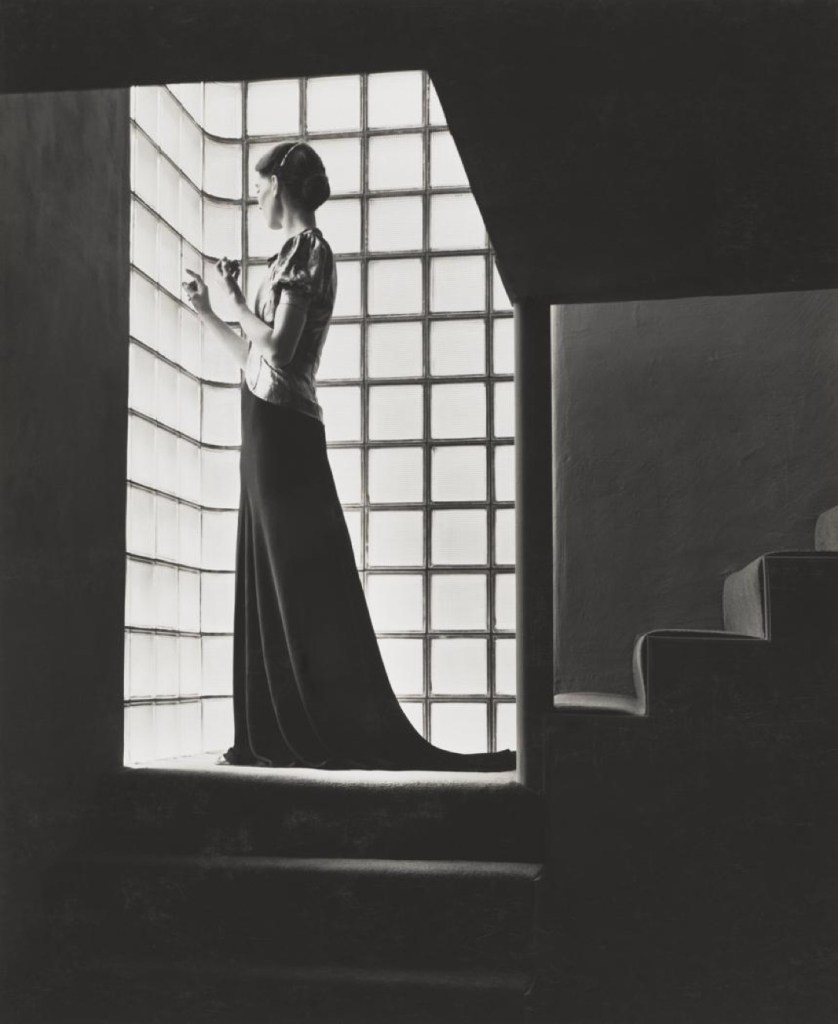


hands and feet 1930
thanks for stoppin’ by y’all
Mac Tag

 The Lovers’ Chronicle
Leave a comment