Dear Zazie, Here is today’s Lovers’ Chronicle from Mac Tag dedicated to his muse. Have you known sadness? Rhett
The Lovers’ Chronicle
Dear Muse,
this is a line
from the Guy Clark song
“The Cape”
“You will have to play it for me”
the song follows a man from
childhood to old age with
the common thread,
he always trusts his cape
“Important that you know your cape”
absolutely, gotta make sure
it is securely fastened
“As ours are”
yes
*as i spread my arms for you*
© copyright 2023 mac tag/cowboy coleridge all rights reserved
tried that several times before i found my cape; the crash and burns that followed were inevitable and often colorful, suppose we can drag out that worn out better late blah blah blah, but some never figure it out, so some solace there, and now with cape secure, we can spread our arms
© copyright 2022.2023 mac tag/cowboy coleridge all rights reserved
the trick was findin’ the cape
after that, it all made sense
seems that should be the purpose
makin’ sense of what comes by
figurin’ out have, need and want
and how to git through the days
the best way possible
found my cape
so when you came along
all i had to do was spread my arms
© copyright 2021.2023 mac tag/cowboy coleridge all rights reserved
Pale Love, Pale Rider
the way your name sounds
when i say it out loud
how else can it be,
givin’ everything we have
to each other
sure enough,
much to our surprise,
after all, here we are
stronger than before
anyhow, this is our story
time for us to revel
in our shared abandon
© copyright 2020 mac tag/cowboy coleridge all rights reserved
unto the eye, why
was i ever undoin’
all that had been done
had but one, well
maybe several,
turns more, even
in the state i was in
more naked or more
plainly seen
“’Twas well for thee
leaving this place,
hadst thou viewed her.”
so lost a thing
as thou hadst been
© copyright 2019 mac tag/cowboy coleridge all rights reserved
of course i felt like
burnin’ everything down
gave the finger to Faith,
told Hope to go to hell,
and gave Grace away
there was nothin’ left
nowhere to hide
the rope was played out
cannot say
what kept me holdin’ on
pure stubbornness i s’pose
anyhow,
grateful for what i have
and for you
© copyright 2018 mac tag/cowboy coleridge all rights reserved
the greatest pleasure for me…
to bring a smile to the face
of an extraordinary woman
thanks Karen…
i love the way
your name sounds
in a candlelit room…
did you know
that lionesses
and cowboys always
land on their feet…
our minds are strong,
our hearts are resilient
how else can you explain
givin’ everything you have
to someone only to find
it is not enough
and then sure enough,
much to our surprise,
after the fall, there it is
beatin’ stronger than before
recoverin’ from the rendin’
it gets through the hurt
and learns to beat for itself
anyhow, that is our story
we keep remindin’ ourselves,
and hopin’ we succeed
with the convincin’
however the disappointment comes
whether it be
from one sided love
or when the one you love
loves you and talks about
a rare connection then
of a sudden, insists it is over
either way, s’pose those
are moments in life
when one must accept
that sometimes
there is no understandin’
someone else’s feelin’s
and sometimes
it is better to let go…
let go… let go…
for one’s own well bein’
and we are learnin’
to spread our arms
and hold our breaths
© copyright 2017 mac tag/cowboy Coleridge/Dead Lioness all rights reserved
Shoulda been born
With a warnin’ label:
Not fit for human
Cohabitation
© copyright 2016 mac tag/cowboy Coleridge/Dead Lioness all rights reserved
Darlin’, all I need
are the particulars
And you can have
whatever you want
“I would ask you
if you could remain
emotionally detached
But I do no think that
is your problem. Is it?”
Nope
“Disposable pleasures
Or meaningful pursuits”
i will take disposable pleasures
for two thousand Alex
“Am I going to have
a problem with you?”
Oh no, darlin’.
You are not my type.
“Smart?”
No. Single.
“You do not trust
anyone, do you?”
Nope
“Then you have learnt
your lesson.”
Yep
© copyright 2015 mac tag/cowboy Coleridge/Dead Lioness all rights reserved

Today is the birthday of Louis Racine (Paris 6 November 1692 – 29 January 1763, Paris); poet of the Age of the Enlightenment.
The second son and the seventh and last child of the celebrated tragic dramatist Jean Racine, he was interested in poetry from childhood but was dissuaded from trying to make it his career by the poet Boileau on the grounds that the gift never existed in two successive generations. However, in 1719 Racine became a member of the Académie des Inscriptions and published his first major poem, La Grâce, in 1722. But, because of the poem’s Jansenist inspiration, Cardinal de Fleury, chief minister of Louis XV, blocked the poet’s admission to the Académie Française, and instead Racine was induced to accept the post of inspector-general of taxes at Marseille in Provence.
For the next 24 years, although he continued to write poetry, Racine worked as a tax inspector in various provincial towns and cities, marrying in 1728. His most important poem, La Religion, in which he was careful to avoid further accusations of Jansenism, was published in 1742. He eventually retired from government service in 1746, aged 54, and returned to Paris where he devoted himself to his writing.
In November 1755, he lost his only son and his daughter-in-law when they were swept away by the tsunami from the Lisbon earthquake while on honeymoon at Cadiz in Spain. This tragedy, commemorated by the French poet Écouchard-Lebrun, is said to have broken Racine’s spirit. He sold his large library, gave up writing, and devoted himself now to the practice of religion. It was around this time that Racine wrote his last published work, an essay on the famous feral child of 18th-century France Marie-Angélique Memmie Le Blanc whom he had interviewed and written of in his philosophical poem L’Épître II sur l’homme (1747) (Second Epistle on Man).
Racine was characterised by Voltaire, the leading French intellectual of his day, as le bon versificateur Racine, fils du grand Racine (“the good versifier Racine, son of the great Racine”). His Oeuvres complètes (complete works) were collected in six volumes and published in Paris in 1808.
His father’s poem (and my no doubt inept translation) “Choer D’Esther” served as inspiration for this poem:
Sadness
Lost then found then lost
Sadness; a story
Found
She found me against the odds,
Lonely, my life blood flowin’
Like water on earth, spreadin’
From beyond, I heard Her voice,
A lost man
Lost
I had seen love lost
Like a hidden beast
Its countenance bold
Governin’ the thunder
Tramplin’ the defeated
I had that happen, and happen again
Found
Then she came
Happiness in me who knew the sweetness
I felt young, in the shadow of her beauty;
The most charmin’ dreams have nothin’
comparable, comparable
The pleasure she spread in me
Lost
Then she was gone
Sadness in me who knows the bitterness
Sadness
Nothin’ soothes, nothin’ forgives;
Crazy heart abandoned
It awaits the return;
It excuses my weakness;
To get me down it hastens:
For the words she uncovered
Are all I know of affection
If I could share with her
Sadness
It shows there is no mercy
One of the not chosen
It has revealed its pain
Sadness
Ah Could I share with her
Sadness
That it not be blessed, that it not be sung;
Though it will be known to me
Beyond time and age
© copyright 2012 mac tag/Cowboy Coleridge all rights reserved
The Song of the Day is “Sadness” by Enigma.
Today is the birthday of Dennis Miller Bunker (New York City; November 6, 1861 – December 28, 1890 Boston); painter and innovator of American Impressionism. His mature works include both brightly colored landscape paintings and dark, finely drawn portraits and figures. One of the major American painters of the late 19th century, and a friend of many prominent artists of the era.


Bunker Painting at Calcot, John singer sargent
Bunker married Eleanor Hardy in Boston. The couple then moved to New York. Returning to Boston to celebrate Christmas with the Hardy family, Bunker fell ill. he died of heart failure, probably caused by cerebro-spinal meningitis at the age of 29. He was interred at Milton Cemetery, Milton, Massachusetts. His tombstone was designed by his friends Stanford White and Augustus Saint-Gaudens.
Gallery

Portrait Sketch of Eleanor Hardy Bunker, 1890. Private collection.

Jessica, 1890. Museum of Fine Arts, Boston

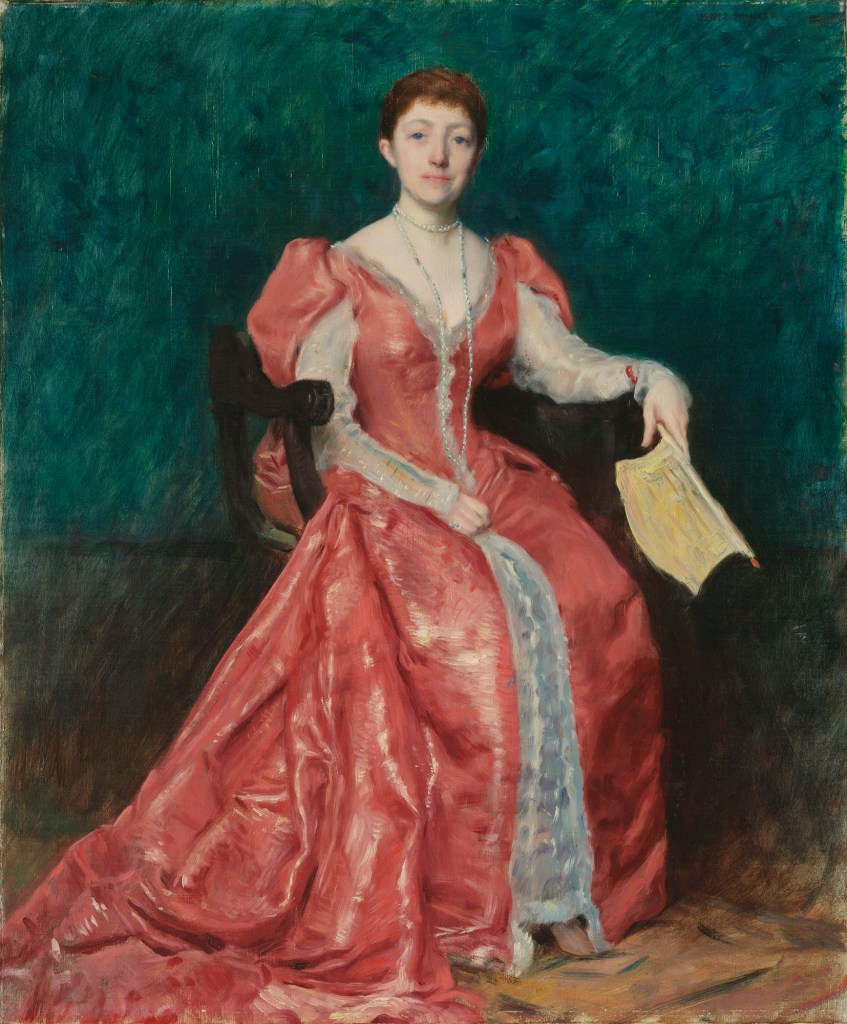
Isabella Stewart Gardner – P33e6 – Isabella Stewart Gardner Museum
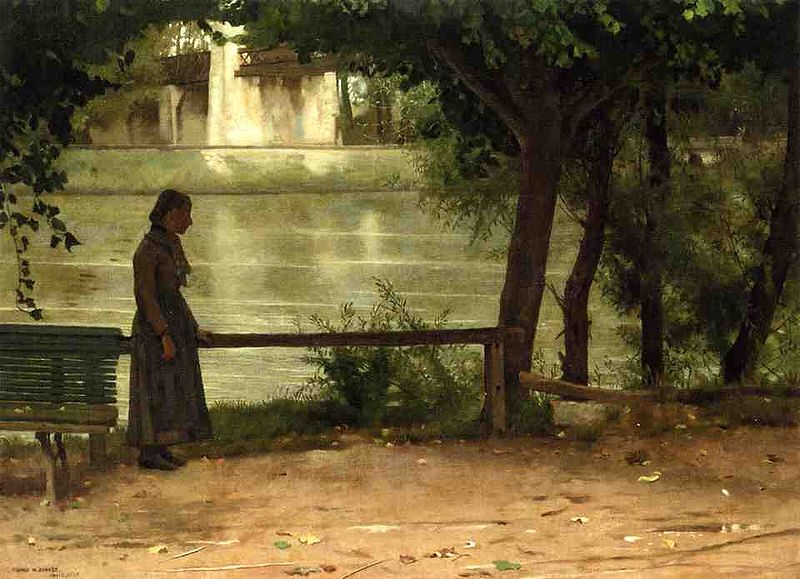
On the Banks of the Oise

portrait of a woman

Anne Page
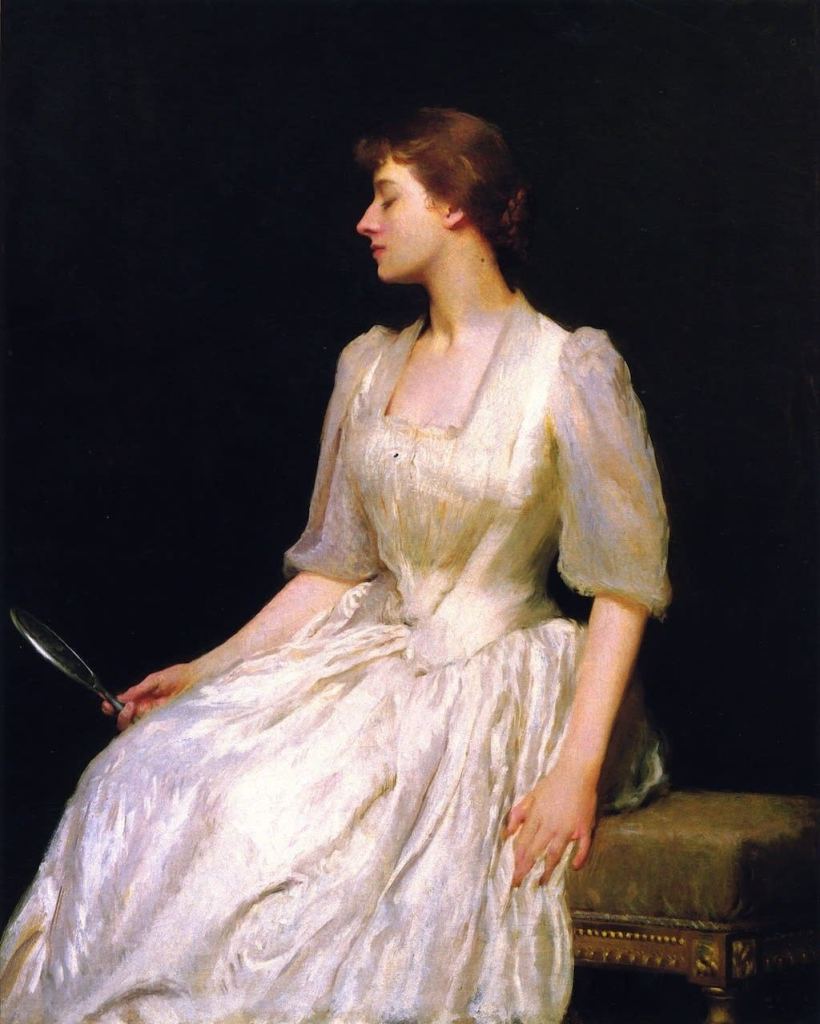
the mirror
| Everett Shinn | |
|---|---|
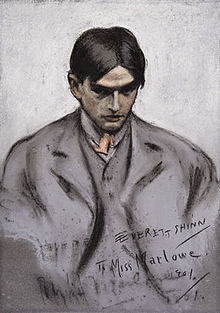 | |
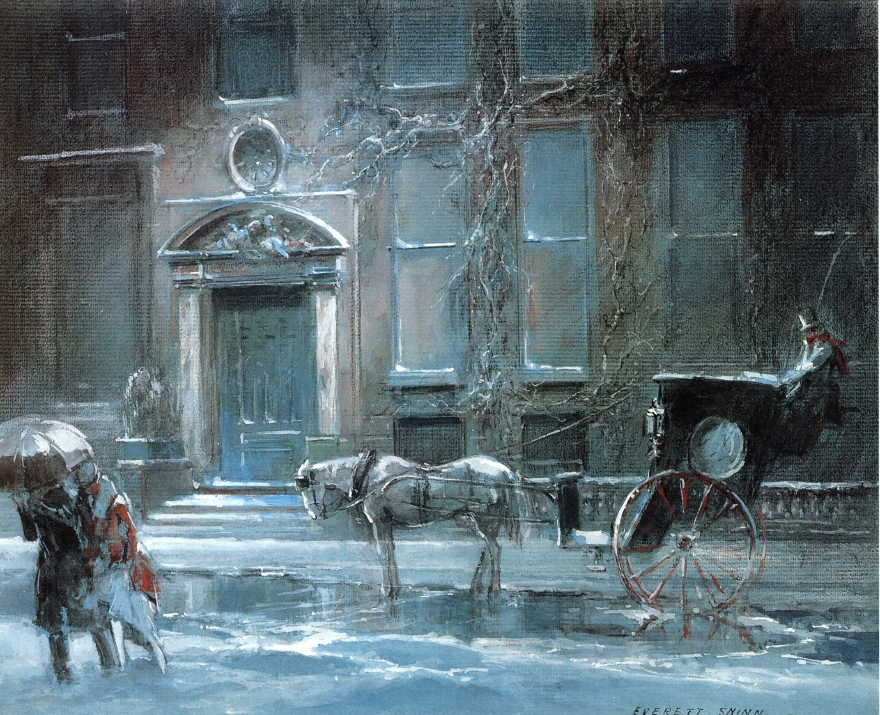
Today is the birthday of Everett Shinn (Woodstown, New Jersey; November 6, 1876 – May 1, 1953 New York City); realist painter and member of the Ashcan School. He also exhibited with the short-lived group known as “The Eight,” who protested the restrictive exhibition policies of the powerful, conservative National Academy of Design. He is best known for his robust paintings of urban life in New York and London, a hallmark of Ashcan art, and for his theater and residential murals and interior-design projects. His style varied considerably over the years, from gritty and realistic to decorative and rococo.

The 1940s saw his work included in more museum exhibitions and just prior to his death he was taken on by the prestigious James Graham Gallery in New York. In his best years, Shinn was well-paid and owned large houses in Connecticut and Upstate New York, but he went through a vast amount of money (along with four wives and numerous mistresses) and was financially straitened in his final days.
Gallery

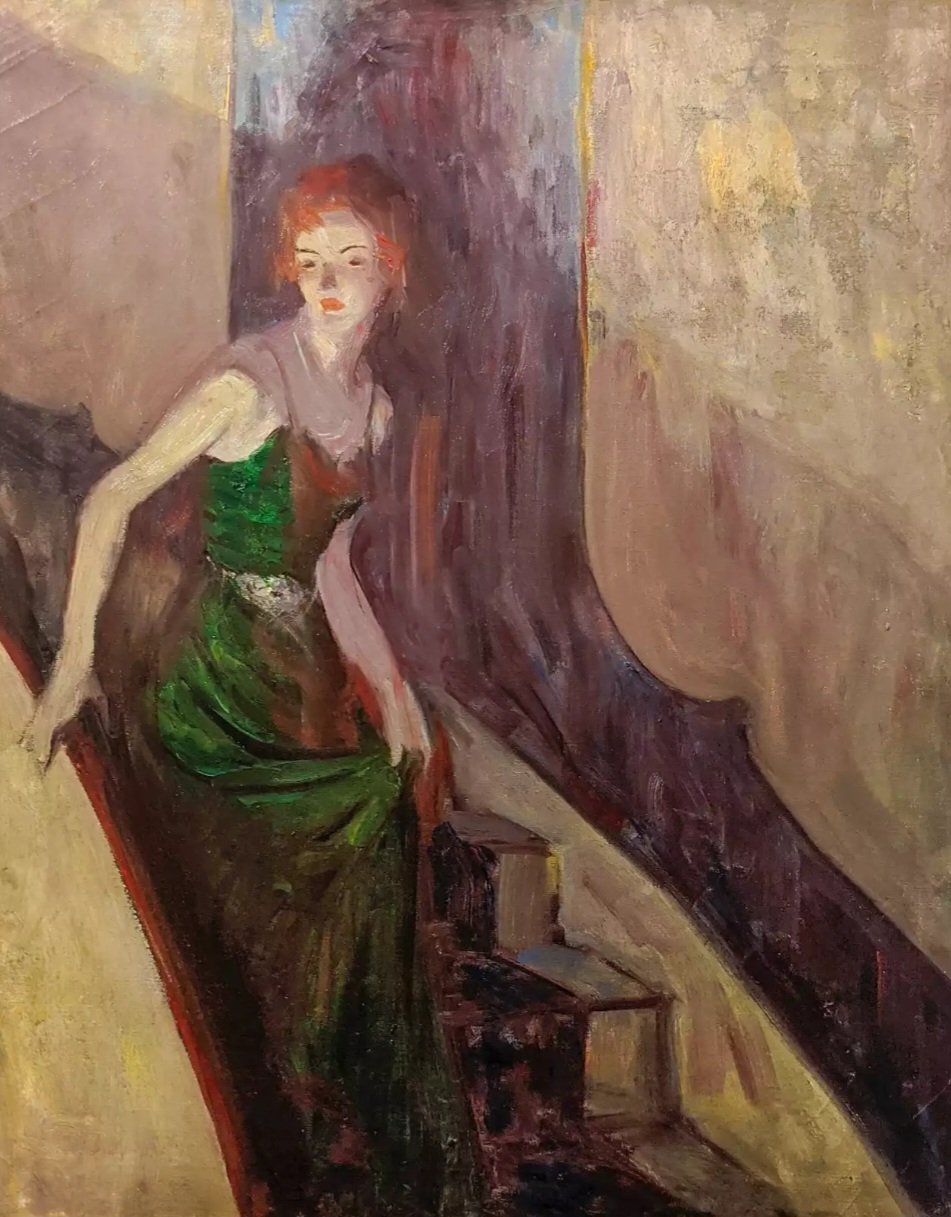
woman on staircase
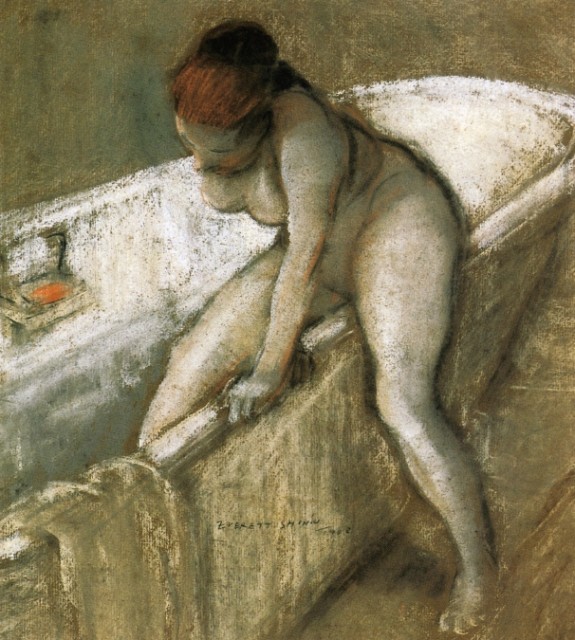
Girl in Bathtub

1910 Nude

Mrs A Stewart Walker in a Fur, 1910
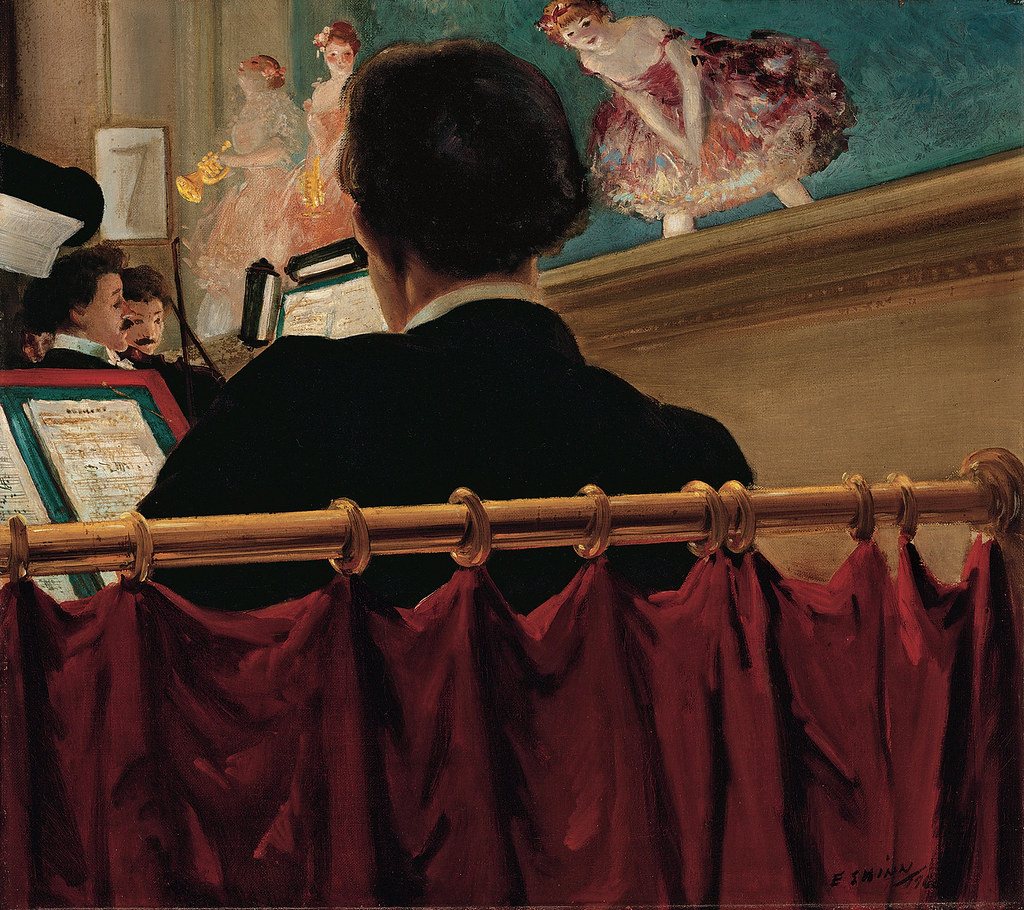
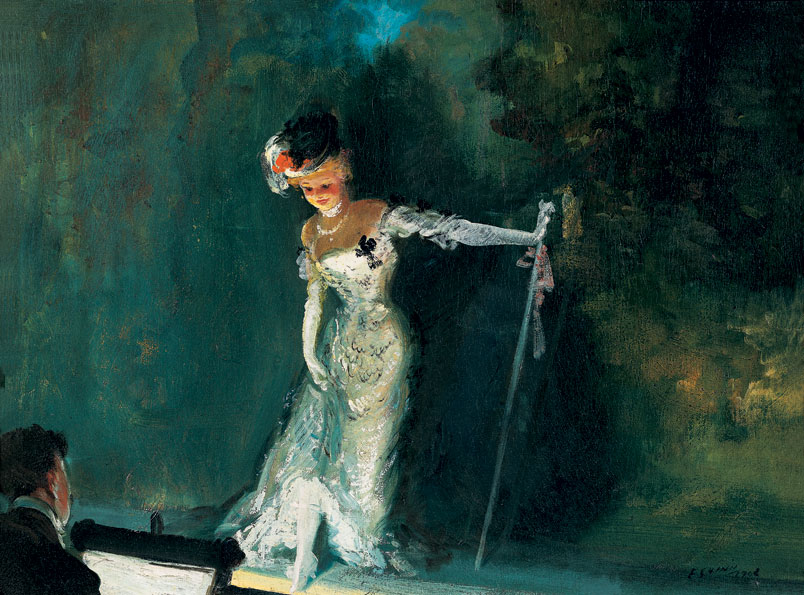
Revue, 1903

A girl on stage, 1906

Rehearsal of the Ballet, 1903

The White Ballet

Keith’s Union Square, ca. 1902-06. Brooklyn Museum

Fifth Avenue, 1910 – – Brooklyn Museum
The Canfield Gambling House, 1912

Couple Sitting Among Lanterns, Vanity Fair, June 1916

And today is the birthday of Anne Porter (Anne Elizabeth Channing; Sherborn, Massachusetts; 6 November 1911 – 10 October 2011 Hampton Bays, Long Island); poet. She was educated at Bryn Mawr College and Radcliffe College. When she was 16 she met artist Fairfield Porter and they were married by the time she was 20. She had been writing poetry since she was seven but now, as a busy mother of five, she didn’t have much time for her own pursuits. The choir and women’s group at the Methodist church were her only social outlets, apart from playing hostess to her husband’s artist friends. Sometimes she modeled for her husband’s paintings, but they weren’t portraits of her; she compared the experience to being an apple in a still life.
When her husband died in 1975, she began to write poetry much more seriously. As she told the Wall Street Journal: “I remember realizing that I was alone, and I’d have to be more organized. I had these poems, and I thought that it would be worthwhile working on them. I started to write.” Her first collection, An Altogether Different Language (1994), published when she was 83, was named a finalist for the National Book Award. Her other volume of poetry is Living Things: Collected Poems (2006). Her work has been anthologized in the Oxford Book of American Poetry (2006), and featured on Garrison Keillor’s radio program, The Writer’s Almanac.
An Altogether Different Language
There was a church in Umbria, Little Portion,
Already old eight hundred years ago.
It was abandoned and in disrepair
But it was called St. Mary of the Angels
For it was known to be the haunt of angels,
Often at night the country people
Could hear them singing there.
What was it like, to listen to the angels,
To hear those mountain-fresh, those simple voices
Poured out on the bare stones of Little Portion
In hymns of joy?
No one has told us.
Perhaps it needs another language
That we have still to learn,
An altogether different language.
An excerpt from Living Things, by Anne Porter, published by Zoland Books, an imprint of Steerforth Press of Hanover, New Hampshire. Copyright © 2006 Anne Porter.
A November Sunrise
Wild geese are flocking and calling in pure golden air,
Glory like that which painters long ago
Spread as a background for some little hermit
Beside his cave, giving his cloak away,
Or for some martyr stretching out
On her expected rack.
A few black cedars grow nearby
And there’s a donkey grazing.
Small craftsmen, steeped in anonymity like bees,
Gilded their wooden panels, leaving fame to chance,
Like the maker of this wing-flooded golden sky,
Who forgives all our ignorance
Both of his nature and of his very name,
Freely accepting our one heedless glance.
from An Altogether Different Language. ©1994 Anne Porter, published by Zoland Books
Thanks for stoppin’ by y’all
Mac Tag
You and I are the same, Darien. We are smart enough not to buy in to the oldest myth running; love. A fiction created by people to keep them from jumping out of windows.
Gordon Gekko
O how could I be so calm
When she rose up to depart?
Now words that called up the lightning
Are hurtling through my heart.
– WB Yeats
 The Lovers’ Chronicle
Leave a comment