Dear Zazie, Here is today’s Lovers’ Chronicle from Mac Tag dedicated to his muse. Are you just passin’ through? Rhett
The Lovers’ Chronicle
Dear Muse,
passin’ dream…
why does the train whistle sound
more mournful tonight
and where did this lonesome
feelin’ come from
i seem to be driftin’ along
*A song starts playing in the background*
oh i know this song, hold on, i got it
‘’Lost Highway’’ written by Leon Payne
and sung by Hank on his birthday;
‘’When I pass by
All the people say
Just another guy
On the lost highway’’
Baby wake up, wake up
oh what happened
You were moaning and rocking back and forth
wow it felt real, i was layin’ in the back seat
of a car rollin’ down a highway and it was cold
and i was so lonesome, it was consumin’ me
Then I saved you
yes thanks my love
Now that the bad dream has passed by
lets git consumed in each other

© copyright 2024 mac tag/cowboy coleridge all rights reserved

in one way or another we all are,
so this should be about how
“Oh I see”
open or blind
“Seeing or not”
goin’ through the motions
or with purpose
“Making the most
or least of it”
we are all at this party
not by our choice, but
we can choose how
we follow through
“Together”
not just passin’
© copyright 2023 mac tag/cowboy coleridge all rights reserved
on by or through, collectin’ words and spreadin’ ’em out, used to think i should be gatherin’ other stuff but finally figured out there are only three things worth havin’; words, notes and lines; cannot hear the notes but i can see the lines, may git to those someday but for now the words have other plans
© copyright 2022.2023 mac tag/cowboy coleridge all rights reserved
you know, on my way
from here to there
no particular destination
kinda depends on which way
the wind is blowin’
travellin’ light
the way i like it
not havin’ many needs
keeps things simple
till now
never figured on
meetin’ someone like you
reckon i am no longer
just passin’ through
© copyright 2021.2023 mac tag/cowboy coleridge all rights reserved
Pale Love, Pale Rider
the windows are open
and the mountain breeze
rustles gently through
we lie there
curious to catch
the next wave
i call your name
you shudder,
under my touch
an astonished look
passes in your eyes,
your heart quickens
so alike, this man
and this woman
weavin’ this vision
© copyright 2020 mac tag/cowboy coleridge all rights reserved
nothin’ lost in tryin’
and takin’ journeys
and always okay,
to just let go
about you,
knowin’ you
and you showin’
me your truth
gettin’ caught up
in all of you,
cannot help feelin’
from now, not walkin’ alone
learnin’ that worth is found
in followin’ our own song

ok, so this might be
as near ’bout heaven
as i will get…
a good bar
tended by my
beautiful friend Sophie
Cheers y’all
© Copyright 2019 Mac tag/cowboy Coleridge all rights reserved

never figured out
how to bridge the gap
between infatuation
and ever after
always seemed to go
from head over heals
to headin’ out the door
there never was
any in between
of course,
the mistake
was in the tryin’
should have always aimed
for hey, just passin’ through
© copyright 2018 mac tag/cowboy coleridge all rights reserved

you sleep
stretched out
on our bed
the windows are open
and the mountain breeze
rustles gently through;
candles burn
in nooks and corners
with a few gentle taps
you wake surprised
curious to catch
your first impression
i call your name
you start up,
look through me
and around,
and hang your head
a look of sadness
passes in your eyes
a sinkin’ of the heart
***
Drove the Audi
Like she was meant
To be driven
On a road trip
To my favorite
Winery
© copyright 2017 mac tag/cowboy Coleridge all rights reserved
“Where the hell
have you been?”
enjoyin’ bein’
detached
© copyright 2016 mac tag/cowboy Coleridge all rights reserved
What now but voices
promisin’ that which
cannot be. Wantin’
will not make it so
Clingin’ to the edge
Either way, above
or below, let go
Shinin’, the sunlight on your hair
Between waves, slip amorously
The great dreamin’, while time goes by
Beautiful, archin’ your marvellous curves
Displayin’ the vision of your body
In my strength, our skin, ours, as with glory
© copyright 2015 mac tag/cowboy Coleridge all rights reserved
for Tamela
The Blue-Eyed Girl
Sometimes it is alright to be wrong,
Sometimes it is okay to just let it go
They like to gossip
About her, often,
But they do not know her
No one knows her truth
Sometimes, she gets caught
Up in their rumours
But she refuses
To follow their rules
She tries to laugh about it
But she cannot help feelin’
Like they are stealin’ somethin’
Away from her in pieces
She does not need anyone
To tell her right from wrong
She wants to sing her own song
From now on, she walks alone
Needin’ no one’s permission
She has learned that happiness
Lies in followin’ her own song
For what it is worth;
The Blue-Eyed Man
Feels the pain
Of the Blue-Eyed Girl
© copyright 2012 mac tag/cowboy Coleridge all rights reserved
Today we have a story of love found and lost from my friend Jett.
Jett received the followin’ letter from his friend Adele, who also happens to be a friend of Zazie:
Ok! I did it! Call it lust, love or the meeting of two sole mates. On Saturday night, I went out with a guy I used to work with. We drink a box of wine and end up on the roof. We just talk most all night and yes he gave me a kiss. Tuesday he left his wife (it was a dead situation anyway), last night he moved in! Wow! Did you expect that from me? I cannot explain what happened other than we are both crazy about each other. We just reconnected and decided we had suppressed the feelings we had for long enough. I equate this whole thing to two people jumping out of an airplane. We don’t yet know if we will land on our feet or our face! Right now all we can do is enjoy the ride. Jett I have been so lonely for so long just to be held again is well worth the insanity of it. The only part that stresses me is the fact that either one of us could crush the others heart. He has made major external moves and I have made equal internal moves. Just last week I could not imagine sharing my closet with anyone. Tonight I pick up boxes to pack up half my closet. For some weird reason I am not afraid. What do you think….. If you really felt that you found your soul mate would you jump in or hang on at a distance to be sure?
Jett told her he agreed with their leap of faith. Life is too short and you will never get a rose unless you reach for it. Yes, you may end up with a handful of thorns, but the reward is worth the risk. Protect yourself as best you can and when you fancy, take some fancy chances.
Then Adele texts Zazie with a picture update on her romance or rather the apparent end of it;

Need I say more!
In part it says; “You lied to me. You said you loved me. I trusted you. I was fine before you came. I’m broken hearted. I cried.” Jett wishes he could reach out and hug Adele and he wishes he could stomp a mud hole in this guy, which trust me, he could.
For the Poem of the Day, Jett suggested, “Blue-Eyed Ann” by the Scottish poet Tobias Smollett, who died on this day in 1771 in Livorno, Italy. This goes out to Adele from Jett.
Blue-Eyed Ann
When the rough North forgets to howl,
And Ocean’s billows cease to roll;
When Libyan sands are bound in frost,
And cold to Nova Zembla’s lost!
When heavenly bodies cease to move,
My blue-eyed Ann I’ll cease to love.
No more shall flowers the meads adorn;
Nor sweetness deck the rosy thorn;
Nor swelling buds proclaim the spring;
Nor parching heats the dogstar bring;
Nor laughing lilies paint the grove,
When blue-eyed Ann I cease to love.
No more shall joy in hope be found;
Nor pleasures dance their frolic round;
Nor Love’s light god inhabit earth;
Nor beauty give to passion birth;
Nor heat to summer sunshine cleave,
When blue-eyed Annie I deceive.
When rolling seasons cease to change,
Inconstancy forgets to range;
When lavish May no more shall bloom,
Nor gardens yield a rich perfume;
When Nature from her sphere shall start,
I’ll tear my Annie from my heart.
The Song of the Day is “Blue Eyed Girl” by Ida Jensush. Again, this goes out to Adele from Jett.
| Émile Augier | |
|---|---|
 by Antoine Samuel Adam-Salomon, circa 1870s by Antoine Samuel Adam-Salomon, circa 1870s | |
Today is the birthday of Émile Augier (Guillaume Victor Émile Augier; Valence, Drôme, France 17 September 1820 – 25 October 1889 Croissy-sur-Seine, France); dramatist. He was the thirteenth member to occupy seat 1 of the Académie française on 31 March 1857.
Augier described his own life as “without incident”. L’Aventurière(1848), the first of his important works, already shows a deviation from romantic ideals; and in the Mariage d’Olympe (1855), the courtesan is shown as she is, not glorified as in Dumas’s Dame aux Camélias. In Gabrielle (1849), the husband, not the lover, is the sympathetic character. Augier provided the libretto for the first opera composed by Charles Gounod, Sapho (1851). In this version of the story a courtesan Glycère is the perfidious villainess, and the self-sacrificing title character is wholly heterosexual, not a “sapphist”. In the Lionnes pauvres (1858) the wife who sells her favours comes under the lash. Greed of gold, social moralization, ultramontanism, lust of power, these are satirized Les Effrontés(1861), Le Fils de Giboyer (1862), La Contagion announced under the title of Le Baron d’Estrigaud (1866), Lions et renards (1869)—which, with Le Gendre de Monsieur Poirier (1854), written in collaboration with Jules Sandeau, reach the high-water mark of Augier’s art; in Philiberte (1853), he produced a graceful and delicate drawing-room comedy; and in Jean de Thommeray, acted in 1873 after the great reverses of 1870, the regenerating note of patriotism rings high and clear.
Verse
L’Aventurière (1848)
- L’amour chez les vieillards a d’étranges racines,
Et trouve, comme un lierre aux fentes des ruines,
Dans ces cœurs ravagés par le temps et les maux,
Cent brèches où pousser ses tenaces rameaux.- Act I., Scene V. (translation by Fabrice).
- From strangest roots love in old men doth grow;
Like ivy on a ruin it doth show,
And in these hearts laid waste by grief and time,
By myriad clefts its clinging branches climb.
Today is the birthday of François Marius Granet (Aix-en-Provence, France 17 December 1775 – 21 November 1849 Aix-en-Provence) ; painter.
 Portrait by Ingres
Whilst a lad he had, at Aix, made the acquaintance of the young comte de Forbin, and upon his invitation Granet, in the year 1797, went to Paris. De Forbin was one of the pupils of David, and Granet entered the same studio. Later he got possession of a cell in the convent of Capuchins, which, having served for a manufactory of assignats during the Revolution, was afterwards inhabited almost exclusively by artists. In the changing lights and shadows of the corridors of the Capuchins, Granet found the materials for that one picture to the painting of which, with varying success, he devoted his life.
In 1802, he left Paris for Rome, where he remained until 1819, when he returned to Paris, bringing with him besides various other works one of fourteen repetitions of his celebrated “Chœur des Capucins,” executed in 1811. The figures of the monks celebrating mass are taken in this subject as a substantive part of the architectural effect, and this is the case with all Granet’s works, even with those in which the figure subject would seem to assert its importance, and its historical or romantic interest. “Stella painting a Madonna on his Prison Wall,” 1810 (Leuchtenberg collection); “Sodoma à l’hôpital,” 1815 (Louvre); “Basilique basse de St François d’Assise,” 1823 (Louvre); “Rachat de prisonniers,” 1831 (Louvre); “Mort de Poussin,” 1834 (Villa Demidoff, Florence), are among his principal works; all are marked by the same peculiarities, everything is sacrificed to tone.
In 1819, Louis Philippe decorated Granet, and afterwards named him Chevalier de l’Ordre St Michel, and Conservateur des tableaux de Versailles (1826). He became a member of the institute in 1830; but in spite of these honours, and the ties which bound him to M. de Forbin, then director of the Louvre, Granet constantly returned to Rome. After 1848 he retired to Aix, immediately lost his wife, and died himself on 21 November 1849. He bequeathed the greater part of his fortune to his native town and all his collections (including the very fine portrait by Ingres from 1811[citation needed] ) to the Museum of Aix en Provence, which was renamed the Musée Granet in 1949, the centenary of his death.
Gallery
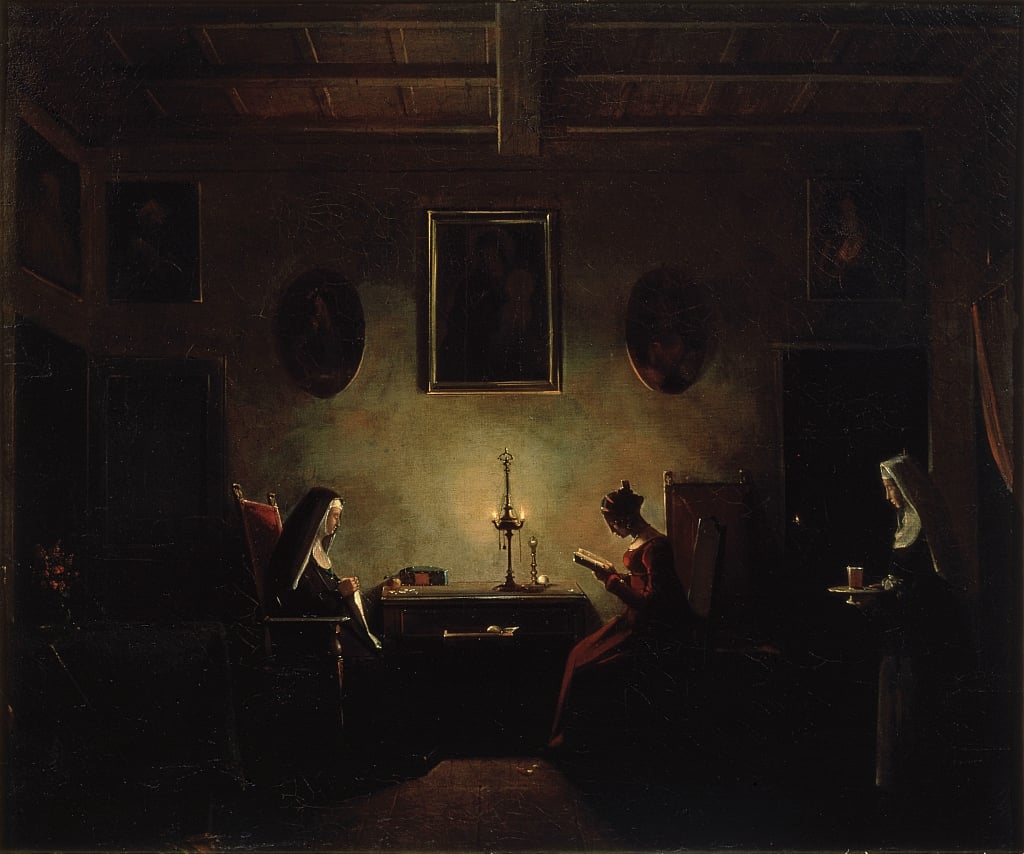
scène intérieure
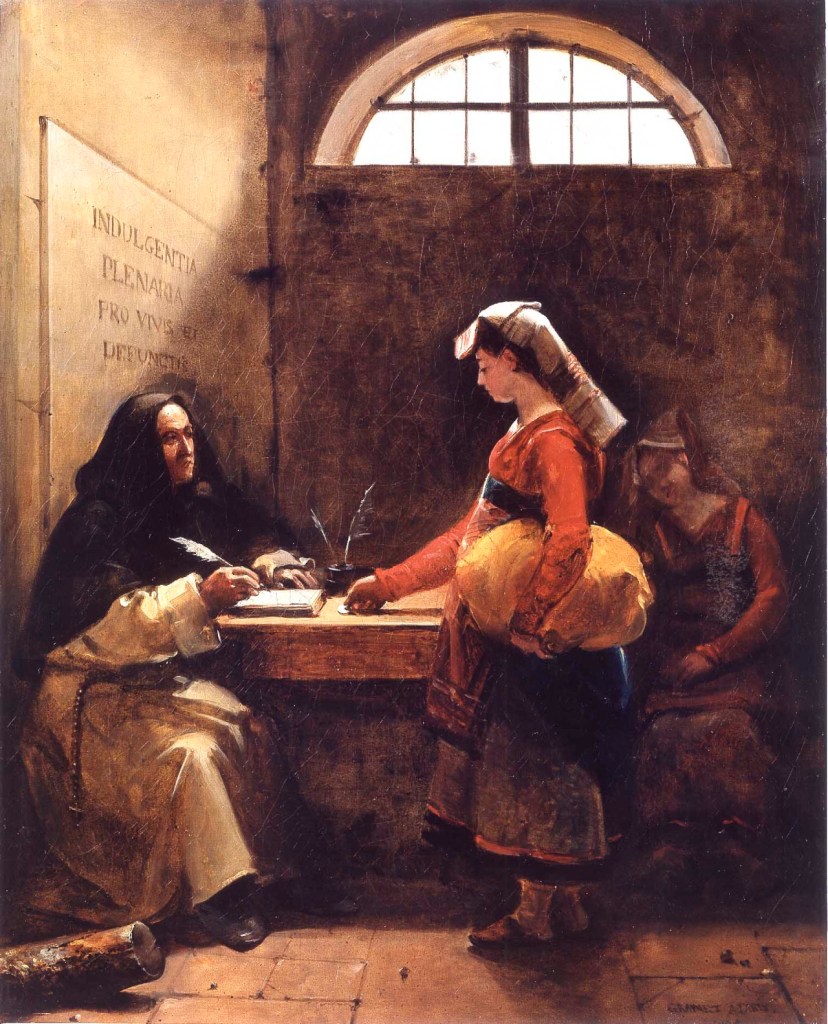
une paysanne achetant des indulgences
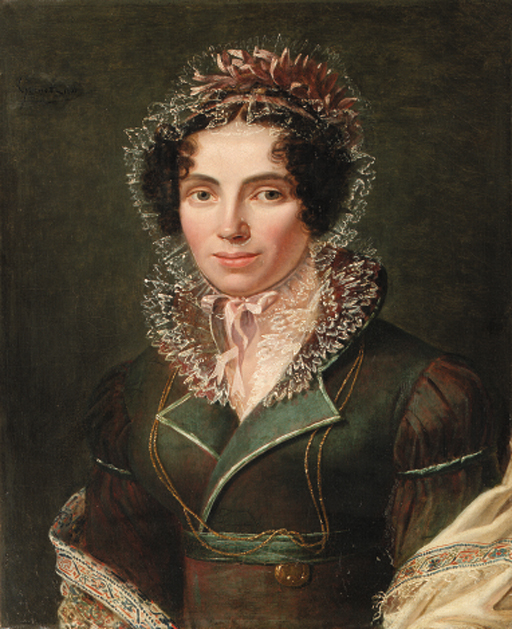
Portrait of a lady, half-length, in a green dress
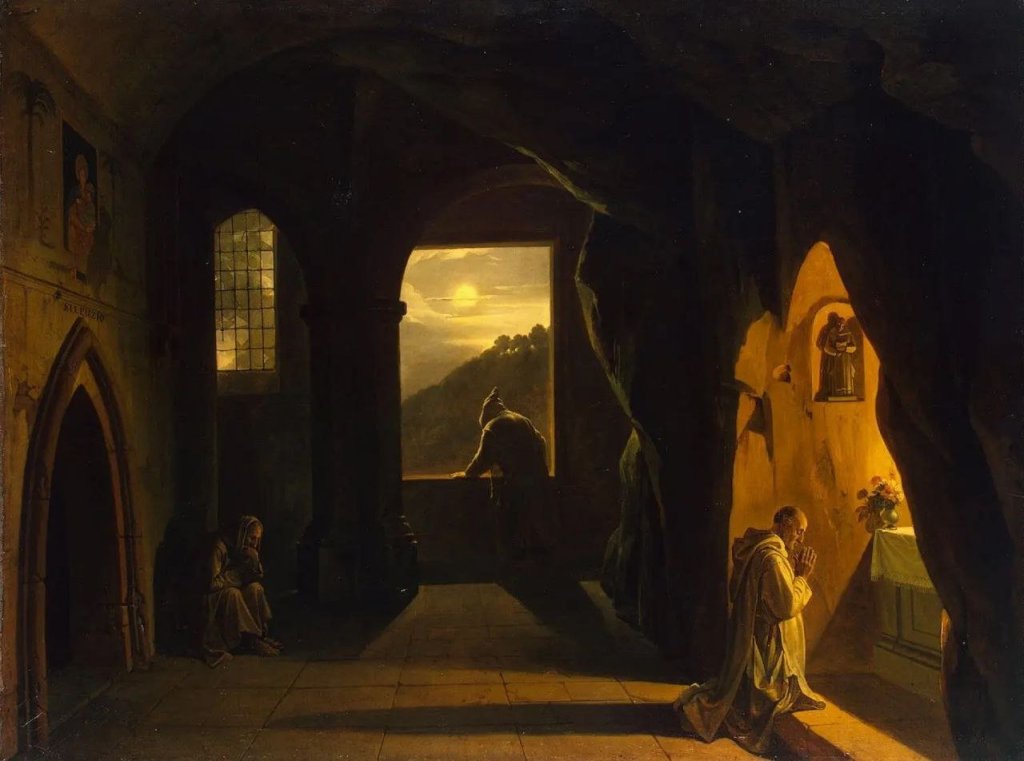
monks in a grave
Today is the birthday of Samuel Prout (Plymouth, England 17 September 1783 – 10 February 1852 London); watercolourist, and one of the masters of watercolour architectural painting. Prout secured the position of Painter in Water-Colours in Ordinary to King George IV in 1829 and afterwards to Queen Victoria. John Ruskin, whose work often emulated Prout’s, wrote in 1844, “Sometimes I tire of Turner, but never of Prout”. Prout is often compared to his contemporaries: Turner, Constable and Ruskin, whom he taught. He was the uncle of the artist John Skinner Prout.
Prout was appointed the coveted title of ‘Painter in Water-Colours in Ordinary’ to King George IV in 1829, and afterwards to Queen Victoria.
At the time of his death there was hardly a place in France, Germany, Italy (especially Venice) or the Netherlands where his face had not been seen searching for antique gables and sculptured pieces of stone. He died after a stroke at his home, 5 De Crespigny Terrace, Denmark Hill, London and was buried at West Norwood Cemetery.
A large quantity of his original sketchbooks, lithographs, account books, letters and family materials are held at the North Devon Athenaeum, Barnstaple, Devon. The collection was sold at auction in 2010, and much was acquired by Plymouth City Museum & Art Gallery, adding to its existing holdings of his work.
Samuel Gillespie Prout followed in his father’s footsteps by also painting watercolours. his nephew was the composer Ebenezer Prout. Another member of the family, John Skinner Prout made a career for himself painting and writing books in Tasmania.
Gallery

the fountain
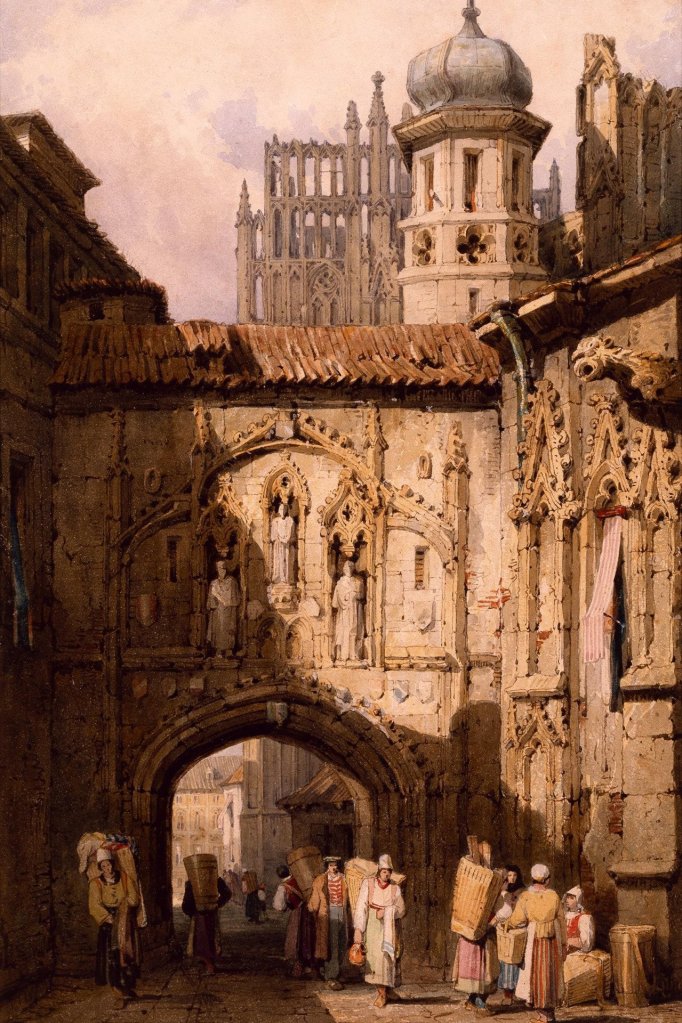
a view in Nuremberg
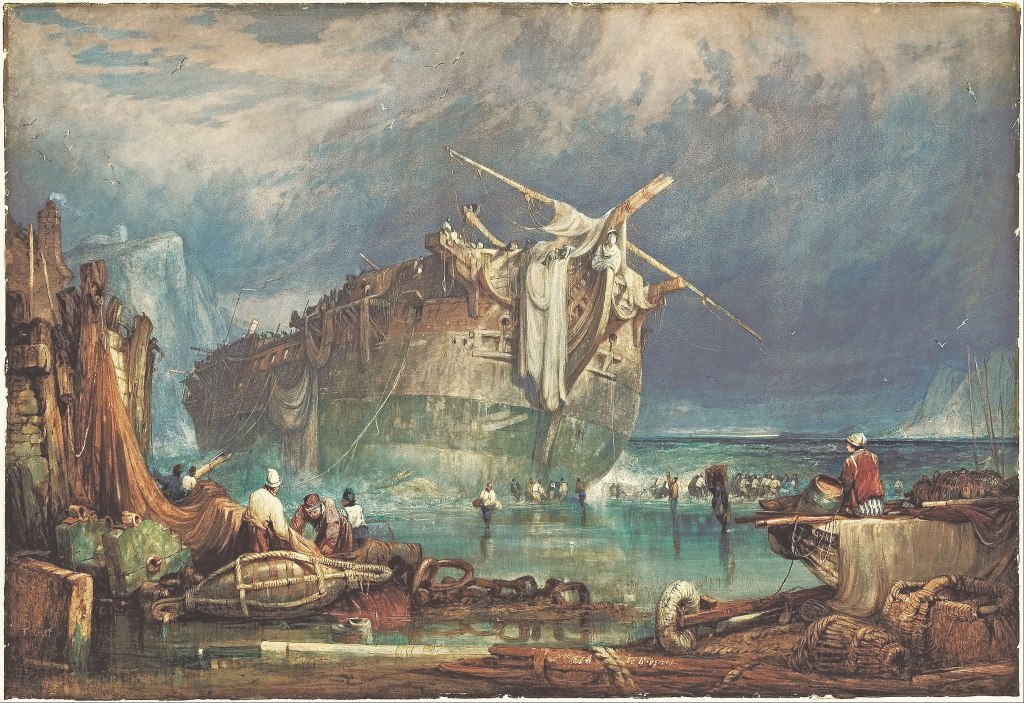
Salving from the wreck
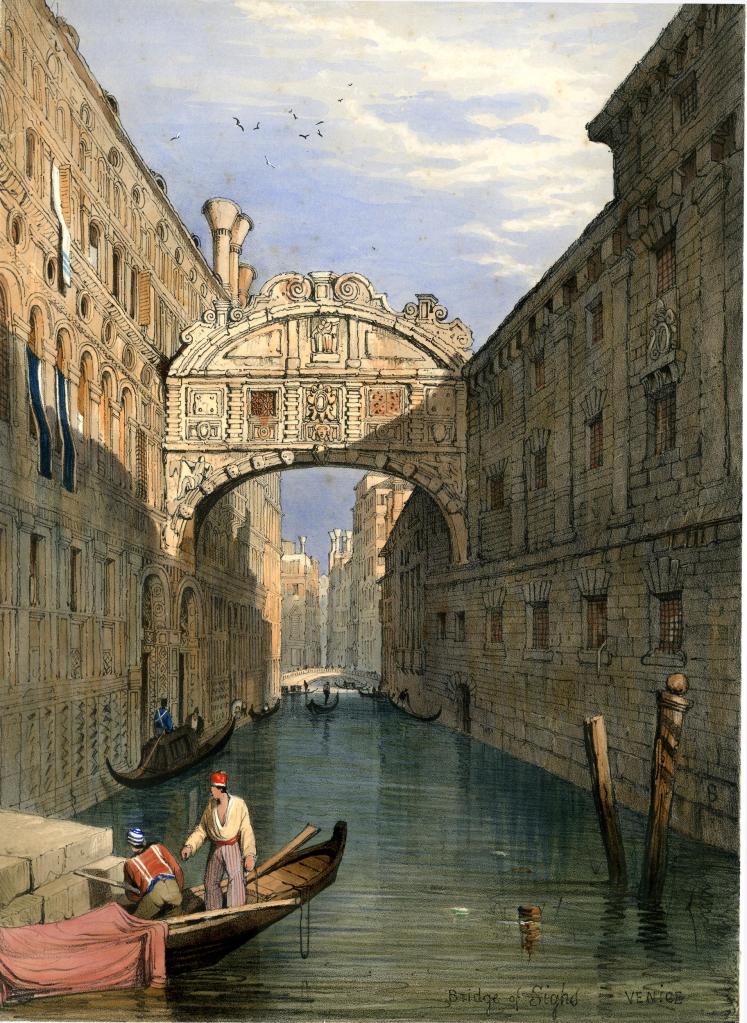
bridge of sighs
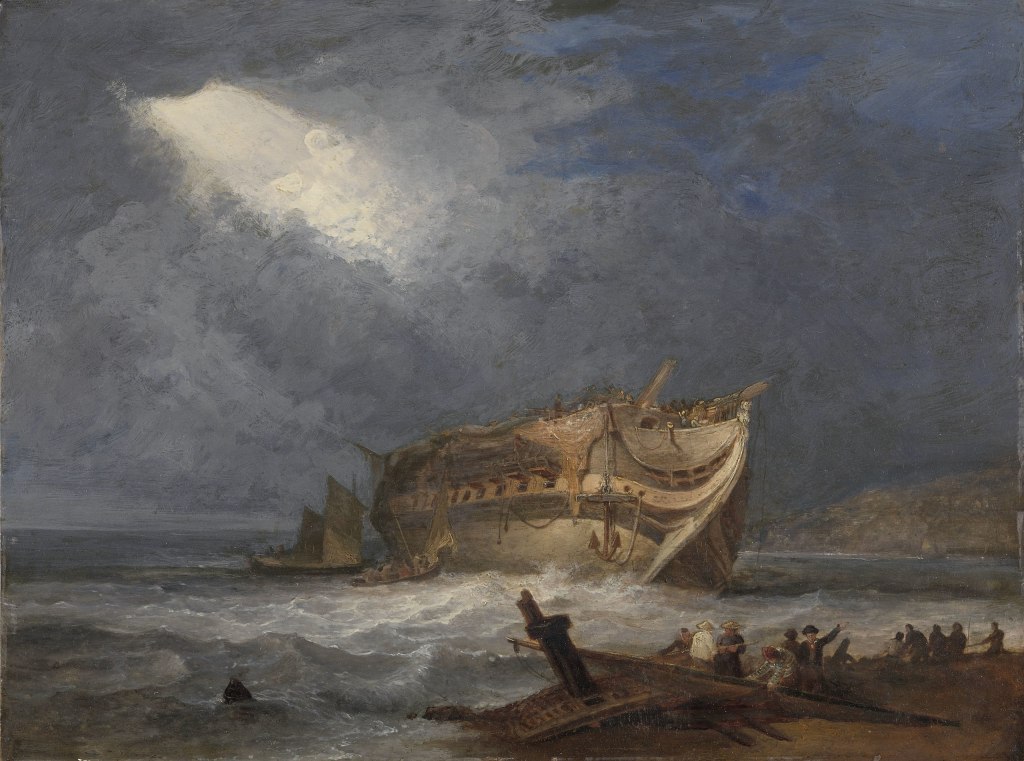
The Wreck of the Dutton, An East Indiaman – B2011.33.1 – Yale Center for British Art
 Figures on a beach
| William Carlos Williams | |
|---|---|
 passport photograph,1921 passport photograph,1921 | |
Today is the birthday of William Carlos Williams (Rutherford, New Jersey; September 17, 1883 – March 4, 1963 Rutherford); poet closely associated with modernism and imagism. He is among the group of four major American poets born in the twelve-year period following 1874, including Robert Frost, born in 1874; Wallace Stevens, born in 1879; and H.D. (Hilda Doolittle), born in 1886. His work has an affinity with painting, in which he had a lifelong interest.
In addition to his writing, Williams had a long career as a physician practicing both pediatrics and general medicine. He was affiliated with what was then known as Passaic General Hospital in Passaic, New Jersey, where he served as the hospital’s chief of pediatrics from 1924 until his death. The hospital, which is now known as St. Mary’s General Hospital, paid tribute to Williams with a memorial plaque that states “we walk the wards that Williams walked”.
Verse
Marriage (1916)
- So different, this man
And this woman:
A stream flowing
In a field.- Poetry Chicago, 1916)
Al Que Quiere! (1917)
- Why do I write today?
- The beauty of
the terrible faces
of our nonentities
stirs me to it: - “Apology”
- I lie here thinking of you:—the stain of love
is upon the world!- “Love Song”
- Brother!
— if we were rich
we’d stick our chests out
and hold our heads high! - It is dreams that have destroyed us.
- There is no more pride
in horses or in rein holding. - We sit hunched together brooding
our fate. - Well —
all things turn bitter in the end
whether you choose the right or
the left way
and —
dreams are not a bad thing.- “Libertad! Igualidad! Fraternidad!”
Collected Poems 1921-1931 (1934)
- “He’s come out of the man
and he’s let
the man go —
the liar
Dead
his eyes
rolled up out of
the light — a mockery
which
love cannot touch —just bury it
and hide its face
for shame.
- “Death”
Complete Collected Poems (1938)
- These
- are the desolate, dark weeks
when nature in its barrenness
equals the stupidity of man. - The
- year plunges into night
and the heart plunges
lower than night- “These”
Collected Later Poems (1950)
- Not now. Love itself a flower
with roots in a parched ground.
Empty pockets make empty heads.
Cure it if you can but
do not believe that we can live
today in the country
for the country will bring us
no peace.- “Raleigh Was Right” (1940)
The Desert Music and Other Poems (1954)
- I think
of the poetry
of René Char
and all he must have seen
and suffered
that has brought him
to speak only of
sedgy rivers,
of daffodils and tulips
whose roots they water,
even to the free-flowing river
that laves the rootlets
of those sweet-scented flowers
that people the
milky
way- “To a Dog Injured in the Street”
- The cries of a dying dog
are to be blotted out
as best I can.
René Char
you are a poet who believes
in the power of beauty
to right all wrongs.
I believe it also.
With invention and courage
we shall surpass
the pitiful dumb beasts,
let all men believe it,
as you have taught me also
to believe it.- “To a Dog Injured in the Street”
Journey to Love (1955)
Asphodel, That Greeny Flower
- Of asphodel, that greeny flower,
like a buttercup
upon its branching stem —
save that’s green and wooden —
I come, my sweet,to sing to you.
We lived long together,
a life filled,if you will,
with flowers. So that
I was cheered
when I first came to know
that there were flowers also
in hell.
Today
I’m filled with the fading memory of those flowers
that we both loved,
even to this poor
colorless thing —
I saw it
when I was a child —
little prized among the living
but the dead see,
asking among themselves:
What do I remember
that was shapedas this thing is shaped?
while our eyes fill
with tears.
Of love, abiding love
it will be telling
though too weak a wash of crimson
colors it
to make it wholly credible.
There is something
something urgent
I have to say to you
and you alone
but it must wait
while I drink in
the joy of your approach,
perhaps for the last time.
And so
with fear in my heart
I drag it out
and keep on talking
for I dare not stop.
- Only give me time,
time to recall them
before I shall speak out.
Give me time,
time.
When I was a boy
I kept a book
to which, from time
to time,
I added pressed flowers
until, after a time,
I had a good collection.
The asphodel,
forebodingly,
among them.
I bring you,
reawakened,
a memory of those flowers.
They were sweet
when I pressed them
and retained
something of their sweetness
a long time.
It is a curious odor,
a moral odor,
that brings me
near to you.
- Endless wealth,
I thought,
held out its arms to me.
A thousand tropics
in an apple blossom.
The generous earth itself
gave us lief.
The whole world
became my garden!
But the sea
which no one tends
is also a garden
when the sun strikes it
and the waves
are wakened.
I have seen it
and so have you
when it puts all flowers
to shame.
- I cannot say
that I have gone to hell
for your love
but often
found myself there
in your pursuit.
I do not like it
and wanted to be
in heaven. Hear me out.
Do not turn away.
I have learned much in my life
from books
and out of them
about love.
Death
is not the end of it.
- The storm unfolds.
Lightning
plays about the edges of the clouds.
The sky to the north
is placid,
blue in the afterglow
as the storm piles up.
It is a flower
that will soon reach
the apex of its bloom.
- When I speak
of flowers
it is to recall
that at one time
we were young.
All women are not Helen,
I know that,
but have Helen in their hearts.
My sweet,
you have it also, therefore
I love you
and could not love you otherwise.
- The storm bursts
or fades! it is not
the end of the world.
Love is something else,
or so I thought it,
a garden which expands,
though I knew you as a woman
and never thought otherwise,
until the whole sea
has been taken up
and all its gardens.
It was the love of love,
the love that swallows up all else,
a grateful love,
a love of nature, of people,
of animals,
a love engendering
gentleness and goodness
that moved me
and that I saw in you.
- I come, my sweet,
to sing to you!
My heart rouses
thinking to bring you news
of something
that concerns you
and concerns many men. Look at
what passes for the new.
You will not find it there but in
despised poems.
- It is difficult
to get the news from poems
yet men die miserably every day
for lackof what is found there.
| Hank Williams | |
|---|---|
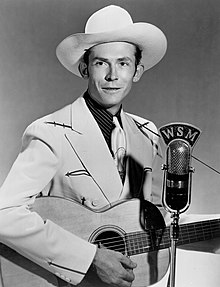 in 1951 in 1951 | |
And today is the birthday of Hiram King “Hank” Williams, (Mount Olive, Alabama; September 17, 1923 – January 1, 1953 Oak Hill, West Virginia); singer-songwriter and musician. In my opinion, one of the most significant and influential American singers and songwriters of the 20th century, Williams recorded 35 singles (five released posthumously) that reached the Top 10 of the Billboard Country & Western Best Sellers chart, including 11 that ranked number one (three posthumously). Among the hits he wrote were “Your Cheatin’ Heart”, “Hey, Good Lookin’”, “Jambalaya (On the Bayou)” and “I’m So Lonesome I Could Cry”.
On December 15, 1944, Williams married Audrey Sheppard. It was her second marriage and his first. Their son, Randall Hank Williams, who would achieve fame in his own right as Hank Williams, Jr., was born on May 26, 1949. The marriage, always turbulent, rapidly disintegrated. The couple divorced on May 29, 1952.
A relationship with a woman named Bobbie Jett resulted in a daughter, Jett Williams, who was born five days after Williams’ death.
On October 18, 1952, Williams and Billie Jean Jones Eshlimar were married in Minden, Louisiana by a justice of the peace. It was the second marriage for both (both being divorced with children). After Williams’ death, a judge ruled that the wedding was not legal because Jones Eshlimar’s divorce had not become final until eleven days after she married Williams. Williams’ first wife, Audrey, and his mother, Lillie Williams, were the driving forces behind having the marriage declared invalid and pursued the matter for years.
Several years of back pain, alcoholism, and prescription drug abuse severely damaged Williams’ health. Williams died at the age of 29, from heart failure exacerbated by pills and alcohol. Despite his short life, Williams has had a major influence on 20th-century popular music, especially country music. The songs he wrote and recorded have been covered by numerous artists and have been hits in various genres. He has been inducted into multiple music halls of fame, such as the Country Music Hall of Fame (1961), the Songwriters Hall of Fame (1970), and the Rock and Roll Hall of Fame (1987).
Lyrics
- You wore out a brand new trunk,
packin’ and unpackin your junk.- “You’re gonna change (or I’m gonna leave)” (1949)
- No matter how I struggle and strive,
I’ll never get out of this world alive.- “I’ll Never Get Out Of This World Alive” (1952)
- We’ll put aside a little time to fix a flat or 2,
my tires and tubes are doing fine but the air is showing through- “Settin’ the Woods on Fire” (1952)
Mac Tag
It is difficult to get the news from poems, yet men die miserably every day for lack of what is found there. – Simone de Beauvoir
I am in love, hence free to live by heart, to ad lib as I caress. – Vera Pavlova
We are blind and live our blind lives out in blindness. Poets are damned but they are not blind, they see with the eyes of angels. – William Carlos Williams
 The Lovers’ Chronicle
Leave a comment