
Dear Zazie, Here is today’s Lovers’ Chronicle from Mac Tag dedicated to his muse. Follow us on twitter @cowboycoleridge. Have you ever been to the turnin’ point? Rhett
The Lovers’ Chronicle
Dear Muse,
dream turnin’…

wait how do you start this thing
why does the steerin’ wheel
look like my pillow
(cue Fleetwood Mac’s “World Turning”)
”Everybody’s trying to say I’m wrong
I just wanna be back where I belong”
oh i see what you did there, alright
i can roll with that, awesome song
is that Christine over there
another of the ones we miss
“World turning
I gotta get my feet back on the ground
World turning
Everybody’s got me down”
been through several cycles of turnin’
each time i thought, just stay on your feet
but it was mostly myself keepin’ me down
“Maybe I’m wrong but who’s to say what’s right
I need somebody to help me through the night”
exactly what i kept lookin’ for and kept not findin’
and i was just trying’ to find where i belonged,
which is here writin’, next to the beautiful red head
”You called my love”
i did my dear, it is time to enjoy
gittin’ through another night
“World turning”

© copyright 2024 mac tag/cowboy coleridge all rights reserved
i like where i was goin’
with this last year
these moments are comin’
for all of us
“Whatcha gonna do,
oh wait, we don’t
want to go there”
ha, no maybe next time
“Ok”
but i do think that is a key,
what we do in those situations
“Rise to the occasion”
or fold like a bad play
on openin’ night
“Well our opening night was a smash”
and every night since
© copyright 2023 mac tag/cowboy coleridge all rights reserved
what do you do when they come along, perhaps a key to life, how you handle ’em; with aplomb, unruffled like a suave Cary Grant, or rumblin’, fumblin’, stumblin’, clueless to what to do; some i think fail to see ’em, and oblivious, life passes ’em by, tried all three, did not miss the last and hopefully, handled it like Cary
© copyright 2022.2023 mac tag/cowboy coleridge all rights reserved
ok, tryin’ to leave
the drama in the rear view
but, on topic here,
this year was the biggest yet
not possible to understand the bounces
when you decide to put yourself
out there in the mix
either ends up
goin’ badly
or nowhere
or maybe you meet
someone who can
fill in the gaps
© copyright 2021.2023 mac tag/cowboy coleridge all rights reserved
Pale Love, Pale Rider
for Gay
naked, next to me
you are beautiful
ivory skin, dark eyes
you raise the covers
and lay on top of me
pressin’ your face
against my chest
so warm
it fills me complete
i feel your breath
your touch, your words
flowin’, soothin’ across my skin
“Say my name”
i do, again and again
© copyright 2020 mac tag/cowboy coleridge all rights reserved
oh yes a major one this year
leavin’ the beloved High Plains
in the rear view on a leap o’ faith
holdin’ zero expectations regardin’
any romantical possibilities here
i like to let that kinda thang
come to me
been leavin, myself open
but c’mon man
we know where this is goin’
but there could be good verse
so what the hell, bring it
oh, and happy birthday Pamela
which way you wanna turn
© copyright 2019.2023 mac tag/cowboy coleridge all rights reserved
well, yes and no
it was an awakenin’
of given-up-for-gone feelin’s
and it did change
the course of the verse
and for that i am thankful
it did not lead
where some hoped
i was torn
whether i wanted
it to or not
she is happy now
with another
and i as well
with you
in solitude
© copyright 2018 mac tag/cowboy coleridge all rights reserved
whoa
plenty o’ drama
back in 2014
had to go there
that is what poetry
was for generations
and i modestly say,
i had more than my fair share
but shall we shift now
to the topic of the day
a few months in
to the biggest one
of my life
i stutter before
the immensity
of what is to follow
© copyright 2017.2023 mac tag/cowboy coleridge all rights reserved
all I want…
write a little verse
sing a little song
just for you
© copyright 2016 mac tag/cowboy coleridge all rights reserved
Still remember how to be a lover
If only the times which have come,
Come and gone, might come again
Ideal, eternal, invincible thought, which is all;
Livin’ flesh, will rise, mount, burn beneath
Free from all fear, come give redemption
© copyright 2015 mac tag/cowboy coleridge all rights reserved
Suddenly awake and aware
of Her presence
Cold, dread desire
She has come to use me
to amuse herself, to
feed on my passion
to satiate herself
And i will allow her
i will succumb because
she will give me the words
the dark words i must have
for i must have words to write
and i can no longer
hear words of light and love
She comes, presses her cold
lips upon mine
but then She turns and leaves
i call out, plead with Her
to return, that She may
have whatever She wants
But She does not return
And I am left
cold and alone
bereft, without
words, with nothin’
Then, in the distance
It is, but soft, a light
growin’ nearer
Wait, not a light, a woman
naked, next to my bed
and she is beautiful
with blonde hair and blue eyes
She raises the covers
and lays herself on top of me
pressin’ her face against my chest
She is so warm
a warmth such as i have never known
and it fills me complete,
and stills my shiverin’
She whispers, but i cannot hear
i feel her breath
and her whispered words
flowin’, soothin’ across my skin
The same refrain,
she whispers, over and again
until,
the meanin’ begins to sink in
and i can feel
what she has been sayin’
Then, finally,
i can hear her
as she whispers over again,
The words will come
the words will come
© Copyright 2014 Mac Tag/Cowboy Coleridge All rights reserved

On this day in 1707 Irish writer Richard Steele sat in St. James Coffee House in London and wrote a love letter to Mary Scurlock, whom he wanted to marry.
“Madam — It is the hardest thing in the world to be in love, and yet attend to business. As for me, all who speak to me do find out, and I must lock myself up, or other people will do it for me.
“A gentleman asked me this morning, ‘What news from Lisbon?’ and I answered, ‘She is exquisitely handsome.’ Another desired to know ‘when I had been last at Hampton Court?’ I replied, ‘It will be on Tuesday come se’nnight.’ Pr’ythee allow me at least to kiss your hand before that day, that my mind may be in some composure. O love!
“A thousand torments dwell about thee,
Yet who would live, to live without thee?”
They got married later in 1707. They stayed married, though perhaps stormily, until her death in 1718. During their relationship Steele wrote her more than 400 letters.
| Innokenty Annensky | |
|---|---|
 | |
Today is the birthday of Innokentiy Annensky (Innokentiy Fyodorovich Annensky; Omsk, Russian Empire; September 1, 1855 (N.S.) – December 13, 1909 (N.S.) St. Petersburg, Russian Empire); poet, critic and translator, representative of the first wave of Russian Symbolism. Sometimes cited as a Slavic counterpart to the poètes maudits, Annensky managed to render into Russian the essential intonations of Baudelaire and Verlaine, while the subtle music, ominous allusions, arcane vocabulary, the spell of minutely changing colours and odours were all his own. He influenced the first post-Symbolist generation of poets (Akhmatova, Gumilyov, Mandelshtam).
Annensky first gained renown with his translations of Euripides and the French Symbolists. From 1890 until his death in 1909, he translated from Ancient Greek all the works of Euripides. At the beginning of the 1900s, Annensky wrote a series of tragedies modelled after those of ancient Greece: Melanippa-filosof (1901), Tsar Iksion (1903), Laodamia (1906). Some of these works were dedicated to his colleague, Faddei Zielinski, who would later write his obituary.
Among the Worlds (1901)
Among the worlds, in glimmering of stars,
The single Star is ever my attraction…
Not because i had so wanted you so far,
But because I live with others with aversion
And if my doubts are an awful plight,
I just from you wait for the final answers,
Not because you send to me the saving light,
But because with you I can live and in darkness

Among cold worlds, immersed in starry glow,
There is the One, whose name I always utter
Not because you have my all to give
But because I languish with others
And if heavy with doubt
Yours is the only answer heeded
Not because your light is abundant
But because no light with you is needed
…
a feeling; a shadow
in the light near you – you listen,
at night, silently hugs…
together night and day…
translations by mac tag
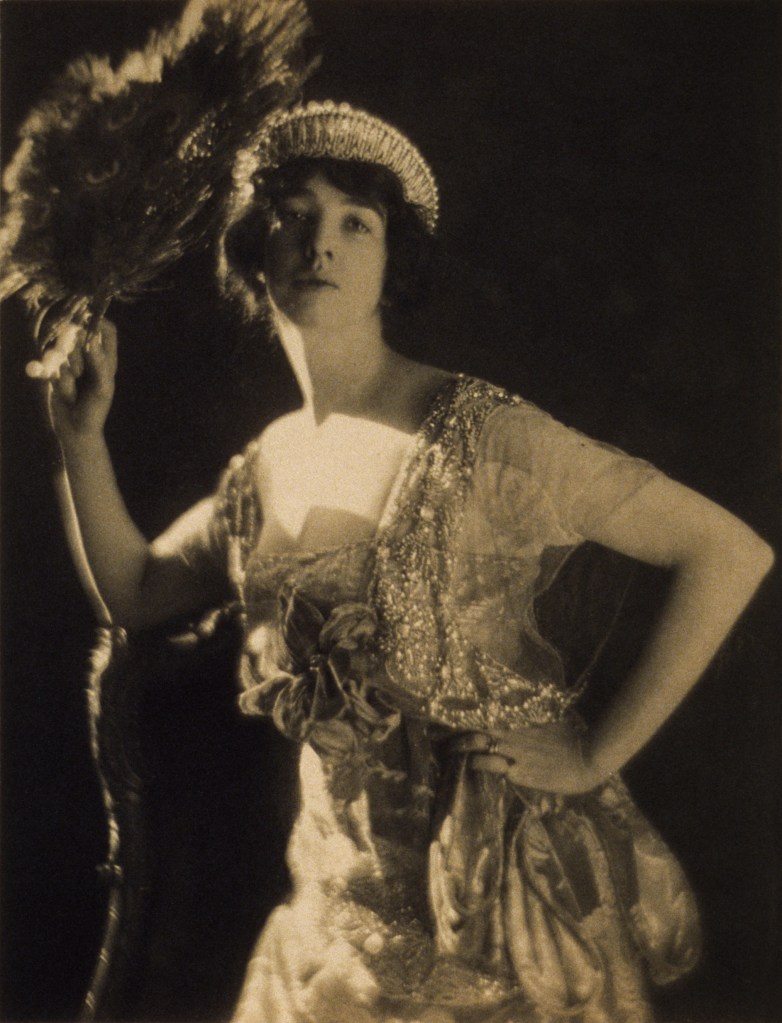
today is the birthday of Adolph de Meyer (Adolphe Edouard Sigismond Meyer; Paris 1 September 1868 – 6 January 1946 Los Angeles); photographer famed for his portraits in the early 20th century, many of which depicted celebrities such as Mary Pickford, Rita Lydig, Luisa Casati, Billie Burke, Irene Castle, John Barrymore, Lillian Gish, Ruth St. Denis, King George V, and Queen Mary. He was also the first official fashion photographer for the American magazine Vogue, appointed to that position in 1913.
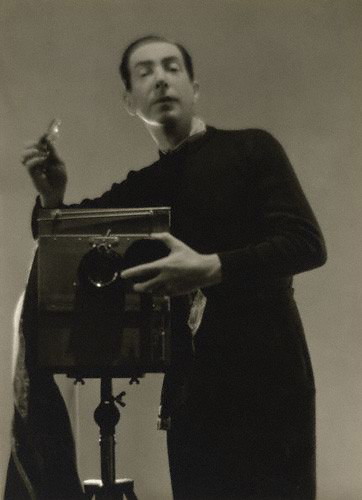
On 25 July 1899, at Holy Trinity Church, Sloane Street, Cadogan Square in London, England, de Meyer married Donna Olga Caracciolo, an Italian noblewoman who had been divorced earlier that year from Marino Brancaccio; some said she was a goddaughter of Edward VII. The couple reportedly met in 1897, at the home of a member of the Sassoon banking family, and Olga would be the subject of many of her husband’s photographs.
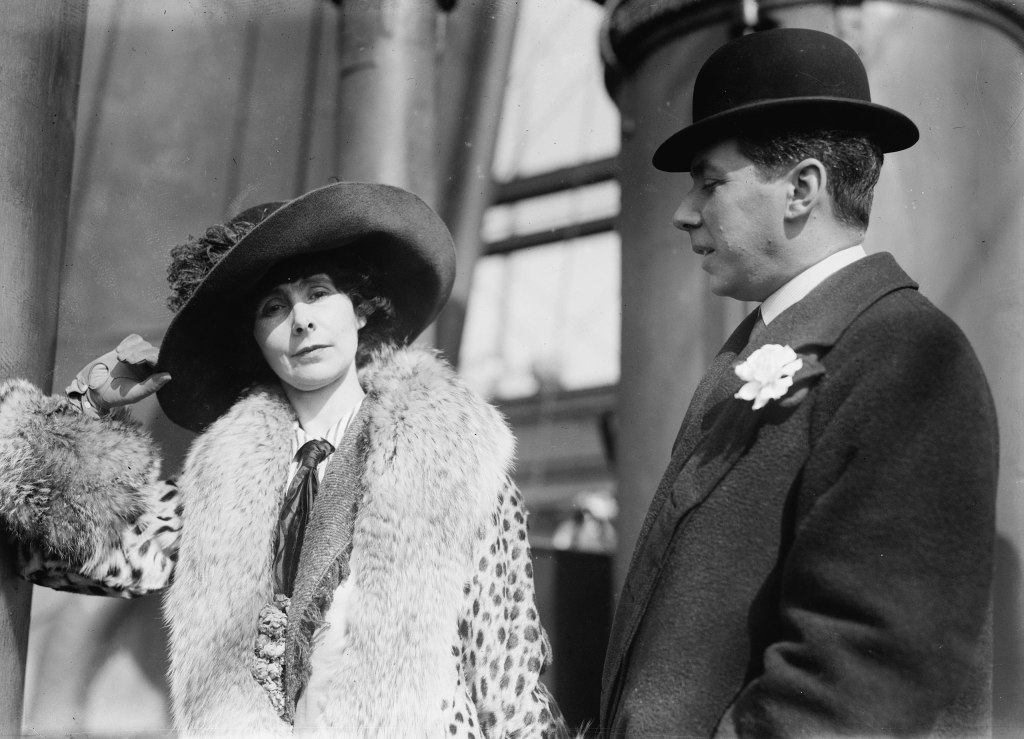
Baron and Baroness de Meyer
The de Meyers’ marriage was one of convenience rather than romantic love because the groom was homosexual and the bride was bisexual or lesbian. As Baron de Meyer wrote in an unpublished autobiographical novel, before they wed, he explained to Olga “the real meaning of love shorn of any kind of sensuality”. He continued by observing, “Marriage based too much on love and unrestrained passion has rarely a chance to be lasting, whilst perfect understanding and companionship, on the contrary, generally make the most durable union”.
In 1922, de Meyer accepted an offer to become the chief photographer and Parisian fashion correspondent for Harper’s Bazaar in Paris, spending the next 12 years there.
After the death of Olga in 1931, Baron de Meyer became romantically involved with a young German, Ernest Frohlich (born circa 1914), whom he hired as his chauffeur and later adopted as his son. The latter went by the name Baron Ernest Frohlich de Meyer.
On the eve of World War II, in 1938, de Meyer returned to the United States. Today, few of his prints survive, most having been destroyed during World War II but some 52 photographs of Olga, packed by his adopted son Ernest, came to light in 1988 and were published in 1992.
He died on the anniversary of his wife’s death being registered as ‘Gayne Adolphus Demeyer, writer (retired), and was interred at Forest Lawn Memorial Park in Glendale.
gallery
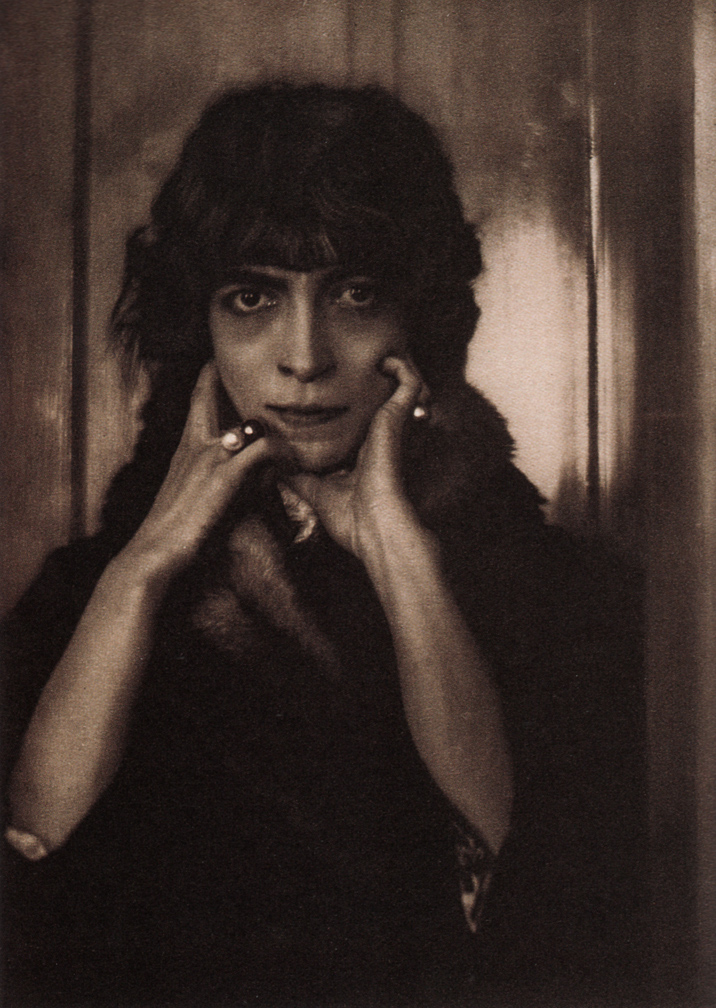
Marchesa Casati (1912)

Jeanne Eagels wearing a cape over a dress in tulle with an ostrich ruff by Madeleine Chéruit, Paris fashion designer, 1921
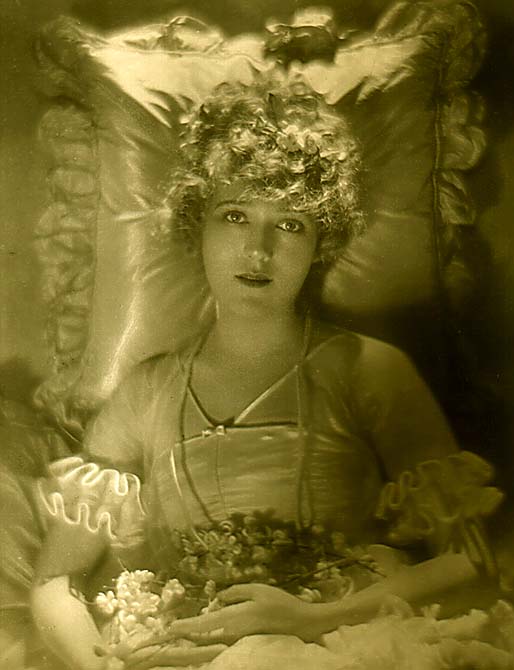
Mary Pickford
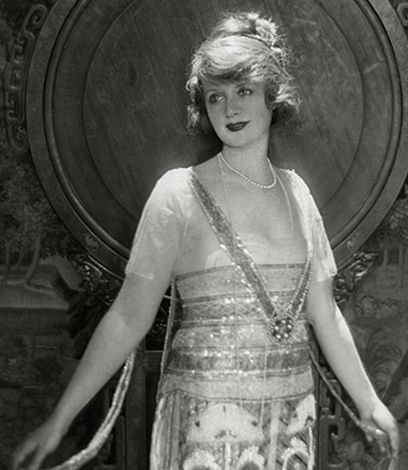
Billie Burke posant pour le Vanity Fair de février 1920

Ann Pennington

Portrait d´Ann Andrews (vers 1919)
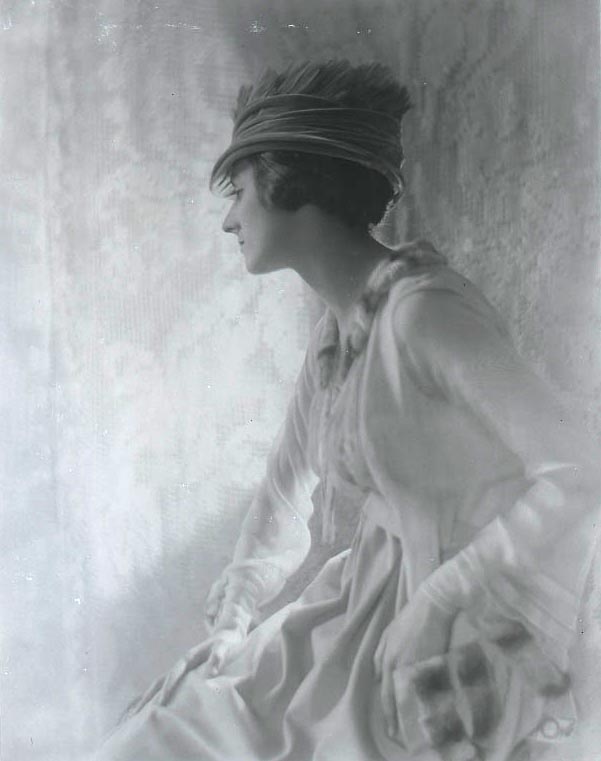
Illustration pour Vogue
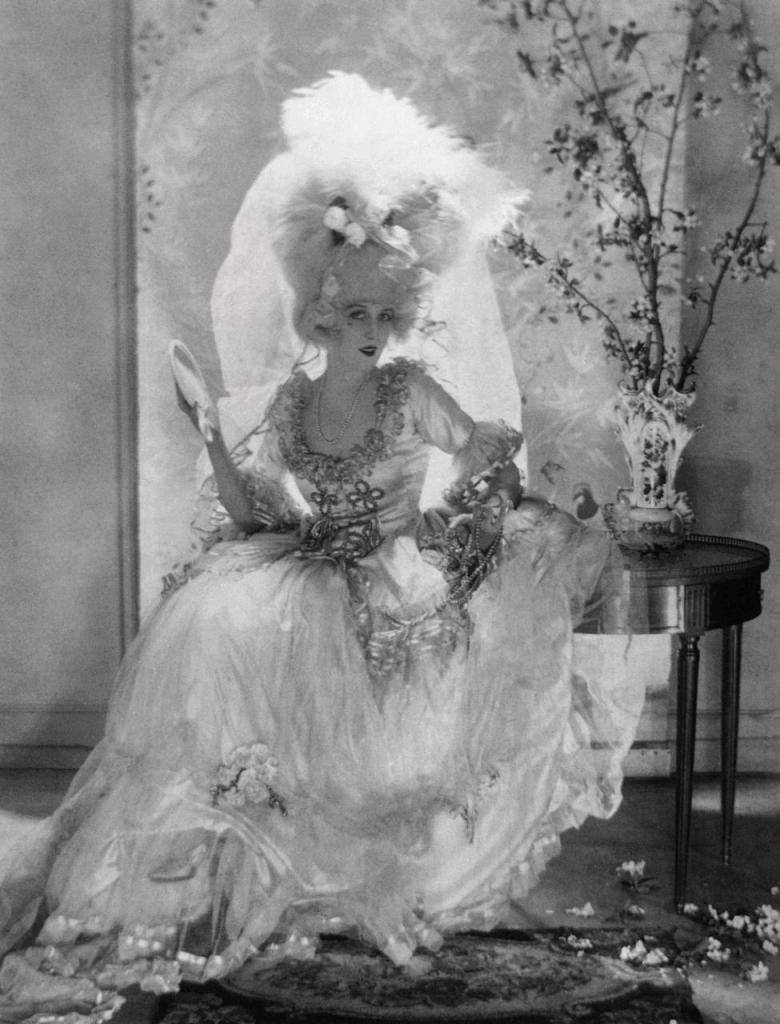
Helen Lee Worthing
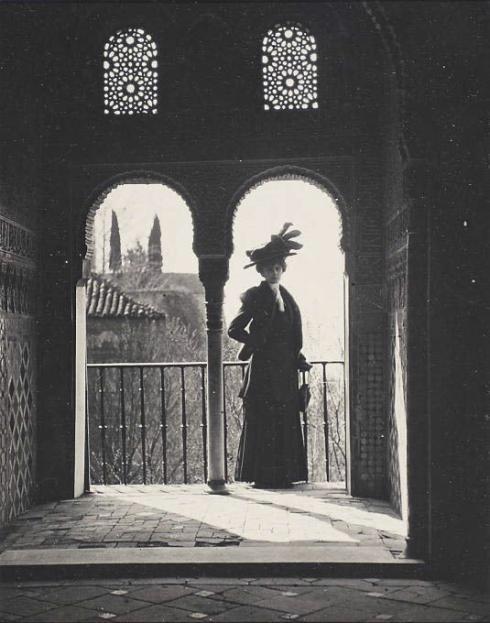
Femme en noir devant les arches d´une mosquée, (vers 1900)
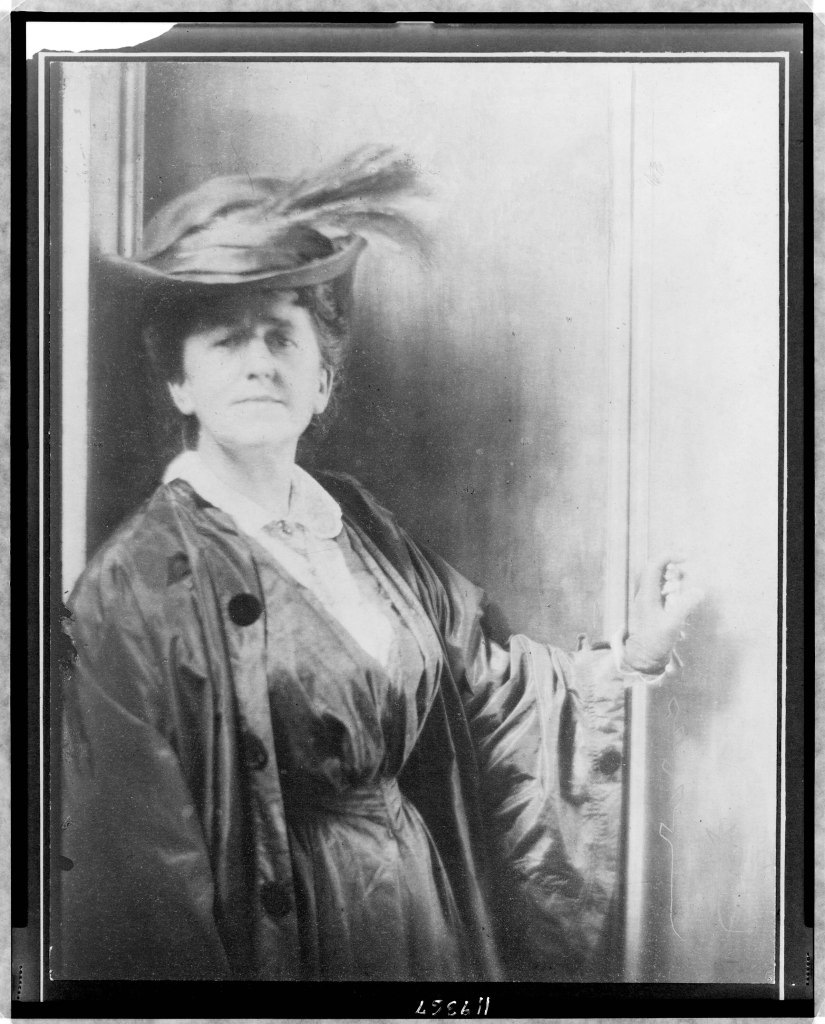
Portrait de la photographe américaine Gertrude Käsebier (vers 1900)

| Hilda Rix Nicholas | |
|---|---|
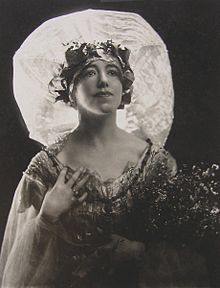 C. 1920, dressed as “the spirit of the bush” C. 1920, dressed as “the spirit of the bush” | |
Today is the birthday of Hilda Rix Nicholas (née Rix, later Wright, Ballarat, Victoria, Australia 1 September 1884 – 3 August 1961 Delegate, New South Wales, Australia); artist. She was born in the Victorian city of Ballarat. Her father was an education administrator and poet, her mother was a musician and artist. She studied under a leading member of the Heidelberg School, Frederick McCubbin, at the National Gallery of Victoria Art School from 1902 to 1905 and was an early member of the Melbourne Society of Women Painters and Sculptors. Following the death of her father in 1907, Hilda Rix, her only sibling Elsie and her mother travelled to Europe where she undertook further study in London and then in Paris.
After travelling to Tangiers in 1912, Rix held several successful exhibitions of her work, with one drawing, Grande marche, Tanger, purchased by the French government. She was one of the first Australians to paint post-impressionist landscapes, was made a member of the Société des Peintres Orientalistes Français, and had works hung in the Paris Salon first in 1911 and again in 1913. The family evacuated from France to England after the outbreak of World War I. A period of personal tragedy followed, as Rix’s sister died in 1914, then her mother in 1915. In 1916 she met and married George Matson Nicholas, only to be widowed the next month when he was killed on the Western Front.
Returning to Australia in 1918, Rix Nicholas once more took up professional painting, and held an exhibition of over a hundred works at Melbourne’s Guild Hall. Many sold, including In Picardy, purchased by the National Gallery of Victoria. Following a period painting in rural locations in the early 1920s, Rix Nicholas returned to Europe. A 1925 exhibition in Paris led to the sale of her work In Australia to the Musée du Luxembourg, followed by an extensive tour of her paintings around regional British art galleries. There followed representation in other exhibitions, including at the International Society of Sculptors, Painters and Gravers, and the Royal Academy of Arts, both in London. Following the inclusion of several works in the 1926 Société Nationale des Beaux-Arts Spring exhibition in Paris she was made an Associate of that organisation.
In 1926, Rix Nicholas returned to Australia, and in 1928 she married Edgar Wright, whom she had met during her travels in the early 1920s. The couple settled at Delegate, New South Wales; their only child, a son named Rix Wright, was born in 1930. Though she continued to paint significant works including The Summer House and The Fair Musterer, Rix Nicholas, a staunch critic of modernism who was disdainful of the works of emerging major artists such as Russell Drysdale and William Dobell, grew out of step with trends in Australian art. Her pictures remained didactic, portraying an Australian pastoral ideal, and reviews of her exhibitions grew more uneven. She held her last solo show in 1947. Rix Nicholas remained at Delegate until her death in 1961. Her works are held in most major Australian collections, including the Art Gallery of South Australia, Australian War Memorial, National Gallery of Australia, National Gallery of Victoria, and the Queensland Art Gallery.
Gallery
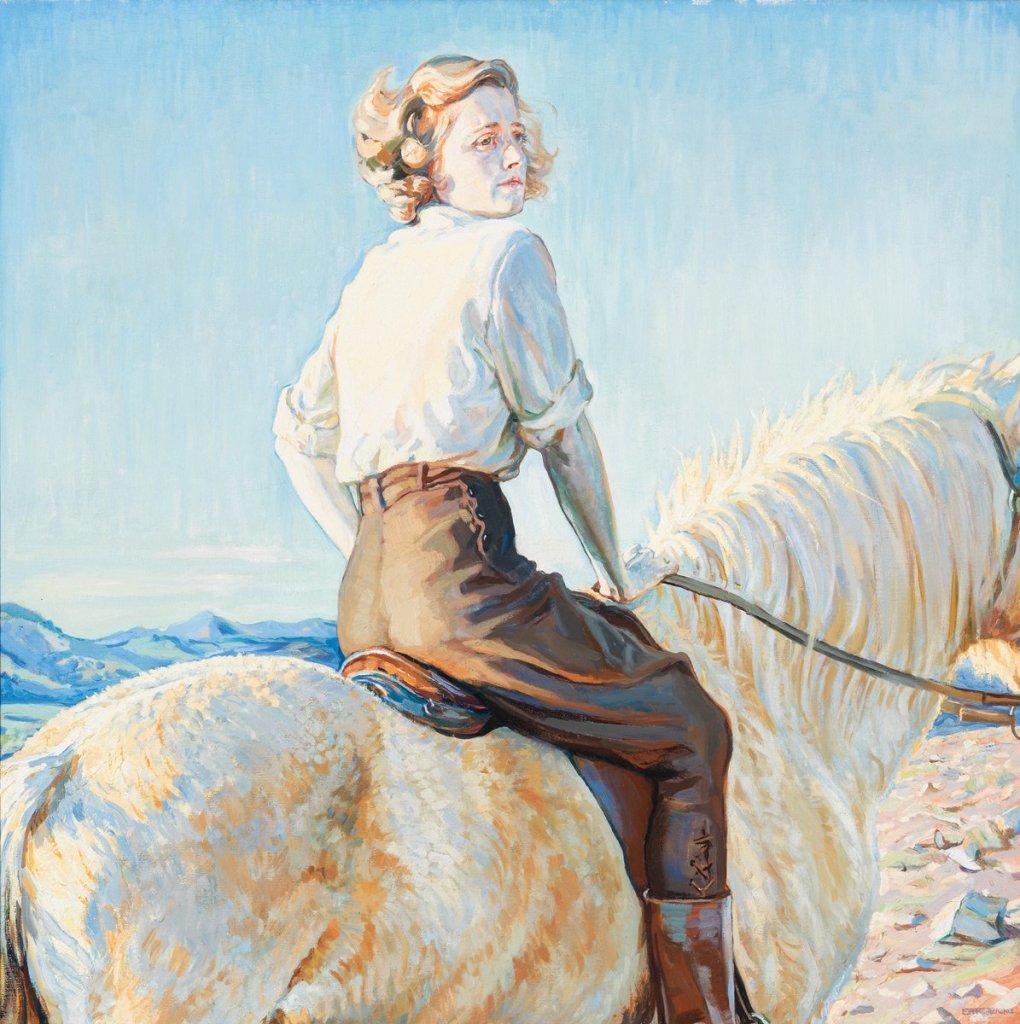
Autumn evenings golden glow, c.1942

The Fair Musterer
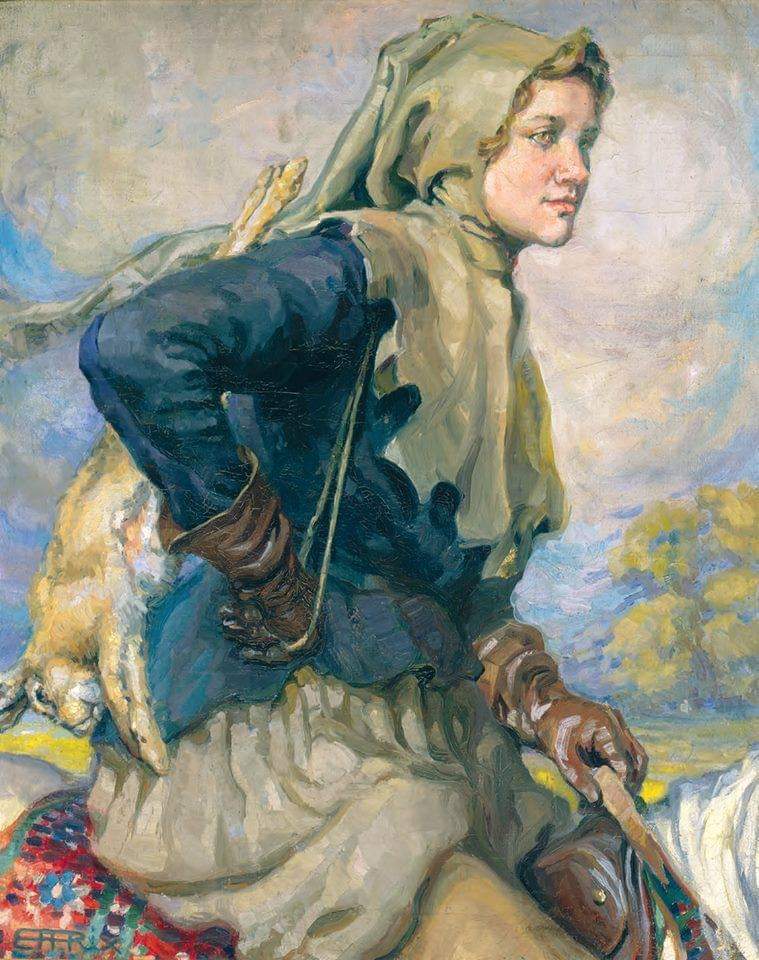
Retour de la Chasse. 1911
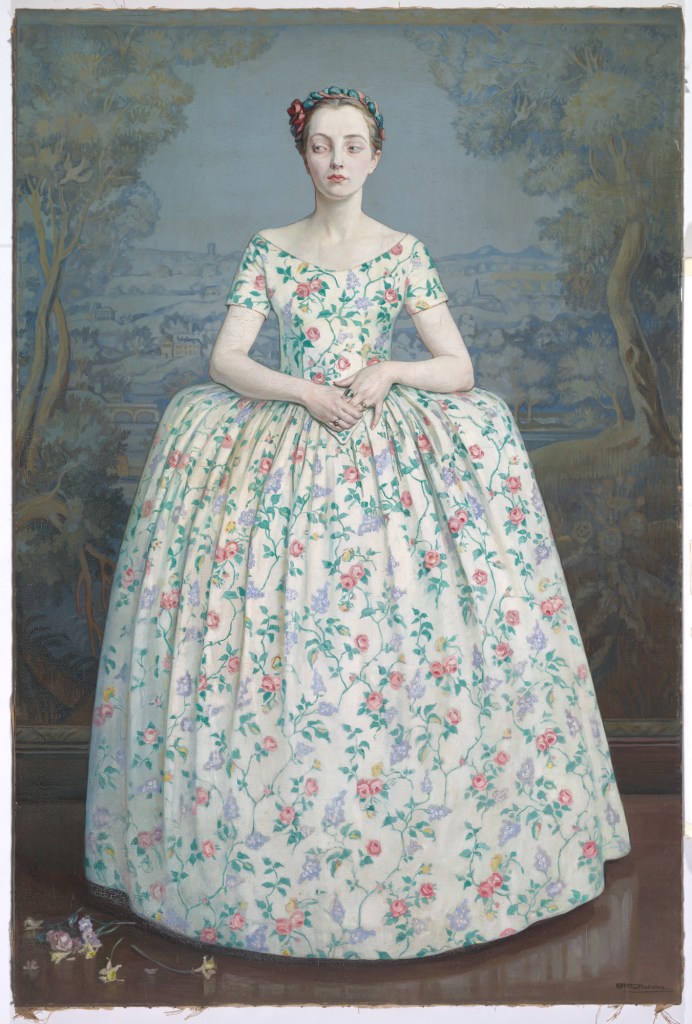
Les fleurs dédaignées (1925)

‘The Gold Coat’ (Portrait of Dorothy Richards, travelling companion & friend)

Une Australienne, 1926
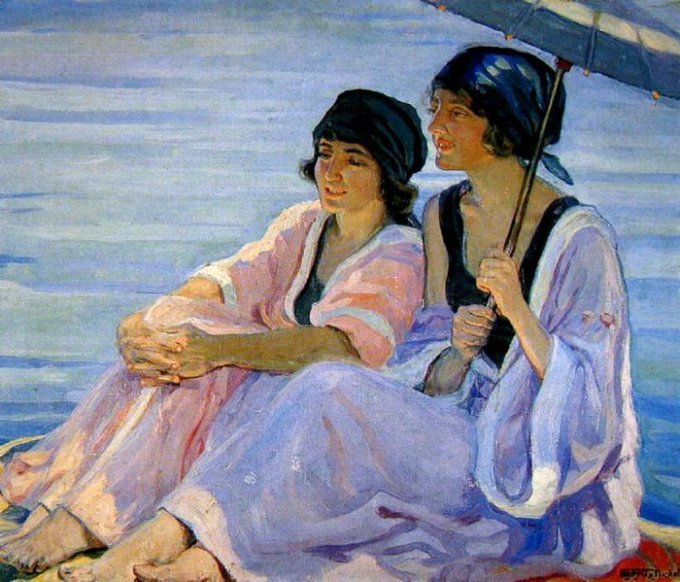
The Bathers
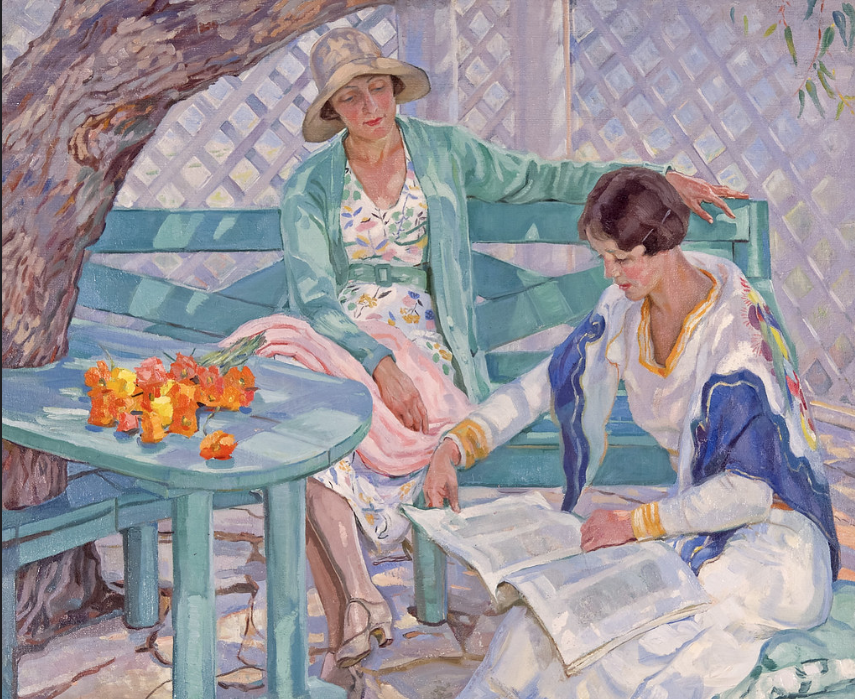
The Summer House, painted circa 1933, is one of Rix Nicholas’s best known works, but the artist herself was ambivalent about it and never showed it publicly
And today is the birthday of Tarsila do Amaral (Tarsila de Aguiar do Amaral; Capivari (modern-day Rafard), São Paulo, Empire of Brazil 1 September 1886 – 17 January 1973 São Paulo); painter, draftswoman, and translator. In my opinion, one of the leading Latin American modernist artists, and is regarded as the painter who best achieved Brazilian aspirations for nationalistic expression in a modern style. As a member of the Grupo dos Cinco, Tarsila is also considered a major influence in the modern art movement in Brazil, alongside Anita Malfatti, Menotti Del Picchia, Mário de Andrade, and Oswald de Andrade. She was instrumental in the formation of the aesthetic movement, Antropofagia (1928–1929); in fact, Tarsila was the one with her celebrated painting, Abaporu, who inspired Oswald de Andrade’s famous Manifesto Antropófago.

c 1925
In 1926, Tarsila married de Andrade and they traveled throughout Europe and the Middle East. In Paris, in 1926, she had her first solo exhibition at the Galerie Percier. The paintings shown at the exhibition, which marked the culmination of her Pau Brasil period, as well as her earlier stay in Paris, included São Paulo(1924), A Negra (1923), Lagoa Santa (1925), and Morro de Favela (1924). Her works were praised and called “exotic”, “original”, “naïve”, and “cerebral”, and her use of bright colors and tropical images was commented on.
Gallery

Estudo nú, Figura dos quadris para cima
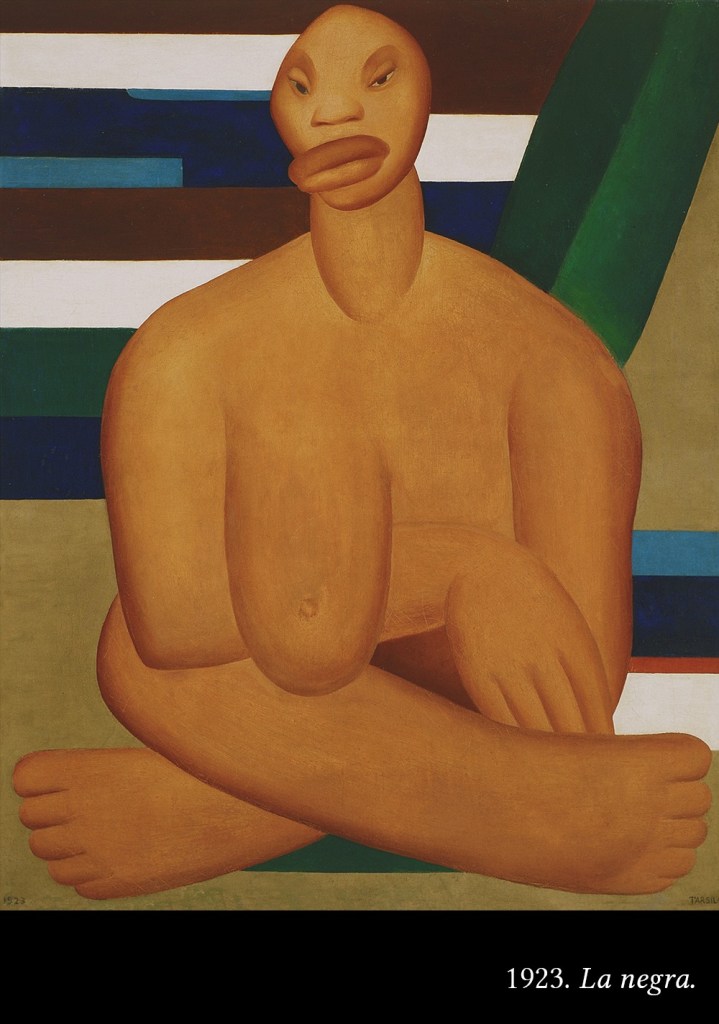
à negra
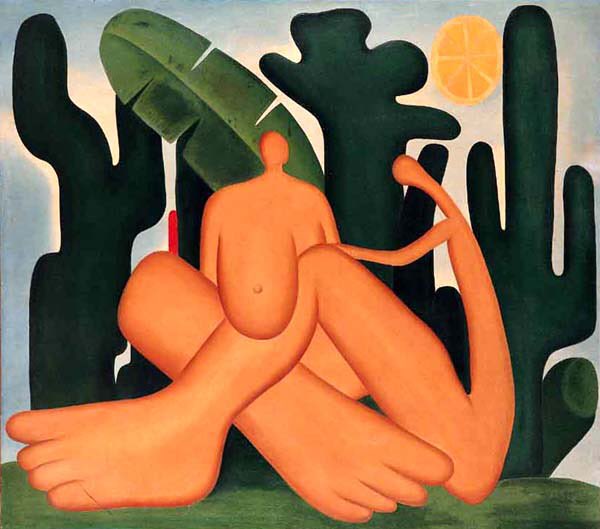


“Figura em Azul”

moon
thanks for stoppin’ by y’all
Mac Tag
 The Lovers’ Chronicle
Leave a comment