Dear Zazie, Here is today’s Lovers’ Chronicle from Mac Tag to his muse. Follow us on twitter @cowboycoleridge. My brother Jett puts on the costume. Do you? Where you are not: Does love dawn or is the sunlight missin’? Rhett
The Lovers’ Chronicle
Dear Muse,
oh, i thought of a better analogy
to describe my rocky trail here
“Ok let’s hear it”
there were enough bad choices
to fill a libretto for an opera,
a grand tragic four hour one
“Not surprised you went there”
but as we have discussed,
they were all necessary
“Every one of them”
for had they not
run there course
“We would not be here”
in this intimate refrain
© copyright 2023 mac tag/cowboy coleridge all rights reserved
sweet Goddess there have been enough wrong choices, i could stack ’em like cord wood; wrong place, wrong time, wrong one; in every conceivable mix; of course, the search for the one, when i should not have been searchin’, was the biggest; if only i had picked up my pen instead, there would not be so many failin’ refrains echoin’ around here
© copyright 2022.2023 mac tag/cowboy coleridge all rights reserved
finally
put a screechin’
halt to that
since we found us
had enough wrong turns
for a novel except no one
would believe some of ’em
unless i called it fantasy
now with time runnin’ out
no room for any twists
on the trail but the right ones
and the lovers’ refrain
© copyright 2021.2023 mac tag/cowboy coleridge all rights reserved
Pale Love, Pale Rider
ready to find the why
the answer is just waitin’
for us to catch up
at last lettin’ my mind
go where it should
and my words
goin’ right along
the times we had
talkin’, laughin’
watchin’ movies
gettin’ swept up
in your voice
and energy
again
a welcome refrain
i missed you, as much as i can
© copyright 2020 mac tag/cowboy coleridge all rights reserved
whoa what a week
“Your usual? Vodka
martini, double, stirred.”
no, not tonight
mezcal martini
two jalapeno olives
keep ’em comin’
***
bleedin’ me
from the beginnin’
i expect
not her fault
i s’pose
weakness does
what it does
just thought
that was the way
it was supposed to be
got used to it
expected it, hell
demanded it
ran or hid
when i could not
get it
so calm down
trust me
it is ok
bleed me
***
can there be
a finer place
than to be here
with y’all
stay tuned
© copyright 2019 mac tag/cowboy coleridge all rights reserved
a dancin’, drinkin’, laughin’
almost unbelievable time
calm through storms
when the hour was at hand
and day and night were ruled
unless of course
that is not the way it happened
and it was full of bad decisions
and sad refrains
guess which is correct
© copyright 2018.2023 mac tag/cowboy Coleridge all rights reserved
am i ready to find the why
or at least make an attempt
is the answer just waitin’
for me to catch up
why is change so hard
when change is all that is left
if i could git my mind
to go where it should
if i could git my words
to go where they could
c’mon, who am i kiddin’
play and play again
each mistake’s refrain
and i will pick deprivation
instead of daffodils
© copyright 2017 mac tag/cowboy Coleridge all rights reserved
Lurkin’ immortality, allurin’
Laurelled consoler scary to behold,
Death is a womb, a mother’s breast, she feigns
The fine illusion, damn the pious trick
Who does not know, and who is not made ill
That empty skull, that everlastin’ grin
old cafes
cheap hotels
rundown hopes
sad rendezvous
whiskey soaked memories
© copyright 2016 mac tag/cowboy Coleridge all rights reserved
Great soul, does hope yet lie waitin’ somewhere
To find some dream without the lyin’ eyes
That wave on wave offers to stir desire
Sighin’ still when but in a thin cold air
But all perishes; things of flesh and bone
As is, divine impatience also dies
© copyright 2015 mac tag/cowboy Coleridge all rights reserved
| John Dryden | |
|---|---|
 | |
Today is the birthday of John Dryden (Aldwincle, Thrapston, Northamptonshire, England; 19 August [O.S. 9 August] 1631 – 12 May [O.S. 1 May] 1700 London); poet, literary critic, translator, and playwright who was made England’s first Poet Laureate in 1668. He is seen as dominating the literary life of Restoration England to such a point that the period came to be known in literary circles as the Age of Dryden. Walter Scott called him “Glorious John.”
On 1 December 1663 Dryden married Lady Elizabeth Howard (died 1714). The marriage was at St. Swithin’s, London, and the consent of the parents is noted on the license, though Lady Elizabeth was then about twenty-five. She was the object of some scandals, well or ill founded. It was said that Dryden had been bullied into the marriage by her brothers. A small estate in Wiltshire was settled upon them by her father. The lady’s intellect and temper were apparently not good. Dryden apparently was treated as an inferior by those of her social status. Lady Elizabeth Dryden survived her husband, but went insane soon after his death.
Verse
The Secular Masque (1700)
- A very merry, dancing, drinking,
Laughing, quaffing, and unthinkable time.- Lines 38-39.
- The sword within the scabbard keep,
And let mankind agree.- Lines 61-62.
- Calms appear, when storms are past,
Love will have its hour at last.- Lines 72-73.
- Joy rul’d the day, and Love the night.
- Line 82.
- All, all of a piece throughout:
Thy chase had a beast in view;
Thy wars brought nothing about;
Thy lovers were all untrue.
‘Tis well an old age is out,
And time to begin a new.- Lines 86-91.
Cymon and Iphigenia
- Old as I am, for ladies’ love unfit,
The power of beauty I remember yet.- Lines 1-2.
- When beauty fires the blood, how love exalts the mind!
- Line 41.
- He trudged along unknowing what he sought,
And whistled as he went, for want of thought.- Lines 84-85.
- The fool of nature stood with stupid eyes
And gaping mouth, that testified surprise.- Line 107.
- Love taught him shame; and shame, with love at strife,
Soon taught the sweet civilities of life.- Line 133.
- She hugged the offender, and forgave the offense:
Sex to the last.- Lines 367-368.
- And raw in fields the rude militia swarms,
Mouths without hands; maintain’d at vast expense,
In peace a charge, in war a weak defence;
Stout once a month they march, a blustering band,
And ever but in times of need at hand.- Line 400.
- Of seeming arms to make a short essay,
Then hasten to be drunk — the business of the day.- Lines 407-408.
Today is the birthday of Xavier Mellery (9 August 1845, Laken, Belgium – 4 February 1921, Brussels); symbolist painter.
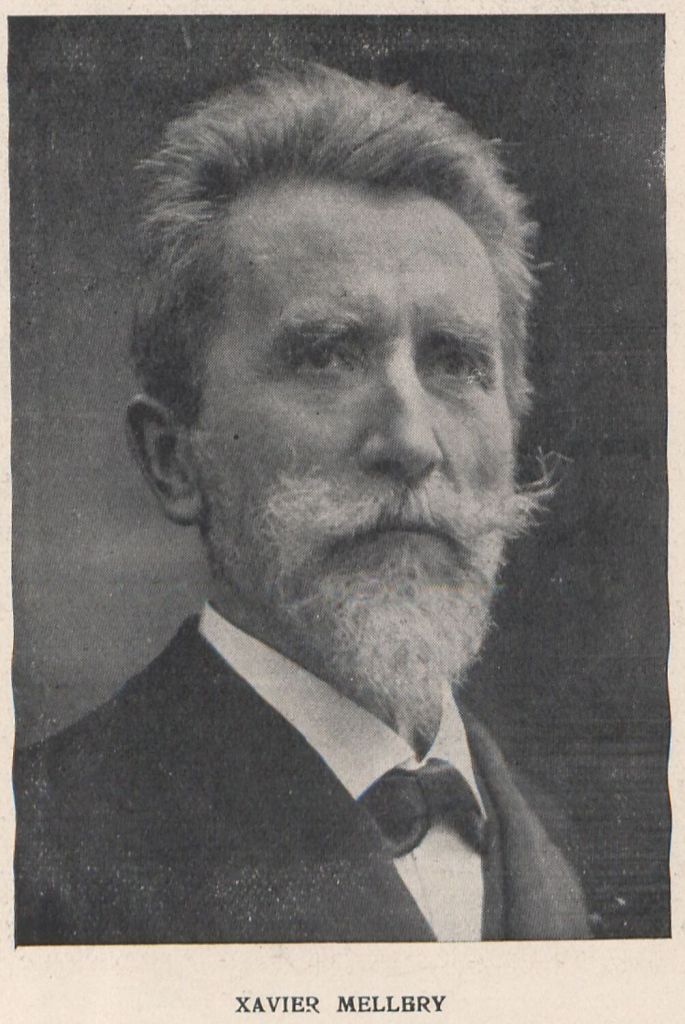
The son of a gardener at the Royal Palace of Laeken. He attended the Royal Academy of Fine Arts of Brussels from 1860 to 1867. Mellery won the Prix de Rome and traveled to Italy where he studied paintings from the Renaissance.
Gallery
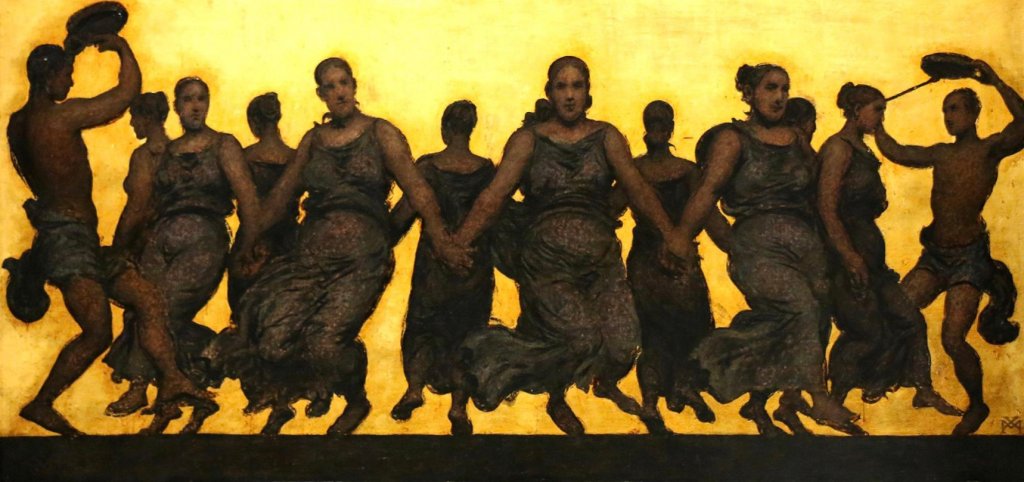
la danse
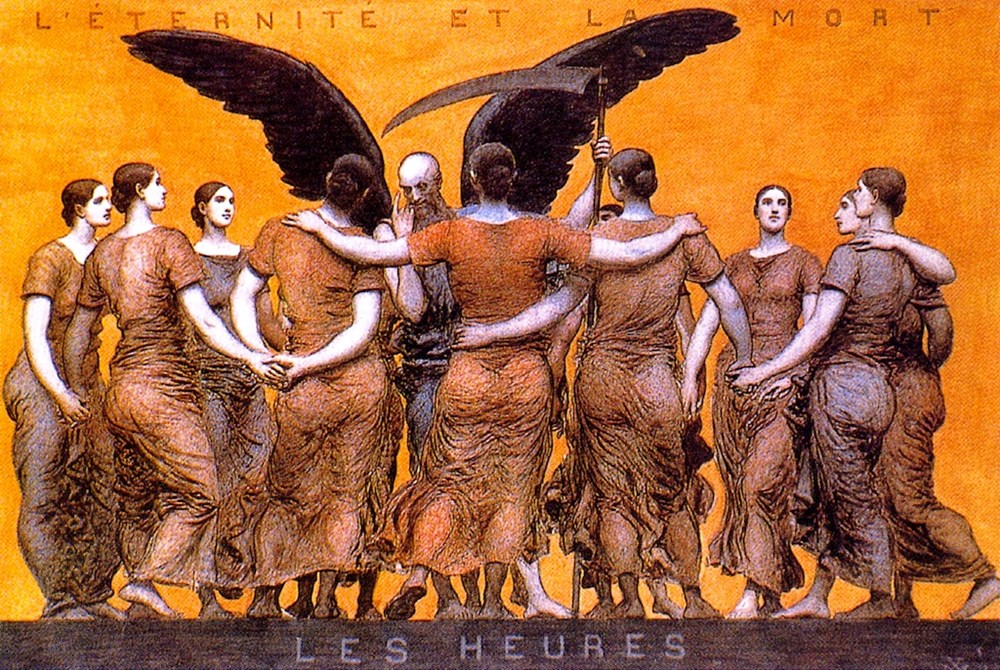
les heures; l’ éternité et la mort
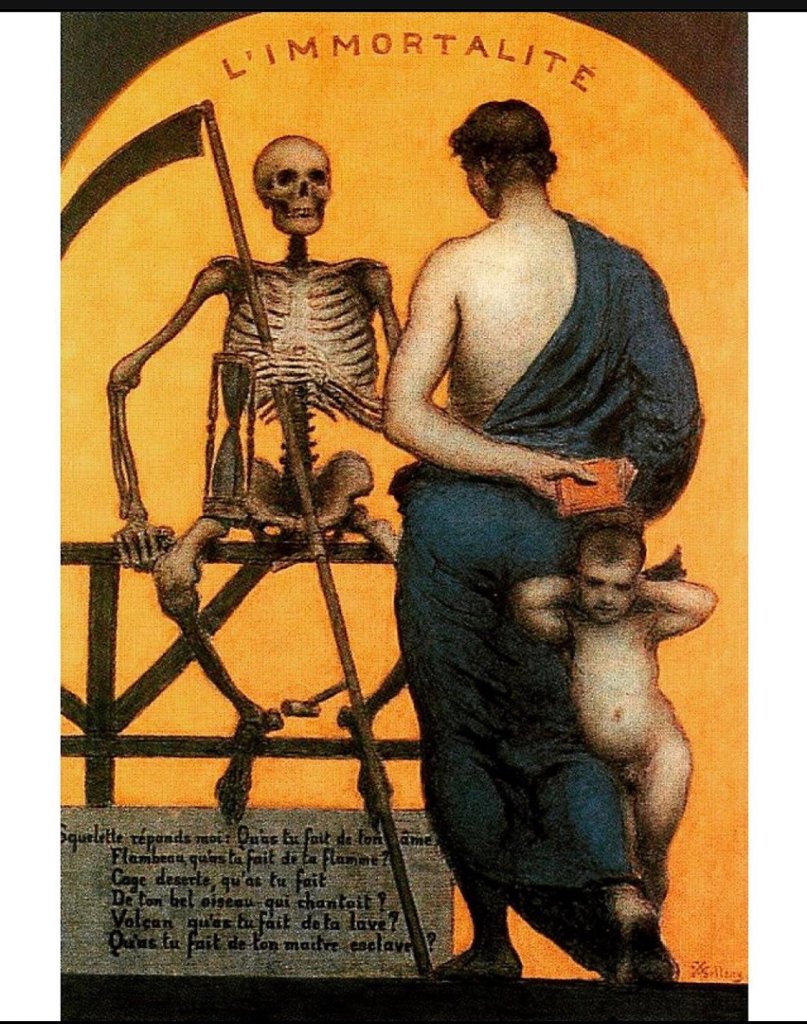
l’ immortalite

le bonheur
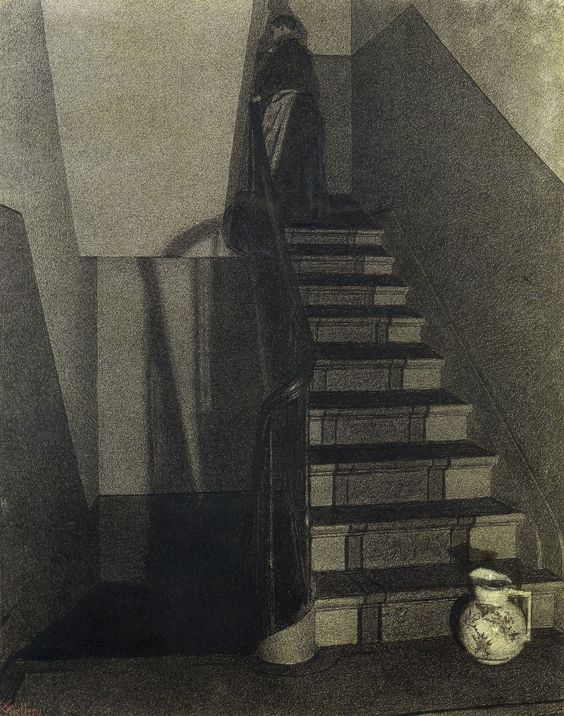
the staircase 1889

It was on this day in 1919 that the Italian composer Ruggero Leoncavallo died. He composed one of my favorite operas, Pagliacci, which includes the famous tenor aria “Vesti la giubba” (Put on the costume). The story revolves around Canio who is married to Nedda but she is in love with Silvio. Leadin’ up to the aria, Canio discovers her infidelity, but must nevertheless prepare for his performance as Pagliaccio the clown because “the show must go on”. He sings:
Act! While in delirium,
I no longer know what I say,
or what I do!
And yet it’s necessary… make an effort!
Bah! Are you not a man?
You are a clown!
Put on your costume, powder your face.
The people pay to be here, and they want to laugh.
And if Harlequin shall steal your Columbina,
laugh, clown, so the crowd will cheer!
Turn your distress and tears into jest,
your pain and sobbing into a funny face – Ah!
Laugh, clown,
at your broken love!
Laugh at the grief that poisons your heart
And he wrote the Italian popular song “Matinatta” (Morning or Morning Serenade).
Morning Serenade
Dawn, dressed in white,
Already opens the door to broad daylight;
Already, with her rosy fingers,
She caresses the multitude of flowers!
All around, creation seems stirred
By a mysterious shiver;
And you do not awaken; and in vain
I stay here, aching to sing.
Put on your white dress too,
And open the door to your minstrel!
Where you are not, sunlight is missing;
Where you are love dawns.
All around, creation seems stirred
By a mysterious shiver;
And you do not awaken; and in vain
I stay here, aching to sing.
Where you are not, sunlight is missing
(Ain’t no sunlight here, MT)
The Songs of the day are “Vesti la giubba” as performed by Luciano Pavarotti – http://www.youtube.com/watch?v=Z0PMq4XGtZ4 we do not own the rights to this song.
And “Matinatta” as performed by Andrea Bocelli – http://www.youtube.com/watch?v=hMe3irDmptA we do not own the rights to this song
And it was on this day in 1930 that Betty Boop made her cartoon debut in Dizzy Dishes.

Betty Boop is an animated cartoon character created by Max Fleischer, with help from animators including Grim Natwick. She originally appeared in the Talkartoon and Betty Boop film series, which were produced by Fleischer Studios and released by Paramount Pictures. She has also been featured in comic strips and mass merchandising.
A caricature of a Jazz Age flapper, Betty Boop was described in a 1934 court case as: “combin[ing] in appearance the childish with the sophisticated—a large round baby face with big eyes and a nose like a button, framed in a somewhat careful coiffure, with a very small body of which perhaps the leading characteristic is the most self-confident little bust imaginable”. Despite having been toned down in the mid-1930s as a result of the Hays Code to appear more demure, she became one of the best-known and popular cartoon characters in the world.

Betty Boop was originally a caricature of Helen Kane.
Betty Boop made her first appearance on August 9, 1930, in the cartoon Dizzy Dishes, the seventh installment in Fleischer’s Talkartoon series. Although Clara Bow is often given as being the model for Boop, she actually began as a caricature of singer Helen Kane, who in turn gained fame by imitating the style of black singer Baby Esther Jones.
Betty Boop is regarded as one of the first and most famous sex symbols on the animated screen; she is a symbol of the Depression era, and a reminder of the more carefree days of Jazz Age flappers. Her popularity was drawn largely from adult audiences, and the cartoons, while seemingly surreal, contained many sexual and psychological elements, particularly in the 1932 “Talkartoon” Minnie the Moocher, featuring Cab Calloway and his orchestra.

The transformation from pre-Code to post-Code
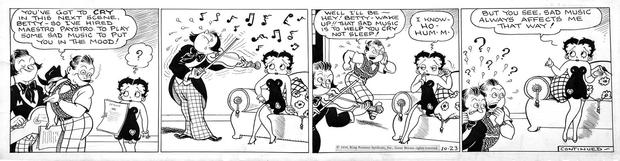
Bud Counihan’s Betty Boop (October 23, 1934)
Mac Tag
thanks for stoppin’ by y’all
I just miss you, in a quite simple desperate human way. — Letter from Vita Sackville-West to Virginia Woolf
 The Lovers’ Chronicle
Leave a comment