Dear Zazie,
Here is today’s Lovers’ Chronicle from Mac Tag. What song do you hear?
Rhett
The Lovers’ Chronicle
Dear Muse,
not a river runnin’ through it
“Oh I see where you’re going”
yes indeed, music pulses
through, the lifeblood, definin’
these feelin’s and emotions
“My life has certainly been
defined by musical stages”
your beautiful voice is one
of the many things
i love about you
“And I love the music
we make together”
c’mon baby, lets make some more
© copyright 2023 mac tag/cowboycoleridge all rights reserved
oh i still hear it playin’, i am not deaf, just far removed; listen, the wind whirls through each and every one; do you feel it on your cheek, as i do; now, becomin’ clear, you, red hair gleamin’ in the sun and flowin’ with the breeze, it is all i can do to stand here in wonder; what else matters
© copyright 2022 mac tag/cowboycoleridge all rights reserved
i hear it playin’
bids me welcome
i draw near,
guilty
but clear-ey’d,
observin’ the dream
comin’ on
from your first entrance,
inspiration born again
smitten, questionin’,
i lacked everything
and yet, there it was
belief, breathin’
light shinin’ through
the many cracks
hear it
© copyright 2021 mac tag/cowboy coleridge all rights reserved
Pale Love, Pale Rider
low times again
shoulda damn well
known better
will get around to bein’ grateful
for driven home the point
and usherin’ in this
what the hell difference
does it make feelin’
Schopenhauer was right
you gotta keep the bar low,
the lower the better
an odd comfort found
not givin’ a shit, knowin’
that whatever happens
it does not really matter
© copyright 2020 mac tag/cowboycoleridge all rights reserved
at a small bar out on the high plains,
where spent too much time drinkin’,
but not pretendin’ anymore,
writin’ about what it was like
to have and have not
and the song, plaintiff
though no longer trapped
by the past, and the light,
shinin’ in your hair that day,
makin’ it impossible
not to believe
this was meant for us
© copyright 2019 mac tag/cowboy coleridge all rights reserved
bade not
despite, or perhaps
due to, tryin’ so hard
the song plays on
from the first entrance
guilty of withdrawin’,
the nearer drawn
plaintive, i guess
if you must go there
what other outcomes
could have come
from such
a misguided search
the song plays on
the voice
the melody
pulls you in
go with it
it will take you
where you need to go
© copyright 2018 mac tag/cowboy coleridge all rights reserved
inside, a voice
then the sound of a guitar,
and the song of a woman
plaintive, gentle, echoin’
in the sonority
of the empty house
outside, rain
on the rain-starved country
to the very farthest end
of the vast plain,
silence reigns
but inside,
the woman’s voice
continues to sing
in a key of sadness
and the guitar accompanies
in somber notes
© copyright 2017 mac tag/cowboy Coleridge all rights reserved
Breathe deep. Breathe deep
Enter, enter…
The totem spins
Then you appear
As pretty as
ever. And we
are as we once
were, and I: I
am overcome
***
Cool, 30 degrees, sunny,
High Plains mornin’,
cigar, strong coffee,
front porch.
Might just make it.
© copyright 2015 mac tag/cowboy Coleridge all rights reserved

Today is the birthday of George Herbert (Montgomery, Wales 3 April 1593 – 1 March 1633 Bemerton, Wiltshire, England); poet, orator and Anglican priest.
In 1628 or 1629, Herbert lodged at Dauntsey House in the north of Wiltshire, the home of his stepfather’s brother Henry Danvers and Henry’s elderly widowed mother Elizabeth. A day’s ride to the south, at Baynton in Edington, lived the family of Henry’s cousin Charles Danvers (died 1626) who is said to have had a desire for Herbert to marry his daughter Jane. It was arranged for Herbert and Jane to meet, and they found mutual affection; Jane was ten years younger than George. They were married at Edington church on 5 March 1629.
Having suffered for most of his life from poor health, he died of consumption, only three years after taking holy orders. Jane died in 1661.
Love (III)
Love bade me welcome; yet my soul drew back,
Guilty of dust and sin.
But quick-ey’d Love, observing me grow slack
From my first entrance in,
Drew nearer to me, sweetly questioning,
If I lacked any thing.
Lines 1-6
Today is the birthday of Anne Lister (Halifax, United Kingdom 3 April 1791 – 22 September 1840 Kutaisi, Georgia); Yorkshire landowner, diarist, mountaineer and traveller. Throughout her life she kept diaries which chronicled the details of her daily life, including her lesbian relationships, her financial concerns, her industrial activities and her work improving Shibden Hall. Her diaries contain more than 4,000,000 words and about a sixth of them—those concerning the intimate details of her romantic and sexual relationships—were written in code. The code, derived from a combination of algebra and Ancient Greek, was deciphered in the 1980s. Lister is often called “the first modern lesbian” for her clear self-knowledge and openly lesbian lifestyle. Called “Fred” by her lover and “Gentleman Jack” by Halifax residents, she suffered from harassment for her sexuality, and recognised her similarity to the Ladies of Llangollen, whom she visited.
| Anne Lister | |
|---|---|
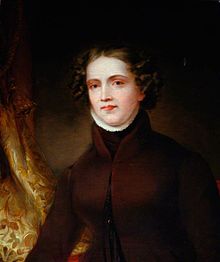 | |
In 1804 Lister was sent to the Manor House School in York (in the King’s Manor buildings), where she would meet her first love, Eliza Raine (1791–1869). Eliza and her sister Jane were the rich daughters of an East India Company surgeon in Madras, brought to Yorkshire after his death. Anne and Eliza met and shared a bedroom aged 13 at boarding school, but Anne was asked to leave after two years. She rejoined the school after Eliza had left. Eliza expected to live with Anne as an adult, but Anne began affairs with Isabella Norcliffe and Mariana Belcombe, day-pupils at the school. In despair and frustration Eliza became a patient at Clifton Asylum, run by Mariana’s father Dr Belcombe. While being educated at home Lister developed an interest in classical literature. In a surviving letter to her aunt from 3 February 1803, a young Lister explains “My library is my greatest pleasure… The Grecian History had please me much.”
Her wealth allowed her some measure of freedom to live as she pleased. She inherited the family estate on her aunt’s death in 1836, Shibden Hall, but took charge of it from 1826.
Lister is described as having a “masculine appearance”; one of her lovers, Marianna Lawton (née Belcombe), was initially ashamed to be seen in public with her because her appearance was commented on. She dressed entirely in black and took part in many activities that were not perceived as the norm for gentlewomen, such as opening and owning a colliery. Lawton and Lister were lovers for several years, including a period during which Lawton was married and had her husband’s permission.
Lister’s subsequent affair with a wealthy heiress, Ann Walker, whom she met in 1832, was a story of local repute and her eventual marriage (without legal recognition) to Walker in 1834 was highly unusual. The couple lived together an Shibden Hall until Lister’s death in 1840. Walker’s fortune was used to improve Shibden Hall and the property’s waterfall and lake. Lister renovated Shibden Hall quite significantly to her own design. In 1838 she added a Gothic tower to the main house, to serve as her private library. She also had a tunnel dug under the building which allowed the staff to move about without disturbing her.
In 1830 while travelling in France, Lister was the first woman to ascend Monte Perdido in the Aragonese Pyrenees. In 1838, she came back to the Pyrenees with Walker and completed the first “official” ascent of the Vignemale (3,298 metres (10,820 ft)). In France she was known as Ann Lister or Lady Lister only for this accomplishment.

Lister is buried in St Anne’s church, Southowram, West Yorkshire
Lister died aged 49 of a fever at Koutais (now Kutaisi, Georgia) while travelling with Ann Walker. Walker, to whom ownership of Shibden Hall passed, had Lister’s body embalmed and brought back to the UK, where she is buried in the parish church in Halifax, West Yorkshire. Ann Walker died in 1854 at her childhood home, Cliff Hill in Lightcliffe.
Today is the birthday of Mistinguett (Jeanne Florentine Bourgeois; Enghien-les-Bains, Île-de-France, France; 3 April 1875 – 5 January 1956 Bougival, Île-de-France, France); actress and singer. She was at one time the highest-paid female entertainer in the world.
| Mistinguett | |
|---|---|
 | |
At an early age Bourgeois aspired to be an entertainer. She began as a flower seller in a restaurant in her hometown, singing popular ballads as she sold blossoms. After taking classes in theatre and singing, she began her career as an entertainer in 1885. One day on the train to Paris for a violin lesson, she met Saint-Marcel, who directed the revue at the Casino de Paris. He engaged her first as a stage-hand, and here she began to pursue her goal to become an entertainer, experimenting with various stage-names, being successively Miss Helyett, Miss Tinguette, Mistinguette and, finally, Mistinguett. In the 1880’s Mistinguett visited her neighbor Anna Thibaud to ask for advice. Thibaud told her, “To succeed in the theatre … you must be pretty. You must excite men.” Mistinguett asked if she meant that she had to excite the crowds. Thibaud repeated, “No, the men!”
Bourgeois made her debut as Mistinguett at the Casino de Paris in 1895 and went on to appear in venues such as the Folies Bergère, Moulin Rouge and Eldorado. Her risqué routines captivated Paris, and she went on to become the most popular French entertainer of her time and the highest-paid female entertainer in the world, known for her flamboyance and a zest for the theatrical. In 1919 her legs were insured for 500,000 francs.
Mistinguett never married. She also had a long relationship with Maurice Chevalier, 13 years her junior.
She first recorded her signature song, “Mon Homme”, in 1916. It was popularised under its English title “My Man” by Fanny Brice and has become a standard in the repertoire of numerous pop and jazz singers.
During a tour of the United States, Mistinguett was asked by Time magazine to explain her popularity. Her answer was, “It is a kind of magnetism. I say ‘Come closer’ and draw them to me.”
Mistinguett died at the age of 80, attended by her son, a doctor. She is buried in the Cimetière Enghien-les-Bains, Île-de-France, France.
Upon her death, writer Jean Cocteau observed in an obituary, “Her voice, slightly off-key, was that of the Parisian street hawkers—the husky, trailing voice of the Paris people. She was of the animal race that owes nothing to intellectualism. She incarnated herself. She flattered a French patriotism that was not shameful. It is normal now that she should crumble, like the other caryatids of that great and marvelous epoch that was ours”.
Gallery

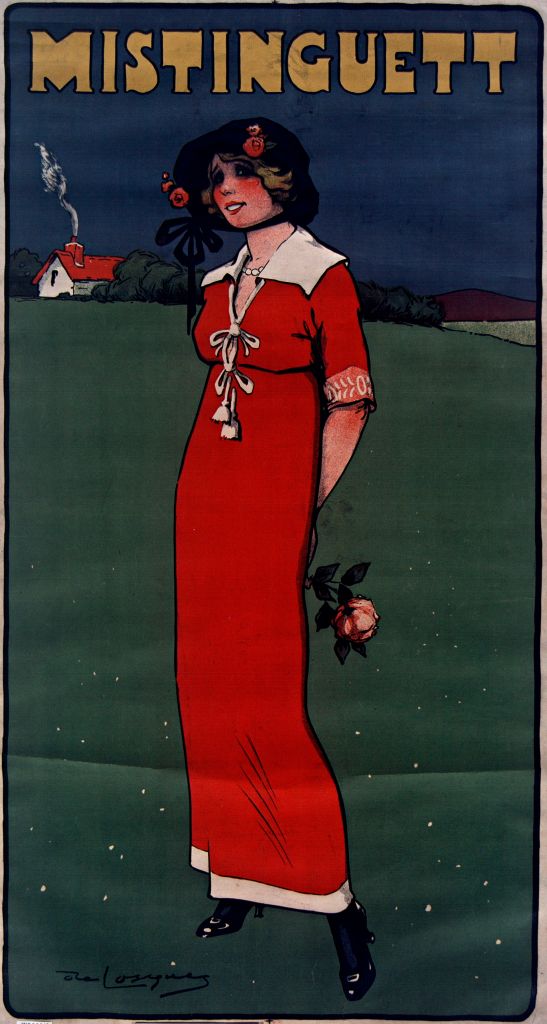
poster, 1911

Poster Mistinguett Moulin Rouge, by Charles Gesmar, 1926

With Josephine Baker in 1927
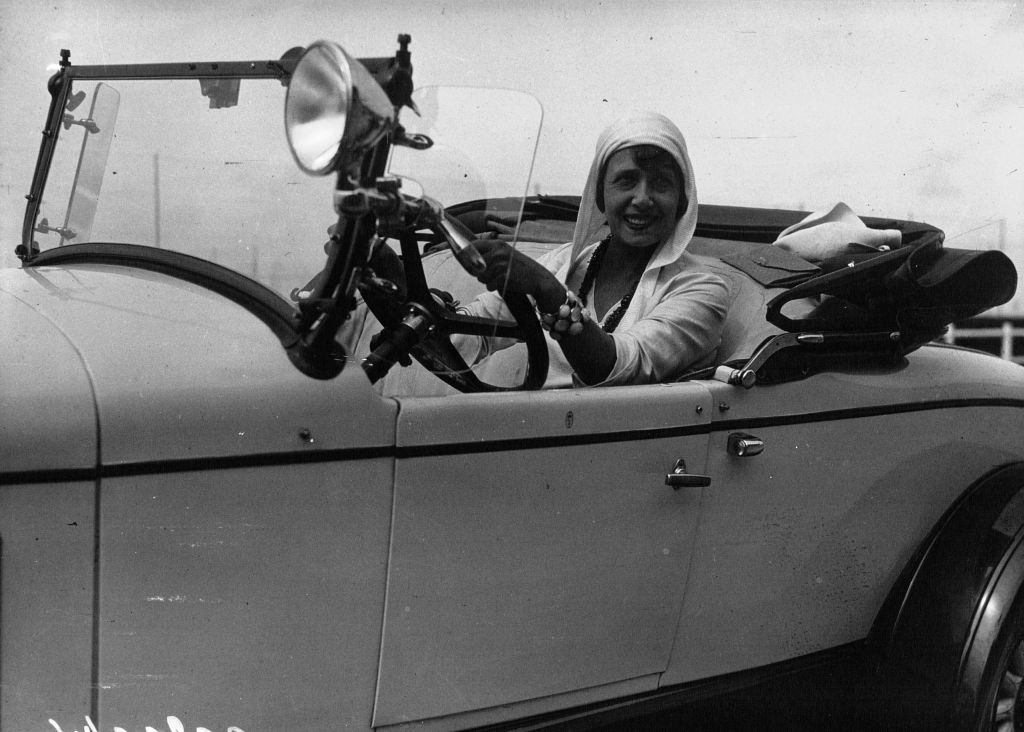
in her Chrysler, Deauville, France, 1929
Today is the birthday of Peter Gowland (Peter Andrew Gowland; Los Angeles April 3, 1916 – March 17, 2010 Pacific Palisades, California); glamour photographer and actor. He was known for designing and building his own studio equipment and was active professionally for six decades with his business partner, Alice Beatrice Adams, whom he married in 1941.
Gowland shot more than 1,000 magazine covers, mostly glamour shots of female models but also portraits of male celebrities. His covers included Rolling Stone, Playboy, and Modern Photography. His acting roles were mostly uncredited.
Gallery
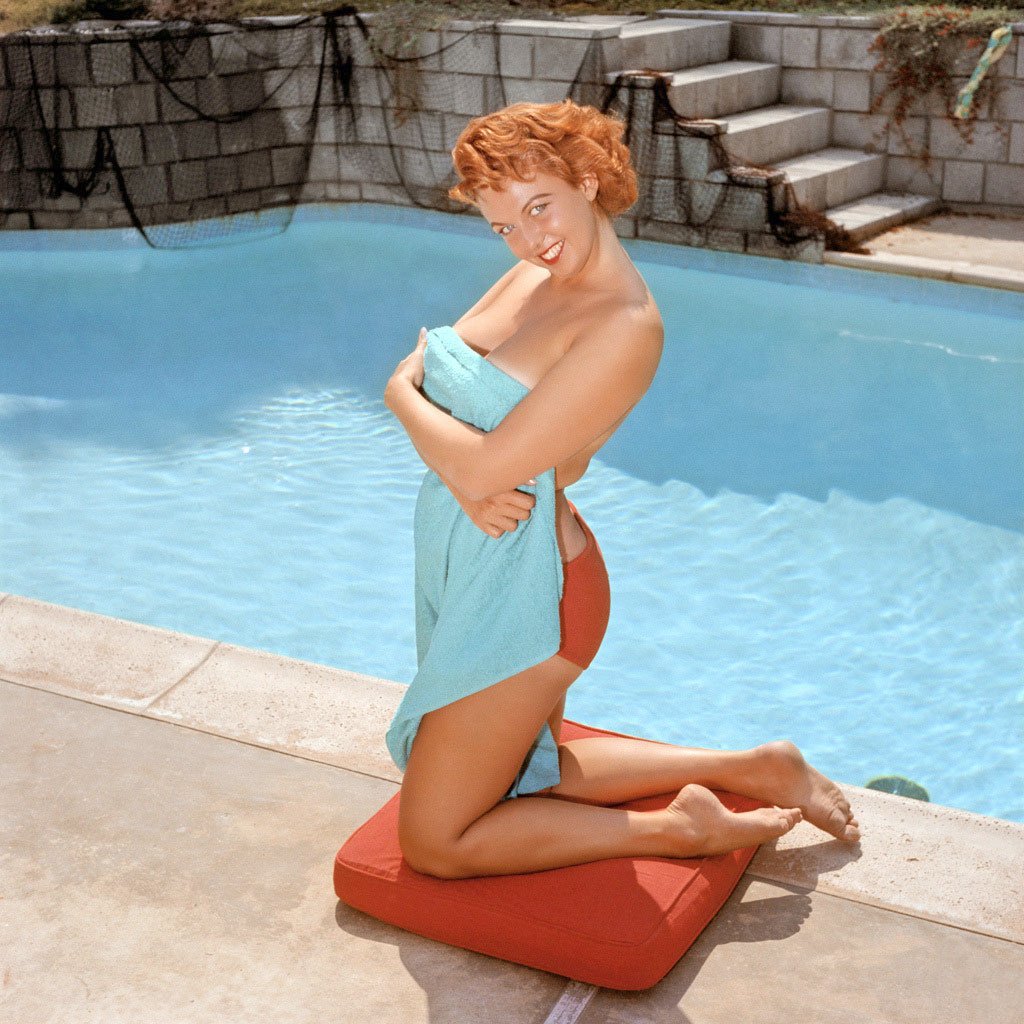
Lynn Turner 1956


Susan Denberg / Playboy’s Playmate of the Month, August 1966

Candace Thayer

Melody Lowell

Suzi Quatro on the cover of the January 2nd, 1975, issue of Rolling Stone

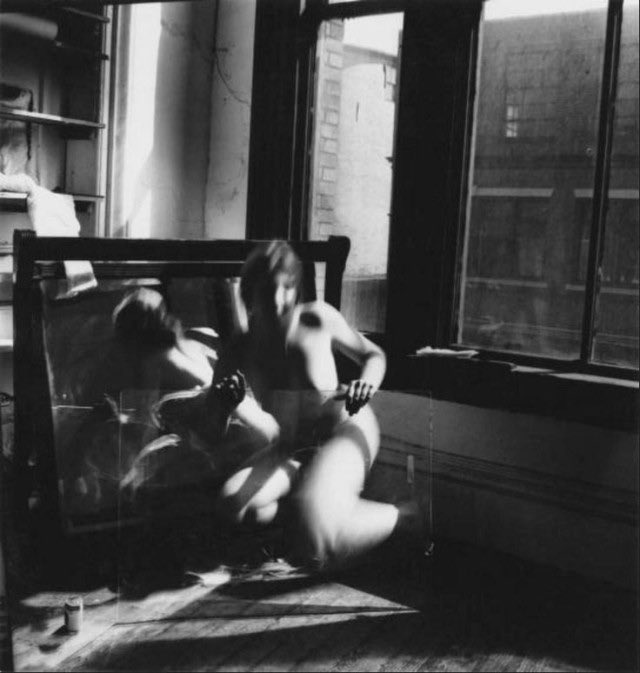
And today is the birthday of Francesca Woodman (Francesca Stern Woodman; Boulder, Colorado April 3, 1958 – January 19, 1981 Barbizon 63, Manhattan); photographer perhaps best known for her black and white pictures featuring either herself or female models.
Beginning in 1975, Woodman attended the Rhode Island School of Design (RISD) in Providence, Rhode Island. She studied in Rome between 1977 and 1978 in a RISD honors program. Because she spoke fluent Italian, she was able to befriend Italian intellectuals and artists. She returned to Rhode Island in late 1978 to graduate from RISD.
Woodman moved to New York City in 1979. After spending the summer of 1979 in Stanwood, Washington whilst visiting her boyfriend at Pilchuck Glass School, she returned to New York. In the summer of 1980, she was an artist-in-residence at the MacDowell Colony in Peterborough, New Hampshire.
In late 1980, Woodman became depressed due to the failure of her work to attract attention and to a broken relationship. She survived a suicide attempt in the autumn of 1980, after which she lived with her parents in Manhattan.
Woodman died by jumping out of a loft window of a building on the East Side of Manhattan. An acquaintance wrote, “things had been bad, there had been therapy, things had gotten better, guard had been let down”. Her father has suggested that Woodman’s suicide was related to an unsuccessful application for funding from the National Endowment for the Arts.
Gallery


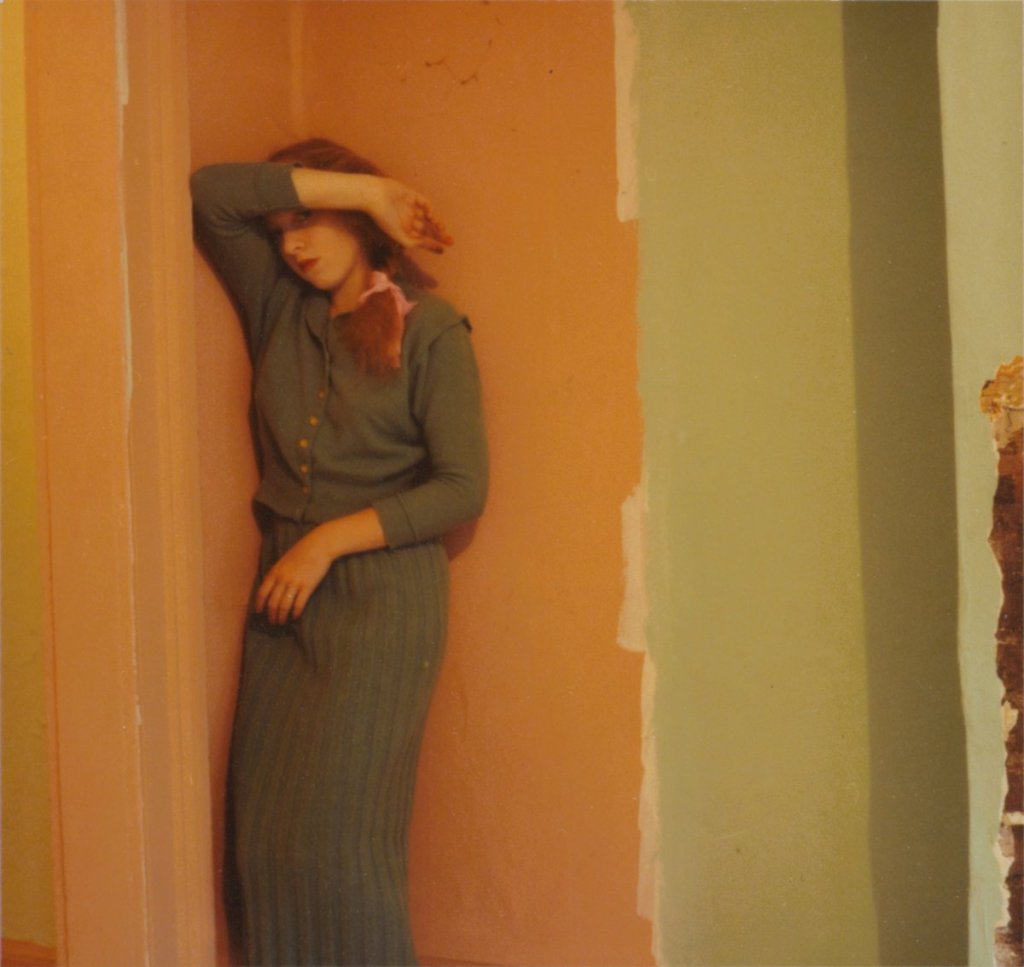
Untitled (from Swan Song series), Providence, Rhode Island (BFA.03), 1978
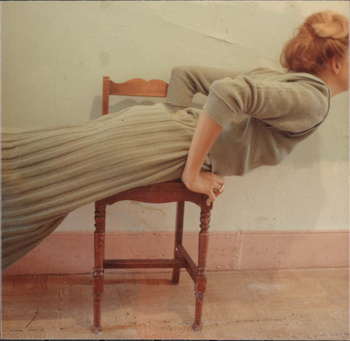 Untitled, New York (N.405) , 1979
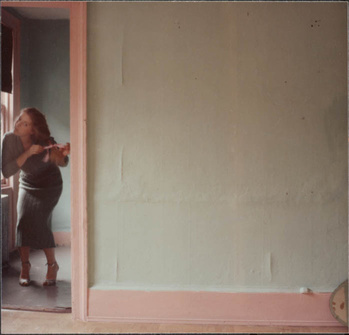


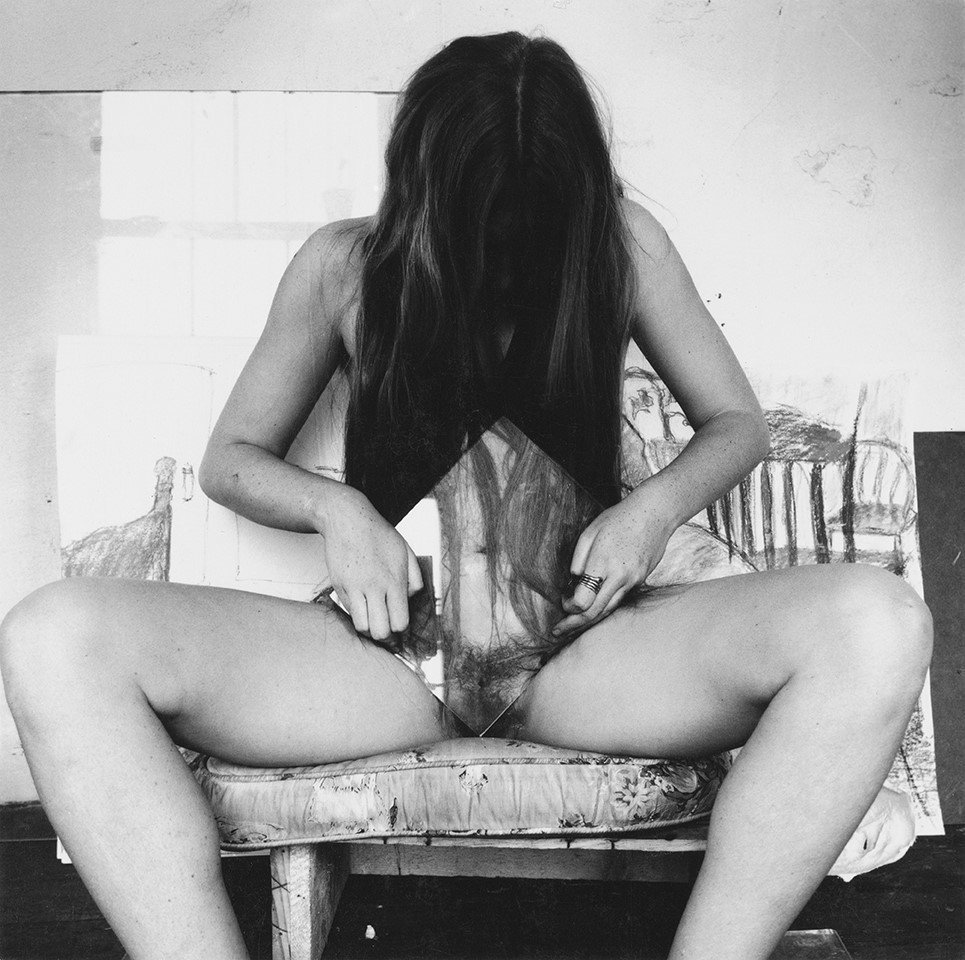


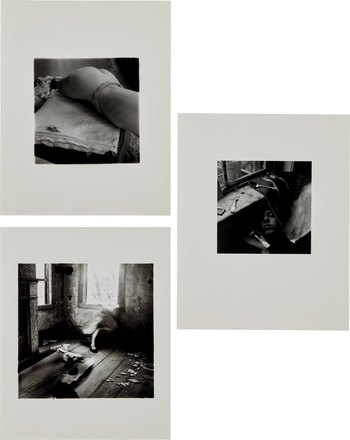
Untitled (New York); It must be time for lunch now; and House #3, Providence, Rhode Island, 1979-80 Phillips: Editions and Works on Paper (April 2017)
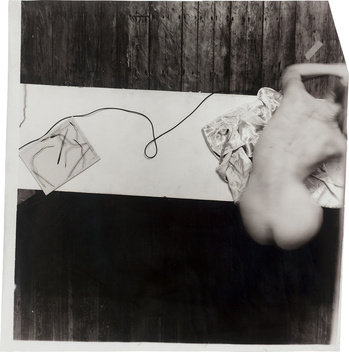
Untitled (Providence, Rhode Island), 1978
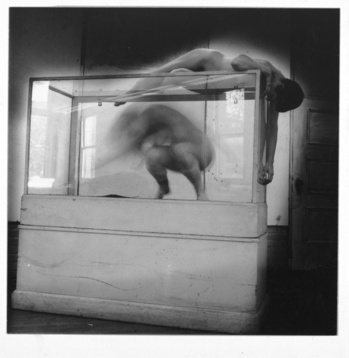
Space2, Providence, Rhode Island (P.008), 1975-1976
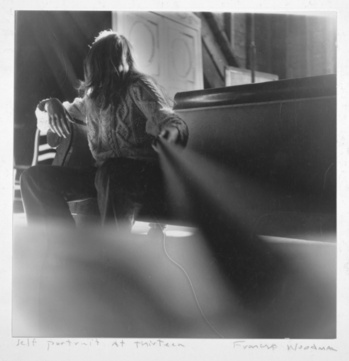
Self-portrait at 13, Antella, Italy (E.1), 1972
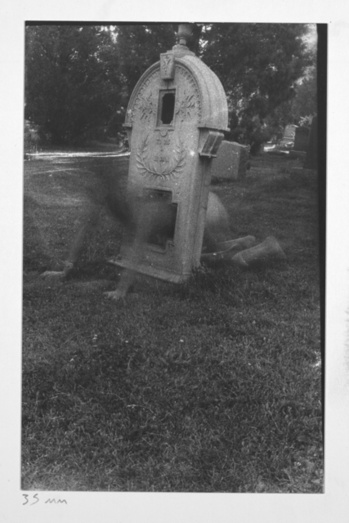
Untitled, Boulder, Colorado (E.4) , 1972-1975
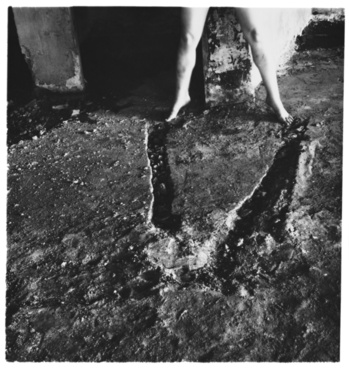
Untitled, Providence, Rhode Island(P.45), 1975-1978
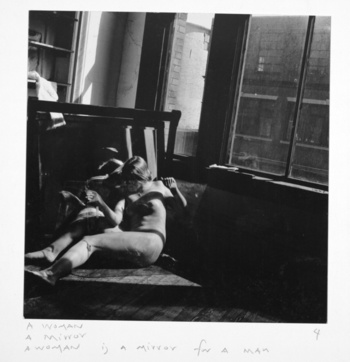
A Woman; A Mirror; A Woman is a Mirror for a Man, Providence, Rhode Island (P.48), 1975-1978
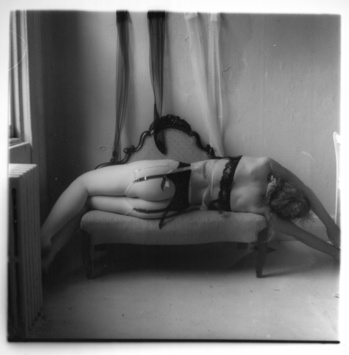
Untitled, New York, 1979-1980 (N.391)
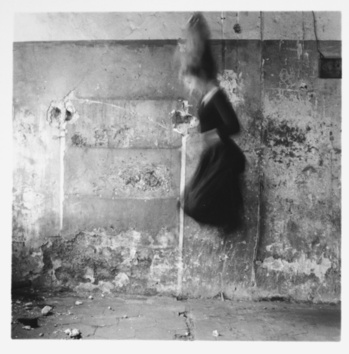
Untitled, Rome, Italy (I.126.2), 1977-1978
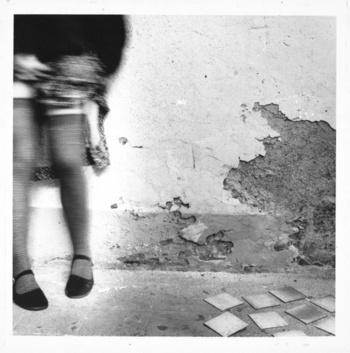
Several Cloudy Days, Rome, Italy (I.126), 1977-1978
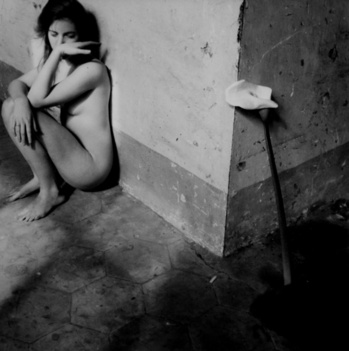
Early E03 , 1972
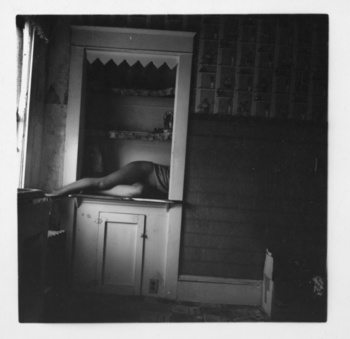
Untitled, Providence, Rhode Island (P.57), 1976
thanks for stoppin’ by y’all
mac tag
 The Lovers’ Chronicle
Leave a comment