Dear Zazie, Here is today’s Lovers’ Chronicle from Mac Tag dedicated to his muse. Follow us on twitter @cowboycoleridge. Rhett
The Lovers’ Chronicle
Dear Muse,
dream sounds…
feeling the wind in his hair he thinks, this must be the High Plains
then he sees that he is standing on a mesa
been awhile since i was here, he thinks, but i can still hear the moan
Rosalía could hear it, Kees could hear it and he got lost in it
there was a time when that was all he heard, all he wanted
but now, he hears something else in the wind
a lovely voice, worth getting lost in
My darling, says the beautiful redhead, are you coming back to bed
absolutely
© copyright 2024 mac tag/cowboycoleridge all rights reserved
no need to follow Kees tonight
“Will go wherever you lead”
that is where the phrase
came from, and it is
“Dark yet evocative”
was a time, everywhere
i turned it was there,
so i started goin’ in deeper
“Glad you found a way out”
still mostly there when we met
“Now for a different kind of moan”
© copyright 2023 mac tag/cowboycoleridge all rights reserved
long plateaus of emptiness, kinda wordy but woulda been an appropriate topic for a day, could be what this was all about, pre-you, it was a call for understandin’, a plea sometimes, and i think it was important to poke and prod to prove that somethin’ could penetrate the numbness, the blue moan, an important part of the story, but now the vistas are full and the only moan is that of bliss
© copyright 2022.2024 mac tag/cowboycoleridge all rights reserved
fillin’ time
with thoughts
contentment
in dreamin’,
awakenin’
can we feel, can we find
what we are lookin’ for
the promise has no end
nightfall comin’ on,
late February, rainin’
a song, playin’
i see now,
the trail ahead
and the years with you
can you hear
can you see
© copyright 2021 mac tag/cowboy coleridge all rights reserved
Pale Love, Pale Rider
have to write one for Kees today
High Plains guy
yes there is wind in his verse
and loss and desolation
he wrote testimonials
to long plateaus of emptiness
right up until he disappeared
cannot imagine that level of despair
yet these pages contain other stories
of those who could not carry the burden
any further
the blue moan
we gonna keep totin’ ours
on the back of these words
© copyright 2020.2024 mac tag/cowboy coleridge all rights reserved
wander through thoughts yet,
and gaze upon thy memory
where feeds countless notes,
from remembered looks,
worn by the waste of time
listen
at the close of day,
hear the story
whispered
will be the cry
a murmur
against the wail
of the lone night
© copyright 2019 mac tag/cowboy coleridge all rights reserved
like all the others
ended abruptly
takin’ chances for years
just intensified
the episodes
a blue moan
tried not to fall
but could not manage it
talked of leavin’
another country
gittin’ lost
become a mystery
“What keeps you going?”
do you know…
© copyright 2018 mac tag/cowboy coleridge all rights reserved
loneliness
to fill the void
with thoughts
happiness,
no too strong,
contentment
in dreamin’,
awakenin’
wretched
must be
livin’ without
soundin’
i shall find you,
i shall find…
can you find
what you do not know
you are lookin’ for
the promise
has no end
nightfall comin’ on,
late February, snow falls
driftin’ in piles, the wind
whippin’
across the plains
a song, playin’
a blue moan
i see now,
mapped and marred,
the trail behind
and the years ahead
hurt, madness, fear
threaten, escape, survive
may this night
open Her comfort
to these tired eyes
i look at you
across time
and darkness
and wonder
can you feel
can you hear
do you know…
© copyright 2017 mac tag/cowboy Coleridge all rights reserved
brave
swingin’ out
over the edge
on hopes tied
to nothin’ but dreams
the risk was it all
comin’ unraveled
and that is what happened
one day found at the bottom
broken and disillusioned
***
one winter evenin’
she hugged me
in her little black dress
after the opera and
my mind raced
in all directions
© copyright 2016 mac tag/cowboy Coleridge all rights reserved
Is it just that
I am lonely
Or, really, are
You just that hot!
***
She makes my day
She is funny
She has spirit
She is as sharp
as the crease in
my jeans, & her
eyes; so pretty
Too bad tellin
her matters not
***
Sowed it, dang sure
reapin’ it. Earned
it, deserve it,
own it. Payin’
for it. No end
to it. It is
the way it must
be. Accept it.
***
Superpower?
Why yes I do:
Findin’ women
with more baggage
than the Denver
airport and then
makin’ ’em fall
in love with me.
© copyright 2015 mac tag/cowboy Coleridge all rights reserved
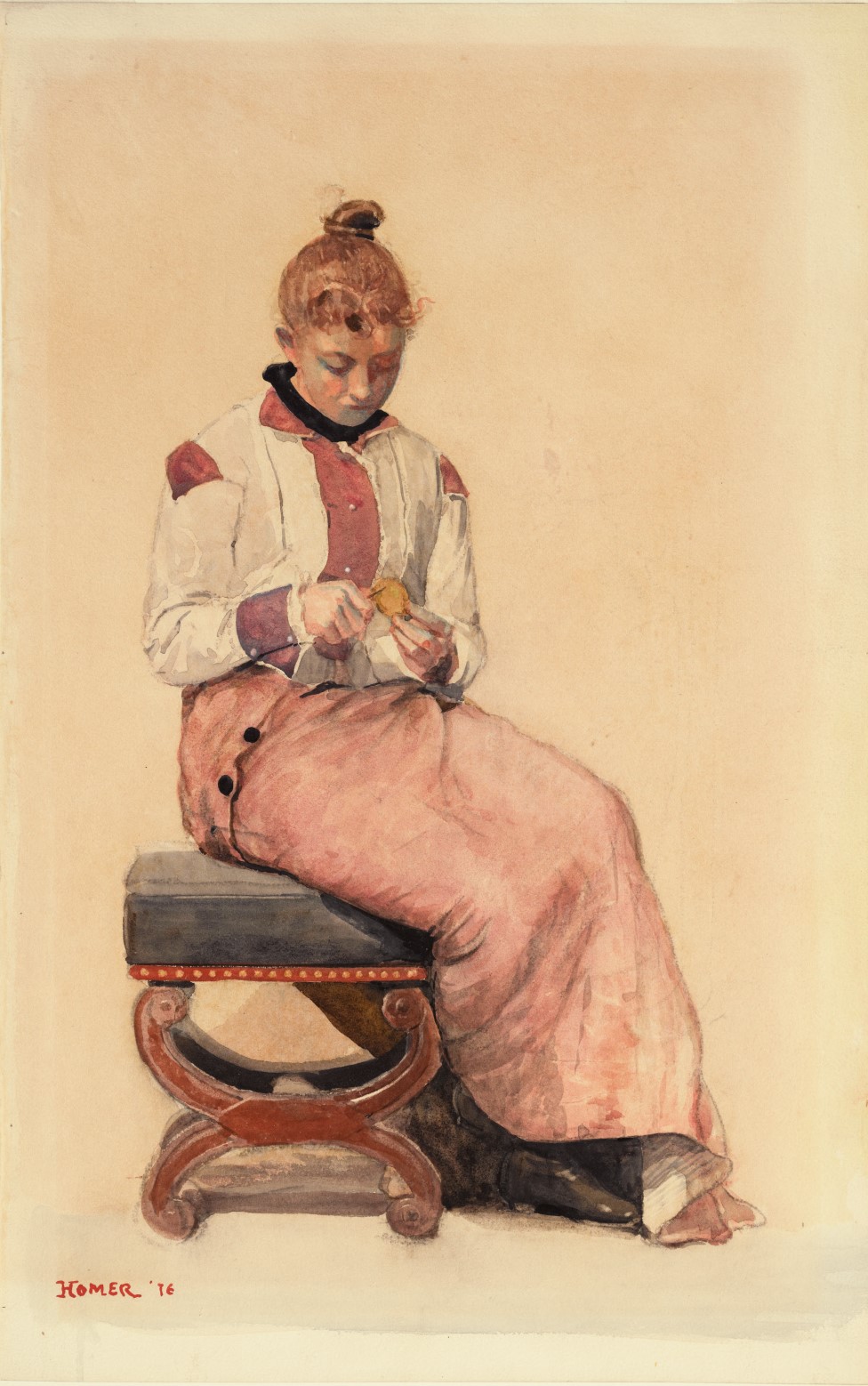
| Winslow Homer | |
|---|---|
 | |
Today is the birthday of Winslow Homer (Boston; February 24, 1836 – September 29, 1910 Prouts Neck, Maine); landscape painter and printmaker, perhaps best known for his marine subjects. In my opinion, he is one of the foremost painters of 19th-century America and a preeminent figure in American art.
Largely self-taught, Homer began his career working as a commercial illustrator. He subsequently took up oil painting and produced major studio works characterized by the weight and density he exploited from the medium. He also worked extensively in watercolor, creating a fluid and prolific oeuvre, primarily chronicling his working vacations.
As a result of disappointments with women or from some other emotional turmoil, Homer became reclusive in the late 1870s, no longer enjoying urban social life and living instead in Gloucester. For a while, he even lived in secluded Eastern Point Lighthouse (with the keeper’s family). In re-establishing his love of the sea, Homer found a rich source of themes while closely observing the fishermen, the sea, and the marine weather. After 1880, he rarely featured genteel women at leisure, focusing instead on working women.
Homer died at the age of 74 and was interred in the Mount Auburn Cemetery in Cambridge, Massachusetts. His painting, Shooting the Rapids, Saguenay River, remains unfinished.
Gallery
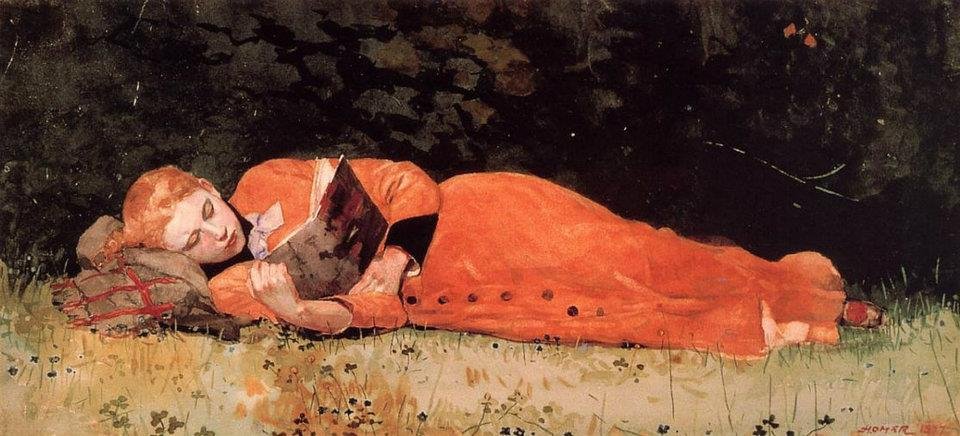
The new novel
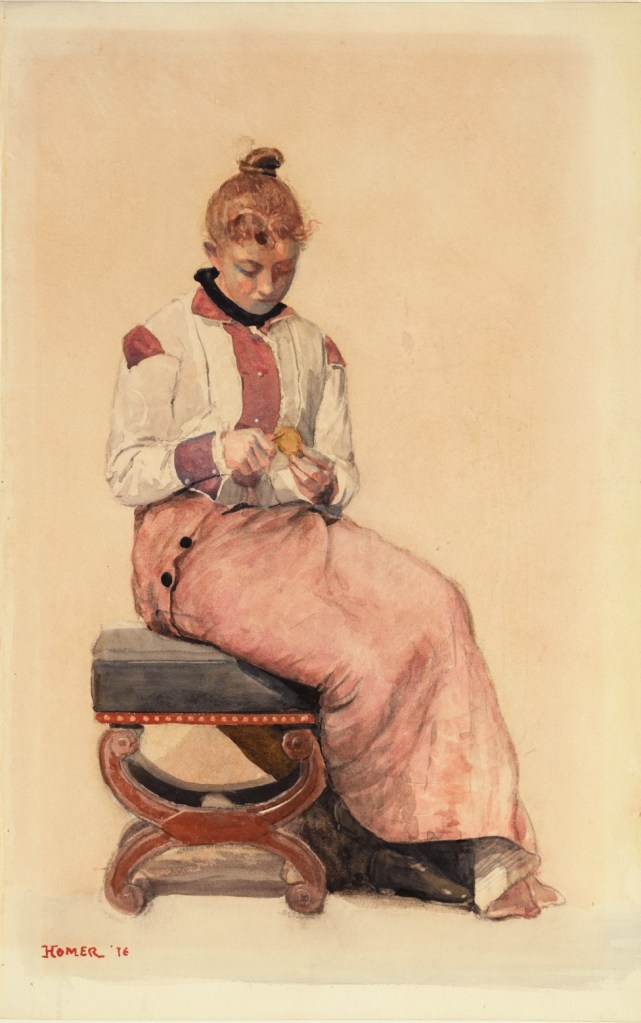
Lemon (1876)
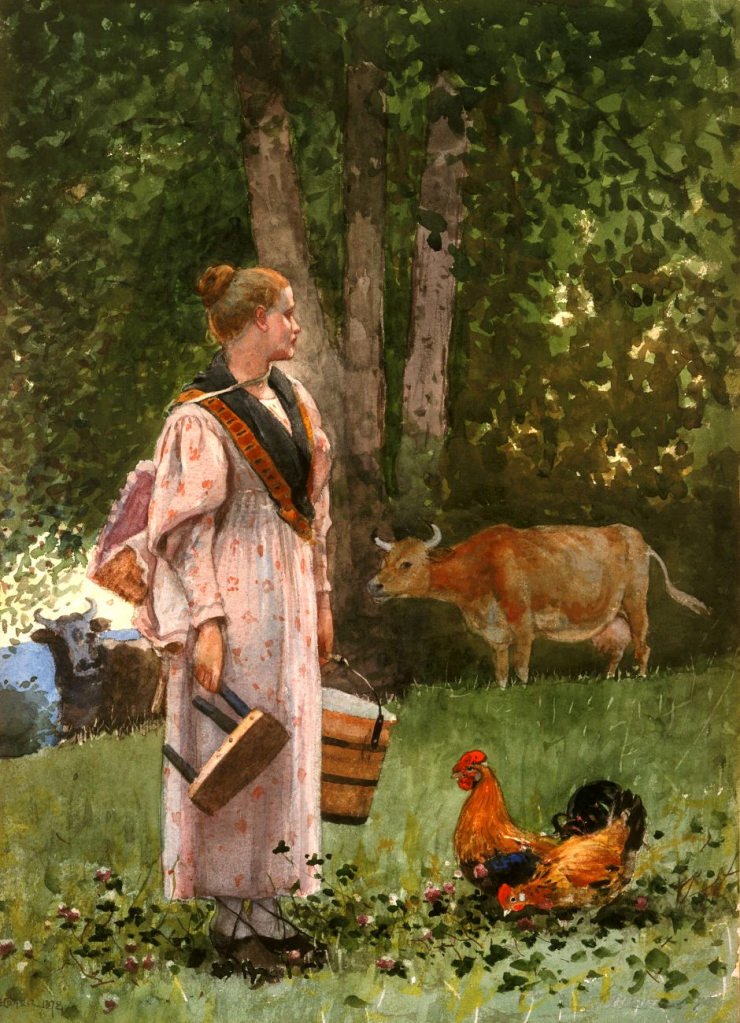
The Milk Maid, 1878
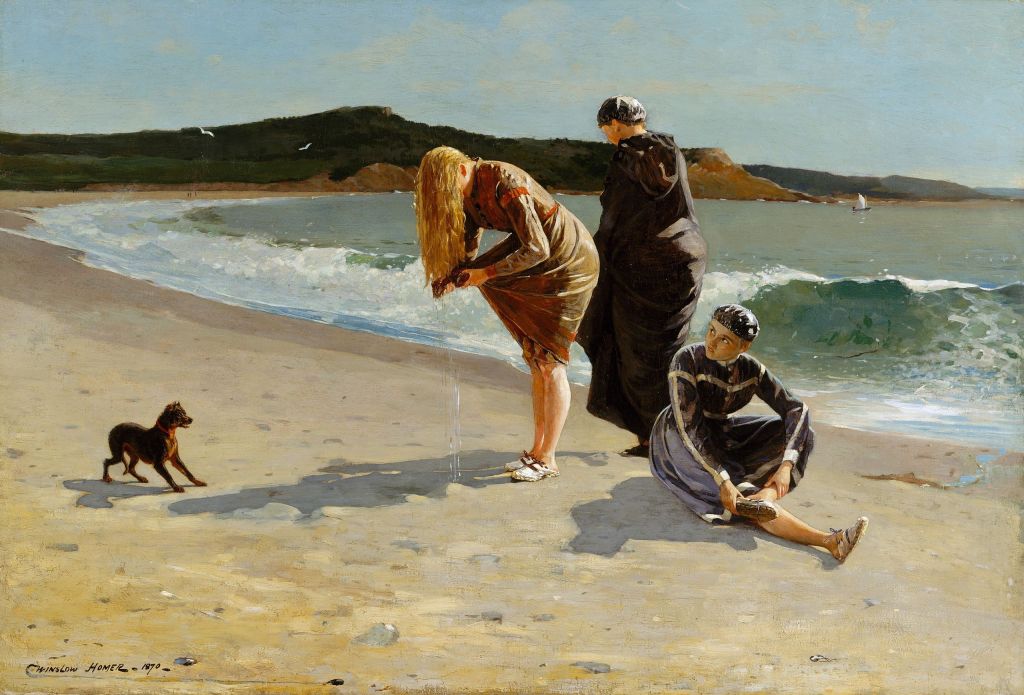
Eagle Head, Manchester, Massachusetts, 1870
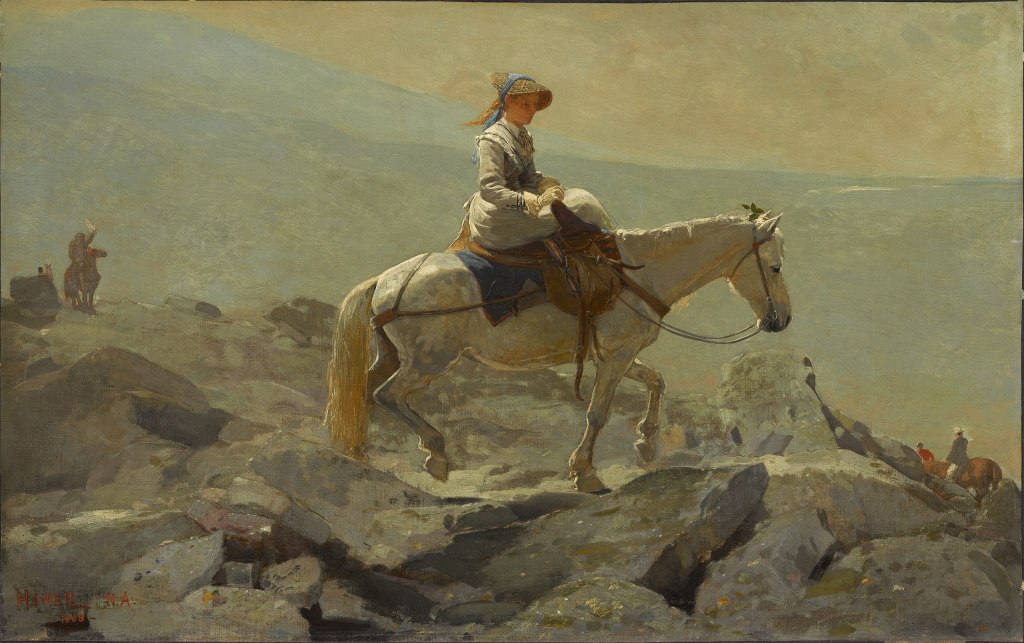
The Bridle Path, 1868, oil painting (Clark Art Institute)
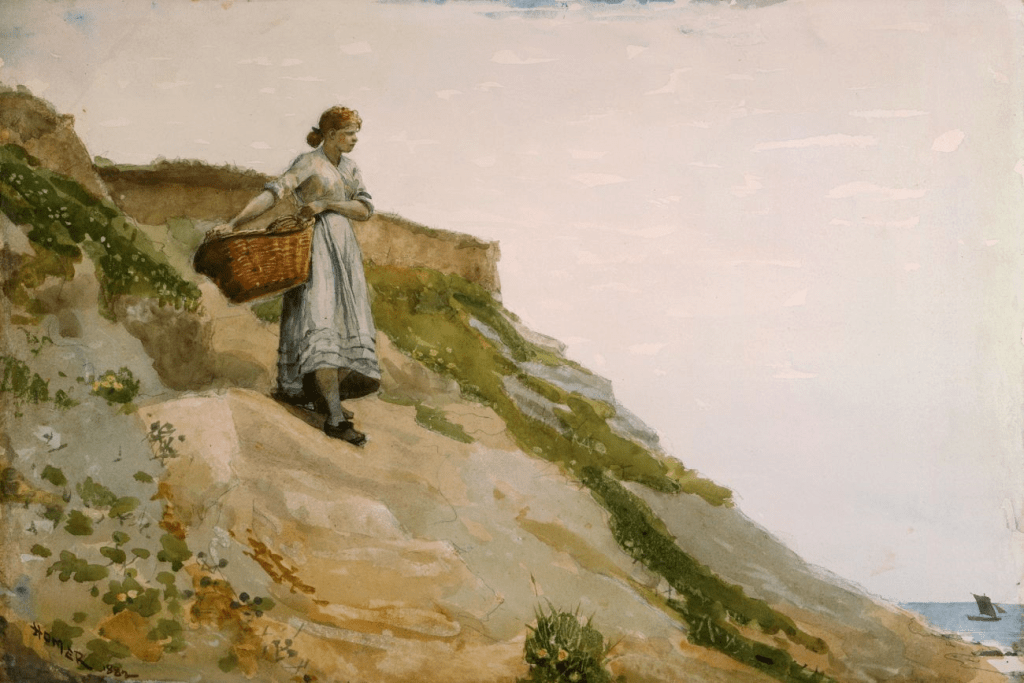
Girl Carrying a Basket, 1882
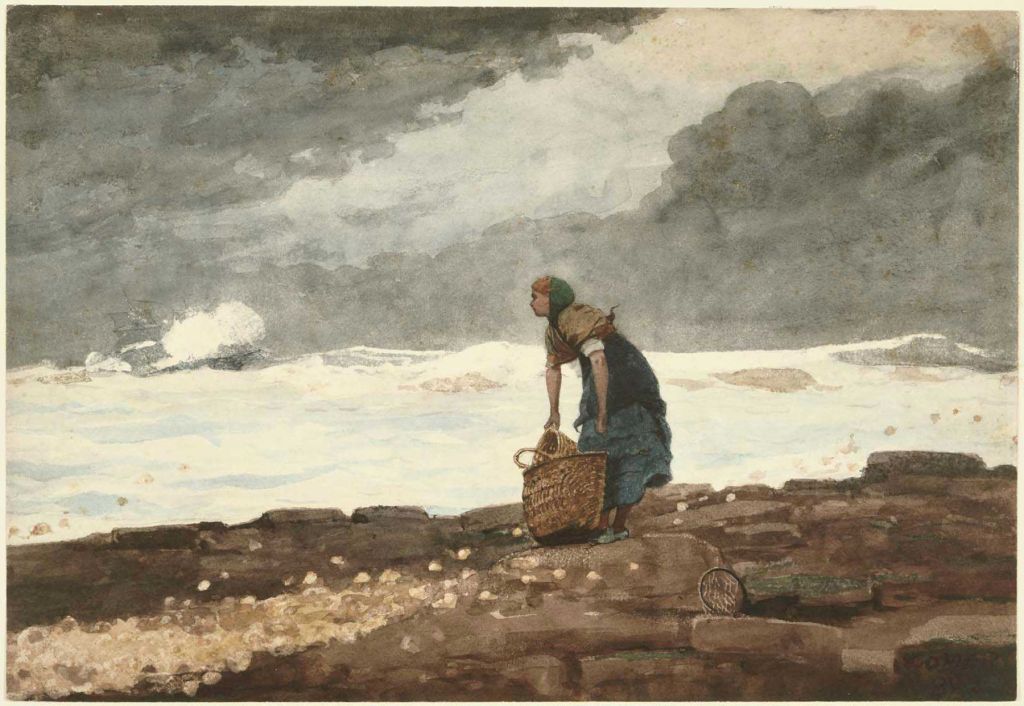
Girl with Red Stockings, 1882
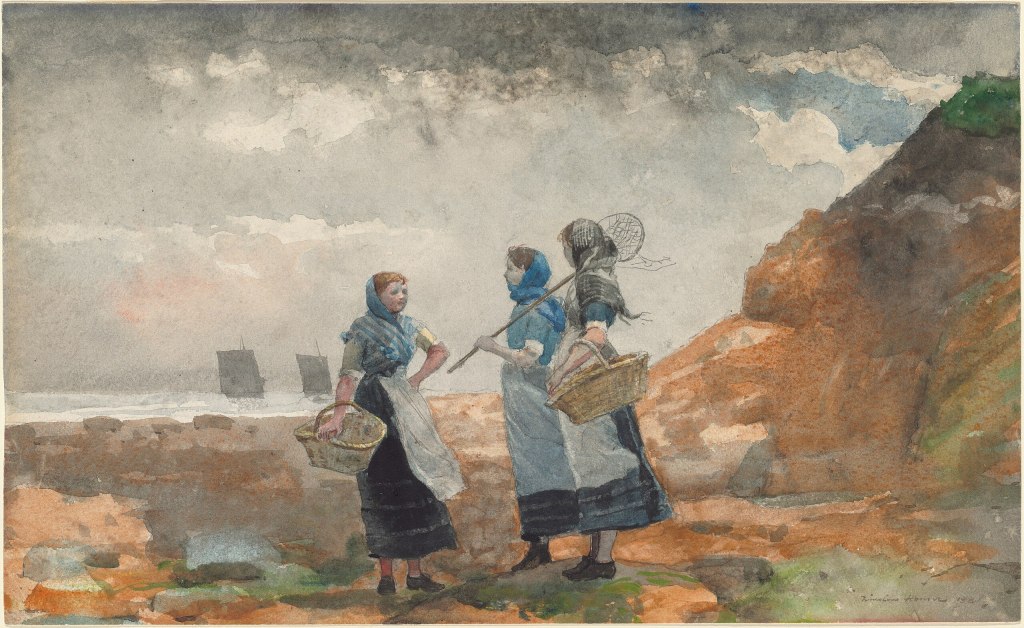
Three Fisher Girls, Tynemouth, watercolor on paper 1881, National Gallery of Art, Washington D.C.
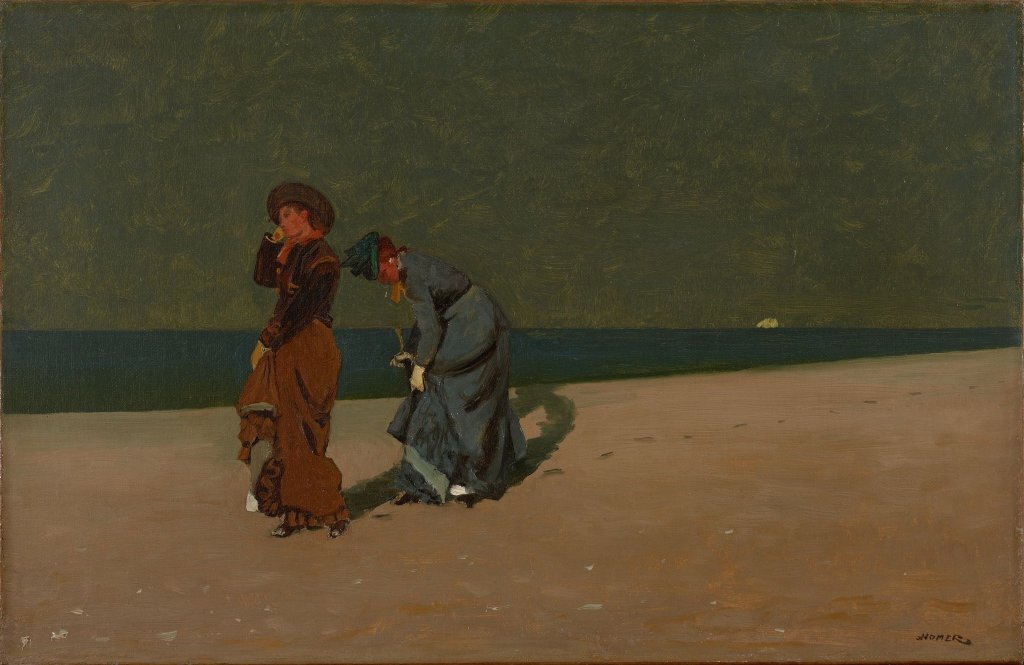
evening on the beach
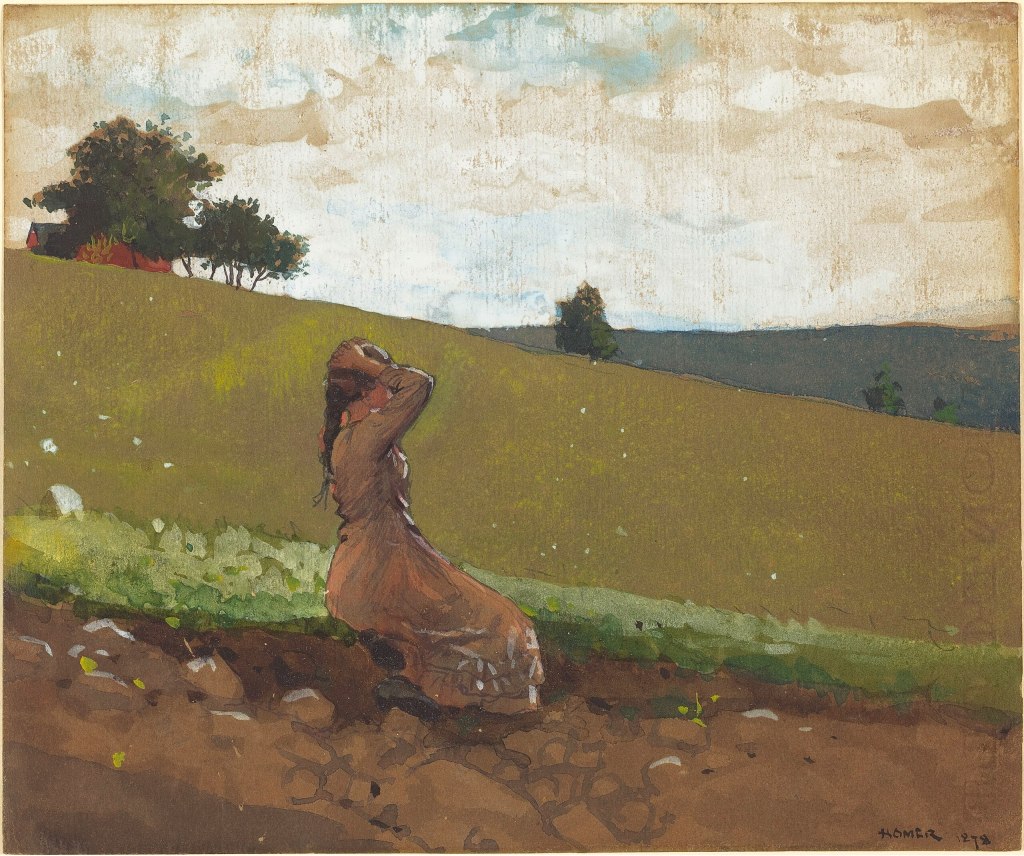
The Green Hill, 1878
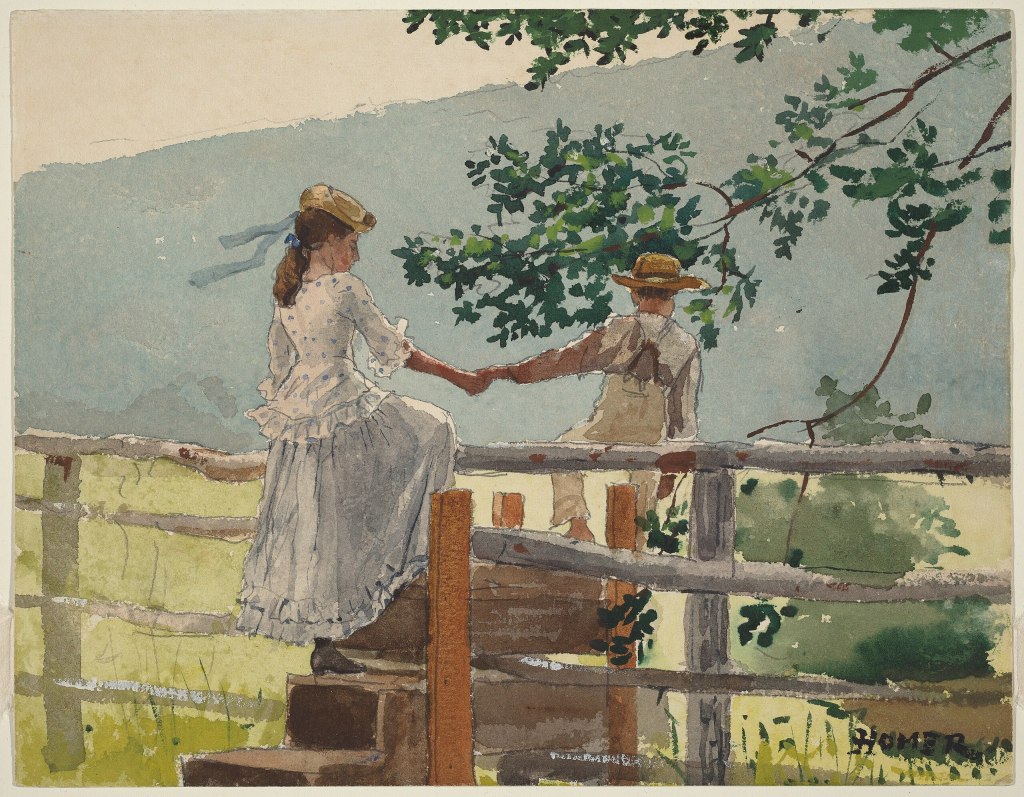
On the Stile, c. 1878
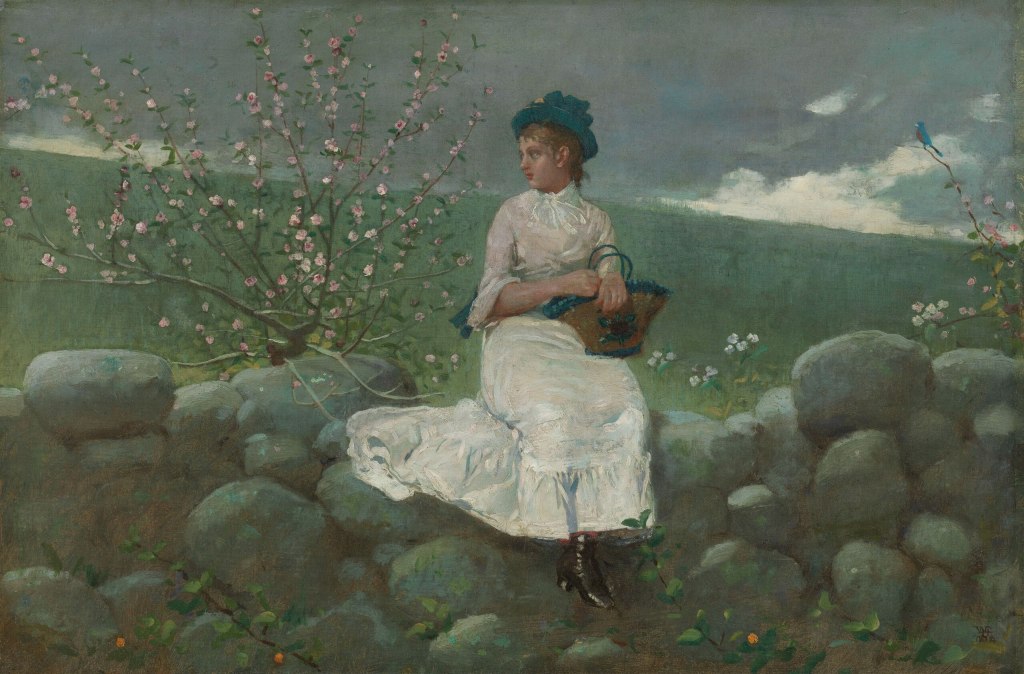
Peach Blossoms, 1878
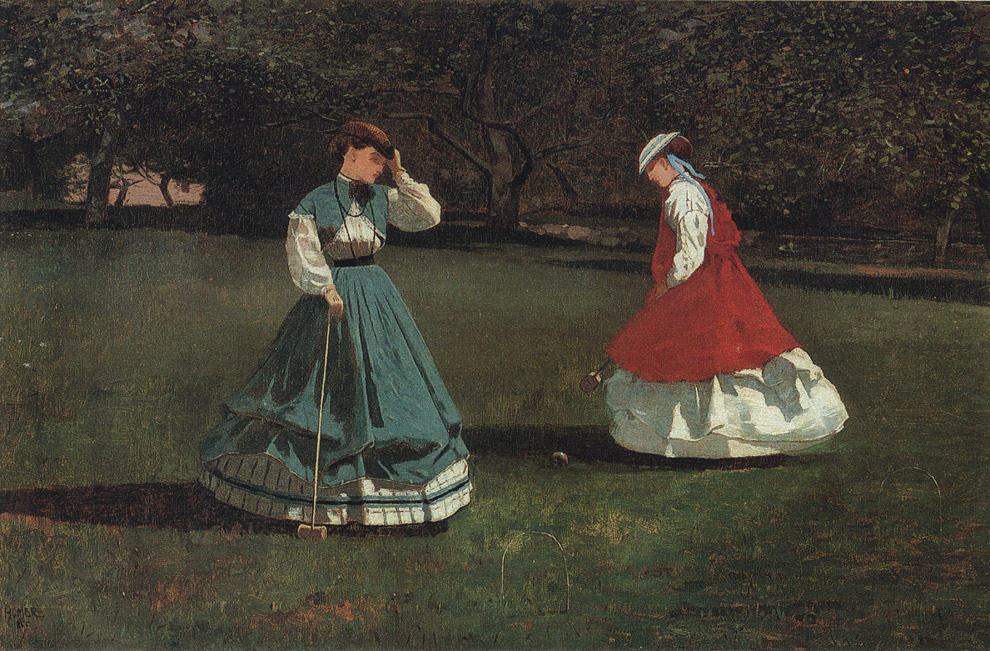
A Game of Croquet, 1866
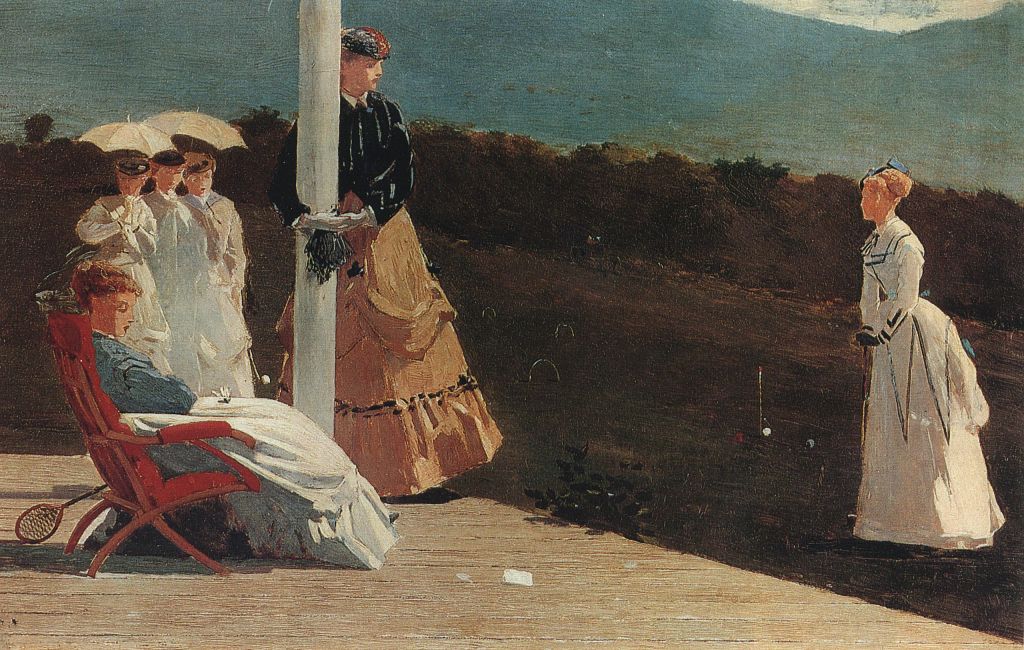
The Croquet Match, c. 1869
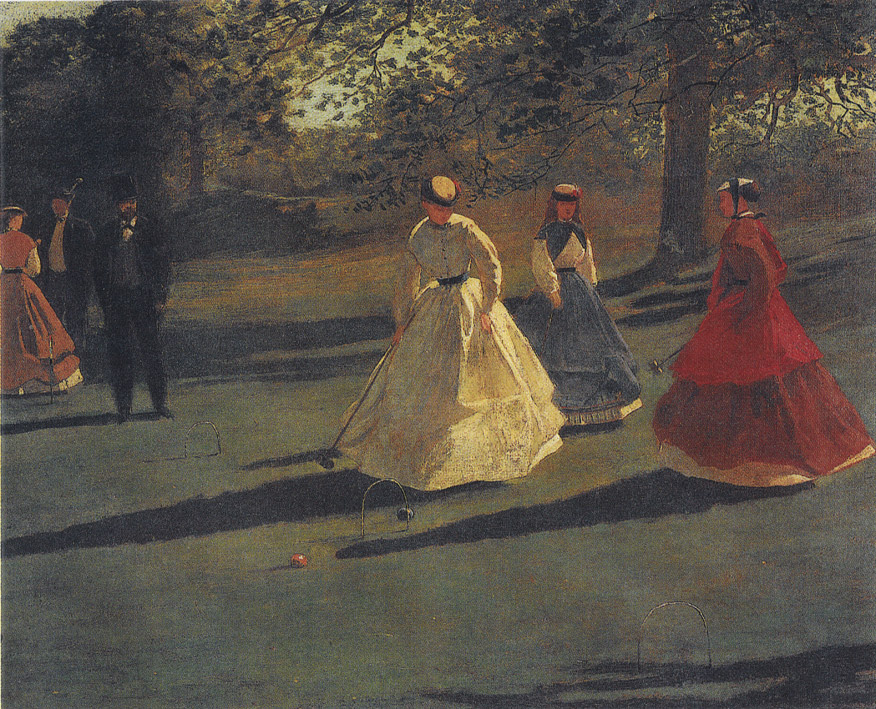
Croquet Players, 1865
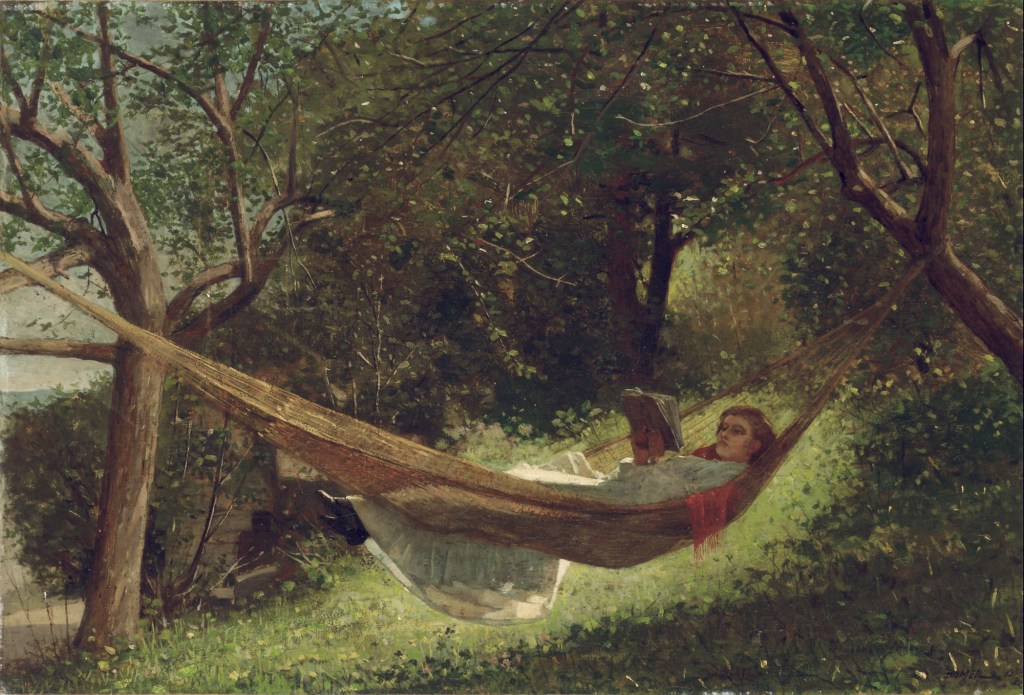
Girl in the Hammock, 1873
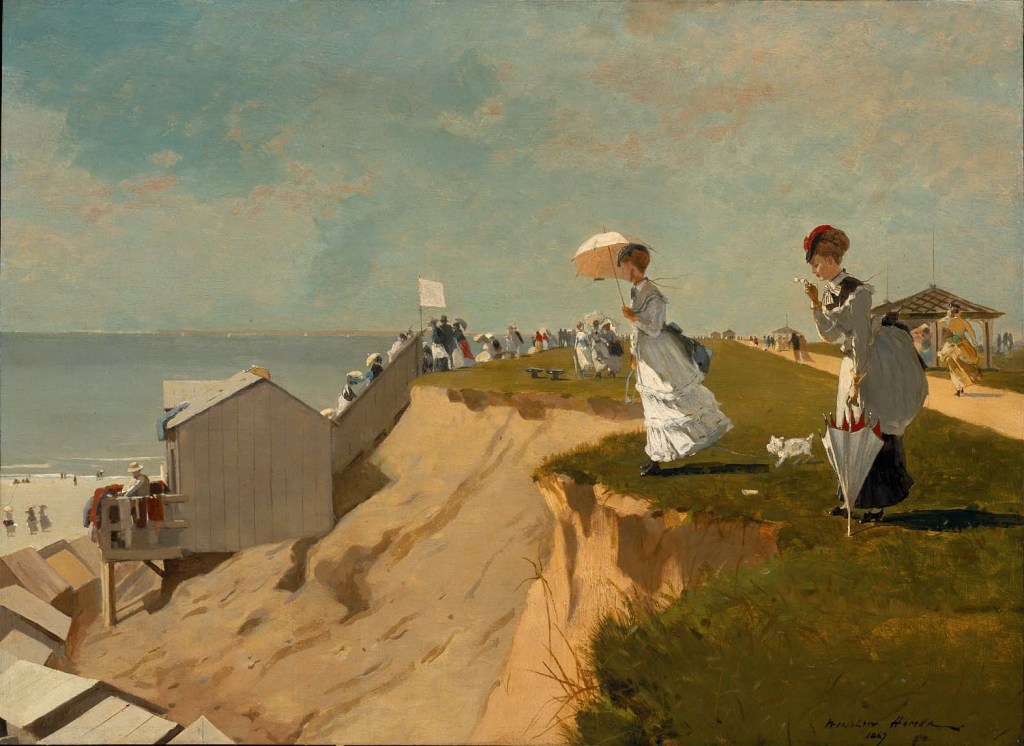
Long Branch, New Jersey (1869), now housed in the Museum of Fine Arts in Boston
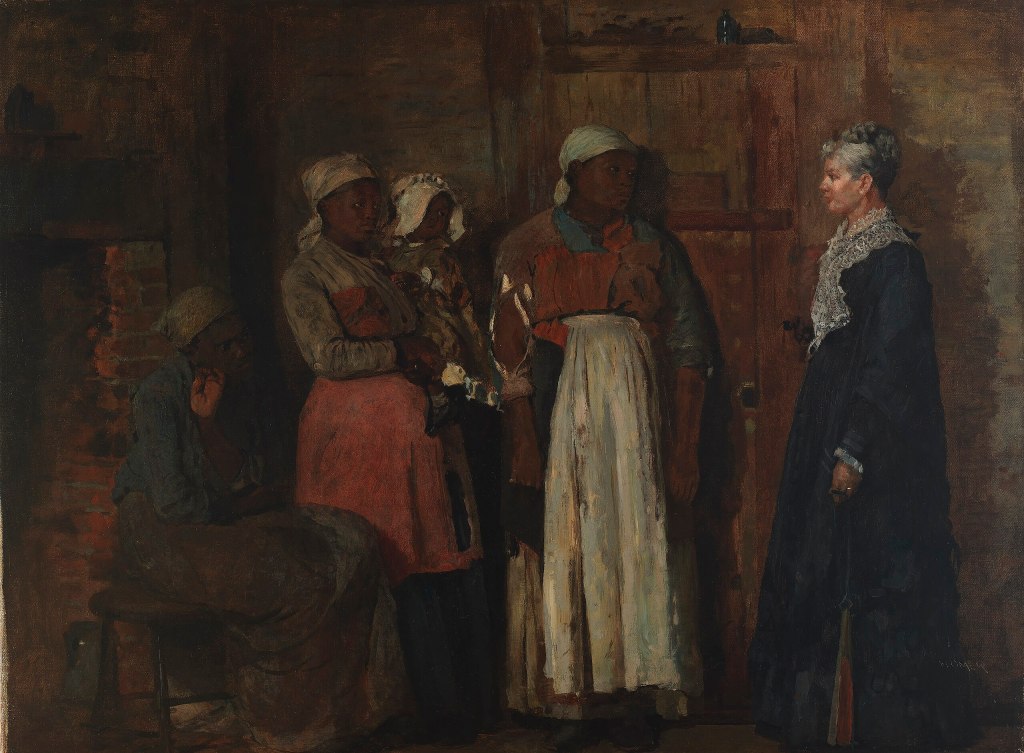
A Visit from the Old Mistress, 1876, Smithsonian American Art Museum
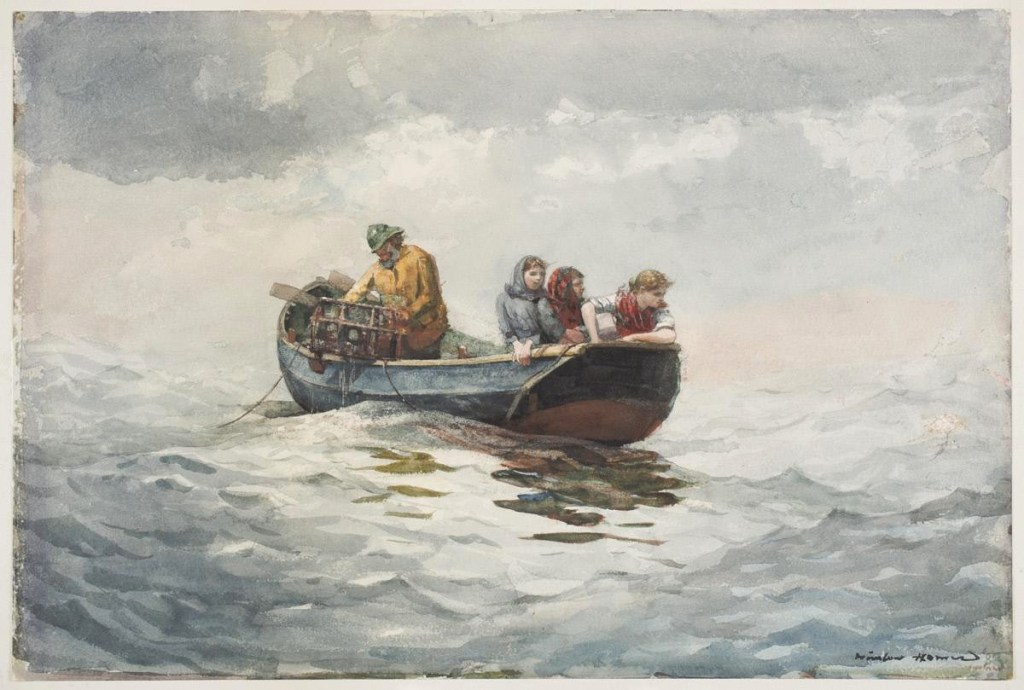
Crab Fishing, 1883
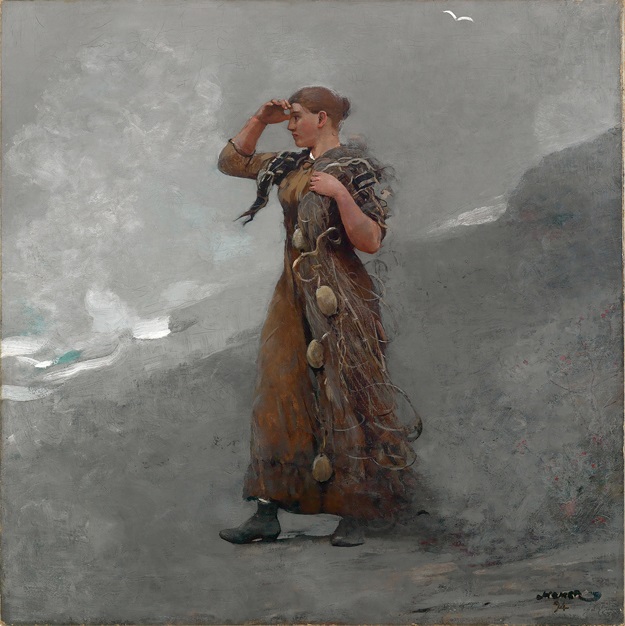
The Fisher Girl, 1894
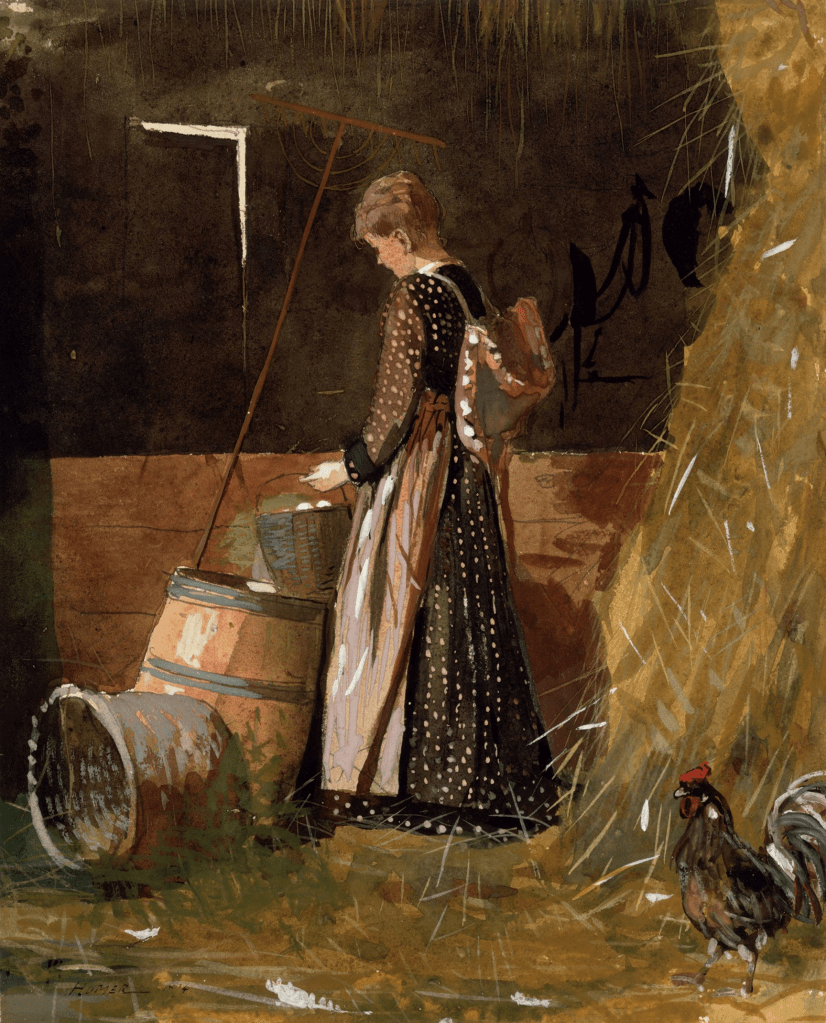
Fresh Eggs, 1874
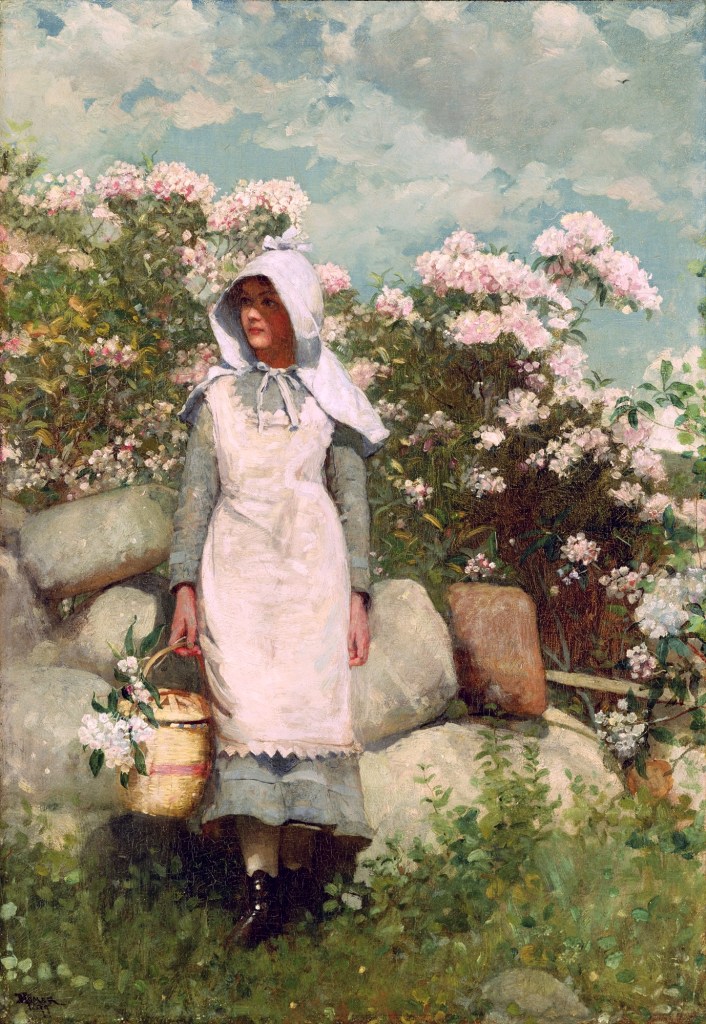
Girl and Laurel, 1879
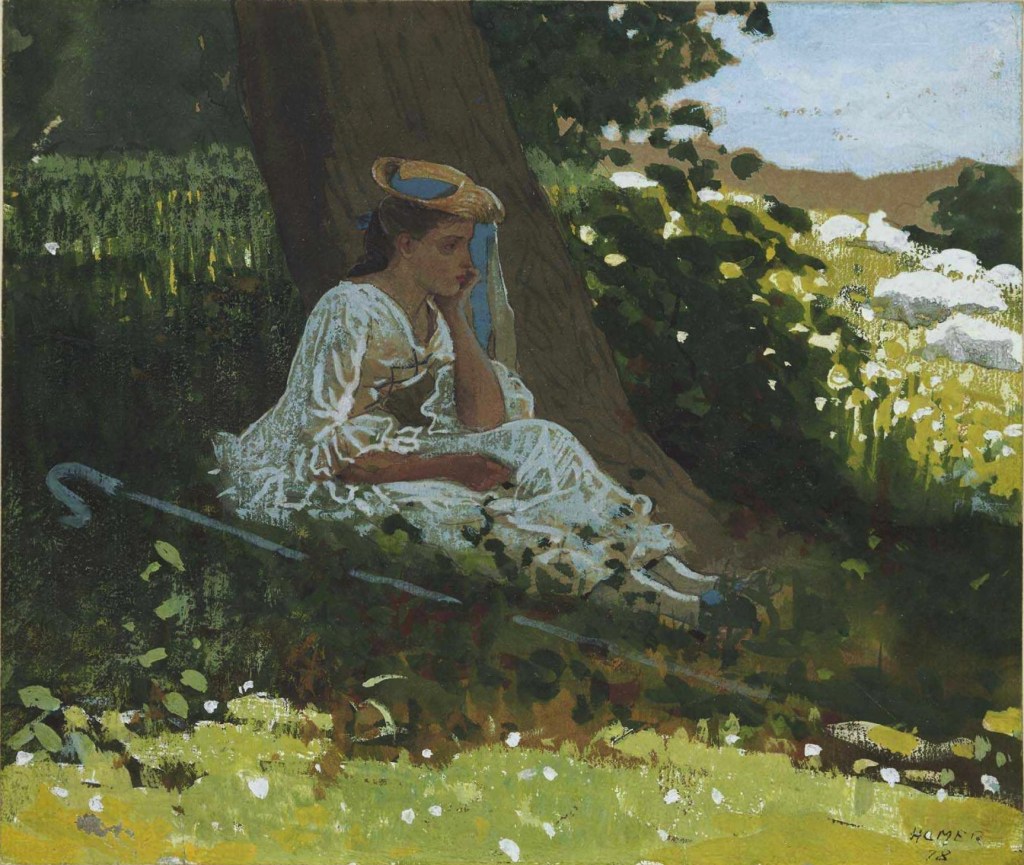
Bo-Peep, 1878
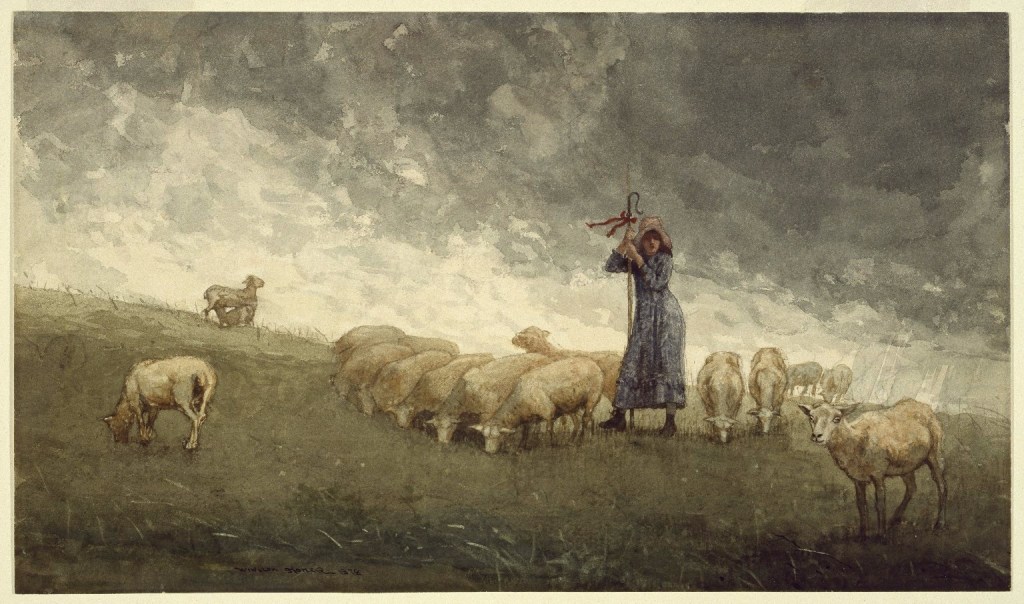
Shepherdess Tending Sheep, 1878
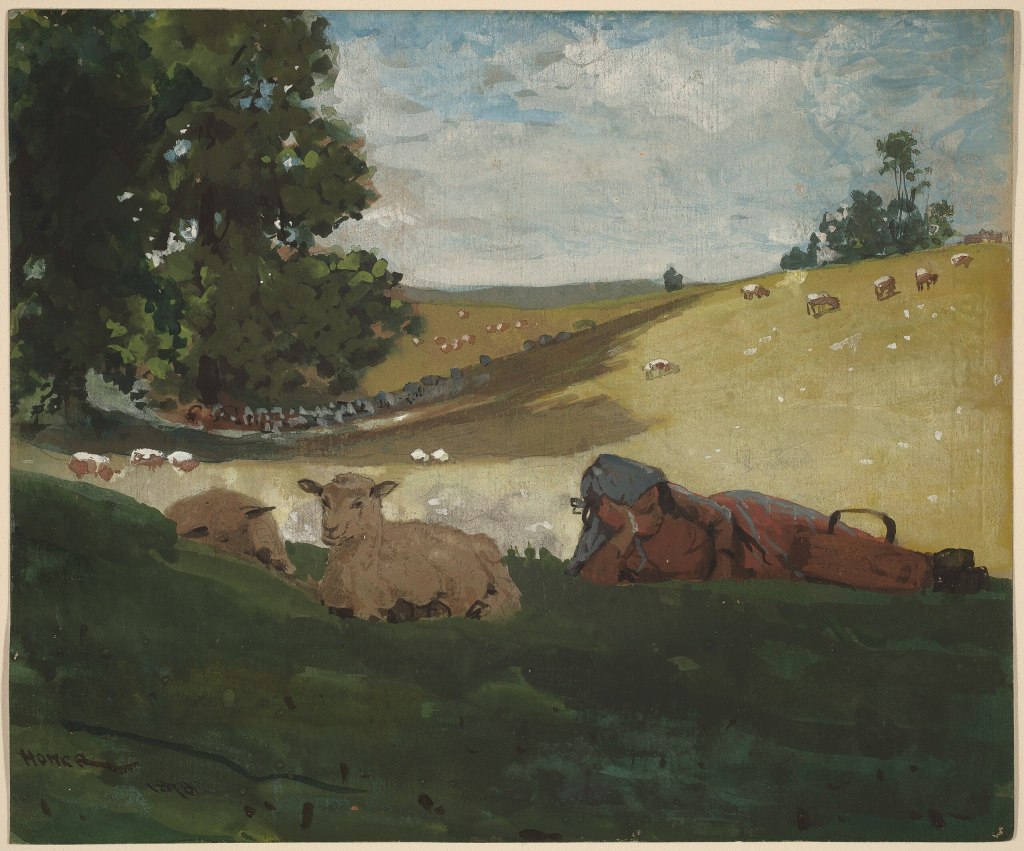
Warm Afternoon (Shepherdess), 1878
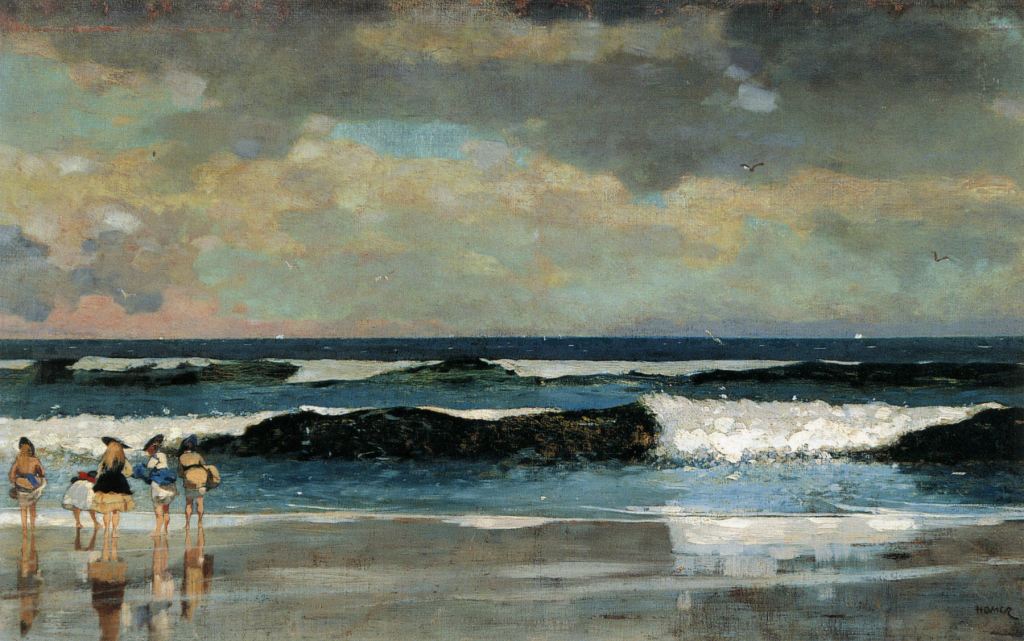
On the Beach, 1869
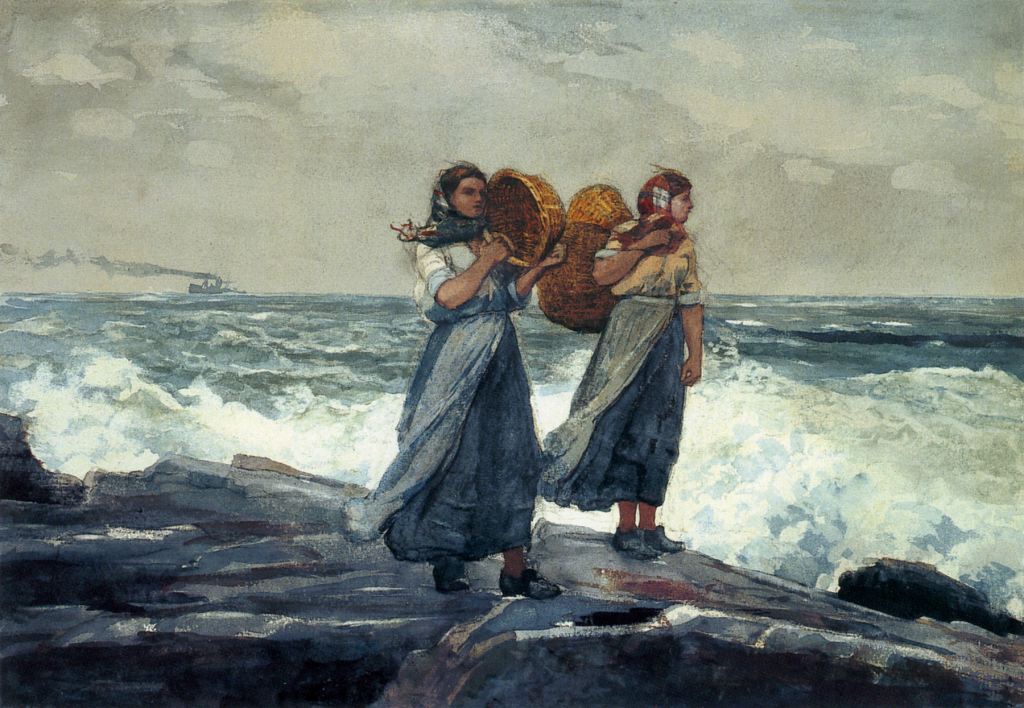
A Fresh Breeze, c. 1881
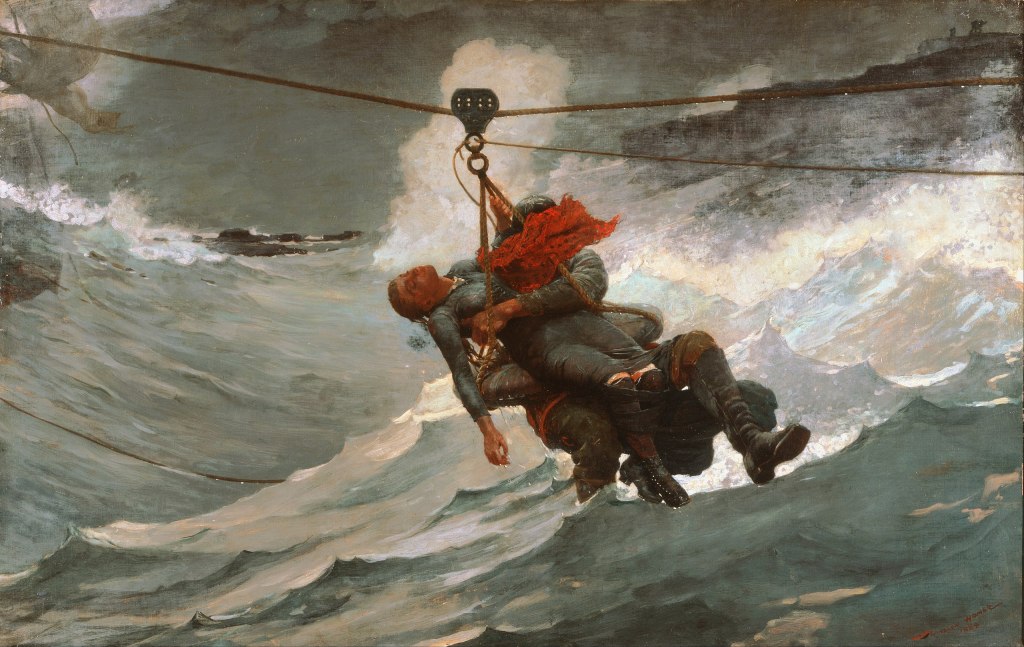
The Life Line, 1884
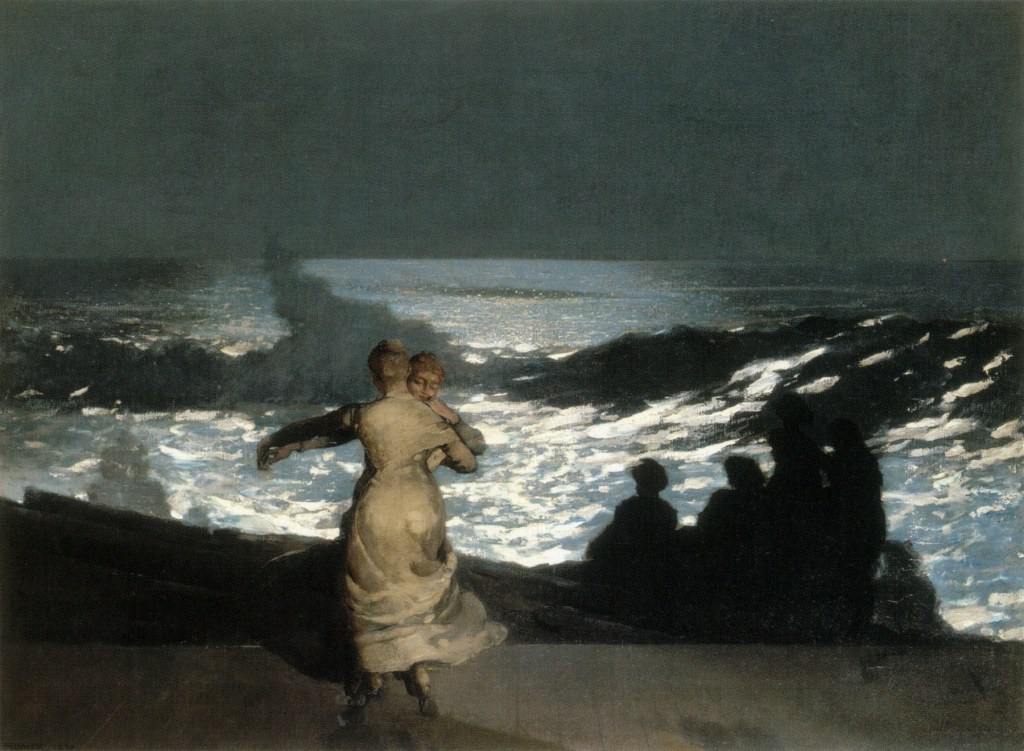
Summer Night, 1890
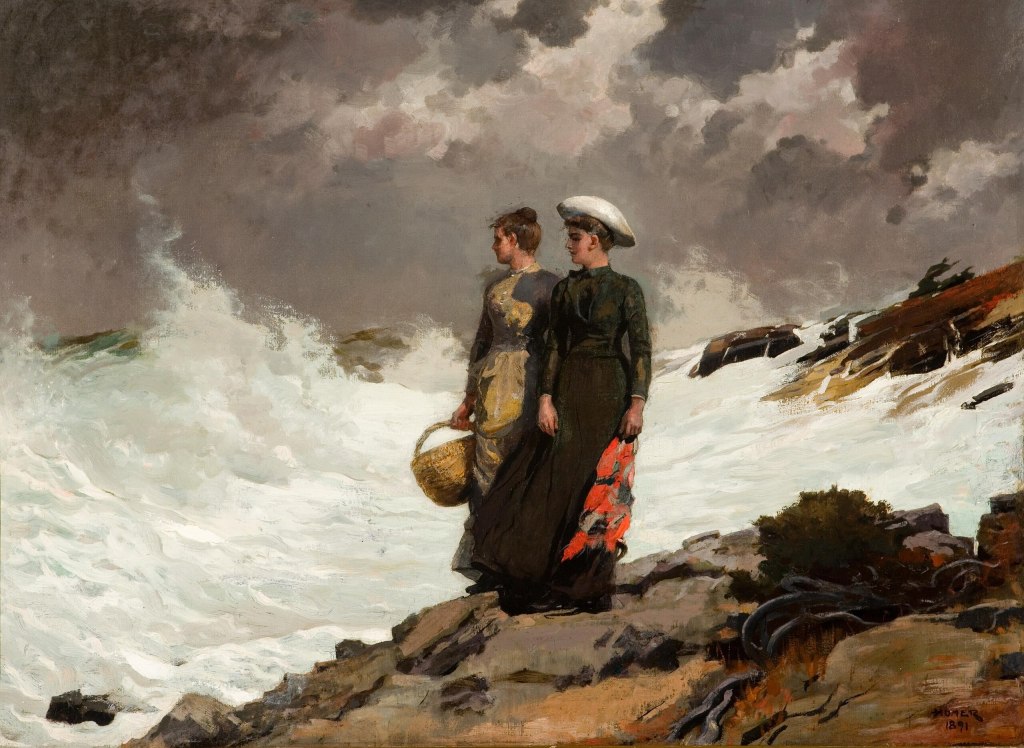
Watching the Breakers, 1891
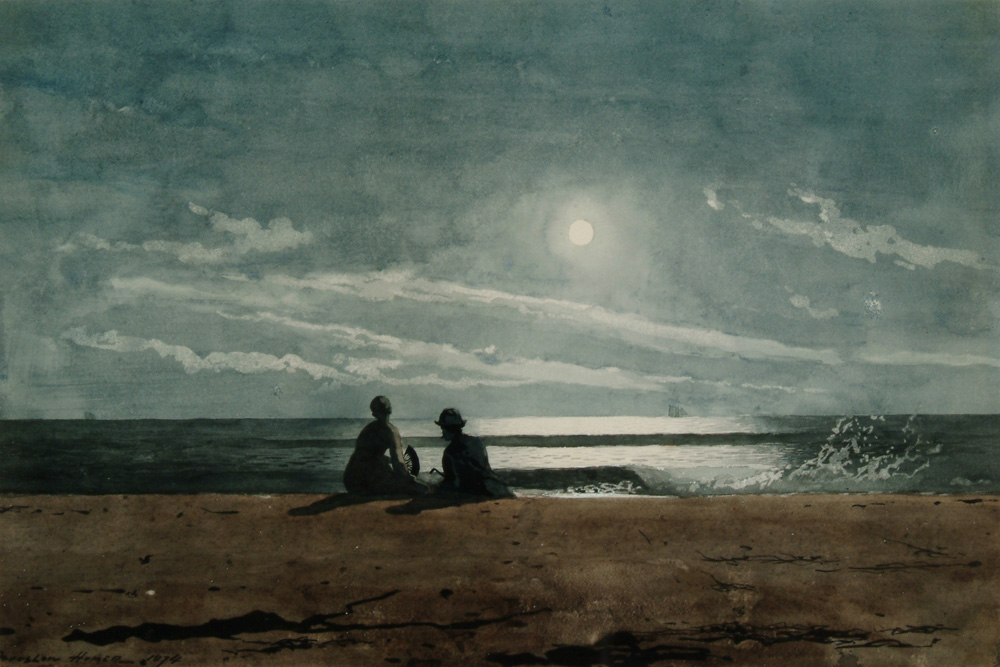
Moonlight, 1874
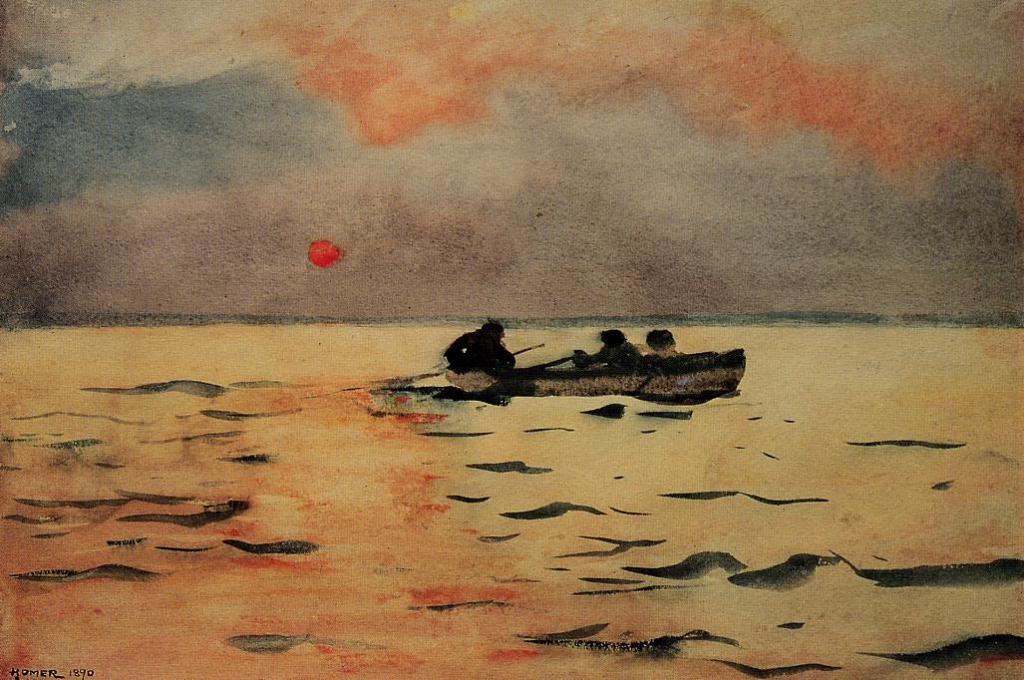
rowing home
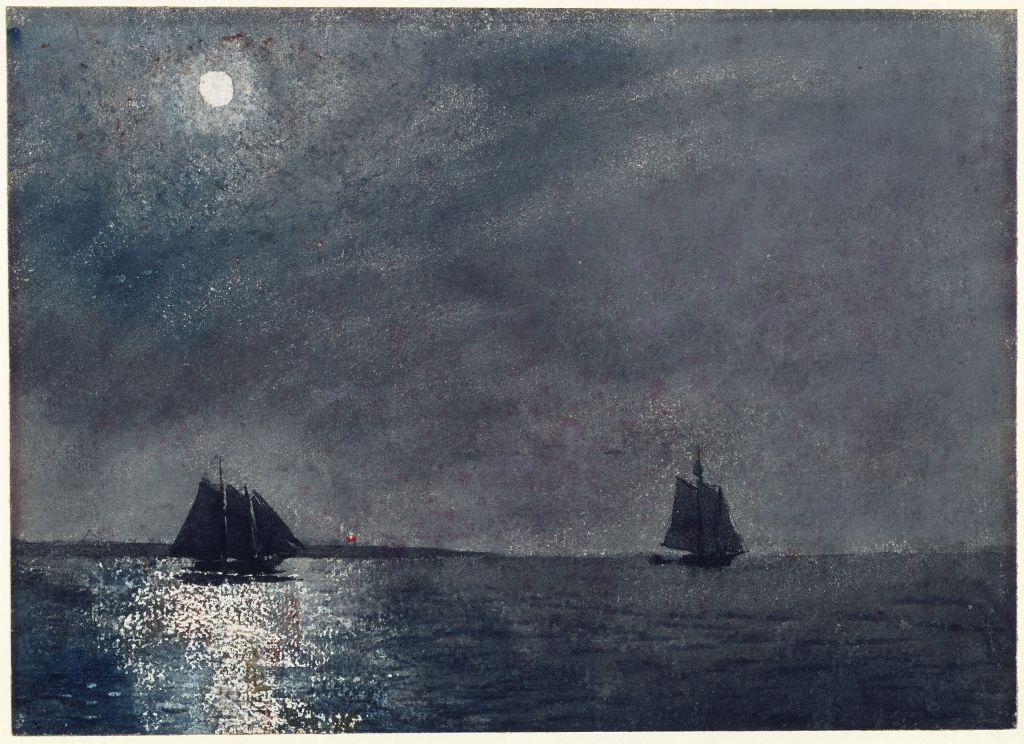
Eastern Point Light, 1880, Princeton University Art Museum
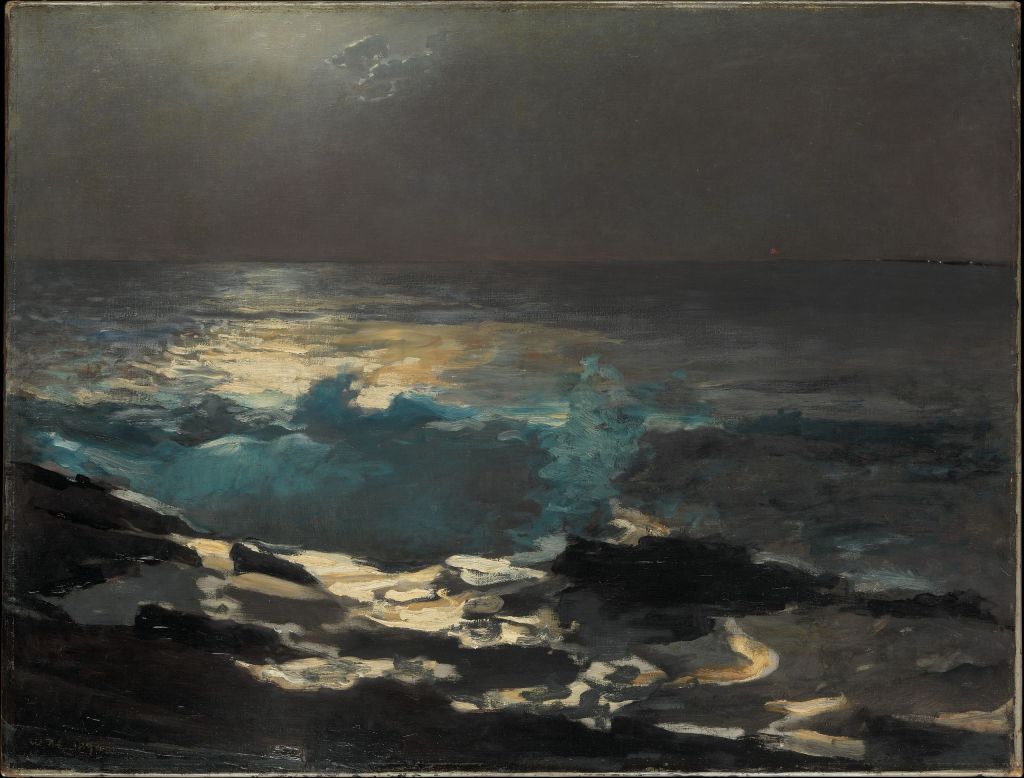
Moonlight, Wood Island Light, 1894, Metropolitan Museum of Art
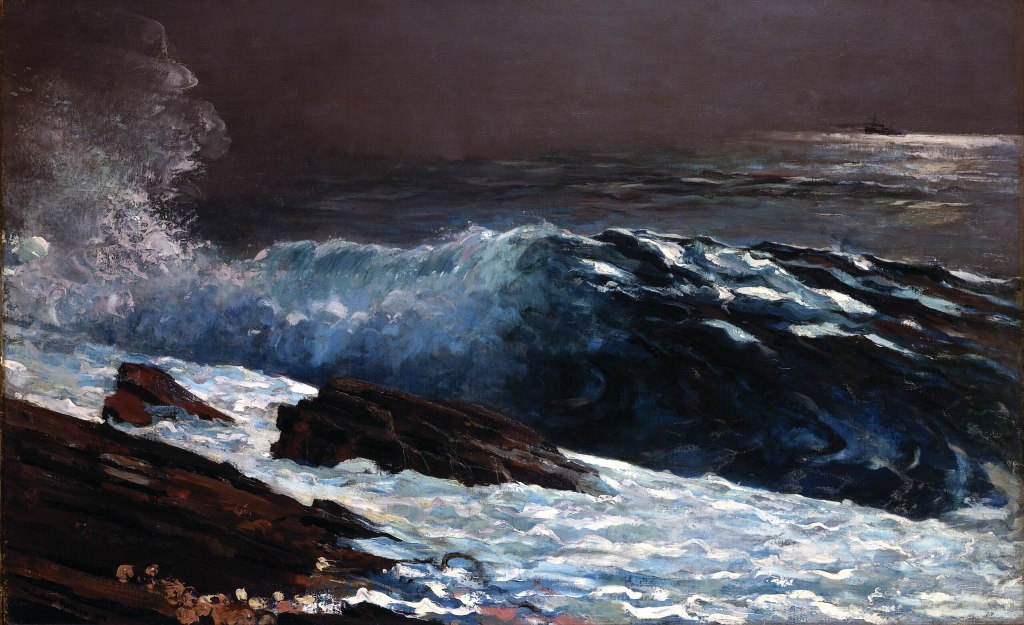
Sunlight on the Coast, 1890 (Toledo Museum of Art, Ohio)
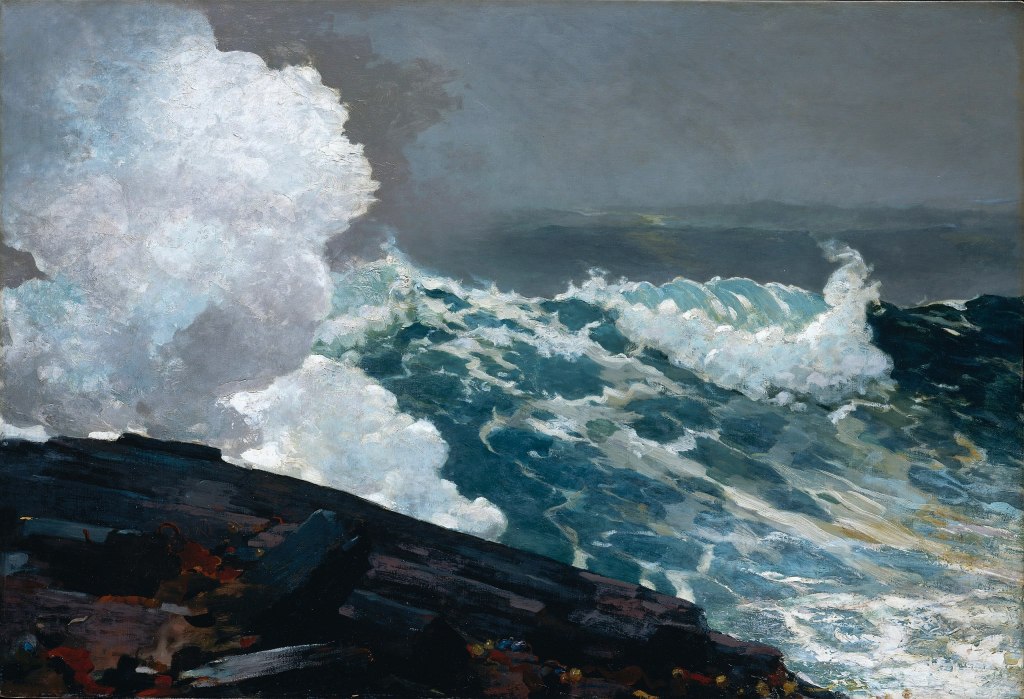
Northeaster, 1895
Today is the birthday of Rosalía de Castro (María Rosalía Rita de Castro; Santiago de Compstela, Galicia, Spain; 24 February 1837 – 15 July 1885 Padrón, Galicia); romanticist writer and poet.
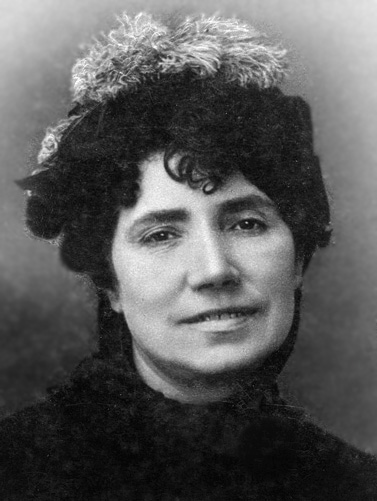
Writing in the Galician language, after the Séculos Escuros (lit. Dark Centuries), she became an important figure of the Galician romantic movement, known today as the Rexurdimento (“renaissance”), along with Manuel Curros Enríquez and Eduardo Pondal. Her poetry is marked by saudade, an almost ineffable combination of nostalgia, longing and melancholy.
She married Manuel Murguía, member of the Galician Academy, historian, journalist and editor of Rosalía’s books.
The date she published her first collection of poetry in Galician, Cantares gallegos (gl) (“Galician Songs”), 17 May 1863, is commemorated every year as the Día das Letras Galegas (“Galician Literature Day”), an official holiday of the Autonomous Community of Galicia, and has been dedicated to an important writer in the Galician language since 1963.
Relative poverty and sadness marked her life, although she had a sense of commitment to the poor and to the defenseless. She was an opponent of abuse of authority and defender of women’s rights. She suffered from uterine cancer and died of this illness.
She is buried in the Panteón de Galegos Ilustres, a pantheon (mausoleum) in the Convent of San Domingos de Bonaval at Santiago.
Verse
¿Qué es soledad?
Para llenar el mundo
basta a veces
un solo pensamiento.
Es feliz el que soñando, muere.
Desgraciado el que muera sin sonar.
Yo te hallaré y me hallarás.
No, no puede acabar lo que es eterno,
ni puede tener fin la inmensidad
Today is the birthday of Franz Skarbina (Berlin 24 February 1849 – 18 May 1910 Berlin); impressionist painter, draftsman, etcher and illustrator.
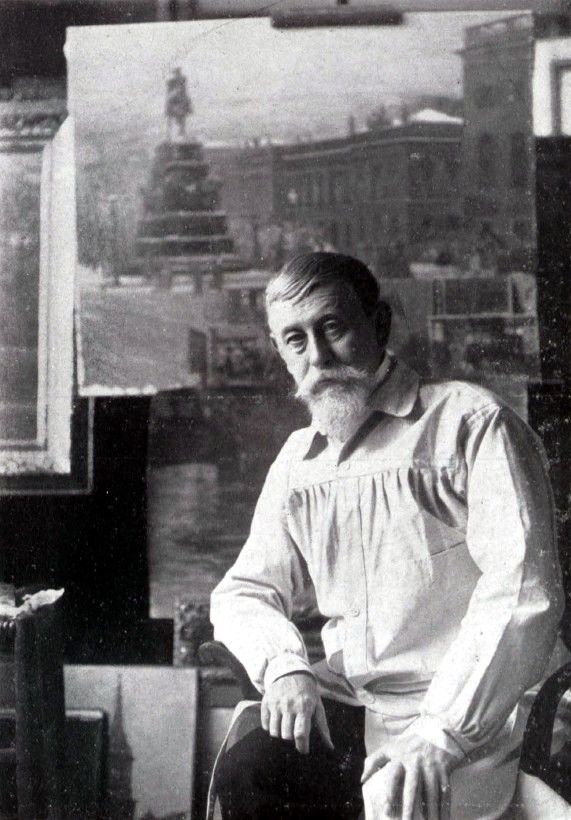
in 1909.
Photograph by Marta Wolff
In 1888, he was appointed a professor at the Prussian Academy and, in 1892, became a full member there. A year later, however, he resigned his teaching position due to disagreements with the academy’s Director, Anton von Werner. The problem stemmed from his participation in the “Group of Eleven”, an association of artists dedicated to promoting their own exhibitions of what was then considered “radical” art, free of the academy’s influence. This eventually (in 1898) led to the establishment of the Berlin Secession, of which Skarbina was a co-founder.
He died at his home from an acute kidney ailment, and is buried in the Old Cemetery of St. Jacobkirche. All of the items in his estate were destroyed during World War II.
Gallery
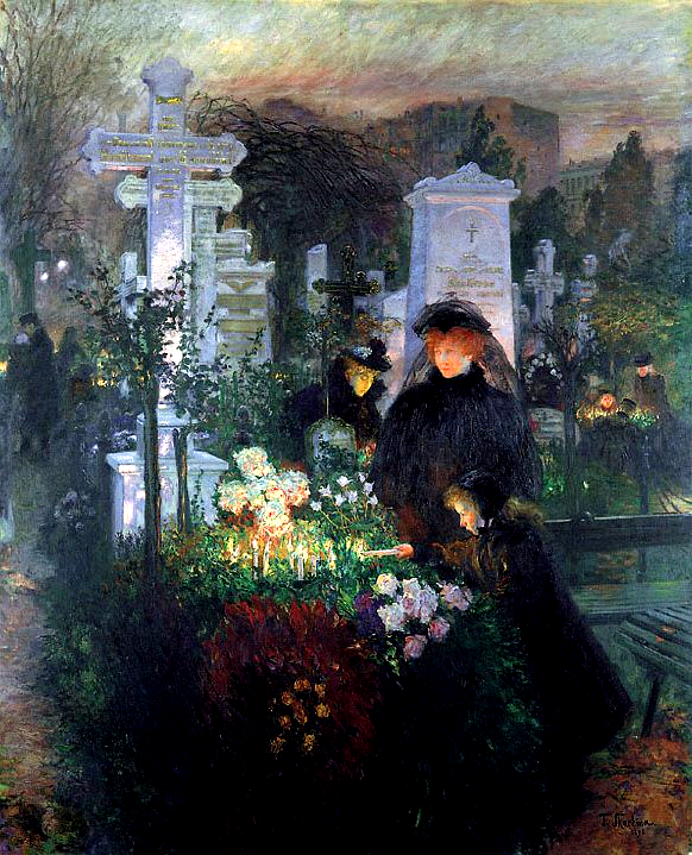
All Souls’ Day (Hedwigskirchhof) 1896 Alte Nationalgalerie Berlin
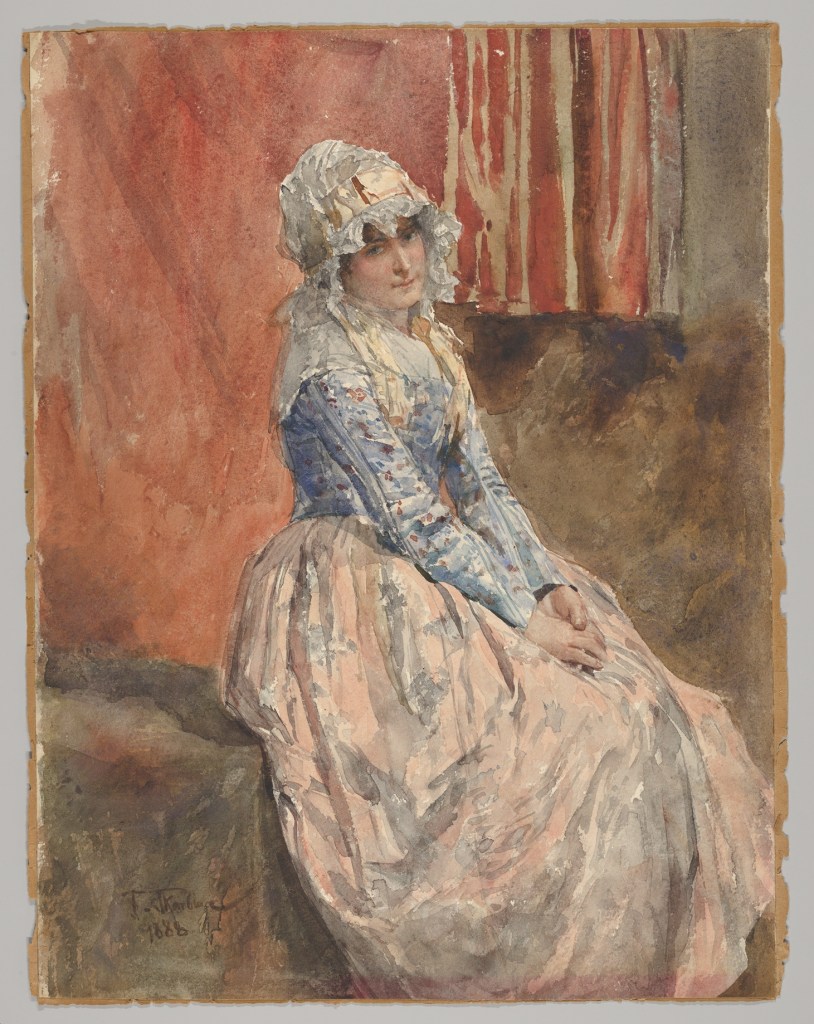
a seated woman
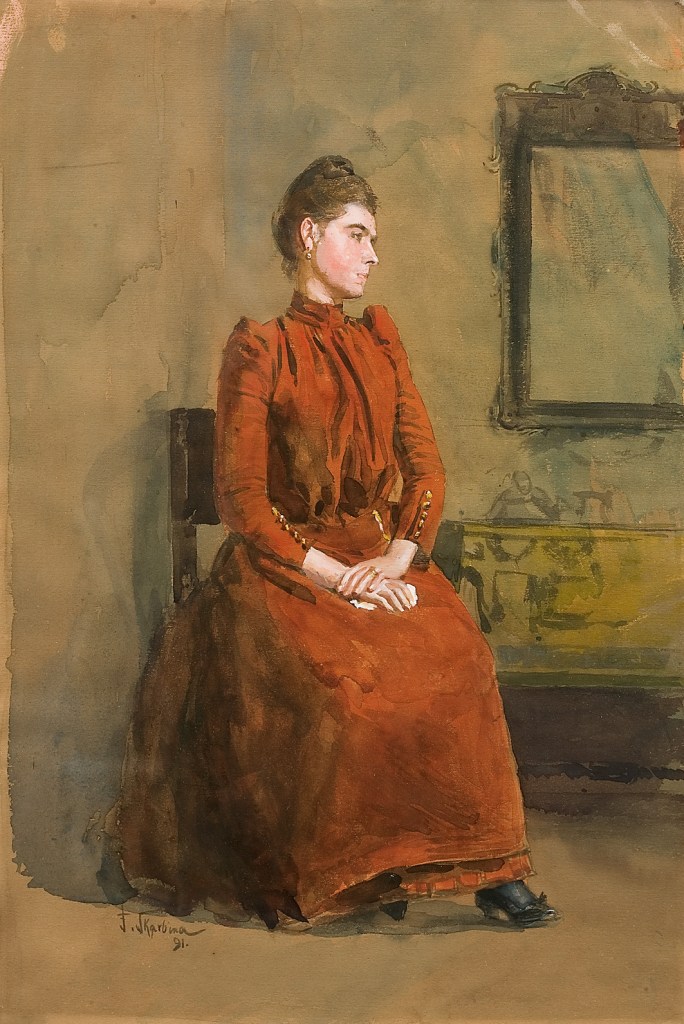
Junge Dame in rotem Kleid, 1891
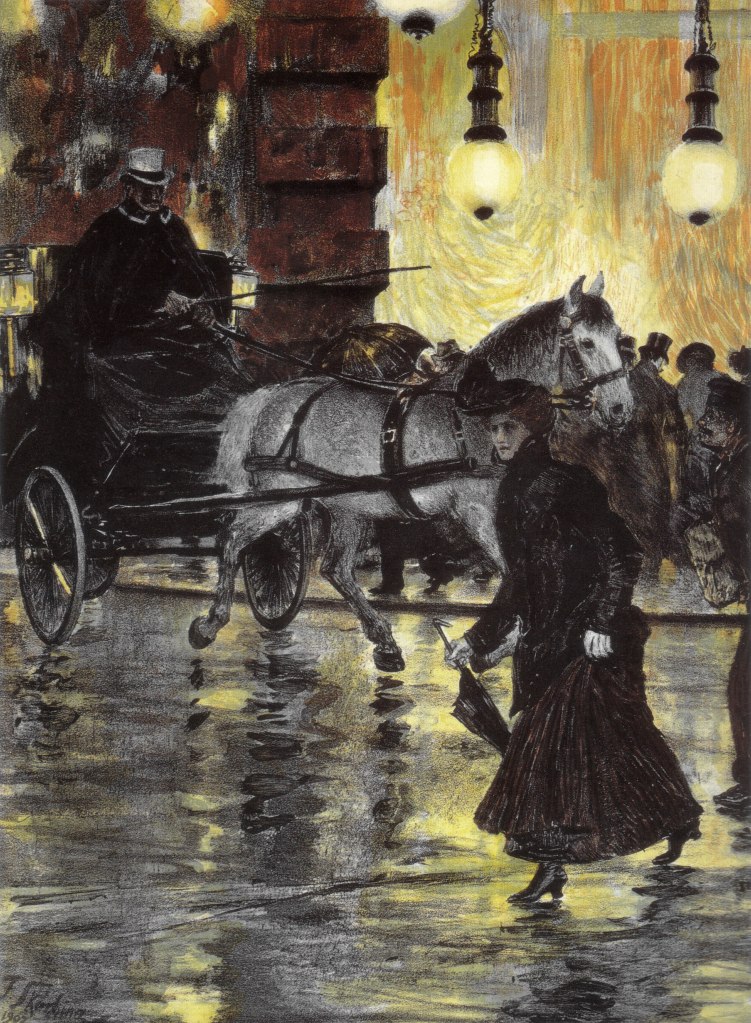
Friedrichstraße on a Rainy Evening
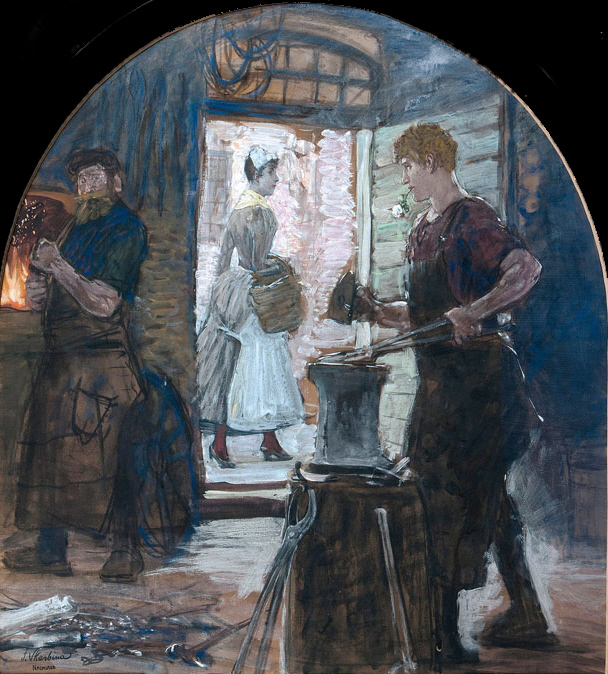
The Smith in Love
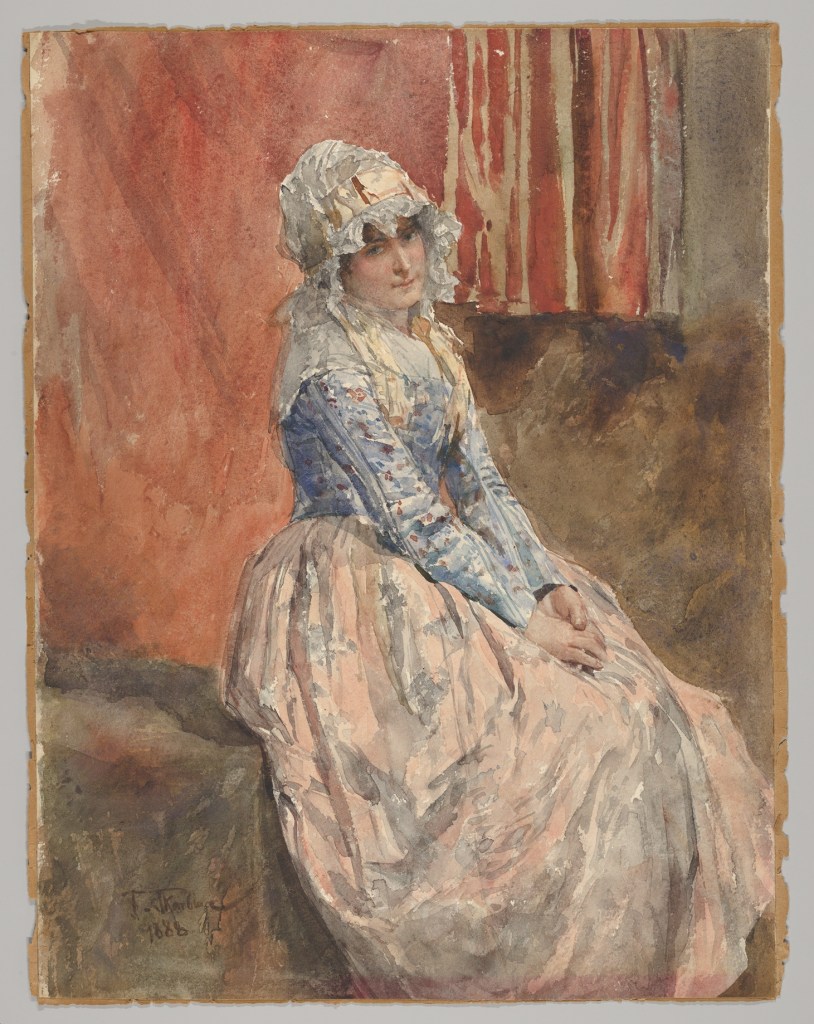
A seated woman
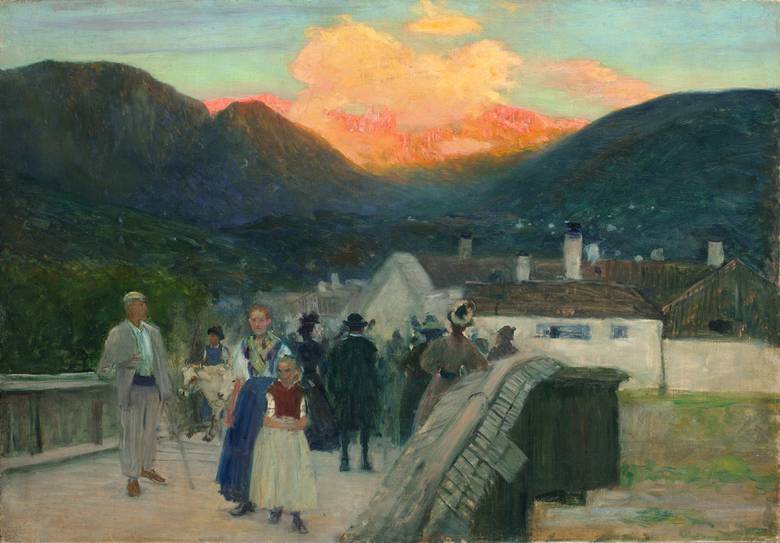
Dorf- und Stadtbewohner auf einer Brücke bei Alpenglühen, Öl auf Leinwand
Today is the birthday of Witkacy (Stanisław Ignacy Witkiewicz; Warsaw 24 February 1885 – 18 September 1939 Jeziory, Poland); writer, painter, philosopher, theorist, playwright, novelist, and photographer active before World War I and during the interwar period.
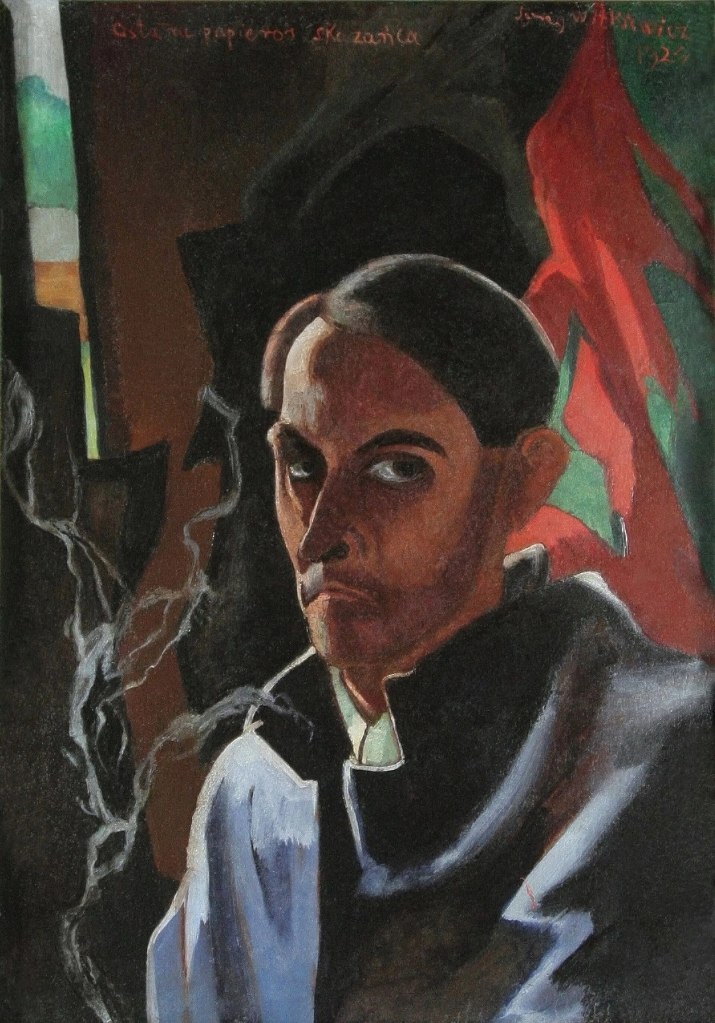
self portrait 1924
In 1914 following a crisis in Witkiewicz’s personal life due to the suicide of his fiancée Jadwiga Janczewska, for which he blamed himself, he was invited to act as draftsman and photographer on an anthropological expedition to the then Territory of Papua, by way of Ceylon and Australia.
Shortly after Poland was invaded by Germany in September 1939, Witkiewicz escaped with his young lover Czesława Oknińska to the rural frontier town of Jeziory, in what was then eastern Poland. After hearing the news of the Soviet invasion of Poland on 17 September 1939, Witkacy died by suicide by taking a drug overdose and trying to slit his wrists. He convinced Czesława to attempt suicide with him by consuming Luminal, but she survived. The film Mystification (2010), written and directed by Jacek Koprowicz proposes, in surrealist fashion, that Witkiewicz faked his own death and lived secretly in Poland until 1968.
gallery
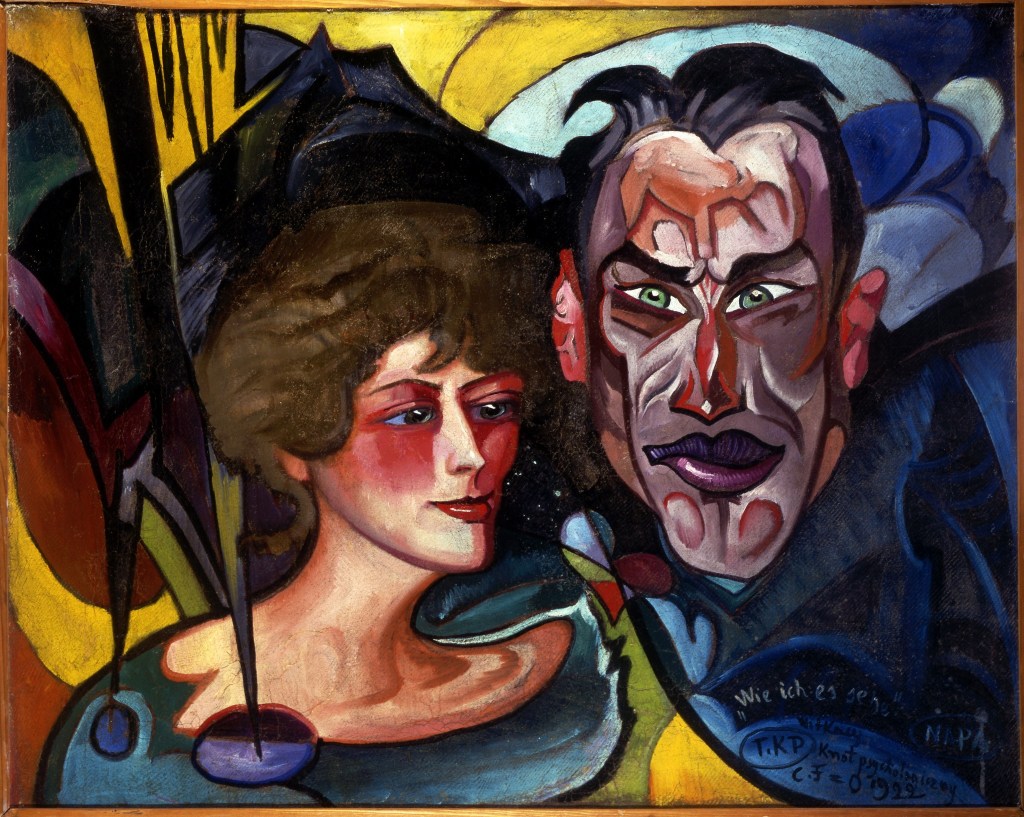
Portret Anny i Jarosława Iwaszkiewiczów
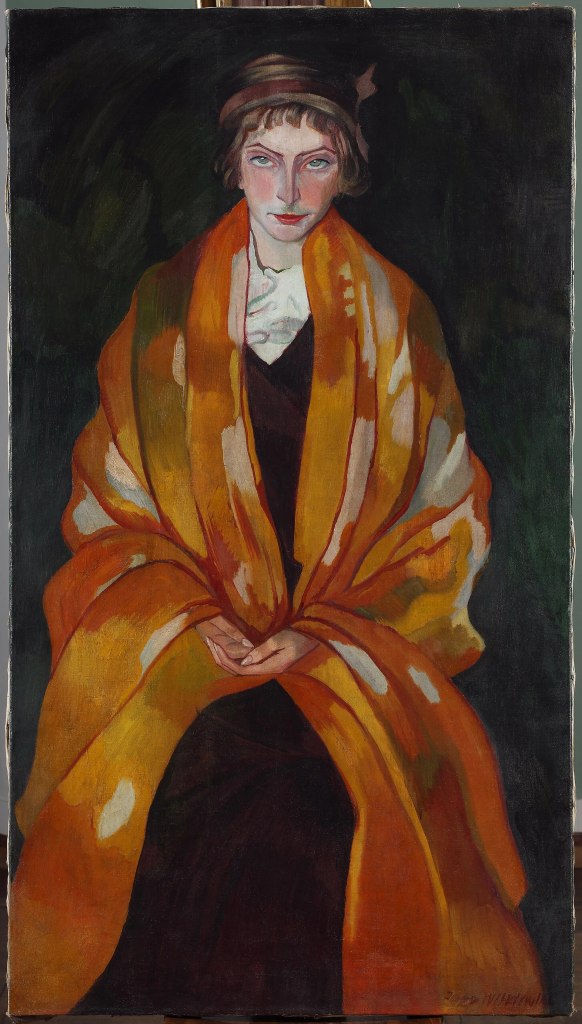
E Dunin Borkowska
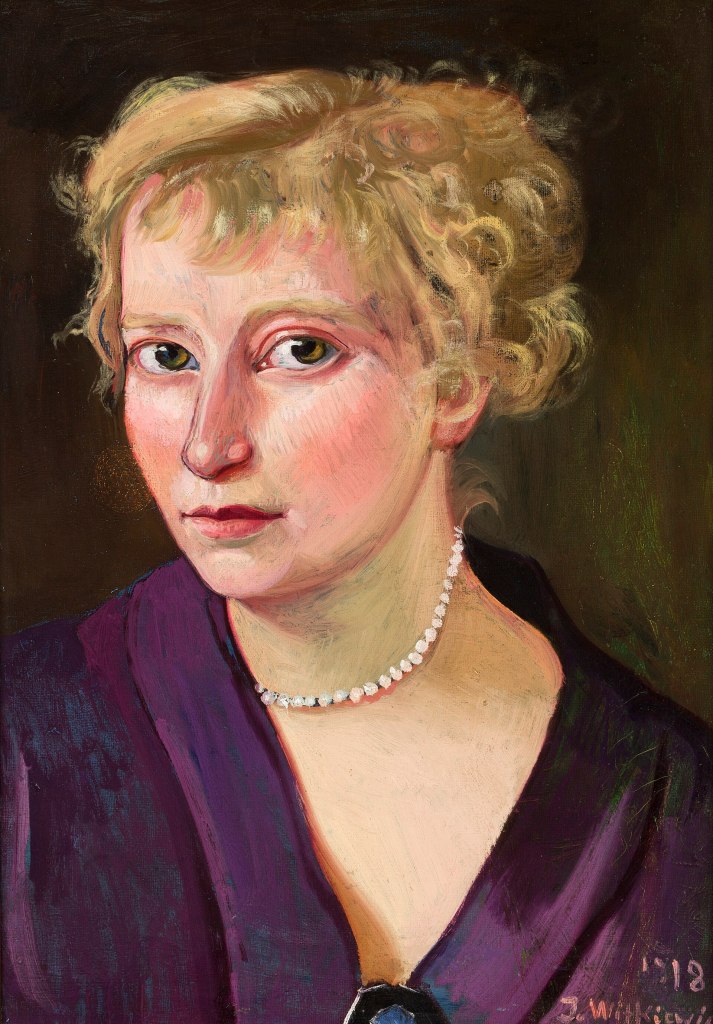
Portret kobiety – Muzeum Narodowe w Krakowie
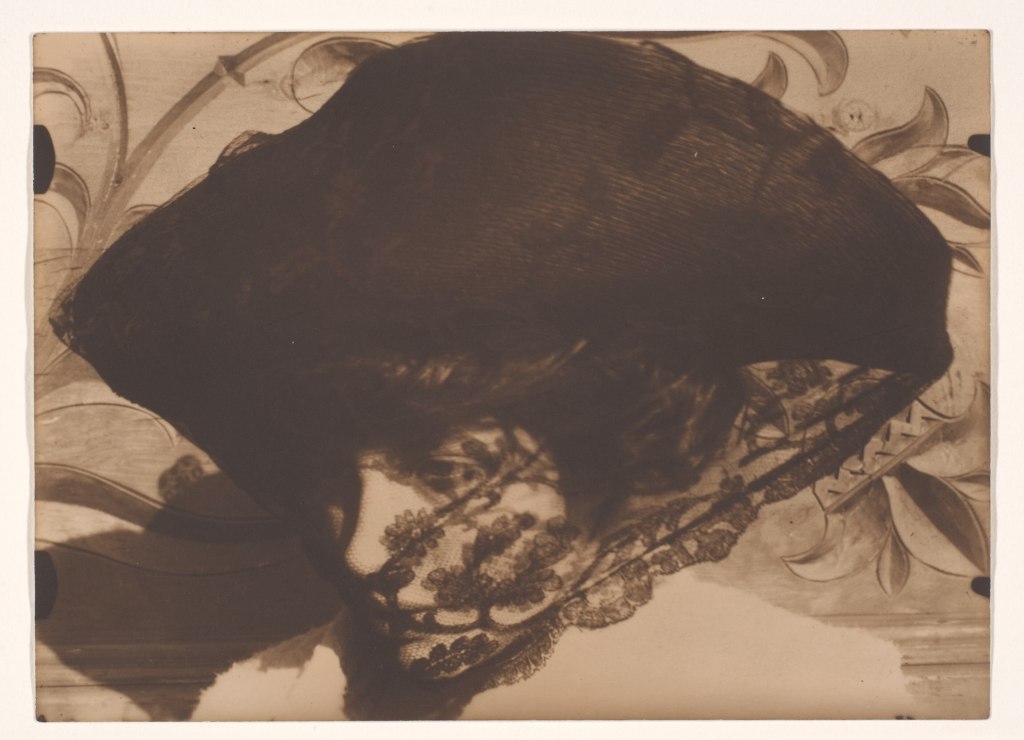
Jadwiga Janczewska, Zakopane 1913
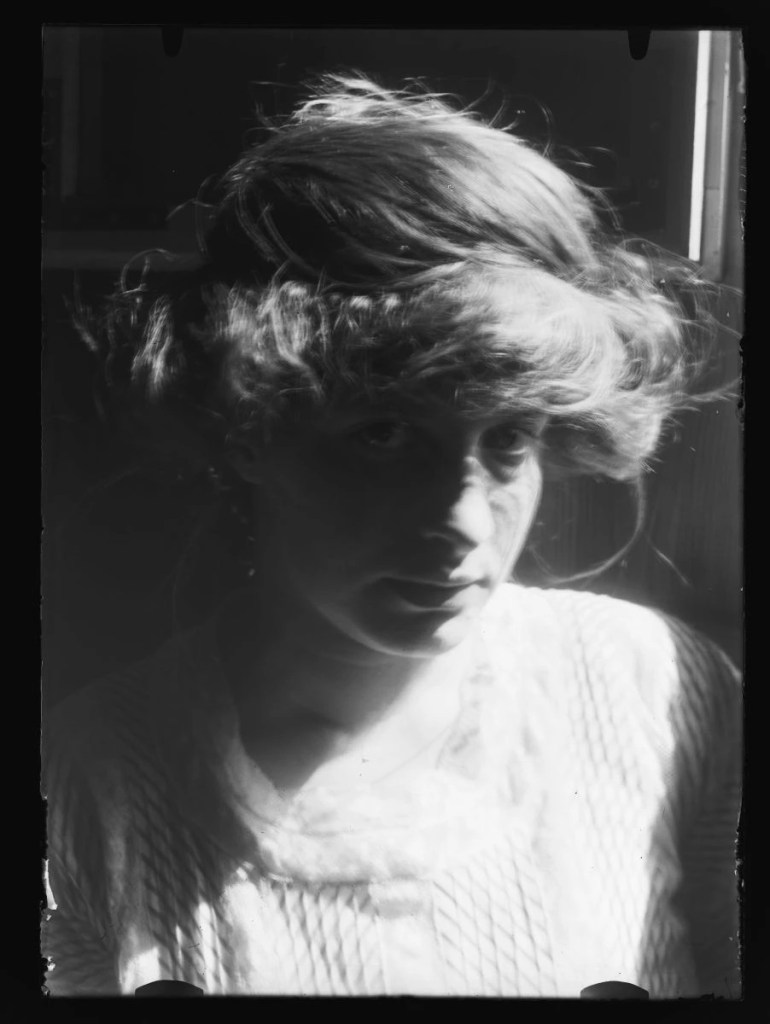
jadwiga
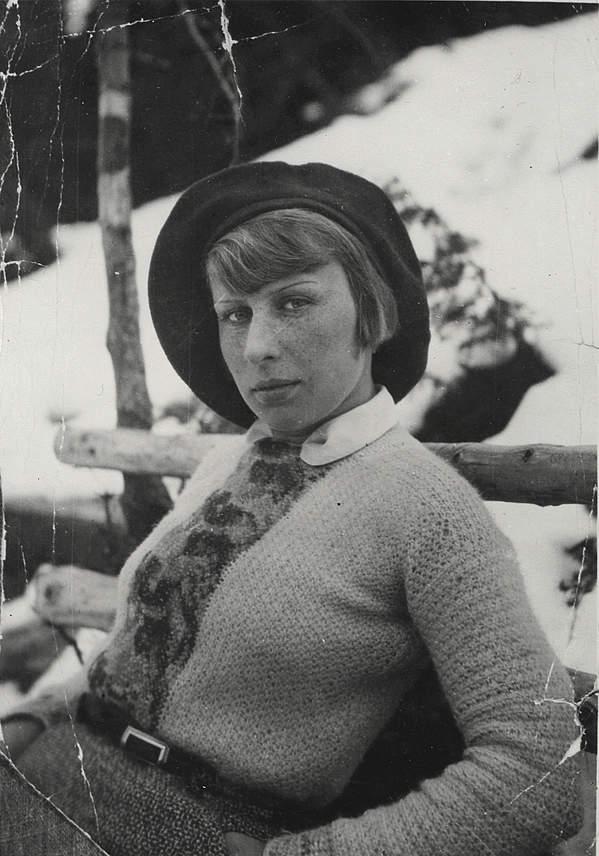
Czesława Oknińska
And today is the birthday of Weldon Kees (Harry Weldon Kees; Beatrice, Nebraska; February 24, 1914 – July 18, 1955 San Francisco); poet, painter, literary critic, novelist, playwright, jazz pianist, short story writer, and filmmaker. In my opinion, he is an important mid-twentieth-century poet of the same generation as John Berryman, Elizabeth Bishop, and Robert Lowell. His work has been influential on subsequent generations of poets writing in English and other languages and his collected poems have been included in many anthologies.
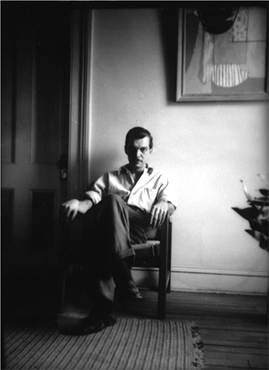
In 1937, he married Ann Swan.
In 1948, Weldon and Ann began summering at the artist colony at Provincetown, Massachusetts on Cape Cod. In the autumn of that year, Kees had his first one-man show at the Peridot Gallery and one of his paintings was included in a group show of established and rising artists at the Whitney Museum. Despite these initial successes, however, Kees’s work only had modest sales.
Kees and Ann drove cross-country to San Francisco in late 1950.
From 1951 to 1954, Kees also made many new contacts as well as renewed old ones in the San Francisco Renaissance, among them Kenneth Rexroth and the founder of City Lights Bookstore, Lawrence Ferlinghetti. Kees’s poetry, however, did not embrace the kind dionysiac character and became increasingly sardonic and confessional in poems such as “1926.”
Restless and often estranged from his poetry, Kees began to collaborate with the jazz clarinetist Bob Helm in 1953 on ballads and torch songs (some written for the singer Ketty Lester).
In 1954, Kees separated from Ann, whose alcoholism led to a psychotic episode triggered by watching the Army–McCarthy hearings on television. After having her institutionalized, Kees divorced her around the time that his last book appeared, Poems, 1947–1954 (San Francisco, Adrian Wilson, 1954). He then focused on organizing a musical revue, Pick Up the Pieces, which eventually became a much more elaborate venue of literary burlesque, titled Poets Follies, which premiered in January 1955 and featured a stripper reading the poetry of Sara Teasdale.
In July 1955, Kees spent time with a woman he had met while working at Langley Porter, a Jungian psychiatrist named Virginia Patterson. Like other relationships Kees had following his divorce, this ended abruptly. Kees, too, had been taking barbiturates for the past two years, which also had intensified his episodes of manic depression. He confessed to trying to jump over the rail of the Golden Gate Bridge, but he could not physically manage it. He talked of going to Mexico as an alternative, a country that fascinated him, in books such as Malcolm Lowry’s Under the Volcano. Kees returned to his home in the Marina District on the evening of July 17, 1955. What he did the following day is a mystery. He telephoned a friend, the memoirist Janet Richards, asking her, “What keeps you going?” On July 19, 1955, Kees’s car was found deserted on the Marin County side of the Golden Gate Bridge. He was never found.
Verse
The porchlight coming on again,
Early November, the dead leaves
Raked in piles, the wicker swing
Creaking. Across the lots
A phonograph is playing Ja-Da.
An orange moon. I see the lives
Of neighbors, mapped and marred
Like all the wars ahead, and R.
Insane, B. with his throat cut,
Fifteen years from now, in Omaha.
from “1926”
Change, move, dead clock, that this fresh day
May break with dazzling light to these sick eyes
I look at you
Across those fires and the dark
A good night for the fireplace to be
crackling with flames – or so he figured,
Crumpling the papers he could only see
As testimonials to long plateaus of emptiness.
- The Heat in the Room
thanks for stoppin’ by y’all
mac tag
 The Lovers’ Chronicle
Leave a comment