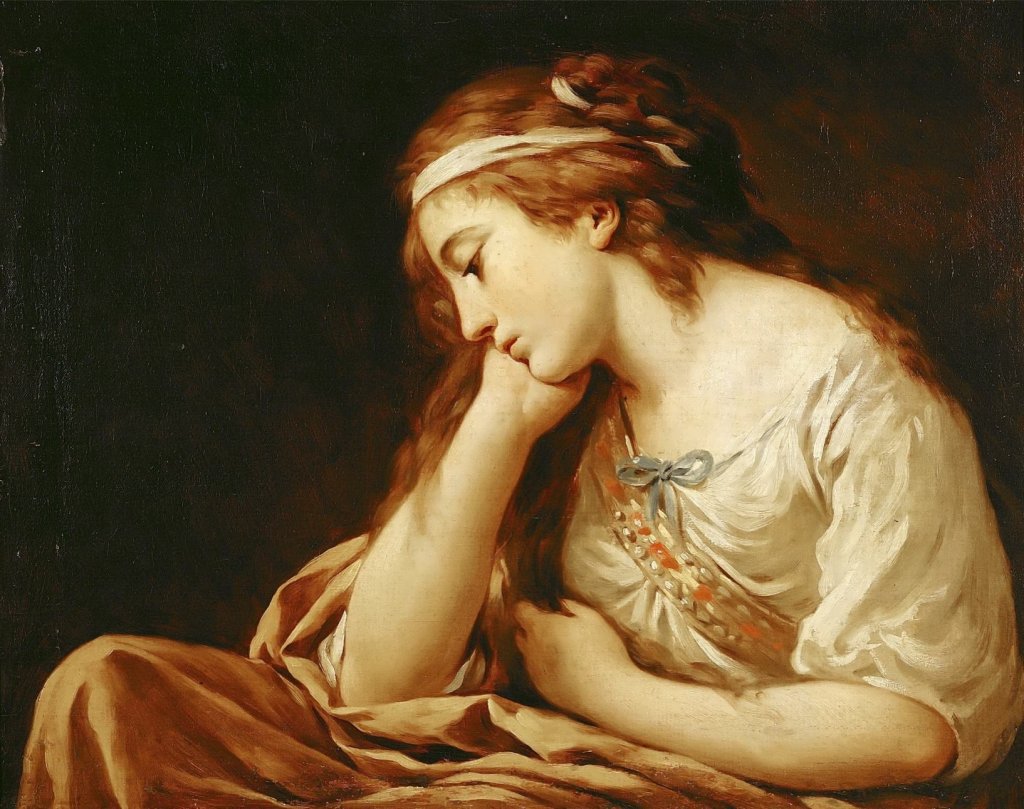
Dear Zazie, Here is today’s Lovers’ Chronicle from Mac Tag dedicated to his muse. Rhett
The Lovers’ Chronicle
Dear Muse,
you will not be surprised
by the song that came to mind
it is one of the most beautifully sad
songs ever written and performed;
“How many times do I have to try to tell you
That I’m sorry for the things I’ve done”
“Ah we love Annie, anything and everything”
she is a treasure, could listen to her all day,
but i want to turn those lyrics around;
this is the story i finally wrote
these are the words i could never say
this is the trail i ride now
these are the dreams i dream
these are the contents of my head
and these are the years we spend
and this is what it represents
and this is how i feel
you know why
© copyright 2023 mac tag/cowboy coleridge all rights reserved
one for Bowles and the shelterin’ sky, where we are not, alienated in existential despair, though visitin’ Tangiers would be très intéressant, the cafes, the souks, the staggered cityscape of striking blue and white houses topped with the occasional turret, overlookin’ the Strait of Gibraltar, how many more times will we see the moonrise, why limitless
© copyright 2022.2023 mac tag/cowboy coleridge all rights reserved
that question can be dismissed
promptly, we have no need of it
no point in askin’ questions
the vagaries of life, the trail
here, were what they were
we are proof that we held on
made our way through as if
traversin’ an obstacle course
if someone asks why, smile
and say it is a beautiful tale
© copyright 2021.2023 mac tag/cowboy coleridge all rights reserved
Pale Love, Pale Rider
yes, a fine question
the night happenin’, cool, full moon
illumes, words all powerful i craft
hopin’ the answer lies within
to you an offerin’
i seem to possess and am possessed
of where i would be, and your curves
shall soothe and sustain me
when next i hold you
© copyright 2020 mac tag/cowboy coleridge all rights reserved
the night happenin’
hope illumined
why,
because
you believed
the circle
complete
we still can
“Yes,”
she smiles
what makes you
the only one
this, meant to be,
two halves of a whole
just bein’ with her is all
fulfill her wish
when breath passes
through your lips
© Copyright 2019 Mac tag/cowboy Coleridge all rights reaerved
the night happenin’
hope illumined in the sails
of tomorrow’s stars
will glow on what remains
why
you believed
the light pressed,
reserved for you
the circle complete,
sigh,
“We still can.”
you seek out
the invisible
that fills
“Yes,”
she smiles
“What makes your happiness.”
the only one
stillness, without end,
hungry lover, why
“What makes you leave.”
her foresight is all
the rest, confusion
overwhelms
you, like you,
disappear
“Fulfill her wish.”
when breath passes
through your lips
© copyright 2018 mac tag/cowboy coleridge all rights reserved
you are right
a tricky trail
at times you swear,
there is no light
at times you think,
what is the point
at times you wonder,
if the night will ever end
but then…
someone tells you
they will be there
if you need to talk
you recall a smile
and you dare
believe
hell of a thing, sorrow
some say you need it
in order to appreciate
beauty
not sure about that
i would like to have tried
but if you have it
you should
ever once in awhile,
touch it, take it out
and hold it
for if you try
to ignore it
it will eat you alive
© copyright 2017 mac tag/cowboy coleridge all rights reserved
you wrote about hope
and that it goes on
but i god she is
a cold hearted bitch
oh i cannot deny, of her
i have caught a glimpse
in a sunrise,
‘neath a cotton dress,
in well written verse
but when you have not
been well loved nor
know how to love well
and it has been
so goddamn long since…
you tell me why hope
you tell me, why hope
© copyright 2016 mac tag/cowboy Coleridge all rights reserved
Shut your eyes, to see through the dream,
Advancin’ shadows of visions,
Those swirlin’ memories, a totem spins
Realities-Illusions converge
Then you will feel upon your lips…
A little kiss, and my fingertips,
Will run over your neck…
And you will say: ‘Take me! ‘ pullin’ me close,
– And we will take our time findin’ that place
– For those who travel this far…
© copyright 2014 mac tag/cowboy Coleridge all rights reserved

Today is the birthday of Louis-Jean-François Lagrenée (a.k.a. Lagrenée the elder) (Paris 30 December 1724 – 19 June 1805 Paris); rococo painter. He won the Grand Prix de Rome for painting in 1749 and was elected a member of the Académie royale de peinture et de sculpture in 1755. His younger brother Jean-Jacques Lagrenée (a.k.a. Lagrenée the younger) was also a painter.
Lagrenée’s notable career appointments included:
- Court painter to Elizabeth, Empress of Russia.
- Director of the Academy of Arts in Saint Petersburg.
- Director of the French Academy in Rome.
- Professor-rector of the Académie royale de peinture et de sculpture.
- Honorary director-curator of the Louvre museum.
In July 1804, Napoleon I conferred upon Lagrenée the rank of chevalier (Knight) of the Legion d’Honneur.
On Monday 10 July 1758, at the age of 33, Lagrenée married 16-year-old Anne-Agathe Isnard. Fifty-five years later, on 19 June 1805, Lagrenée’s death certificate recorded that they were still married.
Gallery

Mélancolie
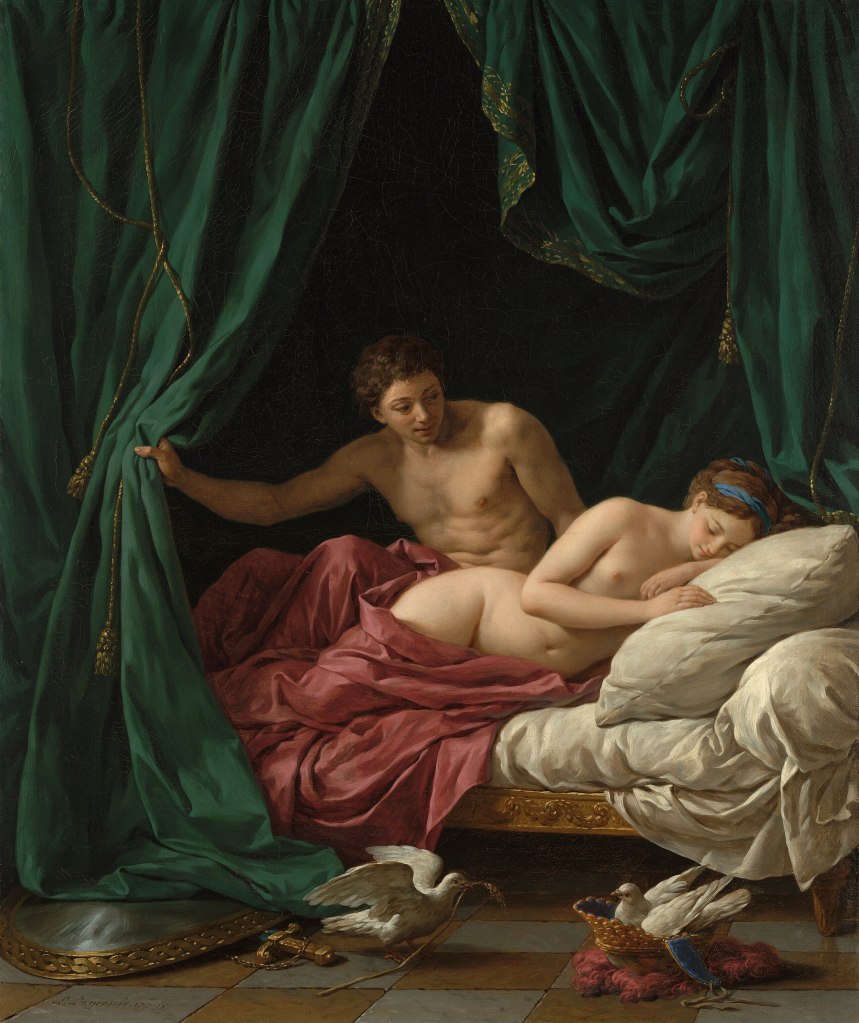
Vénus et Mars (1770), Los Angeles, Getty Center

Apelles Falls in Love with Campaspe; Beloved of Alexander the Great (1772)
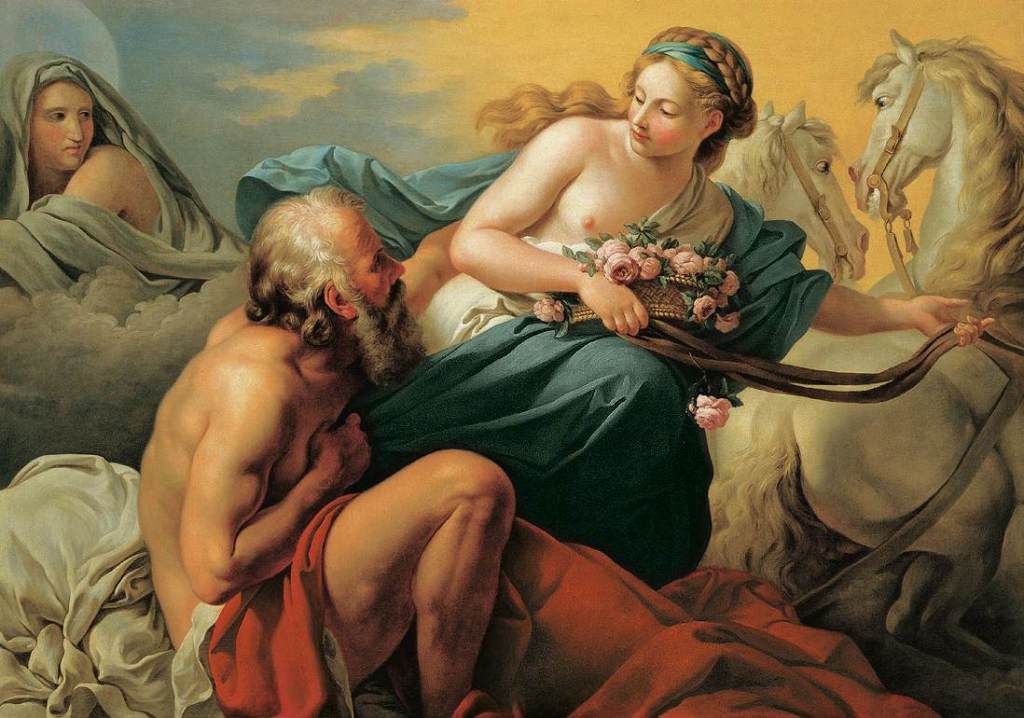
The Ascent of Aurora, (1763)

Alcibiades on his Knees Before his Mistress (c.1781)
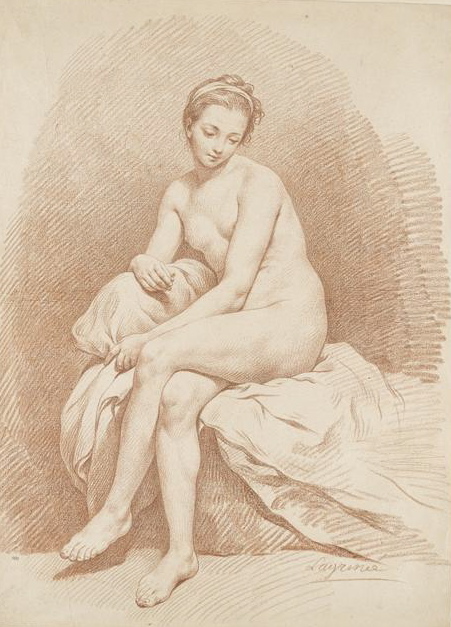
Jeune fille nue, assise sur un lit, vue de face, regardant à terre, Musée du Louvre

La mère spartiate (1770) National Trust for Places of Historic Interest or Natural Beauty
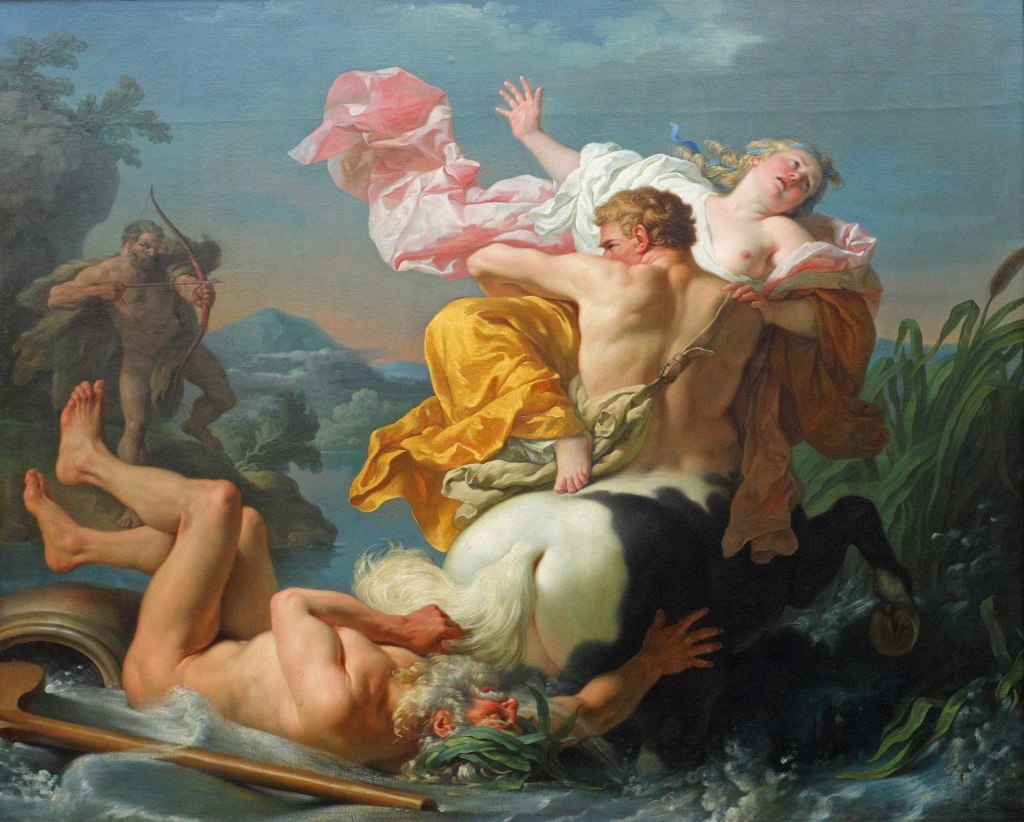
L’Enlèvement de Déjanire (1755), Paris, musée du Louvre

L’Union de la Peinture et de la Sculpture
| Rudyard Kipling | |
|---|---|
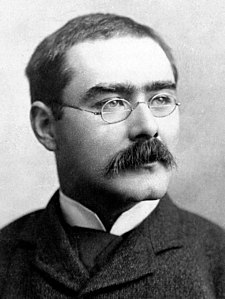 | |
Today is the birthday of Rudyard Kipling (Joseph Rudyard Kipling; Bombay; 30 December 1865 – 18 January 1936 London); journalist, short-story writer, poet, and novelist. Kipling’s works of fiction include The Jungle Book (1894), Kim (1901), and many short stories, including “The Man Who Would Be King” (1888). His poems include “Mandalay” (1890), “Gunga Din” (1890), “The Gods of the Copybook Headings” (1919), “The White Man’s Burden” (1899), and “If—” (1910).
In 1907, at the age of 42, he was awarded the Nobel Prize in Literature, making him the first English-language writer to receive the prize, and its youngest recipient to date. He was also sounded out for the British Poet Laureateship and on several occasions for a knighthood, both of which he declined.
As was the custom in British India, he and his three-year-old sister Alice (“Trix”) were taken to the United Kingdom – in their case to Southsea, Portsmouth – to live with a couple who boarded children of British nationals living abroad. For the next six years (from October 1871 to April 1877), the children lived with the couple – Captain Pryse Agar Holloway, once an officer in the merchant navy, and Sarah Holloway – at their house, Lorne Lodge, 4 Campbell Road, Southsea. Kipling referred to the place as “the House of Desolation”.
In his autobiography published 65 years later, Kipling recalled the stay with horror, and wondered if the combination of cruelty and neglect that he experienced there at the hands of Mrs Holloway might not have hastened the onset of his literary life: “If you cross-examine a child of seven or eight on his day’s doings (specially when he wants to go to sleep) he will contradict himself very satisfactorily. If each contradiction be set down as a lie and retailed at breakfast, life is not easy. I have known a certain amount of bullying, but this was calculated torture – religious as well as scientific. Yet it made me give attention to the lies I soon found it necessary to tell: and this, I presume, is the foundation of literary effort.”
Caroline Starr Balestier met Kipling via her brother Wolcott Balestier who had co-authored The Naulahka with Kipling. Balestier had come to London to keep house for her brother and serve as hostess for him. She taught Kipling how to use a typewriter. When Wolcott Balestier died suddenly of typhoid in 1891, Kipling was distraught and spent time with Miss Balestier, proposing to her via telegram and marrying her a week later. The couple were married in London on January 18, 1892. The bride was given away by Henry James who exclaimed “It’s a union of which I don’t forecast the future.”
The Kiplings had planned a round-the-world trip for their honeymoon but Kipling’s bank failed, causing them to relocate to Balestier’s family residence in Brattleboro, Vermont. Once the Kiplings built the family house, Naulakha, Rudyard Kipling would write in an office that could only be accessed via Carrie Kipling’s own office, where she would maintain his correspondence and manage the household accounts. The Kiplings left the United States in 1896 after Kipling and Caroline’s brother Beatty had an altercation over money.
The Kiplings eventually settled in England, in rural Burwash in the county of Sussex. They purchased Bateman’s, a grand house that had been built in 1634. Bateman’s was Carrie Kipling’s home from 1902 until her death in 1939.
On the night of 12 January 1936, he suffered a haemorrhage in his small intestine. He underwent surgery, but died at Middlesex Hospital in London less than a week later at the age of 70, of a perforated duodenal ulcer. Kipling’s body lay in state in the Fitzrovia Chapel, part of Middlesex Hospital, after his death, and is commemorated with a plaque near the altar. His death had previously been incorrectly announced in a magazine, to which he wrote, “I’ve just read that I am dead. Don’t forget to delete me from your list of subscribers.”
The pallbearers at the funeral included Kipling’s cousin, Prime Minister Stanley Baldwin, and the marble casket was covered by a Union Jack. Kipling was cremated at Golders Green Crematorium in north-west London, and his cremated remains interred at Poets’ Corner, part of the south transept of Westminster Abbey, next to the graves of Charles Dickens and Thomas Hardy.
Verse
A fool there was and he made his prayer
(Even as you and I!)
To a rag and a bone and a hank of hair
We called her the woman who did not care),
But the fool he called her his lady fair
(Even as you and I!)
- The Vampire, Stanza 1.
And a woman is only a woman, but a good cigar is a smoke.
- The Betrothed, Stanza 25.
- I’ve taken my fun where I’ve found it;
I’ve rogued an’ I’ve ranged in my time.- The Ladies, Stanza I.
- An’ I learned about women from ‘er.
- The Ladies, ending line to Stanzas III, IV, and V.
- I’ve taken my fun where I’ve found it,
An’ now I must pay for my fun,
For the more you ‘ave known o’ the others
The less will you settle to one.- The Ladies, Stanza VII.
- For the colonel’s lady an’ Judy O’Grady,
Are sisters under their skins.- The Ladies, Stanza VIII.
For to admire an’ for to see,
For to be’old this world so wide—
It never done no good to me,
But I can’t drop it if I tried!
- For to Admire, Stanza 2.
Now I possess and am possessed of the land where I would be,
And the curve of half Earth’s generous breast shall soothe and ravish me!
- The Prairie, Stanza 5.
Words are, of course, the most powerful drug…
And today is the birthday of Paul Bowles (Paul Frederic Bowles; Jamaica, Queens; December 30, 1910 – November 18, 1999 Tangier); composer, author, and translator. He became associated with the Moroccan city of Tangier, where he settled in 1947 and lived for 52 years to the end of his life.
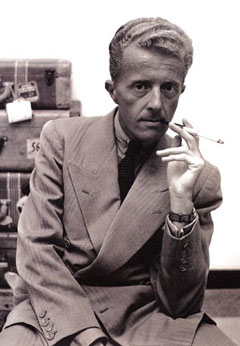
Following a cultured middle-class upbringing in New York City, during which he displayed a talent for music and writing, Bowles pursued his education at the University of Virginia before making several trips to Paris in the 1930s. He studied music with Aaron Copland, and in New York wrote music for theatrical productions, as well as other compositions. He achieved critical and popular success with his first novel The Sheltering Sky (1949), set in French North Africa, which he had visited in 1931.
In 1947, Bowles settled in Tangier, at that time in the Tangier International Zone, and his wife Jane Bowles followed in 1948. Except for winters spent in Ceylon during the early 1950s, Tangier was Bowles’s home for the remainder of his life. He came to symbolize American immigrants in the city.
Upon his death his body was cremated and his cremated remains are buried near family graves in Lakemont Cemetery, in upstate New York.
- Paul Bowles (1995) edited by Jeffrey Miller, p. 192
The Sheltering Sky (1949)
A novel about an American couple travelling in North Africa. A film adaptation of the book directed by Bernardo Bertolucci was released in 1990.
- Many days later another caravan was passing and a man saw something on top of the highest dune there. And when they went up to see, they found Outka, Mimouna and Aicha; they were still there, lying the same way as when they had gone to sleep. And all three of the glasses… were full of sand. That was how they had their tea in the Sahara.
- Because we don’t know when we will die, we get to think of life as an inexhaustible well. Yet everything happens only a certain number of times, and a very small number really. How many more times will you remember a certain afternoon of your childhood, some afternoon that is so deeply a part of your being that you can’t even conceive of your life without it? Perhaps four or five times more, perhaps not even that. How many more times will you watch the full moon rise? Perhaps twenty. And yet it all seems limitless.
- In a 1993 interview just prior to his accidental on-set death, actor Brandon Lee quoted this passage. Lee had chosen this quote to be included in his upcoming wedding invitations; it is now inscribed on his tombstone.
- For in order to avoid having to deal with relative values, he had long since come to deny all purpose to the phenomenon of existence — it was more expedient and comforting. p. 65
- So she said banteringly: “What’s the unit of exchange in this different world of yours?”
He did not hesitate. “The tear.”
“It isn’t fair,” she objected. “Some people have to work very hard for a tear. Others can have them just for thinking.”
“What system of exchange is fair?” he cried, and his voice sounded as if he were really drunk. “And whoever invented the concept of fairness, anyway? Isn’t everything easier if you simply get rid of the idea of justice altogether? You think the quantity of pleasure, the degree of suffering is constant among all men? It somehow comes out in the end? You think that? If it comes out even it’s only because the final sum is zero.” p. 148
- A black star appears, a point of darkness in the night sky’s clarity. Point of darkness and gateway to repose. Reach out, pierce the fine fabric of the sheltering sky, take repose.
thanks for stoppin’ by y’all
Mac Tag
 The Lovers’ Chronicle
Leave a comment