Dear Zazie, Here is today’s Lovers’ Chronicle from Mac Tag dedicated to his muse. Follow us on twitter @cowboycoleridge. Who is the trace of your dreams? Rhett
The Lovers’ Chronicle
Dear Muse,
live from Marathon, Florida
dream outline…
a disturbance within the flow
tryin’ to get through, to fall into
pickin’ up somethin’, at a desk
writin’ a short story in honor
of one of today’s birthday boys
has to have a surprise endin’
and the lovely redhead
 wait hold please, another
signal comin’ through,
a change in scenery,
in Taos, a favorite place,
writin’ again, this time,
could it be after many
years of denial, a tale,
more than a trace,
inspired by D. H.,
about love, for you
it goes like this…

© copyright 2024 mac tag/cowboy coleridge all rights reserved
my original idea for this
was someone who was in a relationship
but now alone, lyin’ in bed missin’ their lover
“That is a compelling scene”
if it was a song, the tempo
would be slow, and maybe;
all that remains
in the early light
of that life once had
an imagined imprint
on a pillow and the refrain;
a trace of you,
a trace of was
“That goes well with where you were”
yes, now though, the refrain would be;
traces of you
stayin’ with me
through my days
© copyright 2023 mac tag/cowboy coleridge all rights reserved
a silhouette, sometimes clear, other times faint, in the shadows, in dreams, perhaps in a scene or a painting, in a photograph, a poem or a story, when you least expect it, or if lucky, when needed most; these impressions of you, gifts, threads in the tie that binds
© copyright 2022.2023 mac tag/cowboy coleridge all rights reserved
did i dream you
once ago
i have dreamed
women before
comin’ into my life
but i never met
anyone like you
was it just
that we both needed
to become who we are
before we could meet
i miss
your smilin’ eyes
the feel of your skin,
your body movin’
with mine
timeless embrace
oh my
© copyright 2021 mac tag/cowboy coleridge all rights reserved
Pale Love, Pale Rider
should that feelin’ come
around again, believe
i am in the best place
to deal with that
as a writer, open
to any adventure
that leaves a trace,
to build the stories,
gotta have ’em
and the most compellin’
ones involve two people
tryin’ to figure out
how to be immortal
so bring it on
© copyright 2020.2023 mac tag/cowboy coleridge all rights reserved
despite D. H.’s birth today
still not in the mood
to talk about the “L” word
to be clear,
it is a fine thing
and if it comes
embrace it
but it may not
and trust me
we will be fine
if it does not
i have had a few
brief encounters
and they left a trace
plenty enough for me
© copyright 2019.2023 mac tag/cowboy coleridge all rights reserved
it is so,
that those who cannot,
never find it
and those that can,
never have to seek
realize, too late for sure,
that the emotional self
recovers from loss
but only in appearance
eventually the wound
will make itself felt
as an ache that deepens
and fills everything
only then
after recovery
and forgettin’
can the worst
be faced
© copyright 2018 mac tag/cowboy coleridge all rights reserved
a deluge of rain
skies darken
thunder booms
and in the noise
all appears to me
an abode
of gloomy sadness
on this night
sleep comes
mercifully
in the mornin’
sunlight pierces
through the shutters
in our room,
where night lingers still,
tracin’ a vague outline
of you lyin’ here
© copyright 2017 mac tag/cowboy Coleridge all rights reserved
The totem spins…
We have been carried off
By winds that moan
Across the prairie
Look, dawn eternal
You smile at me
Please do not…
The totem spins…
we venture forth
through deserts, hot days,
and pitch-black nights
we seek enchanted places
Please, do not…
Let hope be but a dream,
or even less;
As it wobbles…
And follows now,
pain and dole
© copyright 2016 mac tag/cowboy Coleridge all rights reserved
for Kelli
I will never forget
the first day
we started talking.

© copyright 2014 mac tag/cowboy Coleridge all rights reserved
I dreamed I dream of you
but it came with pain and dole
for the vision of my dream
is not the truth
© copyright 2012 mac tag/cowboy Coleridge all rights reserved
Today is the birthday of Pierre de Ronsard (Couture-sur-Loir, Kingdom of France; 11 September 1524 – 27 December 1585 La Riche, Kingdom of France); poet or, as his own generation in France called him, a “prince of poets”.
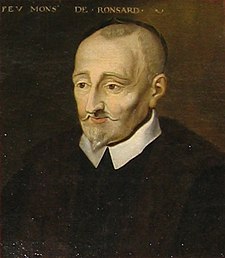
He apparently became the acknowledged leader of the Pléiade, a group of seven French poets aiming to apply classical criticism and scholarship to the vernacular. Ronsard was a prolific writer, and his work was both admired and criticized throughout his life. His poetry is characterized by its magnificence of language and imagery and graceful variety of metre.
In 1552 he published his Amours de Cassandre with the fifth book of Odes, dedicated to the 15-year-old Cassandre Salviati, whom he had met at Blois and followed to her father’s Château de Talcy.
quotes
Quand vous serez bien vieille, au soir, à la chandelle,
Assise auprès du feu, dévidant et filant,
Direz, chantant mes vers, en vous émerveillant:
“Ronsard me célébrait du temps que j’étais belle.”
- When you are very old, at evening, by candelight,
Sitting near the fire, spooling and spinning the wool,
You will say, in wonder, as you sing my verses,
“Ronsard praised me in the days when I was beautiful.”- “Quand vous serez bien vieille, au soir, à la chandelle”, Sonnets pour Hélène (1578), ll. 1-4
- Cueillez dès aujourd’hui les roses de la vie.
- Gather today the roses of life.
- “Quand vous serez bien vieille, au soir, à la chandelle,” l. 14
- Gather today the roses of life.
| Thomas Hill | |
|---|---|
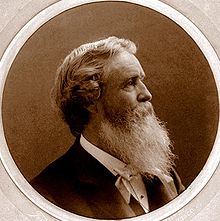 | |
Today is the birthday of Thomas Hill (Birmingham, England; September 11, 1829 – June 30, 1908 Raymond, California); artist of the 19th century. He produced many paintings of the California landscape, in particular of the Yosemite Valley, as well as the White Mountains of New Hampshire. He is buried at Mountain View Cemetery in Oakland, California.
Gallery

the golden gate from point lobos
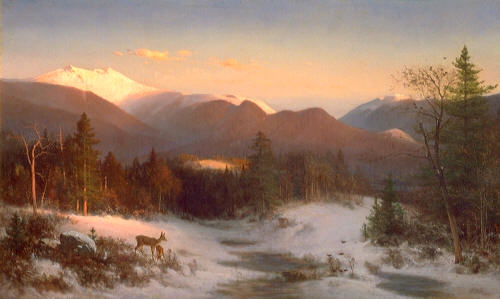
Mount Lafayette in Winter (1870)
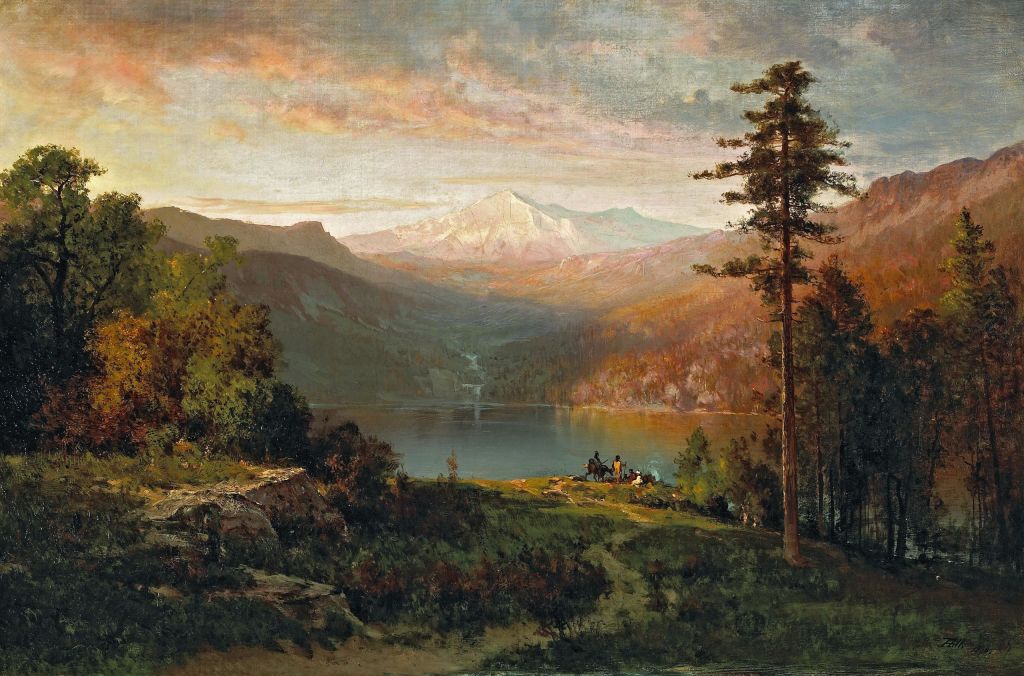
Indian by a lake in a majestic California landscape
| O. Henry | |
|---|---|
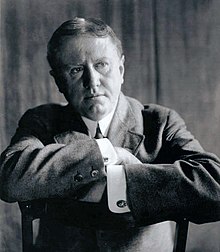 Portrait by W. M. Vanderweyde, 1909 Portrait by W. M. Vanderweyde, 1909 | |
Today is the birthday of O. Henry (William Sydney Porter; Greensboro, North Carolina; September 11, 1862 – June 5, 1910 New York City); short story writer. His short stories are known for their wit, wordplay, warm characterization, and surprise endings.
In Austin, Texas, Porter met and began courting Athol Estes, then seventeen years old and from a wealthy family. Her mother objected to the match because Athol was ill, suffering from tuberculosis. On July 1, 1887, Porter eloped with Athol to the home of Reverend R. K. Smoot, where they were married. Athol died from tuberculosis on July 25, 1897. Porter married again in 1907 to childhood sweetheart Sarah (Sallie) Lindsey Coleman, whom he met again after revisiting his native state of North Carolina. Sarah Lindsey Coleman was herself a writer and wrote a romanticized and fictionalized version of their correspondence and courtship in her novella Wind of Destiny.
Porter was a heavy drinker, and his health deteriorated markedly in 1908, which affected his writing. In 1909, Sarah left him, and he died of cirrhosis of the liver, complications of diabetes, and an enlarged heart. After funeral services in New York City, he was buried in the Riverside Cemetery in Asheville, North Carolina.
| D. H. Lawrence | |
|---|---|
 | |
Today is the birthday of D. H. Lawrence (David Herbert Lawrence; Eastwood, Nottinghamshire, England 11 September 1885 – 2 March 1930 Vence, France); novelist, poet, playwright, essayist, literary critic and painter. His collected works, represent an extended reflection upon the dehumanising effects of modernity and industrialisation. Lawrence explored emotional health, vitality, spontaneity and instinct.
Lawrence endured official persecution, censorship, and misrepresentation of his creative work throughout the second half of his life, much of which he spent in a voluntary exile which he called his “savage pilgrimage”. At the time of his death, his public reputation was that of a pornographer who had wasted his considerable talents. Later, his works were championed, placing much of Lawrence’s fiction within the canonical “great tradition” of the English novel.
In March 1912 Lawrence met Frieda Weekley (née von Richthofen), with whom he was to share the rest of his life. Six years older than her new lover, she was married to Ernest Weekley, Lawrence’s former modern languages professor at University College, Nottingham, and had three young children. She eloped with Lawrence to her parents’ home in Metz, a garrison town then in Germany near the disputed border with France. Lawrence left for a small hamlet to the south of Munich, where he was joined by Frieda for their “honeymoon”, later memorialised in the series of love poems titled Look! We Have Come Through (1917).
From Germany they walked southwards across the Alps to Italy, a journey that was recorded in the first of his travel books, a collection of linked essays titled Twilight in Italy and the unfinished novel, Mr Noon.
Lawrence and Frieda returned to Britain in 1913 for a short visit, during which they encountered and befriended critic John Middleton Murry and New Zealand-born short story writer Katherine Mansfield.
Lawrence and Weekley soon went back to Italy, staying in a cottage in Fiascherino on the Gulf of Spezia. Here he started writing the first draft of a work of fiction that was to be transformed into two of his better-known novels, The Rainbow and Women in Love. While writing Women in Love in Cornwall during 1916–17, Lawrence developed a strong and possibly romantic relationship with a Cornish farmer named William Henry Hocking. In a letter written during 1913, he writes, “I should like to know why nearly every man that approaches greatness tends to homosexuality, whether he admits it or not …” He is also quoted as saying, “I believe the nearest I’ve come to perfect love was with a young coal-miner when I was about 16.”
Eventually, Frieda obtained a divorce from Weekley. The Lawrence’s returned to Britain shortly before the outbreak of World War I and were married on 13 July 1914. During this period he finished writing Women in Love in which he explored the destructive features of contemporary civilization through the evolving relationships of four major characters as they reflect upon the value of the arts, politics, economics, sexual experience, friendship and marriage. The novel is a bleak, bitter vision of humanity and proved impossible to publish in wartime conditions. Not published until 1920, it is now widely recognised as an English novel of dramatic force and intellectual subtlety.
In late February 1922 the Lawrences left Europe behind with the intention of migrating to the United States. They sailed in an easterly direction, first to Ceylon and then on to Australia.
The Lawrences finally arrived in the US in September 1922. Here they encountered Mabel Dodge Luhan, a prominent socialite, and considered establishing a utopian community on what was then known as the 160-acre (0.65 km2) Kiowa Ranch near Taos, New Mexico. After arriving in Lamy, New Mexico via train, they bought the property, now called the D. H. Lawrence Ranch, in 1924, in exchange for the manuscript of Sons and Lovers. He stayed in New Mexico for two years, with extended visits to Lake Chapala and Oaxaca in Mexico.
A brief voyage to England at the end of 1923 was a failure and he soon returned to Taos, convinced that his life as an author now lay in America. However, in March 1925 he suffered a near fatal attack of malaria and tuberculosis while on a third visit to Mexico. Although he eventually recovered, the diagnosis of his condition obliged him to return once again to Europe. He was dangerously ill and the poor health limited his ability to travel for the remainder of his life. The Lawrences made their home in a villa in Northern Italy, living near Florence while he wrote The Virgin and the Gipsy and the various versions of Lady Chatterley’s Lover (1928). The latter book, his last major novel, was initially published in private editions in Florence and Paris and reinforced his notoriety.
Lawrence continued to write despite his failing health. In his last months he wrote numerous poems, reviews and essays, as well as a robust defence of his last novel against those who sought to suppress it. After being discharged from a sanatorium, he died on 2 March 1930 at the Villa Robermond in Vence, France, from complications of tuberculosis. Frieda Weekley commissioned an elaborate headstone for his grave bearing a mosaic of his adopted emblem of the phoenix. After Lawrence’s death, Frieda lived with Angelo Ravagli on the ranch in Taos and eventually married him in 1950. In 1935 Ravagli arranged, on Frieda’s behalf, to have Lawrence’s body exhumed and cremated and his ashes brought back to the ranch to be interred there in a small chapel amid the mountains of New Mexico
Verse
Those that go searching for love
only make manifest their own lovelessness,
and the loveless never find love,
only the loving find love,
and they never have to seek for it.
- “Search for Love” in: The Works of D. H. Lawrence, Wordsworth Editions, 1994, p. 552
Prose
- And dimly she realized one of the great laws of the human soul: that when the emotional soul receives a wounding shock, which does not kill the body, the soul seems to recover as the body recovers. But this is only appearance. It is really only the mechanism of the reassumed habit. Slowly, slowly the wound to the soul begins to make itself felt, like a bruise, which only slowly deepens its terrible ache, till it fills all the psyche. And when we think we have recovered and forgotten, it is then that the terrible after-effects have to be encountered at their worst.
- Lady Chatterley’s Lover (1928)
- Folks should do their own fuckin’, then they wouldn’t want to listen to a lot of clatfart about another man’s.
- Lady Chatterley’s Lover (1928)
- I believe in being warm-hearted. I believe especially in being warm-hearted in love, in fucking with a warm heart. I believe if men could fuck with warm hearts, and the women take it warm-heartedly, everything would come all right. It’s all the cold-hearted fucking that is death and idiocy.
- Lady Chatterley’s Lover (1928)
No form of love is wrong, so long as it is love, and you yourself honour what you are doing. Love has an extraordinary variety of forms! And that is all that there is in life, it seems to me.
Be still when you have nothing to say; when genuine passion moves you, say what you’ve got to say, and say it hot.
And today is the birthday of Stephen Etnier (Stephen Morgan Etnier; York, Pennsylvania; September 11, 1903 – November 7, 1984 Harpswell, Maine); realist painter, painting for six decades. His work is distinguished by a mixture of realism and luminism, favoring industrial and working scenes, but always imbued with atmospheric light. Geographically, his career spanned the length of the eastern Atlantic and beyond.
Etnier purchased land in South Harpswell, Maine in 1948 to build “Old Cove”, his dream house and studio. The home featured a porch cantilevered over the ocean, north-facing windows for his studio, and a living room overlooking the ocean and framed by Mondrian-inspired window frames. Named for the private cove it overlooked, the home served as the foundation for a productive and increasingly serene period in Etnier’s career. Old Cove was sold to new owners in 2014 and subsequently demolished.
The 1950s and 1960s mark a maturing, accomplished style in Etnier’s work. Although still traveling south most winters in his boat, his life took a more domestic turn as he re-adopted Maine as his permanent home and married his fourth wife, Samuella “Brownie” Brown Rose. They were married for thirty-three years.
Gallery
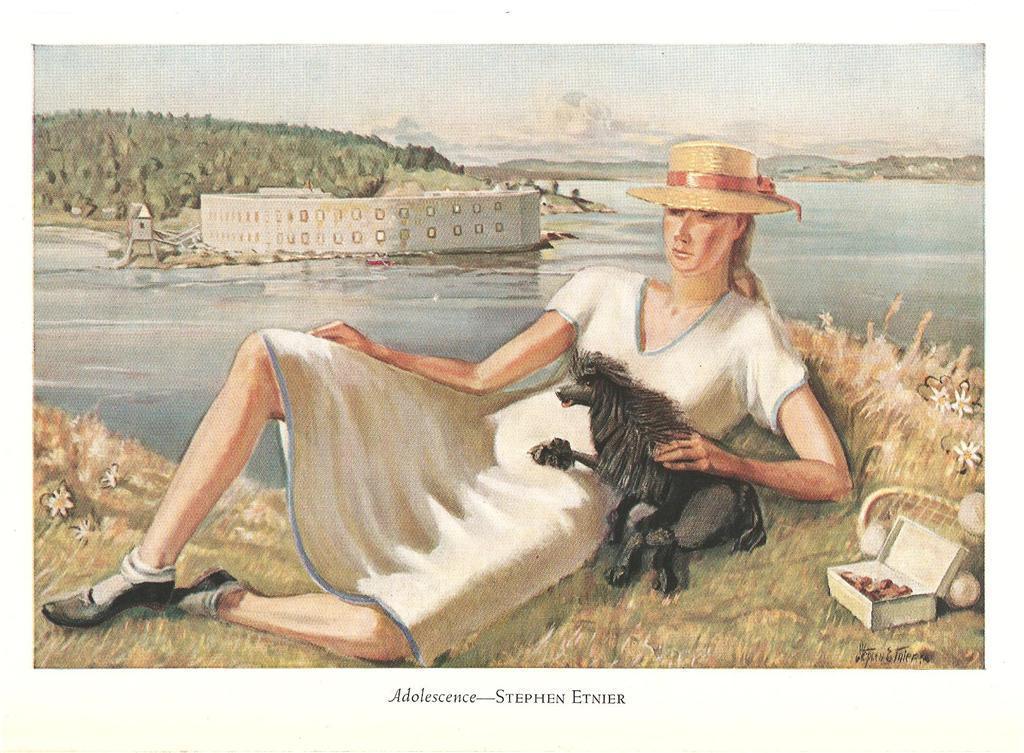
adolescence
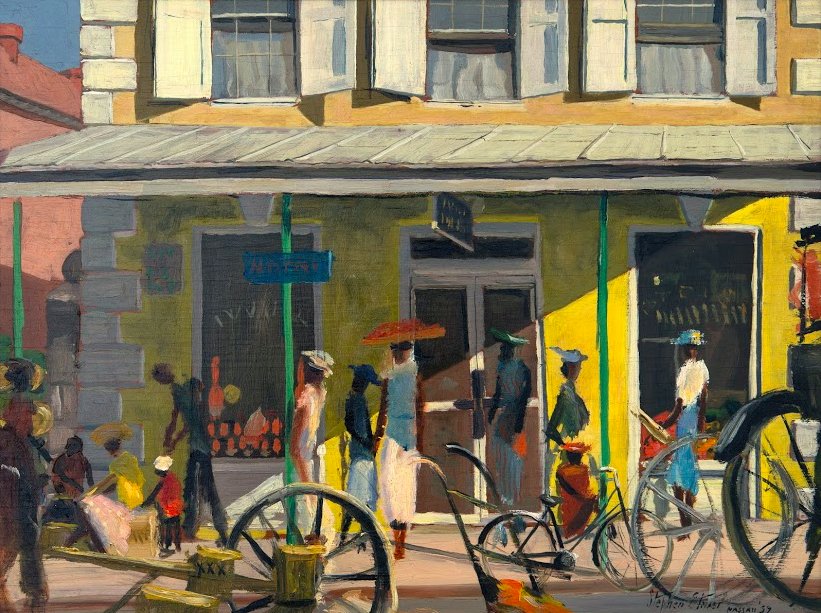
Street in Nassau, 1939
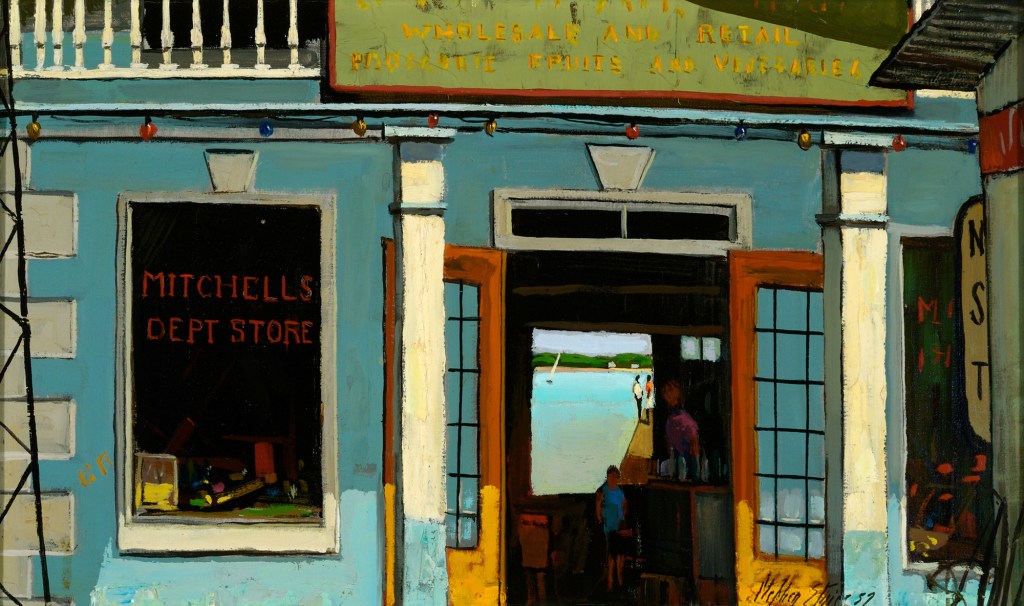
Storefront, Nassau 1957
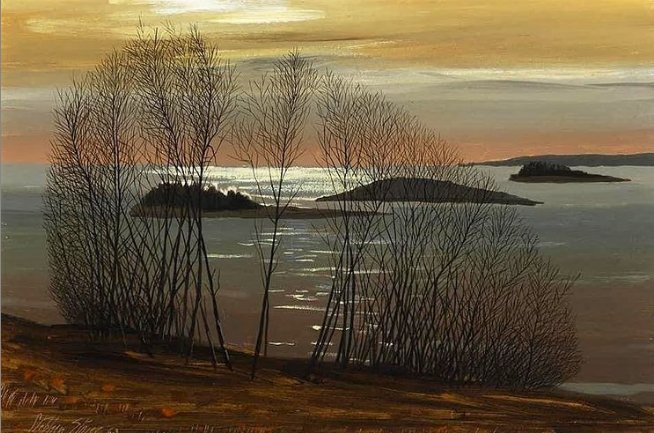
Three islands
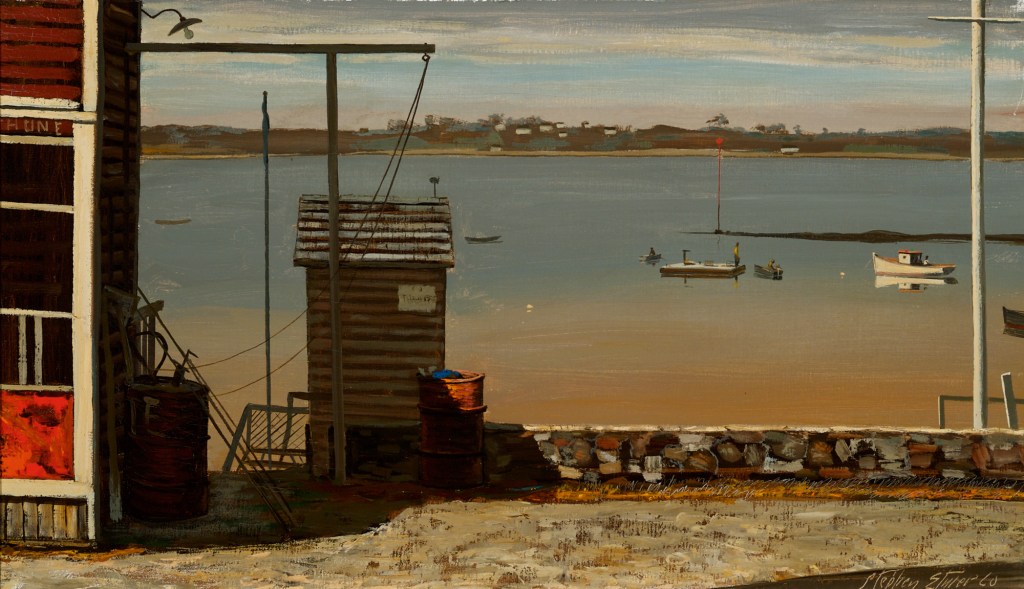
Still Morning 1960
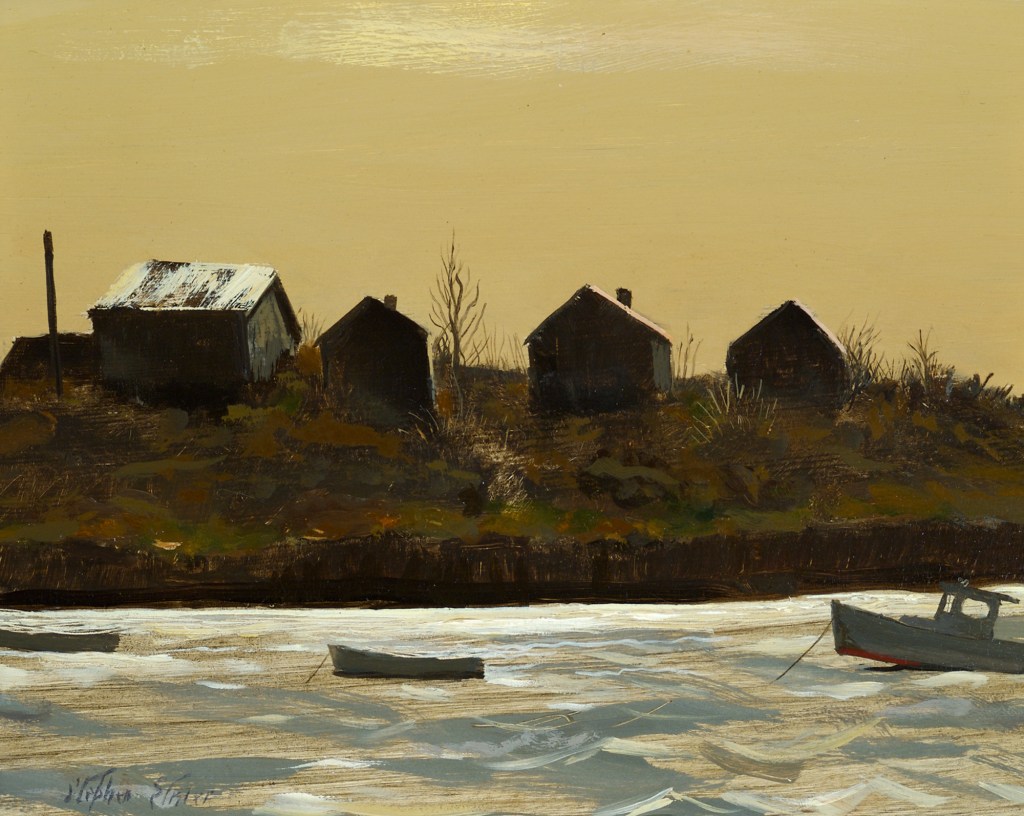
Study for Hurricane Ridge, Harpswell ca. 1970s
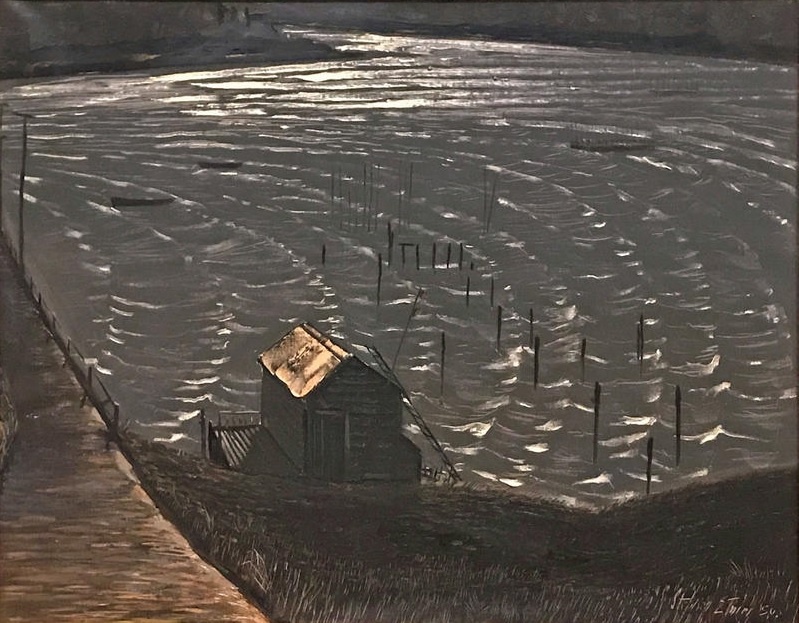
late afternoon 1950
And on this day in 1951, The Rake’s Progress, an English-language opera in three acts and an epilogue by Igor Stravinsky premiered at the Teatro La Fenice in Venice. The libretto, written by W. H. Auden and Chester Kallman, is based loosely on the eight paintings and engravings A Rake’s Progress (1733–1735) of William Hogarth (see below), which Stravinsky had seen on 2 May 1947, in a Chicago exhibition.
The story concerns the decline and fall of Tom Rakewell, who deserts Anne Trulove for the delights of London in the company of Nick Shadow, who turns out to be the Devil. After several misadventures, all initiated by the devious Shadow, Tom ends up in Bedlam, a hospital for the insane at that time situated in the City of London. The moral of the tale is: “For idle hearts and hands and minds the Devil finds work to do.”

I – The Heir

II – The Levée

III – The Orgy

IV – The Arrest

V – The Marriage
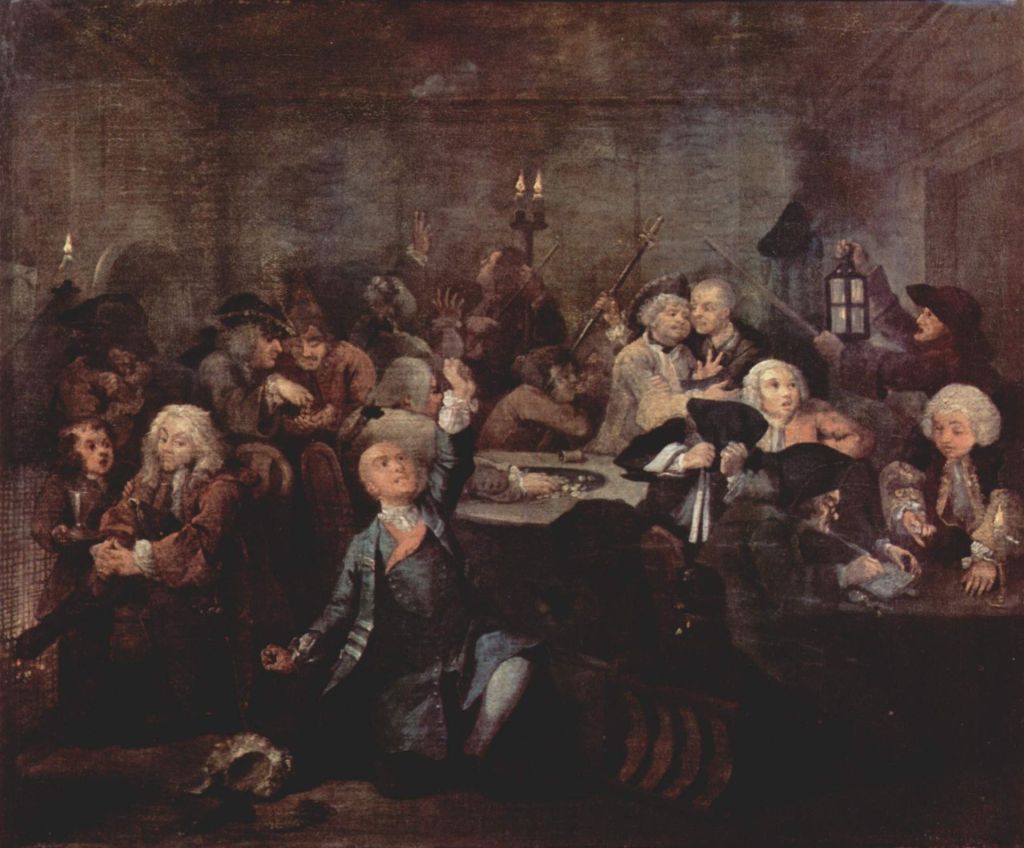
VI – The Gaming House

VII – The Prison

VIII – The Madhouse
Mac Tag
thanks for stoppin’ by y’all
When you are sad,
The mother of the wind mourns too,
And her old wind that no mirth ever had,
Wanders and wails before my heart most true.
– W.B. Yeats
 The Lovers’ Chronicle
Leave a comment