Dear Zazie, Here is today’s Lovers’ Chronicle from Mac Tag to his muse. Follow us on twitter @cowboycoleridge. Rhett
The Lovers’ Chronicle
Dear Muse,
a thinkin’ dream…
music, sounds like opera, which one he thinks,
oh yes, "Ah, fuyez douce image" (Ah, flee, sweet image)
an aria from Massenet’s Manon, but wait
why, i was asleep, must be dreamin’
-He walks along a foggy street then turns
a corner and goes up a short flight of steps,
now into a building, up the stairs to the third floor
and walks into what looks like an artists studio
the walls are lined with portraits of women
with red hair, he recognizes Rossetti’s work-
Hello my love, says the lovely redhead
hey bebe, are you sittin’ for Rossetti
Yes, I was walking down a street
when I heard a man shout,
then I saw him leap from a carriage
and he ran up, told me who he was
and pleaded with me to sit for him
ha, fabulous, that is how he found Alexa Wilding
The man had a proper appreciation of redheads
he did not have a thinkin’ problem when
it came to choosin’ his models to paint;
his wife Elizabeth Siddal, his mistress
Fanny Cornforth, Wilding and others
We don’t have any thinking problems
i think i need a kiss and do you think
he has anything around here to drink

© copyright 2024 mac tag/cowboy coleridge all rights reserved
never had a drinkin’ problem,
or should i write it as, drankin’
”That’s closer to the way you say it”
no, i had a thankin’ problem,
from the David Ball song;
”Yes I admit,
I’ve got a thinkin’ problem”
but unlike the song
mine was not about someone
it was about thinkin’ i could
be something i could not
”Because you weren’t ready”
right, for relationships or
for my purpose
”Well it worked out for us”
exactly what i was thankin’

© copyright 2023.2024 mac tag/cowboy coleridge all rights reserved
live from Beverly Beach
moon on the water
180 degree view
of the atlantic
at beverly
could be came true
brought us here
our first time
watchin’ the moonbeams
float on the waves, feelin’
the ocean breeze movin’
the air, a constant caress
arm in arm we are,
we will be in tune
a song to believe
© copyright 2022.2023 mac tag/cowboy coleridge all rights reserved
about what has been
and what could be
about you
have me as i you
whatever world
and time enough
once wrote:
there is no could be
only what was
and what could have been
ain’t no damn could be
best go ahead and bury
that sumbitch right now
believe it is time
to dig it up
© copyright 2021.2023 mac tag/cowboycoleridge all rights reserved
Pale Love, Pale Rider
as shall not be, the poet saith,
and the painter with her brush
the same desire, mystery,
wisdom, memory, still
we think as we go
we have been here before,
we know how it feels
the sounds, the light
through the trees
as destined
wherever the road lies
we shall not find one day
© copyright 2020 mac tag/cowboy coleridge all rights reserved
in twilight’s reckonin’
a familiar refrain
tells us, like none other
tells us, what we need
to discover, to know
what we are holdin’
close, together
what we are searchin’
at dawn’s orange rise
ravishin’, repeat, we are
touchin’, we are
on our way
© copyright 2019 mac tag/cowboy coleridge all rights reserved
*Forgive her
Forgive yourself*
“Did you find
what you were looking for?”
yes
“Good.
I assume you have no regrets?”
no, do you
“Of course not.”
congratulations
you were right
“About what?”
about her
“I need you.”
i never left
…………
“Thank you.”
my pleasure
are you all right
“Fine, but I keep
thinking, now what.”
trust your inspiration
it will not let you down
“Will you be able to sleep now.”
not likely
“I wish I could set you free.
But your prison is inside.”
*silence*
© copyright 2018 mac tag/cowboy coleridge all rights reserved
No verse tonight
Could not figure out
How to turn a night
Of workin’ on my boat
Into a tale of bein’ without
You and the shadows of doubt
In one month y’all…
The question before those that care;
Is it too late to start over
Would it be wise to uncover
Long denied emotions
Is it possible,
Does it even make sense
To try; to believe
How would one begin
I do not know
Can you just promise
To be here
To listen
“Your past is a lesson,
not a life sentence”
I know, and I know
I took the path
Of least resistance
But it was all I could do
I wanted what they had
I knew it was out there
Waitin’ for me
I could not have been
More certain
Or more wrong
© copyright 2017 mac tag/cowboy coleridge all rights reserved
thinkin’ about what has been
and what could have been
about the ones
let go or driven away
none of ’em the one though
of course thinkin’ about you
if only you had loved me
as i loved you
still love you
could you have loved me
had we but world enough and time
sometimes wonder
if fate punished me
by sendin’ me you
how ironic to hear
words i have said
come back to haunt me
“I want you, I need you
but I can’t love you.”
there is no could be
only what was
and what could have been
ain’t no damn could be
best go ahead and bury
that sumbitch right now
© copyright 2016 Mac Tag/Cowboy Coleridge all rights reserved
You can have my
heart, though it is
broken. You can
have my body
it will not fail
you. My soul has
been sold or you
could have it too
If you are makin’ up
more than you are makin’ out
Well, it is time to make a move
© copyright 2015 Mac Tag/Cowboy Coleridge all rights reserved
Bocca baciata non perde ventura, anzi rinnova come fa la luna.
Italian proverb
‘The mouth that has been kissed does not lose its savour,
indeed it renews itself just as the moon does.’
Translation of Italian proverb
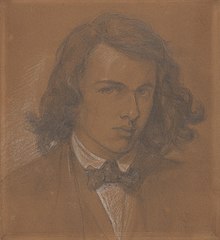
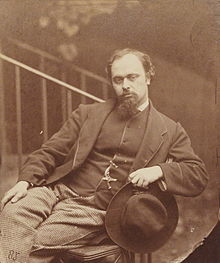
Today is the birthday of Dante Gabriel Rossetti (London 12 May 1828 – 9 April 1882 Birchington-on-Sea, Kent, England); poet, illustrator, painter and translator. He founded the Pre-Raphaelite Brotherhood in 1848 with William Holman Hunt and John Everett Millais. Rossetti was later to be the main inspiration for a second generation of artists and writers influenced by the movement. His work also influenced the European Symbolists and was a major precursor of the Aesthetic movement. Rossetti’s art was characterised by its sensuality and its medieval revivalism. His early poetry was influenced by John Keats. His later poetry was characterised by the complex interlinking of thought and feeling, especially in his sonnet sequence, The House of Life. Poetry and image are closely entwined in Rossetti’s work. He frequently wrote sonnets to accompany his pictures, spanning from The Girlhood of Mary Virgin (1849) and Astarte Syriaca (1877), while also creating art to illustrate poems such as “Goblin Market” by the celebrated poet Christina Rossetti, his sister. Rossetti’s personal life was closely linked to his work, especially his relationships with his models and muses Elizabeth Siddal, Fanny Cornforth, both redheads, and Jane Morris, who was not a redhead but whom he painted as a redhead.
 | |
Rossetti and Siddal were married on Wednesday 23 May 1860 at St Clement’s Church in the seaside town of Hastings. Siddal died of an overdose of laudanum in 1862, shortly after giving birth to a stillborn child. Overcome with grief, Rossetti enclosed in his wife’s coffin a journal containing the only copy he had of his many poems, supposedly sliding the book into Siddal’s red hair. By 1869, Rossetti was addicted to drugs and alcohol. He had convinced himself he was going blind and could not paint. He began to write poetry, but before publishing his newer poems he became obsessed with retrieving the poems he had slipped into his Siddal’s coffin. Rossetti had exhumed and the notebook was retrieved. The poetry was published in 1870. The poems were sensual and erotic, and caused a scandal.
Rossetti met Cornforth in 1856 and she soon became his model and mistress. He maintained Cornforth in her own establishment and painted many voluptuous images of her between 1863 and 1865. After Siddall’s death she moved into his home.

Morris, whom Rossetti had used as a model for the Oxford Union murals he painted with William Morris and Edward Burne-Jones in 1857, also sat for him during these years, she “consumed and obsessed him in paint, poetry, and life”. In 1869, Morris and Rossetti rented a country house, Kelmscott Manor at Kelmscott, Oxfordshire, as a summer home, but it became a retreat for Rossetti and Morris to have a long-lasting and complicated liaison. They spent summers there with the Morris’s children, while Morris travelled to Iceland in 1871 and 1873.
Gallery

The Blessed Damozel (model: Alexa Wilding) see the poem below

Pia de’ Tolomei (1868–1880), Spencer Museum of Art, University of Kansas, Lawrence (model: Jane Morris)
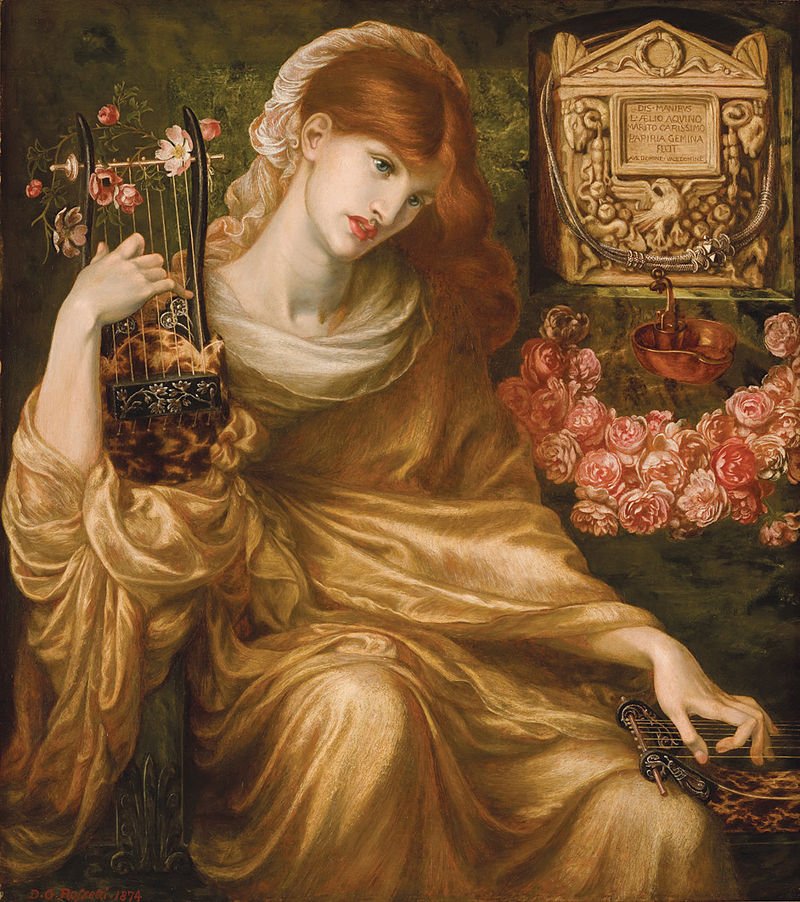
The Roman Widow at Museo de Arte de Ponce, Puerto Rico
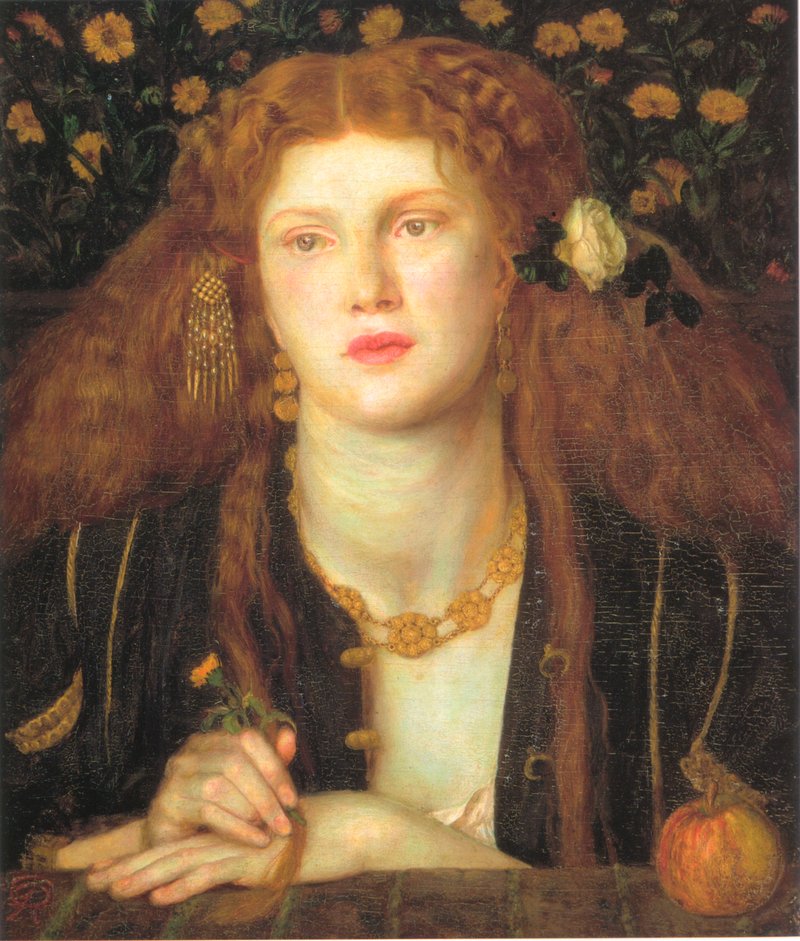
Bocca Baciata (1859) signalled a new direction on Rossetti’s work. (Model: Fanny Cornforth)

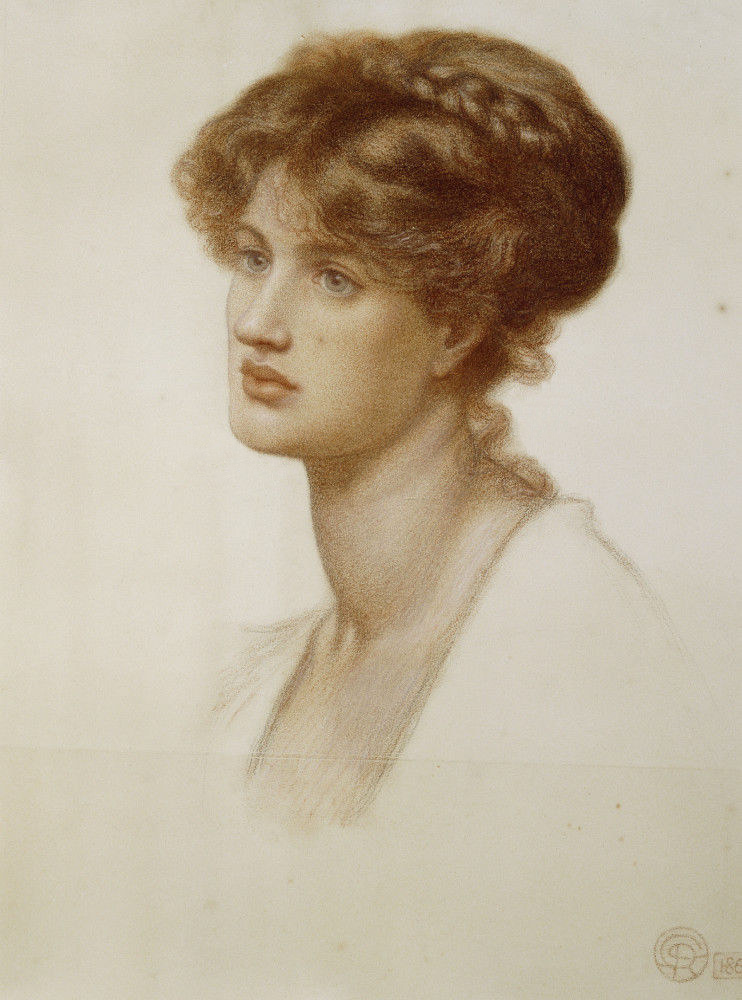
A Vision of Fiammetta (1878), one of Rossetti’s last paintings, now in the collection of Andrew Lloyd Webber (model: Marie Spartali Stillman)
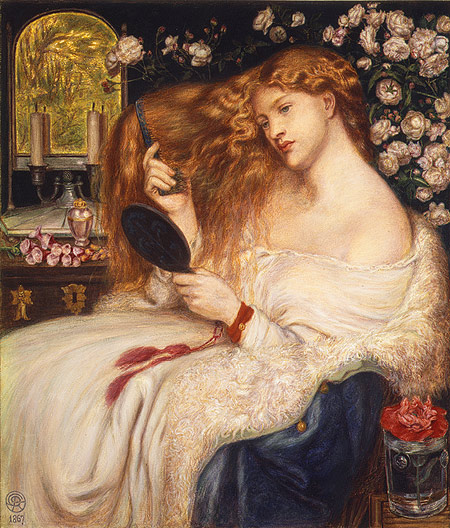
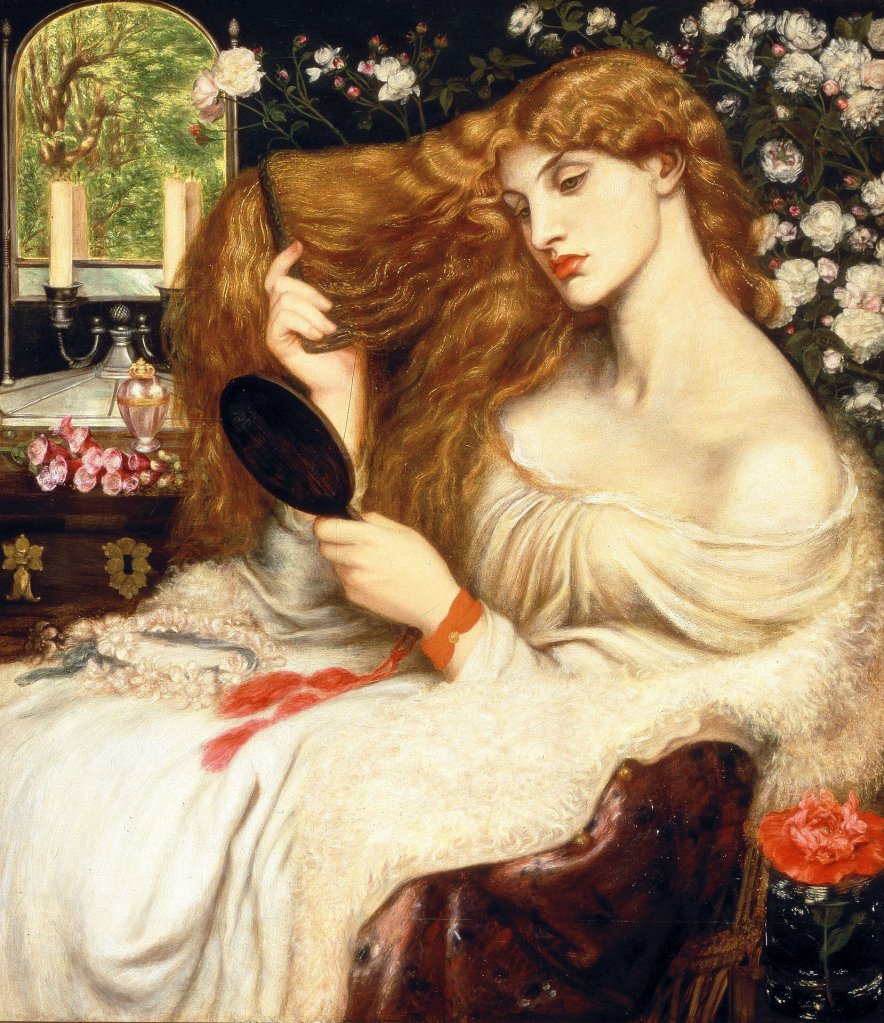
Lady Lilith (1868), Delaware Art Museum (Fanny Cornforth, overpainted at Kelsmcott 1872–73 with the face of Alexa Wilding)
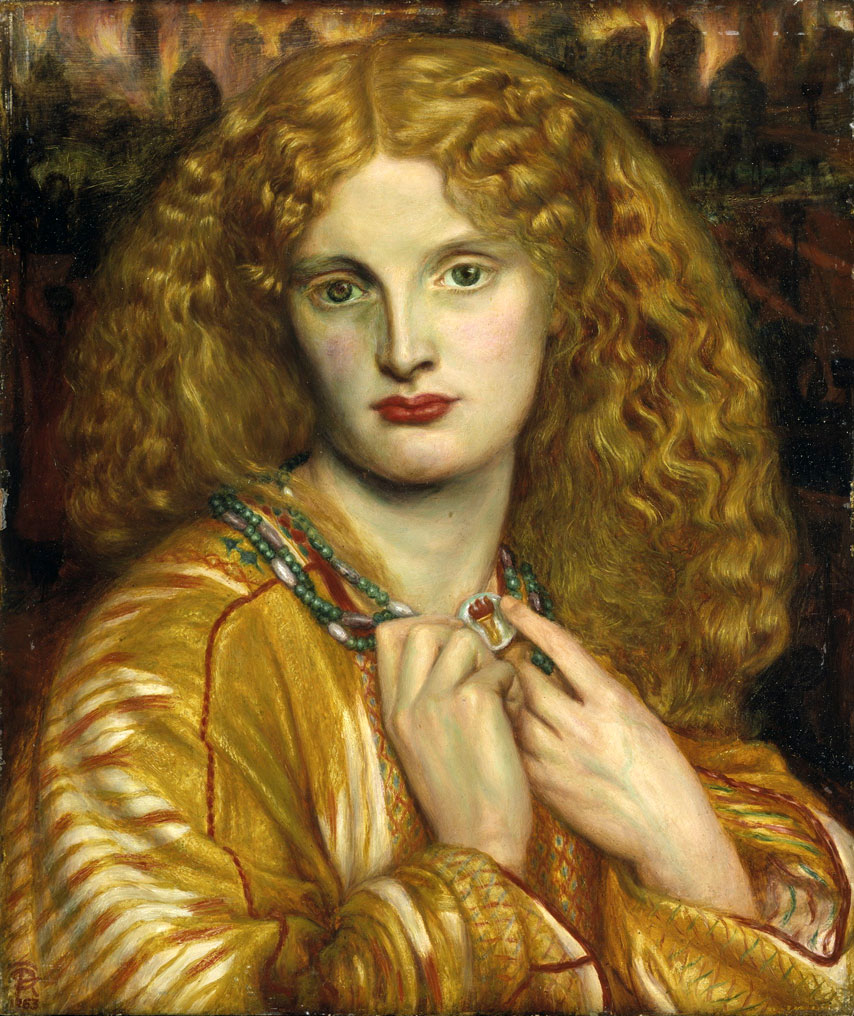
Helen of Troy, 1863, Kunsthalle Hamburg, Hamburg, Germany

Ecce Ancilla Domini (1850), Tate Britain, London

Ligeia Siren (1873), colored chalk


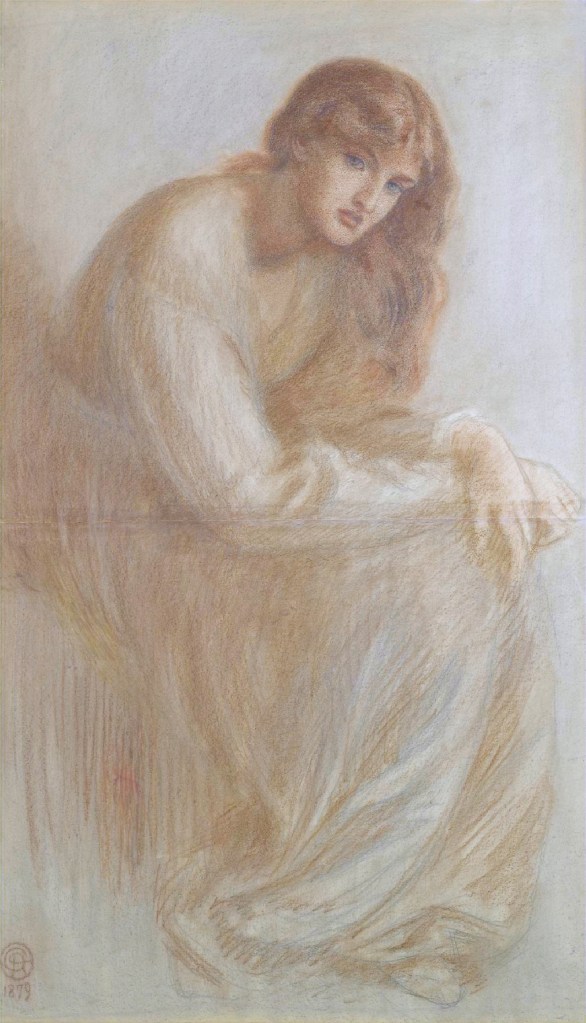
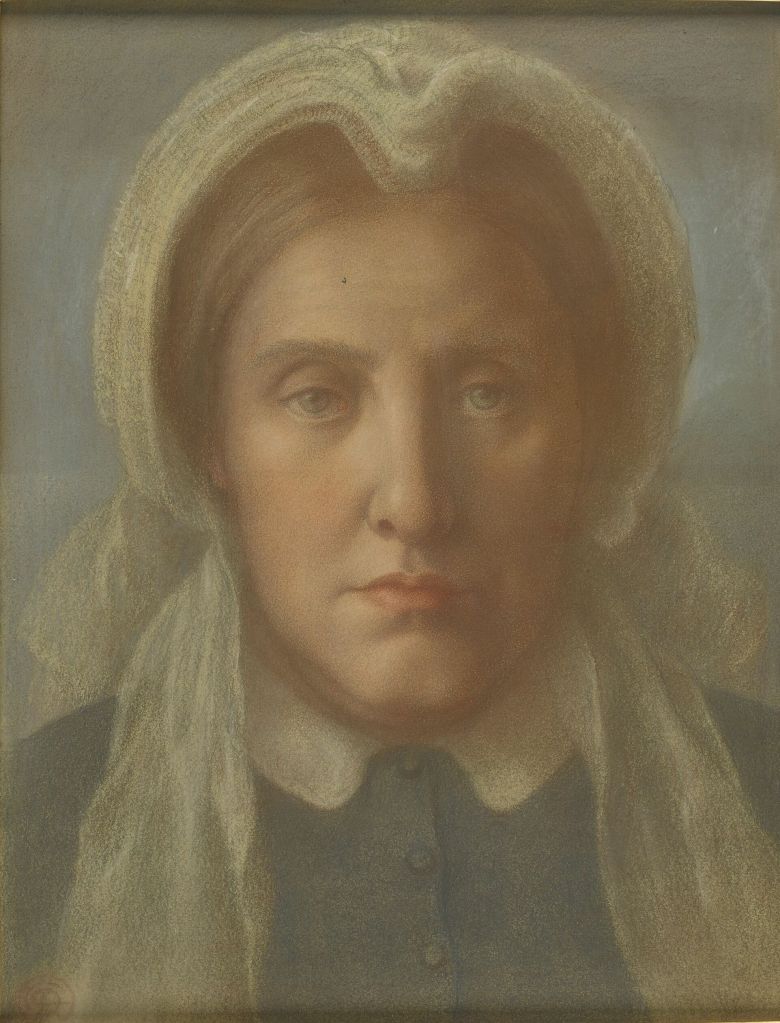

The Day Dream. The sitter is Jane Morris

Select Rossetti Poems
- I am not as these are, the poet saith
In youth’s pride, and the painter, among men
At bay, where never pencil comes nor pem- from Not As These in The House of Life 1870
- From perfect grief there need not be
Wisdom or even memory;
One thing then learned remains to me —
The woodspurge has a cup of three.- The Woodspurge, st. 4 (1870).
- Tell me now in what hidden way is
Lady Flora the lovely Roman?
Where’s Hipparchia, and where is Thais,
Neither of them the fairer woman?
Where is Echo, beheld of no man,
Only heard on river and mere—
She whose beauty was more than human?—
But where are the snows of yester-year?- The Ballad of Dead Ladies, st. 1 (1870).
- I have been here before,
But when or how I cannot tell:
I know the grass beyond the door,
The sweet, keen smell,
The sighing sound, the lights around the shore.- Sudden Light, st. 1 (1881).
- If God in his wisdom have brought close
The day when I must die,
That day by water or fire or air
My feet shall fall in the destined snare
Wherever my road may lie.- The King’s Tragedy, reported in Bartlett’s Familiar Quotations, 10th ed. (1919).
- Still we say as we go,—
“Strange to think by the way
Whatever there is to know,
That shall we know one day.”- The Cloud Confines, reported in Bartlett’s Familiar Quotations, 10th ed. (1919).
- Gather a shell from the strewn beach
And listen at its lips: they sigh
The same desire and mystery,
The echo of the whole sea’s speech.- The Sea-Limits, reported in Bartlett’s Familiar Quotations, 10th ed. (1919).
- Was it a friend or foe that spread these lies?
Nay, who but infants question in such wise,
‘T was one of my most intimate enemies.- Fragment, reported in Bartlett’s Familiar Quotations, 10th ed. (1919).
- If the light is
It is because God said ‘Let there be light.’- At Sunrise, reported in Bartlett’s Familiar Quotations, 10th ed. (1919).
- Thou fill’st from the wingèd chalice of the soul
Thy lamp, O Memory, fire-wingèd to its goal.- Mnemosyne, reported in Bartlett’s Familiar Quotations, 10th ed. (1919).
The Blessed Damozel (1850)
- The blessed damozel lean’d out
From the gold bar of Heaven;
Her eyes were deeper than the depth
Of waters still’d at even;
She had three lilies in her hand,
And the stars in her hair were seven.- Stanza 1.
- Around her, lovers, newly met
‘Mid deathless love’s acclaims,
Spoke evermore among themselves
Their heart-remember’d names;
And the souls mounting up to God
Went by her like thin flames.- Stanza 7.
- From the fix’d place of Heaven she saw
Time like a pulse shake fierce
Through all the worlds. Her gaze still strove
Within the gulf to pierce
Its path; and now she spoke as when
The stars sang in their spheres. - The sun was gone now; the curl’d moon
Was like a little feather
Fluttering far down the gulf; and now
She spoke through the still weather.
Her voice was like the voice the stars
Had when they sang together. - We two will stand beside that shrine,
Occult, withheld, untrod,
Whose lamps are stirr’d continually
With prayer sent up to God;
And see our old prayers, granted, melt
Each like a little cloud. - We two will lie i’ the shadow of
That living mystic tree
Within whose secret growth the Dove
Is sometimes felt to be,
While every leaf that His plumes touch
Saith His Name audibly.
The House of Life (1870—1881)
- A Sonnet is a moment’s monument,—
Memorial from the Soul’s eternity
To one dead deathless hour.- Introductory Sonnet.
- At length their long kiss severed, with sweet smart:
And as the last slow sudden drops are shed
From sparkling eaves when all the storm has fled,
So singly flagged the pulses of each heart.- Nuptial Sleep.
- Beauty like hers is genius.
- Genius in Beauty.
- Even as the moon grows queenlier in mid-space
When the sky darkens, and her cloud-rapt car
Thrills with intenser radiance from afar,—
So lambent, lady, beams thy sovereign grace
When the drear soul desires thee.- Gracious Moonlight.
- And Love, our light at night and shade at noon,
Lulls us to rest with songs, and turns away
All shafts of shelterless tumultuous day.- Heart’s Haven.
- Each hour until we meet is as a bird
That wings from far his gradual way along
The rustling covert of my soul.- Winged Hours.
- Sometimes thou seem’st not as thyself alone,
But as the meaning of all things that are.- Heart’s Compass.
- Look in my face; my name is Might-have-been;
I am also called No-more, Too-late, Farewell.- A Superscription.
- When all desire at last and all regret
Go hand in hand to death, and all is vain,
What shall assuage the unforgotten pain
And teach the unforgetful to forget?- Newborn Death.
The Choice
I
- Eat thou and drink; to-morrow thou shalt die.
Surely the earth, that’s wise being very old,
Needs not our help. Then loose me, love, and hold
Thy sultry hair up from my face; that I
May pour for thee this golden wine, brim-high,
Till round the glass thy fingers glow like gold.
We’ll drown all hours: thy song, while hours are toll’d,
Shall leap, as fountains veil the changing sky. - Now kiss, and think that there are really those,
My own high-bosom’d beauty, who increase
Vain gold, vain lore, and yet might choose our way!
Through many years they toil; then on a day
They die not, — for their life was death, — but cease;
And round their narrow lips the mould falls close.
II
- Watch thou and fear; to-morrow thou shalt die.
- Now while we speak, the sun speeds forth: can I
Or thou assure him of his goal? God’s breath
Even at this moment haply quickeneth
The air to a flame; till spirits, always nigh
Though screen’d and hid, shall walk the daylight here.
III
- Think thou and act; to-morrow thou shalt die
Outstretch’d in the sun’s warmth upon the shore,
Thou say’st: “Man’s measur’d path is all gone o’er:
Up all his years, steeply, with strain and sigh,
Man clomb until he touch’d the truth; and I,
Even I, am he whom it was destin’d for.”
How should this be? Art thou then so much more
Than they who sow’d, that thou shouldst reap thereby? - Nay, come up hither. From this wave-wash’d mound
Unto the furthest flood-brim look with me;
Then reach on with thy thought till it be drown’d.
Miles and miles distant though the last line be,
And though thy soul sail leagues and leagues beyond,—
Still, leagues beyond those leagues, there is more sea.
And today is the birthday of Jules Massenet (Jules Émile Frédéric Massenet; Montaud, France 12 May 1842 – 13 August 1912 Paris); composer of the Romantic era best known for his operas, of which he wrote more than thirty. The two most frequently staged are Manon (1884) and Werther (1892). He also composed oratorios, ballets, orchestral works, incidental music, piano pieces, songs and other music. Between 1867 and his death forty-five years later he wrote more than forty stage works in a wide variety of styles, from opéra-comique to grand-scale depictions of classical myths, romantic comedies, lyric dramas, as well as oratorios, cantatas and ballets. Massenet had a good sense of the theatre and of what would succeed with the Parisian public.

Massenet photographed by Eugène Pirou, 1895
In 1861 Massenet’s music was published for the first time, the Grande Fantasie de Concert sur le Pardon de Ploërmel de Meyerbeer, a virtuoso piano work in nine sections. Having graduated to the composition class under Ambroise Thomas, Massenet was entered for the Conservatoire’s top musical honour, the Prix de Rome, previous winners of which included Berlioz, Thomas, Gounod and Bizet.
The prize brought a well-subsidised three-year period of study, two-thirds of which was spent at the French Academy in Rome, based at the Villa Medici. At that time the academy was dominated by painters rather than musicians; Massenet enjoyed his time there, and made lifelong friendships with, among others, the sculptor Alexandre Falguière and the painter Carolus-Duran, but the musical benefit he derived was largely self-taught. He absorbed the music at St Peter’s, and closely studied the works of the great German masters, from Handel and Bach to contemporary composers. During his time in Rome, Massenet met Franz Liszt, at whose request he gave piano lessons to Louise-Constance “Ninon” de Gressy, the daughter of one of Liszt’s rich patrons. Massenet and Ninon fell in love. They married in October 1866.
Manon is one of my very favorite operas. The French libretto was written by Henri Meilhac and Philippe Gille, based on the 1731 novel L’histoire du chevalier des Grieux et de Manon Lescaut by Abbé Prévost. Of course, this is one of my favorite books. It is the sad story of a young girl, Manon Lescaut, from the French countryside who is on her way to a convent but instead turns into a Parisian prostitute, betraying her true love, the Chevalier Des Grieux. In the aria, “Adieu, notre petite table” (“Goodbye, our little table”), after vacillatin’ in her decision she bids farewell to the humble domesticity she has shared. In the aria “Ah, fuyez douce image” (Ah, flee, sweet image), Des Grieux tries to mentally banish the love of his life. “Et c’est là l’histoire de Manon Lescaut!”
The songs of the day: Anna Netrebko as Manon “Adieu, notre petite table”
Luciano Pavarotti as Chevalier Des Grieux “Ah, fuyez douce image“
thanks for stoppin’ by y’all
mac tag
I kiss you and the world begins to fade. – WB Yeats
 The Lovers’ Chronicle
Leave a comment