Dear Zazie,
Here is today’s Lovers’ Chronicle from Mac Tag.
Rhett
The Lovers’ Chronicle
Dear Muse,
dream revelator…
*tell me who’s that writin’*
though not religious
“One of the reasons for us”
yes, i have always felt
a pull to this call
“It is powerful”
when i write it seems
as if someone has come
to tell me somethin’
“That’s what the song is about”
exactly, and the answer is me
with more revelations for this
© copyright 2023 mac tag/cowboycoleridge all rights reserved
*tell me who’s that writin’* come down to tell me what i know, or should, but have i not been listenin’ or payin’ attention, not sure it matters; answer back from where would you have me go, to what purpose or place; best keep on, turn to see one who continues, arms opened wide *tell me who’s that writin’*
© copyright 2022.2023 mac tag/cowboycoleridge all rights reserved
Tell me who’s that writin’
you know a voice called down
in the dark of night, said my name
but i refused to answer because
i was ashamed, deaf and dumb
the voice came back years later
when despair was closin’ in
i answered, and have yet to stop
Tell me who’s that writin’
© copyright 2021 mac tag/cowboy coleridge all rights reserved
Pale Love, Pale Rider
Tell me who’s that writin’
still comes ’round
once a year, well
maybe more
at one time, a constant
companion, now
feels like a visit
from an old friend
came by today
but i pushed it away
thoughts of here
keep me holdin’ on
just only ever care
about whatever need
creation has
Tell me who’s that writin’
© copyright 2020 mac tag/cowboy coleridge all rights reserved
*Tell me who’s that writin’*
since it must be told,
there has been this dichotomy…
the inability to be without,
the inability to be with
and now solitude
this to make the best of
*Tell me who’s that writin’*
© copyright 2019 mac tag/cowboy coleridge all rights reserved
*Tell me who’s that writin’*
knows wherein
salvation lies
in the arms
of another
and i succumb
on occasion
but i am not
convinced
too many mistakes
and wrong choices
the faults run too deep
She knows…
*Tell me
who’s that writin’*
© copyright 2018 mac tag/cowboy coleridge all rights reserved
*tell me who’s that writin’*
Stoppin’ in Dodge City
Clear day, windy of course
Must stay the night sometime
Wonder how many spirits
Roam these streets and halls
No sign of Wyatt
Or Doc yet
Y’all believe
In spirits right
If you are askin’,
Oh hell yes
Sometime,
I will regale
You with tales
© copyright 2017 mac tag/cowboy coleridge all rights reserved
*Tell me
who’s that writin’*
the Revelator
comes round to explain
what will have to be done
i want to tell Her, it is alright
i have heard worse
live long enough
you come to understand
sorry for the wait, She says
it is alright
i will be home soon
*tell me who’s that writin’*
© copyright 2016 Mac Tag all rights reserved
*tell me who’s that writin’*
Is somebody
better than
nobody
If you cannot
find the one:
Is somebody
better than
nobody
For some yes
For others,
no. That is
the challenge
To figure out
which you are
***
*tell me who’s that writin’*
When one of those cold winds blow,
You do not always write the right words
Even if you have a thousand nights
So then let loose these two sinners
For our journey, bodies of mortals
And souls paid for in weights of old
*tell me who’s that writin’*
© copyright 2015 Mac Tag all rights reserved
Today is the birthday of Friedrich von Amerling (Vienna 14 April 1803 – 14 January 1887 Vienna); portrait painter in the court of Franz Josef, between 1835 and 1880. With Ferdinand Georg Waldmüller, he is one of the outstanding Austrian portrait painters of the 19th century.

Self-portrait, 1834
Amerling spent much time traveling: in 1836 and 1838 to Italy, 1838 to the Netherlands, 1839 to Munich, 1840-43 in Rome, 1882 in Spain, 1883 in England, 1884 in Greece, 1885 in Scandinavia up to Norway’s North Cape and 1886 to Egypt and Palestine. He was married four times: to Antonie Kaltenthaler from 1832 until her death in 1843; from 1844–45 to Katharina Heissler (ending in divorce); from 1857 until her death in 1880 with Emilie Heinrich; and finally to Maria Nemetschke from 1881 until his death.
Gallery
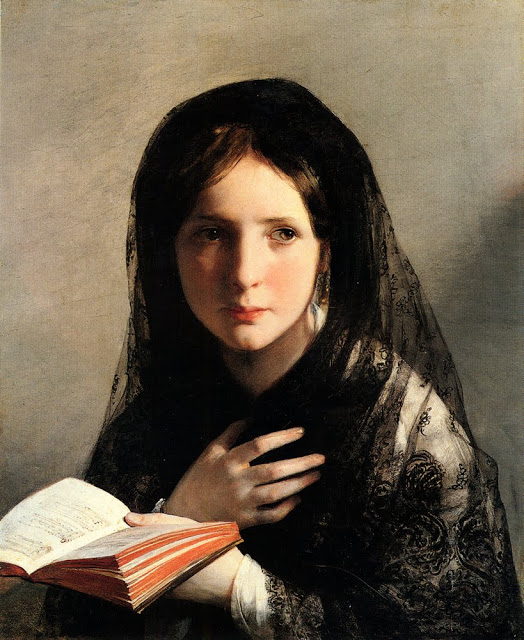
Reading girl (1835)

Chiaruccia” (Römische Spinnerin, 1846)

Julie Countess of Woyna (1832)

Portrait of Ms. Plach (1850)

in the wardrobe
Today is the birthday of Victor Borisov-Musatov (Victor Elpidiforovich Borisov-Musatov, Saratov, Russian Empire; April 14 [O.S. April 2] 1870 – November 8 [O.S. October 26] 1905 Tarusa, Russian Empire); painter, prominent for his unique Post-Impressionistic style that mixed Symbolism, pure decorative style and realism. Together with Mikhail Vrubel he is often referred as the creator of Russian Symbolism style.

He was married to the artist Yelena Alexandrova.
Gallery

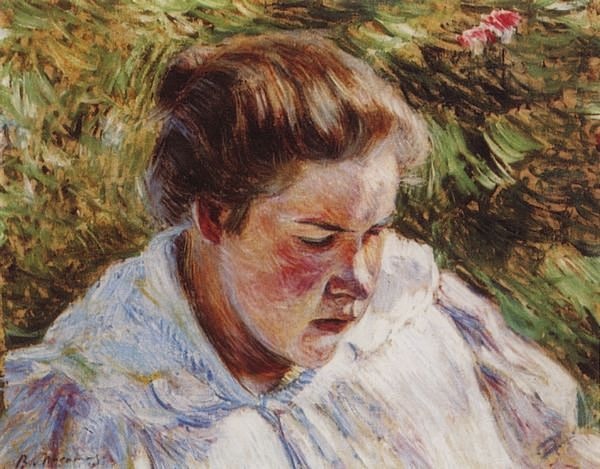

Self-Portrait with sister, 1898

Loneliness (on the balcony) 1903

The Emerald Necklace

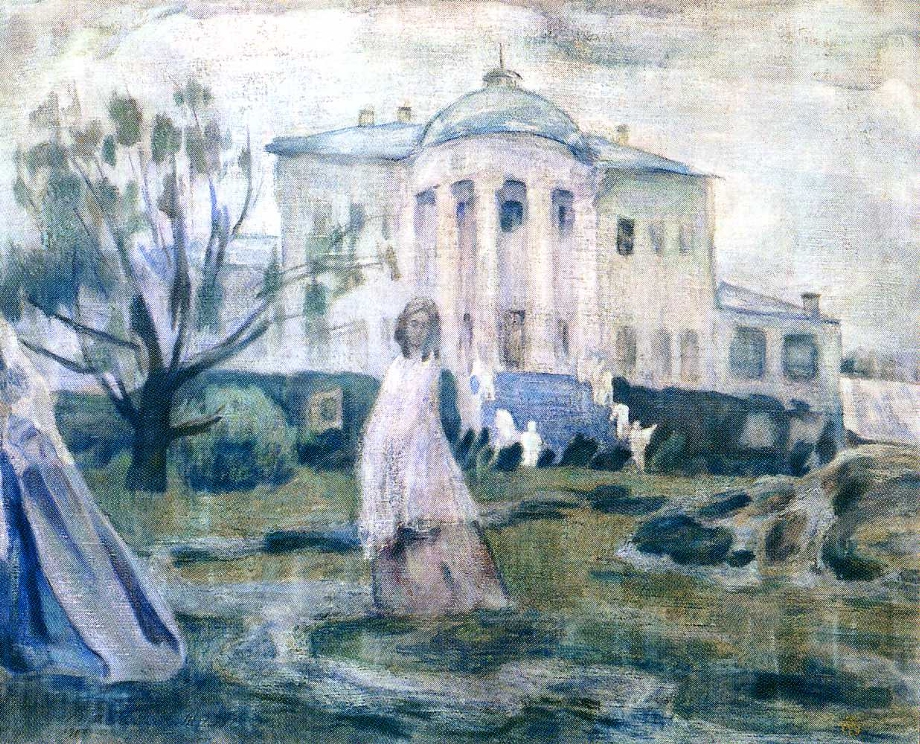
Phantoms, 1903
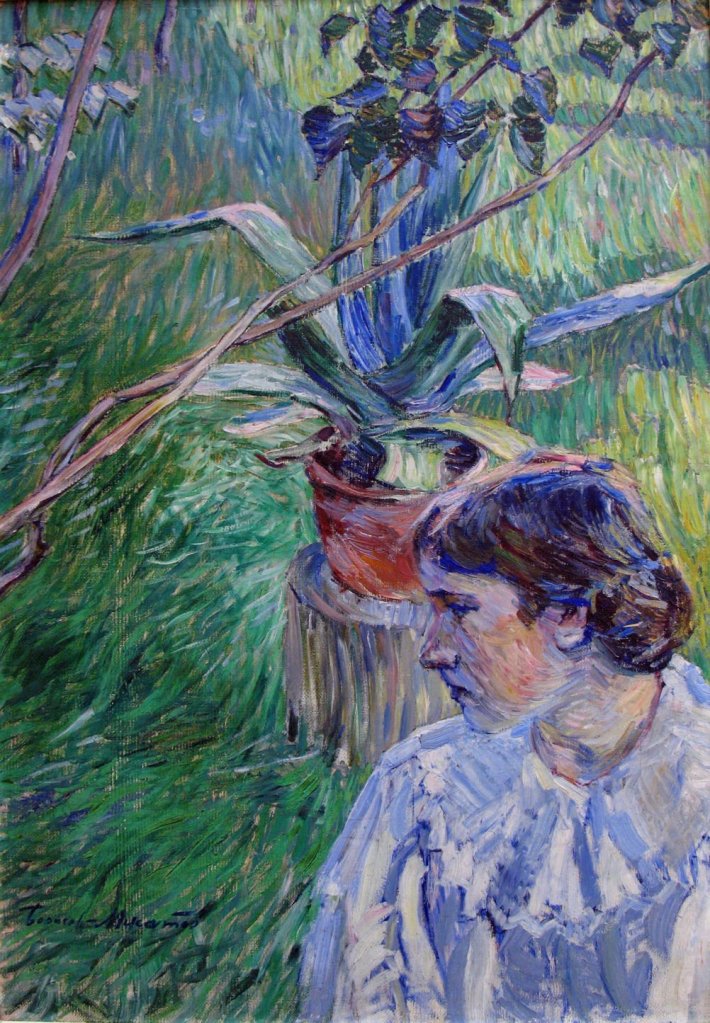
Girl with Agave (1897)
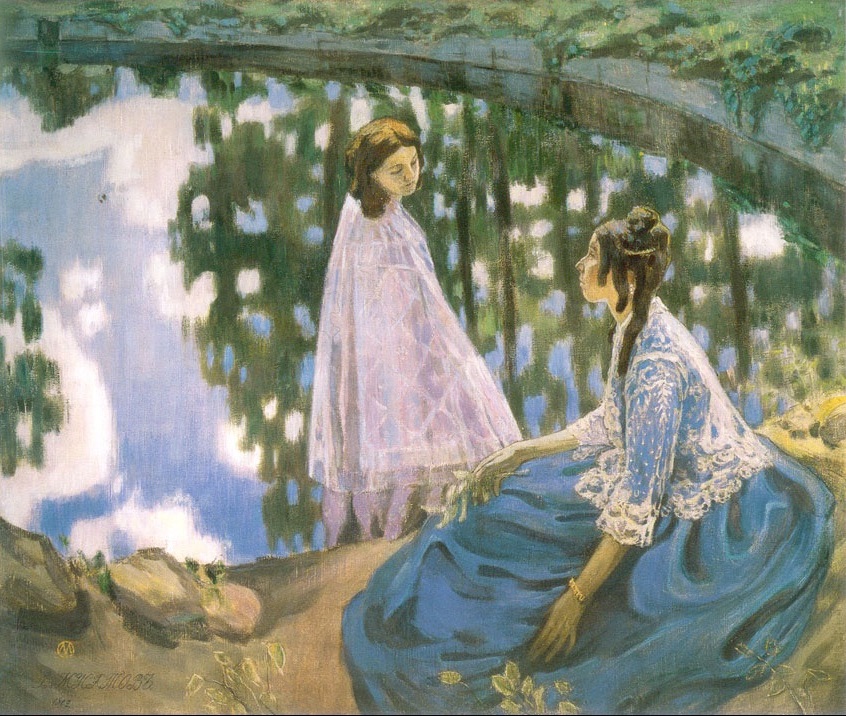
The Pool. 1902

Spring, 1898-1901
Self-portrait

And on this day in 1883 the premiere of Lakmé, an opera in three acts by Léo Delibes to a French libretto by Edmond Gondinet and Philippe Gille.
The score, written from 1881–1882, was first performed by the Opéra-Comique at the (second) Salle Favart in Paris, with stage decorations designed by Auguste Alfred Rubé and Philippe Chaperon (Act I), Eugène Louis Carpezat and (Joseph-)Antoine Lavastre (Act II), and Jean-Baptiste Lavastre(Act III). Set in British India in the mid-19th century, Lakmé is based on Théodore Pavie’s story “Les babouches du Brahamane” and novel Le Mariage de Loti by Pierre Loti.
The opera includes the popular Flower Duet (Sous le dôme épais) for sopranos performed in Act 1 by Lakmé, the daughter of a Brahmin priest, and her servant Mallika. The name Lakmé is the French rendition of Sanskrit Lakshmi, the name of the Hindu Goddess of Wealth. Perhaps the most famous aria is the Bell Song (L’Air des clochettes) in Act 2.
Like other French operas of the period, Lakmé captures the ambience of the Orient seen through Western eyes, which was periodically in vogue during the latter part of the 19th century and in line with other operatic works such as Bizet’s The Pearl Fishers and Massenet’s Le roi de Lahore. The subject of the opera was suggested by Gondinet as a vehicle for the American soprano Marie van Zandt.
The Indian fashion brand Lakmé, established in 1952 by the Tata Group and now owned by Hindustan Unilever, is named after the opera.
Synopsis
Place: IndiaTime: Late nineteenth century during the British Raj. Many Hindus have been forced by the British to practise their religion in secret.
Act 1
The Hindus go to perform their rites in a sacred Brahmin temple under the high priest, Nilakantha. Nilakantha’s daughter Lakmé (which derives from the Sanskrit Lakshmi) and her servant Mallika are left behind and go down to the river to gather flowers where they sing the “Flower Duet”. As they approach the water at the river bank, Lakmé removes her jewelry and places it on a bench. A party of British officers, Frederic and Gérald, arrive nearby while on a picnic with two British girls and their governess. The British girls see the jewelry and request sketches; Gérald volunteers to stay and make sketches of the jewelry. He sees Lakmé and Mallika returning and hides. Mallika leaves Lakmé for a while; while alone Lakmé sees Gérald and, frightened by the foreigner’s incursion, cries out for help. However, simultaneously, she is intrigued and so she sends away those who had responded to her call for help when they come to her rescue. Lakmé and Gérald begin to fall in love with each other. Nilakantha returns and learns of the British officer’s trespassing and vows revenge on him for his affront to Lakmé’s honor.
Act 2
At a bazaar, Nilakantha forces Lakmé to sing (the Bell Song) in order to lure the trespasser into identifying himself. When Gérald steps forward, Lakmé faints, thus giving him away. Nilakantha stabs Gérald, wounding him. Lakmé takes Gérald to a secret hideout in the forest, where she nurses him back to health.
Act 3
While Lakmé fetches sacred water that will confirm the vows of the lovers, Fréderic, a fellow British officer, appears before Gérald and reminds him of his duty to his regiment. After Lakmé returns, she senses the change in Gérald and realises that she has lost him. She dies with honour, rather than live with dishonor, killing herself by eating the poisonous datura leaf.
thanks for stoppin’ by y’all
mac tag
 The Lovers’ Chronicle
Leave a comment