Dear Zazie, Here is today’s Lovers’ Chronicle from Mac Tag dedicated to his muse. Rhett
The Lovers’ Chronicle
Dear Muse,
closest i could git to a song
was one by the band Orleans
“Oh I remember that one”
the theme came from a 2017 poem,
where i wrote about how i was still me
how i had not changed
though my life certainly had
over the precedin’ year
“Ok I see how you got there”
related to the here and now
i would say,
hey baby, me and you, still us
© copyright 2023 mac tag/cowboy coleridge all rights reserved
still comin’ here, essentially a diary, recordin’ thoughts, happenin’s, a journal of feelin’s lost and found on the trail, an almanac for those who were around in the early years, now a chronicle for and inspired by desire and pain, and driven by the pulse between me and you
© copyright 2022.2023 mac tag/cowboy coleridge all rights reserved
not much of a list maker
but a list of “still” might work
exercisin’ every day
workin’ too much
writin’ or creatin’
appreciatin’
sorrow and beauty in all forms
books, movies, music, art
the sun and moon risin’
but first and last
and most important
you
© copyright 2021.2023 mac tag/cowboy coleridge all rights reserved
Pale Love, Pale Rider
so we have given the gift of ourselves,
each to the other, an intimacy unknown
in long discussions, in love-makin’
and the ensuin’ connection unlike
what we have had before
whatever we have been
livin’ on is not enough
this refrain we will not
be without, return again
© copyright 2020 mac tag/cowboy coleridge all rights reserved
essentially a tragic saga,
so we shall refuse
to take it dramatically
supposed to be full of possibilities,
but they are narrowed down
to pretty few by most
extraordinary is out there
but the vast masses seem
to settle for ordinary
we are not that
© copyright 2019 mac tag/cowboy coleridge all rights reserved
her realization
that she could not
live with the mind alone;
that she must also be alive physically
well, that is what
this is all about, right
but i am not convinced
is it possible…
are you still you
can we still be us
givin’ the gift
of ourselves
to each other
where the discussions
are just as stimulatin’
as the love makin’
the only certainty is this,
the experience
of body and mind
can only be had with you
© copyright 2018 mac tag/cowboy Coleridge all rights reserved
I keep the thermostat
Set on 60 in the winter
So if you plan on comin’ over
Best plan on sleepin’
Cuddled up next to the fire
***
one must wrestle
this to the ground…
you gotta keep tryin’
but you gotta accept
the fact, that it may not
be meant for you
i still git blue,
blue as hell
i can still
throw down sad verse
with the best of ’em
Baudelaire, Poe
and Rimbaud
got nothin’ on me
sometimes
i pick up a book
like Chatterley
and reread
some passages
and git wistful
the loneliness
closes in
and threatens
to take me
but sometimes
i stop myself
in my tracks
and i think,
i god
look what you did
look where you are
you jerked yourself
out of a comfortable
but harmful,
goin’ nowhere situation
you took a hard step
you had to take
to save yourself
and you did
and now,
you can be you
and you look
in the mirror
and smile
cuz you did it
and no one
can take that
so with
or without
you are still you
© copyright 2017 mac tag/cowboy Coleridge all rights reserved
Can you, or can you not
live with the mind alone
Must you also be alive
physically. Takin’
the mind alone
trail myself
© copyright 2016 mac tag/cowboy Coleridge all rights reserved
Perhaps a song, or a word
Or a memory, or a picture
Or a dream, or a feelin’
Brings you back
But I know you are gone
And you are not comin’ back
And I am vacant
© copyright 2015 mac tag/cowboy Coleridge all rights reserved
Today is the birthday of Jean Siméon Chardin (Jean-Baptiste-Siméon Chardin; Rue de Seine, 6th arrondissement of Paris; November 2, 1699 – December 6, 1779 Louvre, Paris); painter. He is considered a master of still life, and is also noted for his genre paintings which depict kitchen maids, children, and domestic activities. Carefully balanced composition, soft diffusion of light, and granular impasto characterize his work.

self portrait
Chardin’s influence on the art of the modern era was wide-ranging and has been well-documented. He was one of Henri Matisse‘s most admired painters; as an art student Matisse made copies of four Chardin paintings in the Louvre. In 1999 Lucian Freud painted and etched several copies after The Young Schoolmistress (National Gallery, London).
Marcel Proust, in the chapter “How to open your eyes?” from In Search of Lost Time (À la recherche du temps perdu), describes a melancholic young man sitting at his simple breakfast table. The only comfort he finds is in the imaginary ideas of beauty depicted in the great masterpieces of the Louvre, materializing fancy palaces, rich princes, and the like. The author tells the young man to follow him to another section of the Louvre where the pictures of Chardin are. There he would see the beauty in still life at home and in everyday activities like peeling turnips.
Gallery

The Scullery Maid’, 1738
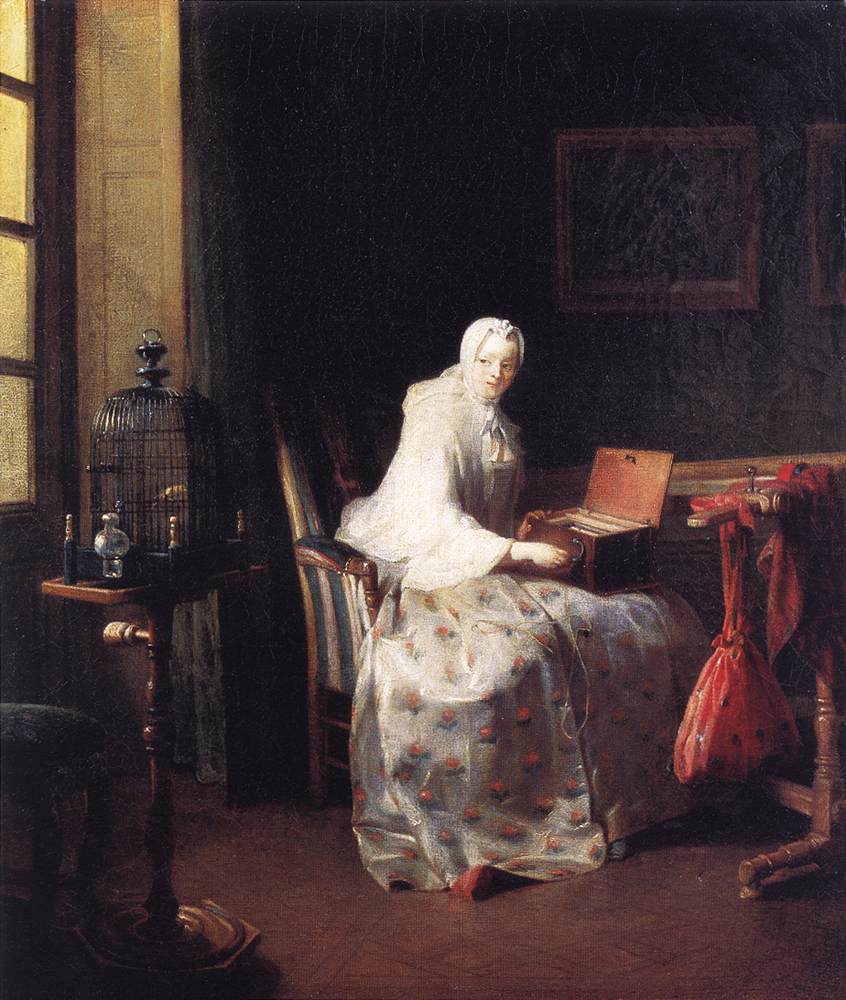
La Serinette, dit aussi Une dame variant ses amusements (1750-1751), Paris, Musée du Louvre
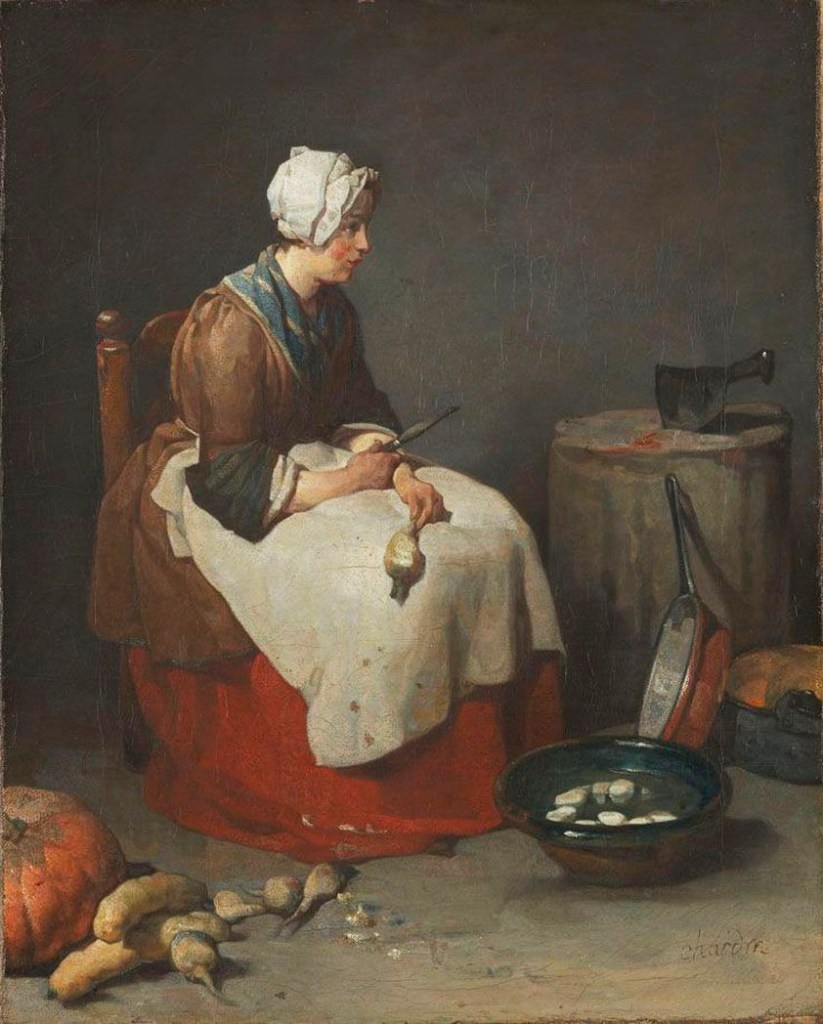
La Fille de cuisine, Washington, National Gallery of Art.
 Femme tirant de l’eau d’une urne
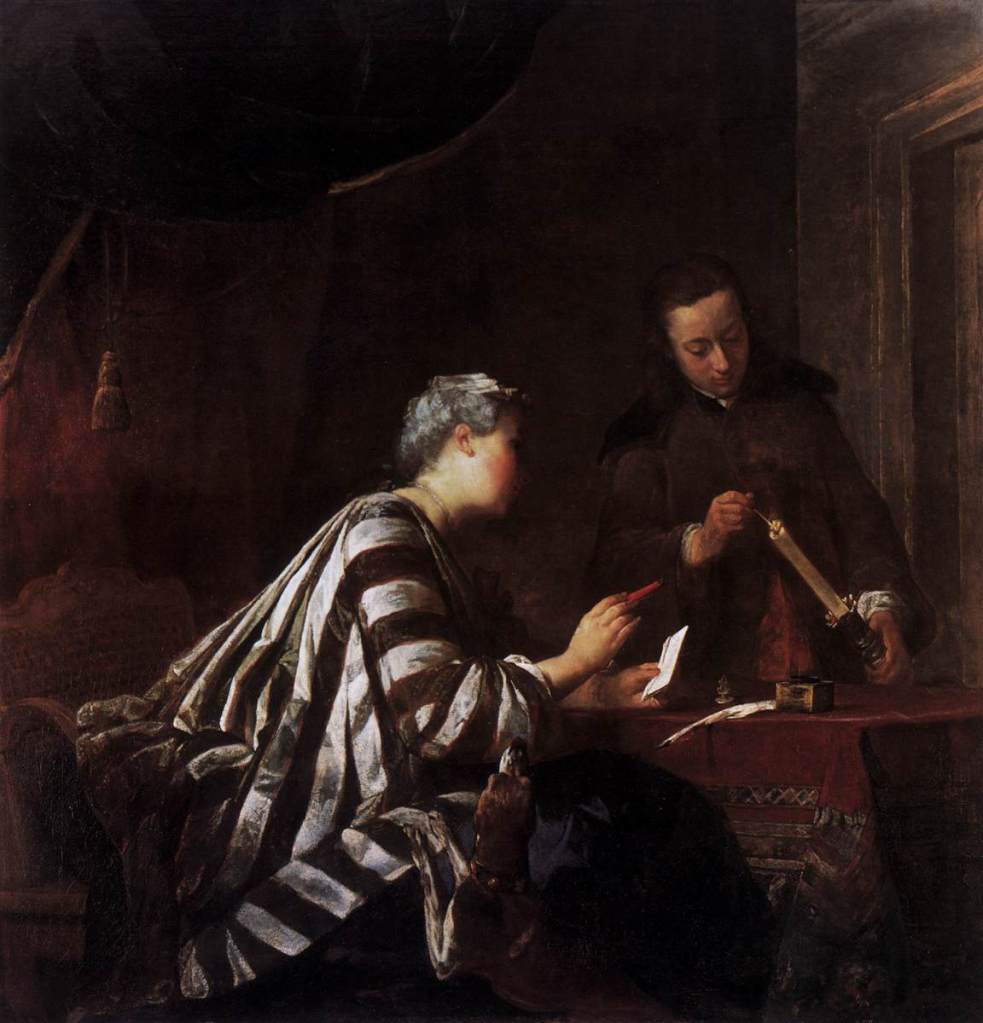
Une Femme occupée à cacheter une lettre (vers 1732), Potsdam, palais de Sanssouci
 Les Osselets

Today is the birthday of James Lesesne Wells (Atlanta, Georgia; November 2, 1902 – January 20, 1993, Washington D. C.); African-American graphic artist and painter associated with the Harlem Renaissance. He was an influential art professor at Howard University from 1929 to 1968 and is considered a pioneer in modern art education.
Wells was a prominent artist in Washington D.C. for sixty years. He retired from teaching in 1968, but continued to work into his eighties. in 1973, Fisk University held a one-man show of Well’s work. In 1980, Wells was awarded the Presidential Citation for Lifelong Contribution to American art by President Jimmy Carter. In 1986, a retrospective exhibition of his work was held at the Washington Project for the Arts. The exhibition was titled “Sixty Years in Art”.
Gallery

The Vamp, 1983
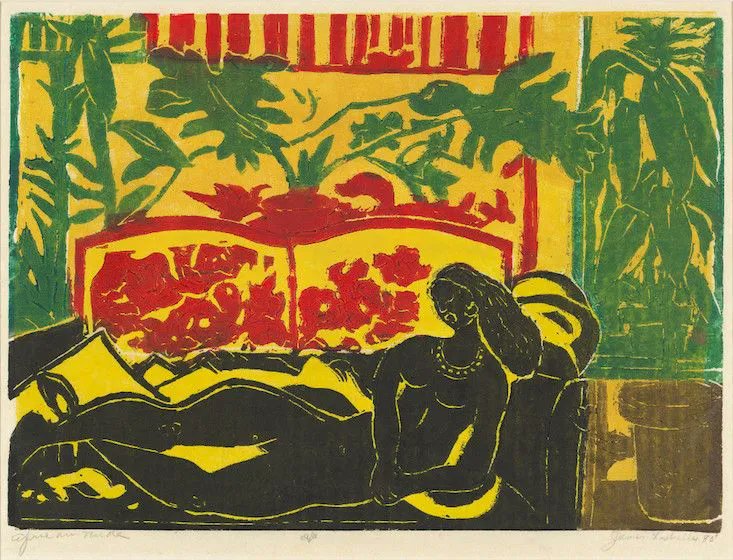
african nude

African Fantasy, woodcut, 1929
 Oh For A Muse Of Fire, 1930
 Portuguese Woman, 1940
And on this day in 1960 – Penguin Books is found not guilty of obscenity in the trial R v Penguin Books Ltd, the Lady Chatterley’s Lover case. (photo from the 1955 film L’Amant de lady Chatterley with Danielle Darrieux and Erno Crisa)

Lady Chatterley’s Lover is a novel by D. H. Lawrence, first published privately in 1928 in Italy, and in 1929 in France and Australia. An unexpurgated edition was not published openly in the United Kingdom until 1960, when it was the subject of a watershed obscenity trial against the publisher Penguin Books. Penguin won the case, and quickly sold 3 million copies. The book soon became notorious for its story of the physical/emotional relationship between a working class man and an upper class woman, its explicit descriptions of sex, and its use of then-unprintable words.
The story is said to have originated from events in Lawrence’s own unhappy domestic life, and he took inspiration for the settings of the book from Eastwood, Nottinghamshire, where he grew up. According to some critics, the fling of Lady Ottoline Morrell with “Tiger”, a young stonemason who came to carve plinths for her garden statues, also influenced the story. Lawrence at one time considered calling the novel Tenderness and made significant alterations to the text and story in the process of its composition. It has been published in three versions.
The story concerns a young married woman, Constance (Lady Chatterley), whose upper class husband, Clifford Chatterley, described as a handsome, well-built man, has been paralysed from the waist down due to a Great War injury. In addition to Clifford’s physical limitations, his emotional neglect of Constance forces distance between the couple. Her sexual frustration leads her into an affair with the gamekeeper, Oliver Mellors. The class difference between the couple highlights a major motif of the novel which is the unfair dominance of intellectuals over the working class. The novel is about Constance’s realization that she cannot live with the mind alone; she must also be alive physically. This realization stems from a heightened sexual experience Constance has only felt with Mellors, suggesting that love can only happen with the element of the body, not the mind.
- So they had given the gift of themselves, each to the youth with whom she had the most subtle and intimate arguments. The arguments, the discussions were the great thing: the love-making and connection were only sort of primitive reversion and a bit of an anti-climax.
- Clifford Chatterley was more upper class than Connie. Connie was well-to-do intelligentsia, but he was aristocracy. Not the big sort, but still it. His father was a baronet, and his mother had been a viscount’s daughter.
British poet Philip Larkin’s poem “Annus Mirabilis” begins with a reference to the trial:Sexual intercourse beganIn nineteen sixty-three(which was rather late for me) –Between the end of the “Chatterley” banAnd the Beatles’ first LP.
- Ours is essentially a tragic age, so we refuse to take it tragically.
- The world is supposed to be full of possibilities, but they narrow down to pretty few in most personal experience. There’s lots of good fish in the sea … maybe … but the vast masses seem to be mackerel or herring, and if you’re not mackerel or herring yourself you are likely to find very few good fish in the sea.
- And dimly she realized one of the great laws of the human soul: that when the emotional soul receives a wounding shock, which does not kill the body, the soul seems to recover as the body recovers. But this is only appearance. It is really only the mechanism of the reassumed habit. Slowly, slowly the wound to the soul begins to make itself felt, like a bruise, which only slowly deepens its terrible ache, till it fills all the psyche. And when we think we have recovered and forgotten, it is then that the terrible after-effects have to be encountered at their worst.
- Folks should do their own fuckin’, then they wouldn’t want to listen to a lot of clatfart about another man’s.
- I believe in being warm-hearted. I believe especially in being warm-hearted in love, in fucking with a warm heart. I believe if men could fuck with warm hearts, and the women take it warm-heartedly, everything would come all right. It’s all the cold-hearted fucking that is death and idiocy.
- The Italians are not passionate: passion has deep reserves. They are easily moved, and often affectionate, but they rarely have any abiding passion of any sort.
- Money poisons you when you’ve got it, and starves you when you haven’t.
Mac Tag
thanks for stoppin’ by y’all
 The Lovers’ Chronicle
Leave a comment