Dear Zazie,
Still workin’ my way through the thoughts and emotions prompted by your letter Bet you didn’t know.
Here is Mac Tag‘s Lovers’ Chronicle to his muse. Follow us on twitter @cowboycoleridge. Rhett
The Lover’s Chronicle
Dear Muse,
obviously no song,
but a story of how we got here
’’You’re driving my dear, and
since you’re driving, I’m having a drink’’
good idea my love, away we go;
in May of 2000 i was livin’ in Houston
”My condolences”
yes thanks, i will take them,
and channel surfin’ one afternoon
when i came across a Three Stooges
short film called, Rhythm and Weep
it struck me right away,
what a great line for a poem or song;
in the film, The Stooges contemplate
suicide, before bein’ saved by three
lovely ladies and a beautiful melody
only of course to have it fall apart
’’As was wont to happen to the Stooges”
they were as unlucky in love as i was
“Past being the operative tense”
of course, now i can say
in rhythm and rhyme,
read ‘em and weep no more

© copyright 2023 mac tag/cowboy coleridge all rights reserved
as mentioned last year, this is the all rhythm and no weep part of the program, what flows across the page, the daily ebb and hum of routine, feels right because it is, know now that the words keep comin’ whether mired in pity and pain, or in bein’ together, a rhythm runs through it, that is the purpose, the reason, findin’ what runs through it, for some a river, on the day Norman Maclean died, for us what we have found the rhythm of two

© copyright 2022.2024 mac tag/cowboy coleridge all rights reserved
all rhythm and no weep now
sure y’all were weary of that,
the weepin’ between the lines
go back far enough
and it was all over the damn page
apologies for that, had to find balance
this was my therapy, never shy about it
screwed up in so many ways,
ordinary and spectacular,
had to write it out to figure out
what was left, where i was
and which way i should go
anyway, ran on about that,
lets end it here with
our own rhythm for two

© copyright 2021.2024 mac tag/cowboy coleridge all rights reserved
Pale Love, Pale Rider
now the thought
of what could be
comes, night and day
readin’ what i have written
over the years, strummin’
memories, findin’ the will,
the rhythm comin’ back
some of ’em come with pain
but they were necessary
they are there for you too
c’mon, all that we want awaits
© copyright 2020 mac tag/cowboy coleridge all rights reserved
plenty of rhythm
but too much drama
in the past
it is poetry but, c'mon;
today's theme for example,
there are no tears
have not been any for years
one would have to be able to feel
and that does not happen
makes it easier that way
saves money on tissue paper
© copyright 2019.2023 mac tag/cowboy coleridge all rights reserved
for Tamela
“The playground of our mind
is such an open and safe place.
Here we stay sexy and simply love,
with none of the worries of reality.
You once asked me…let’s write about Love!
I laughed. What did I know about Love?
Love, that moment when you feel
like you can hold the world in your hand.
When you feel invincible. The moment
where you know right there and then,
that nothing else matters.
But too often, you end up spending
all your time chasing that day. It fades
and never feels so strong. So intense.
And I want that day every day.
I want it to drive me.
I want it to be there
to the very end.
Because of that,
because I fear
that day will not last,
I simply walk away.
My hands drop from the glass
and the fog from my breath
on the glass fades away.
It is a replay of my past,
and a preview to my future.”

rosé at Mac’s Creek Winery in Lexington, Nebraska
© copyright 2018 mac tag/cowboy coleridge all rights reserved
now all of that,
and all of them,
have fallen by the way
and the thought
of what never was
haunts, night and day
“Where do you come up
with this stuff?”
books, readin’ books
and memories
that hurt and haunt…
damnit, lost the rhythm again
then i see, i am still holdin’
the letter that you wrote
i cannot read it,
i cannot stand it
the words, read ’em
the rhythm and rhyme
c’mon, you can find it
rhythm and weep
© copyright 2017 mac tag/cowboy Coleridge all rights reserved
| Rupert Brooke | |
|---|---|
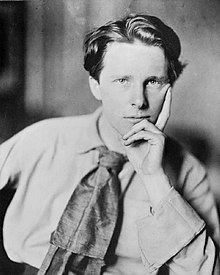 Photograph by Sherrill Schell Photograph by Sherrill Schell | |
Today is the birthday of Rupert Brooke (Rupert Chawner Brooke, middle name sometimes given as “Chaucer”; Rugby, Warwickshire, England; 3 August 1887 – 23 April 1915 Aegean Sea, off the Island of Skyros, Greece); poet known for his idealistic war sonnets written during the First World War, especially “The Soldier”. He was also known for his boyish good looks, which were said to have prompted the Irish poet W. B. Yeats to describe him as “the handsomest young man in England”. Brooke was commissioned into the Royal Naval Volunteer Reserve as a temporary Sub-Lieutenant shortly after his 27th birthday. He sailed with the British Mediterranean Expeditionary Force on 28 February 1915 but developed sepsis from an infected mosquito bite. He died at 4:46 pm on the French hospital ship, the Duguay-Trouin (named after the 17th century privateer, René Duguay-Trouin), moored in a bay off the Greek island of Skyros in the Aegean Sea, while on his way to the landing at Gallipoli. As the expeditionary force had orders to depart immediately, Brooke was buried at 11 pm in an olive grove on Skyros.
- “And when we die,
All’s over that is ours; and life burns on
Through other lovers, other lips,” said I
—”Heart of my heart, our heaven is now, is won!”
“We are earth’s best, that learnt her lesson here,
Life is our cry. We have kept the faith!” we said.- “The Hill” (1910)
- Oh! Death will find me, long before I tire
Of watching you; and swing me suddenly
Into the shade and loneliness and mire
Of the last land! There, waiting patiently,
One day, I think, I’ll feel a cool wind blowing,
See a slow light across the Stygian tide,
And hear the Dead about me stir, unknowing,
And tremble. And I shall know that you have died,
And watch you, a broad-browed and smiling dream,
Pass, light as ever, through the lightless host,
Quietly ponder, start, and sway, and gleam—
Most individual and bewildering ghost!—
And turn, and toss your brown delightful head
Amusedly, among the ancient Dead.- Sonnet (1908-1910)
Today is the birthday of Iwata Nakayama (Yanagawa, Fukuoka, Japan; August 3, 1895 – January 20, 1949 Ashiya, Japan); avant-garde photographer.

self portrait
His wife, Nakayama Masako became an English language educator after their years aboard. His father was an inventor who held a patent for a fire extinguisher. Iwata moved to Tokyo and was educated at the private school Kyohoku-Chūgakkō. After graduating, he entered Tokyo University of the Arts as the first student of its photography course. After learning artistic and commercial techniques there, he moved to the United States in 1918 as an overseas student of California State University, sent by the Japanese government. However he quit studying and began to work at a photo studio run by Tōyō Kikuchi in New York City.
He suffered a stroke and died at the age of 53. It was just a few days after he was selected as a trustee of the Japanese Photography Association.
Throughout the 1960s and 1970s, as the academic discipline of Japanese Photography expanded, Nakayama’s works were rediscovered and researched. Nakayama’s works are included in the permanent collections of Modern Museum of Art in New York, United States; The British Museum in London, England; and the Tokyo Photographic Art Museum, Tokyo, Japan.
Gallery


Festival of the Demon
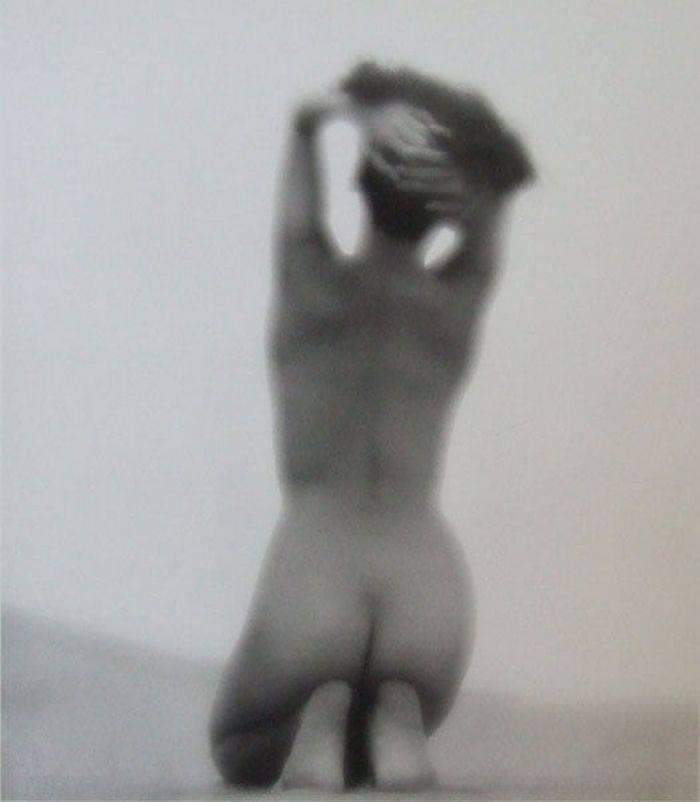
nude 1932

A woman from Shanghai

untitled

untitled

A woman with long hair

Night, Wine, and Lady, 1933
Today is the birthday of Dolores del Río (born María de los Dolores Asúnsolo López-Negrete; Durango, Mexico 3 August 1904 – 11 April 1983 Newport Beach, California); actress. She was the first major female Latin American crossover star in Hollywood, with a career in American films in the 1920s and 1930s. She was also considered one of the more important female figures of the Golden Age of Mexican cinema in the 1940s and 1950s. Del Río is remembered as one of the most beautiful faces of the cinema in her time. Her long and varied career spanned silent film, sound film, television, stage and radio.

After being discovered in Mexico by the filmmaker Edwin Carewe, she began her film career in 1925. She had roles in a series of successful silent films like What Price Glory? (1926), Resurrection (1927) and Ramona (1928). During this period she came to be considered a sort of feminine version of Rudolph Valentino, a “female Latin Lover”.
With the advent of sound, she acted in films that included Bird of Paradise (1932), Flying Down to Rio (1933), Madame Du Barry (1934) and Journey into Fear(1943). In the early 1940s, when her Hollywood career began to decline, del Río returned to Mexico and joined the Mexican film industry, which at that time was at its peak.
When del Río returned to her native country, she became one of the more important promoters and stars of the Golden Age of Mexican cinema. A series of films, including Wild Flower (1943), María Candelaria (1943), Las Abandonadas (1944), Bugambilia (1944) and The Unloved Woman (1949), are considered classic masterpieces and helped boost Mexican cinema worldwide. Del Río remained active in Mexican films throughout the 1950s. She also worked in Argentina and Spain.
In 1960 she returned to Hollywood. During the next years she appeared in Mexican and American films. From the late 1950s until the early 1970s she also successfully ventured into theater in Mexico and appeared in some American television series. Del Río performed her final screen appearance in 1978.

in a publicity photo for the film The Fugitive (1947).

in Evangeline (1929)
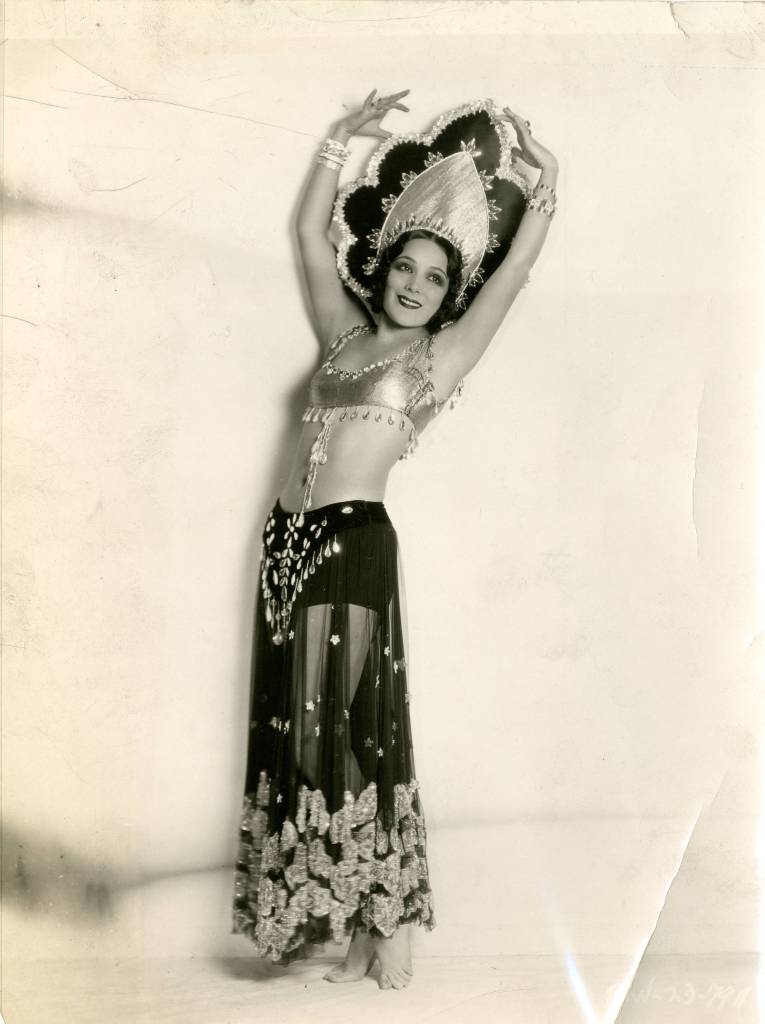
in 1928

in Bird of Paradise (1932)

portraying Madame du Barry in Madame Du Barry (1934)

with Joseph Cotten in Journey into Fear (1943)

photograph taken by Annemarie Heinrich, c. 1948

considered a pioneer on wearing the two piece swimsuit later known as the bikini. Here she is posing in a publicity photograph for the film In Caliente (1935)
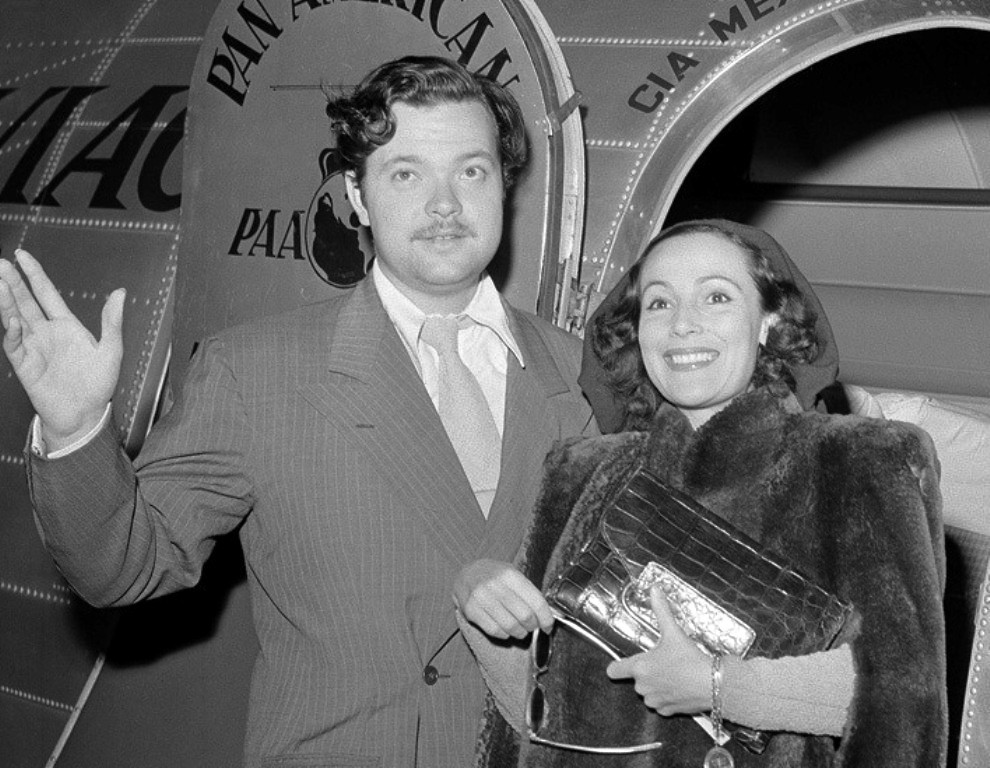
with Orson Welles in 1941

in The Man from Dakota (1940)
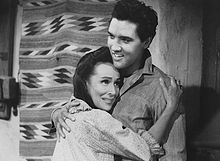
with Elvis in Flaming Star (1960)
Del Río married Jaime Martínez del Río in 1921. Her marriage ended in 1928. The differences between the couple emerged after settling in Hollywood. In Mexico she had been the wife of Jaime Martinez del Río, but in Hollywood Jaime became husband of a movie star. The trauma of a miscarriage added to the marital difficulties and del Río was advised not to have children. After a brief separation, Dolores filed for divorce. Six months later, she received news that Jaime had died in Germany.
In 1930, del Río met Cedric Gibbons, an art director at Metro-Goldwyn-Mayer and one of the most influential men in Hollywood, at a party at Hearst Castle. The couple began a romance and finally married on August 6, 1930. The del Rio-Gibbons were one of the most famous couples of Hollywood in the early thirties. They organized ‘Sunday brunches’ in their Art Deco house at 757 Kingman Avenue in the Rustic Canyon neighborhood of Pacific Palisades. Many celebrities would attend and play tennis or swim in the pool including Marlene Dietrich, Greta Garbo, Gary Cooper and Cary Grant. The couple divorced in 1941. Del Río alleged before the judge in her divorce that her relationship with her husband had become cold and distant due to their work commitments.
In 1949 she met the American millionaire Lewis A. Riley in Acapulco. Riley was known in the Hollywood cinema in the forties for being a member of the Hollywood Canteen, an organization created by movie stars to support relief efforts in World War II. At that time Riley was engaged in an affair with Bette Davis. Del Río and Riley started a romance. In 1959, the couple married in New York after ten years of relationship. They remained together until her death in 1983.
Regardless of their marriages at different times in her life, she was romantically linked with actor Errol Flynn, filmmaker John Farrow, writer Erich Maria Remarque, film producer Archibaldo Burns, and actor Tito Junco.
Her relationship with Welles (1939-1943) ended after four years largely due to his infidelities. Rebecca Welles, the daughter of Welles and Rita Hayworth, expressed her desire to travel to Mexico to meet Dolores. In 1954, Dolores received her at her home in Acapulco. After their meeting, Rebecca said: My father considered Dolores the great love of his life. She is a living legend in the history of my family. According to Rebecca, until the end of his life, Welles felt for del Río, a kind of obsession.
Mexican filmmaker Emilio Fernández was one her admirers. He said that he had appeared as an extra in several films of Dolores in Hollywood just to be near her. The beauty and elegance of del Río had impressed him deeply. Fernández said: I fell in love with her, but she always ignored me. I adored her… really I adored her.
The house of the del Río at Coyoacán called “La Escondida” and also spent their days in Acapulco, both homes became a meeting point for personalities like Diego Rivera, Frida Kahlo, María Felix, Merle Oberon, John Wayne, Edgar Neville, Begum Om Habibeh Aga Khan, Nelson Rockefeller, the Duke of Windsor and Wallis Simpson, Princess Soraya of Iran and more.
She is considered the pioneer of the bikini. After her death, actor Vincent Price used to sign his autographs as “Dolores del Río”. When asked why, the actor replied: “I promised Dolores on her deathbed that I would not let people forget about her.”
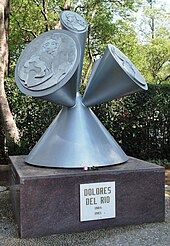
She was cremated and her cremated remains were moved from the United States to Mexico where they were interred at the Dolores Cemetery in Mexico City, Mexico, specifically on The Rotunda of Illustrious Persons.
Joan Crawford said, on a visit to Mexico in 1963,
Dolores became, and remains, as one of the most beautiful stars in the world.
Marlene Dietrich said of del Río,
Dolores del Río was the most beautiful woman who ever set foot in Hollywood.
George Bernard Shaw once said,
The two most beautiful things in the world are the Taj Mahal and Dolores del Río.
Fashion designer Elsa Schiaparelli said,
I have seen many beautiful women in here, but none as complete as Dolores del Río!
Rivera said,
The most beautiful, the most gorgeous of the west, east, north and south. I’m in love with her as 40 million Mexicans and 120 million Americans that can’t be wrong.
Mexican writer Carlos Fuentes said,
Garbo and Dietrich were women turned into goddesses. Del Rio was a goddess about being a woman.
Photographer Jerome Zerbe said,
Dolores del Río and Marlene Dietrich are the most beautiful women I’ve ever photographed.
The fashion designer Orry-Kelly reminisced about the first time he dressed del Rio,
I draped her naked body in jersey. She wanted no underpinnings to spoil the line. When I finished draping her she became a Greek goddess as she walked close to the mirror and said, it is beautiful. Gazing into the mirror she said in a half-whisper, Jesus, I am beautiful. Narcissistic? Probably yes, but she was right. She looked beautiful.
Remarque, who compared her beauty with Greta Garbo, described that a perfect woman would be a merger between the two actresses.
When she appeared swimming naked in Bird of Paradise, Welles said that del Río represented the highest erotic ideal with her performance in the film.
Poet Salvador Novo wrote her a sonnet and translated all her stage plays. She inspired Jaime Torres Bodet’s novel La Estrella de Día (Star of the Day), published in 1933, which chronicles the life of an actress named Piedad. Vicente Leñero was inspired by del Río to write his book, Señora. Carlos Pellicer also wrote her a poem in 1967. In 1982, del Río and Maria Félix were parodied in the novel Orchids in the Moonlight: Mexican Comedy by Carlos Fuentes .
Rosa Rolanda made a portrait of her in 1938. In 1941, she was painted by Mexican muralist José Clemente Orozco. Other artists were reflected her in their works were Miguel Covarrubias, John Carroll and Adolfo Best Maugard.

portrait by Rolanda
Del Río was the model of the statue of Evangeline, the heroine of Henry Wadsworth Longfellow’s romantic poem located in St. Martinville, Louisiana. The statue was donated by del Río, who played Evangeline in the 1929 film.
In her will, del Río stipulated that all her artworks were donated to the National Institute of Fine Arts and Literature of Mexico, for display in various museums in Mexico City, including the National Museum of Art, the Museum of Art Carillo Gil and the Home-Studio of Rivera and Kahlo.
today is the birthday of Rik Slabbinck (Bruges, Belgium 3 August 1914 – 19 July 1991 Bruges); painter.
In 1938 he built his studio, later also his home, in the Sint-Pietersmolenstraat, from where he had an unobstructed view of the polder plain. After the war, in 1946, he married Lily Neef and they had two sons.
Gallery

nu rose

lying nude
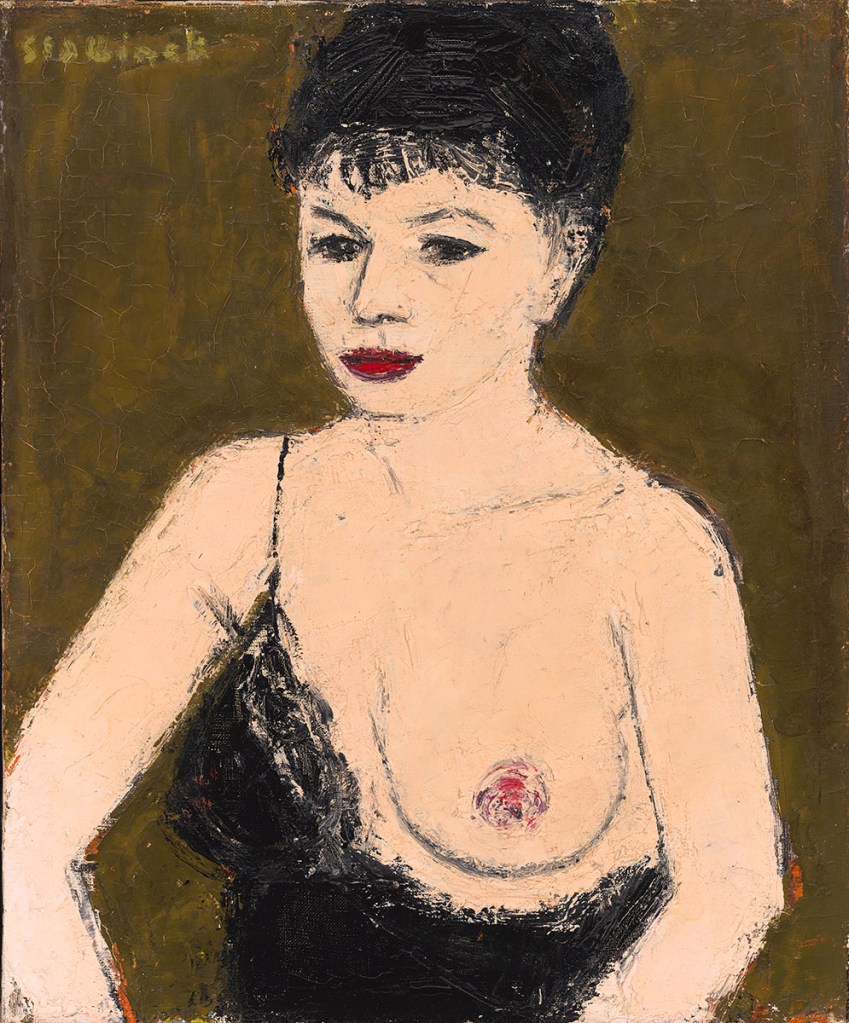
Portrait of a woman

nude


Escena en la playa

And today is the birthday of Frank Paulin (Pittsburgh; August 3, 1926 – June 11, 2016); artist and photographer. Paulin grew up in New York City and Chicago. At the age of 16 in 1942, his photographic education began as an art apprentice at Whittaker-Christiansen Studio, Chicago. In 1944, Paulin joined the Army, spending two years in the Signal Corps in Europe. During this time, Paulin developed his documentary artistic style by photographing wartime devastation of German cities. In 1946, Paulin returned to Chicago and enrolled at the Institute of Design, By the end of the 1950s, Frank Paulin’s educational resume included studies at the New School under the renowned art director Alexey Brodovitch. In 1957, Paulin celebrated his first solo artist exhibition at the Limelight Gallery.
Gallery

Paris couple

play candide New York 1956
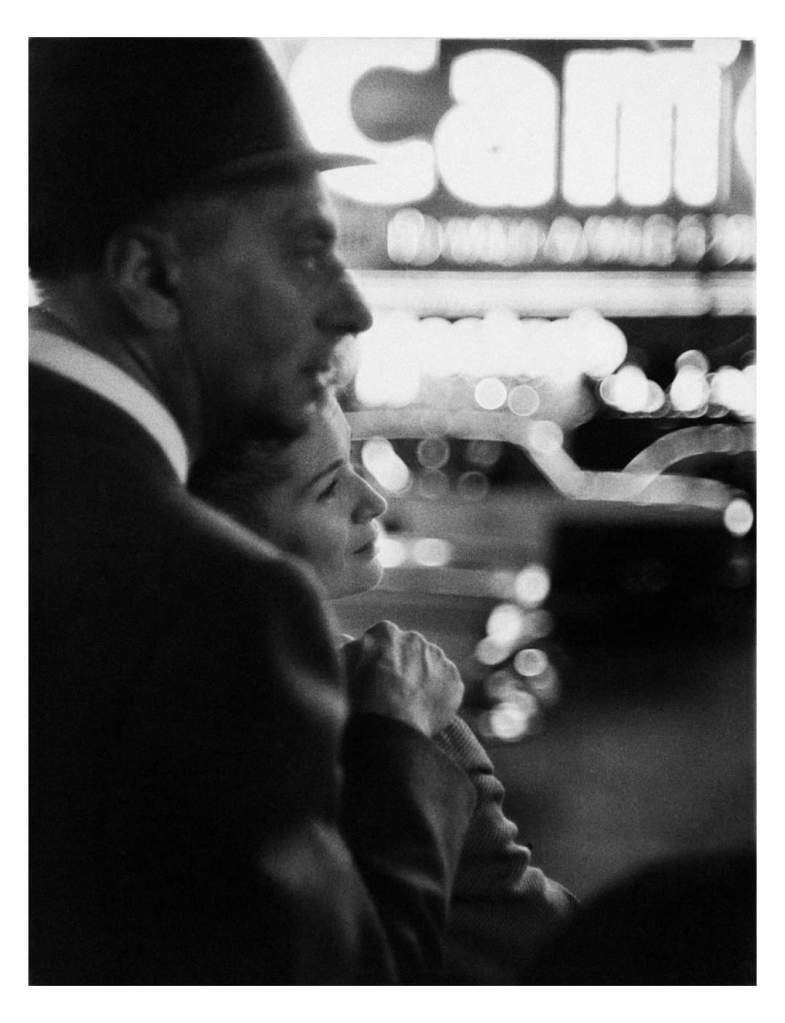

Atlantic City 1955

makeup Central Park New York 1955

Chicago 1951
Mac Tag
thanks for stoppin’ by y’all
 The Lovers’ Chronicle
Leave a comment